Legionella Dr Harriet Whiley Legionellosis Legionnaires disease A







- Slides: 17
Legionella Dr. Harriet Whiley
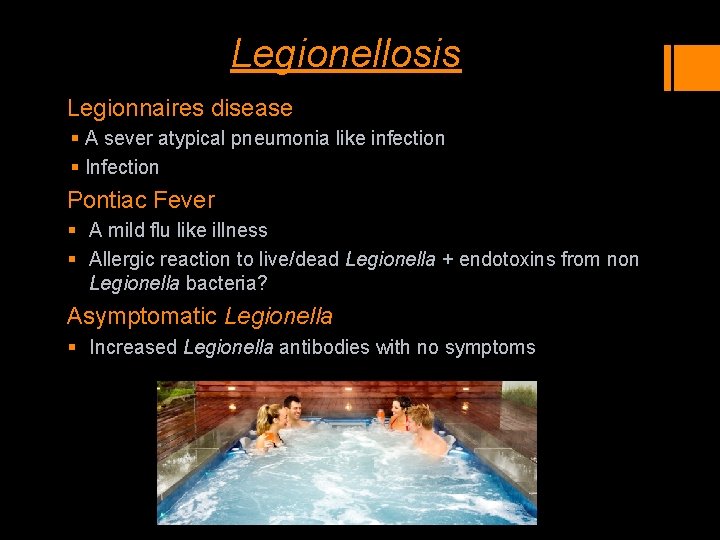
Legionellosis Legionnaires disease § A sever atypical pneumonia like infection § Infection Pontiac Fever § A mild flu like illness § Allergic reaction to live/dead Legionella + endotoxins from non Legionella bacteria? Asymptomatic Legionella § Increased Legionella antibodies with no symptoms
Incidence of Legionellosis § Across Europe (2011) = 4897 Legionellosis cases incidence rate of 0. 97 cases per 100, 000 (European Centre for Disease Prevention and Control, 2013) § Untied Stated (2011) = 4, 202 Legionellosis cases incidence rate of 1. 36 cases per 100, 000 (Centers for Disease Control and Prevention 2013) § Australia (2014) = 427 Legionellosis cases (40 from SA) incidence rate of 1. 8 per 100, 000 (0. 4 per 100, 000 for SA) 149 Meningococcal cases 1840 dengue fever cases 12785 salmonellosis cases 82625 Chlamydia infection cases (Department of Health, National Notifiable Disease Surveillance System 2015).
§ True incidence of Legionellosis could be 20 times greater than the currently reported incidence. § In the US Legionella is the leading cause of all drinking water outbreaks (Centers for Disease Control and Prevention 2013). § The annual cost of hospitalisations due to Legionellosis in the United States is estimated to exceed US$716 million (Giambrone 2013) § Melbourne aquarium outbreak (2000) § 125 cases, 95 hospitalisations, 4 deaths § loss of business/tourism etc. § $35 million legal claims
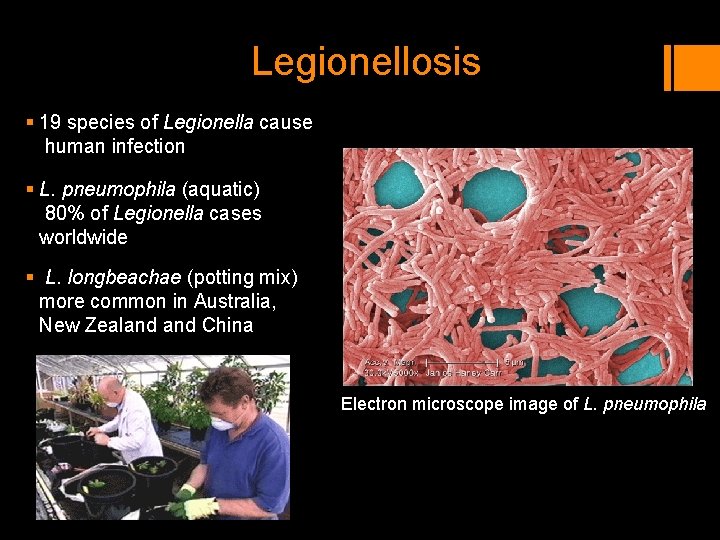
Legionellosis § 19 species of Legionella cause human infection § L. pneumophila (aquatic) 80% of Legionella cases worldwide § L. longbeachae (potting mix) more common in Australia, New Zealand China Electron microscope image of L. pneumophila
Sources of L. pneumophila Cooling towers Birthing pool showers Fountains Dental units Hydrotherapy pools Respirator Feeding tubes Humidifiers Ice machines Spas
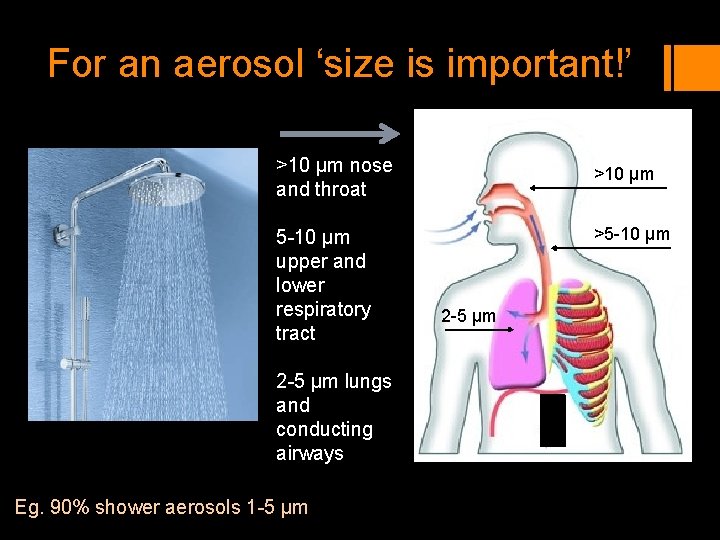
For an aerosol ‘size is important!’ >10 µm nose and throat 5 -10 µm upper and lower respiratory tract 2 -5 µm lungs and conducting airways Eg. 90% shower aerosols 1 -5 µm >10 µm >5 -10 µm 2 -5 µm
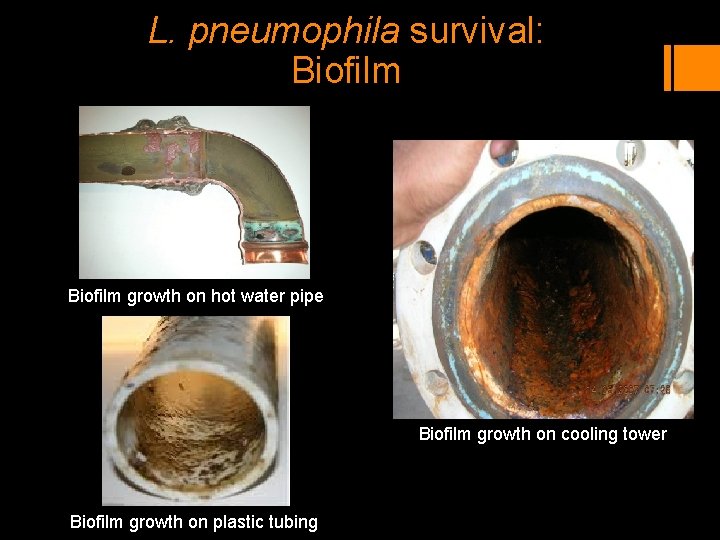
L. pneumophila survival: Biofilm growth on hot water pipe Biofilm growth on cooling tower pipe Biofilm growth on plastic tubing
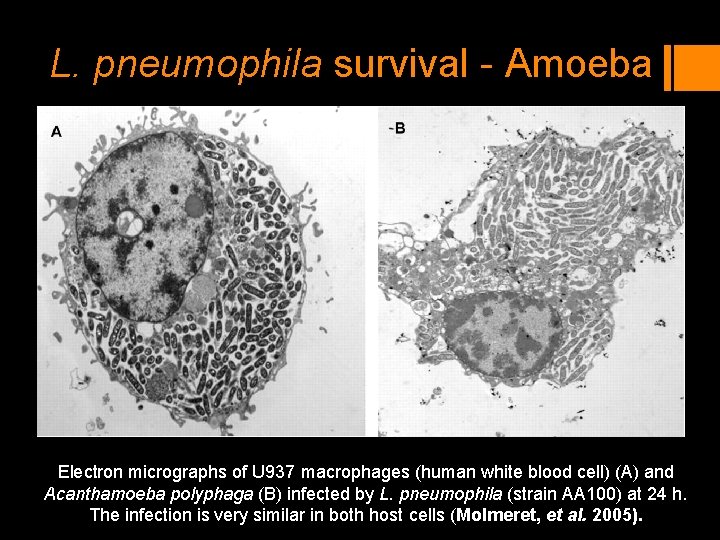
L. pneumophila survival - Amoeba Electron micrographs of U 937 macrophages (human white blood cell) (A) and Acanthamoeba polyphaga (B) infected by L. pneumophila (strain AA 100) at 24 h. The infection is very similar in both host cells (Molmeret, et al. 2005).
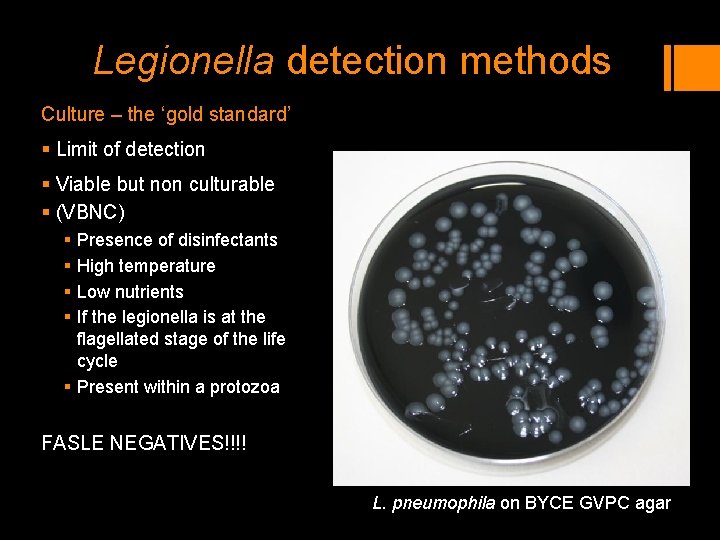
Legionella detection methods § Culture – the ‘gold standard’ Detection methods § PCR / q. PCR § Fluorescent in situ hybridization (FISH) § solid phase cytometry § optical wavelight spectroscopy § Enzyme-Amplified Electrochemical Detection with DNA probe § Surface plasmon resonance immunosensor L. pneumophila on BYCE GVPC agar
Legionella detection methods Culture – the ‘gold standard’ Detection methods § Limit of detection § Viable but non culturable § (VBNC) § § Presence of disinfectants High temperature Low nutrients If the legionella is at the flagellated stage of the life cycle § Present within a protozoa FASLE NEGATIVES!!!! L. pneumophila on BYCE GVPC agar
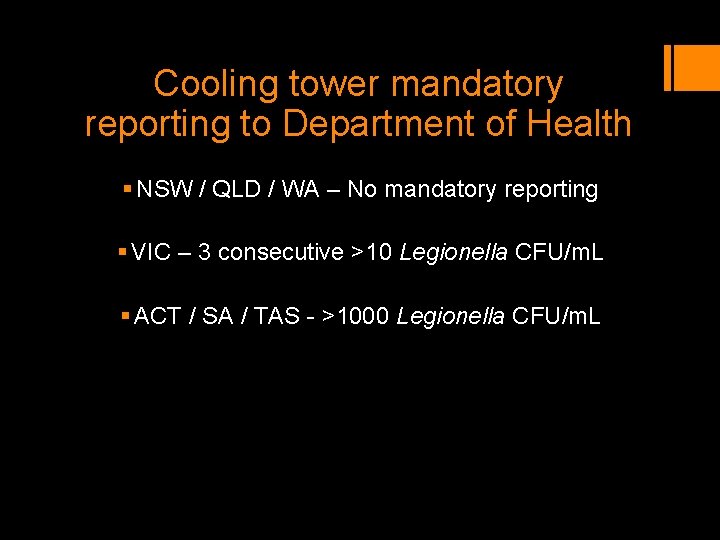
Cooling tower mandatory reporting to Department of Health § NSW / QLD / WA – No mandatory reporting § VIC – 3 consecutive >10 Legionella CFU/m. L § ACT / SA / TAS - >1000 Legionella CFU/m. L
Legionella targets for potable water pipelines using culture (gold standard) detection Country France Germany The Netherlands United Kingdom CFU/m. L Comments <1000 <100 <50 Target for general public facilities Target for prevention of nosocomial Infections Target where at‑risk patients are hospitalized <1000 <100 Guideline target <100 Guideline target
Investigation into South Australian potable water Maximum concentrations § 105 copies/m. L Legionella spp, § 103 copies/m. L L. pneumophila q. PCR Doesn’t differentiate between live and dead § Significant increases in concentration occurred during summer, low disinfection residual and dead end. (Whiley et al. 2014)
Take home message § Assume its always there!!! § Prevent/remove biofilm § Maintain disinfection residual § For hot water systems make sure the temperature are being reached – don’t ever have warm water sitting in the pipes § Protect the high risk groups
Questions? Harriet. Whiley@flinders. edu. au
References § Centers for Disease Control and Prevention (CDC). (2013). Surveillance for waterborne disease outbreaks associated with drinking water and other nonrecreational water-United States, 2009 -2010. MMWR. Morbidity and mortality weekly report, 62(35), 714. § European Centre for Disease Prevention and Control. (2014) Legionnaires’ disease in Europe, 2012. Stockholm: ECDC. § Department of Health. (2015). National Notifiable Disease Surveillance System, Australian Government § Giambrone, G. P. (2013). National Cost of Hospitalization for Legionnaires' Disease, 2001 -2009. 2013 CSTE Annual Conference, Cste. § Molmeret, M. Horn, M. Wagner, M. Santic, and Y. Abu Kwaik. (2005). Amoebae as training grounds for intracellular bacterial pathogens. Appl Environ Microbiol 71: 20– 8 § Whiley, H. , Keegan, A. , Fallowfield, H. , & Bentham, R. (2014). Detection of Legionella, L. pneumophila and Mycobacterium avium complex (MAC) along potable water distribution pipelines. International journal of environmental research and public health, 11(7), 7393 -7405.