
Museum Lobby The Underground Railroad Museum Lobby Stops
Museum Lobby The Underground Railroad Museum Lobby Stops Along the Way Prominent Figures Personal Experiences Culture Curator’s Office Image from National Register of Historic Places
Resources Curator’s Office Created by: Kelly Davies Beth Getka Molly Lindsey Taylor Provax Amanda Scheel Lobby Standards
Prominent Figures Levi Coffin Room #1 Harriet Tubman Image from Cleveland. com Lobby John Rankin Harriet Beecher Stowe
Stops Along the Way Underground Railroad Routes Room #2 Ohio Jordan House Levi Coffin House Image from Asergeev Lobby
Culture of the Underground Railroad Underground Terminology Here We Are, Here We Are Room #3 Lobby The Drinking Gourd The Fugitive Slave Act of 1850 Image from Jasonstraveldotcom
Personal Experiences Reward Poster Lobby Room #4 Slavery Experience First Hand Experience of William Still John Hossack
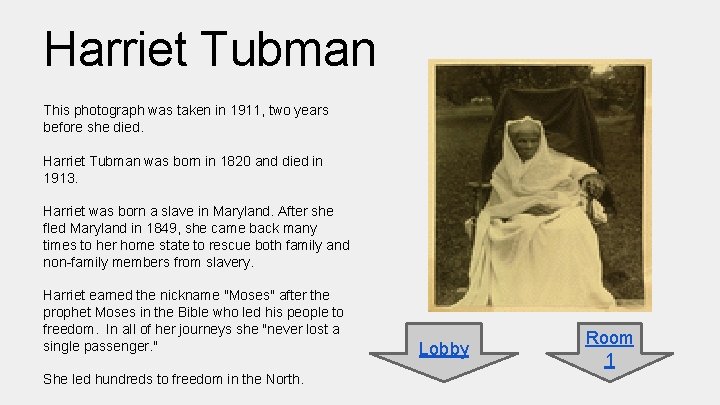
Harriet Tubman This photograph was taken in 1911, two years before she died. Harriet Tubman was born in 1820 and died in 1913. Harriet was born a slave in Maryland. After she fled Maryland in 1849, she came back many times to her home state to rescue both family and non-family members from slavery. Harriet earned the nickname "Moses" after the prophet Moses in the Bible who led his people to freedom. In all of her journeys she "never lost a single passenger. " She led hundreds to freedom in the North. Lobby Room 1
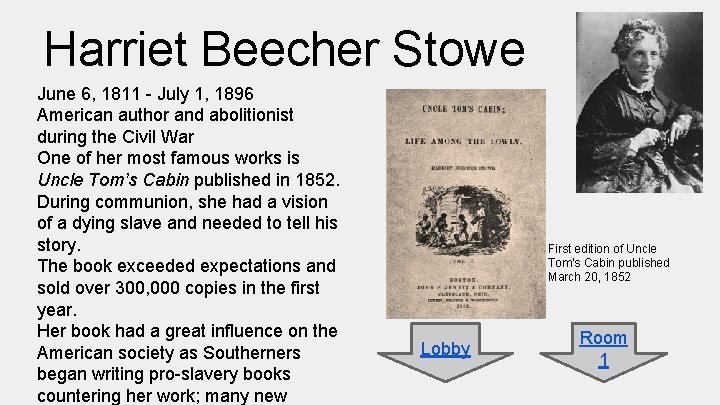
Harriet Beecher Stowe June 6, 1811 - July 1, 1896 American author and abolitionist during the Civil War One of her most famous works is Uncle Tom’s Cabin published in 1852. During communion, she had a vision of a dying slave and needed to tell his story. The book exceeded expectations and sold over 300, 000 copies in the first year. Her book had a great influence on the American society as Southerners began writing pro-slavery books countering her work; many new First edition of Uncle Tom’s Cabin published March 20, 1852 Lobby Room 1
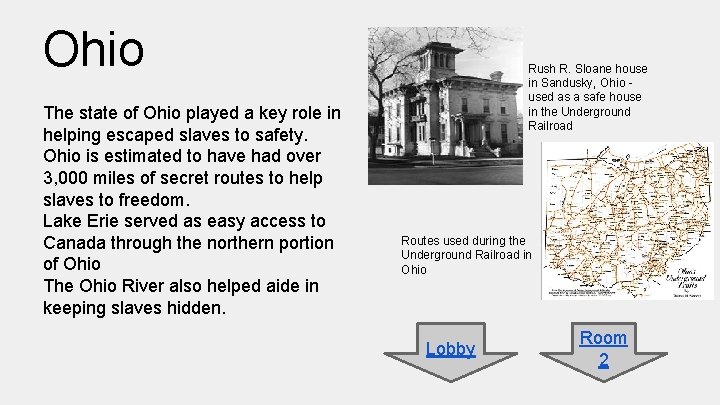
Ohio The state of Ohio played a key role in helping escaped slaves to safety. Ohio is estimated to have had over 3, 000 miles of secret routes to help slaves to freedom. Lake Erie served as easy access to Canada through the northern portion of Ohio The Ohio River also helped aide in keeping slaves hidden. Rush R. Sloane house in Sandusky, Ohio used as a safe house in the Underground Railroad Routes used during the Underground Railroad in Ohio Lobby Room 2
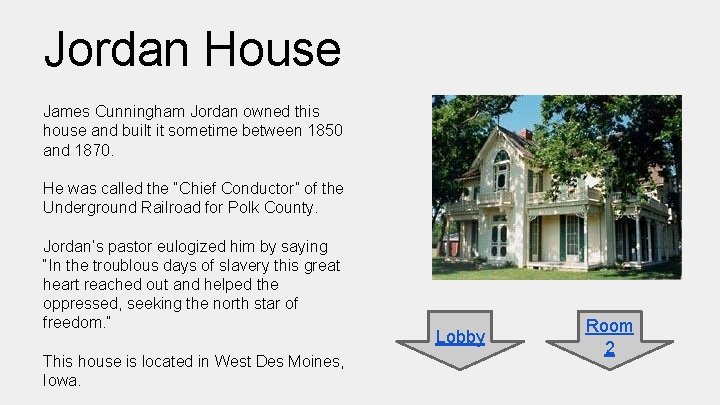
Jordan House James Cunningham Jordan owned this house and built it sometime between 1850 and 1870. He was called the “Chief Conductor” of the Underground Railroad for Polk County. Jordan’s pastor eulogized him by saying “In the troublous days of slavery this great heart reached out and helped the oppressed, seeking the north star of freedom. ” This house is located in West Des Moines, Iowa. Lobby Room 2
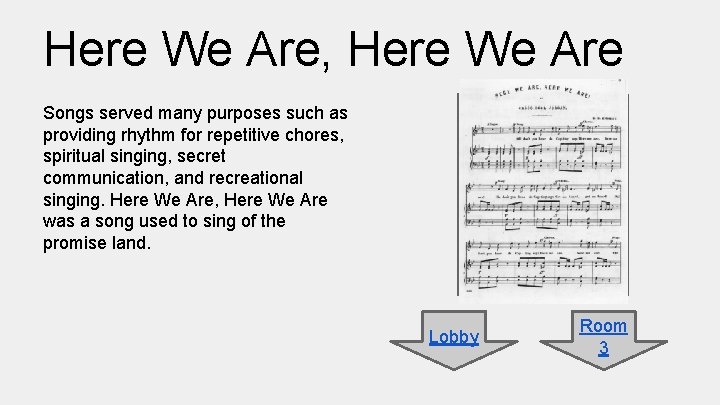
Here We Are, Here We Are Songs served many purposes such as providing rhythm for repetitive chores, spiritual singing, secret communication, and recreational singing. Here We Are, Here We Are was a song used to sing of the promise land. Lobby Room 3
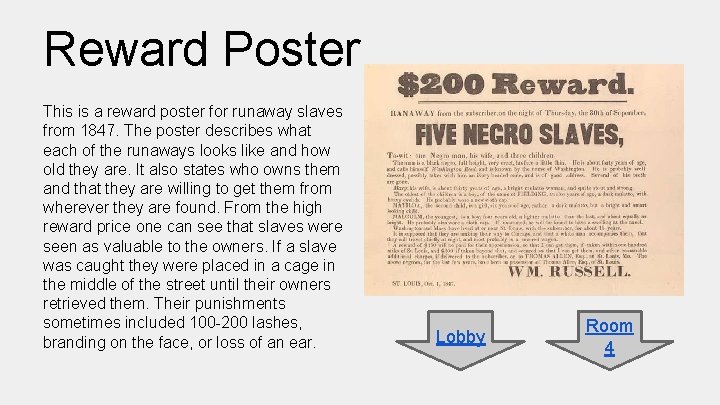
Reward Poster This is a reward poster for runaway slaves from 1847. The poster describes what each of the runaways looks like and how old they are. It also states who owns them and that they are willing to get them from wherever they are found. From the high reward price one can see that slaves were seen as valuable to the owners. If a slave was caught they were placed in a cage in the middle of the street until their owners retrieved them. Their punishments sometimes included 100 -200 lashes, branding on the face, or loss of an ear. Lobby Room 4
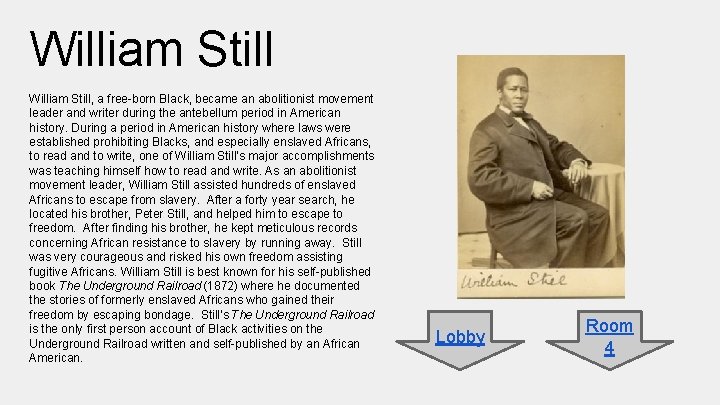
William Still, a free-born Black, became an abolitionist movement leader and writer during the antebellum period in American history. During a period in American history where laws were established prohibiting Blacks, and especially enslaved Africans, to read and to write, one of William Still’s major accomplishments was teaching himself how to read and write. As an abolitionist movement leader, William Still assisted hundreds of enslaved Africans to escape from slavery. After a forty year search, he located his brother, Peter Still, and helped him to escape to freedom. After finding his brother, he kept meticulous records concerning African resistance to slavery by running away. Still was very courageous and risked his own freedom assisting fugitive Africans. William Still is best known for his self-published book The Underground Railroad (1872) where he documented the stories of formerly enslaved Africans who gained their freedom by escaping bondage. Still’s The Underground Railroad is the only first person account of Black activities on the Underground Railroad written and self-published by an African American. Lobby Room 4

John Hossack was a strong opponent to slavery and would hide as many as 13 fleeing slaves in his home in Ottawa, IL, until it was safe to reach their next destination. Hossack was violating not only the Federal Fugitive Slave Act, as well as the infamous Illinois “Black Law, ” which forbade most African Americans from living within the state. In 1860, Hossack was one of several Ottawans charged and convicted in Federal Court in Chicago for violating the Fugitive Slave Law. The famous case involved Jim Gray, a slave who had reached Ottawa after fleeing slavery in a Southern state. During the trial, Gray was abducted from the Ottawa courtroom and helped to freedom in Canada. Lobby Room 4

John Rankin February 5, 1793 - March 18, 1886 Minister, educator and abolitionist Wrote antislavery letters to his brother, a slaveowner, who eventually freed his slaves and worked together These letters were published in Letters on Slavery in 1826 His house was a main point on the Underground Railroad route. It sat on top of a large hill on the Ohio River and he kept a light outside to guide escaped slaves to his house for safety. Rankin built a staircase that led down to the river to easily help slaves to safety. The Rankin House is now a National Historical Landmark. Looking up the staircase at the Rankin House in Ripley, Ohio Lobby Room 1

Underground Railroad Routes This map shows the United States during slavery and the various routes of the underground railroad. The darker shaded states are slave states and the lighter shaded states are free. Many of the buildings and landmarks along the routes are still standing and open to the public today. Specific codes and phrases were used to allow slaves and abolitionists to talk about the underground railroad. Examples: Baggage- Fugitive slaves Conductor- Person who directly helped the escaping slaves Station- Safe house Lobby Room 2
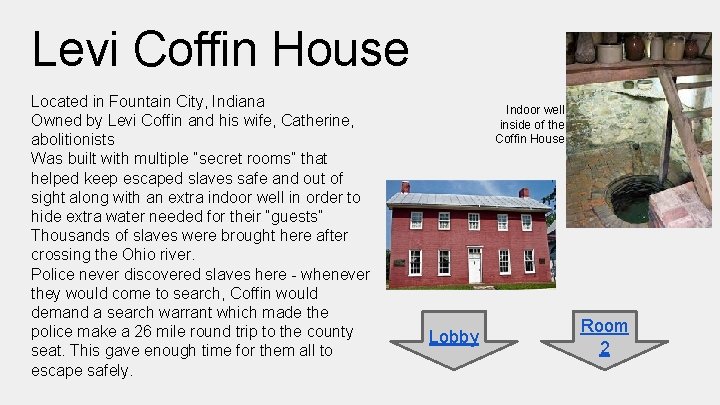
Levi Coffin House Located in Fountain City, Indiana Owned by Levi Coffin and his wife, Catherine, abolitionists Was built with multiple “secret rooms” that helped keep escaped slaves safe and out of sight along with an extra indoor well in order to hide extra water needed for their “guests” Thousands of slaves were brought here after crossing the Ohio river. Police never discovered slaves here - whenever they would come to search, Coffin would demand a search warrant which made the police make a 26 mile round trip to the county seat. This gave enough time for them all to escape safely. Indoor well inside of the Coffin House Lobby Room 2
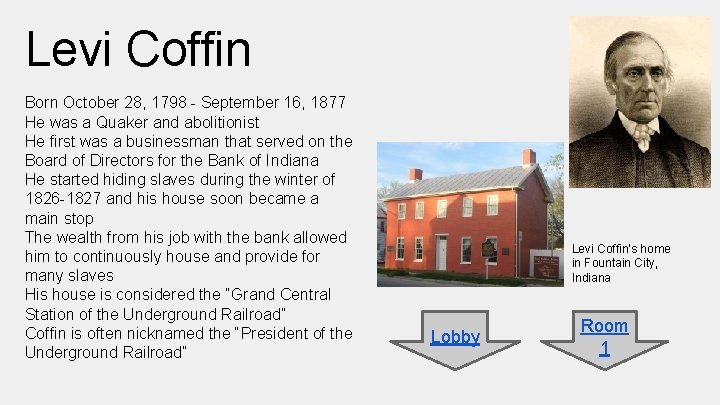
Levi Coffin Born October 28, 1798 - September 16, 1877 He was a Quaker and abolitionist He first was a businessman that served on the Board of Directors for the Bank of Indiana He started hiding slaves during the winter of 1826 -1827 and his house soon became a main stop The wealth from his job with the bank allowed him to continuously house and provide for many slaves His house is considered the “Grand Central Station of the Underground Railroad” Coffin is often nicknamed the “President of the Underground Railroad” Levi Coffin’s home in Fountain City, Indiana Lobby Room 1
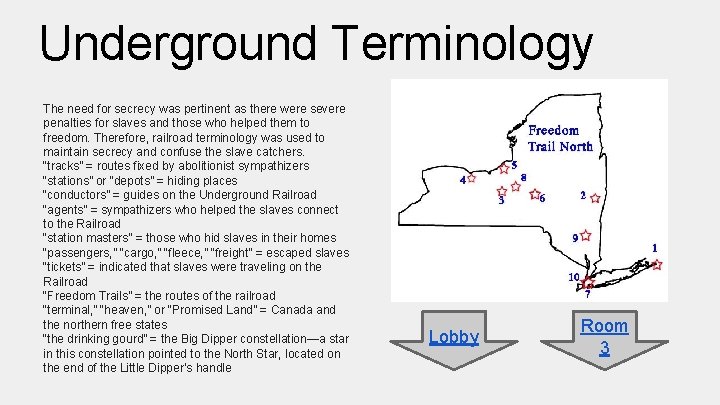
Underground Terminology The need for secrecy was pertinent as there were severe penalties for slaves and those who helped them to freedom. Therefore, railroad terminology was used to maintain secrecy and confuse the slave catchers. “tracks” = routes fixed by abolitionist sympathizers “stations” or “depots” = hiding places “conductors” = guides on the Underground Railroad “agents” = sympathizers who helped the slaves connect to the Railroad “station masters” = those who hid slaves in their homes “passengers, ” “cargo, ” “fleece, ” “freight” = escaped slaves “tickets” = indicated that slaves were traveling on the Railroad “Freedom Trails” = the routes of the railroad “terminal, ” “heaven, ” or “Promised Land” = Canada and the northern free states “the drinking gourd” = the Big Dipper constellation—a star in this constellation pointed to the North Star, located on the end of the Little Dipper’s handle Lobby Room 3
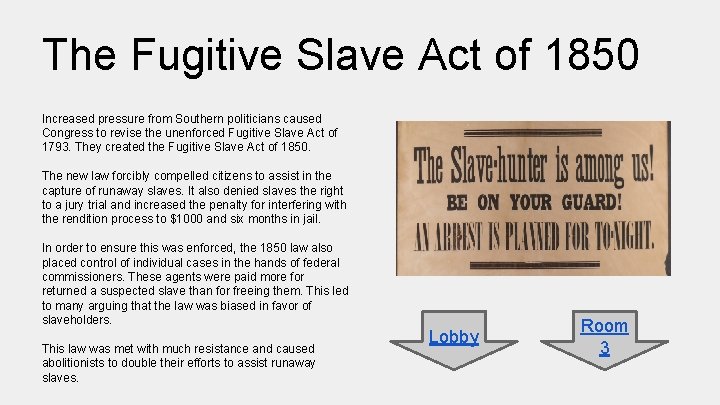
The Fugitive Slave Act of 1850 Increased pressure from Southern politicians caused Congress to revise the unenforced Fugitive Slave Act of 1793. They created the Fugitive Slave Act of 1850. The new law forcibly compelled citizens to assist in the capture of runaway slaves. It also denied slaves the right to a jury trial and increased the penalty for interfering with the rendition process to $1000 and six months in jail. In order to ensure this was enforced, the 1850 law also placed control of individual cases in the hands of federal commissioners. These agents were paid more for returned a suspected slave than for freeing them. This led to many arguing that the law was biased in favor of slaveholders. This law was met with much resistance and caused abolitionists to double their efforts to assist runaway slaves. Lobby Room 3
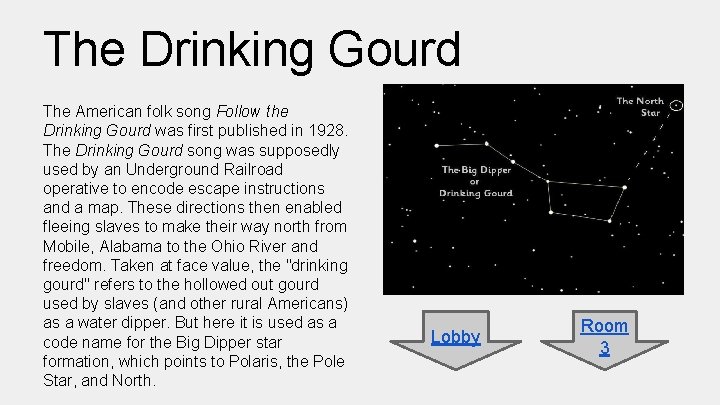
The Drinking Gourd The American folk song Follow the Drinking Gourd was first published in 1928. The Drinking Gourd song was supposedly used by an Underground Railroad operative to encode escape instructions and a map. These directions then enabled fleeing slaves to make their way north from Mobile, Alabama to the Ohio River and freedom. Taken at face value, the "drinking gourd" refers to the hollowed out gourd used by slaves (and other rural Americans) as a water dipper. But here it is used as a code name for the Big Dipper star formation, which points to Polaris, the Pole Star, and North. Lobby Room 3
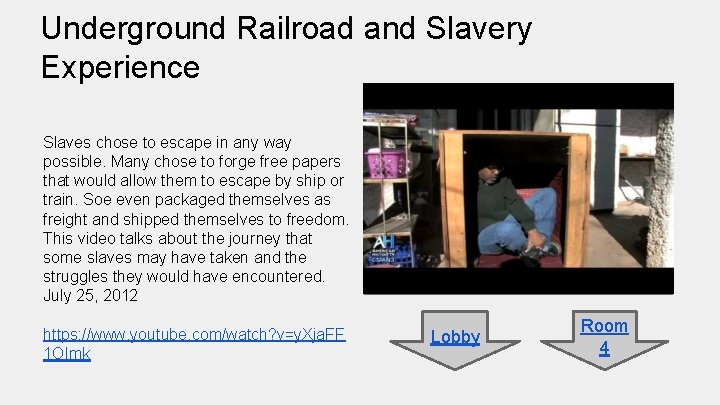
Underground Railroad and Slavery Experience Slaves chose to escape in any way possible. Many chose to forge free papers that would allow them to escape by ship or train. Soe even packaged themselves as freight and shipped themselves to freedom. This video talks about the journey that some slaves may have taken and the struggles they would have encountered. July 25, 2012 https: //www. youtube. com/watch? v=y. Xja. FF 1 OImk Image or Video Lobby Room 4
Resources http: //www. ohiohistorycentral. org/w/Undergroun d_Railroad http: //www. nps. gov/nr/travel/underground/states. htm http: //www. indianahistory. org/ourcollections/reference/notable-hoosiers/levi-andcatharine-coffin#. VS 2 d. RUatwl. M http: //memory. loc. gov/cgibin/query/h? ammem/rbcmillerbib: @field(DOCID +@lit(rbcmiller 002657)) https: //www. harrietbeecherstowecenter. org/hbs/ http: //www. pbs. org/black-culture/explore/harriettubman/#. VTAh. GI 54 pdc http: //memory. loc. gov/cgibin/query/h? ammem/rbcmillerbib: @field(DOCID +@lit(rbcmiller 002657)) http: //www. nps. gov/nr/travel/underground/ia 4. ht m Lobby http: //www. nps. gov/nr/travel/underground/il 2. ht m http: //landmarkhunter. com/photos/54/15/541575 -M. jpg http: //www. history. com/topics/blackhistory/fugitive-slave-acts
Common Core and NCSS Standards Lobby • CCSS. ELA-Literacy. RH. 6 -8. 10 By the end of grade 8, read and comprehend history/social studies texts in the grades 6 -8 text complexity band independently and proficiently. • CCSS. ELA-Literacy. RH. 6 -8. 7 Integrate visual information (e. g. , in charts, graphs, photographs, videos, or maps) with other information in print and digital texts. NCSS. 1. 1. b. Guide learners are they predict how data and experiences may be interpreted by people from diverse cultural perspectives and frames of references. NCSS. 1. 1. d. Encourage learners to compare and analyze societal patterns for preserving and transmitting culture while adapting to environmental and social change.
- Slides: 24