Lecture 9 Magnetic Fields due to Currents Chp
- Slides: 23
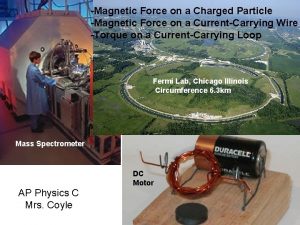
Lecture 9 Magnetic Fields due to Currents Chp. 30 • • • Cartoon - Shows magnetic field around a long current carrying wire and a loop of wire Opening Demo - Iron filings showing B fields around wires with currents Warm-up problem Physlet Topics – Magnetic field produced by a moving charge – Magnetic fields produced by currents. Big. Bite as an example. – Using Biot Savart Law to calculate magnetic fields produced by currents. – Examples: Field at center of loop of wire, at center of circular arc of wire, at center of segment of wire. – Amperes’ Law : Analogous to Gauss’ L: aw in electrostatics, Useful in symmetric cases. – Infinitely long straight wire of radius a. Find B outside and inside wire. – Solenoid and Toroid Find B field. – Forces between current carrying wires or parallel moving charges • Demos – Torque on a current loop(galvanometer) – Iron filings showing B fields around wires with currents. – Compass needle near current carrying wire – Big. Bite as an example of using a magnet as a research tool. – Force between parallel wires carrying identical currents.
Magnetic Fields due to Currents • Torque on a coil in a magnetic field demo– left over from last time • So far we have used permanent magnets as our source of magnetic field. Historically this is how it started. • In early decades of the last century, it was learned that moving charges and electric currents produced magnetic fields. • How do you find the Magnetic field due to a moving point charge? • How do you find the Magnetic field due to a current? – Biot-Savart Law – direct integration – Ampere’s Law – uses symmetry • Examples and Demos
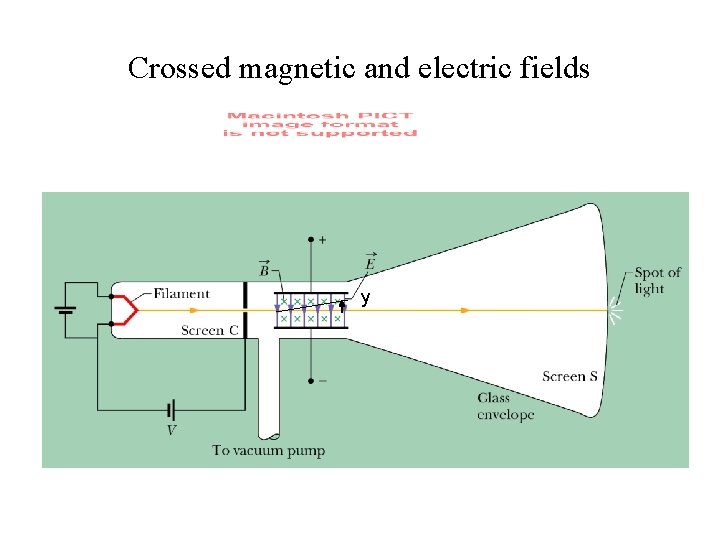
Crossed magnetic and electric fields y
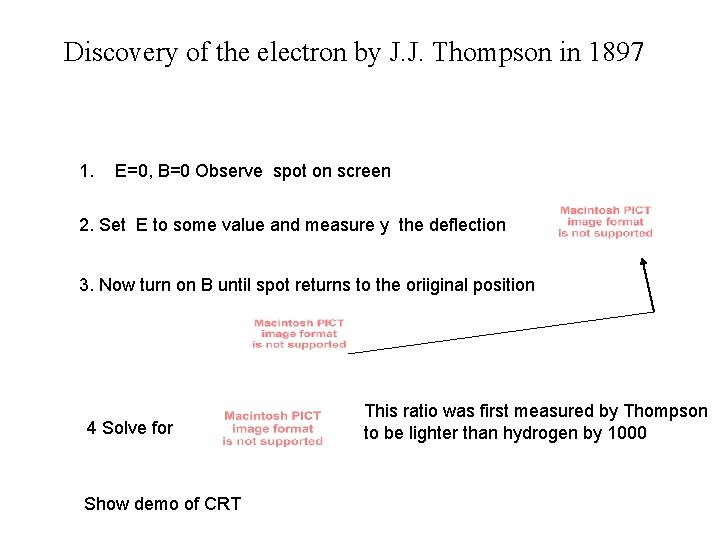
Discovery of the electron by J. J. Thompson in 1897 1. E=0, B=0 Observe spot on screen 2. Set E to some value and measure y the deflection 3. Now turn on B until spot returns to the oriiginal position 4 Solve for Show demo of CRT This ratio was first measured by Thompson to be lighter than hydrogen by 1000
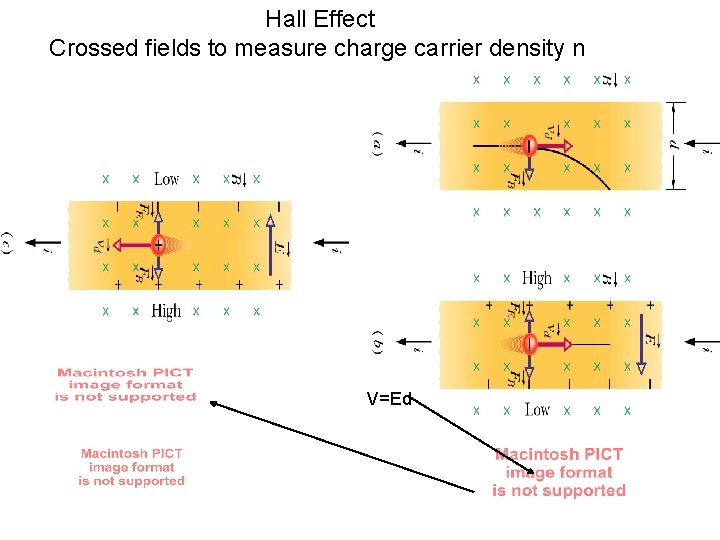
Hall Effect Crossed fields to measure charge carrier density n V=Ed
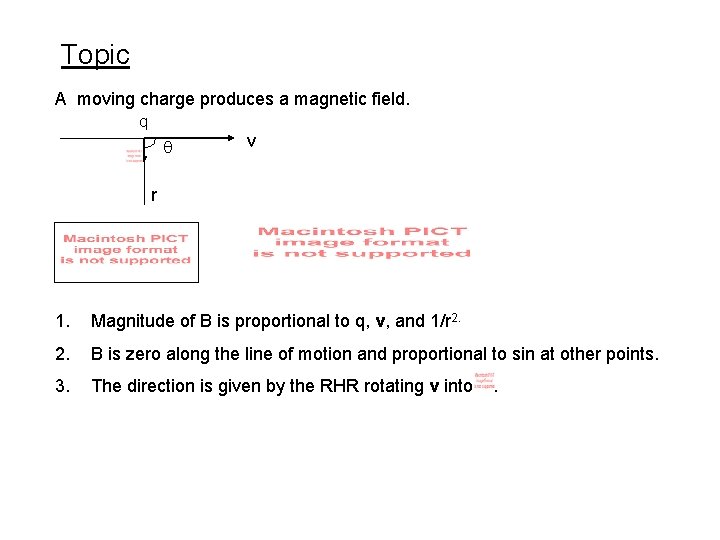
Topic A moving charge produces a magnetic field. q v r 1. Magnitude of B is proportional to q, v, and 1/r 2. B is zero along the line of motion and proportional to sin at other points. 3. The direction is given by the RHR rotating v into .
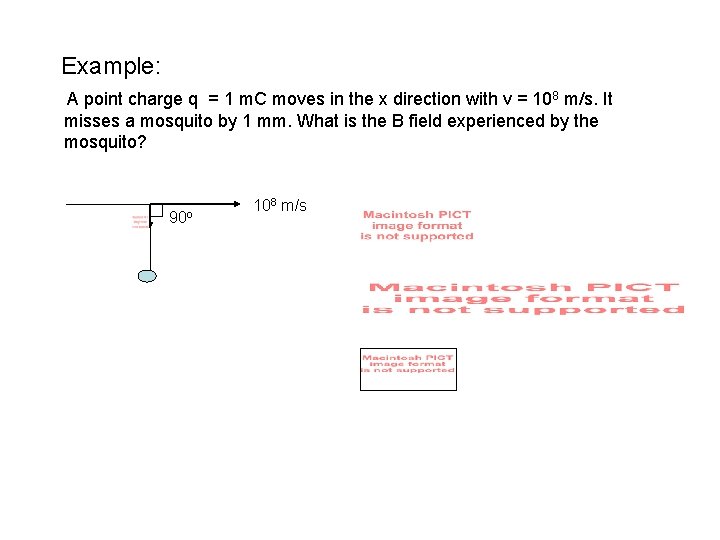
Example: A point charge q = 1 m. C moves in the x direction with v = 108 m/s. It misses a mosquito by 1 mm. What is the B field experienced by the mosquito? 90 o 108 m/s
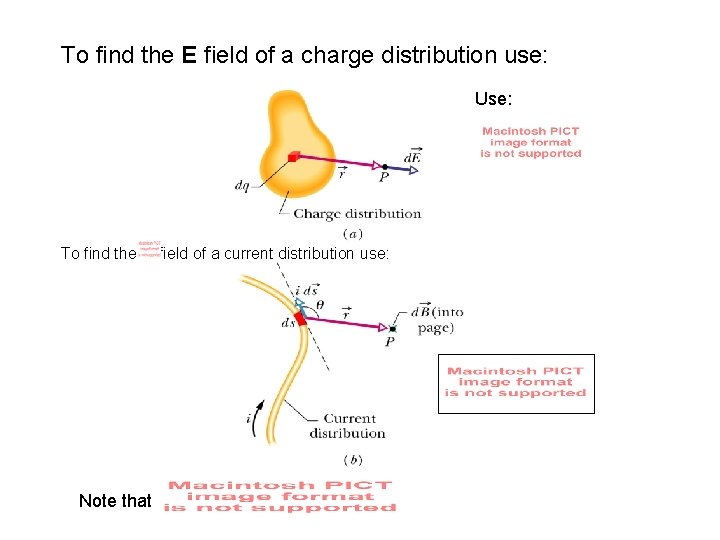
To find the E field of a charge distribution use: Use: To find the Note that field of a current distribution use:
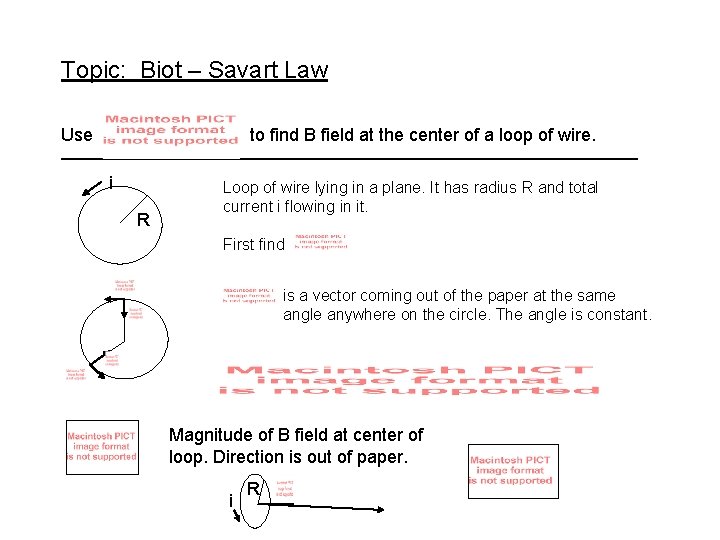
Topic: Biot – Savart Law Use to find B field at the center of a loop of wire. i R Loop of wire lying in a plane. It has radius R and total current i flowing in it. First find is a vector coming out of the paper at the same angle anywhere on the circle. The angle is constant. Magnitude of B field at center of loop. Direction is out of paper. i R
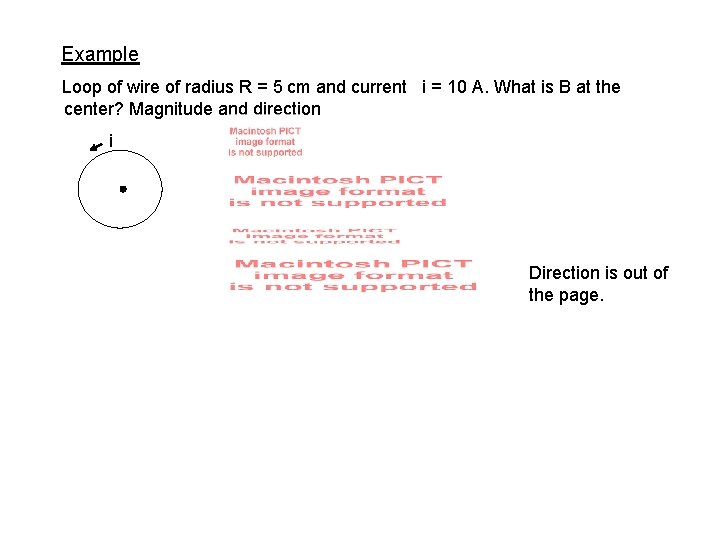
Example Loop of wire of radius R = 5 cm and current i = 10 A. What is B at the center? Magnitude and direction i Direction is out of the page.
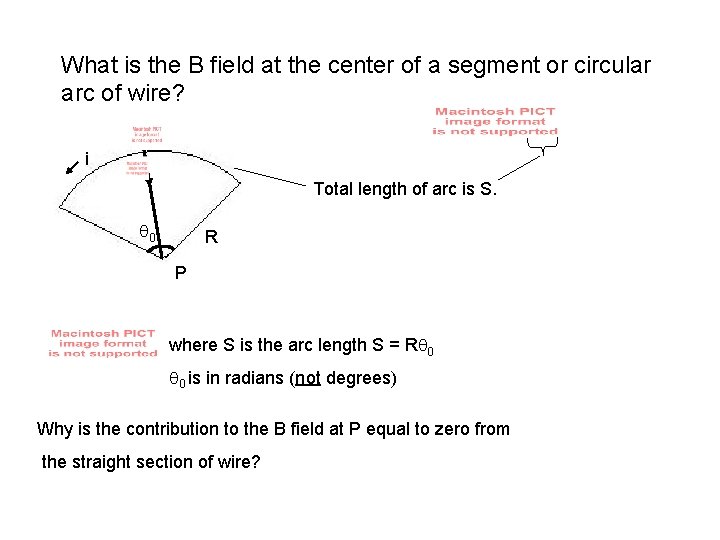
What is the B field at the center of a segment or circular arc of wire? i Total length of arc is S. 0 R P where S is the arc length S = R 0 0 is in radians (not degrees) Why is the contribution to the B field at P equal to zero from the straight section of wire?
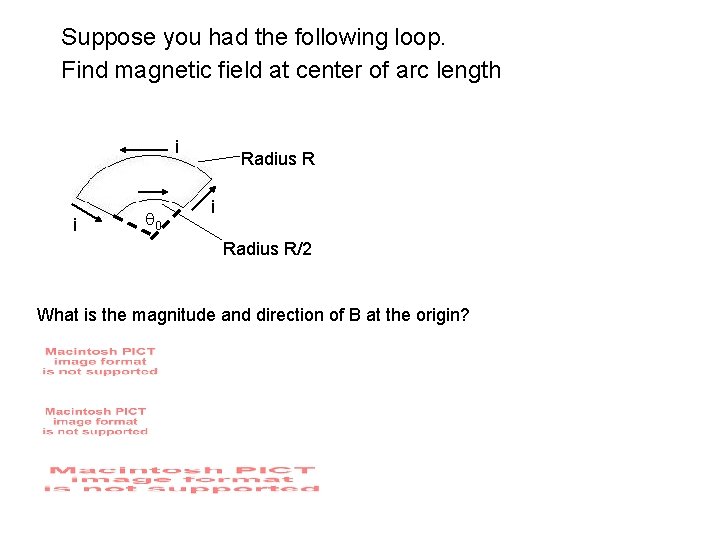
Suppose you had the following loop. Find magnetic field at center of arc length i i 0 Radius R i Radius R/2 What is the magnitude and direction of B at the origin?
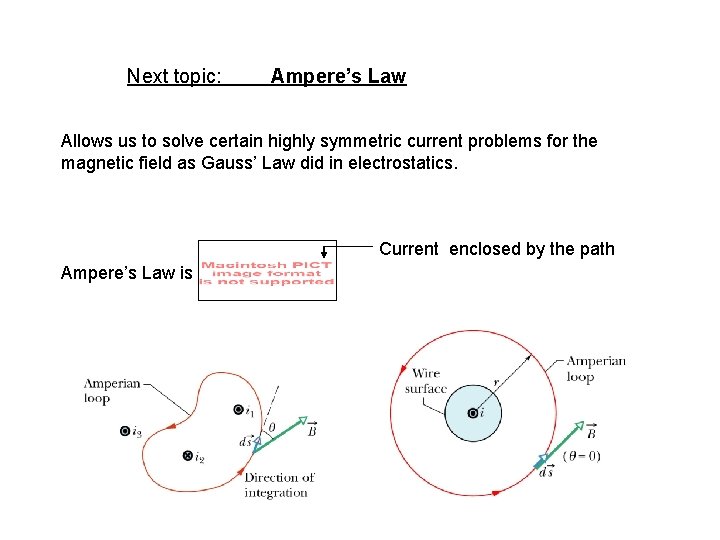
Next topic: Ampere’s Law Allows us to solve certain highly symmetric current problems for the magnetic field as Gauss’ Law did in electrostatics. Current enclosed by the path Ampere’s Law is
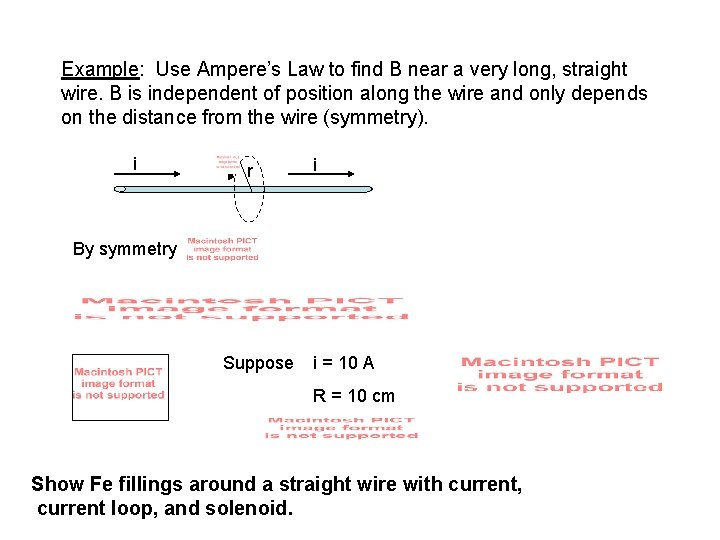
Example: Use Ampere’s Law to find B near a very long, straight wire. B is independent of position along the wire and only depends on the distance from the wire (symmetry). i r i By symmetry Suppose i = 10 A R = 10 cm Show Fe fillings around a straight wire with current, current loop, and solenoid.
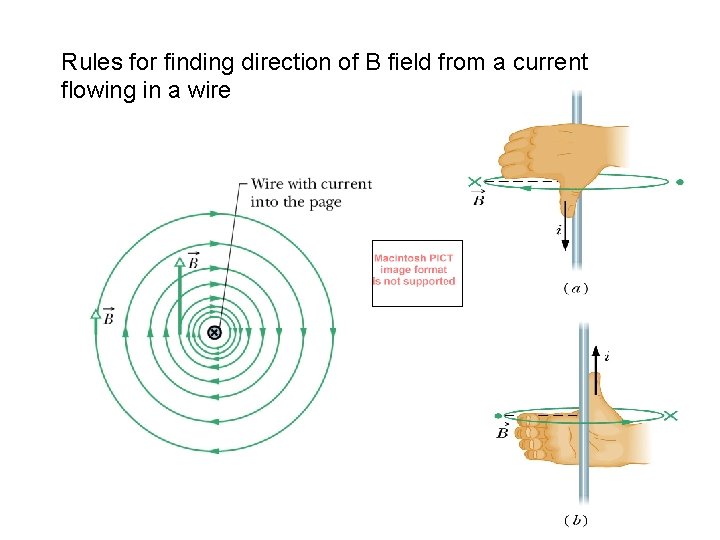
Rules for finding direction of B field from a current flowing in a wire
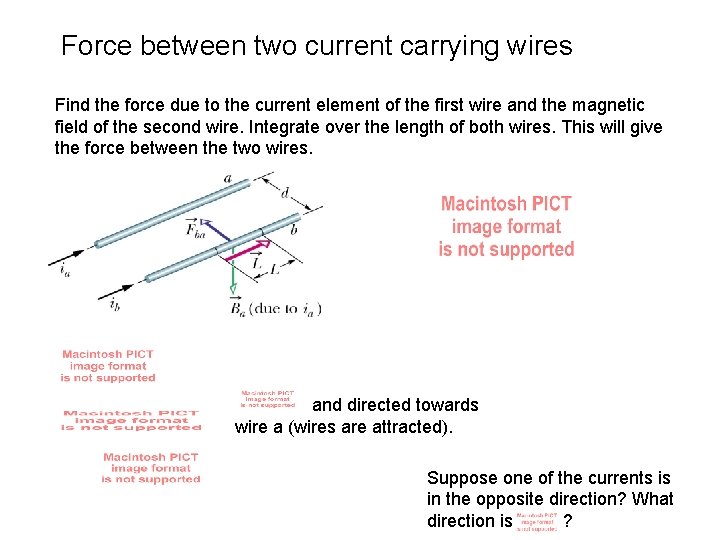
Force between two current carrying wires Find the force due to the current element of the first wire and the magnetic field of the second wire. Integrate over the length of both wires. This will give the force between the two wires. and directed towards wire a (wires are attracted). Suppose one of the currents is in the opposite direction? What direction is ?
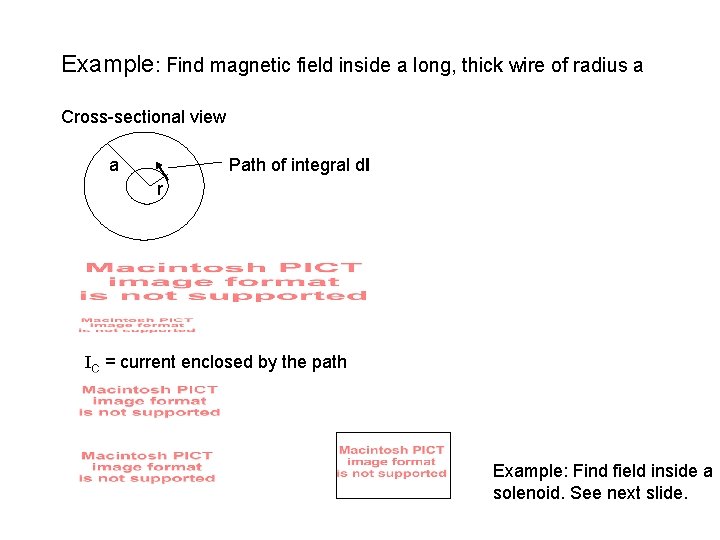
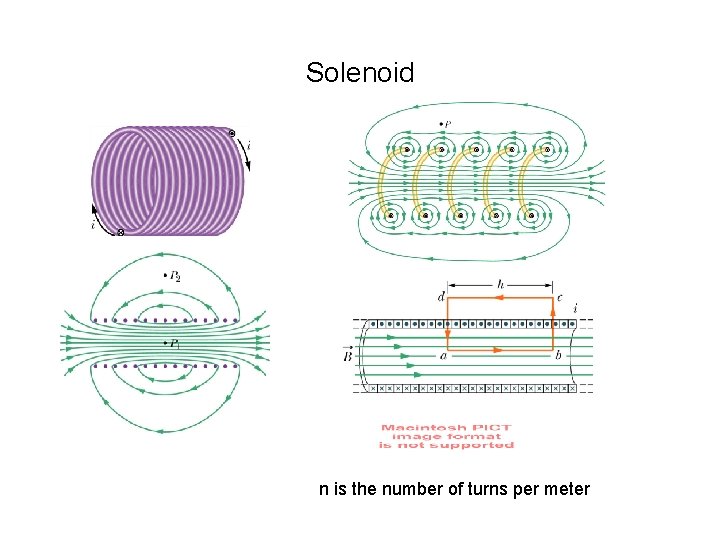
Example: Find magnetic field inside a long, thick wire of radius a Cross-sectional view a Path of integral dl r IC = current enclosed by the path Example: Find field inside a solenoid. See next slide.
Solenoid n is the number of turns per meter
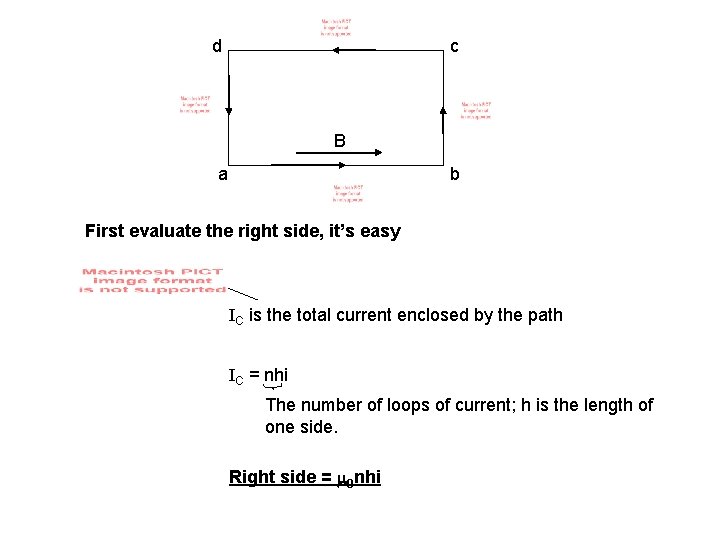
d c B a b First evaluate the right side, it’s easy IC is the total current enclosed by the path IC = nhi The number of loops of current; h is the length of one side. Right side = 0 nhi
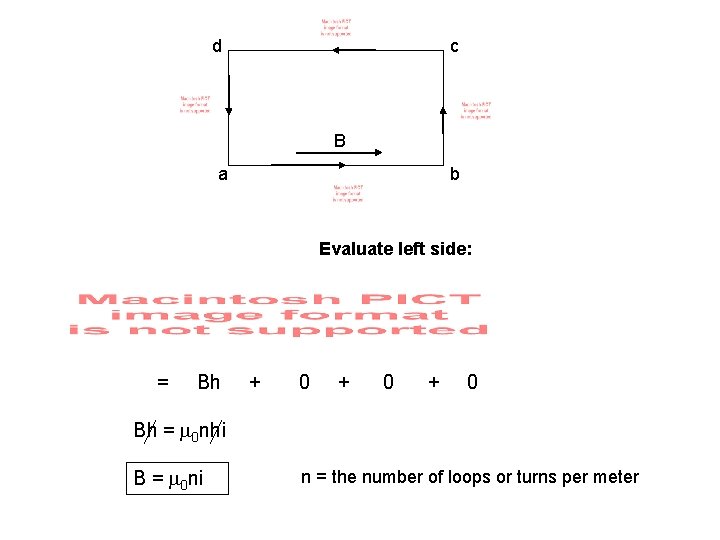
d c B a b Evaluate left side: = Bh + 0 + 0 Bh = 0 nhi B = 0 ni n = the number of loops or turns per meter
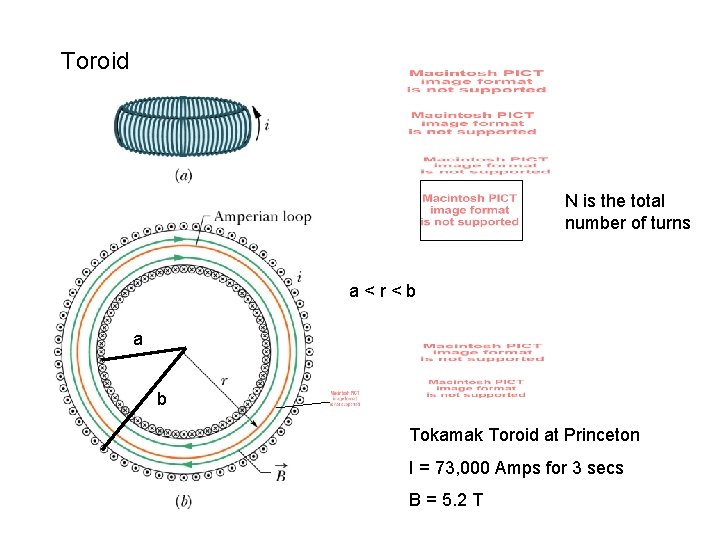
Toroid N is the total number of turns a<r<b a b Tokamak Toroid at Princeton I = 73, 000 Amps for 3 secs B = 5. 2 T
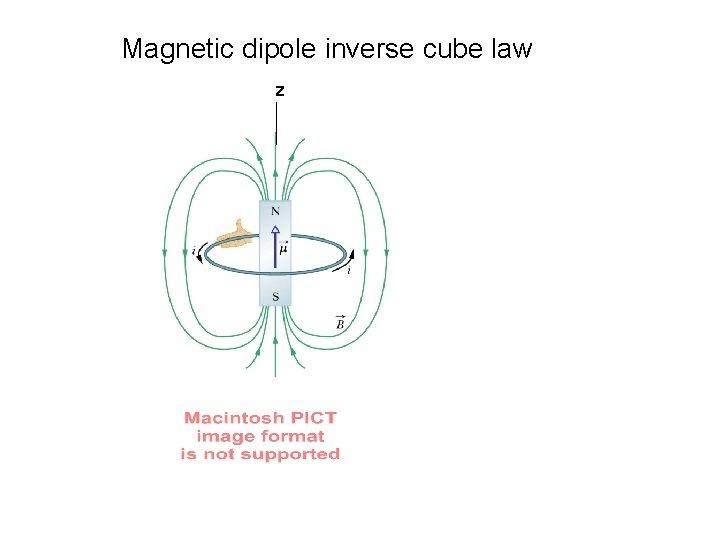
Magnetic dipole inverse cube law z
Warm up Problem Set 9 Warm up set 9 Due 8: 00 am Thursday 1. HRW 6 30. TB. 02. [119973] A "coulomb" is: one ampere per second an abbreviation for a certain combination of kilogram, meter and second the quantity of charge which will exert a force of 1 N on a similar charge at a distance of 1 m the amount of current in each of two long parallel wires separated by 1 m, which produces a force of 2 10 -7 N per meter the amount of charge which flows past a point in one second when the current is 1 A 2. HRW 6 30. TB. 03. [119974] Electrons are going around a circle in a counterclockwise direction as shown. At the center of the circle they produce a magnetic field that is: to the left into the page out of the page zero to the right 3. HRW 6 30. TB. 07. [119978] Lines of the magnetic field produced by a long straight wire carrying a current: are circles concentric with the wire leave the wire radially are in the direction of the current are lines similar to those produced by a bar magnet are opposite to the direction of the current