Lecture 4 Matrices and Matrix Operations 1 3

- Slides: 26
Lecture 4 Matrices and Matrix Operations
1. 3 Matrices and Matrix Operations 2
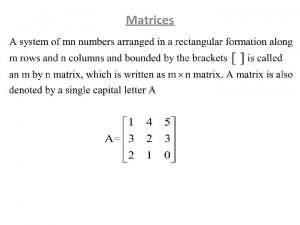
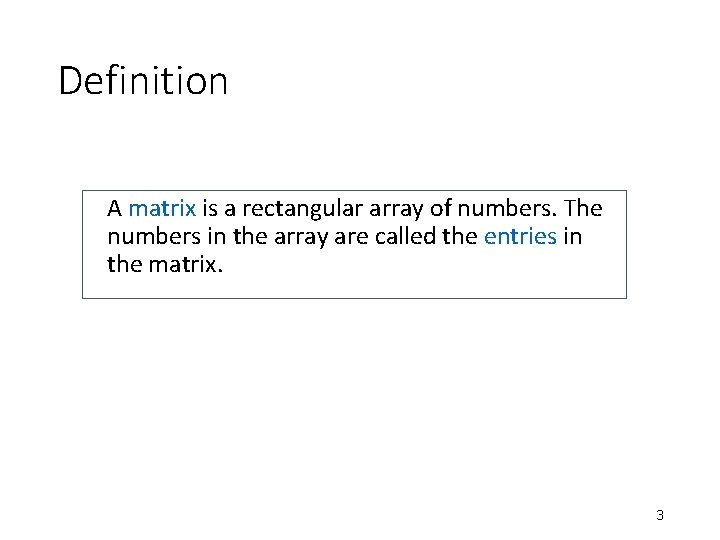
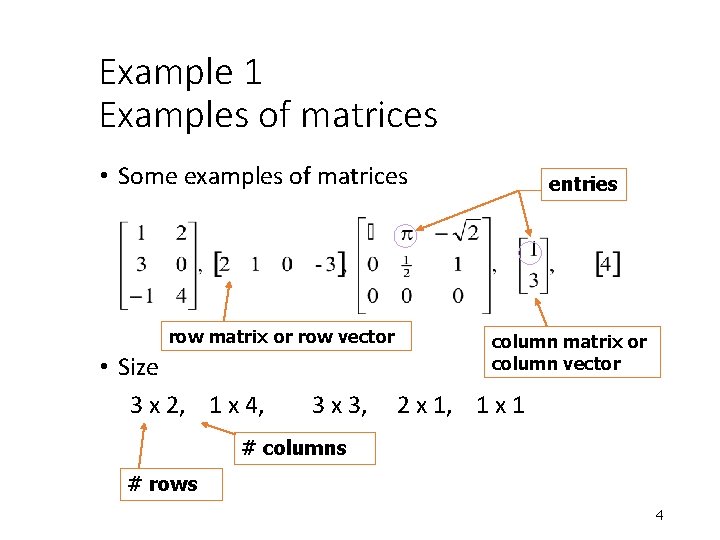
Definition A matrix is a rectangular array of numbers. The numbers in the array are called the entries in the matrix. 3
Example 1 Examples of matrices • Some examples of matrices row matrix or row vector • Size 3 x 2, 1 x 4, 3 x 3, entries column matrix or column vector 2 x 1, 1 x 1 # columns # rows 4
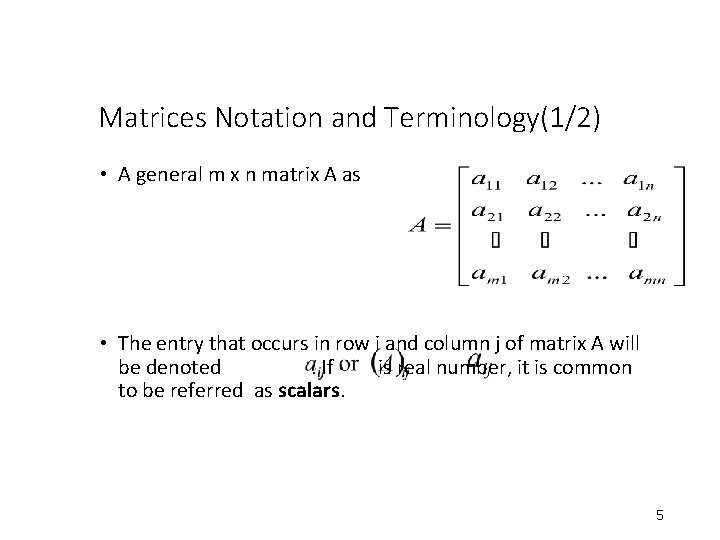
Matrices Notation and Terminology(1/2) • A general m x n matrix A as • The entry that occurs in row i and column j of matrix A will be denoted. If is real number, it is common to be referred as scalars. 5
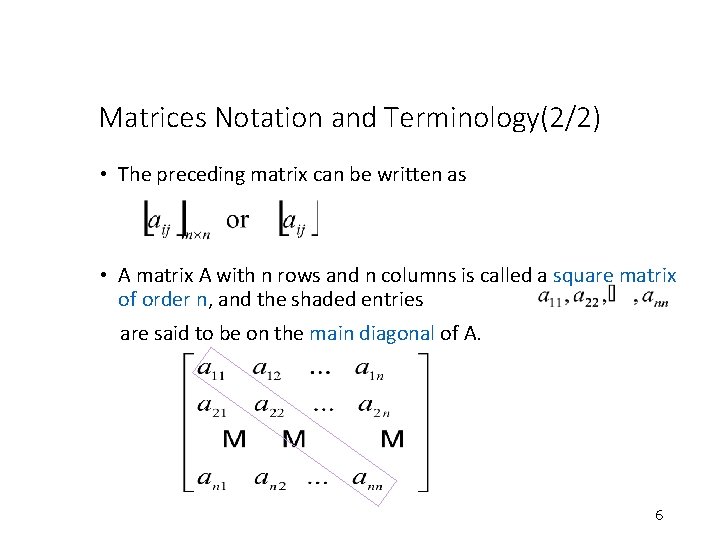
Matrices Notation and Terminology(2/2) • The preceding matrix can be written as • A matrix A with n rows and n columns is called a square matrix of order n, and the shaded entries are said to be on the main diagonal of A. 6
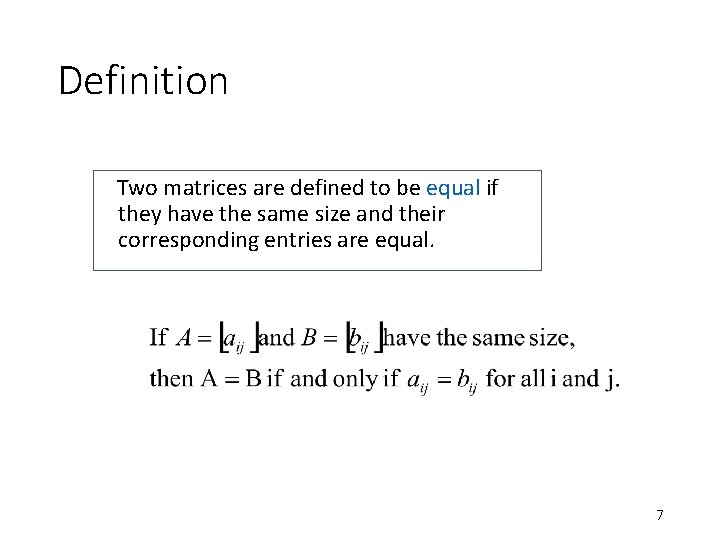
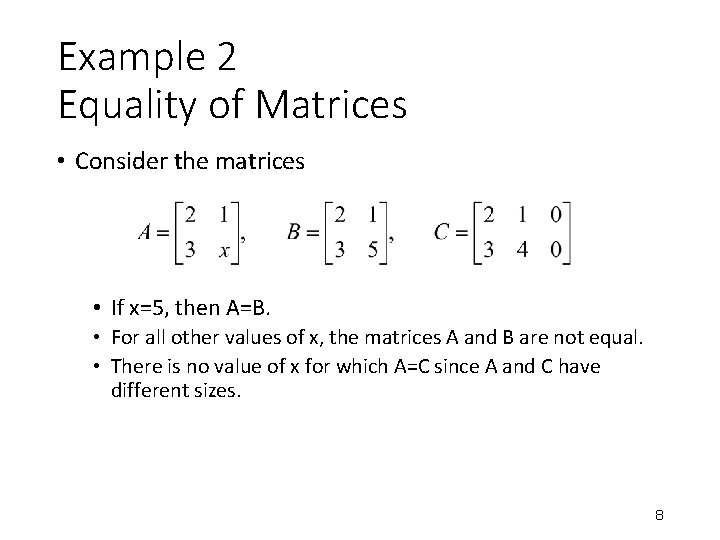
Definition Two matrices are defined to be equal if they have the same size and their corresponding entries are equal. 7
Example 2 Equality of Matrices • Consider the matrices • If x=5, then A=B. • For all other values of x, the matrices A and B are not equal. • There is no value of x for which A=C since A and C have different sizes. 8
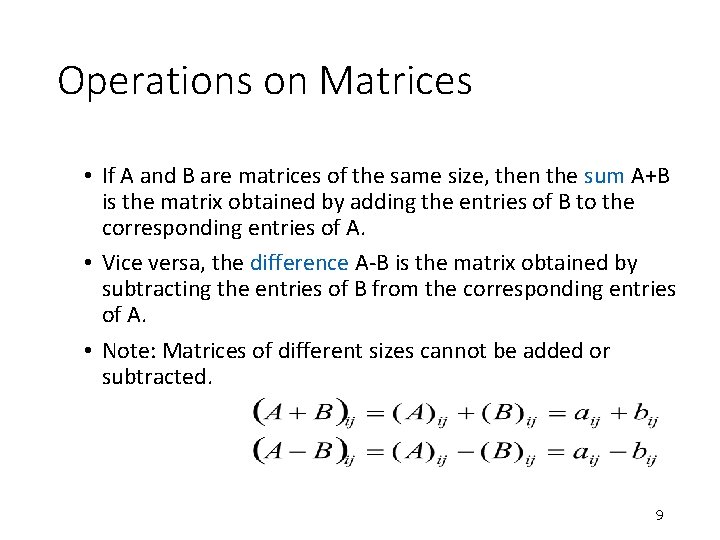
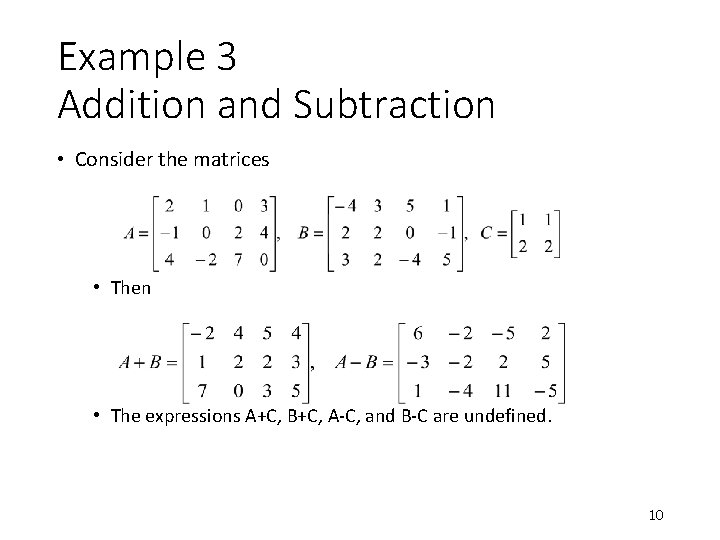
Operations on Matrices • If A and B are matrices of the same size, then the sum A+B is the matrix obtained by adding the entries of B to the corresponding entries of A. • Vice versa, the difference A-B is the matrix obtained by subtracting the entries of B from the corresponding entries of A. • Note: Matrices of different sizes cannot be added or subtracted. 9
Example 3 Addition and Subtraction • Consider the matrices • Then • The expressions A+C, B+C, A-C, and B-C are undefined. 10
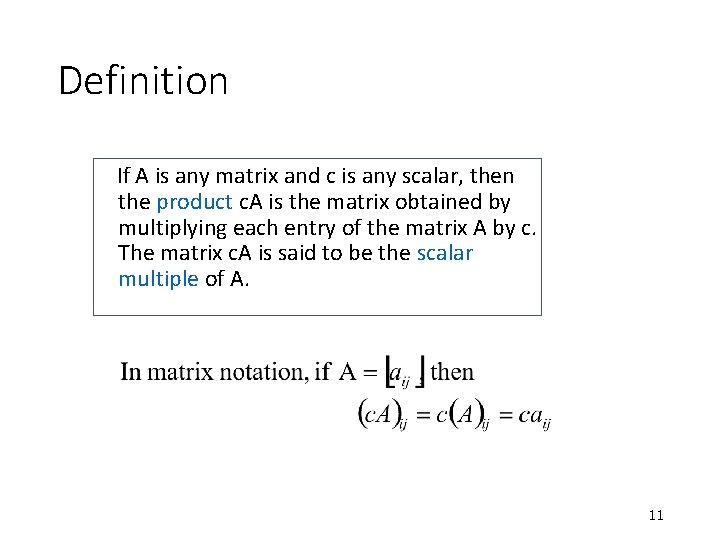
Definition If A is any matrix and c is any scalar, then the product c. A is the matrix obtained by multiplying each entry of the matrix A by c. The matrix c. A is said to be the scalar multiple of A. 11
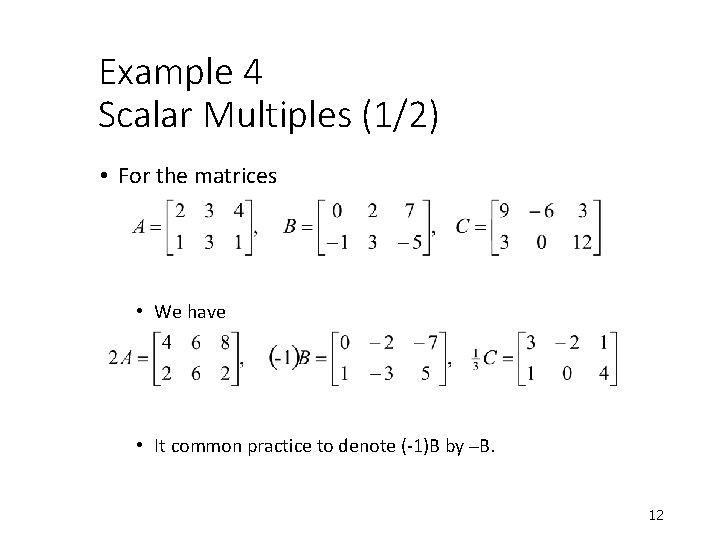
Example 4 Scalar Multiples (1/2) • For the matrices • We have • It common practice to denote (-1)B by –B. 12
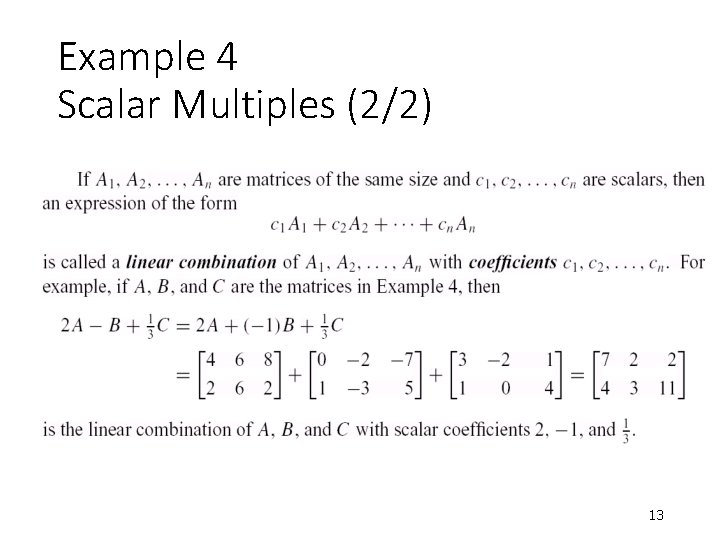
Example 4 Scalar Multiples (2/2) 13
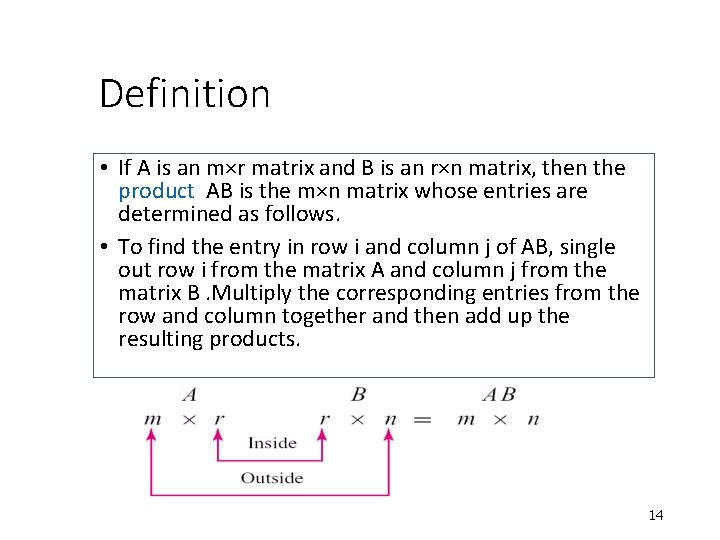
Definition • If A is an m×r matrix and B is an r×n matrix, then the product AB is the m×n matrix whose entries are determined as follows. • To find the entry in row i and column j of AB, single out row i from the matrix A and column j from the matrix B. Multiply the corresponding entries from the row and column together and then add up the resulting products. 14
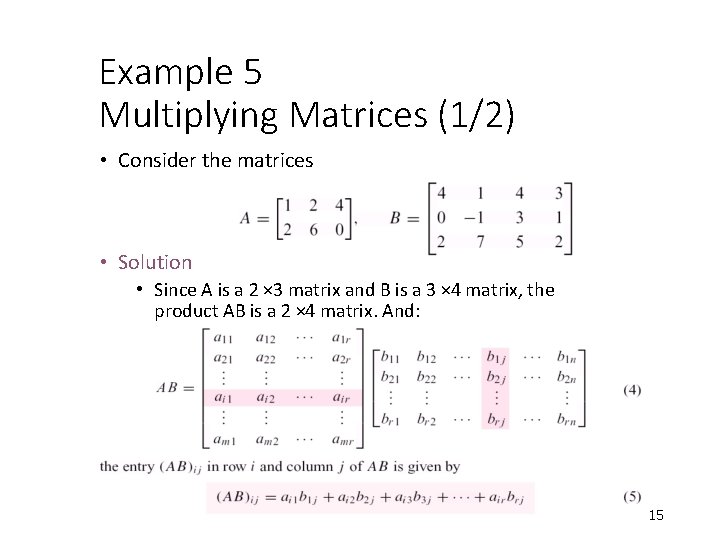
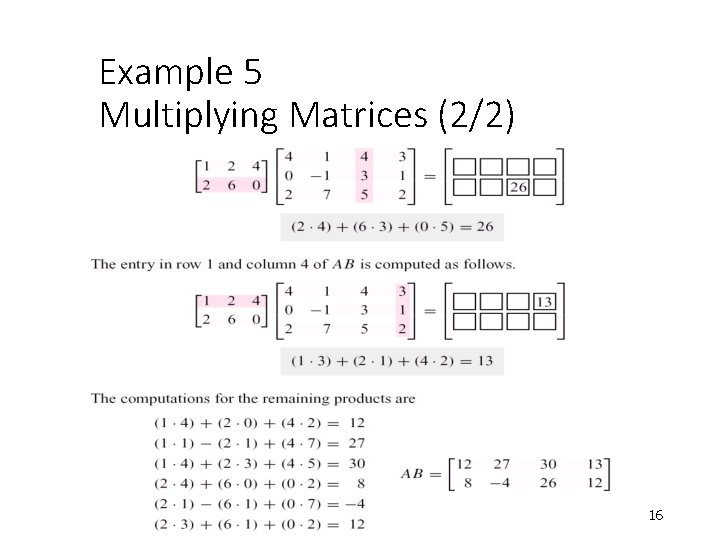
Example 5 Multiplying Matrices (1/2) • Consider the matrices • Solution • Since A is a 2 × 3 matrix and B is a 3 × 4 matrix, the product AB is a 2 × 4 matrix. And: 15
Example 5 Multiplying Matrices (2/2) 16
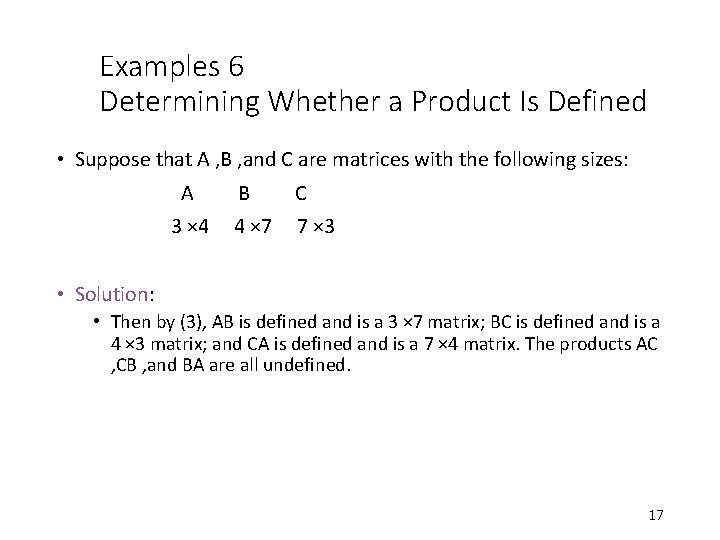
Examples 6 Determining Whether a Product Is Defined • Suppose that A , B , and C are matrices with the following sizes: A 3 × 4 B C 4 × 7 7 × 3 • Solution: • Then by (3), AB is defined and is a 3 × 7 matrix; BC is defined and is a 4 × 3 matrix; and CA is defined and is a 7 × 4 matrix. The products AC , CB , and BA are all undefined. 17
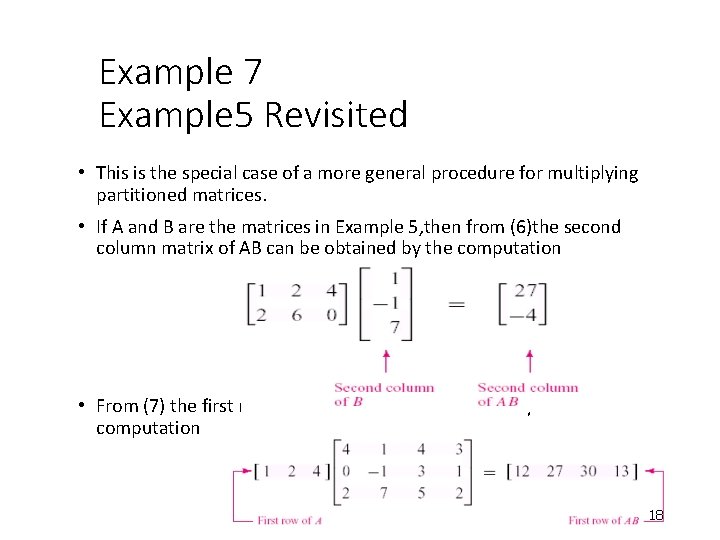
Example 7 Example 5 Revisited • This is the special case of a more general procedure for multiplying partitioned matrices. • If A and B are the matrices in Example 5, then from (6)the second column matrix of AB can be obtained by the computation • From (7) the first row matrix of AB can be obtained by the computation 18
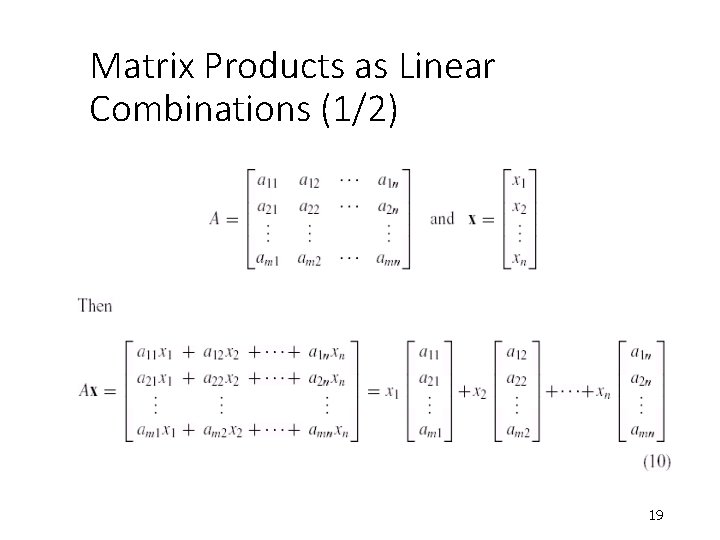
Matrix Products as Linear Combinations (1/2) 19
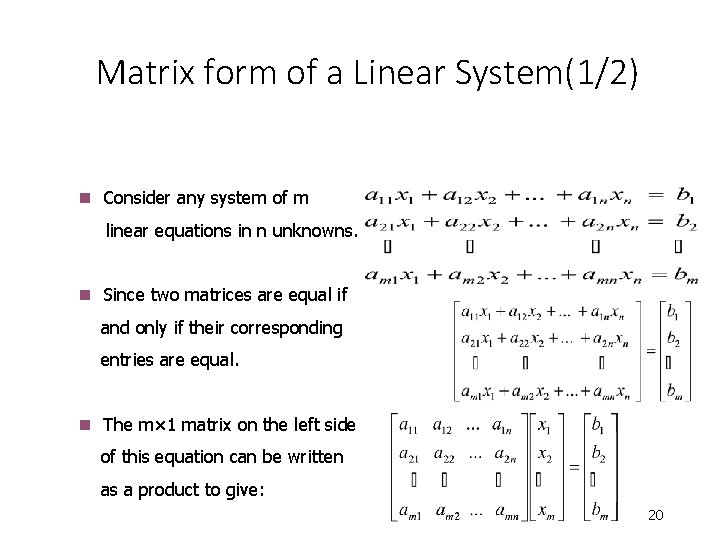
Matrix form of a Linear System(1/2) n Consider any system of m linear equations in n unknowns. n Since two matrices are equal if and only if their corresponding entries are equal. n The m× 1 matrix on the left side of this equation can be written as a product to give: 20
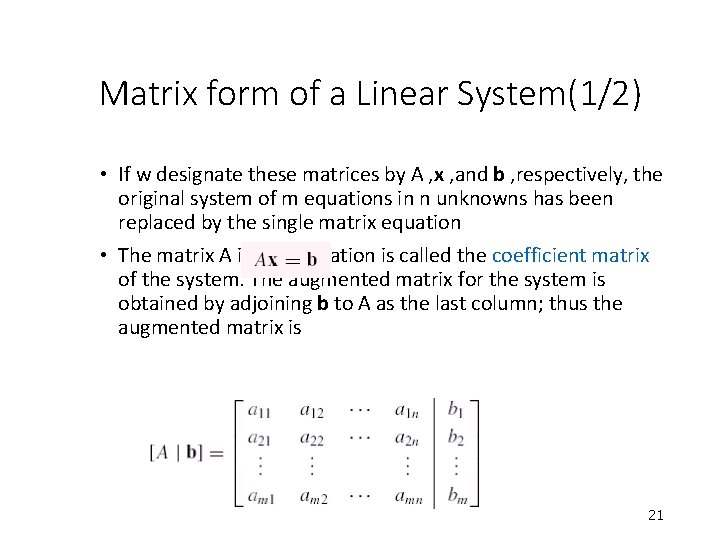
Matrix form of a Linear System(1/2) • If w designate these matrices by A , x , and b , respectively, the original system of m equations in n unknowns has been replaced by the single matrix equation • The matrix A in this equation is called the coefficient matrix of the system. The augmented matrix for the system is obtained by adjoining b to A as the last column; thus the augmented matrix is 21
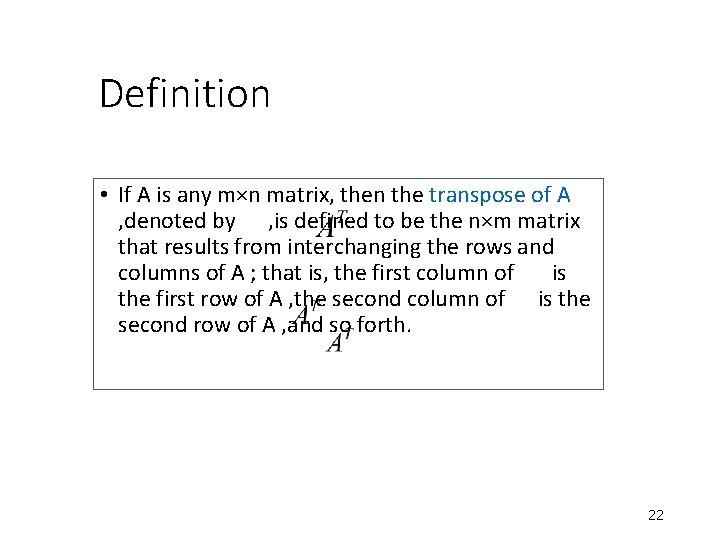
Definition • If A is any m×n matrix, then the transpose of A , denoted by , is defined to be the n×m matrix that results from interchanging the rows and columns of A ; that is, the first column of is the first row of A , the second column of is the second row of A , and so forth. 22
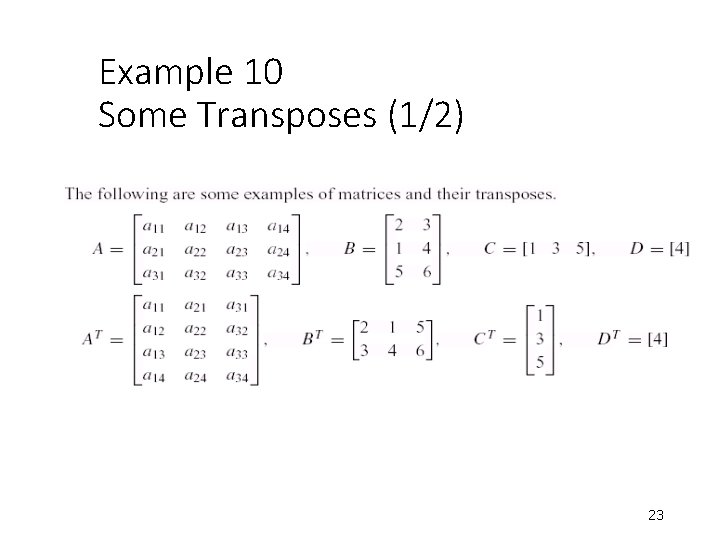
Example 10 Some Transposes (1/2) 23
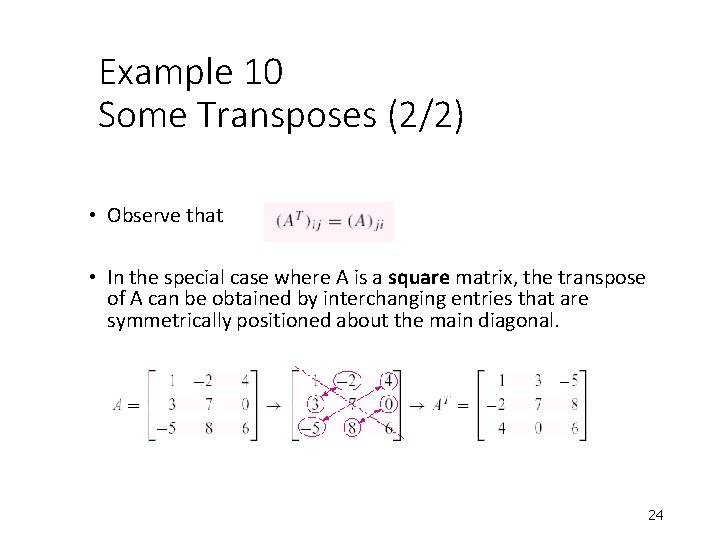
Example 10 Some Transposes (2/2) • Observe that • In the special case where A is a square matrix, the transpose of A can be obtained by interchanging entries that are symmetrically positioned about the main diagonal. 24
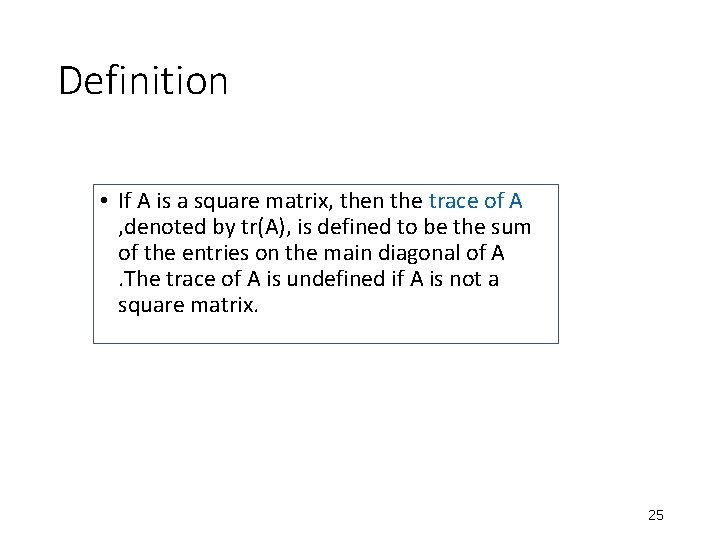
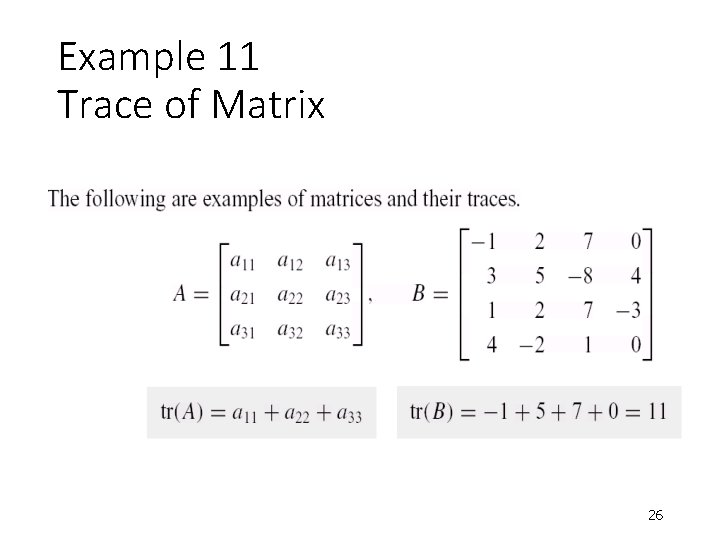
Definition • If A is a square matrix, then the trace of A , denoted by tr(A), is defined to be the sum of the entries on the main diagonal of A. The trace of A is undefined if A is not a square matrix. 25
Example 11 Trace of Matrix 26