LCFI Vertex Package Precision Physics Opportunities with Heavy
- Slides: 24
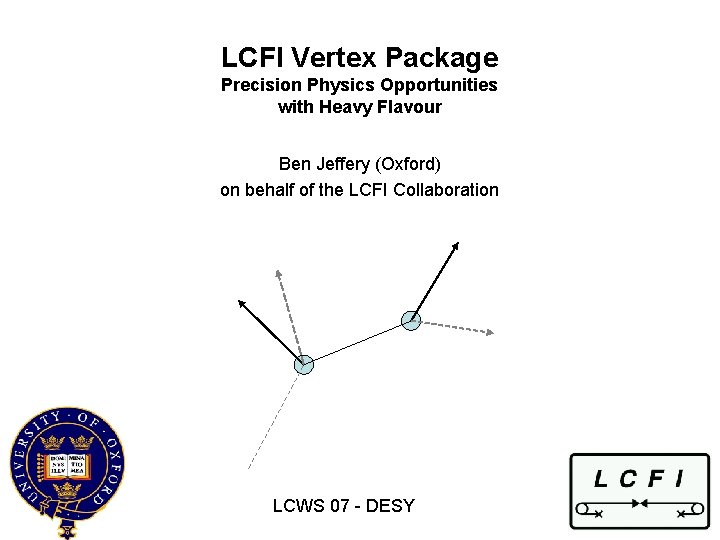
LCFI Vertex Package Precision Physics Opportunities with Heavy Flavour Ben Jeffery (Oxford) on behalf of the LCFI Collaboration LCWS 07 - DESY
Aims • • One of the key features of the ILC is to see events at the parton level with unprecedented accuracy. Includes the ability to distinguish heavy quark flavours and charge. How well can we do this? What are the best methods? What sensitivity does it bring? LCFI are developing tools for investigating these issues in a modern full simulation and reconstruction framework. Key to heavy flavour is the measurement of secondary vertices 2
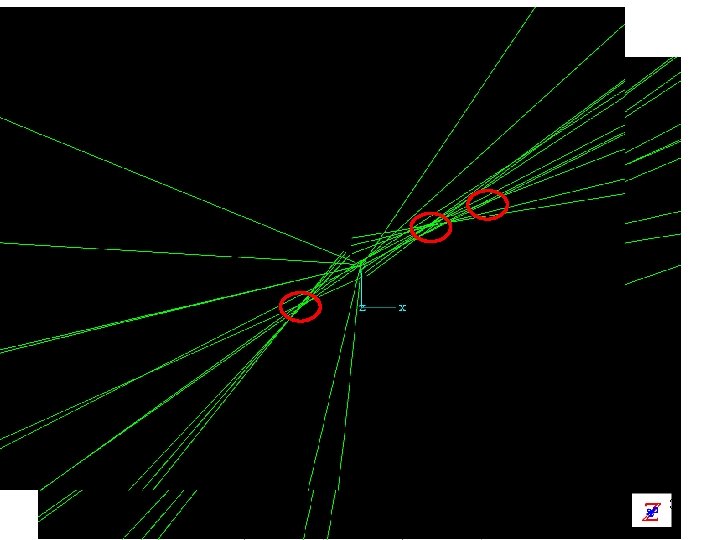
The Vertex Detector 3
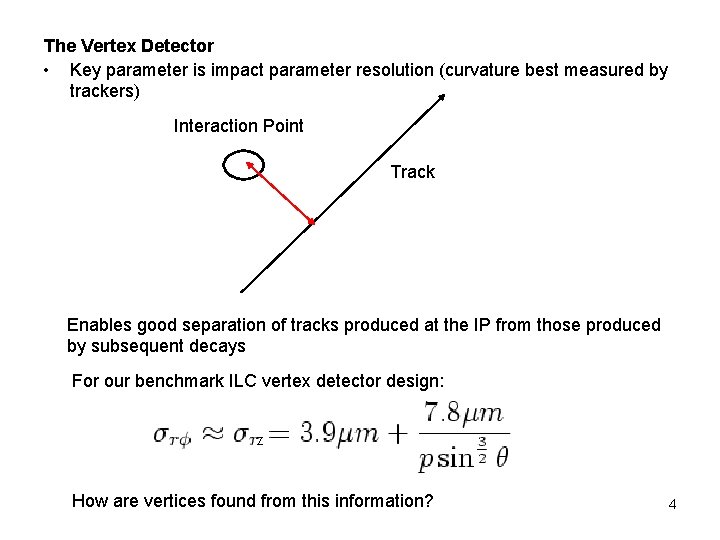
The Vertex Detector • Key parameter is impact parameter resolution (curvature best measured by trackers) Interaction Point Track Enables good separation of tracks produced at the IP from those produced by subsequent decays For our benchmark ILC vertex detector design: z How are vertices found from this information? 4
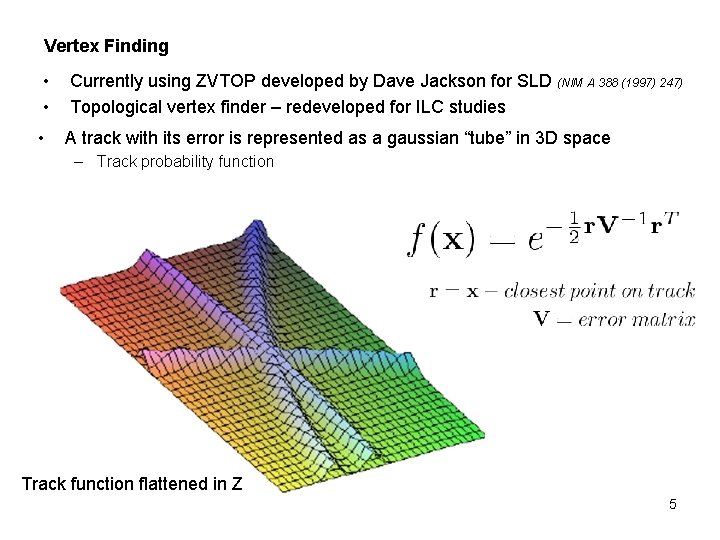
Vertex Finding • • Currently using ZVTOP developed by Dave Jackson for SLD (NIM A 388 (1997) 247) Topological vertex finder – redeveloped for ILC studies • A track with its error is represented as a gaussian “tube” in 3 D space – Track probability function Track function flattened in Z 5
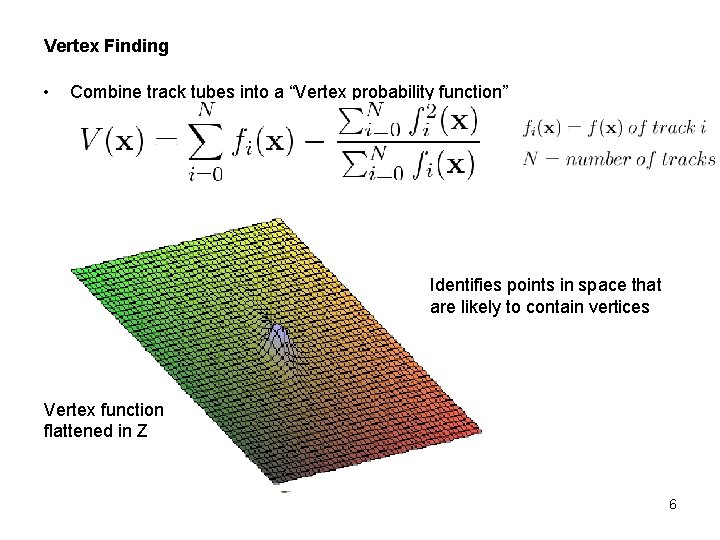
Vertex Finding • Combine track tubes into a “Vertex probability function” Identifies points in space that are likely to contain vertices Vertex function flattened in Z 6
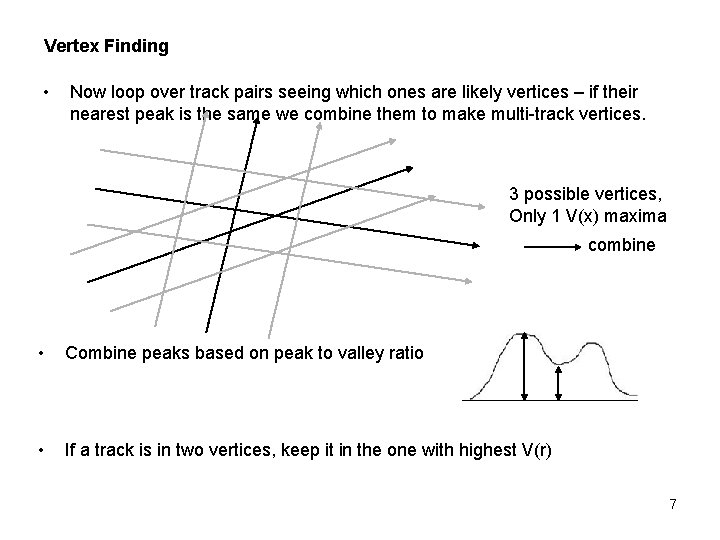
Vertex Finding • Now loop over track pairs seeing which ones are likely vertices – if their nearest peak is the same we combine them to make multi-track vertices. 3 possible vertices, Only 1 V(x) maxima combine • Combine peaks based on peak to valley ratio • If a track is in two vertices, keep it in the one with highest V(r) 7
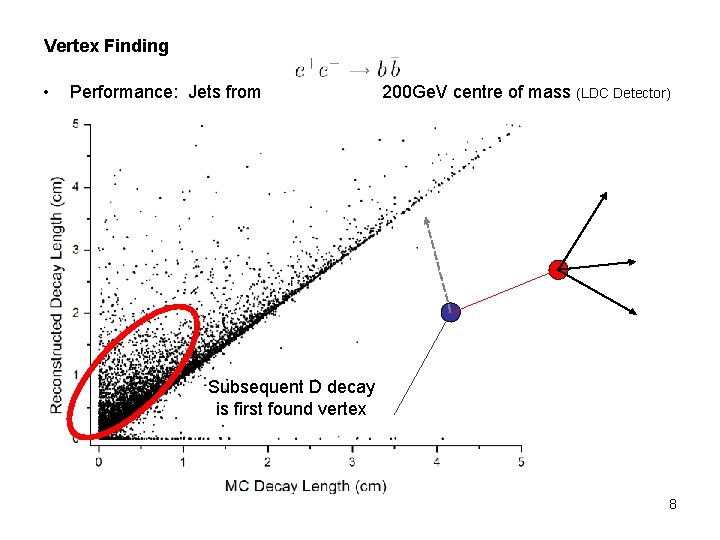
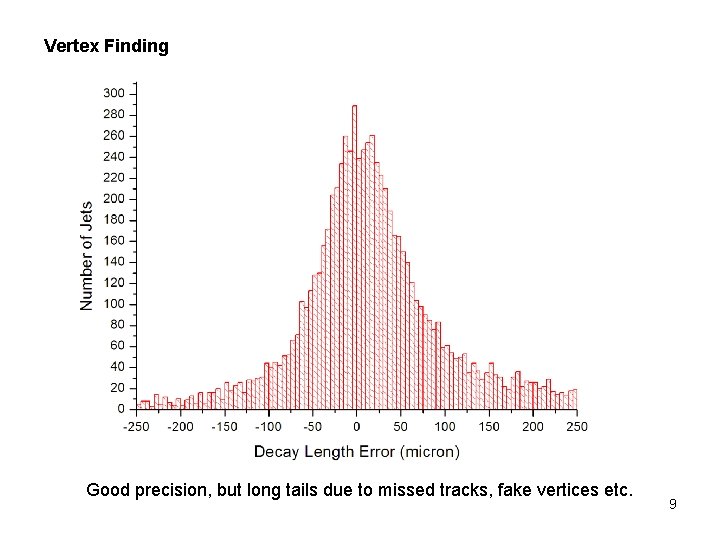
Vertex Finding • Performance: Jets from 200 Ge. V centre of mass (LDC Detector) Subsequent D decay is first found vertex 8
Vertex Finding Good precision, but long tails due to missed tracks, fake vertices etc. 9
Flavour Tagging • • Vertex information can be used to determine the quark flavour of hadronic jets. Able to tag jets as light quark (uds) c or b • All the properties of the vertices are useful : – Position (with error) Decay length – Mass – Momentum – Track Multiplicity 10
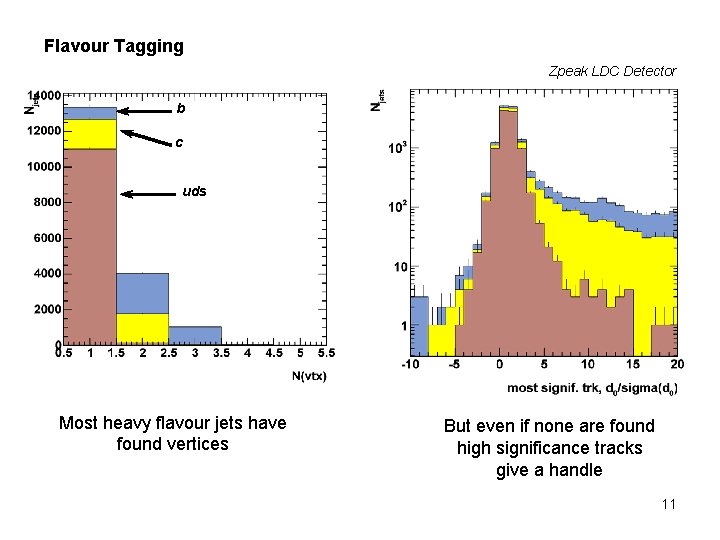
Flavour Tagging Zpeak LDC Detector b c uds Most heavy flavour jets have found vertices But even if none are found high significance tracks give a handle 11
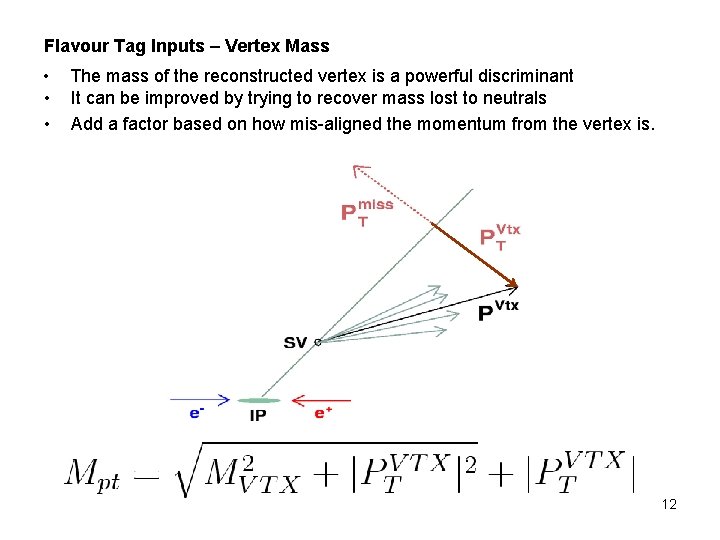
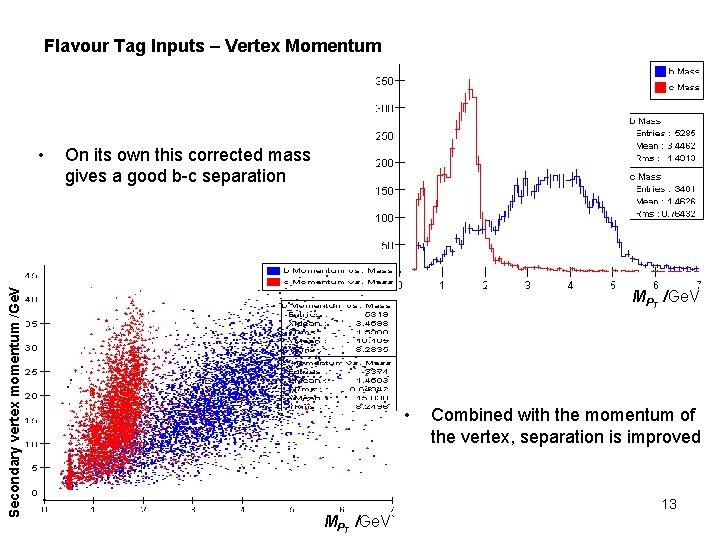
Flavour Tag Inputs – Vertex Mass • • • The mass of the reconstructed vertex is a powerful discriminant It can be improved by trying to recover mass lost to neutrals Add a factor based on how mis-aligned the momentum from the vertex is. 12
Flavour Tag Inputs – Vertex Momentum Secondary vertex momentum /Ge. V • On its own this corrected mass gives a good b-c separation MPT /Ge. V • Combined with the momentum of the vertex, separation is improved 13 MPT /Ge. V`
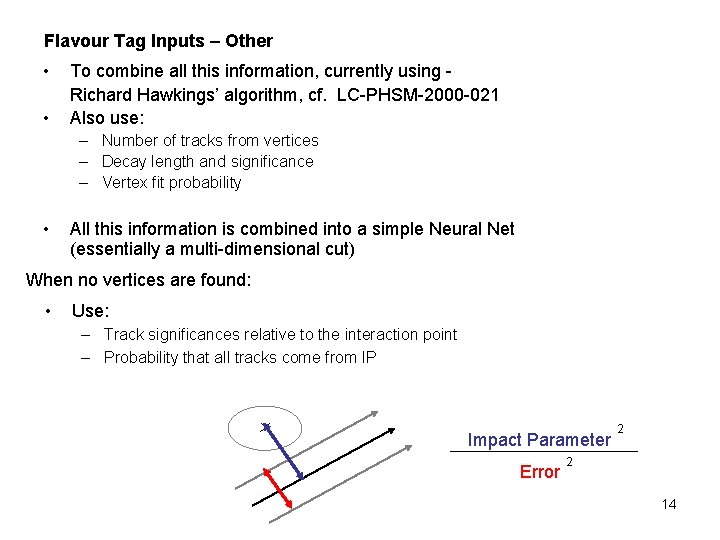
Flavour Tag Inputs – Other • • To combine all this information, currently using Richard Hawkings’ algorithm, cf. LC-PHSM-2000 -021 Also use: – Number of tracks from vertices – Decay length and significance – Vertex fit probability • All this information is combined into a simple Neural Net (essentially a multi-dimensional cut) When no vertices are found: • Use: – Track significances relative to the interaction point – Probability that all tracks come from IP Impact Parameter Error 2 2 14
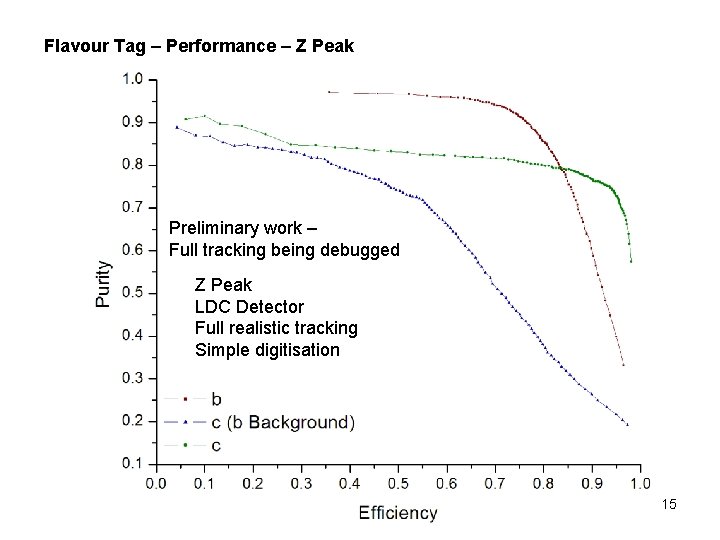
Flavour Tag – Performance – Z Peak Varying Neural Net Cut Preliminary work – Full tracking being debugged Z Peak LDC Detector Full realistic tracking Simple digitisation 15
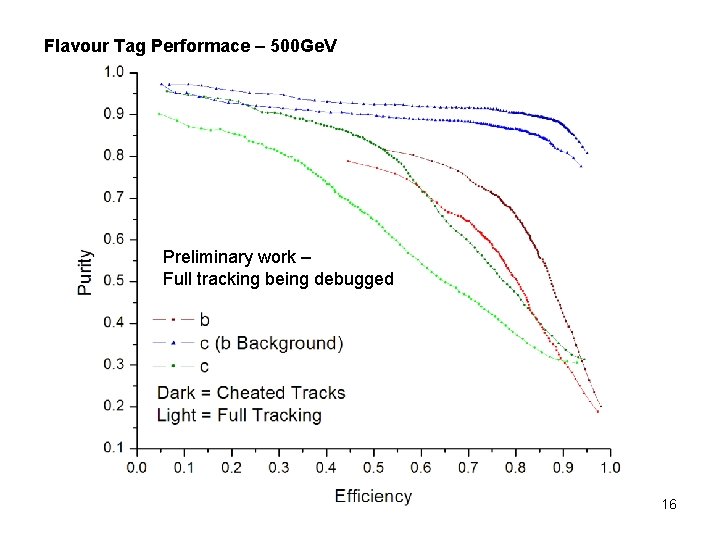
Flavour Tag Performace – 500 Ge. V Preliminary work – Full tracking being debugged 16
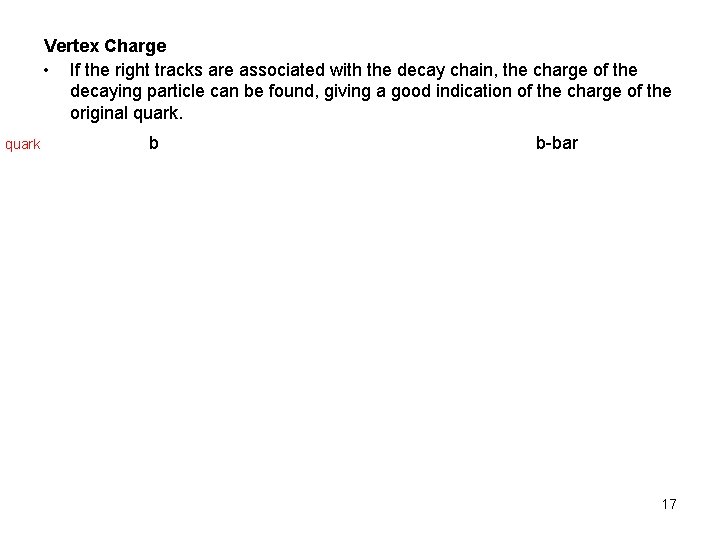
Vertex Charge • If the right tracks are associated with the decay chain, the charge of the decaying particle can be found, giving a good indication of the charge of the original quark. b quark b-bar 0. 4 hadron 0. 6 B- 0. 6 B 0 0. 4 B 0 -bar B+ vtx charge X-- X- X 0 X+ X++ Interpretation b Neutral vertices need a different technique – charge dipole b-bar 17
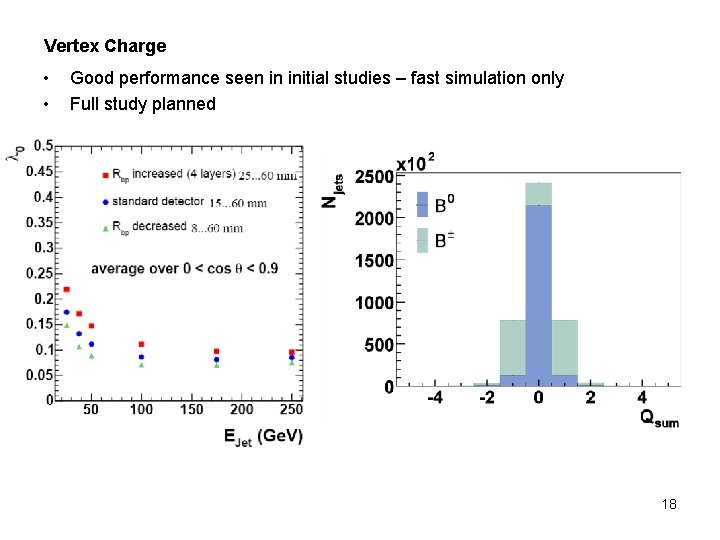
Vertex Charge • • Good performance seen in initial studies – fast simulation only Full study planned 18
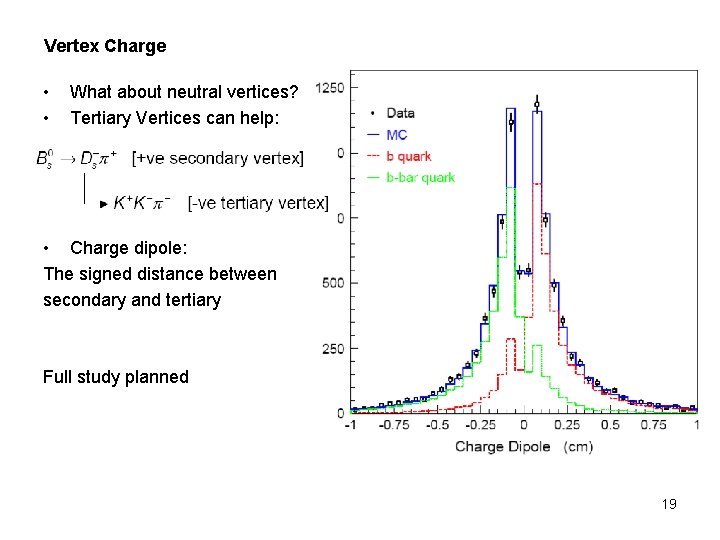
Vertex Charge • • What about neutral vertices? Tertiary Vertices can help: • Charge dipole: The signed distance between secondary and tertiary Full study planned 19
Applications • The tools to study the use and performance of this information in a full simulation environment were recently released to the ILC community. • The LCFI Vertex Package • • 2 Vertexing algorithms, full flavour tag and vertex charge http: //www-flc. desy. de/ilcsoftware/LCFIVertex/ • Being able to reconstruct the flavour and charge of jets with high efficiency and purity is a useful tool for physics: – – – Reducing backgrounds Reducing combinatory effects Unfolding cross-sections Top polarisation Asymmetry measurements 20
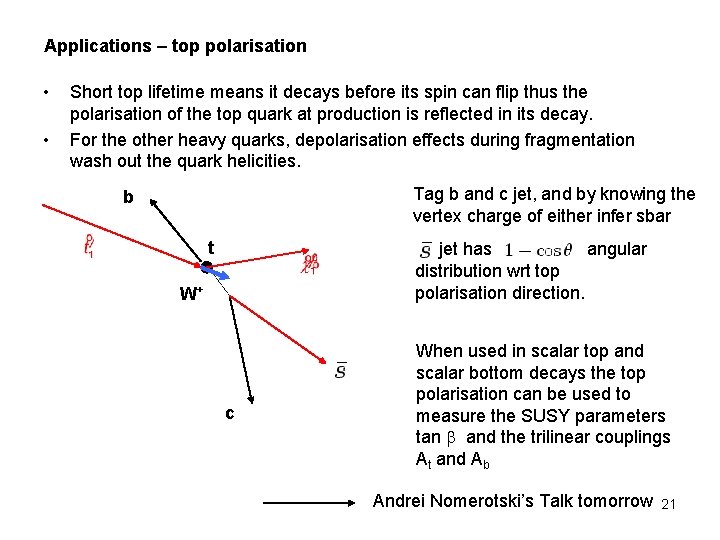
Applications – top polarisation • • Short top lifetime means it decays before its spin can flip thus the polarisation of the top quark at production is reflected in its decay. For the other heavy quarks, depolarisation effects during fragmentation wash out the quark helicities. Tag b and c jet, and by knowing the vertex charge of either infer sbar b t jet has angular distribution wrt top polarisation direction. W+ c When used in scalar top and scalar bottom decays the top polarisation can be used to measure the SUSY parameters tan b and the trilinear couplings At and Ab Andrei Nomerotski’s Talk tomorrow 21
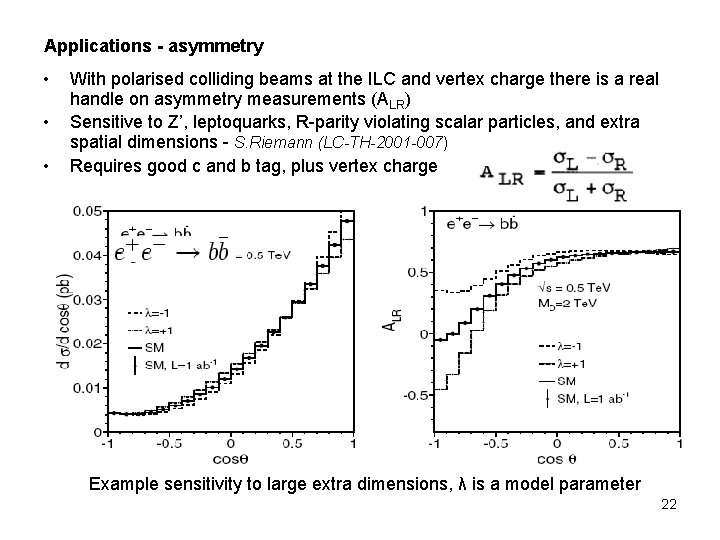
Applications - asymmetry • • • With polarised colliding beams at the ILC and vertex charge there is a real handle on asymmetry measurements (ALR) Sensitive to Z’, leptoquarks, R-parity violating scalar particles, and extra spatial dimensions - S. Riemann (LC-TH-2001 -007) Requires good c and b tag, plus vertex charge Example sensitivity to large extra dimensions, λ is a model parameter 22
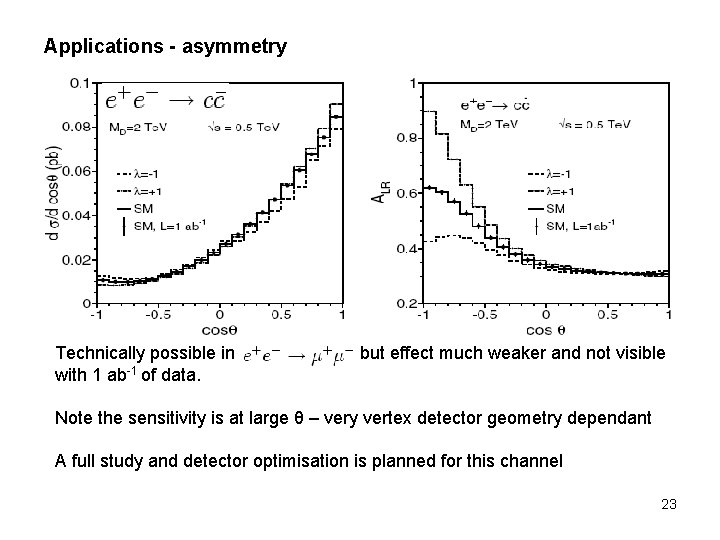
Applications - asymmetry Technically possible in with 1 ab-1 of data. but effect much weaker and not visible Note the sensitivity is at large θ – very vertex detector geometry dependant A full study and detector optimisation is planned for this channel 23
Future Developments and Summary • The software to perform complete realistic studies of physics channels requiring quark flavour and charge tagging in has been released to the community. • Several studies are planned • Flavour tagging and vertex charge are essential tools at the ILC! 24