
Languages and Compilers SProg og Oversttere Code Generation
![Code Generation with Code Templates Commands: execute [C 1 ; C 2] = execute](https://slidetodoc.com/presentation_image/f6fcd4e9cbd4584552224177f1a85925/image-10.jpg "Code Generation with Code Templates Commands: execute [C 1 ; C 2] = execute")
![Code Generation with Code Templates While command execute [while E do C] = JUMP](https://slidetodoc.com/presentation_image/f6fcd4e9cbd4584552224177f1a85925/image-11.jpg "Code Generation with Code Templates While command execute [while E do C] = JUMP")
![Developing a Code Generator “Visitor” execute [C 1 ; C 2] = execute[C 1]](https://slidetodoc.com/presentation_image/f6fcd4e9cbd4584552224177f1a85925/image-12.jpg "Developing a Code Generator “Visitor” execute [C 1 ; C 2] = execute[C 1]")
![Code Template: Global Procedure elaborate [proc I () ~ C] = JUMP g e:](https://slidetodoc.com/presentation_image/f6fcd4e9cbd4584552224177f1a85925/image-15.jpg "Code Template: Global Procedure elaborate [proc I () ~ C] = JUMP g e:")
- Slides: 16
Languages and Compilers (SProg og Oversættere) Code Generation 1
Code Generation – Describe the purpose of the code generator – Code templates – Back patching 2
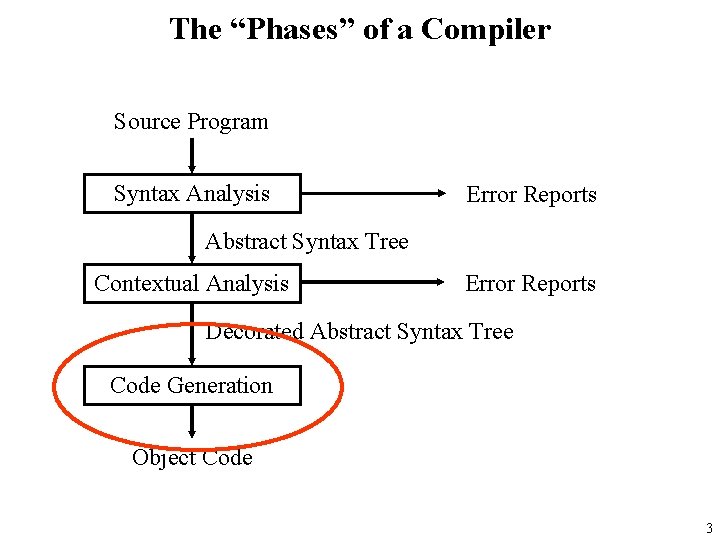
The “Phases” of a Compiler Source Program Syntax Analysis Error Reports Abstract Syntax Tree Contextual Analysis Error Reports Decorated Abstract Syntax Tree Code Generation Object Code 3
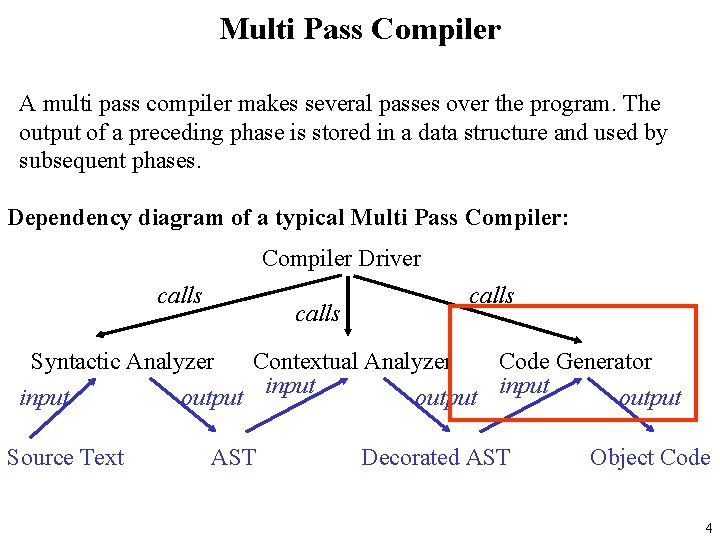
Multi Pass Compiler A multi pass compiler makes several passes over the program. The output of a preceding phase is stored in a data structure and used by subsequent phases. Dependency diagram of a typical Multi Pass Compiler: Compiler Driver calls Syntactic Analyzer Contextual Analyzer Code Generator input output Source Text AST Decorated AST Object Code 4
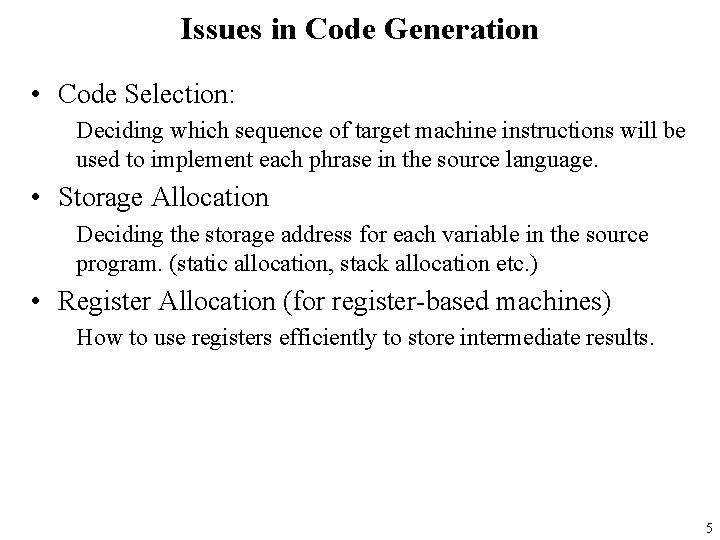
Issues in Code Generation • Code Selection: Deciding which sequence of target machine instructions will be used to implement each phrase in the source language. • Storage Allocation Deciding the storage address for each variable in the source program. (static allocation, stack allocation etc. ) • Register Allocation (for register-based machines) How to use registers efficiently to store intermediate results. 5
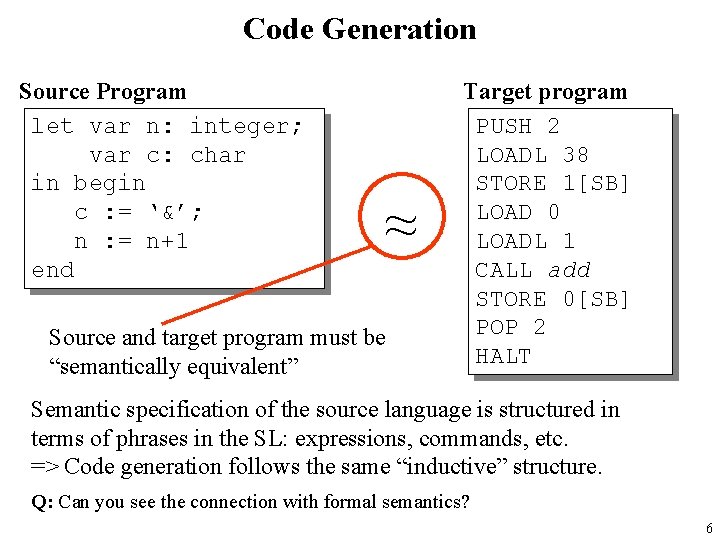
Code Generation Source Program let var n: integer; var c: char in begin c : = ‘&’; n : = n+1 end ~ Source and target program must be “semantically equivalent” Target program PUSH 2 LOADL 38 STORE 1[SB] LOAD 0 LOADL 1 CALL add STORE 0[SB] POP 2 HALT Semantic specification of the source language is structured in terms of phrases in the SL: expressions, commands, etc. => Code generation follows the same “inductive” structure. Q: Can you see the connection with formal semantics? 6
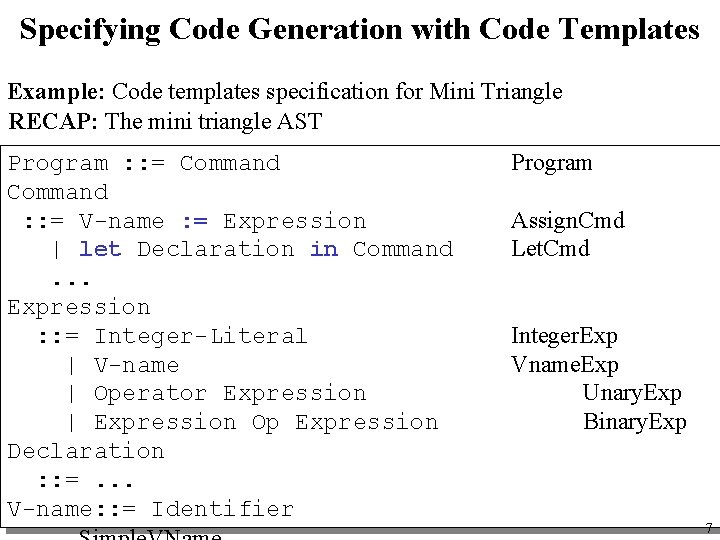
Specifying Code Generation with Code Templates Example: Code templates specification for Mini Triangle RECAP: The mini triangle AST Program : : = Command : : = V-name : = Expression | let Declaration in Command. . . Expression : : = Integer-Literal | V-name | Operator Expression | Expression Op Expression Declaration : : =. . . V-name: : = Identifier Program Assign. Cmd Let. Cmd Integer. Exp Vname. Exp Unary. Exp Binary. Exp 7
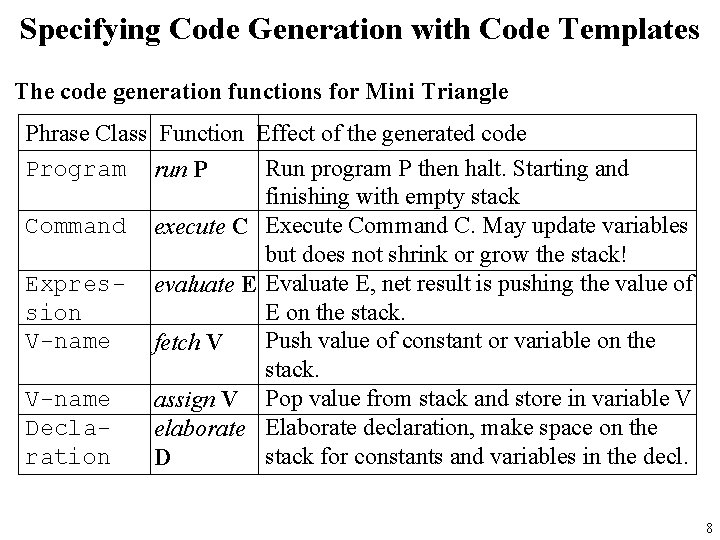
Specifying Code Generation with Code Templates The code generation functions for Mini Triangle Phrase Class Function Effect of the generated code Program run P Run program P then halt. Starting and finishing with empty stack Command execute C Execute Command C. May update variables but does not shrink or grow the stack! Expres- evaluate E Evaluate E, net result is pushing the value of sion E on the stack. V-name Push value of constant or variable on the fetch V stack. V-name assign V Pop value from stack and store in variable V Declaelaborate Elaborate declaration, make space on the ration stack for constants and variables in the decl. D 8
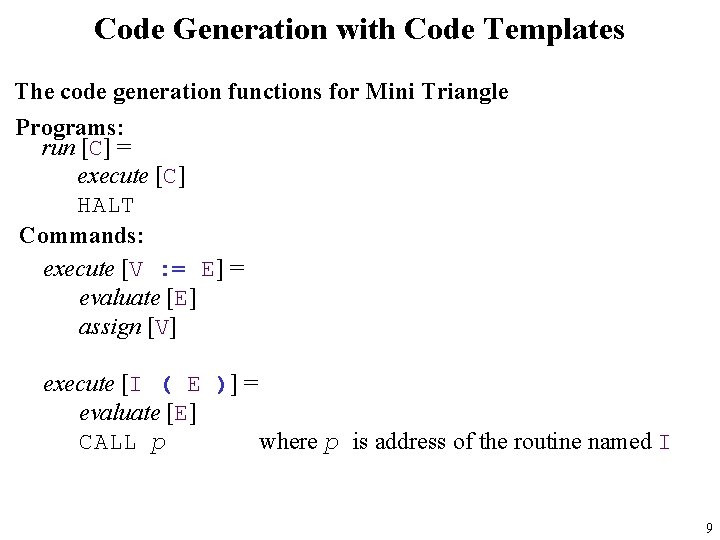
Code Generation with Code Templates The code generation functions for Mini Triangle Programs: run [C] = execute [C] HALT Commands: execute [V : = E] = evaluate [E] assign [V] execute [I ( E )] = evaluate [E] CALL p where p is address of the routine named I 9
Code Generation with Code Templates Commands: execute [C 1 ; C 2] = execute [C 1] execute [C 2] execute [if E then C 1 else C 2] = evaluate [E] E JUMPIF(0) g C 1 execute [C 1] JUMP h g: g: execute [C 2] C 2 h: h: 10
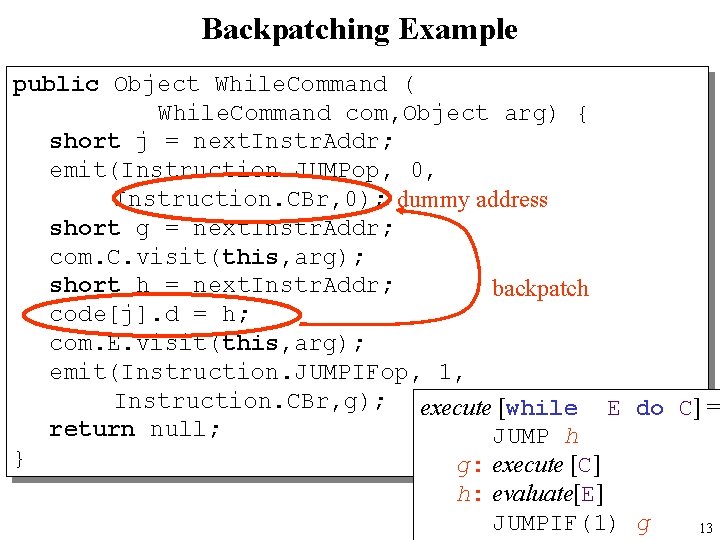
Code Generation with Code Templates While command execute [while E do C] = JUMP h g: execute [C] h: evaluate[E] JUMPIF(1) g C E 11
Developing a Code Generator “Visitor” execute [C 1 ; C 2] = execute[C 1] execute[C 2] public Object visit. Sequential. Command( Sequential. Command com, Object arg) { com. C 1. visit(this, arg); com. C 2. visit(this, arg); return null; } Let. Command, If. Command, While. Command => later. - Let. Command is more complex: memory allocation and addresses - If. Command While. Command: complications with jumps 12
Backpatching Example public Object While. Command ( While. Command com, Object arg) { short j = next. Instr. Addr; emit(Instruction. JUMPop, 0, Instruction. CBr, 0); dummy address short g = next. Instr. Addr; com. C. visit(this, arg); short h = next. Instr. Addr; backpatch code[j]. d = h; com. E. visit(this, arg); emit(Instruction. JUMPIFop, 1, Instruction. CBr, g); execute [while E do C] = return null; JUMP h } g: execute [C] h: evaluate[E] JUMPIF(1) g 13
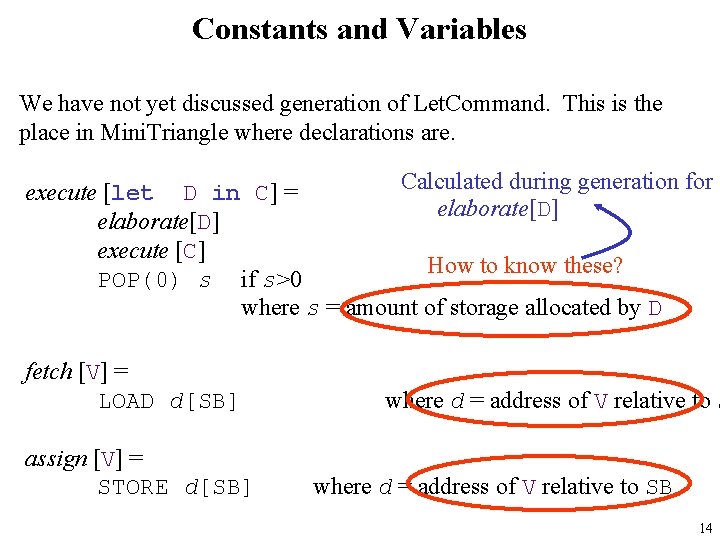
Constants and Variables We have not yet discussed generation of Let. Command. This is the place in Mini. Triangle where declarations are. Calculated during generation for execute [let D in C] = elaborate[D] execute [C] How to know these? POP(0) s if s>0 where s = amount of storage allocated by D fetch [V] = LOAD d[SB] assign [V] = STORE d[SB] where d = address of V relative to SB 14
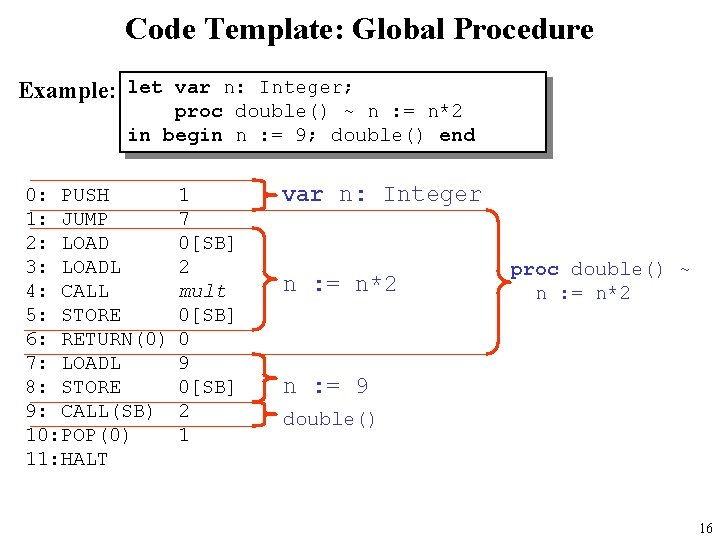
Code Template: Global Procedure elaborate [proc I () ~ C] = JUMP g e: execute [C] C RETURN(0) 0 g: execute [I ()] = CALL(SB) e 15
Code Template: Global Procedure Example: let var n: Integer; proc double() ~ n : = n*2 in begin n : = 9; double() end 0: PUSH 1: JUMP 2: LOAD 3: LOADL 4: CALL 5: STORE 6: RETURN(0) 7: LOADL 8: STORE 9: CALL(SB) 10: POP(0) 11: HALT 1 7 0[SB] 2 mult 0[SB] 0 9 0[SB] 2 1 var n: Integer n : = n*2 proc double() ~ n : = n*2 n : = 9 double() 16