
Languages and Compilers SProg og Oversttere Bent Thomsen
Languages and Compilers (SProg og Oversættere) Bent Thomsen Department of Computer Science Aalborg University
Lecturer • Bent Thomsen – Associate Professor (Database and Programming Technology Research Group) • Research interests: – – – Mobile and global systems Distributed systems Programming Language design and implementation Formal foundations Concurrency theory
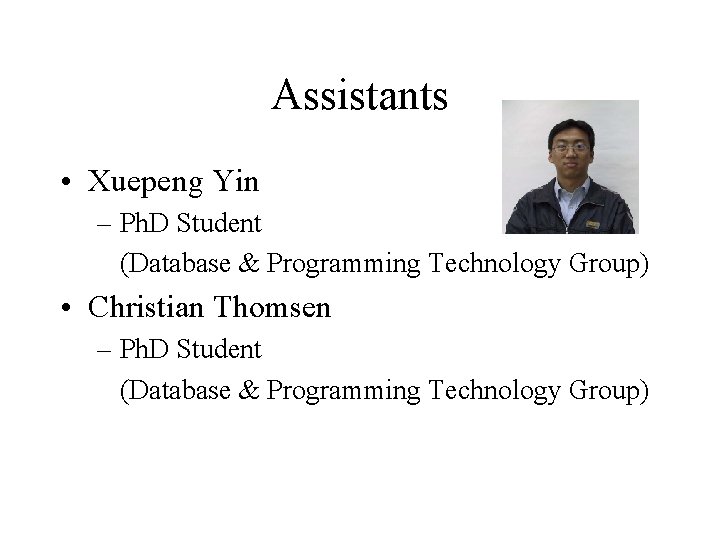
Assistants • Xuepeng Yin – Ph. D Student (Database & Programming Technology Group) • Christian Thomsen – Ph. D Student (Database & Programming Technology Group)

Programming Language Concepts • What is a programming language? • What are the types of programming languages? • How are programming languages implemented? • Why are there so many programming languages? • Does the world need new languages?
Well … "Some believe that we lacked the programming language to describe your perfect world" Agent Smith - The Matrix
Bill Gates casts Visual Studio. Net By Matt Berger February 13, 2002 11: 56 am PT SAN FRANCISCO -- Microsoft's Bill Gates cast his company's. Net initiative wide Wednesday, releasing the final version of the long-anticipated developer toolkit, Visual Studio. Net, as well as the underpinnings of its emerging Web-based development platform, called the. Net Framework. "When we started out we said this could be one of the biggest pieces of work we have to do on a tool, " Gates said of Microsoft's efforts to remodel its development tools already used by millions of Visual Basic and C++ developers to add new support for building Web-based applications. Straying from its typical two-year release cycle, the latest incarnation of Microsoft's application development environment has been in the making for more than three years. New features will allow developers to write applications using more than 20 different programming languages that can run on computers ranging from cell phones to servers and interact with applications written for virtually any computing platform, according to Microsoft.
Sun invites IBM, Cray to collaborate on high-end computer language By Rick Merritt, EE Times December 16, 2003 (8: 14 p. m. EST) URL: http: //www. eetimes. com/story/OEG 20031216 S 0031 MOUNTAIN VIEW, Calif. — Sun Microsystems is inviting competitors IBM Corp. and Cray Inc. to collaborate on defining a new computer language it claims could bolster performance and productivity for scientific and technical computing. The effort is part of a governmentsponsored program under which the three companies are competing to design a petascale-class computer by 2010.
Some new developments in programming langauegs in 2004 • • Java 5 (1. 5 or Tiger) Groovy C# 2. 0 and. Net 2. 0 Aspect Orented Programming – Aspect. J, Aspect. Net • Business Process Management – BPEL-J, PLEW 4 WS
What is this course about? • Programming Language Design – Concepts and Paradigms – Ideas and philosophy – Syntax and Semantics • Compiler Construction – Tools and Techniques – Implementations – The nuts and bolts
Curricula (Studie ordning) The purpose of the course is for the student to gain knowledge of important principles in programming languages and for the student to gain an understanding of techniques for describing and compiling programming languages.
What should you expect to get out of this course Ideas, principles and techniques to help you – Design your own programming language or design your own extensions to an existing language – Tools and techniques to implement a compiler or an interpreter – Lots of knowledge about programming
Something for everybody • Design – Trade offs – Technically feasible – Personal taste • • • User experience and feedback Lots of programming at different levels Clever algorithms Formal specification and proofs History – Compiler construction is the oldest CS discipline
Format • 15 sessions of 4 hours • Each Lecture will have 3 sessions of 30 min • 2 hours for exercises – Exercises from the previous lecture! – Individual exercises • Train specific techniques and methods – Group exercises • Help you discuss concepts, ideas, problems and solutions • Home reading Litterature
Literature • Concepts of Programming Languages (Sixth Edition), Robert W. Sebesta, Prentice Hall, ISBN 0 321 20458 1 • Programming Language Processors in Java – Compilers and Interpreters, David A Watt and Deryck F Brown, Prentice Hall, ISBN 0 -13 -025786 -9 • Some web references
Format (cont. ) • Lectures – Give overview and introduce concepts, … – Will not necessarily follow the books! • Literature – – In-depth knowledge A lot to read (two books and some web references) Browse before lecture Read after lecture, but before exercises • Exercises – Do the exercises – they all serve a purpose – Help you discuss ideas, concepts, designs, … (groups) – Train techniques and tools (sub-groups or individually) • Project – Put it all together
What is expected of you at the end? • One goal for this course is for you to be able to explain concepts, techniques, tools and theories to others – Your future colleagues, customers and boss – (especially me and the examiner at the exam ; -) • That implies you have to – Understand the concepts and theories – Know how to use the tools and techniques – Be able to put it all together • I. e. You have to know and know that you know
What you need to know beyond this course • • • Know about programming Know about machine architectures Know about operating systems Know about formal syntax and semantics So pay attention in those course!
Before we get started • • Tell me if you don’t understand Tell me if I am too fast or too slow Tell me if you are unhappy with the course Tell me before or after the lecture, during exercises, in my office, in the corridors, in the coffee room, by email, … • Don’t tell me through the semester group minutes
Programming Languages and Compilers are at the core of Computing All software is written in a programming language Learning about compilers will teach you a lot about the programming languages you already know. Compilers are big – therefore you need to apply all you knowledge of software engineering. The compiler is the program from which all other programs arise.
What is a Programming Languages • A programming language is a set of rules that provides a way of telling a computer what operations to perform. • A programming language is a set of rules for communicating an algorithm • A programming language provides a linguistic framework for describing computations
What is a Programming Language • English is a natural language. It has words, symbols and grammatical rules. • A programming language also has words, symbols and rules of grammar. • The grammatical rules are called syntax. • Each programming language has a different set of syntax rules.
Why Are There So Many Programming Languages • Why does some people speak French? • Programming languages have evolved over time as better ways have been developed to design them. – First programming languages were developed in the 1950 s – Since then thousands of languages have been developed • Different programming languages are designed for different types of programs.
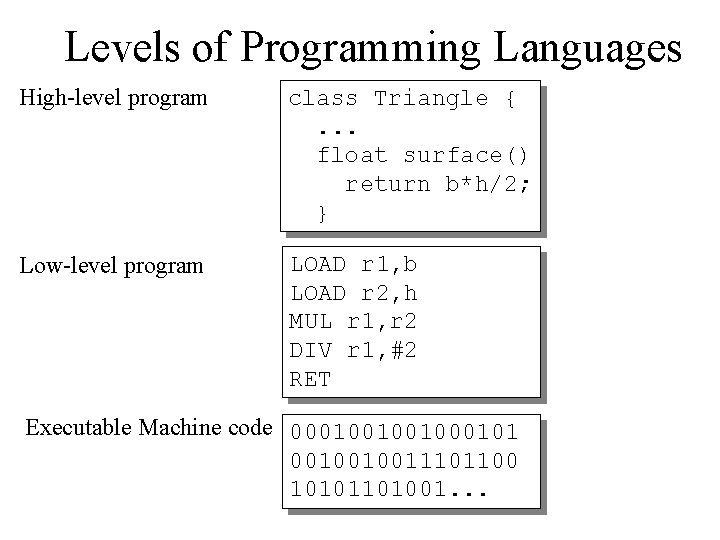
Levels of Programming Languages High-level program class Triangle {. . . float surface() return b*h/2; } Low-level program LOAD r 1, b LOAD r 2, h MUL r 1, r 2 DIV r 1, #2 RET Executable Machine code 000100100101 0010010011101100 10101101001. . .
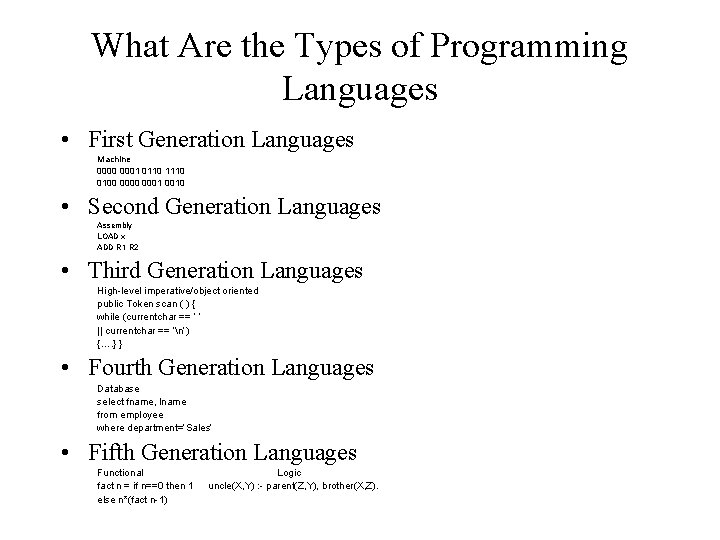
What Are the Types of Programming Languages • First Generation Languages Machine 0000 0001 0110 1110 0100 0001 0010 • Second Generation Languages Assembly LOAD x ADD R 1 R 2 • Third Generation Languages High-level imperative/object oriented public Token scan ( ) { while (currentchar == ‘ ’ || currentchar == ‘n’) {…. } } • Fourth Generation Languages Database select fname, lname from employee where department=‘Sales’ • Fifth Generation Languages Functional fact n = if n==0 then 1 else n*(fact n-1) Logic uncle(X, Y) : - parent(Z, Y), brother(X, Z).
First Generation Languages • Machine language – Operation code – such as addition or subtraction. – Operands – that identify the data to be processed. – Machine language is machine dependent as it is the only language the computer can understand. – Very efficient code but very difficult to write.
Second Generation Languages • Assembly languages – Symbolic operation codes replaced binary operation codes. – Assembly language programs needed to be “assembled” for execution by the computer. Each assembly language instruction is translated into one machine language instruction. – Very efficient code and easier to write. • (Virtual Machine languages) – Easy to interpret or Just-In-Time Compile
Third Generation Languages • Closer to English but included simple mathematical notation. – Programs written in source code which must be translated into machine language programs called object code. – The translation of source code to object code is accomplished by a machine language system program called a compiler.
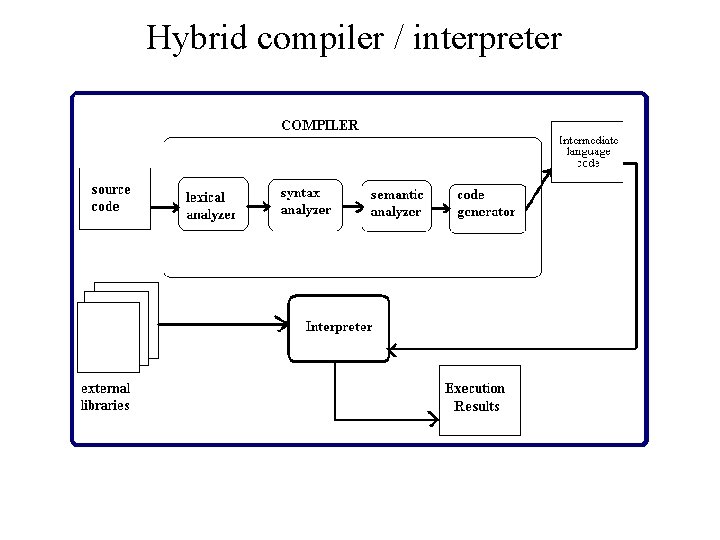
Third Generation Languages (cont’d. ) • Alternative to compilation is interpretation which is accomplished by a system program called an interpreter. • Common third generation languages – FORTRAN – COBOL – C and C++ – (Visual) Basic
Fourth Generation Languages • A high level language (4 GL) that requires fewer instructions to accomplish a task than a third generation language. • Used with databases – Query languages – Report generators – Forms designers – Application generators
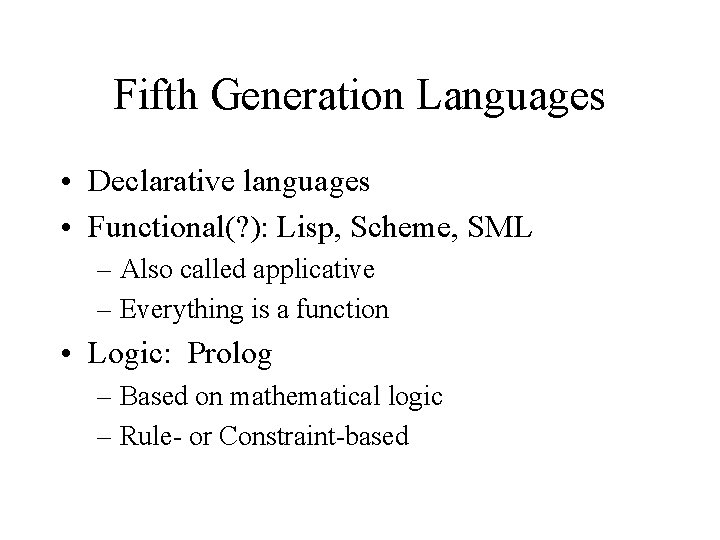
Fifth Generation Languages • Declarative languages • Functional(? ): Lisp, Scheme, SML – Also called applicative – Everything is a function • Logic: Prolog – Based on mathematical logic – Rule- or Constraint-based
Beyond Fifth Generation Languages • Some talk about – Agent Oriented Programming – Aspect Oriented Programming – Intentional Programming – Natural language programming • Maybe you will invent the next big language
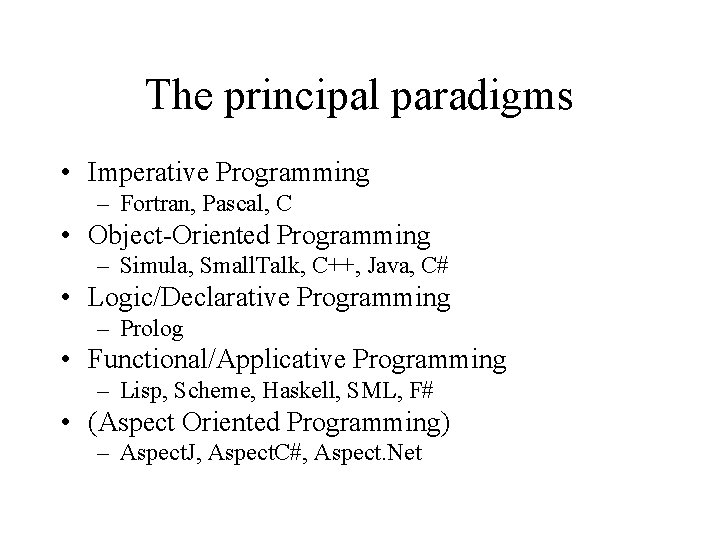
The principal paradigms • Imperative Programming – Fortran, Pascal, C • Object-Oriented Programming – Simula, Small. Talk, C++, Java, C# • Logic/Declarative Programming – Prolog • Functional/Applicative Programming – Lisp, Scheme, Haskell, SML, F# • (Aspect Oriented Programming) – Aspect. J, Aspect. C#, Aspect. Net
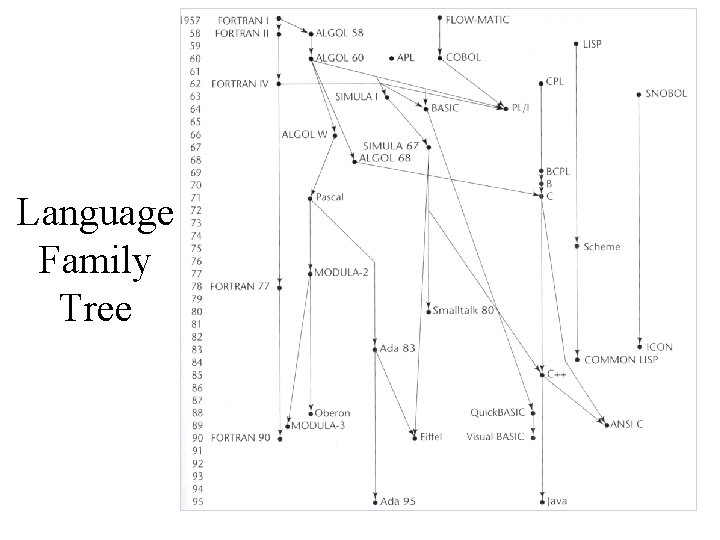
Language Family Tree
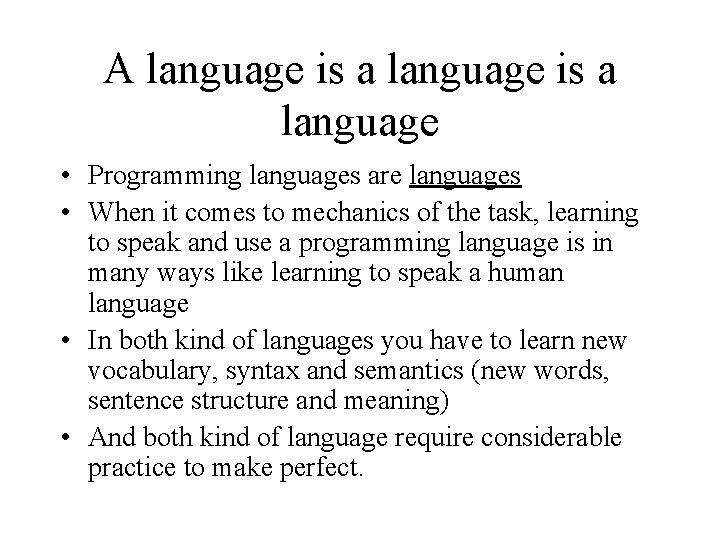
A language is a language • Programming languages are languages • When it comes to mechanics of the task, learning to speak and use a programming language is in many ways like learning to speak a human language • In both kind of languages you have to learn new vocabulary, syntax and semantics (new words, sentence structure and meaning) • And both kind of language require considerable practice to make perfect.
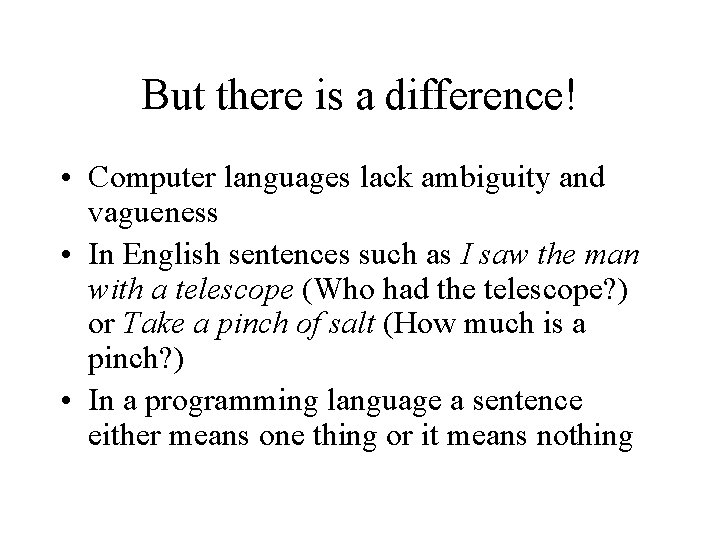
But there is a difference! • Computer languages lack ambiguity and vagueness • In English sentences such as I saw the man with a telescope (Who had the telescope? ) or Take a pinch of salt (How much is a pinch? ) • In a programming language a sentence either means one thing or it means nothing
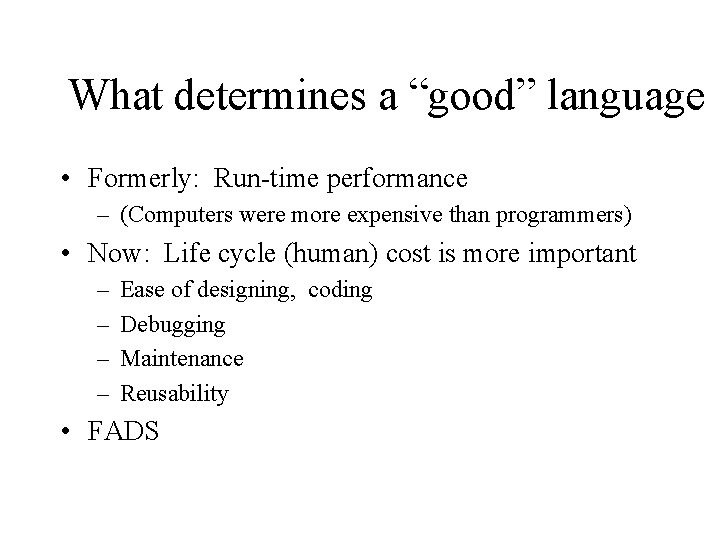
What determines a “good” language • Formerly: Run-time performance – (Computers were more expensive than programmers) • Now: Life cycle (human) cost is more important – – Ease of designing, coding Debugging Maintenance Reusability • FADS
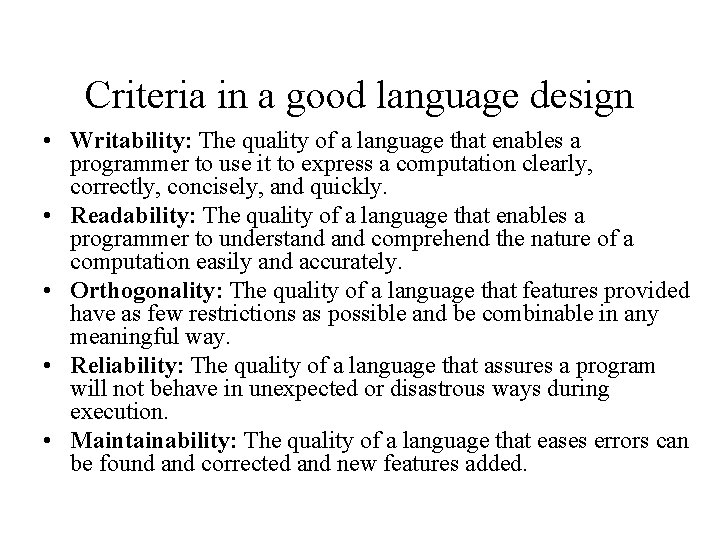
Criteria in a good language design • Writability: The quality of a language that enables a programmer to use it to express a computation clearly, correctly, concisely, and quickly. • Readability: The quality of a language that enables a programmer to understand comprehend the nature of a computation easily and accurately. • Orthogonality: The quality of a language that features provided have as few restrictions as possible and be combinable in any meaningful way. • Reliability: The quality of a language that assures a program will not behave in unexpected or disastrous ways during execution. • Maintainability: The quality of a language that eases errors can be found and corrected and new features added.
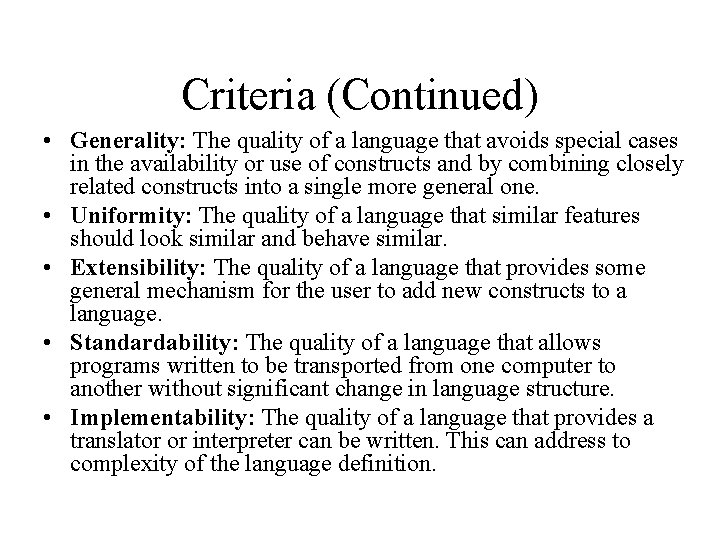
Criteria (Continued) • Generality: The quality of a language that avoids special cases in the availability or use of constructs and by combining closely related constructs into a single more general one. • Uniformity: The quality of a language that similar features should look similar and behave similar. • Extensibility: The quality of a language that provides some general mechanism for the user to add new constructs to a language. • Standardability: The quality of a language that allows programs written to be transported from one computer to another without significant change in language structure. • Implementability: The quality of a language that provides a translator or interpreter can be written. This can address to complexity of the language definition.
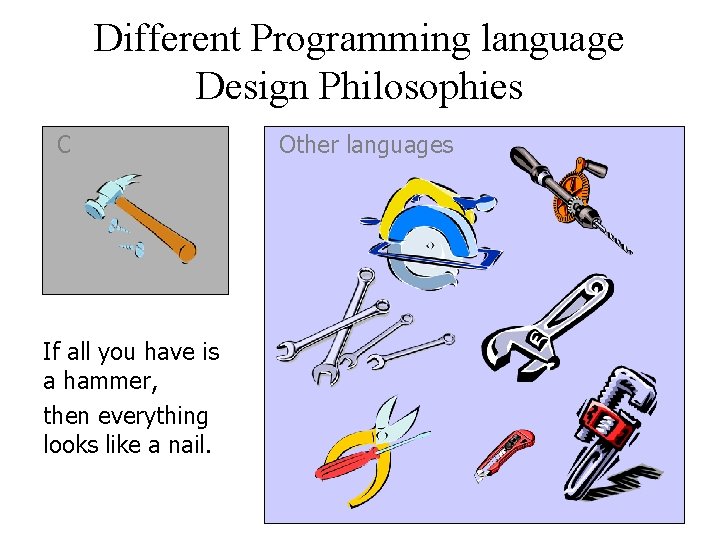
Different Programming language Design Philosophies C If all you have is a hammer, then everything looks like a nail. Other languages
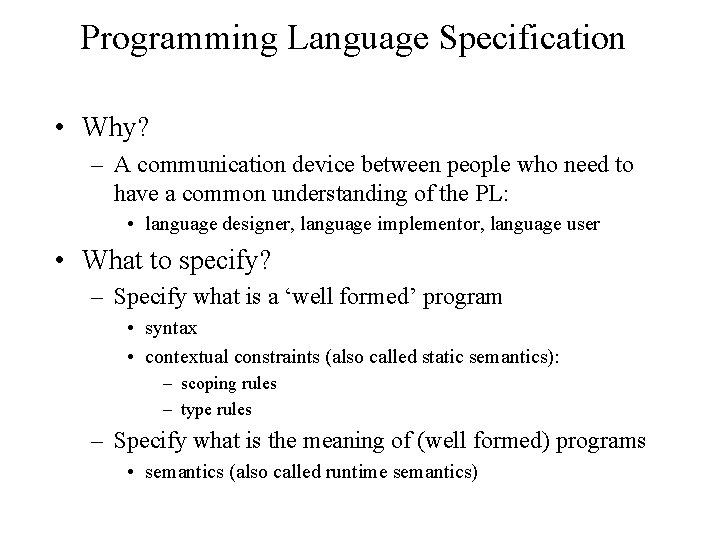
Programming Language Specification • Why? – A communication device between people who need to have a common understanding of the PL: • language designer, language implementor, language user • What to specify? – Specify what is a ‘well formed’ program • syntax • contextual constraints (also called static semantics): – scoping rules – type rules – Specify what is the meaning of (well formed) programs • semantics (also called runtime semantics)
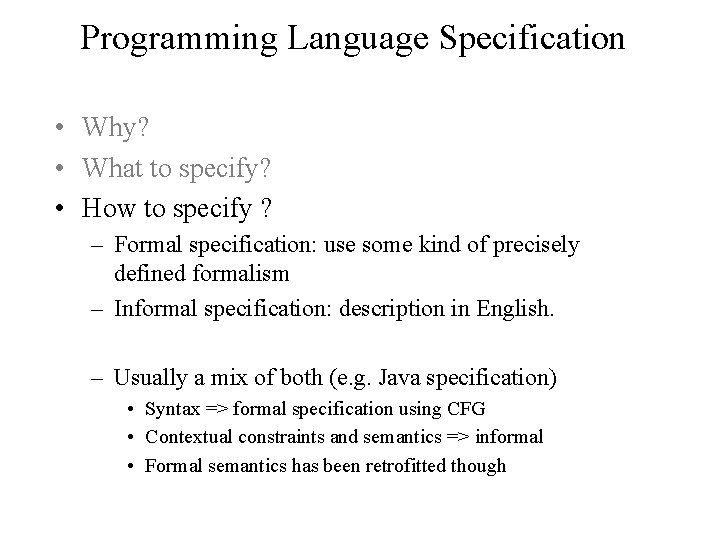
Programming Language Specification • Why? • What to specify? • How to specify ? – Formal specification: use some kind of precisely defined formalism – Informal specification: description in English. – Usually a mix of both (e. g. Java specification) • Syntax => formal specification using CFG • Contextual constraints and semantics => informal • Formal semantics has been retrofitted though
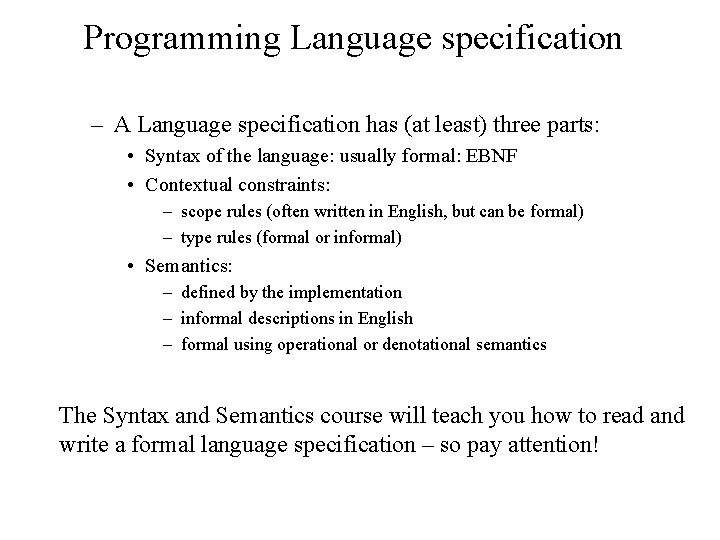
Programming Language specification – A Language specification has (at least) three parts: • Syntax of the language: usually formal: EBNF • Contextual constraints: – scope rules (often written in English, but can be formal) – type rules (formal or informal) • Semantics: – defined by the implementation – informal descriptions in English – formal using operational or denotational semantics The Syntax and Semantics course will teach you how to read and write a formal language specification – so pay attention!
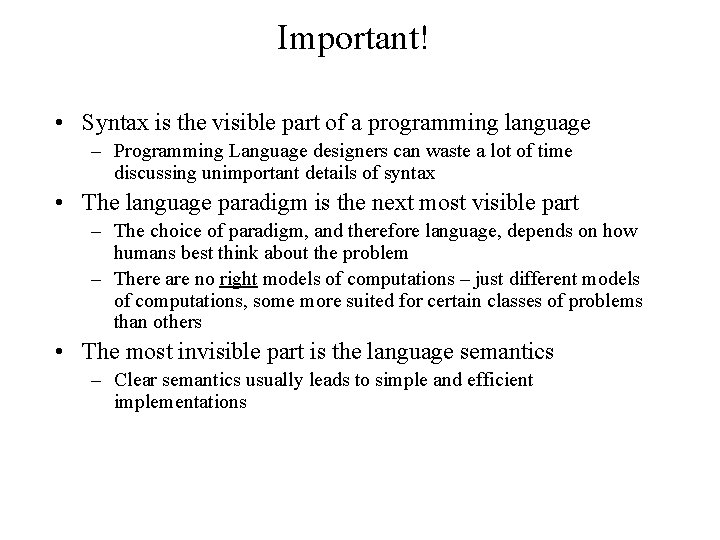
Important! • Syntax is the visible part of a programming language – Programming Language designers can waste a lot of time discussing unimportant details of syntax • The language paradigm is the next most visible part – The choice of paradigm, and therefore language, depends on how humans best think about the problem – There are no right models of computations – just different models of computations, some more suited for certain classes of problems than others • The most invisible part is the language semantics – Clear semantics usually leads to simple and efficient implementations
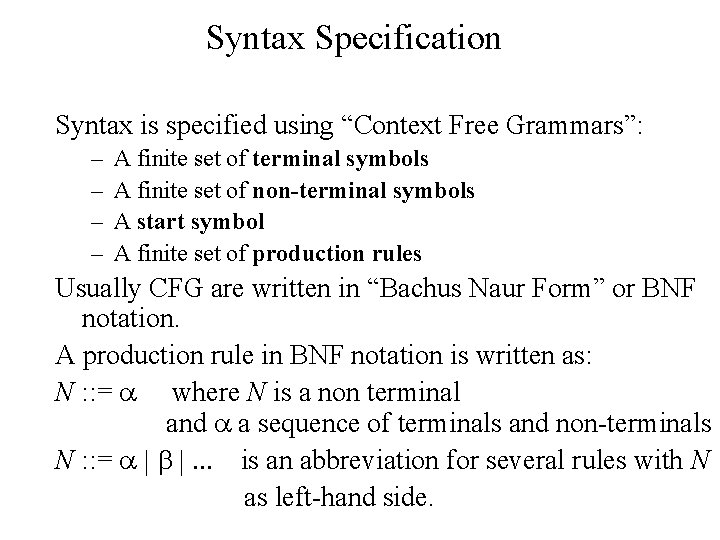
Syntax Specification Syntax is specified using “Context Free Grammars”: – – A finite set of terminal symbols A finite set of non-terminal symbols A start symbol A finite set of production rules Usually CFG are written in “Bachus Naur Form” or BNF notation. A production rule in BNF notation is written as: N : : = a where N is a non terminal and a a sequence of terminals and non-terminals N : : = a | b |. . . is an abbreviation for several rules with N as left-hand side.
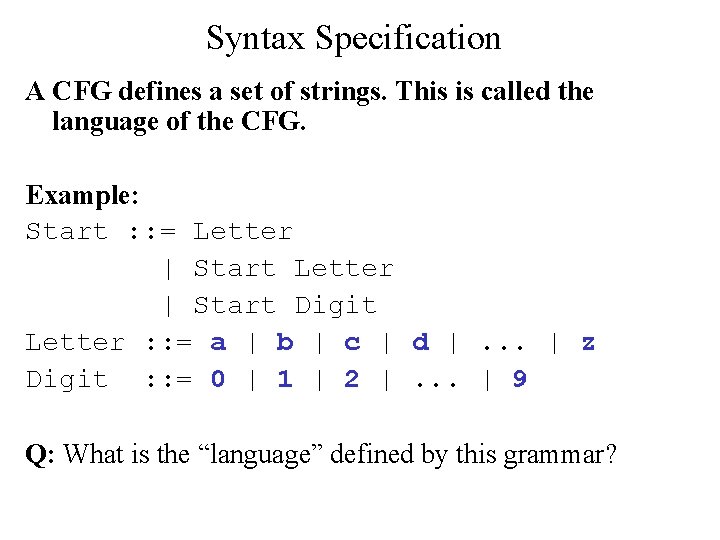
Syntax Specification A CFG defines a set of strings. This is called the language of the CFG. Example: Start : : = Letter | Start Digit Letter : : = a | b | c | d |. . . | z Digit : : = 0 | 1 | 2 |. . . | 9 Q: What is the “language” defined by this grammar?
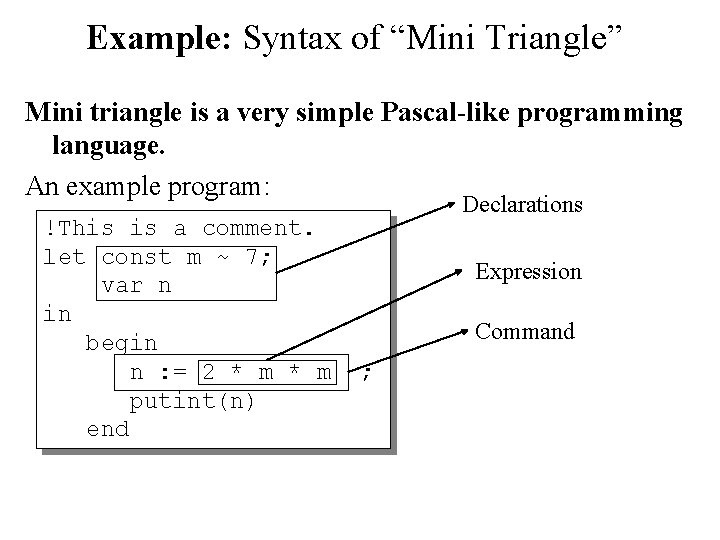
Example: Syntax of “Mini Triangle” Mini triangle is a very simple Pascal-like programming language. An example program: !This is a comment. let const m ~ 7; var n in begin n : = 2 * m putint(n) end Declarations Expression Command ;
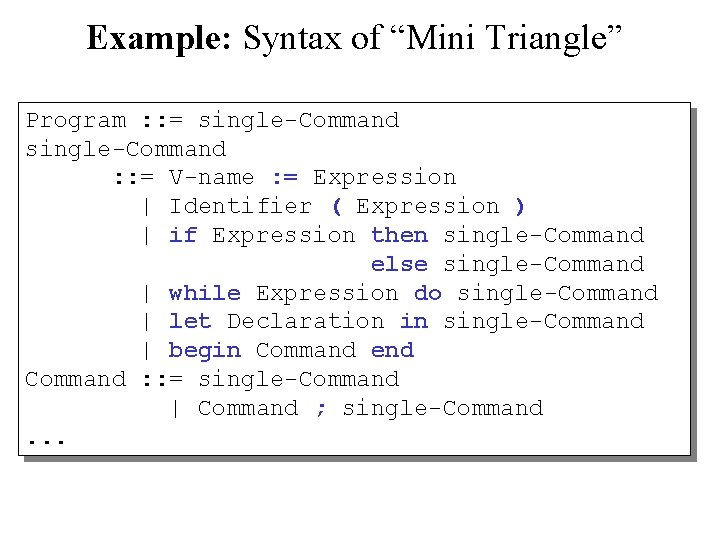
Example: Syntax of “Mini Triangle” Program : : = single-Command : : = V-name : = Expression | Identifier ( Expression ) | if Expression then single-Command else single-Command | while Expression do single-Command | let Declaration in single-Command | begin Command end Command : : = single-Command | Command ; single-Command. . .
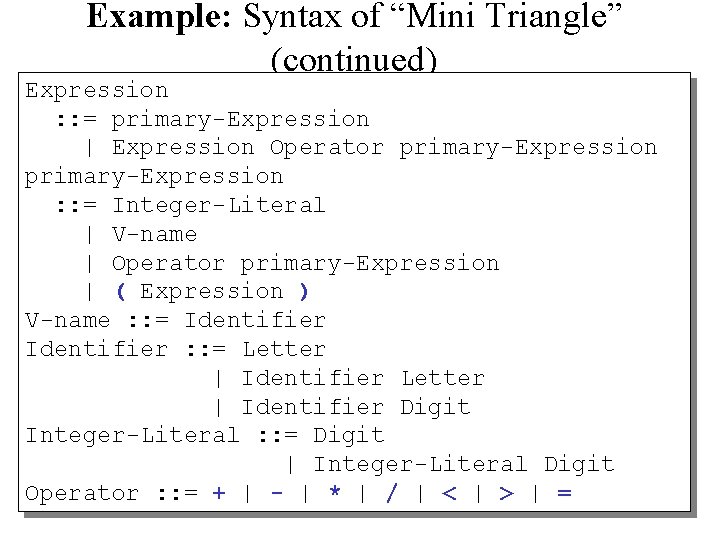
Example: Syntax of “Mini Triangle” (continued) Expression : : = primary-Expression | Expression Operator primary-Expression : : = Integer-Literal | V-name | Operator primary-Expression | ( Expression ) V-name : : = Identifier : : = Letter | Identifier Digit Integer-Literal : : = Digit | Integer-Literal Digit Operator : : = + | - | * | / | < | > | =
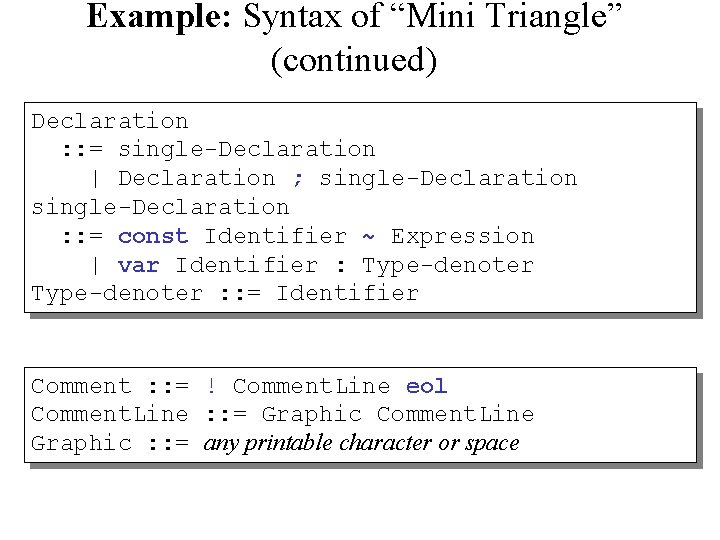
Example: Syntax of “Mini Triangle” (continued) Declaration : : = single-Declaration | Declaration ; single-Declaration : : = const Identifier ~ Expression | var Identifier : Type-denoter : : = Identifier Comment : : = ! Comment. Line eol Comment. Line : : = Graphic Comment. Line Graphic : : = any printable character or space
Syntax Trees A syntax tree is an ordered labeled tree such that: a) terminal nodes (leaf nodes) are labeled by terminal symbols b) non-terminal nodes (internal nodes) are labeled by non terminal symbols. c) each non-terminal node labeled by N has children X 1, X 2, . . . Xn (in this order) such that N : = X 1, X 2, . . . Xn is a production.
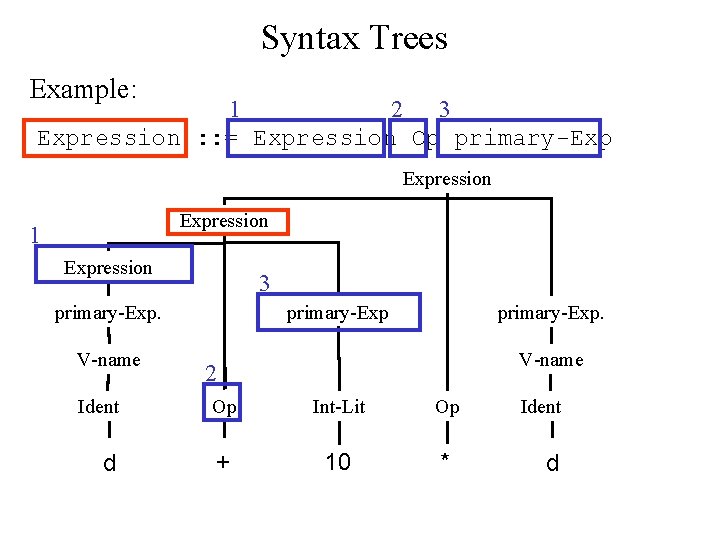
Syntax Trees Example: 1 2 3 Expression : : = Expression Op primary-Exp Expression 1 Expression 3 primary-Exp. V-name Ident d primary-Exp. V-name 2 Op Int-Lit Op + 10 * Ident d
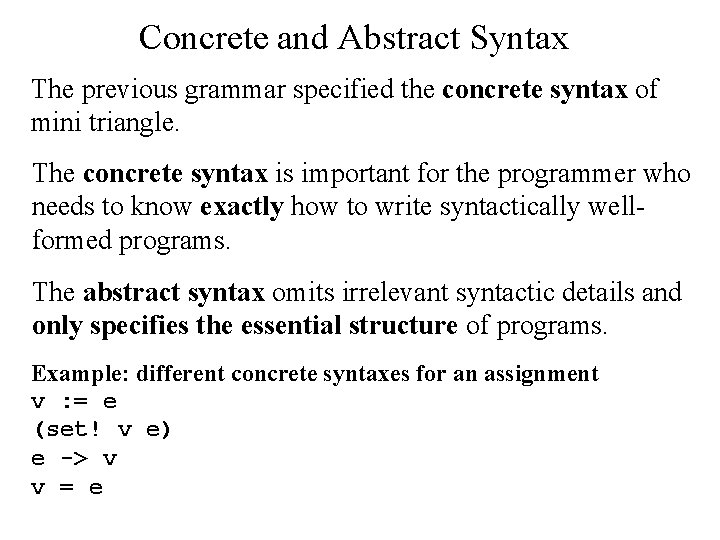
Concrete and Abstract Syntax The previous grammar specified the concrete syntax of mini triangle. The concrete syntax is important for the programmer who needs to know exactly how to write syntactically wellformed programs. The abstract syntax omits irrelevant syntactic details and only specifies the essential structure of programs. Example: different concrete syntaxes for an assignment v : = e (set! v e) e -> v v = e
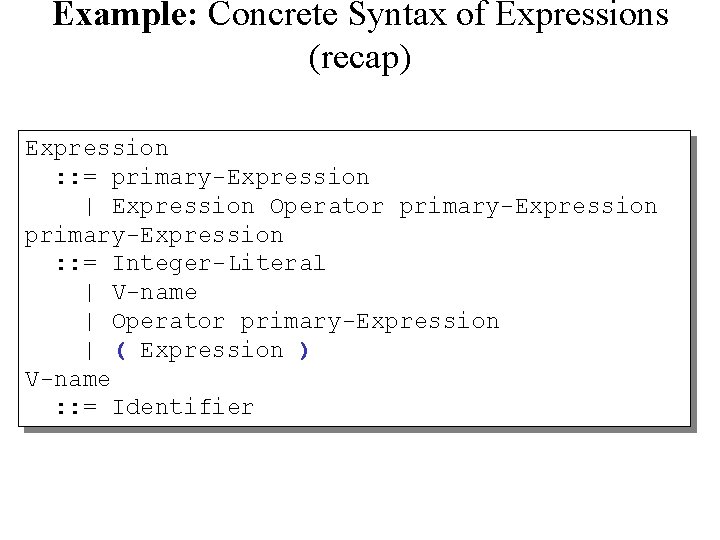
Example: Concrete Syntax of Expressions (recap) Expression : : = primary-Expression | Expression Operator primary-Expression : : = Integer-Literal | V-name | Operator primary-Expression | ( Expression ) V-name : : = Identifier
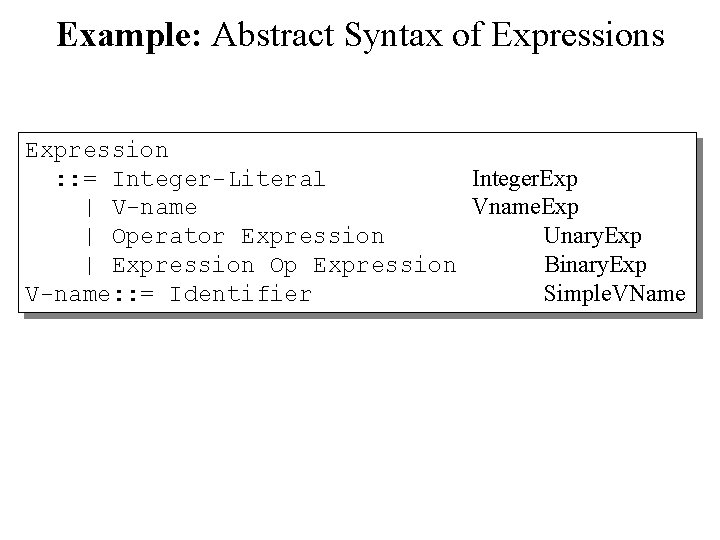
Example: Abstract Syntax of Expressions Expression : : = Integer-Literal Integer. Exp | V-name Vname. Exp | Operator Expression Unary. Exp | Expression Op Expression Binary. Exp V-name: : = Identifier Simple. VName
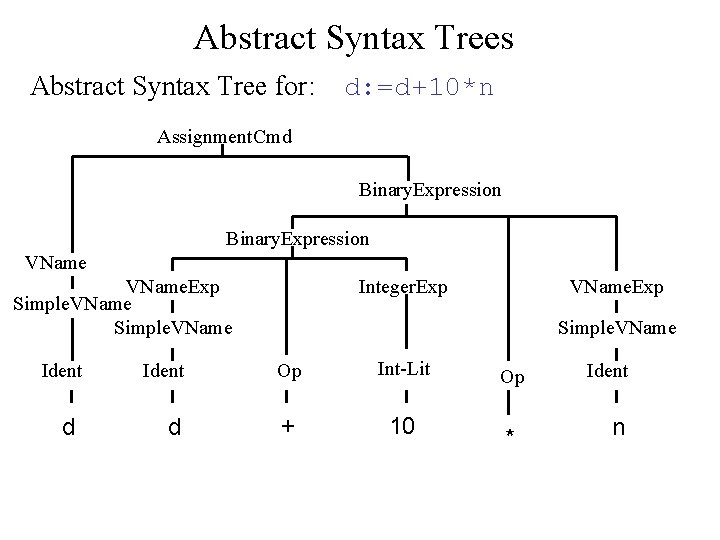
Abstract Syntax Trees Abstract Syntax Tree for: d: =d+10*n Assignment. Cmd Binary. Expression VName. Exp Simple. VName Ident d Integer. Exp VName. Exp Simple. VName Op Int-Lit + 10 Op * Ident n
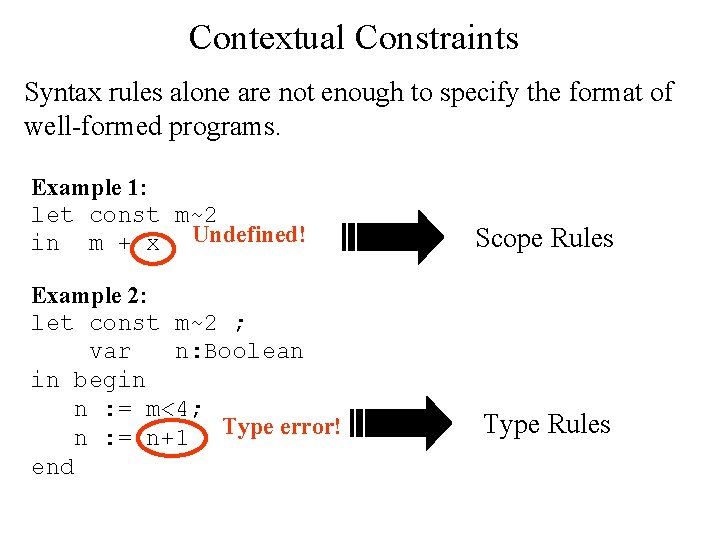
Contextual Constraints Syntax rules alone are not enough to specify the format of well-formed programs. Example 1: let const m~2 in m + x Undefined! Example 2: let const m~2 ; var n: Boolean in begin n : = m<4; n : = n+1 Type error! end Scope Rules Type Rules
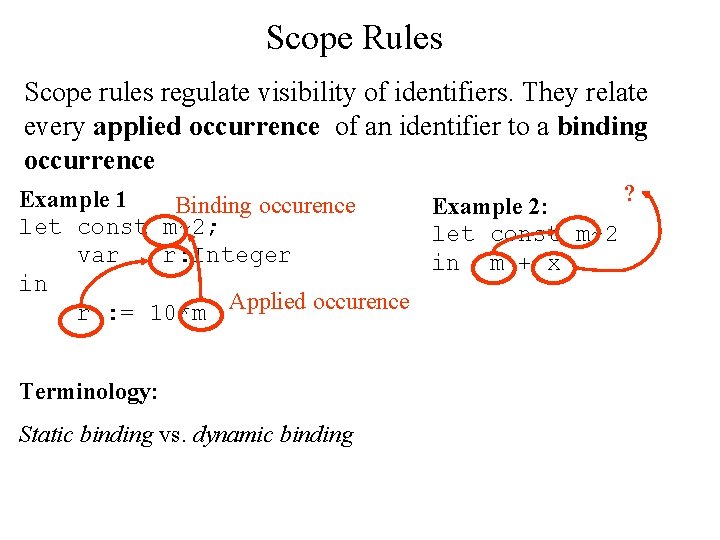
Scope Rules Scope rules regulate visibility of identifiers. They relate every applied occurrence of an identifier to a binding occurrence ? Example 1 Binding occurence Example 2: let const m~2; let const m~2 var r: Integer in m + x in r : = 10*m Applied occurence Terminology: Static binding vs. dynamic binding
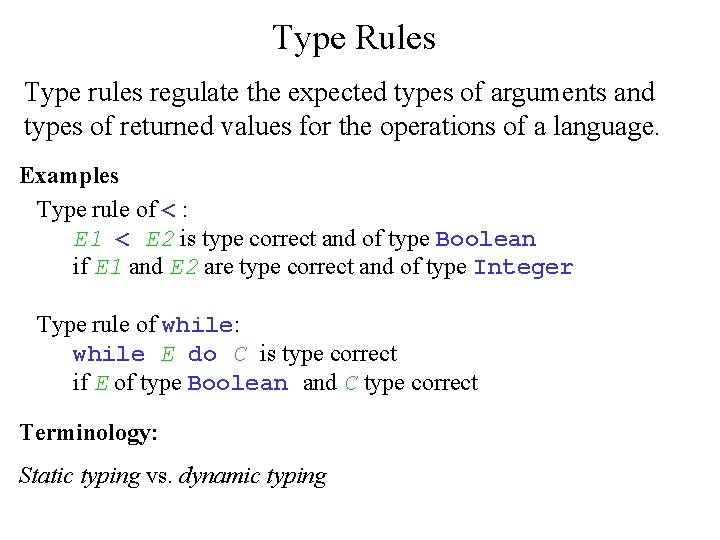
Type Rules Type rules regulate the expected types of arguments and types of returned values for the operations of a language. Examples Type rule of < : E 1 < E 2 is type correct and of type Boolean if E 1 and E 2 are type correct and of type Integer Type rule of while: while E do C is type correct if E of type Boolean and C type correct Terminology: Static typing vs. dynamic typing
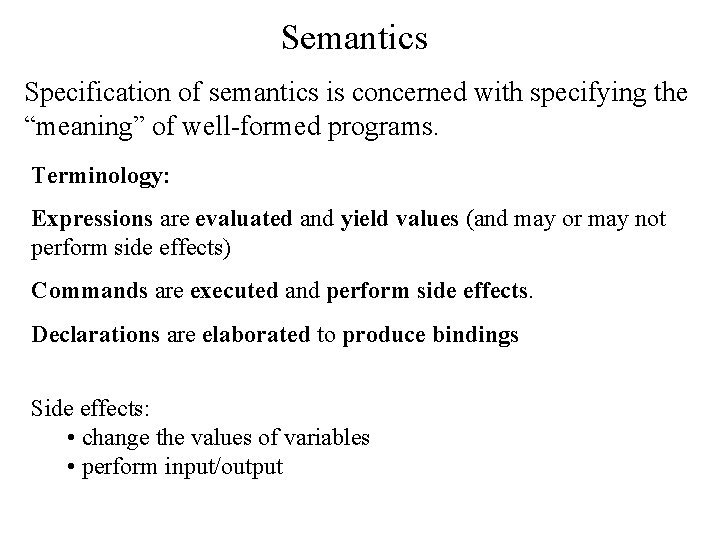
Semantics Specification of semantics is concerned with specifying the “meaning” of well-formed programs. Terminology: Expressions are evaluated and yield values (and may or may not perform side effects) Commands are executed and perform side effects. Declarations are elaborated to produce bindings Side effects: • change the values of variables • perform input/output
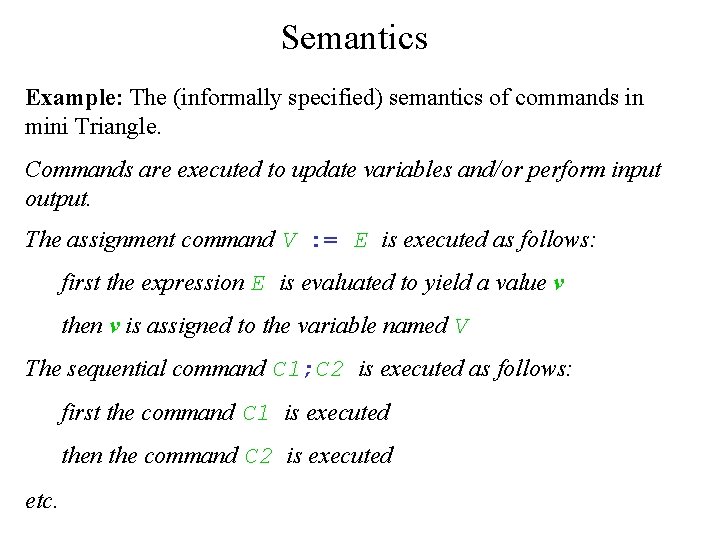
Semantics Example: The (informally specified) semantics of commands in mini Triangle. Commands are executed to update variables and/or perform input output. The assignment command V : = E is executed as follows: first the expression E is evaluated to yield a value v then v is assigned to the variable named V The sequential command C 1; C 2 is executed as follows: first the command C 1 is executed then the command C 2 is executed etc.
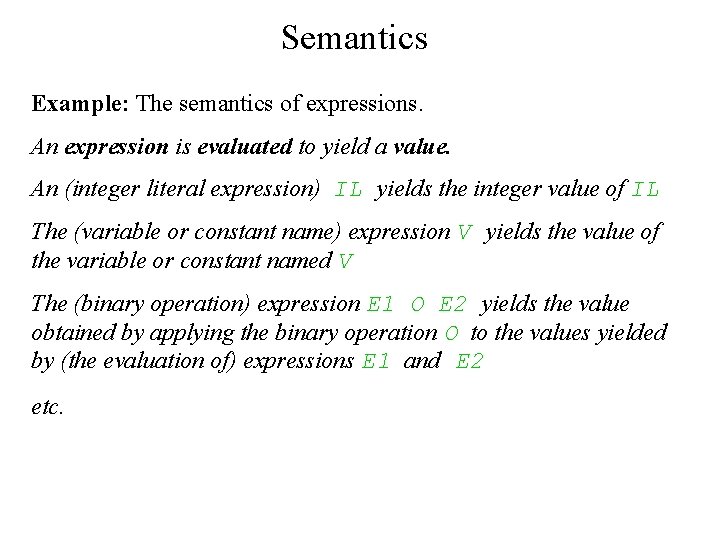
Semantics Example: The semantics of expressions. An expression is evaluated to yield a value. An (integer literal expression) IL yields the integer value of IL The (variable or constant name) expression V yields the value of the variable or constant named V The (binary operation) expression E 1 O E 2 yields the value obtained by applying the binary operation O to the values yielded by (the evaluation of) expressions E 1 and E 2 etc.
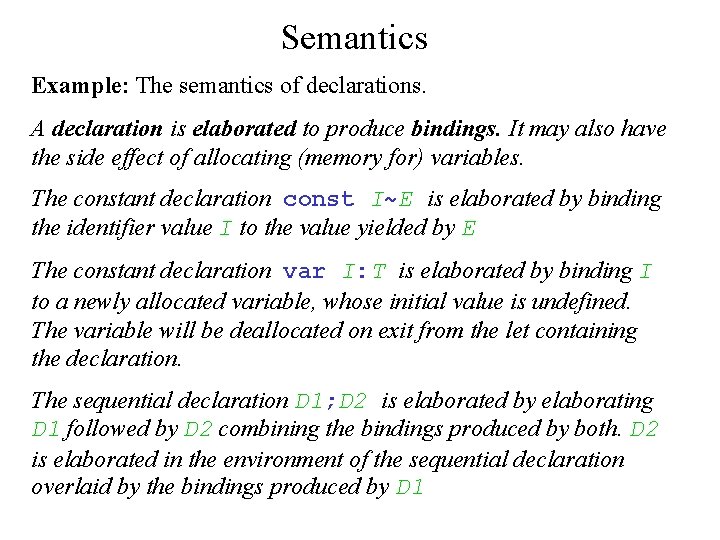
Semantics Example: The semantics of declarations. A declaration is elaborated to produce bindings. It may also have the side effect of allocating (memory for) variables. The constant declaration const I~E is elaborated by binding the identifier value I to the value yielded by E The constant declaration var I: T is elaborated by binding I to a newly allocated variable, whose initial value is undefined. The variable will be deallocated on exit from the let containing the declaration. The sequential declaration D 1; D 2 is elaborated by elaborating D 1 followed by D 2 combining the bindings produced by both. D 2 is elaborated in the environment of the sequential declaration overlaid by the bindings produced by D 1
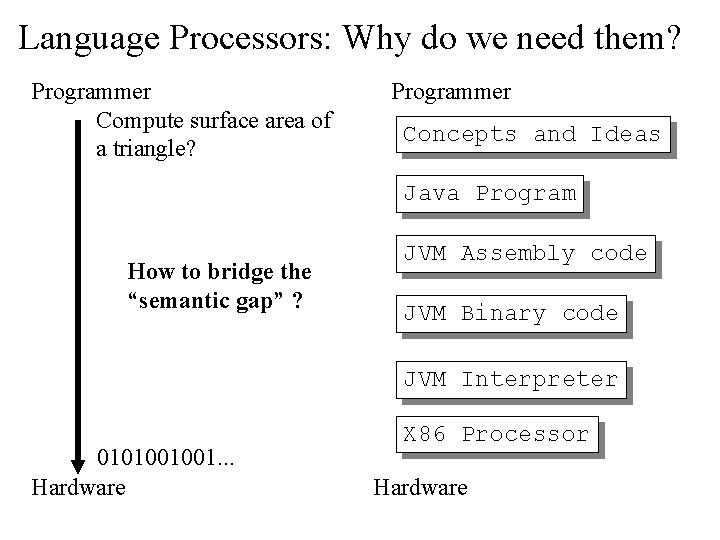
Language Processors: Why do we need them? Programmer Compute surface area of a triangle? Programmer Concepts and Ideas Java Program How to bridge the “semantic gap” ? JVM Assembly code JVM Binary code JVM Interpreter 0101001001. . . Hardware X 86 Processor Hardware
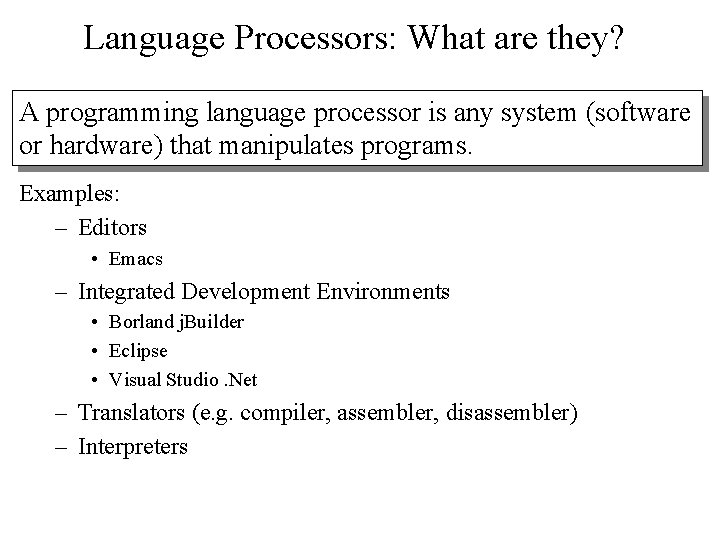
Language Processors: What are they? A programming language processor is any system (software or hardware) that manipulates programs. Examples: – Editors • Emacs – Integrated Development Environments • Borland j. Builder • Eclipse • Visual Studio. Net – Translators (e. g. compiler, assembler, disassembler) – Interpreters
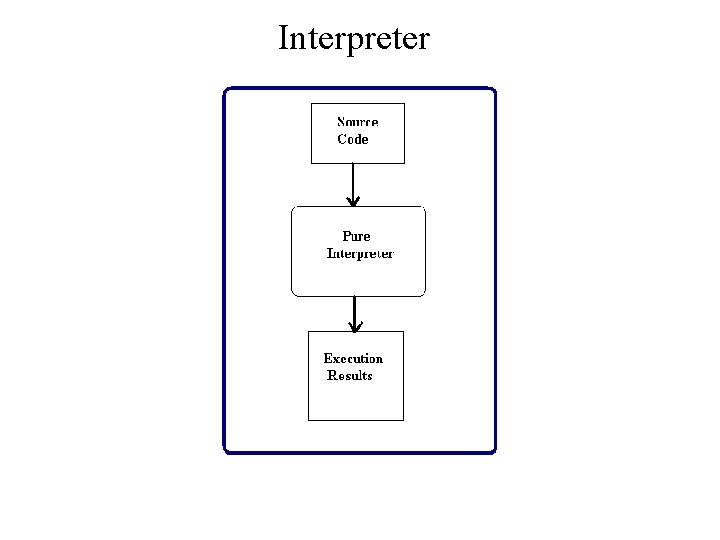
Interpreter
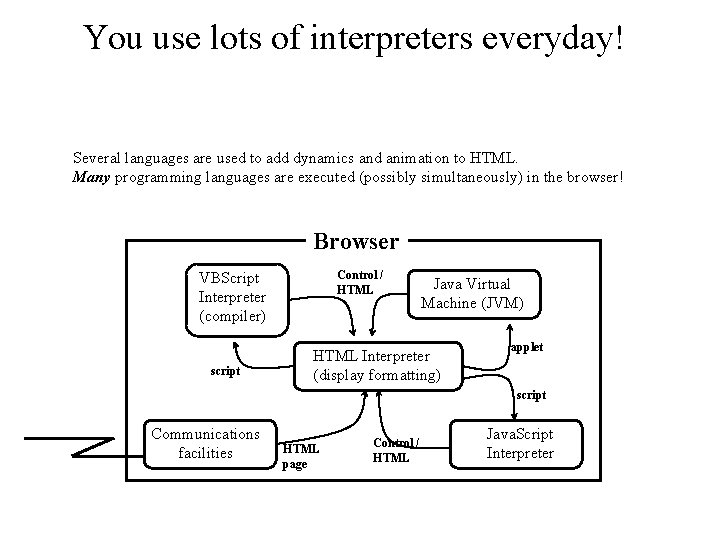
You use lots of interpreters everyday! Several languages are used to add dynamics and animation to HTML. Many programming languages are executed (possibly simultaneously) in the browser! Browser Control / HTML VBScript Interpreter (compiler) script Java Virtual Machine (JVM) HTML Interpreter (display formatting) applet script Communications facilities HTML page Control / HTML Java. Script Interpreter
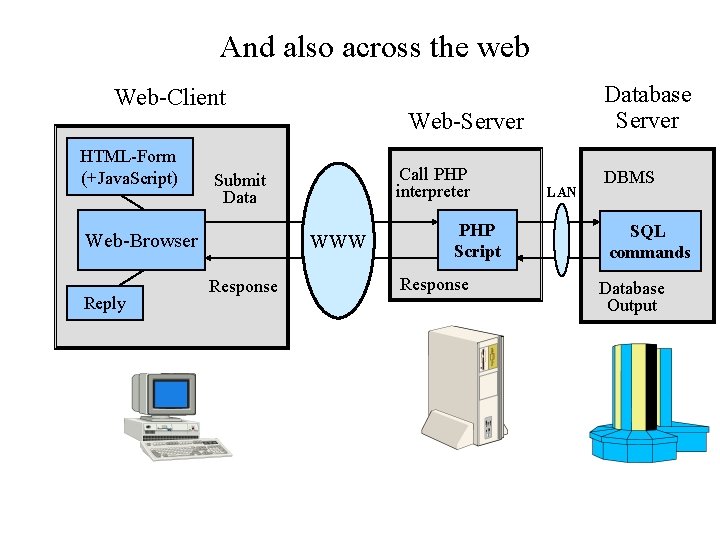
And also across the web Web-Client HTML-Form (+Java. Script) Reply Web-Server Call PHP interpreter Submit Data Web-Browser WWW Response Database Server PHP Script Response LAN DBMS SQL commands Database Output
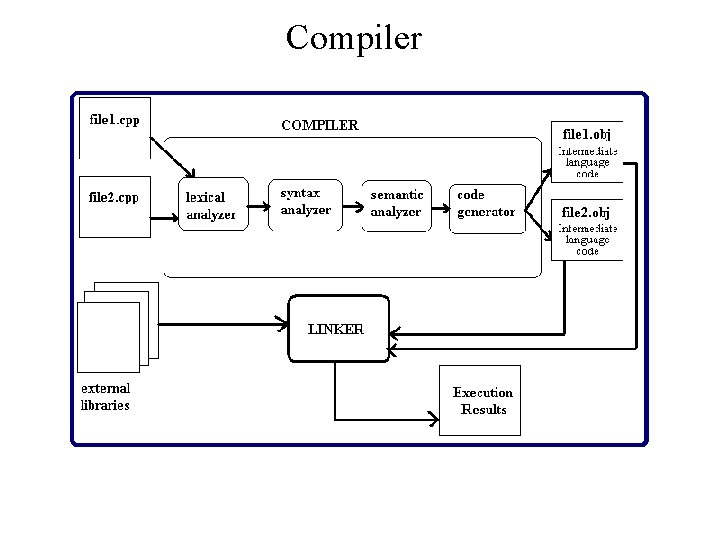
Compilation • Compilation is at least two-step process, in which the original program (source program) is input to the compiler, and a new program (target program) is output from the compiler. The compilation steps can be visualized as the following.
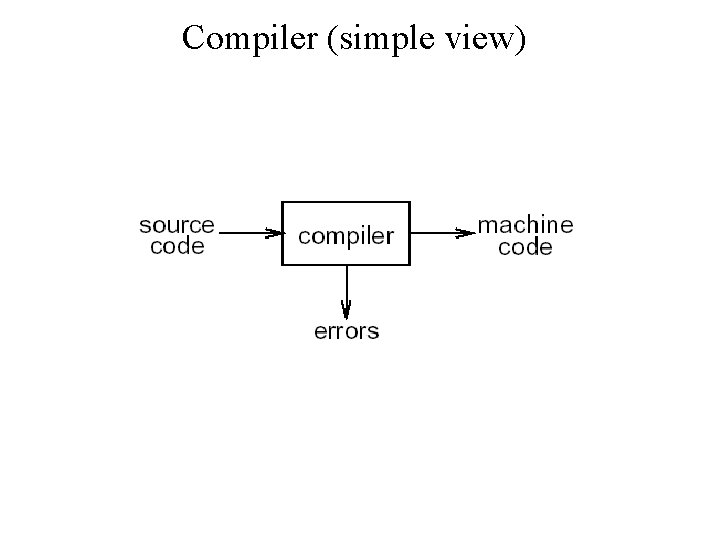
Compiler (simple view)
Compiler
Hybrid compiler / interpreter
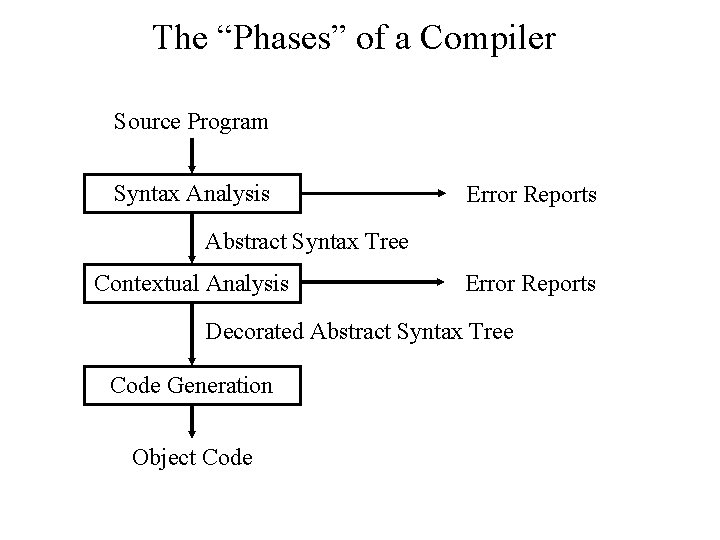
The “Phases” of a Compiler Source Program Syntax Analysis Error Reports Abstract Syntax Tree Contextual Analysis Error Reports Decorated Abstract Syntax Tree Code Generation Object Code
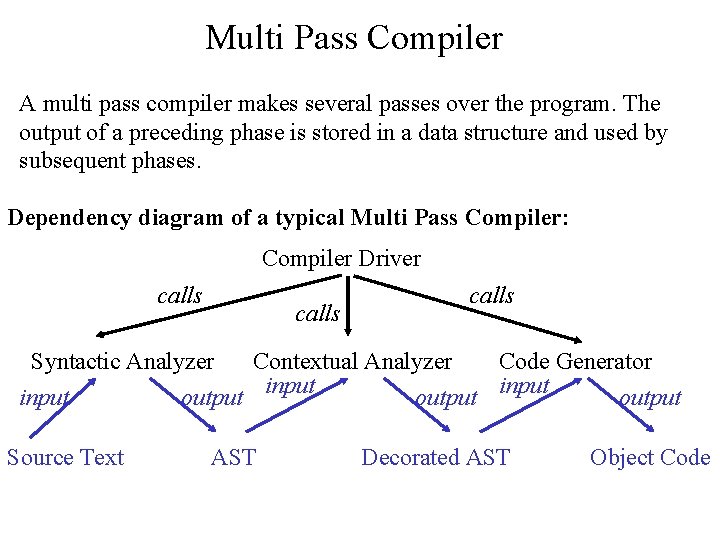
Multi Pass Compiler A multi pass compiler makes several passes over the program. The output of a preceding phase is stored in a data structure and used by subsequent phases. Dependency diagram of a typical Multi Pass Compiler: Compiler Driver calls Syntactic Analyzer Contextual Analyzer Code Generator input output Source Text AST Decorated AST Object Code
Different Phases of a Compiler The different phases can be seen as different transformation steps to transform source code into object code. The different phases correspond roughly to the different parts of the language specification: • Syntax analysis <-> Syntax • Contextual analysis <-> Contextual constraints • Code generation <-> Semantics
Tools and Techniques • Front-end: Syntax analysis – How to build a Scanner and Lexer • By hand in Java • Using Tools – Java. CC – Sable. CC – Lex and Yacc (JLex and Java. CUP) – (lg and pg – compiler tools for. Net) • Middle-part: Contextual Analysis • Back-end: Code Generation – Target Machines • TAM • JVM • . Net CLR
Important • At the end of the course you should … • know – Which techniques exists – Which tools exists • Be able to choose “the right ones” – Objective criteria – Subjective criteria • Be able to argue and justify your choices!
Summary • Programming Language Design – New features – History, Paradigm, philosophy • Programming Language Specification – Syntax – Contextual constraints – Meaning (semantics and code generation) • Programming Language Implementation – Compiler – Interpreter – Hybrid system
Finally Keep in mind, the compiler is the program from which all other programs arise. If your compiler is under par, all programs created by the compiler will also be under par. No matter the purpose or use -- your own enlightenment about compilers or commercial applications -- you want to be patient and do a good job with this program; in other words, don't try to throw this together on a weekend. Asking a computer programmer to tell you how to write a compiler is like saying to Picasso, "Teach me to paint like you. " *Sigh* Nevertheless, Picasso shall try.
- Slides: 78