
Languages and Compilers SProg og Oversttere Bent Thomsen
Languages and Compilers (SProg og Oversættere) Bent Thomsen Department of Computer Science Aalborg University 1
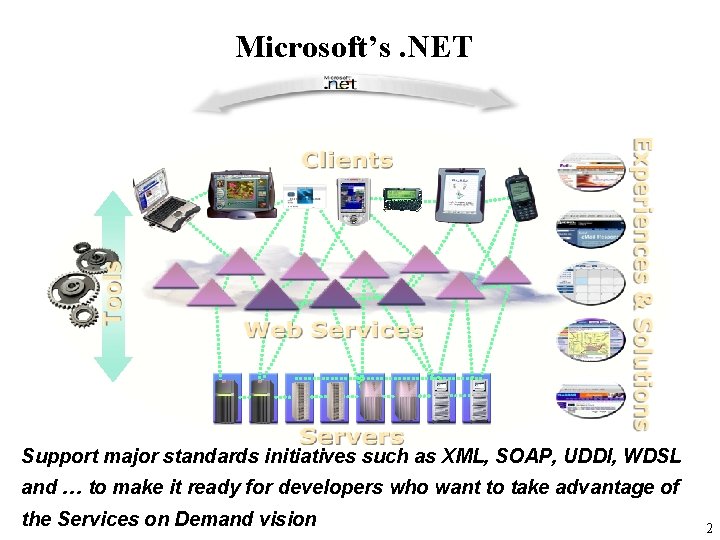
Microsoft’s. NET Support major standards initiatives such as XML, SOAP, UDDI, WDSL and … to make it ready for developers who want to take advantage of the Services on Demand vision 2
What is Microsoft. NET? • . NET is Microsoft’s vision of a world connected using open standards • . NET is the name given to the latest Microsoft technology, products and development framework • . NET is the basis for Microsoft’s current and future roadmap • ‘. NET is Microsoft’s platform for a new computing model built around XML Web Services’ Microsoft Corporation Annual Report, 2001 • . Net is Microsoft’s core business Strategy 3
Programming for. Net • • • Common Language Runtime + class libraries ADO. NET ASP. NET Web services – XML, SOAP, UDDI, WSDL … Programming languages – C++, VB, C#, (J#) – APL, COBOL, Eiffel, Forth, Fortran, Haskel, SML, Mercury, Mondrian, Oberon, Pascal, Perl, Python, RPG, Scheme, Small. Script, … • Visual Studio. Net – – Professional Server Edition Mobile Internet Toolkit Academic 4
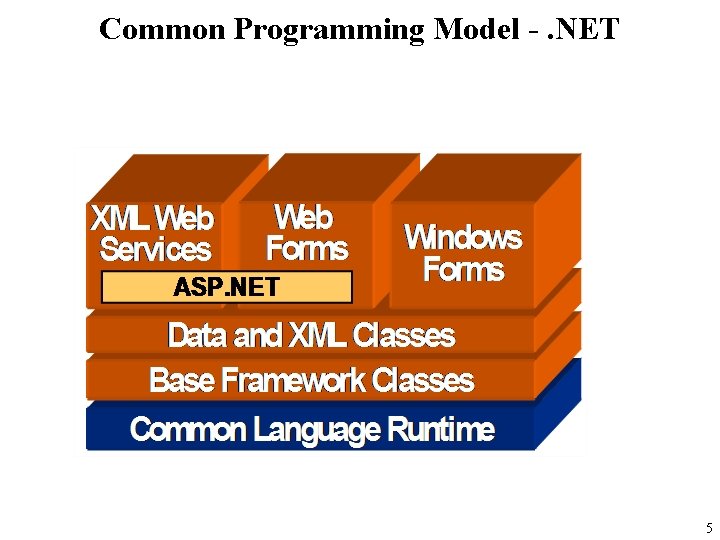
Common Programming Model -. NET 5
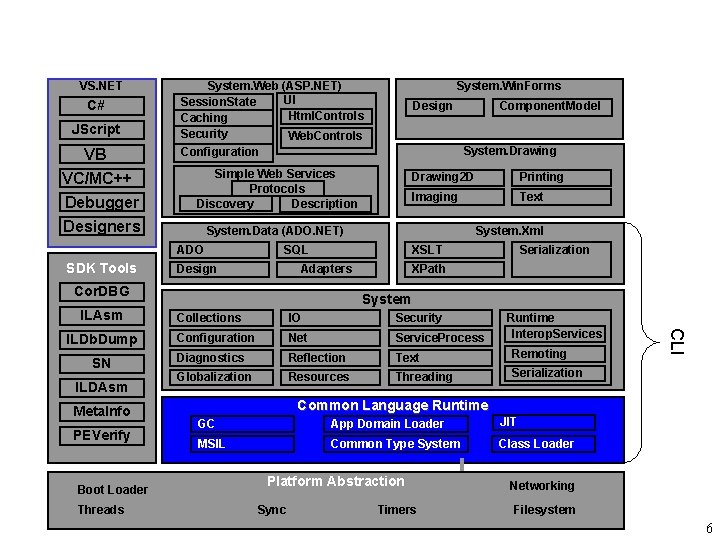
WHERE THE CLR FITS IN THE. NET WORLD VS. NET C# JScript VB VC/MC++ Debugger Designers System. Web (ASP. NET) UI Session. State Html. Controls Caching Security Web. Controls Configuration SN ILDAsm Meta. Info PEVerify Boot Loader Threads Printing Imaging Text XSLT Serialization XPath Adapters System Collections IO Security Runtime Interop. Services Configuration Net Service. Process Diagnostics Reflection Text Remoting Globalization Resources Threading Serialization CLI ILDb. Dump Drawing 2 D System. Xml SQL Design Component. Model System. Drawing System. Data (ADO. NET) Cor. DBG ILAsm Design Simple Web Services Protocols Discovery Description ADO SDK Tools System. Win. Forms Common Language Runtime GC App Domain Loader JIT MSIL Common Type System Class Loader Platform Abstraction Sync Timers Networking Filesystem 6
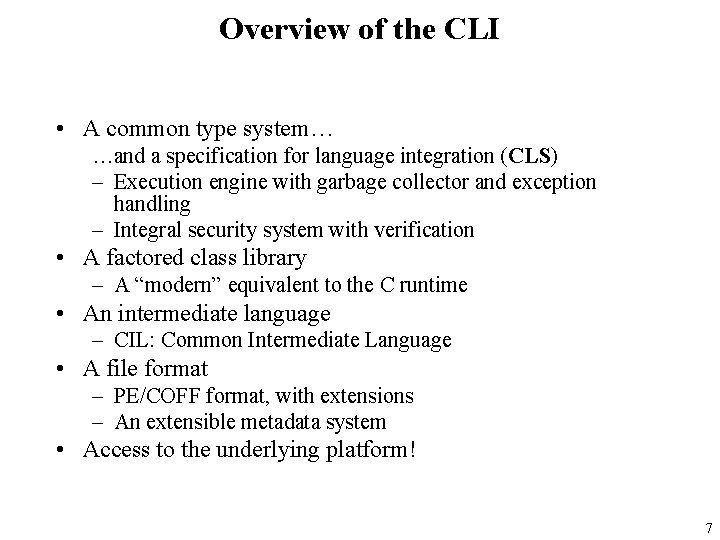
Overview of the CLI • A common type system… …and a specification for language integration (CLS) – Execution engine with garbage collector and exception handling – Integral security system with verification • A factored class library – A “modern” equivalent to the C runtime • An intermediate language – CIL: Common Intermediate Language • A file format – PE/COFF format, with extensions – An extensible metadata system • Access to the underlying platform! 7
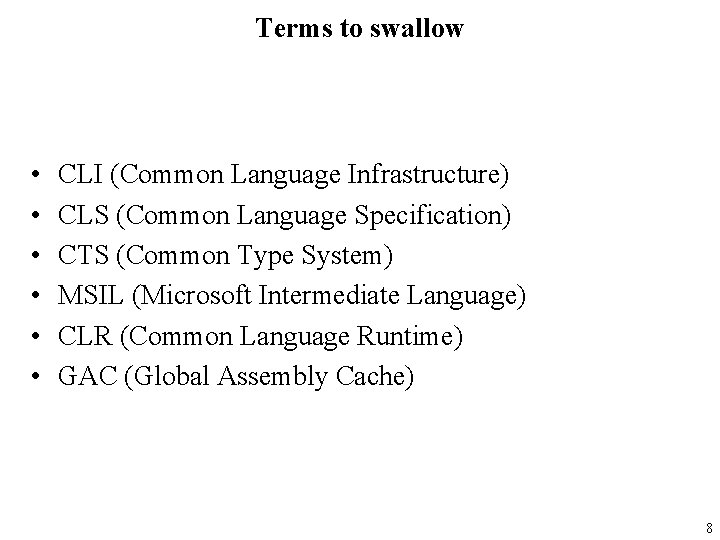
Terms to swallow • • • CLI (Common Language Infrastructure) CLS (Common Language Specification) CTS (Common Type System) MSIL (Microsoft Intermediate Language) CLR (Common Language Runtime) GAC (Global Assembly Cache) 8
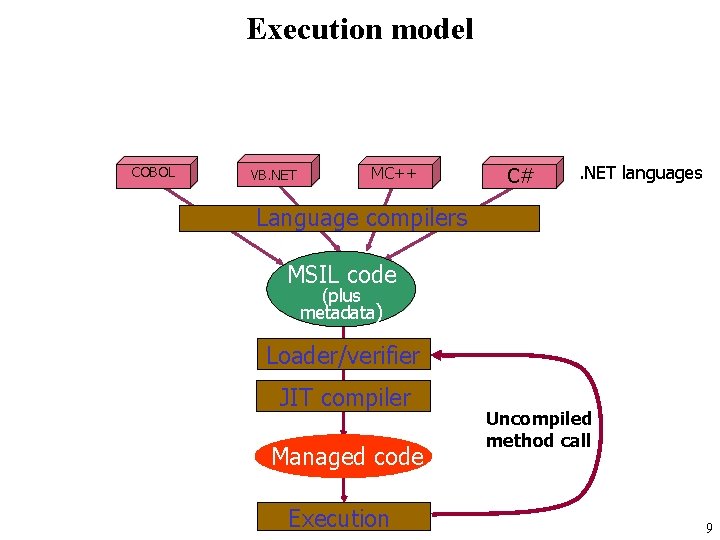
Execution model COBOL VB. NET MC++ C# . NET languages Language compilers MSIL code (plus metadata) Loader/verifier JIT compiler Managed code Execution Uncompiled method call 9
![Managed Code Execution Source code public static void Main(String[] args ) { String usr;](http://slidetodoc.com/presentation_image/b4fd8825e648f986e606ca90358a423f/image-10.jpg "Managed Code Execution Source code public static void Main(String[] args ) { String usr;")
Managed Code Execution Source code public static void Main(String[] args ) { String usr; File. Stream f; Stream. Writer w; try { usr=Environment. Get. Environment. Variable("USERNAME "); f=new File. Stream(“C: \test. txt", File. Mode. Create); w=new Stream. Writer(f); public static void Main(String[] args ) w. Write. Line(usr); { String usr; File. Stream f; Stream. Writer w; w. Close(); try { } catch (Exceptionusr=Environment. Get. Environment. Variable("USERNAME e){ "); Console. Write. Line("Exception: "+e. To. String ()); f=new File. Stream(“C: \test. txt", File. Mode. Create); } w=new Stream. Writer(f); } w. Write. Line(usr); w. Close(); } catch (Exception e){ Console. Write. Line("Exception: "+e. To. String ()); } } DEVELOPMENT Compiler Evidence Host Policy Granted permissions Assembly PE header + MSIL + Metadata + EH Table Assembly Loader Permission request (class) (method) Class Loader NGEN EXECUTION Assembly info Module + Class list Vtable + Class info JIT + verification PEVerify GAC, app. directory, download cache y) bl em ss (a <? xml version="1. 0" encoding="utf-8" ? > <configuration> <mscorlib> <security> <policy> <Policy. Level version="1"> <Code. Group class="Union. Code. Group" version="1" Permission. Set. Name="Nothing" Name="All_Code" Description="Code group grants no permissio ns and forms the root of the code group tree. "> < IMembership. Condition clas s="All. Membership. Condition " version="1"/> < Code. Group class="Union. Code. Group" version="1" Permission. Set. Name="Full. Trust" Policy Manager DEPLOYMENT CLR Services ØGC ØException Native code ØClass init + GC table ØSecurity 10
What is the Common Language Runtime (CLR)? • The CLR is the execution engine for. NET • Responsible for key services: – Just-in-time compilation – heap management – garbage collection – exception handling • Rich support for component software • Language-neutral 11
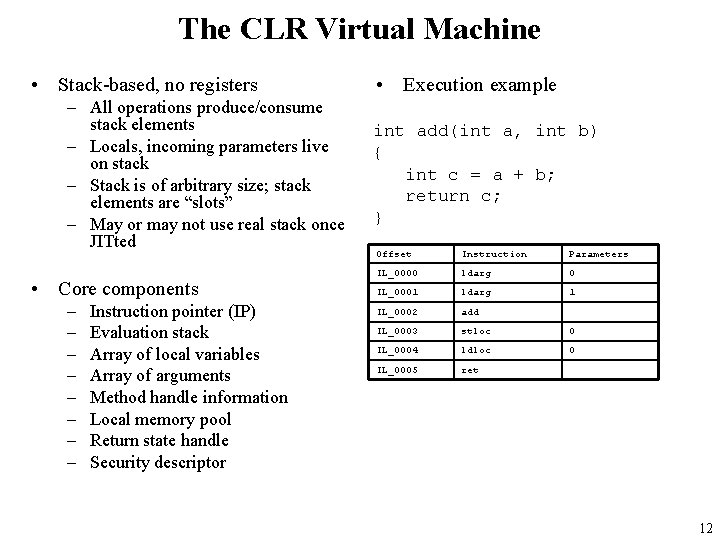
The CLR Virtual Machine • Stack-based, no registers – All operations produce/consume stack elements – Locals, incoming parameters live on stack – Stack is of arbitrary size; stack elements are “slots” – May or may not use real stack once JITted • Core components – – – – Instruction pointer (IP) Evaluation stack Array of local variables Array of arguments Method handle information Local memory pool Return state handle Security descriptor • Execution example int add(int a, int b) { int c = a + b; return c; } Offset Instruction Parameters IL_0000 ldarg 0 IL_0001 ldarg 1 IL_0002 add IL_0003 stloc 0 IL_0004 ldloc 0 IL_0005 ret 12
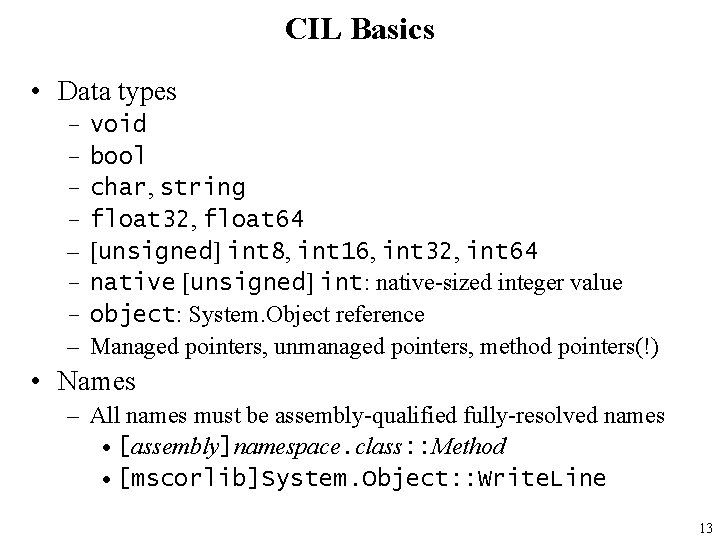
CIL Basics • Data types – – – – void bool char, string float 32, float 64 [unsigned] int 8, int 16, int 32, int 64 native [unsigned] int: native-sized integer value object: System. Object reference Managed pointers, unmanaged pointers, method pointers(!) • Names – All names must be assembly-qualified fully-resolved names • [assembly]namespace. class: : Method • [mscorlib]System. Object: : Write. Line 13
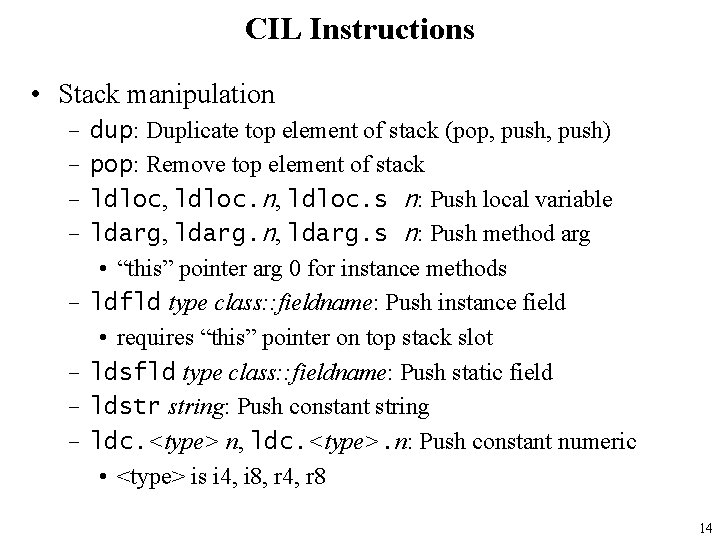
CIL Instructions • Stack manipulation – – – – dup: Duplicate top element of stack (pop, push) pop: Remove top element of stack ldloc, ldloc. n, ldloc. s n: Push local variable ldarg, ldarg. n, ldarg. s n: Push method arg • “this” pointer arg 0 for instance methods ldfld type class: : fieldname: Push instance field • requires “this” pointer on top stack slot ldsfld type class: : fieldname: Push static field ldstr string: Push constant string ldc. <type> n, ldc. <type>. n: Push constant numeric • <type> is i 4, i 8, r 4, r 8 14
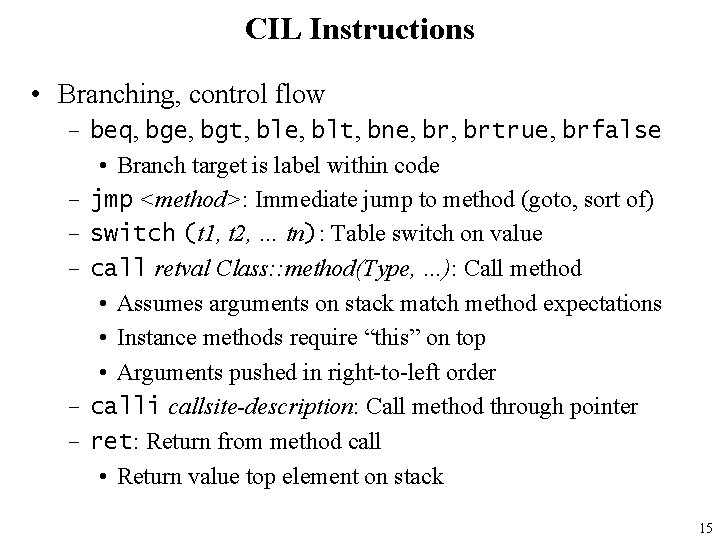
CIL Instructions • Branching, control flow – beq, bge, bgt, ble, blt, bne, brtrue, brfalse • Branch target is label within code – jmp <method>: Immediate jump to method (goto, sort of) – switch (t 1, t 2, … tn): Table switch on value – call retval Class: : method(Type, …): Call method • Assumes arguments on stack match method expectations • Instance methods require “this” on top • Arguments pushed in right-to-left order – calli callsite-description: Call method through pointer – ret: Return from method call • Return value top element on stack 15
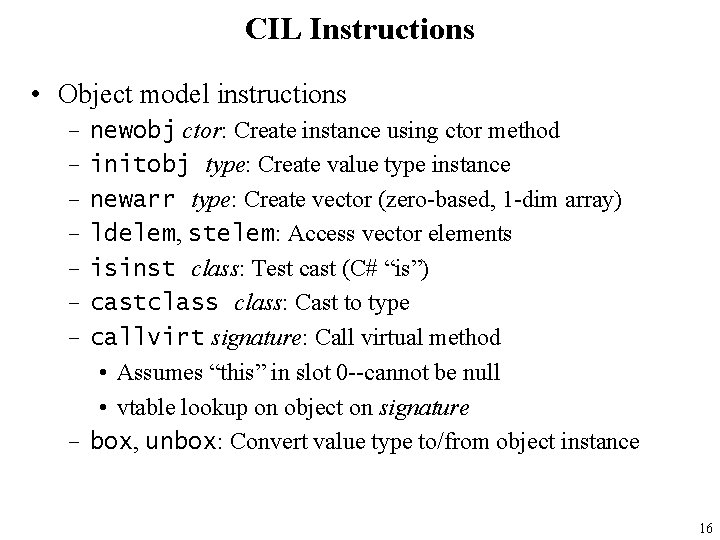
CIL Instructions • Object model instructions newobj ctor: Create instance using ctor method initobj type: Create value type instance newarr type: Create vector (zero-based, 1 -dim array) ldelem, stelem: Access vector elements isinst class: Test cast (C# “is”) castclass: Cast to type callvirt signature: Call virtual method • Assumes “this” in slot 0 --cannot be null • vtable lookup on object on signature – box, unbox: Convert value type to/from object instance – – – – 16
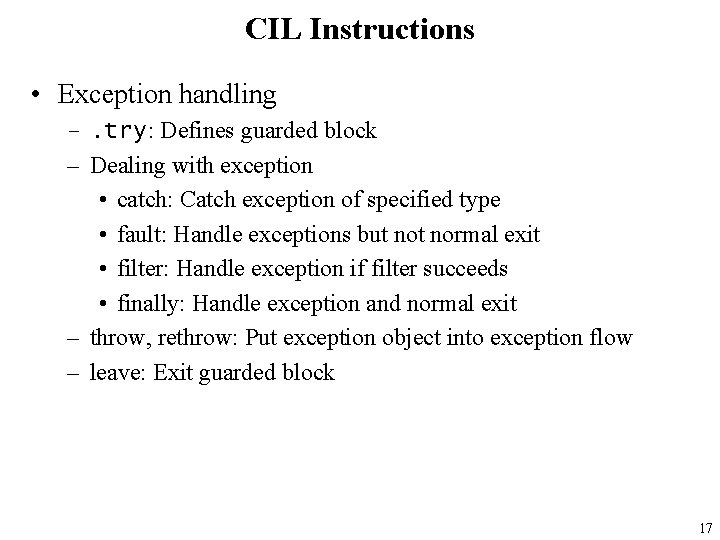
CIL Instructions • Exception handling –. try: Defines guarded block – Dealing with exception • catch: Catch exception of specified type • fault: Handle exceptions but normal exit • filter: Handle exception if filter succeeds • finally: Handle exception and normal exit – throw, rethrow: Put exception object into exception flow – leave: Exit guarded block 17
CIL assembler • ILAsm (IL Assembly) closest to raw CIL – Assembly language • CIL opcodes and operands • Assembler directives • Intimately aware of the CLI (objects, interfaces, etc) – ilasm. exe (like JASMIN for Java/JVM) – Ships with Framework. SDK, Rotor, along with a few samples – Creates a PE (portable executable) file (. exe or. dll)
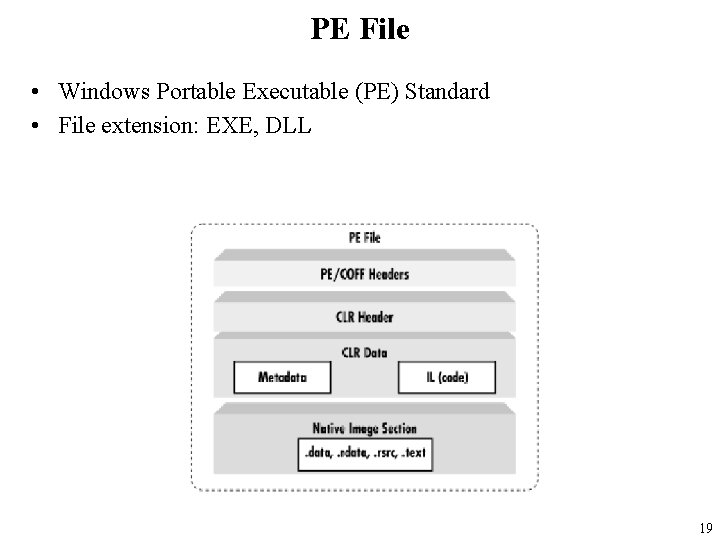
PE File • Windows Portable Executable (PE) Standard • File extension: EXE, DLL 19
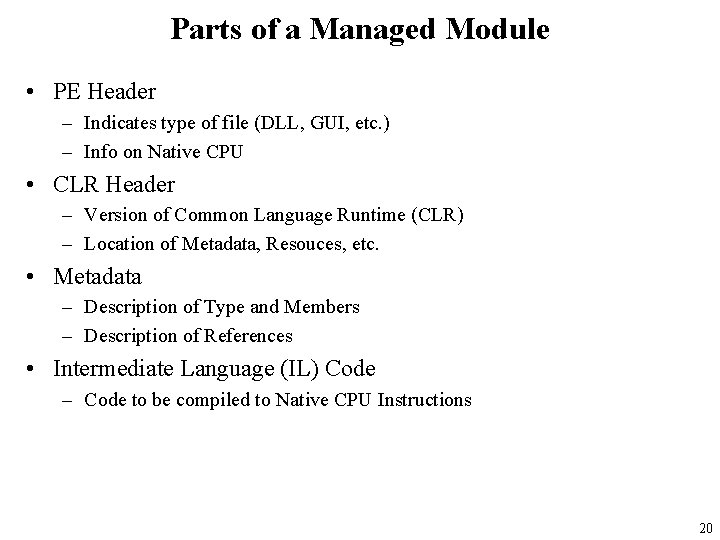
Parts of a Managed Module • PE Header – Indicates type of file (DLL, GUI, etc. ) – Info on Native CPU • CLR Header – Version of Common Language Runtime (CLR) – Location of Metadata, Resouces, etc. • Metadata – Description of Type and Members – Description of References • Intermediate Language (IL) Code – Code to be compiled to Native CPU Instructions 20
ILAsm • Some ILAsm directives – – – – . assembly extern: referencing another assembly: declaring local assembly, version, hash, etc. module: optional declaration of module (file) namespace: declare a lexical namespace for types. entrypoint: marks method as entrypoint (“Main()”). maxstack: optimization; how many stack slots required? . locals: declares local variables • May auto-initialize if init is present 21
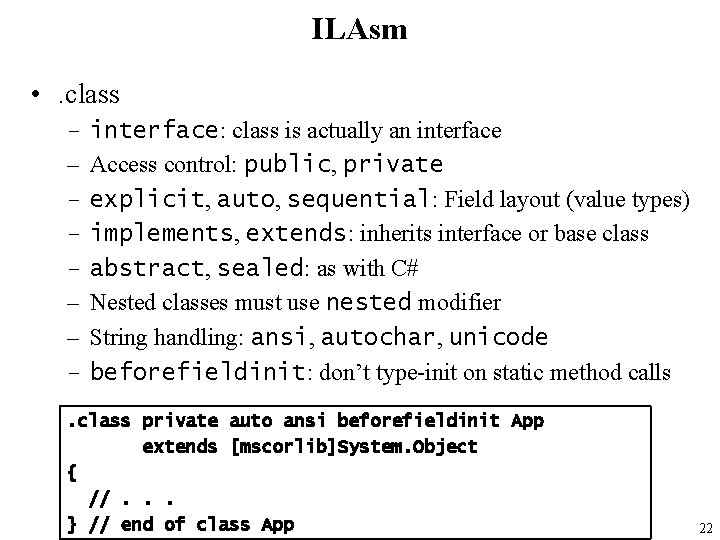
ILAsm • . class – – – – interface: class is actually an interface Access control: public, private explicit, auto, sequential: Field layout (value types) implements, extends: inherits interface or base class abstract, sealed: as with C# Nested classes must use nested modifier String handling: ansi, autochar, unicode beforefieldinit: don’t type-init on static method calls . class private auto ansi beforefieldinit App extends [mscorlib]System. Object { //. . . } // end of class App 22
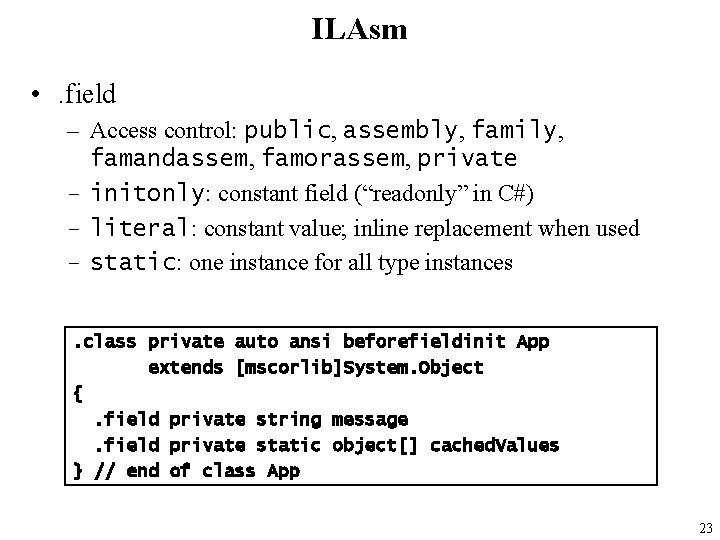
ILAsm • . field – Access control: public, assembly, family, famandassem, famorassem, private – initonly: constant field (“readonly” in C#) – literal: constant value; inline replacement when used – static: one instance for all type instances. class private auto ansi beforefieldinit App extends [mscorlib]System. Object {. field private string message. field private static object[] cached. Values } // end of class App 23
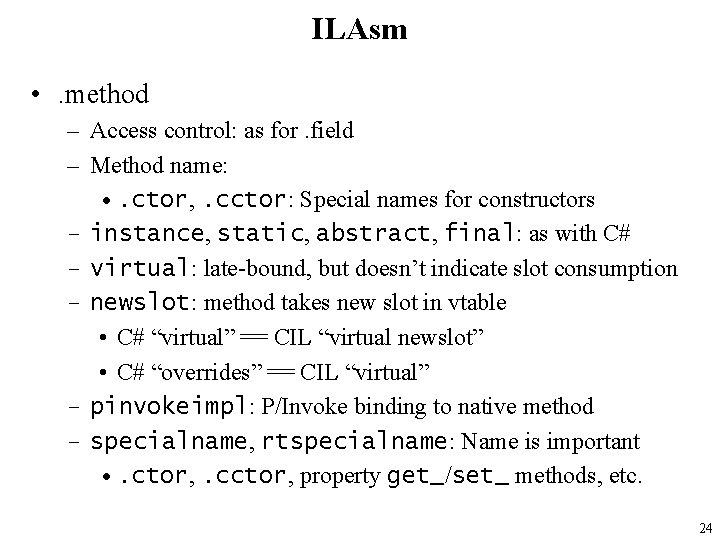
ILAsm • . method – Access control: as for. field – Method name: • . ctor, . cctor: Special names for constructors – instance, static, abstract, final: as with C# – virtual: late-bound, but doesn’t indicate slot consumption – newslot: method takes new slot in vtable • C# “virtual” == CIL “virtual newslot” • C# “overrides” == CIL “virtual” – pinvokeimpl: P/Invoke binding to native method – specialname, rtspecialname: Name is important • . ctor, . cctor, property get_/set_ methods, etc. 24
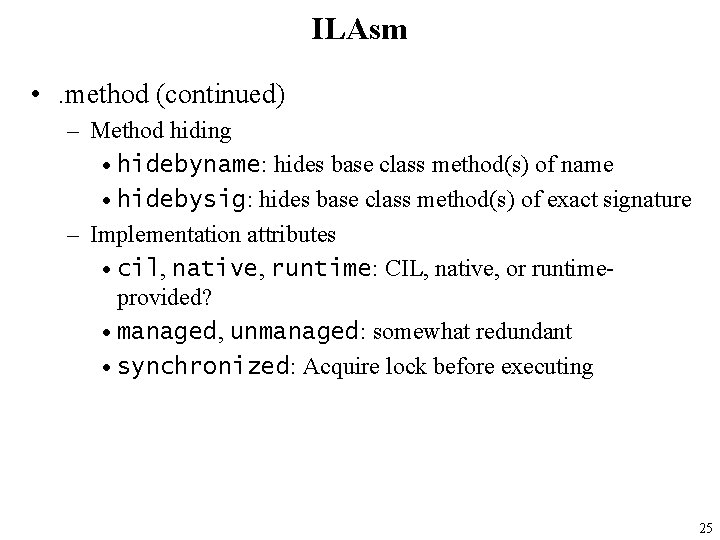
ILAsm • . method (continued) – Method hiding • hidebyname: hides base class method(s) of name • hidebysig: hides base class method(s) of exact signature – Implementation attributes • cil, native, runtime: CIL, native, or runtimeprovided? • managed, unmanaged: somewhat redundant • synchronized: Acquire lock before executing 25
ILAsm • . property – – two directives: . get and. set correspond directly to methods to invoke unlike C#, methods can be named anything no concept of indexer • C# language construct • property named “Item” taking an int 32 parameter • . event – Like. property, binds methods to event targets • . addon • . removeon • . fire – Like. property, methods can be named anything 26
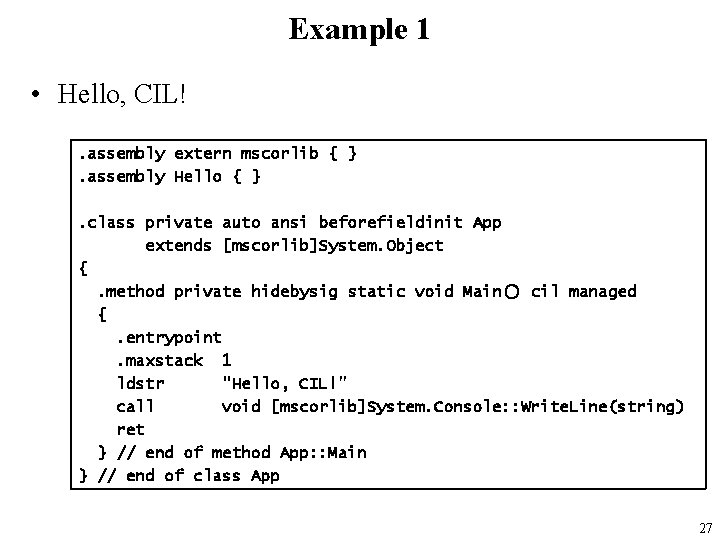
Example 1 • Hello, CIL!. assembly extern mscorlib { }. assembly Hello { }. class private auto ansi beforefieldinit App extends [mscorlib]System. Object {. method private hidebysig static void Main() cil managed {. entrypoint. maxstack 1 ldstr "Hello, CIL!" call void [mscorlib]System. Console: : Write. Line(string) ret } // end of method App: : Main } // end of class App 27
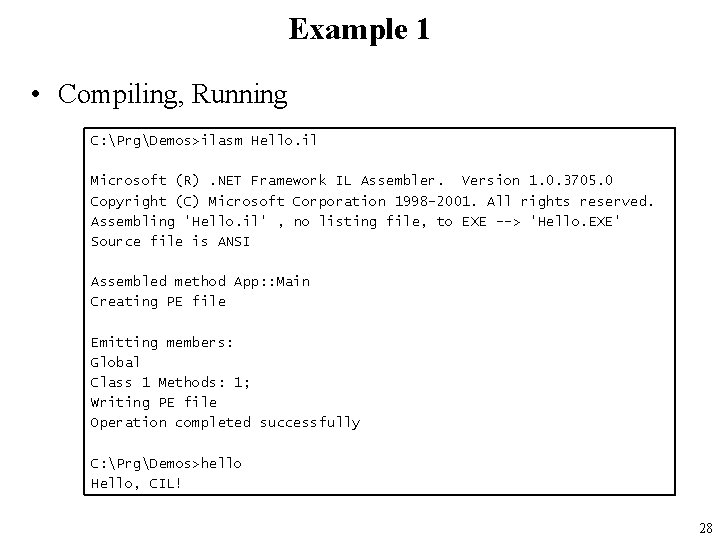
Example 1 • Compiling, Running C: PrgDemos>ilasm Hello. il Microsoft (R). NET Framework IL Assembler. Version 1. 0. 3705. 0 Copyright (C) Microsoft Corporation 1998 -2001. All rights reserved. Assembling 'Hello. il' , no listing file, to EXE --> 'Hello. EXE' Source file is ANSI Assembled method App: : Main Creating PE file Emitting members: Global Class 1 Methods: 1; Writing PE file Operation completed successfully C: PrgDemos>hello Hello, CIL! 28
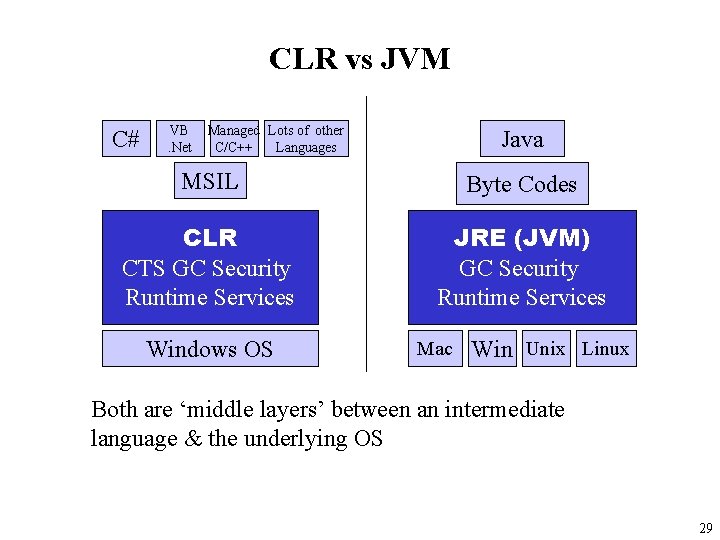
CLR vs JVM C# VB. Net Managed Lots of other C/C++ Languages Java MSIL Byte Codes CLR CTS GC Security Runtime Services JRE (JVM) GC Security Runtime Services Windows OS Mac Win Unix Linux Both are ‘middle layers’ between an intermediate language & the underlying OS 29
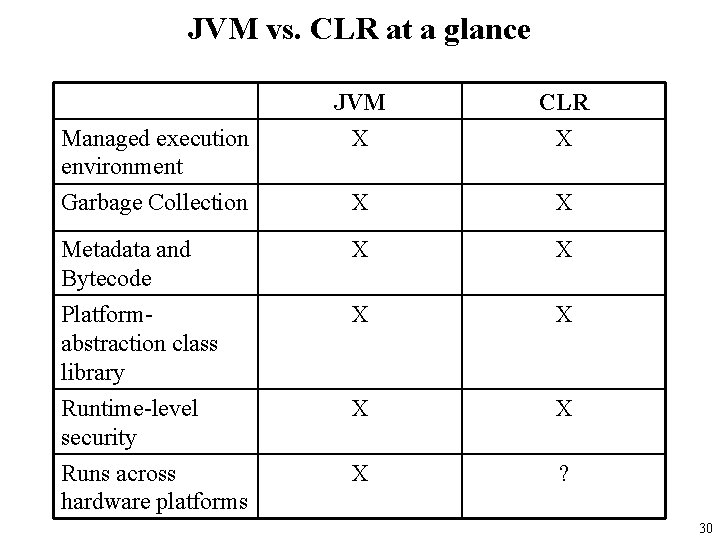
JVM vs. CLR at a glance JVM X CLR X X X Metadata and Bytecode Platformabstraction class library X X Runtime-level security Runs across hardware platforms X X X ? Managed execution environment Garbage Collection 30
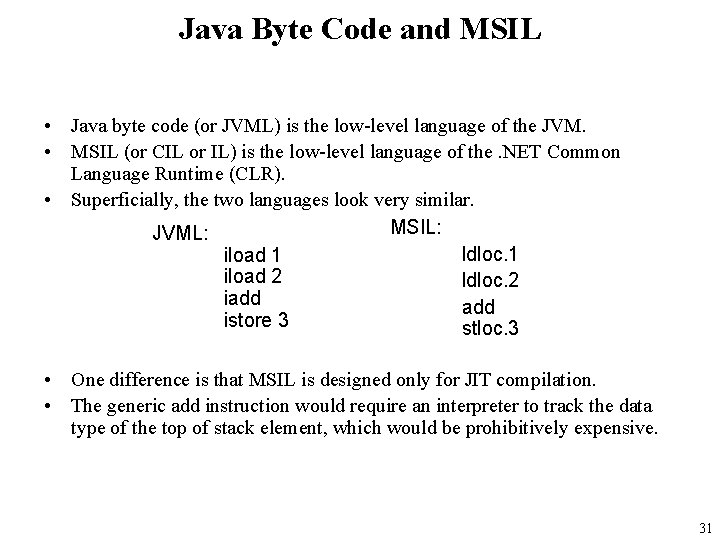
Java Byte Code and MSIL • Java byte code (or JVML) is the low-level language of the JVM. • MSIL (or CIL or IL) is the low-level language of the. NET Common Language Runtime (CLR). • Superficially, the two languages look very similar. MSIL: JVML: ldloc. 1 iload 2 ldloc. 2 iadd istore 3 stloc. 3 • One difference is that MSIL is designed only for JIT compilation. • The generic add instruction would require an interpreter to track the data type of the top of stack element, which would be prohibitively expensive. 31
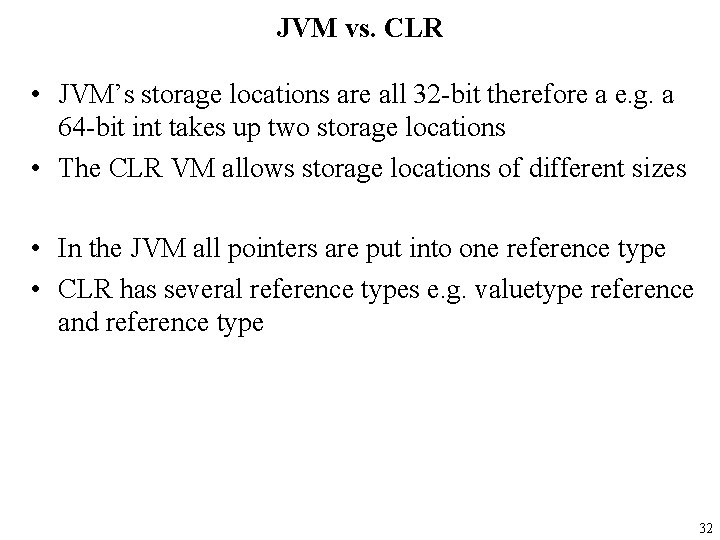
JVM vs. CLR • JVM’s storage locations are all 32 -bit therefore a e. g. a 64 -bit int takes up two storage locations • The CLR VM allows storage locations of different sizes • In the JVM all pointers are put into one reference type • CLR has several reference types e. g. valuetype reference and reference type 32
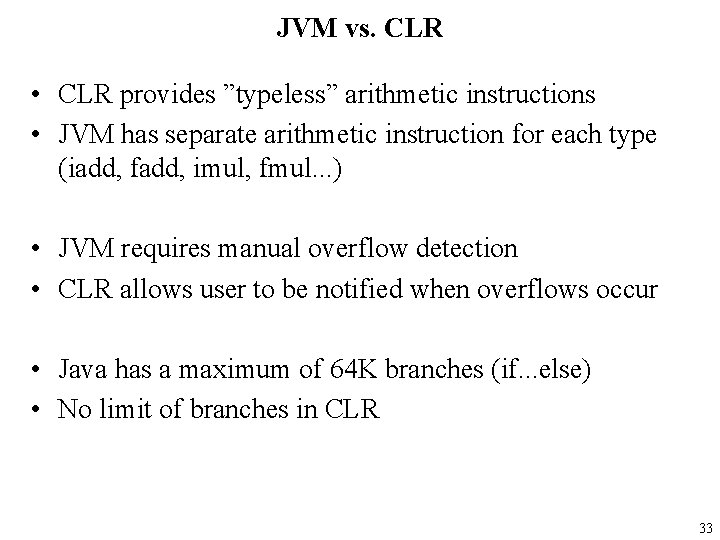
JVM vs. CLR • CLR provides ”typeless” arithmetic instructions • JVM has separate arithmetic instruction for each type (iadd, fadd, imul, fmul. . . ) • JVM requires manual overflow detection • CLR allows user to be notified when overflows occur • Java has a maximum of 64 K branches (if. . . else) • No limit of branches in CLR 33
JVM vs. CLR • JVM distinguish between invoking methods and interface (invokevirtual and invokeinterface) • CLR makes no distinction • CLR support tail calls (iteration in Scheme) • Must resort to tricks in order to make JVM discard stack frames 34
JVM vs. CLR – JVM designed for platform independence • Single language: Java (? ) • A separate JVM for each OS & device – CLR designed for language independence • Multiple languages for development – C++, VB, C#, (J#) – APL, COBOL, Eiffel, Forth, Fortran, Haskel, SML, Mercury, Mondrian, Oberon, Pascal, Perl, Python, RPG, Scheme, Small. Script, … – Impressive usage of formal methods and programming language research during development – Impressive extensions for generics and support for functional languages underway • Underlying OS: – Windows 2000/XP, special version for Windows. CE – Free. BSD Unix, Mac OS X – Linux 35
Why is. Net so interesting from a programming language research point of view? • CIL is more powerful than JVML and allows the compiler writer more freedom in data representation and control structures • The runtime provides services (execution engine, garbage collection, security…) which make producing a good implementation of new languages easier • The freedom to choose language – All features of. NET platform available to any. NET programming language – Application components can be written in multiple languages – Multi-language component-based programming makes it much more practical for other people to use your language in their own projects – The frameworks & libraries mean you can actually do useful things with your new language (graphics, networking, database access, web services, …) • Over 26 languages supported in the CLR – APL, COBOL, Pascal, Eiffel, Haskell, ML, Oberon, Perl, Python, Scheme, Smalltalk or you could write your own! 36
- Slides: 36