Kate Chopin The Awakening 1850 1904 Chopins major

- Slides: 40
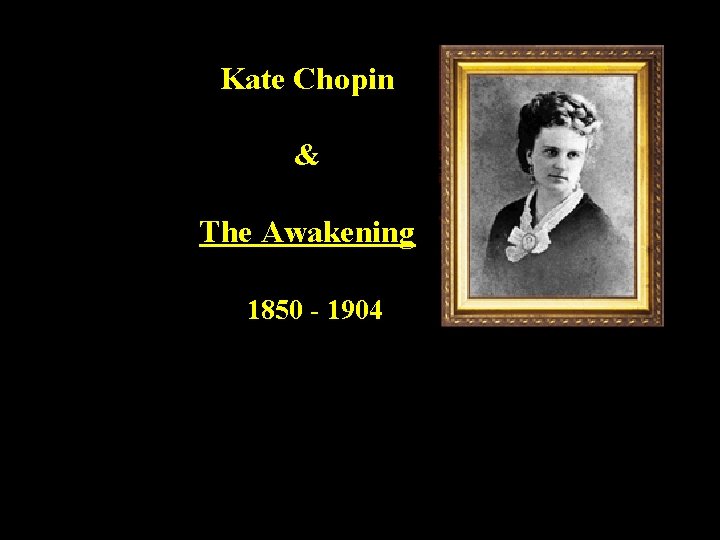
Kate Chopin & The Awakening 1850 - 1904
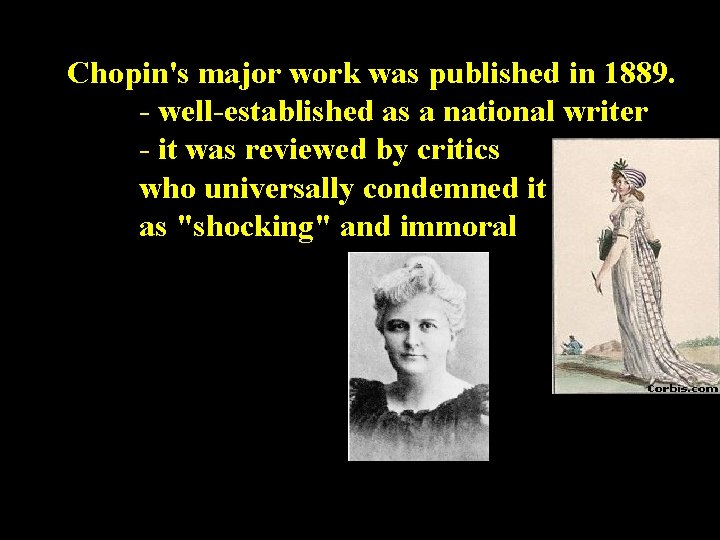
Chopin's major work was published in 1889. - well-established as a national writer - it was reviewed by critics who universally condemned it as "shocking" and immoral
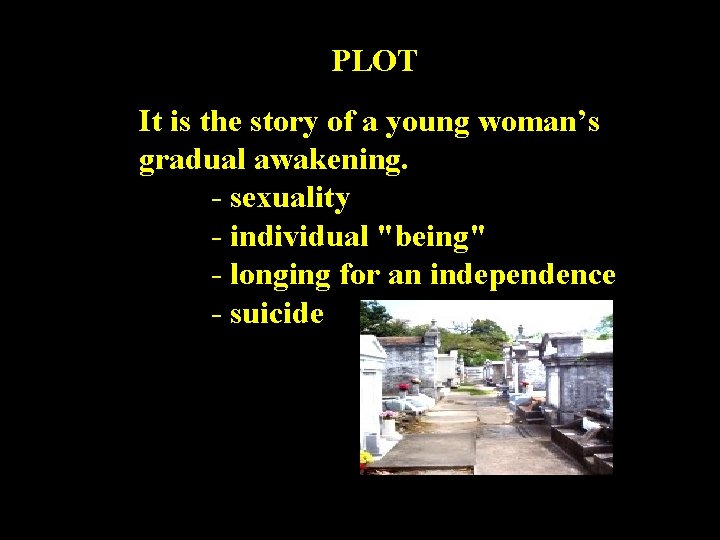
PLOT It is the story of a young woman’s gradual awakening. - sexuality - individual "being" - longing for an independence - suicide
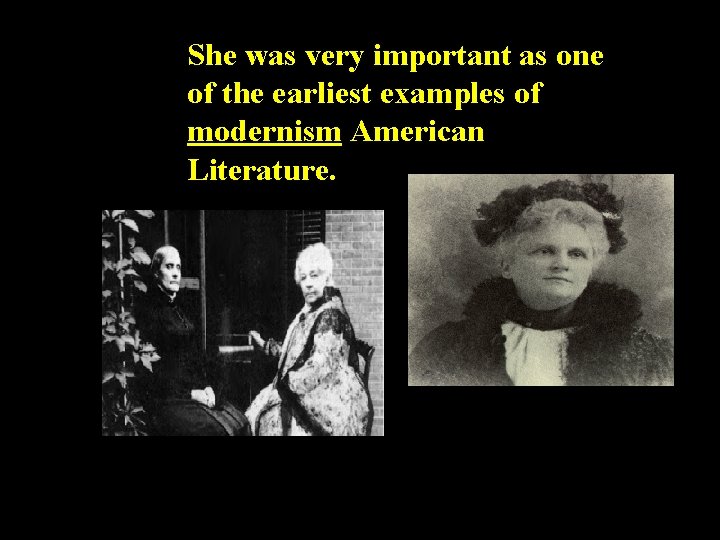
She was very important as one of the earliest examples of modernism American Literature.
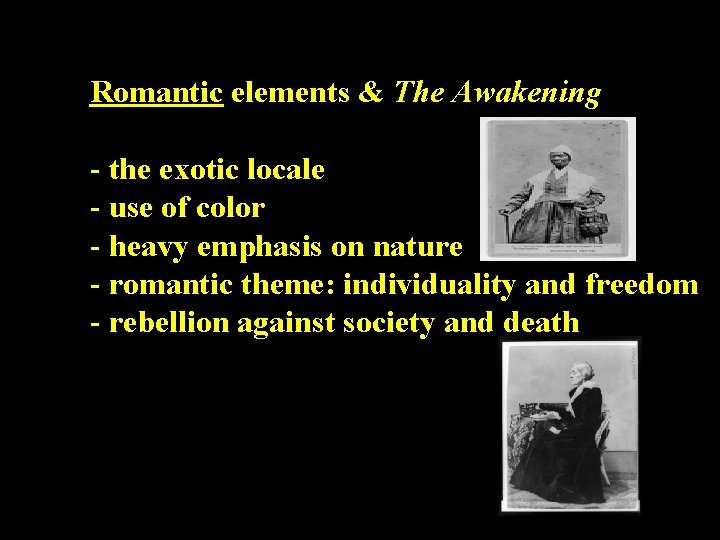
Romantic elements & The Awakening - the exotic locale - use of color - heavy emphasis on nature - romantic theme: individuality and freedom - rebellion against society and death
Edna - two extremes in life - completely alone = romanticism & - frequent inner thoughts - memories of childhood - the personified sea (nature) - the mysterious woman in black - the romantic music, dinner party - desire to express herself
Naturalism & The Awakening - Edna as hostage to her biology - She is female (children & wife) - society dictates behavior - "no attempt to suppress her impulses" - welfare of her children
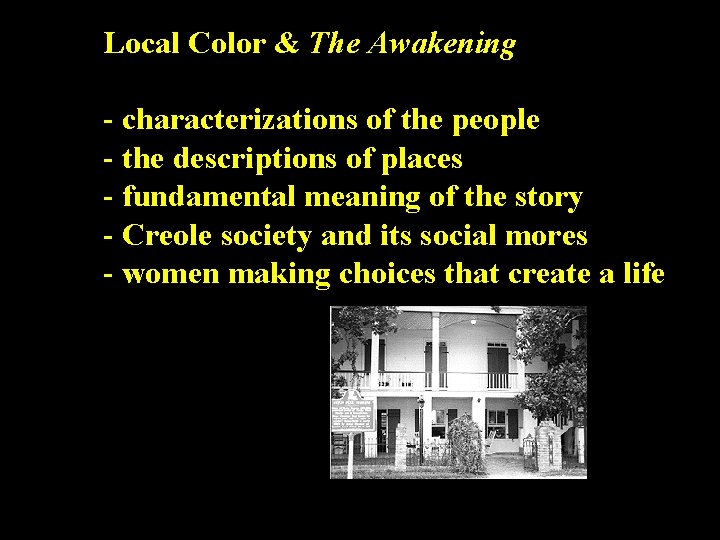
Local Color & The Awakening - characterizations of the people - the descriptions of places - fundamental meaning of the story - Creole society and its social mores - women making choices that create a life
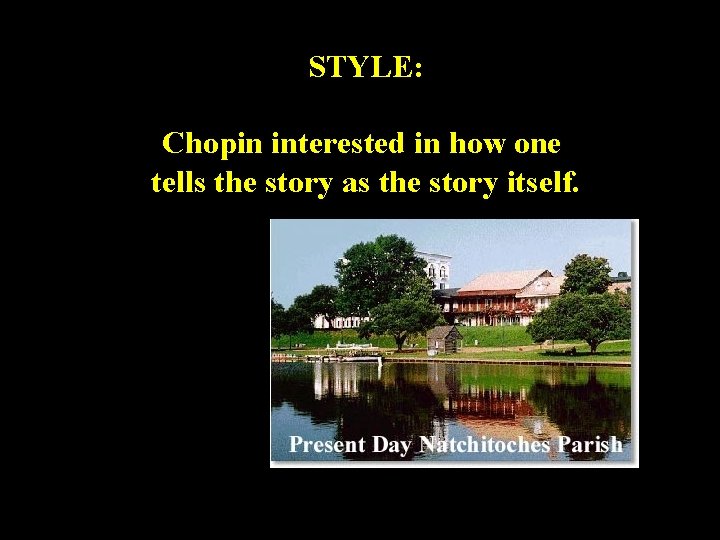
STYLE: Chopin interested in how one tells the story as the story itself.
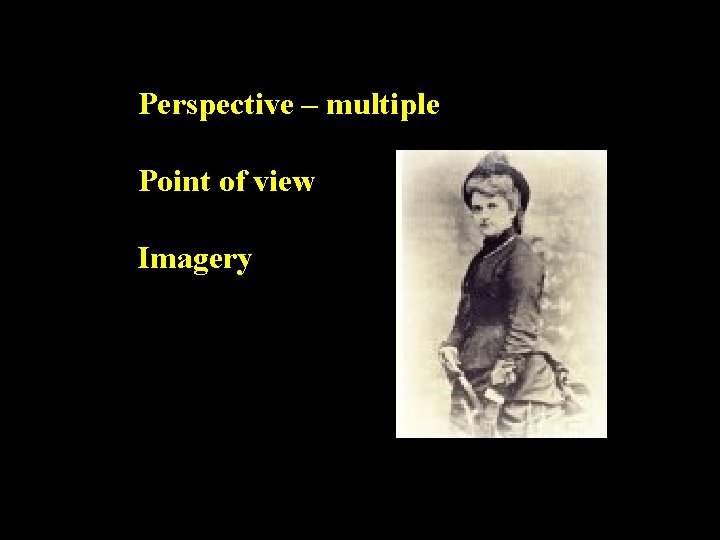
Perspective – multiple Point of view Imagery
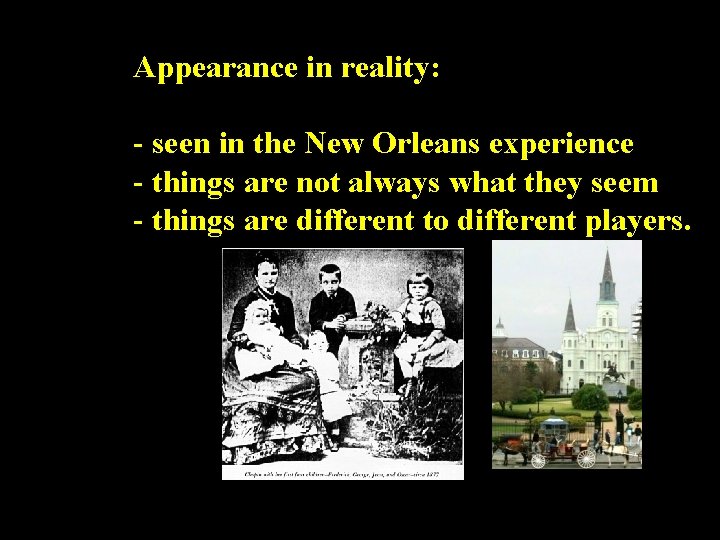
Appearance in reality: - seen in the New Orleans experience - things are not always what they seem - things are different to different players.
All of these formed her style - theme based - her stories were very short - she was experimenting with style
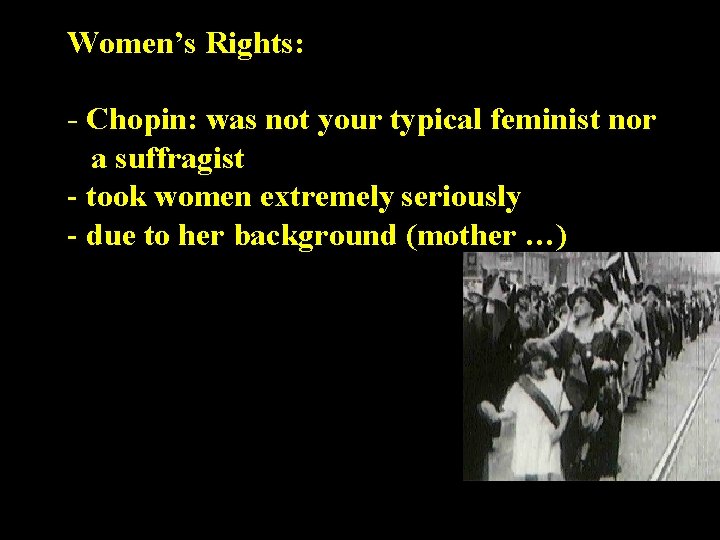
Women’s Rights: - Chopin: was not your typical feminist nor a suffragist - took women extremely seriously - due to her background (mother …) -
- lack of interest in feminism and suffrage: she simply had a different understanding of freedom. - Freedom = “character of living your life within the constraints that the world makes [or] your God offers you, because all of us do live within constraints. ”
Social Classes: - Black v. White - Rich v. Poor - Male v. Female - comfortable with difference - part of life
Theme: - No true beauty without complexity or conflict - tragedy and complexity are needed
Story information: Creole: is a ‘white person descended from the French or Spanish settlers of Louisiana and the Gulf States and preserving their characteristic speech and culture. ’. . .
Three groups: 1) whites - highest class 2) free Blacks - emancipated slaves middle class 3) slaves household property the lowest class They had a complex social organization which included foreign groups: Germans, Irish, and Spaniards.
Culture: - father was dominant - his word was law - not always a faithful spouse - ruled like a king - dutiful in the sense he went places with his wife
Young men: - given their own quarters - entertainment - had mistresses (Black or mulatto) - couldn’t marry them - accepted custom - marriages = business - wives = passive and ‘innocent’ lovers
Young Women: - needed a dowry - marry before 25 years old - “coming out” event (theater) - beginning search for a husband
Three kinds of French: - traditional French - Acadian - Black Creole - Louisiana natives = francophone French-speaking
Kate Chopin: The Early Years • Born in St. Louis, MO in 1850 • Life was full of tragedy; largely death • Attended Sacred Heart Academy • After her father’s death, raised by her mother, grandmother, and great-grandmother (all widows)
Role of the Civil War • St. Louis was a pro-North city • Only documented female friend was forced to retreat to the South • A noted time of change
Death • Though one of 5 children, Chopin was the only one to survive beyond 25 years of age • Many family members died around Holy Days, instilling a strong sense of skepticism surrounding religion
Marriage • Married Oscar Chopin at the age of 20 • Both French Catholic background • He adored her, admired independence and intelligence and “allowed” her unheard of freedom • Gave birth to 5 boys and 2 girls before she was 28
More Tragedy • Oscar was not an able businessman; returned to his old home in rural Louisiana (from New Orleans) and died of swamp fever • Chopin moved her family to St. Louis to live with her mother • Mother died the next year- this began her writing career
Inspiration for The Awakening and Reception • Based on stories of people she’d known in New Orleans • Content and message of The Awakening caused an uproar • Parallels between Chopin and Edna because both defied societal rules
Künstleroman • Like a Bildungsroman, but centered around growth as an artist • The Awakening is a tale of a woman who struggles to realize herself and her artistic ability
Historical and Cultural Background • Written at the end of the 19 th century – Conflict between the old and new – World’s Fair – Darwin – Criticism of the Bible – Women’s Suffrage – Industrial Age (Machine Age)
Louisiana • In addition to the changes the country was facing, Louisiana had its own set of problems: – Mix of three cultures: American, Southern, and Creole – Aftermath of the Civil War still reverberating – Edna’s father is a good example of this.
Creole Culture • Catholic • Creole women were very conservative • Frank and open in discussing marriages and children b/c of understood moral nature and chastity • Deep and personal commitment to fidelity – Adele is a good example of this
Creole Culture Continued… • Louisiana operated under a different legal system • Feminist movement had little hope in the state – A woman belonged to her husband – Under Article 1124, married women were equated with babies and the mentally ill and were deemed incompetent to make a contract
Industrial Age and Lower Class Women’s Independence • With the Machine Age, the crafts women had always produced in their homes became a mass-producible industry • Conditions were hazardous, the pay was low, and women’s income was the property of their husbands, but first move toward female independence
Upper and Middle Class Women • Expected to stay home as idle, decorative symbols of their husbands’ wealth • “angels of the house” • Pregnant frequently • Cared for their homes, their husbands, their children; played music, drew and sang • Often brought a dowry or inherited wealth to the marriage • Adele
Suffrage • Women began to rise up (Elizabeth Cady Stanton, Susan B. Anthony, Lucretia Coffin Mott) • Declaration of Sentiments • Labeled unfeminine, immoral • 15 th Ammendment (1870) gave right to vote regardless of color or creed
Climate of the Time • The Awakening is representative of the time • Chopin was ostracized • Praised for her skill as a writer, but demonized for content – “Not a healthy book. ” – “Sex fiction. ” – “Unhealthy introspection and morbid. ” • The novel encapsulates the struggle of women during this time and speaks to the painful process
Literary Context • Romantic Movement: – Assertion of the self, power of the individual, sense of the infinite and transcendental nature of the universe – Relationship between nature and man – Making success of failure, American landscape, power of man to conquer the land, and individualism
Romanticism in The Awakening • Exotic locale • Emphasis on nature • Use of color • Overriding romantic theme: Edna’s search for individuality and freedom
Naturalism and Realism • Stresses real over fantastic • Societal changes- Bible, Darwin • Uncaring aspects of nature and destiny of man • Life was viewed as relentless Realism in The Awakening: • Portrayal of Edna as hostage to her biology • Women as economic possessions • Edna as a victim of nature and fate • Local color