ISPs A WordofMouth Communication Approach Piotr Wydrych AGH
- Slides: 17
ISPs? A Word-of-Mouth Communication Approach Piotr Wydrych (AGH University of Science and Technology, Poland); Piotr Cholda (AGH University of Science and Technology, Poland) IEEE ICC 2012 - Next-Generation Networking Symposium pp. 2639 -2644 101062643 范家賓 2013/6/18 1
Outline n Abstract n Introduction n The model n Simulation results n Further Work n Conclusion 2
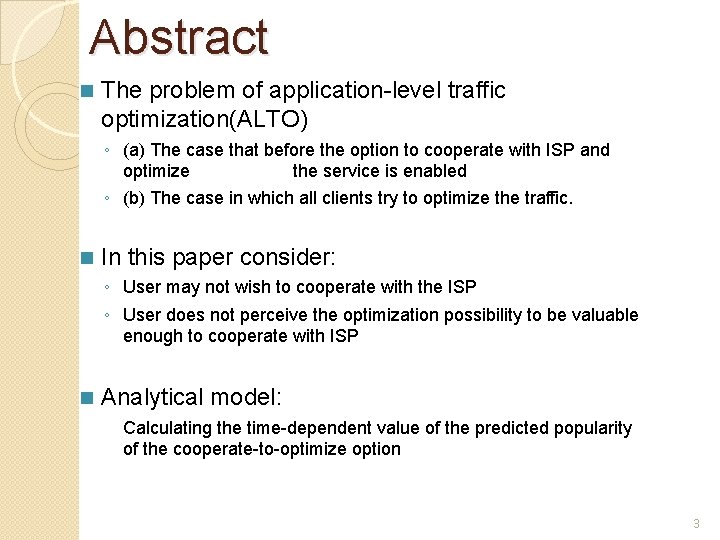
Abstract n The problem of application-level traffic optimization(ALTO) ◦ (a) The case that before the option to cooperate with ISP and optimize the service is enabled ◦ (b) The case in which all clients try to optimize the traffic. n In this paper consider: ◦ User may not wish to cooperate with the ISP ◦ User does not perceive the optimization possibility to be valuable enough to cooperate with ISP n Analytical model: Calculating the time-dependent value of the predicted popularity of the cooperate-to-optimize option 3
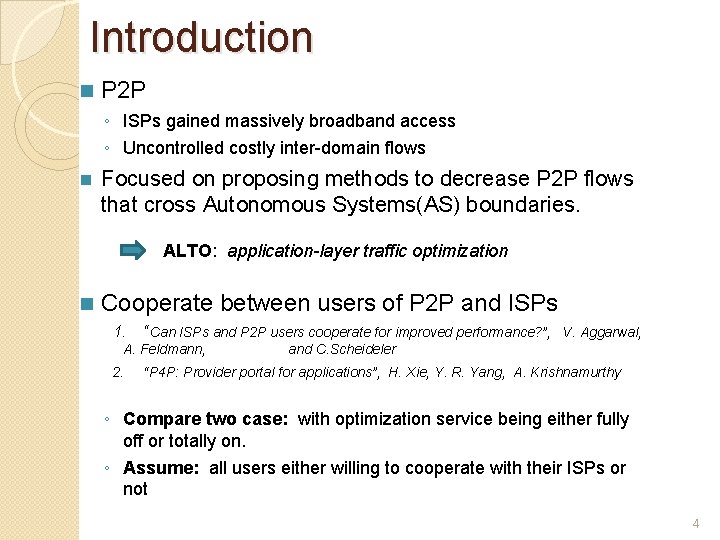
Introduction n P 2 P ◦ ISPs gained massively broadband access ◦ Uncontrolled costly inter-domain flows n Focused on proposing methods to decrease P 2 P flows that cross Autonomous Systems(AS) boundaries. ALTO: application-layer traffic optimization n Cooperate between users of P 2 P and ISPs 1. “Can ISPs and P 2 P users cooperate for improved performance? ”, V. Aggarwal, A. Feldmann, 2. and C. Scheideler “P 4 P: Provider portal for applications”, H. Xie, Y. R. Yang, A. Krishnamurthy ◦ Compare two case: with optimization service being either fully off or totally on. ◦ Assume: all users either willing to cooperate with their ISPs or not 4
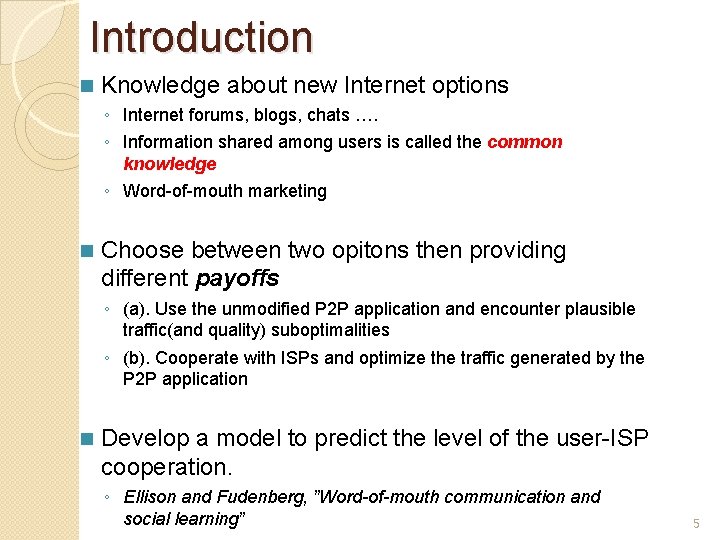
Introduction n Knowledge about new Internet options ◦ Internet forums, blogs, chats …. ◦ Information shared among users is called the common knowledge ◦ Word-of-mouth marketing n Choose between two opitons then providing different payoffs ◦ (a). Use the unmodified P 2 P application and encounter plausible traffic(and quality) suboptimalities ◦ (b). Cooperate with ISPs and optimize the traffic generated by the P 2 P application n Develop a model to predict the level of the user-ISP cooperation. ◦ Ellison and Fudenberg, ”Word-of-mouth communication and social learning” 5
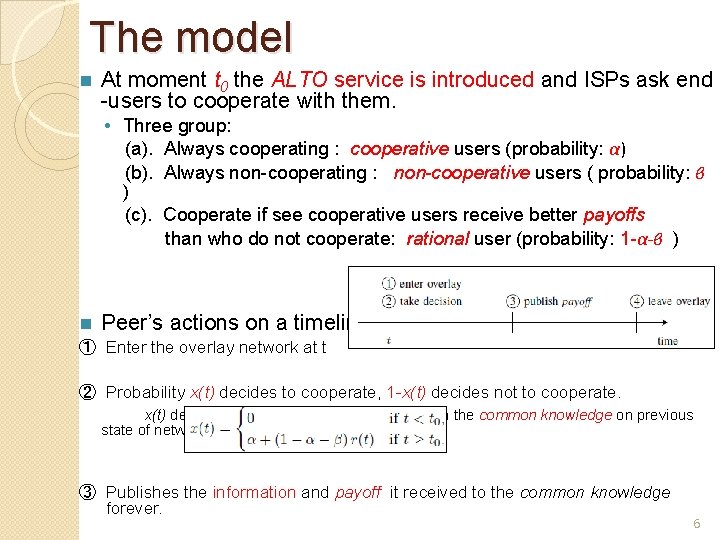
The model n At moment t 0 the ALTO service is introduced and ISPs ask end -users to cooperate with them. • Three group: (a). Always cooperating : cooperative users (probability: α) (b). Always non-cooperating : non-cooperative users ( probability: β ) (c). Cooperate if see cooperative users receive better payoffs than who do not cooperate: rational user (probability: 1 -α-β ) n Peer’s actions on a timeline ① Enter the overlay network at t ② Probability x(t) decides to cooperate, 1 -x(t) decides not to cooperate. x(t) depends on the N payoffs samples held in the common knowledge on previous state of network. ③ Publishes the information and payoff it received to the common knowledge forever. 6
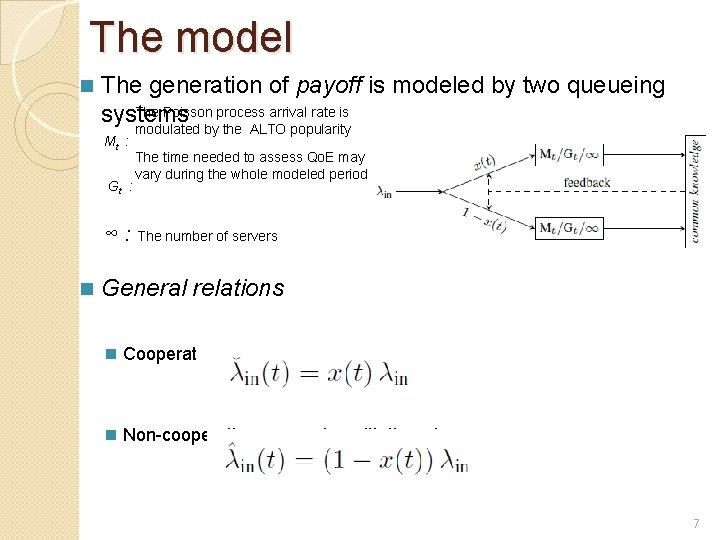
The model n The generation of payoff is modeled by two queueing The Poisson process arrival rate is systems Mt : Gt : ∞: n modulated by the ALTO popularity The time needed to assess Qo. E may vary during the whole modeled period The number of servers General relations n Cooperating user arrive with the rate n Non-cooperating user arrive with the rate 7
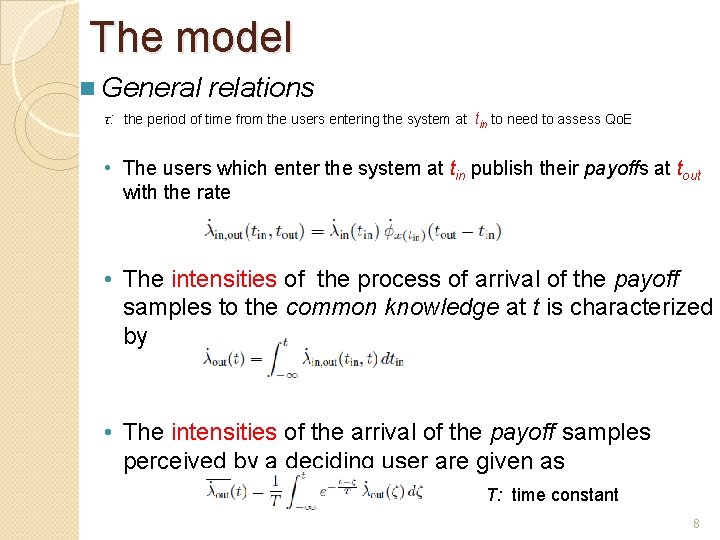
The model n General relations τ: the period of time from the users entering the system at tin to need to assess Qo. E • The users which enter the system at tin publish their payoffs at tout with the rate • The intensities of the process of arrival of the payoff samples to the common knowledge at t is characterized by • The intensities of the arrival of the payoff samples perceived by a deciding user are given as T: time constant 8
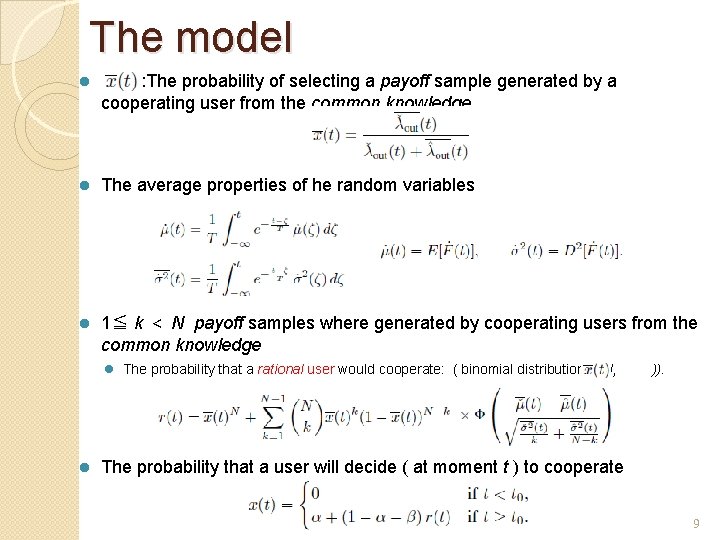
The model l : The probability of selecting a payoff sample generated by a cooperating user from the common knowledge l The average properties of he random variables l 1≦ k < N payoff samples where generated by cooperating users from the common knowledge l The probability that a rational user would cooperate: ( binomial distribution B(N, l )). The probability that a user will decide ( at moment t ) to cooperate 9
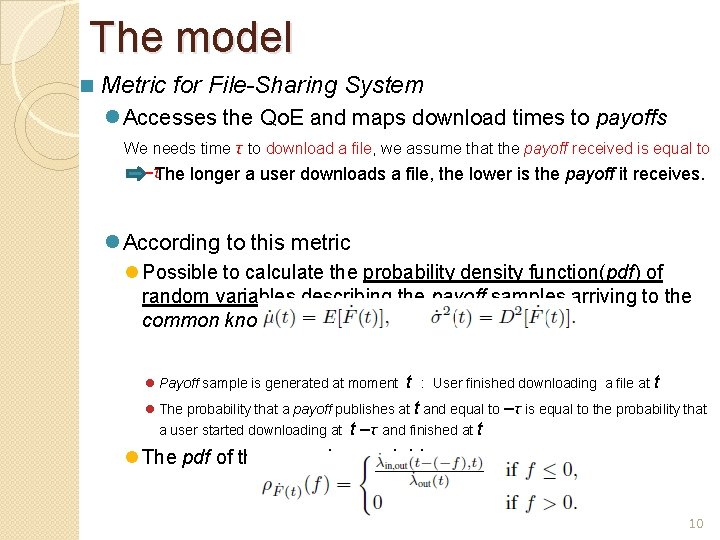
The model n Metric for File-Sharing System l Accesses the Qo. E and maps download times to payoffs We needs time τ to download a file, we assume that the payoff received is equal to –τThe longer a user downloads a file, the lower is the payoff it receives. l According to this metric l Possible to calculate the probability density function(pdf) of random variables describing the payoff samples arriving to the common knowledge l Payoff sample is generated at moment t : User finished downloading a file at t l The probability that a payoff publishes at t and equal to –τ is equal to the probability that a user started downloading at t –τ and finished at t l The pdf of these random variables 10
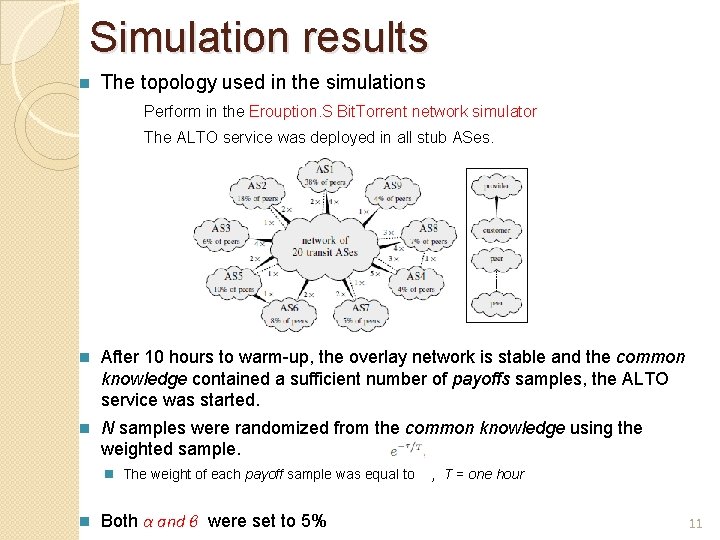
Simulation results n The topology used in the simulations Perform in the Erouption. S Bit. Torrent network simulator The ALTO service was deployed in all stub ASes. n After 10 hours to warm-up, the overlay network is stable and the common knowledge contained a sufficient number of payoffs samples, the ALTO service was started. n N samples were randomized from the common knowledge using the weighted sample. n The weight of each payoff sample was equal to n Both α and β were set to 5% , T = one hour 11
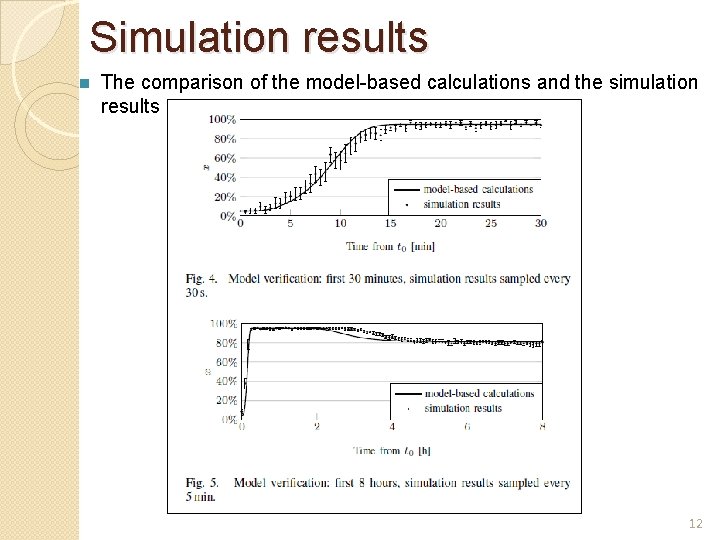
Simulation results n The comparison of the model-based calculations and the simulation results 12
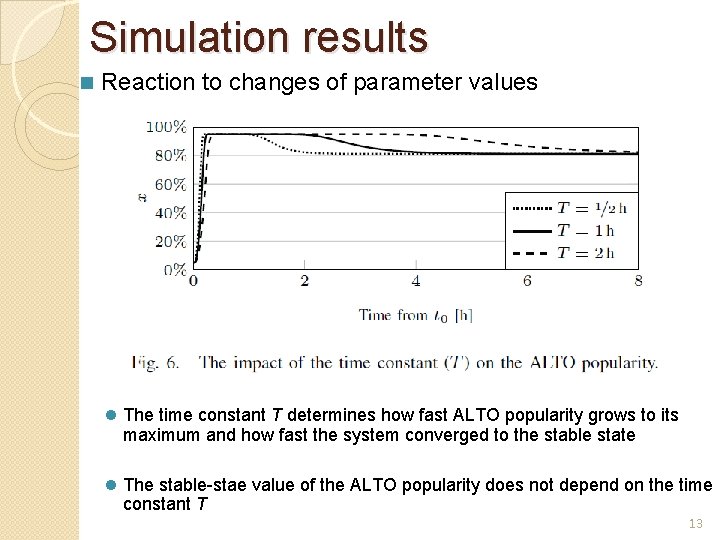
Simulation results n Reaction to changes of parameter values l The time constant T determines how fast ALTO popularity grows to its maximum and how fast the system converged to the stable state l The stable-stae value of the ALTO popularity does not depend on the time constant T 13
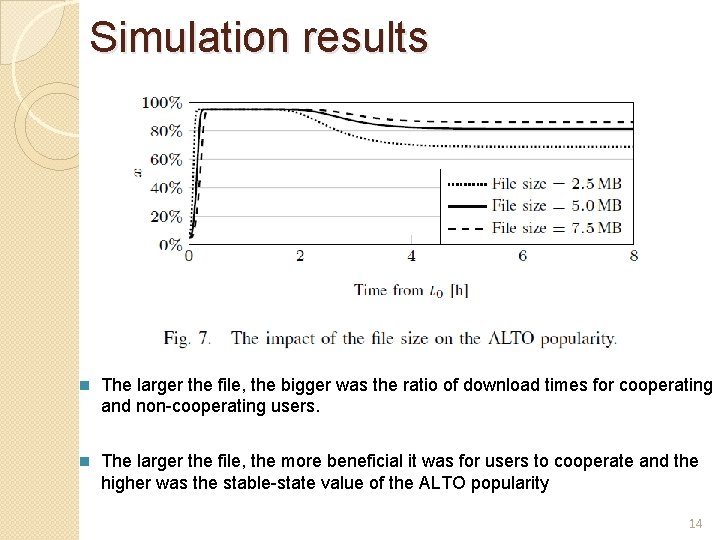
Simulation results n The larger the file, the bigger was the ratio of download times for cooperating and non-cooperating users. n The larger the file, the more beneficial it was for users to cooperate and the higher was the stable-state value of the ALTO popularity 14
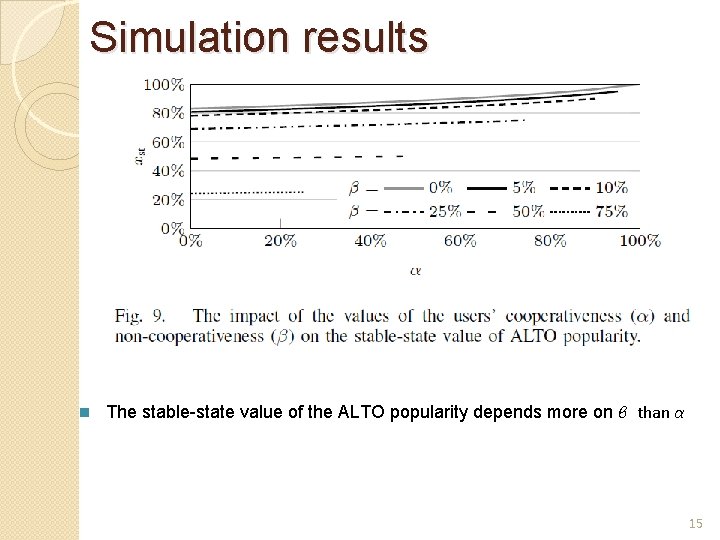
Simulation results n The stable-state value of the ALTO popularity depends more on β than α 15
Further Work n Not every user is aware of the possibility of optimization from t 0 nα should be varied over time. Provides a new service to its clients, it starts an advertising campaign to get the clients interested in the service. n. A user not only at its start to make decision. makes a decision periodically 16
Conclusion n By using a word-of-mouth communication model to calculate the popularity, if the users can be really interested in the ALTO-related cooperation, n Will P 2 P Users Cooperate with ISPs? n The output is not only an the optimistic fact, but also finding some general rules of the thumb (1). The share of cooperating users will be quite high and not dependent on the time horizon. (2). The more a user exploits P 2 P system, the easier it is to convince such a client to the cooperation. (3). In a long-run the only users who will not cooperate are the ones that are generally unwilling to cooperate; the rational or positive user will be convinced by performance improvement at last. 17