IS 2150 TEL 2810 Information Security Privacy James
- Slides: 29
IS 2150 / TEL 2810 Information Security & Privacy James Joshi Associate Professor, SIS Lecture 11 April 10, 2013 Information Privacy (Contributed by Amirreza Masoumzadeh) 1
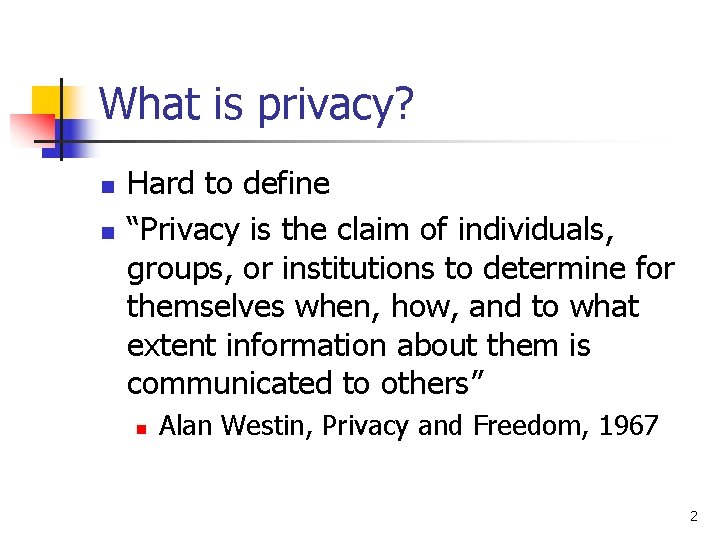
What is privacy? n n Hard to define “Privacy is the claim of individuals, groups, or institutions to determine for themselves when, how, and to what extent information about them is communicated to others” n Alan Westin, Privacy and Freedom, 1967 2
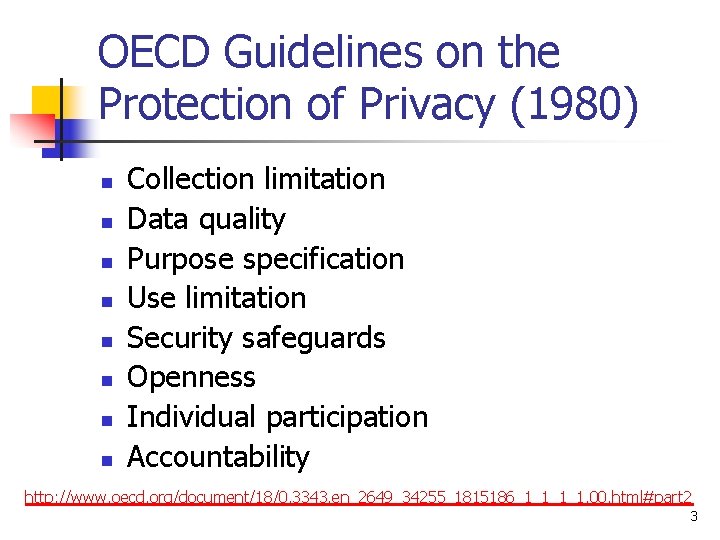
OECD Guidelines on the Protection of Privacy (1980) n n n n Collection limitation Data quality Purpose specification Use limitation Security safeguards Openness Individual participation Accountability http: //www. oecd. org/document/18/0, 3343, en_2649_34255_1815186_1_1, 00. html#part 2 3
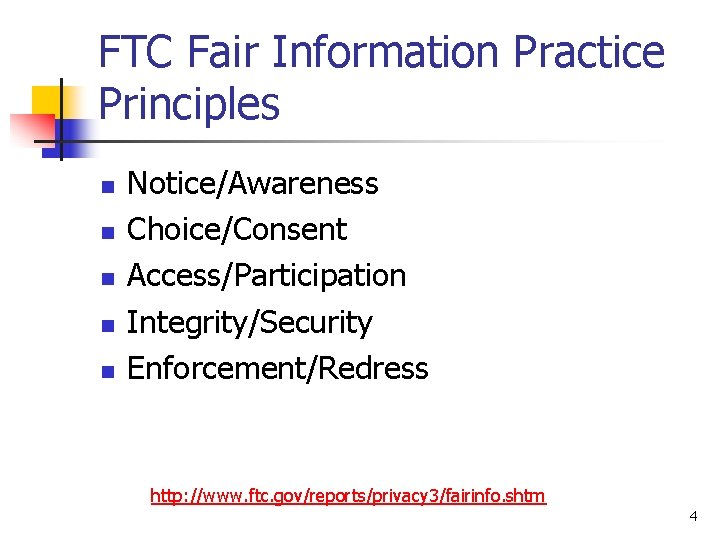
FTC Fair Information Practice Principles n n n Notice/Awareness Choice/Consent Access/Participation Integrity/Security Enforcement/Redress http: //www. ftc. gov/reports/privacy 3/fairinfo. shtm 4
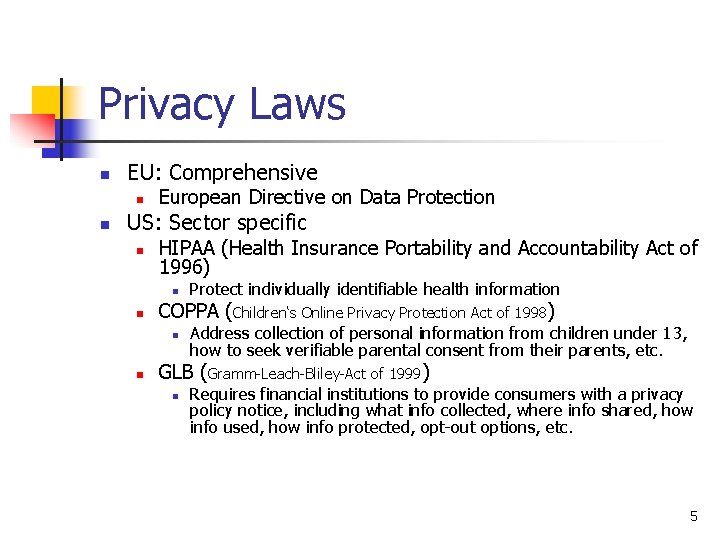
Privacy Laws n EU: Comprehensive n n European Directive on Data Protection US: Sector specific n HIPAA (Health Insurance Portability and Accountability Act of 1996) n n COPPA (Children‘s Online Privacy Protection Act of 1998) n n Protect individually identifiable health information Address collection of personal information from children under 13, how to seek verifiable parental consent from their parents, etc. GLB (Gramm-Leach-Bliley-Act of 1999) n Requires financial institutions to provide consumers with a privacy policy notice, including what info collected, where info shared, how info used, how info protected, opt-out options, etc. 5
Online Privacy Seal Programs (1) n Web. Trust n n n Developed by the American Institute of Certified Public Accountants and the Canadian Institute of Chartered Accountants Privacy standards established by the Online Privacy Alliance, the EU, and Canada with regard to business practices and information privacy, transaction integrity, and security TRUSTe n n n Founded by Electronic Frontier Foundation and Commerce. Net Consortium, Inc. Adherence to TRUSTe's privacy policies of disclosure, choice, access, and security Ongoing oversight and alternative dispute resolution processes http: //www. uschamber. com/issues/technology/online-privacy-seal-programs 6
Online Privacy Seal Programs (2) n BBBOn. Line n n n Developed by the Council of Better Business Bureaus Features verification, monitoring and review, consumer dispute resolution, enforcement mechanisms, and an educational component The Platform for Privacy Preferences (P 3 P) n n Developed by W 3 C Enables Websites to express their privacy practices in a standard format that can be retrieved automatically and interpreted easily by user agents 7
DATA ANONYMIZATION Some slides barrowed from Vitaly Shmatikov 8
Data Collection & Publishing n Health-care datasets n n Genetic datasets n n 1000 genome, Hap. Map, de. Code … Demographic datasets n n Clinical studies, hospital discharge databases … U. S. Census Bureau, sociology studies … Search logs, recommender systems, social networks, blogs … n AOL search data, social networks of blogging sites, Netflix movie ratings, Amazon … 9
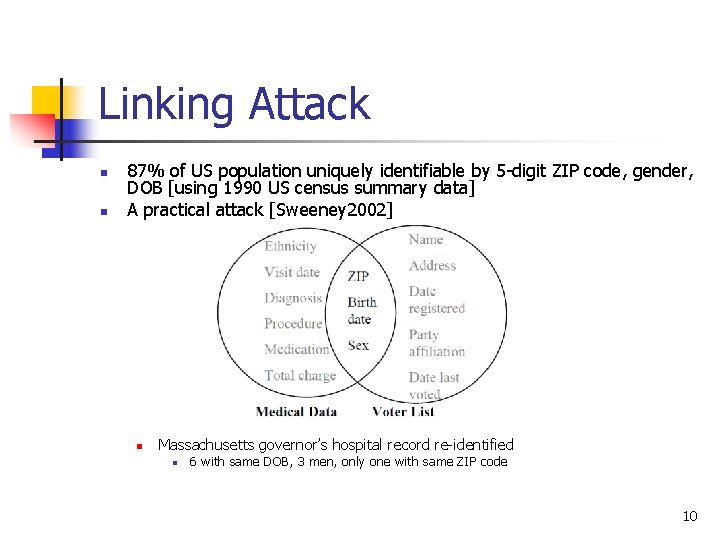
Linking Attack n n 87% of US population uniquely identifiable by 5 -digit ZIP code, gender, DOB [using 1990 US census summary data] A practical attack [Sweeney 2002] n Massachusetts governor’s hospital record re-identified n 6 with same DOB, 3 men, only one with same ZIP code 10
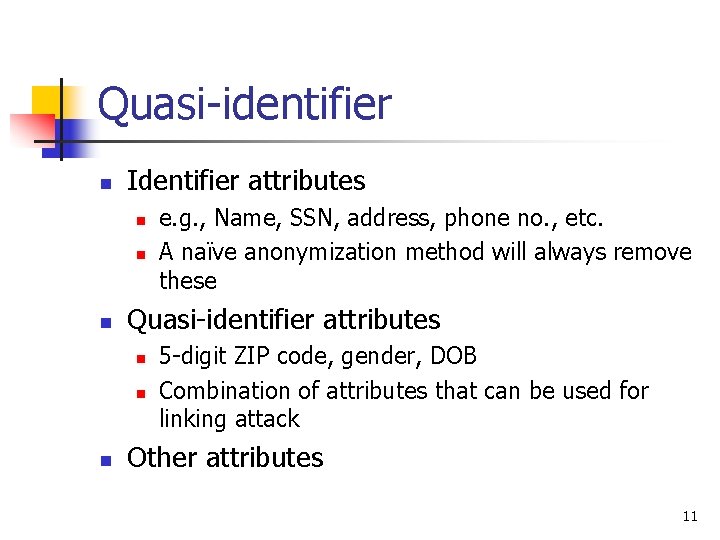
Quasi-identifier n Identifier attributes n n n Quasi-identifier attributes n n n e. g. , Name, SSN, address, phone no. , etc. A naïve anonymization method will always remove these 5 -digit ZIP code, gender, DOB Combination of attributes that can be used for linking attack Other attributes 11
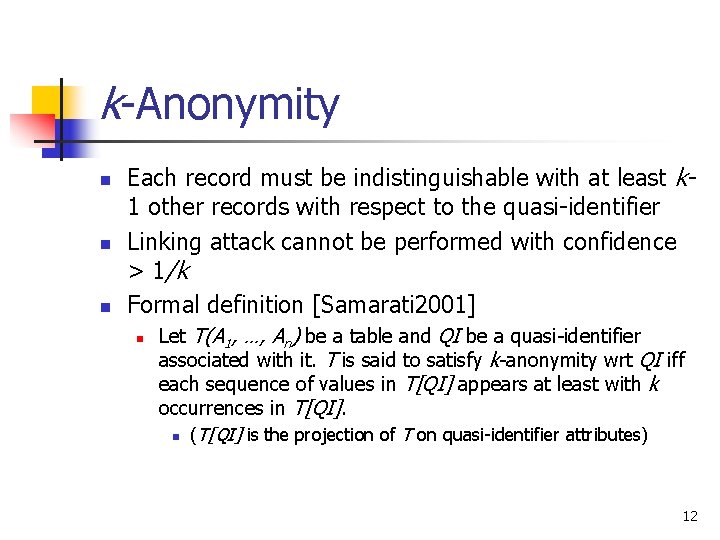
k-Anonymity n n n Each record must be indistinguishable with at least k 1 other records with respect to the quasi-identifier Linking attack cannot be performed with confidence > 1/k Formal definition [Samarati 2001] n Let T(A 1, …, An) be a table and QI be a quasi-identifier associated with it. T is said to satisfy k-anonymity wrt QI iff each sequence of values in T[QI] appears at least with k occurrences in T[QI]. n (T[QI] is the projection of T on quasi-identifier attributes) 12
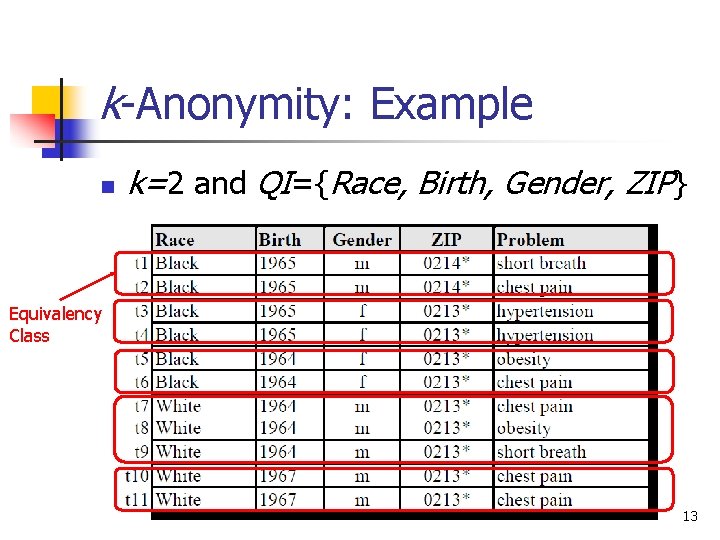
k-Anonymity: Example n k=2 and QI={Race, Birth, Gender, ZIP} Equivalency Class 13
Achieving k-Anonymity n Generalization n Replace specific quasi-identifiers with less specific values until get k identical values Partition ordered-value domains into intervals Suppression n n Remove some records When generalization causes too much information loss n n This is common with “outliers” Lots of algorithms in the literature n Aim to produce “useful” anonymizations … usually without any clear notion of utility 14
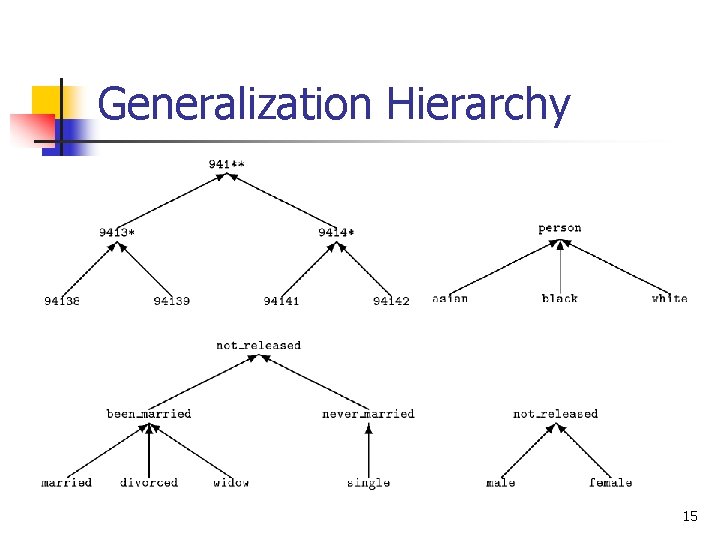
Generalization Hierarchy 15
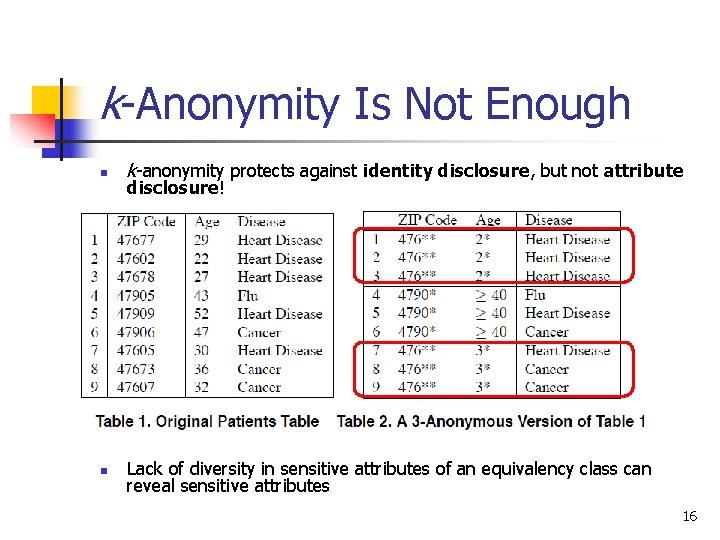
k-Anonymity Is Not Enough n k-anonymity protects against identity disclosure, but not attribute n Lack of diversity in sensitive attributes of an equivalency class can reveal sensitive attributes disclosure! 16
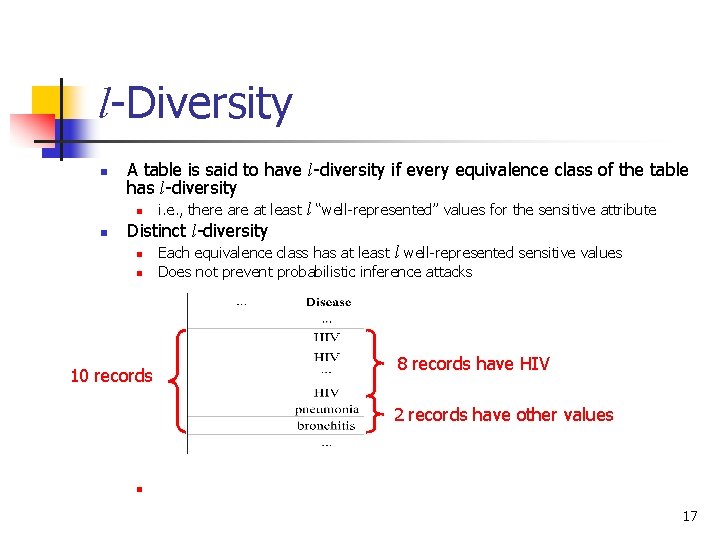
l-Diversity n n A table is said to have l-diversity if every equivalence class of the table has l-diversity n i. e. , there at least l “well-represented” values for the sensitive attribute Distinct l-diversity n Each equivalence class has at least l well-represented sensitive values n 10 records Does not prevent probabilistic inference attacks 8 records have HIV 2 records have other values n 17
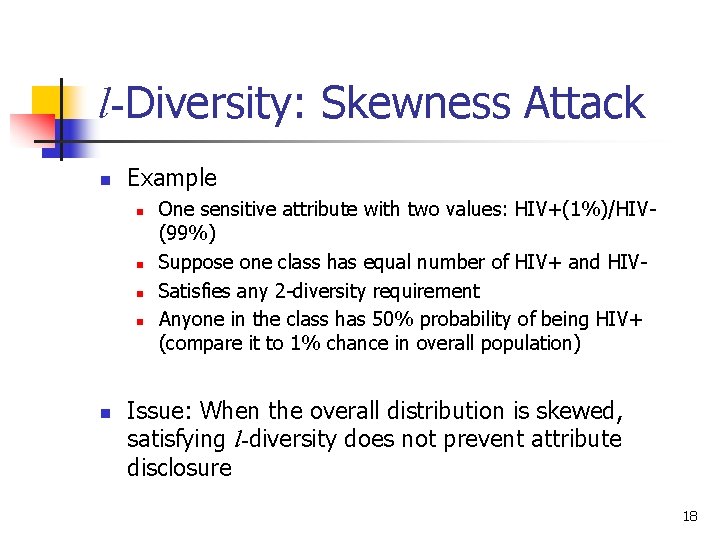
l-Diversity: Skewness Attack n Example n n n One sensitive attribute with two values: HIV+(1%)/HIV(99%) Suppose one class has equal number of HIV+ and HIVSatisfies any 2 -diversity requirement Anyone in the class has 50% probability of being HIV+ (compare it to 1% chance in overall population) Issue: When the overall distribution is skewed, satisfying l-diversity does not prevent attribute disclosure 18
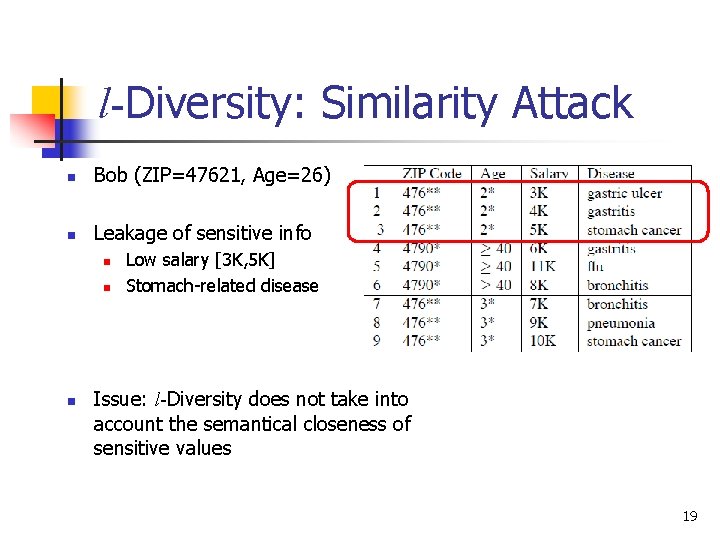
l-Diversity: Similarity Attack n Bob (ZIP=47621, Age=26) n Leakage of sensitive info n n n Low salary [3 K, 5 K] Stomach-related disease Issue: l-Diversity does not take into account the semantical closeness of sensitive values 19
PRIVACY IN LOCATIONBASED SERVICES 20
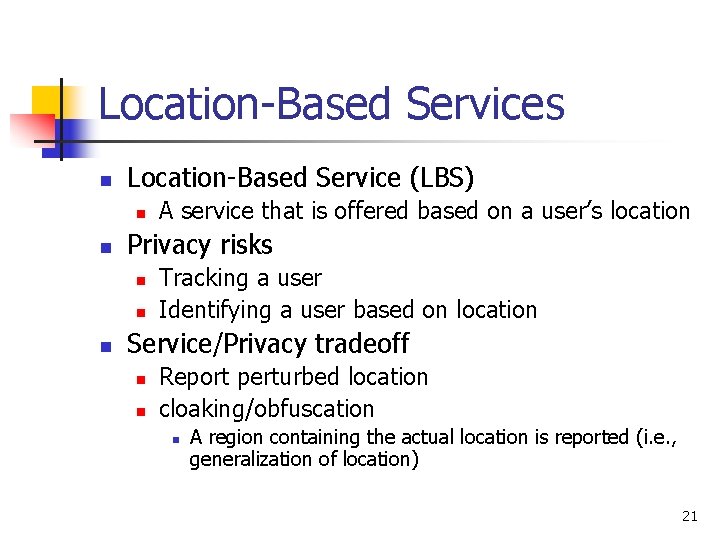
Location-Based Services n Location-Based Service (LBS) n n Privacy risks n n n A service that is offered based on a user’s location Tracking a user Identifying a user based on location Service/Privacy tradeoff n n Report perturbed location cloaking/obfuscation n A region containing the actual location is reported (i. e. , generalization of location) 21
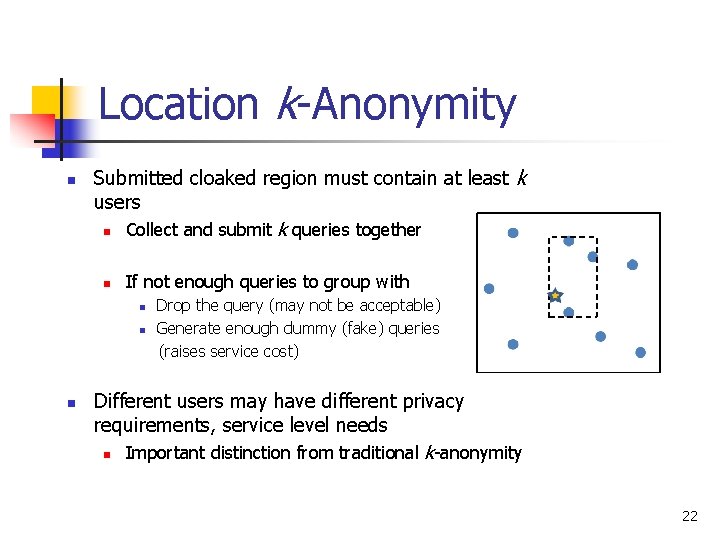
Location k-Anonymity n Submitted cloaked region must contain at least k users n Collect and submit k queries together n If not enough queries to group with n n n Drop the query (may not be acceptable) Generate enough dummy (fake) queries (raises service cost) Different users may have different privacy requirements, service level needs n Important distinction from traditional k-anonymity 22
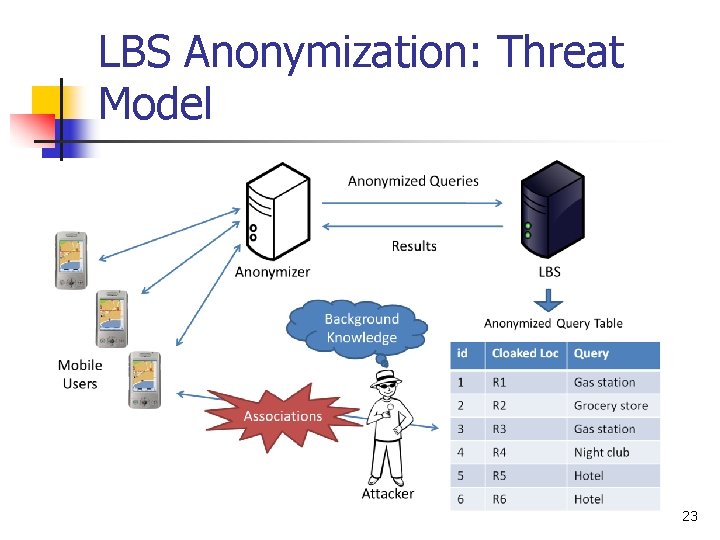
LBS Anonymization: Threat Model 23
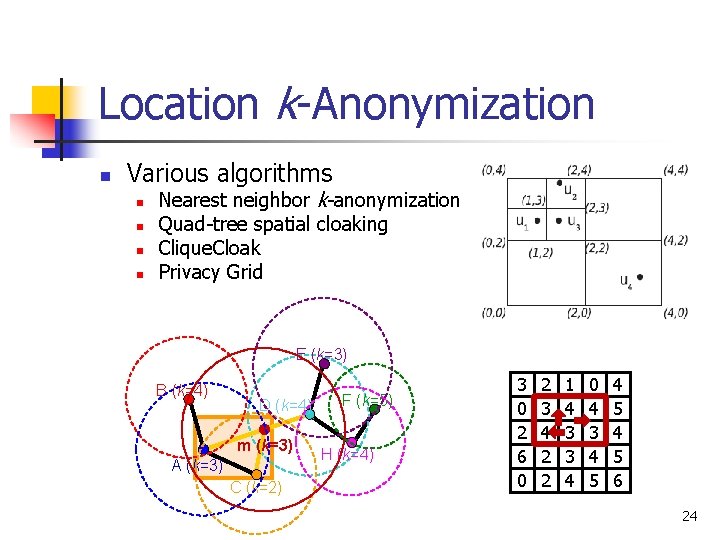
Location k-Anonymization n Various algorithms n n Nearest neighbor k-anonymization Quad-tree spatial cloaking Clique. Cloak Privacy Grid E (k=3) B (k=4) D (k=4) m (k=3) A (k=3) C (k=2) F (k=5) H (k=4) 3 0 2 6 0 2 3 4 2 2 1 4 3 3 4 0 4 3 4 5 4 5 6 24
PRIVACY IN SOCIAL NETWORKING SYSTEMS 25
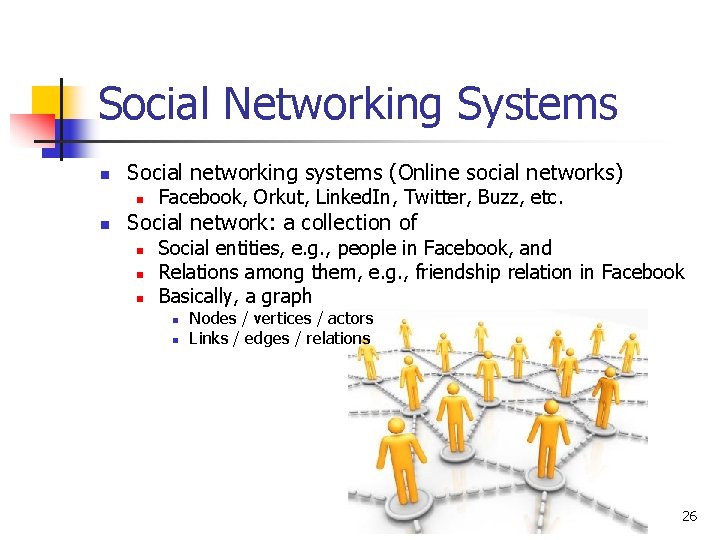
Social Networking Systems n Social networking systems (Online social networks) n n Facebook, Orkut, Linked. In, Twitter, Buzz, etc. Social network: a collection of n n n Social entities, e. g. , people in Facebook, and Relations among them, e. g. , friendship relation in Facebook Basically, a graph n n Nodes / vertices / actors Links / edges / relations 26
Users’ Challenges in Privacy Control n n Not enough control features Configuring a policy is a complicated task for an ordinary user n n Hundreds of just directly linked friends Magnitude of information objects: profile, status, posts, photos, etc. Third party apps Even if you have the tool and knowledge to use it, still hard to determine your ideal protection preferences! 27
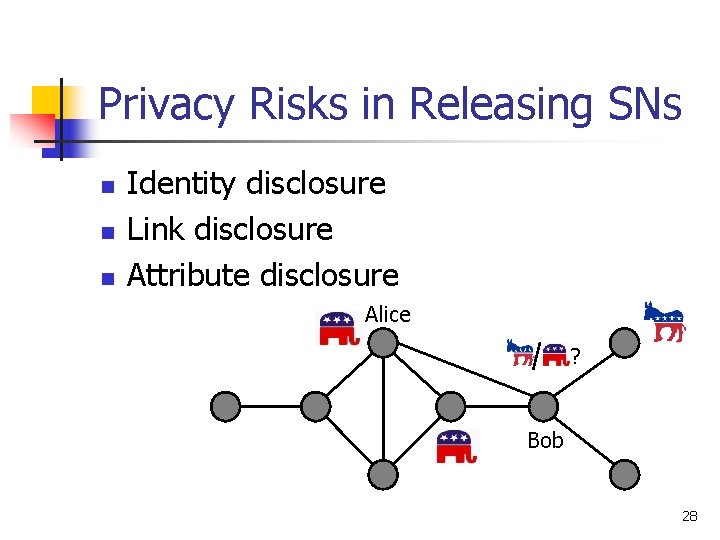
Privacy Risks in Releasing SNs n n n Identity disclosure Link disclosure Attribute disclosure Alice ? Bob 28
Social Network Anonymization n Generalization n n Cluster nodes, usually based on communities Replace a cluster with a hyper node Only report hyper nodes, incl. summarized structural properties, and their links Perturbation n Insert/delete edges in a network to meet a privacy goal such as n n n Degree k-anonymity Neighborhood k-anonymity Community k-anonymity 29