INTRODUCTION TO THE COURSE DAY 1 AUG 27



- Slides: 23
INTRODUCTION TO THE COURSE DAY 1, AUG. 27, 2012 Introduction to Syntax ANTH 3590/7590 Harry Howard Tulane University
OBJECTIVES 8/27/12 The purpose of this course is to introduce you to the philosophy and techniques of syntactic analysis as developed by Noam Chomsky and his followers. No knowledge of linguistics is presupposed, nor does one have to be adept at the kind of grammatical analysis taught in English classes. You do not even have to ‘speak right’. Everybody has a grammar in his or head which is worthy of study. ANTH 3590/7590, Harry Howard, Tulane 2
OUTCOMES For you to demonstrate your understanding of syntactic analysis, you will perform the following tasks: 8/27/12 ANTH 3590/7590, Harry Howard, Tulane Take a quiz almost every Monday. [(11 -1) * 7. 5% = 75%] Present a project on the final exam day. [25%] 3
QUIZZES [(11 -1) * 7. 5% = 75%] The quizzes are on Mondays, except where indicated, during the first 10 minutes of class, covering the material since the previous Monday. 8/27/12 ANTH 3590/7590, Harry Howard, Tulane No make-up quizzes will be given, but I will automatically drop your lowest grade. If you notify me by email ahead of time of a scheduled absence, I will not hold it against you. 4
FINAL PROJECT [25%] The project is to be presented to the class on the final exam day, Mon, Dec 17, 8 am-12. 8/27/12 The topic is anything that interests you about syntax. You may do it in a group, but everyone in the group gets the same grade. We will talk more about this half-way through the semester. ANTH 3590/7590, Harry Howard, Tulane You CANNOT leave town before then! Tell your parents NOW! You are hereby warned. Do not tell me at the end of the semester that your parents bought you a ticket home without knowing. 5
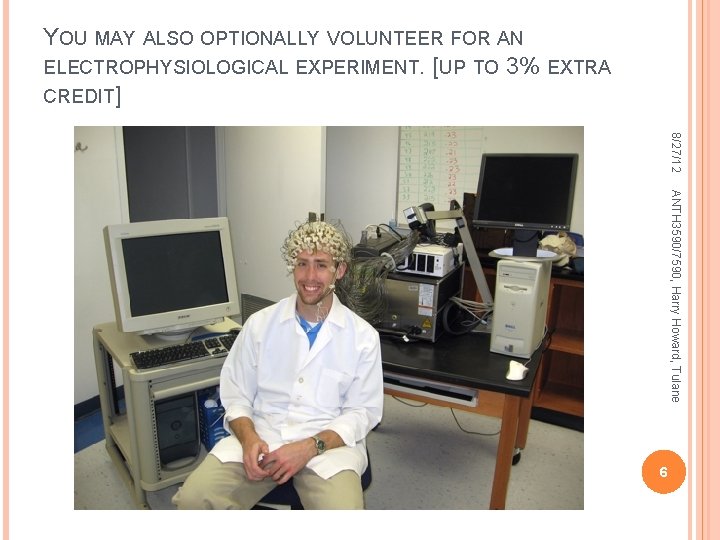
YOU MAY ALSO OPTIONALLY VOLUNTEER FOR AN ELECTROPHYSIOLOGICAL EXPERIMENT. [UP TO 3% EXTRA CREDIT] 8/27/12 ANTH 3590/7590, Harry Howard, Tulane 6
CLASS PARTICIPATION There is no credit for class participation … but I will change a Y- into a X+ if I notice you participating in class. ANTH 3590/7590, Harry Howard, Tulane 8/27/12 Why no class participation? I will post my Power. Point presentation to the course website after every class. I will record myself and post the recordings as mp 3 s to the course website. http: //www. tulane. edu/~howard/ANTH 3590/ We will work out many of the exercises on the board, but I have no way of reproducing that electronically. 7
CODE OF ACADEMIC INTEGRITY ANTH 3590/7590, Harry Howard, Tulane “The integrity of Newcomb-Tulane College is based on the absolute honesty of the entire community in all academic endeavors. As part of the Tulane University community, students have certain responsibilities regarding work that forms the basis for the evaluation of their academic achievement. Students are expected to be familiar with these responsibilities at all times. No member of the university community should tolerate any form of academic dishonesty, because the scholarly community of the university depends on the willingness of both instructors and students to uphold the Code of Academic Conduct. When a violation of the Code of Academic Conduct is observed it is the duty of every member of the academic community who has evidence of the violation to take action. Students should take steps to uphold the code by reporting any suspected offense to the instructor or the associate dean of the college. Students should under no circumstances tolerate any form of academic dishonesty. ” For further information, point your browser at http: //college. tulane. edu/honorcode. htm. 8/27/12 8
STUDENTS WITH DISABILITIES Students with disabilities who need academic accommodation should: 8/27/12 ANTH 3590/7590, Harry Howard, Tulane Contact and register with the Office of Disability Services (ODS). For more information, visit the ODS website at http: //erc. tulane. edu/disability/. Bring official notice to me from the ODS indicating that you need academic accommodation. This should be done before the first quiz. 9
SCHEDULE Textbook: Andrew Radford (2009) English Sentence Structure. should come to class having read and mulled over the pages listed for that day in the schedule. We will cover 10 to 15 pages a day. There may be supplementary readings, distributed as pdf files on Blackboard. Any changes to the schedule will be made to http: //www. tulane. edu/~howard/ANTH 3590/7590, Harry Howard, Tulane You 8/27/12 10
ELECTRONIC COMMUNICATIONS If you want to use a non-Tulane address, e-mail me a message to that effect from the address. ANTH 3590/7590, Harry Howard, Tulane will send you e-mail on a regular basis – you must check your e-mail on a regular basis! 8/27/12 I 11
8/27/12 12 ANTH 3590/7590, Harry Howard, Tulane WHO WE ARE
ME 8/27/12 ANTH 3590/7590, Harry Howard, Tulane Prof. Harry Howard howard at tulane dot edu 862 -3417 (voice mail 24 hours a day) Newcomb Hall 322 -D Office hours: MW 1 -2, T 4 -5 & by appointment 13
WHO ARE YOU? Everyone interview a person sitting near you to find out: or her name and major Where he or she is from What he or she knows about linguistics What language he or she knows ANTH 3590/7590, Harry Howard, Tulane His 8/27/12 14
8/27/12 15 The study of word order. Its unit of study is bigger than a single word, but smaller than a text. That is to say, it is concerned with individual sentences. ANTH 3590/7590, Harry Howard, Tulane WHAT IS SYNTAX?
DESCRIBE THIS IMAGE IN A SENTENCE ANTH 3590/7590, Harry Howard, Tulane Mary 8/27/12 John 16
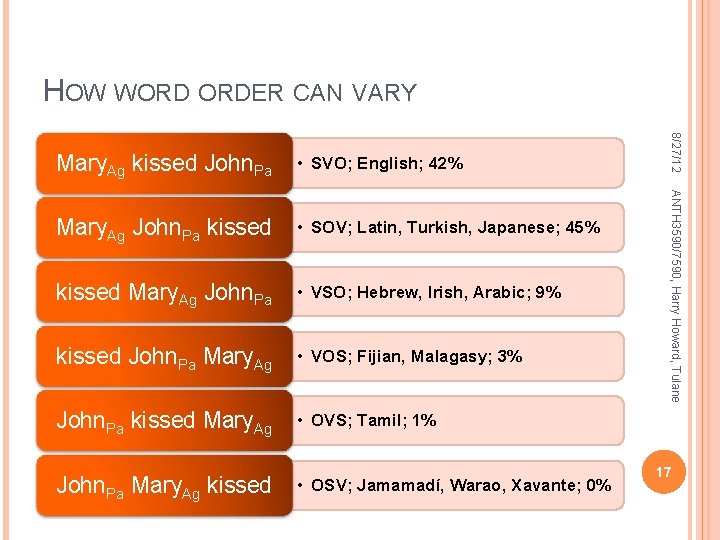
HOW WORD ORDER CAN VARY Mary. Ag John. Pa kissed • SOV; Latin, Turkish, Japanese; 45% kissed Mary. Ag John. Pa • VSO; Hebrew, Irish, Arabic; 9% kissed John. Pa Mary. Ag • VOS; Fijian, Malagasy; 3% John. Pa kissed Mary. Ag • OVS; Tamil; 1% John. Pa Mary. Ag kissed • OSV; Jamamadí, Warao, Xavante; 0% ANTH 3590/7590, Harry Howard, Tulane • SVO; English; 42% 8/27/12 Mary. Ag kissed John. Pa 17
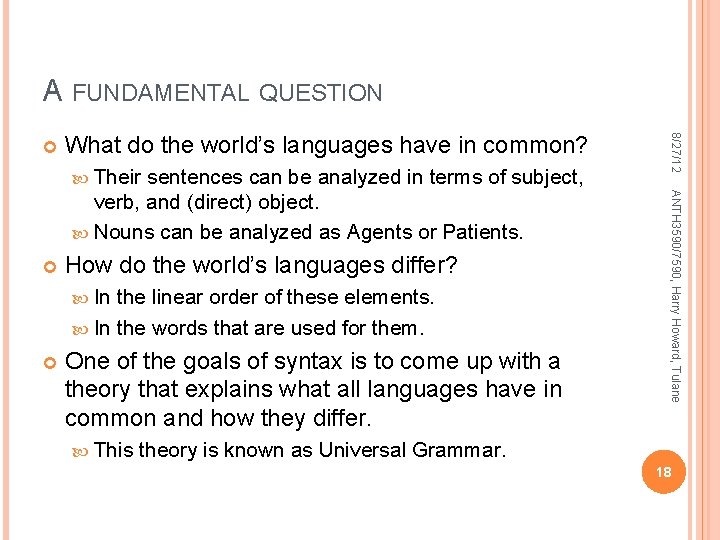
A FUNDAMENTAL QUESTION What do the world’s languages have in common? Their How do the world’s languages differ? In the linear order of these elements. In the words that are used for them. One of the goals of syntax is to come up with a theory that explains what all languages have in common and how they differ. This ANTH 3590/7590, Harry Howard, Tulane sentences can be analyzed in terms of subject, verb, and (direct) object. Nouns can be analyzed as Agents or Patients. 8/27/12 theory is known as Universal Grammar. 18
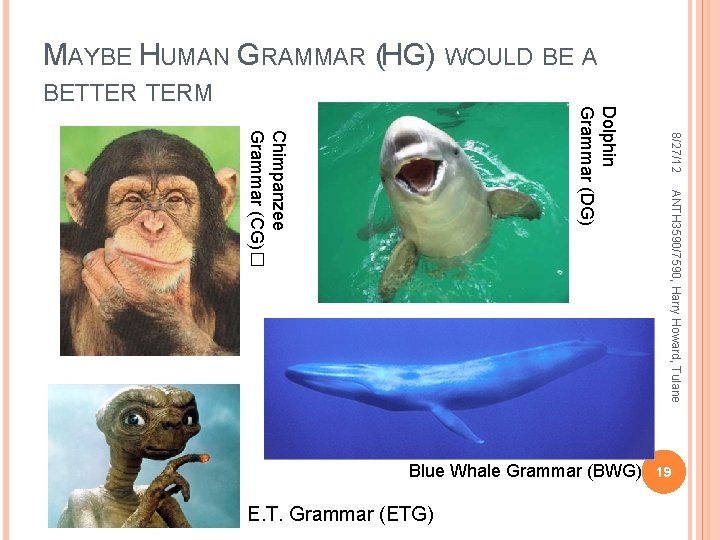
MAYBE HUMAN GRAMMAR (HG) WOULD BE A E. T. Grammar (ETG) ANTH 3590/7590, Harry Howard, Tulane Blue Whale Grammar (BWG) 8/27/12 Chimpanzee Grammar (CG)� Dolphin Grammar (DG) BETTER TERM 19
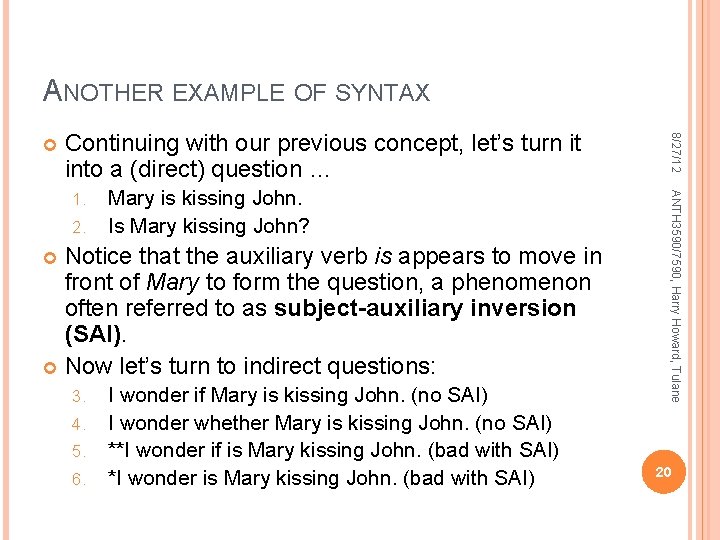
ANOTHER EXAMPLE OF SYNTAX Continuing with our previous concept, let’s turn it into a (direct) question … 2. Mary is kissing John. Is Mary kissing John? Notice that the auxiliary verb is appears to move in front of Mary to form the question, a phenomenon often referred to as subject-auxiliary inversion (SAI). Now let’s turn to indirect questions: 3. 4. 5. 6. I wonder if Mary is kissing John. (no SAI) I wonder whether Mary is kissing John. (no SAI) **I wonder if is Mary kissing John. (bad with SAI) *I wonder is Mary kissing John. (bad with SAI) ANTH 3590/7590, Harry Howard, Tulane 1. 8/27/12 20
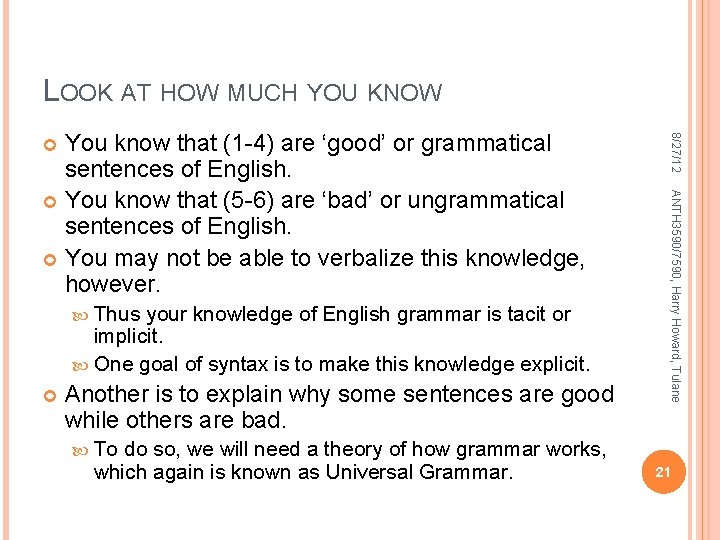
LOOK AT HOW MUCH YOU KNOW your knowledge of English grammar is tacit or implicit. One goal of syntax is to make this knowledge explicit. Another is to explain why some sentences are good while others are bad. do so, we will need a theory of how grammar works, which again is known as Universal Grammar. ANTH 3590/7590, Harry Howard, Tulane Thus 8/27/12 You know that (1 -4) are ‘good’ or grammatical sentences of English. You know that (5 -6) are ‘bad’ or ungrammatical sentences of English. You may not be able to verbalize this knowledge, however. To 21
8/27/12 22 Go over vocabulary in bold face ANTH 3590/7590, Harry Howard, Tulane § 1. 2 TRADITIONAL GRAMMAR
8/27/12 23 UG, FL Radford § 1. 3 - § 1. 5 ANTH 3590/7590, Harry Howard, Tulane NEXT TIME