Introduction to Data Science Lecture 5 Data Integration



- Slides: 27
Introduction to Data Science Lecture 5 Data Integration CS 194 Spring 2014 Michael Franklin Dan Bruckner, Evan Sparks, Shivaram Venkataraman
Outline for this Evening • • Guest Lecture – Josh Wills, Cloudera Q&A with Josh Break Class Lecture • Challenges in Data Integration • Schema Matching • Entity Resolution • Exercise – Joins and Similarity Joins with Pandas (Evan: Tutorial and Lab) • Review of exercise
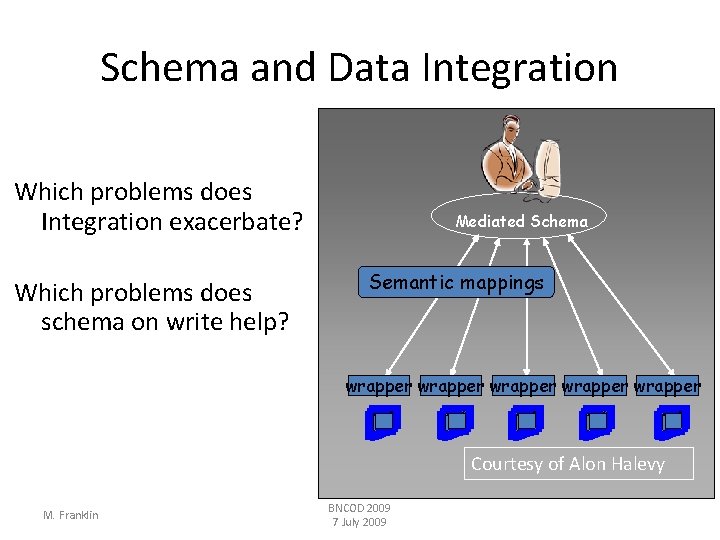
Schema and Data Integration Which problems does Integration exacerbate? Which problems does schema on write help? Mediated Schema Semantic mappings wrapper wrapper Courtesy of Alon Halevy M. Franklin BNCOD 2009 7 July 2009
Data Integration • Combine data sets (acquisitions, across departments). • Common source of problems – Heterogenous data : no common key, different field formats • Approximate matching – Different definitions • What is a customer: an account, an individual, a family, … – Time synchronization • Does the data relate to the same time periods? Are the time windows compatible? – Legacy data • IMS, spreadsheets, ad-hoc structures Adapted from Ted Johnson’s SIGMOD 2003 Tutorial
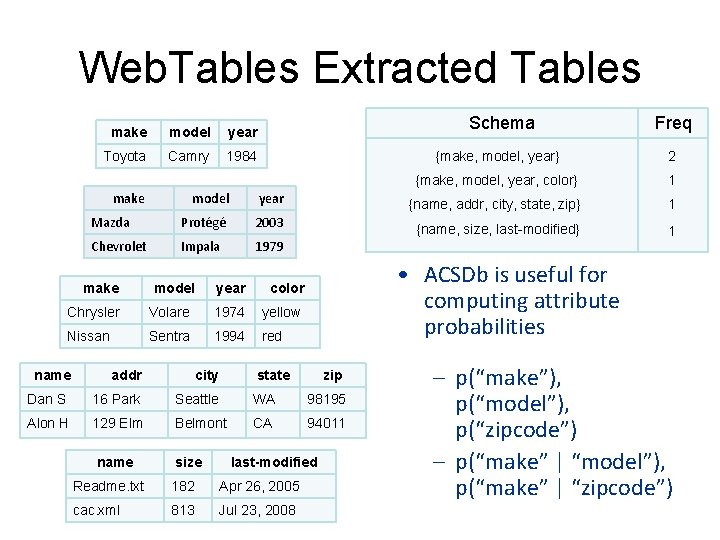
Schema Matching • Original Problem: merge structured databases • But, even in a looser schema (e. g. No. SQL) world structural matching matters • Web. Tables paper shows an extreme version of this • 2. 6 M Unique schemas (appear >1 time) • 5. 4 M Unique attribute (field) names (>1 time) • Found by web crawling/scraping (more on this next time)
ACSDb Recovered Relations Web. Tables Extracted Tables make model year Toyota Camry 1984 make Schema {make, model, year} 2 {make, model, year, color} 1 model year {name, addr, city, state, zip} 1 Mazda Protégé 2003 {name, size, last-modified} Chevrolet Impala 1979 1 make model year color Chrysler Volare 1974 yellow Nissan Sentra 1994 red name Freq • ACSDb is useful for computing attribute probabilities addr city Dan S 16 Park Seattle WA 98195 Alon H 129 Elm Belmont CA 94011 name size state zip last-modified Readme. txt 182 Apr 26, 2005 cac. xml 813 Jul 23, 2008 – p(“make”), p(“model”), p(“zipcode”) – p(“make” | “model”), p(“make” | “zipcode”)
ACSDb* Applications • Schema Auto Complete • Attribute Synonym-Finding • Join Graph Traversal *Attribute correlation statistics database
MATCHING: DATA AND STRUCTURE
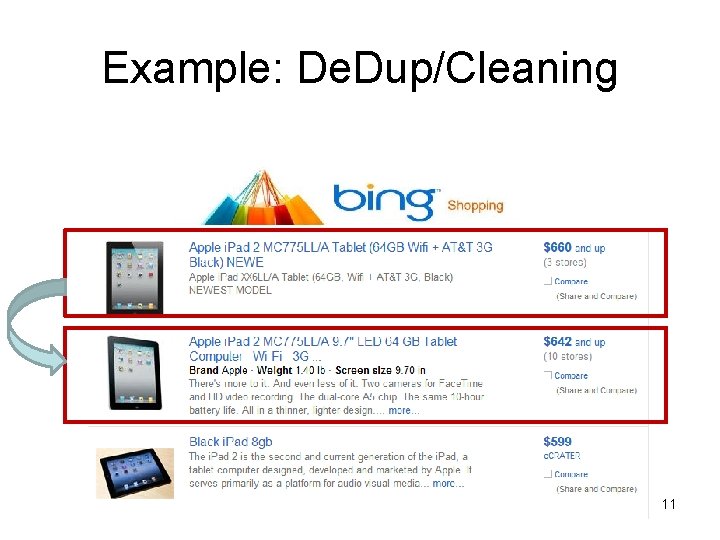
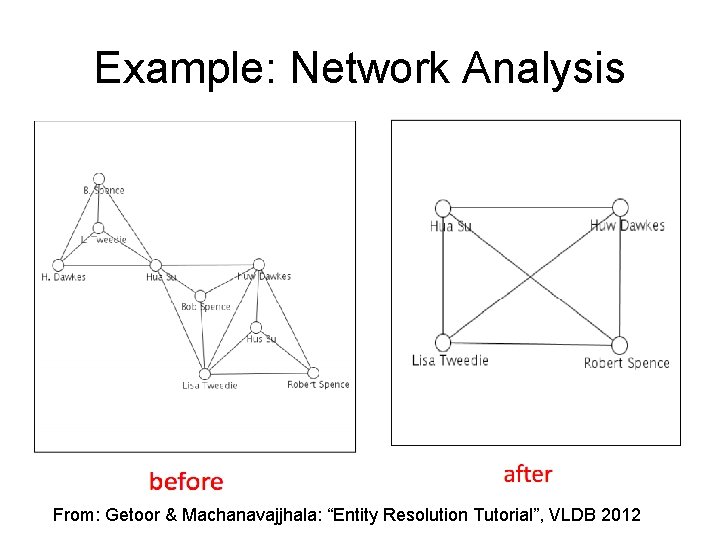
Duplicate Record Detection needs De. Dup! • Resolve multiple different mentions: • Entity Resolution • Reference Reconciliation • Object Identification/Consolidation • Remove Duplicates • Merge/Purge • • Record Linking (across data sources) Householding (interesting special case) Approximate Match (accept fuzziness) …
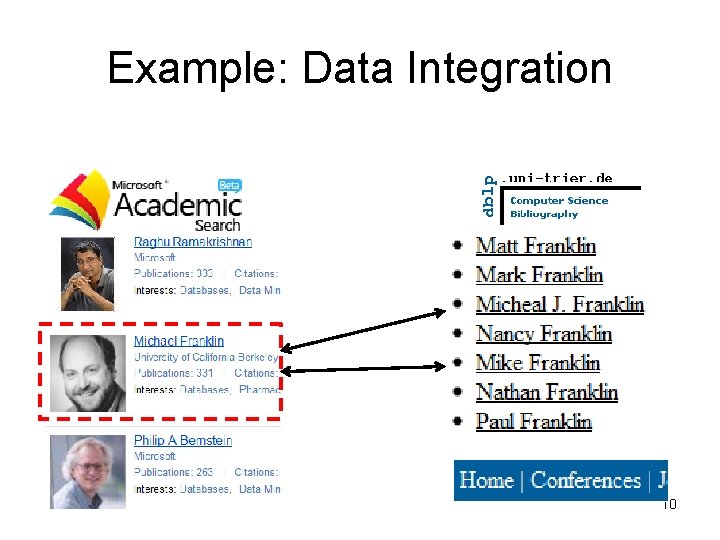
Example: Data Integration 10
Example: De. Dup/Cleaning 11
Example: Network Analysis From: Getoor & Machanavajjhala: “Entity Resolution Tutorial”, VLDB 2012
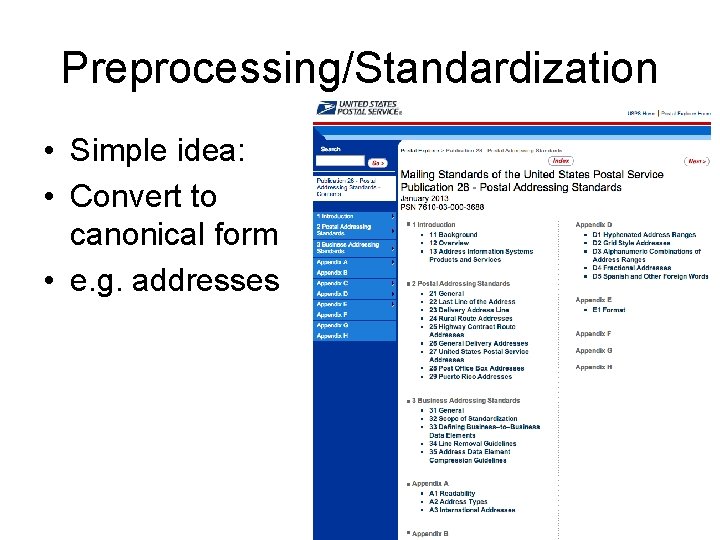
Preprocessing/Standardization • Simple idea: • Convert to canonical form • e. g. addresses
More Complicated: Householding • Different people in same house?
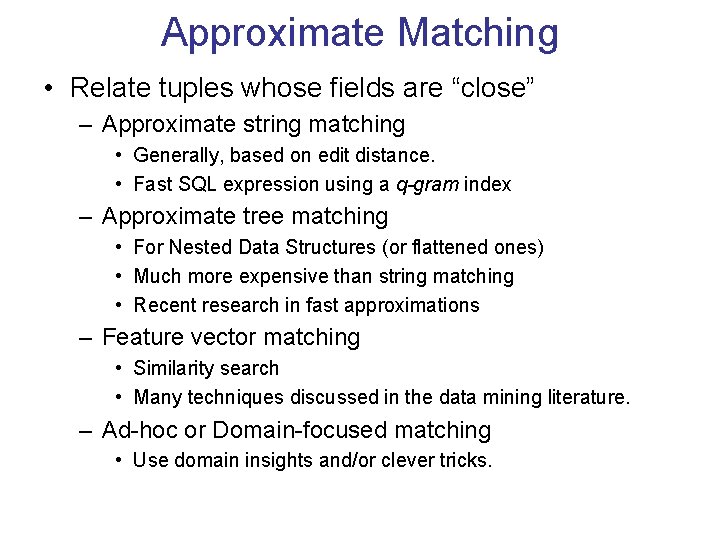
Approximate Matching • Relate tuples whose fields are “close” – Approximate string matching • Generally, based on edit distance. • Fast SQL expression using a q-gram index – Approximate tree matching • For Nested Data Structures (or flattened ones) • Much more expensive than string matching • Recent research in fast approximations – Feature vector matching • Similarity search • Many techniques discussed in the data mining literature. – Ad-hoc or Domain-focused matching • Use domain insights and/or clever tricks.
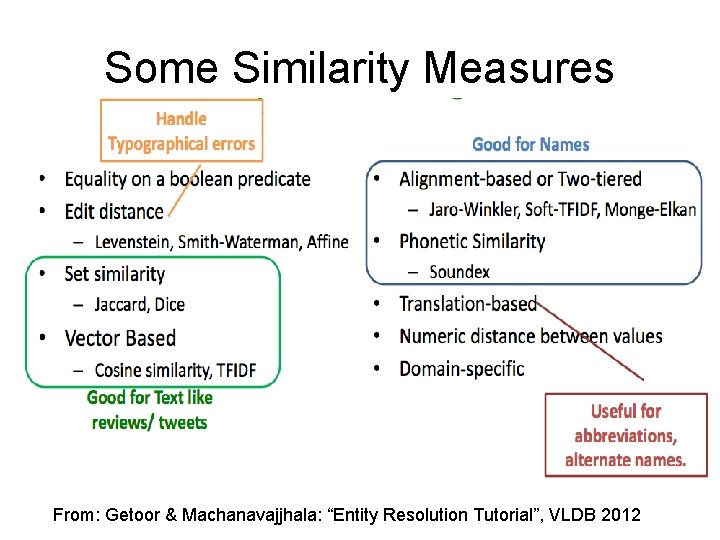
Some Similarity Measures From: Getoor & Machanavajjhala: “Entity Resolution Tutorial”, VLDB 2012
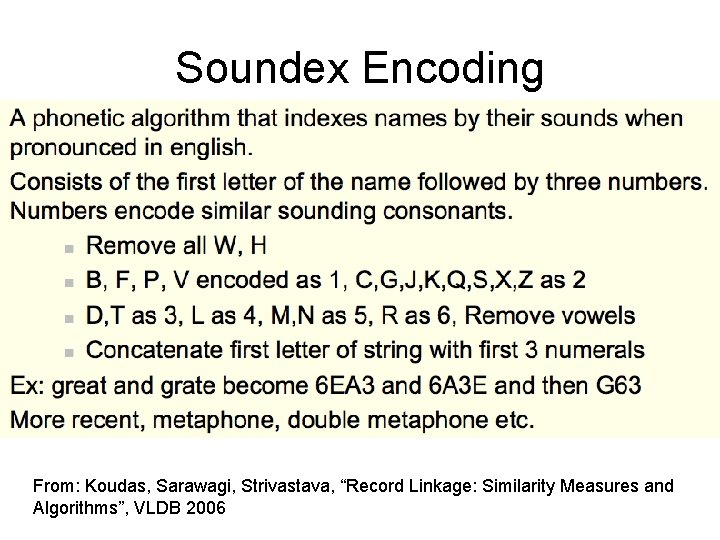
Soundex Encoding From: Koudas, Sarawagi, Strivastava, “Record Linkage: Similarity Measures and Algorithms”, VLDB 2006
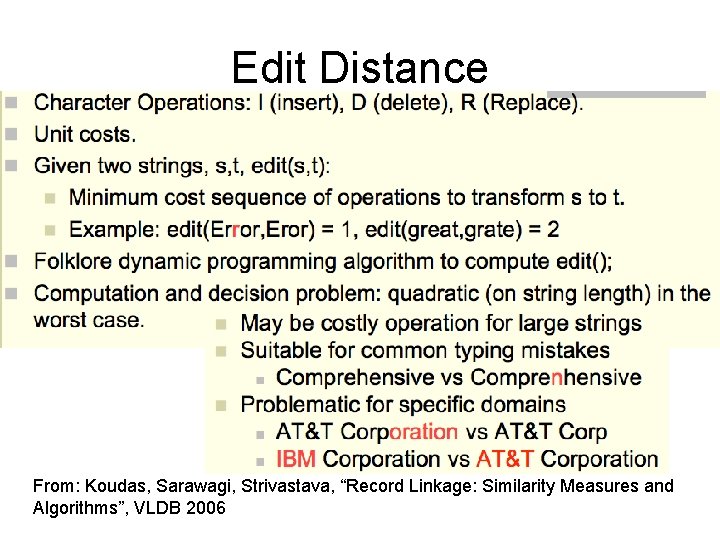
Edit Distance From: Koudas, Sarawagi, Strivastava, “Record Linkage: Similarity Measures and Algorithms”, VLDB 2006
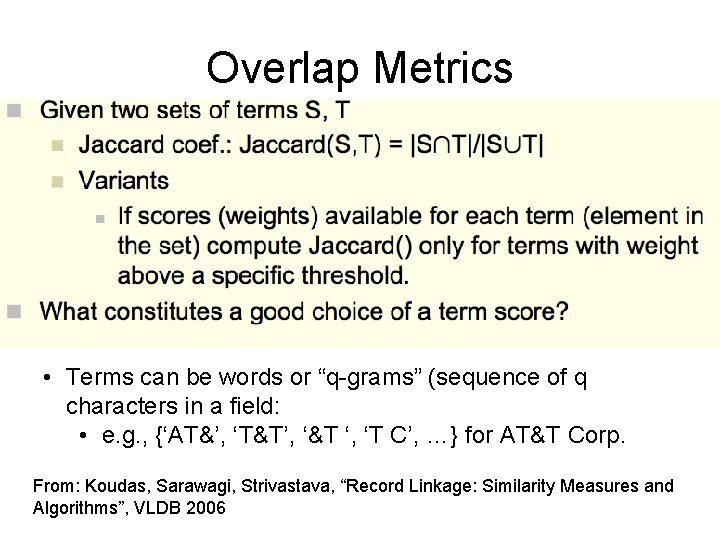
Overlap Metrics • Terms can be words or “q-grams” (sequence of q characters in a field: • e. g. , {‘AT&’, ‘T&T’, ‘&T ‘, ‘T C’, …} for AT&T Corp. From: Koudas, Sarawagi, Strivastava, “Record Linkage: Similarity Measures and Algorithms”, VLDB 2006
More Sophisticated Techniques • Evidence from multiple fields – Postitive and Negative are possible • Evidence from linkage pattern with other records • Clustering-based approaches • …
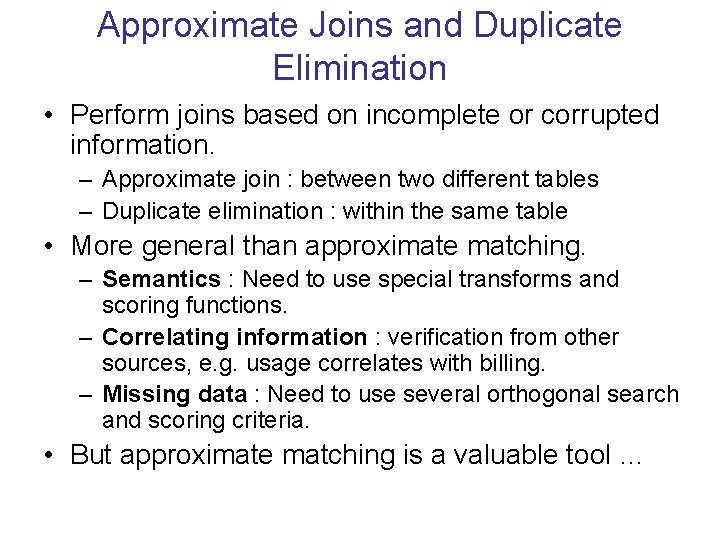
Approximate Joins and Duplicate Elimination • Perform joins based on incomplete or corrupted information. – Approximate join : between two different tables – Duplicate elimination : within the same table • More general than approximate matching. – Semantics : Need to use special transforms and scoring functions. – Correlating information : verification from other sources, e. g. usage correlates with billing. – Missing data : Need to use several orthogonal search and scoring criteria. • But approximate matching is a valuable tool …
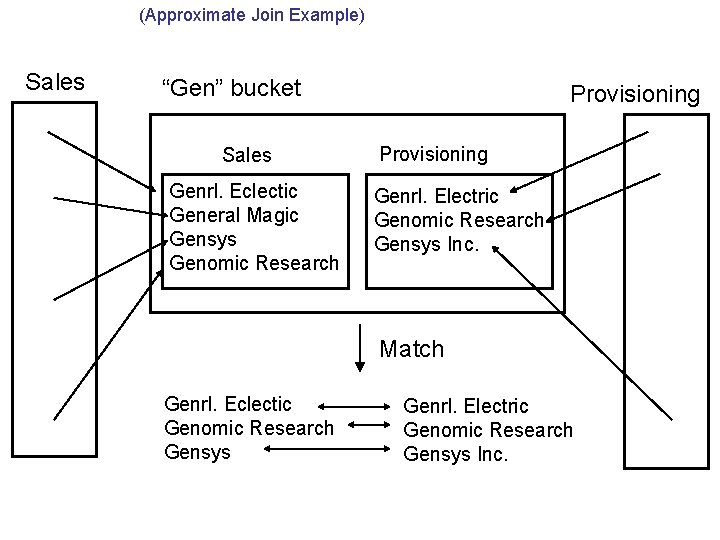
(Approximate Join Example) Sales “Gen” bucket Sales Genrl. Eclectic General Magic Gensys Genomic Research Provisioning Genrl. Electric Genomic Research Gensys Inc. Match Genrl. Eclectic Genomic Research Gensys Genrl. Electric Genomic Research Gensys Inc.
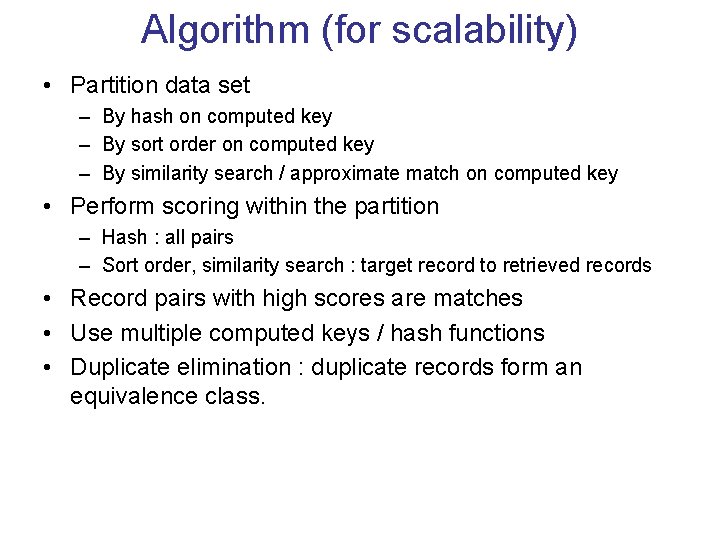
Algorithm (for scalability) • Partition data set – By hash on computed key – By sort order on computed key – By similarity search / approximate match on computed key • Perform scoring within the partition – Hash : all pairs – Sort order, similarity search : target record to retrieved records • Record pairs with high scores are matches • Use multiple computed keys / hash functions • Duplicate elimination : duplicate records form an equivalence class.
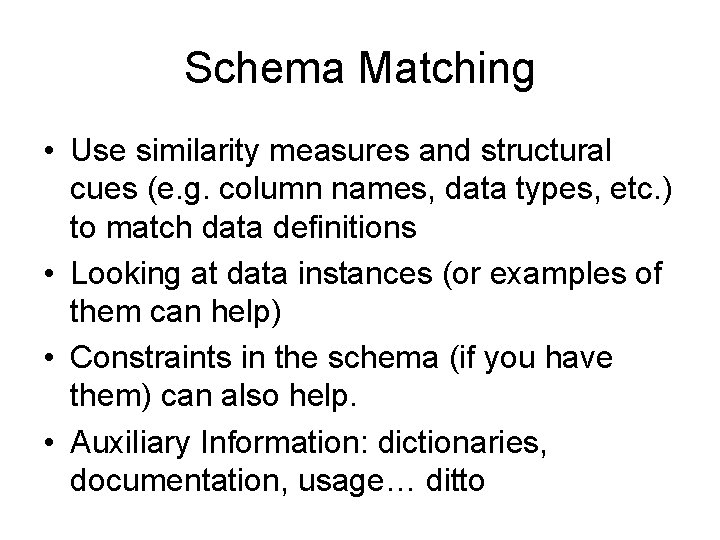
Schema Matching • Use similarity measures and structural cues (e. g. column names, data types, etc. ) to match data definitions • Looking at data instances (or examples of them can help) • Constraints in the schema (if you have them) can also help. • Auxiliary Information: dictionaries, documentation, usage… ditto
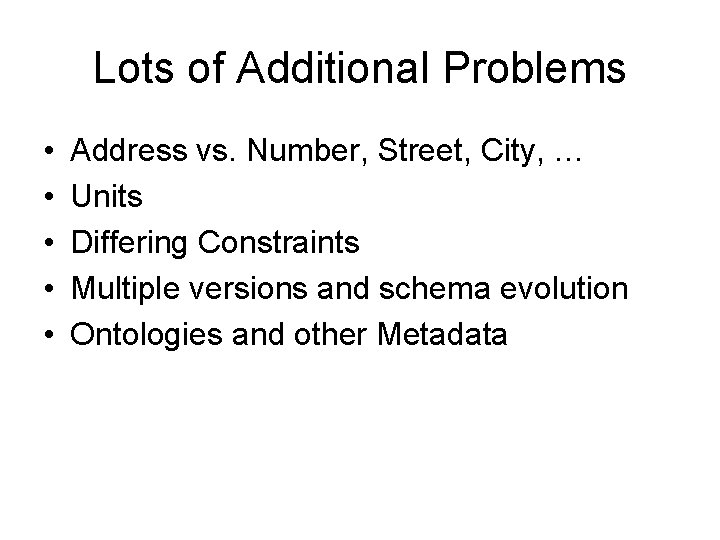
Lots of Additional Problems • • • Address vs. Number, Street, City, … Units Differing Constraints Multiple versions and schema evolution Ontologies and other Metadata
Next Up • Some simple data integration with Pandas • Class Announcements
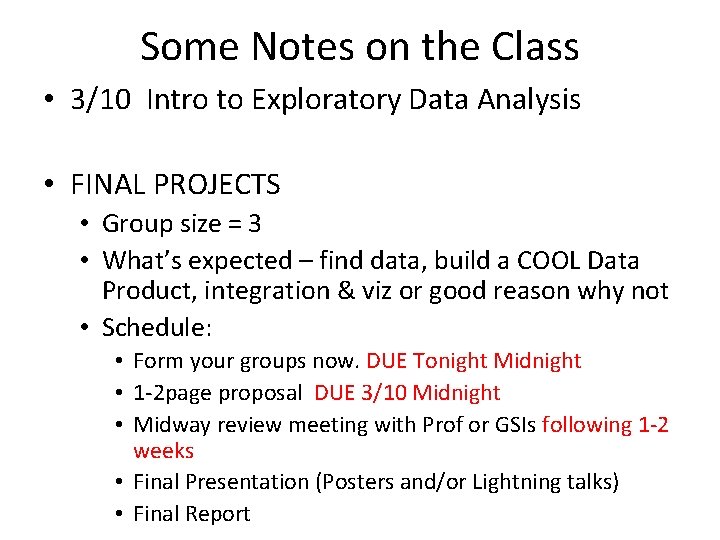
Some Notes on the Class • 3/10 Intro to Exploratory Data Analysis • FINAL PROJECTS • Group size = 3 • What’s expected – find data, build a COOL Data Product, integration & viz or good reason why not • Schedule: • Form your groups now. DUE Tonight Midnight • 1 -2 page proposal DUE 3/10 Midnight • Midway review meeting with Prof or GSIs following 1 -2 weeks • Final Presentation (Posters and/or Lightning talks) • Final Report