Introduction to accelerators for teachers Mariusz Sapiski mariusz
- Slides: 28
Introduction to accelerators for teachers Mariusz Sapiński (mariusz. sapinski@cern. ch) CERN, Beams Department November 30 th, 2011
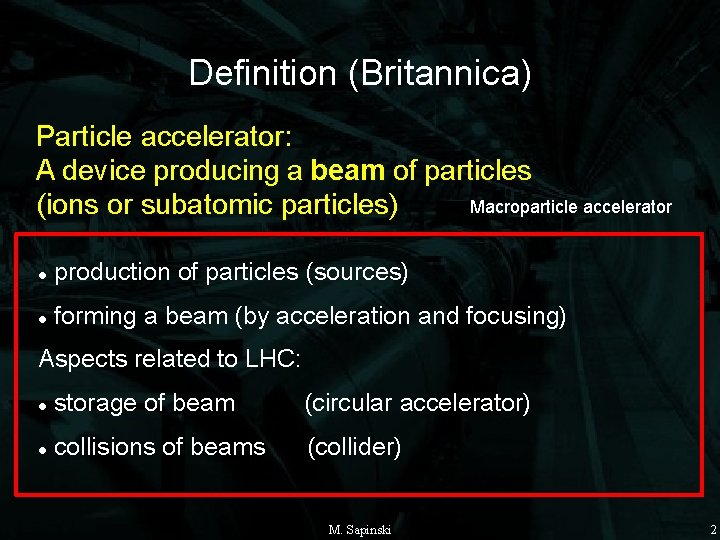
Definition (Britannica) Particle accelerator: A device producing a beam of particles Macroparticle accelerator (ions or subatomic particles) production of particles (sources) forming a beam (by acceleration and focusing) Aspects related to LHC: storage of beam (circular accelerator) collisions of beams (collider) M. Sapinski 2
There exist beams without accelerators For instance beams of alpha radiation are often obtained by collimation of radiation produced by radioactive isotopes. M. Sapinski 3
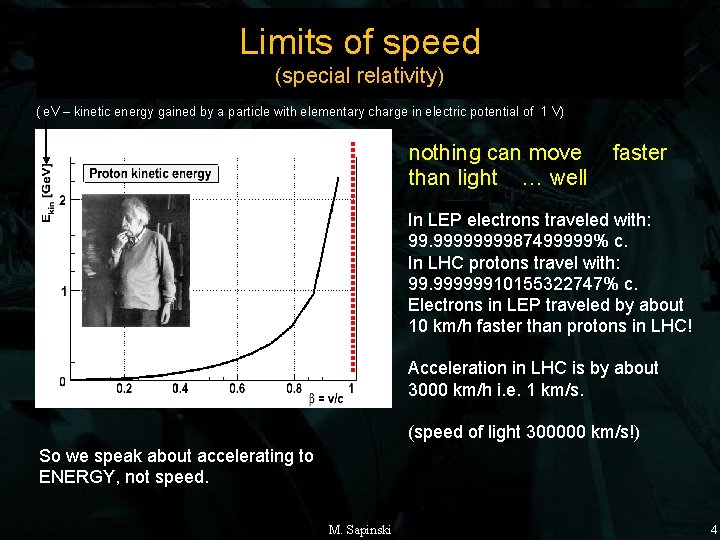
Limits of speed (special relativity) ( e. V – kinetic energy gained by a particle with elementary charge in electric potential of 1 V) nothing can move than light … well faster In LEP electrons traveled with: 99. 999987499999% c. In LHC protons travel with: 99. 99999910155322747% c. Electrons in LEP traveled by about 10 km/h faster than protons in LHC! Acceleration in LHC is by about 3000 km/h i. e. 1 km/s. (speed of light 300000 km/s!) So we speak about accelerating to ENERGY, not speed. M. Sapinski 4
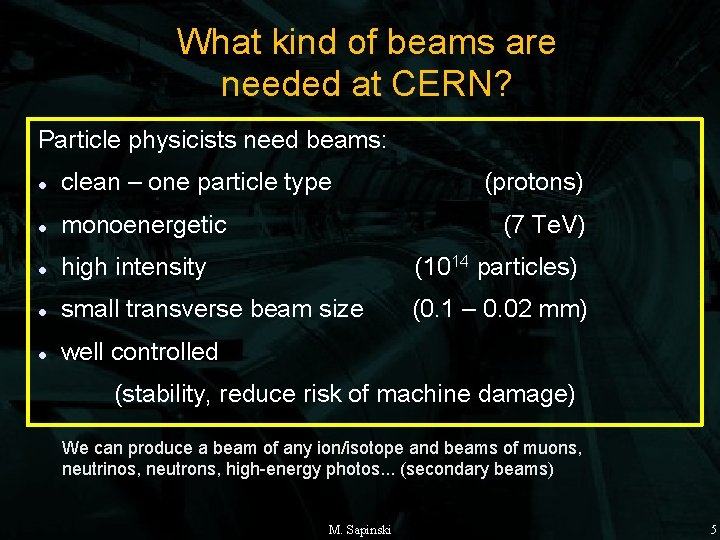
What kind of beams are needed at CERN? Particle physicists need beams: clean – one particle type (protons) monoenergetic high intensity (1014 particles) small transverse beam size (0. 1 – 0. 02 mm) well controlled (7 Te. V) (stability, reduce risk of machine damage) We can produce a beam of any ion/isotope and beams of muons, neutrinos, neutrons, high-energy photos. . . (secondary beams) M. Sapinski 5
Outlook Particle sources Electrostatic acceleration Resonant cavities. Standing and traveling wave acceleration. Synchronism Cosmic acceleration, wakefield acceleration Circular accelerators: cyclotron Synchrotron: dipoles and focusing magnets Colliders: luminosity. LHC beam. Future of accelerators M. Sapinski 6
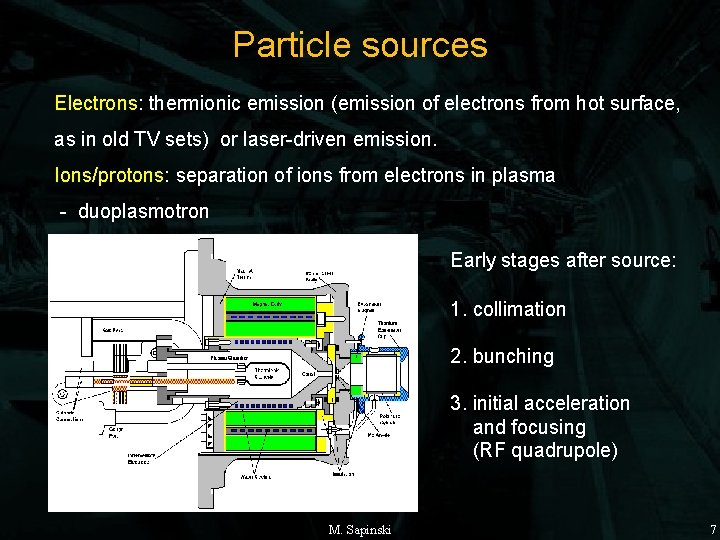
Particle sources Electrons: thermionic emission (emission of electrons from hot surface, as in old TV sets) or laser-driven emission. Ions/protons: separation of ions from electrons in plasma - duoplasmotron Early stages after source: 1. collimation 2. bunching 3. initial acceleration and focusing (RF quadrupole) M. Sapinski 7
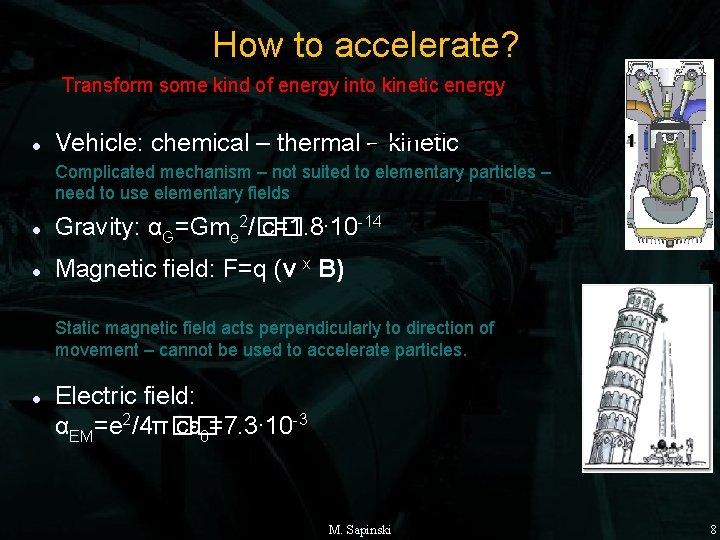
How to accelerate? Transform some kind of energy into kinetic energy Vehicle: chemical – thermal – kinetic Complicated mechanism – not suited to elementary particles – need to use elementary fields Gravity: αG=Gme 2/�� c=1. 8∙ 10 -14 Magnetic field: F=q (v x B) Static magnetic field acts perpendicularly to direction of movement – cannot be used to accelerate particles. Electric field: αEM=e 2/4π�� cε 0=7. 3∙ 10 -3 M. Sapinski 8
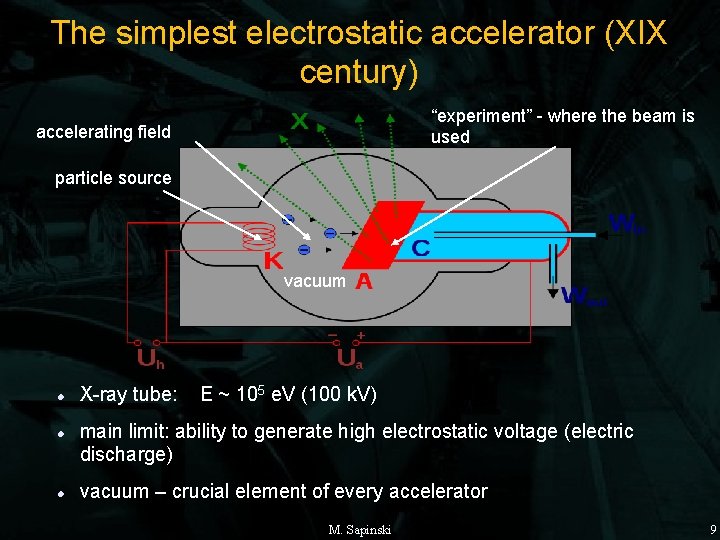
The simplest electrostatic accelerator (XIX century) “experiment” - where the beam is used accelerating field particle source vacuum X-ray tube: E ~ 105 e. V (100 k. V) main limit: ability to generate high electrostatic voltage (electric discharge) vacuum – crucial element of every accelerator M. Sapinski 9
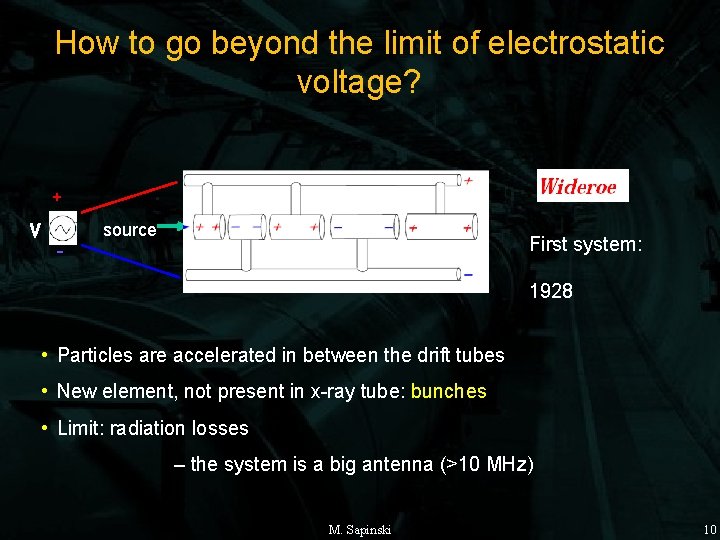
How to go beyond the limit of electrostatic voltage? + V - source First system: 1928 • Particles are accelerated in between the drift tubes • New element, not present in x-ray tube: bunches • Limit: radiation losses – the system is a big antenna (>10 MHz) M. Sapinski 10
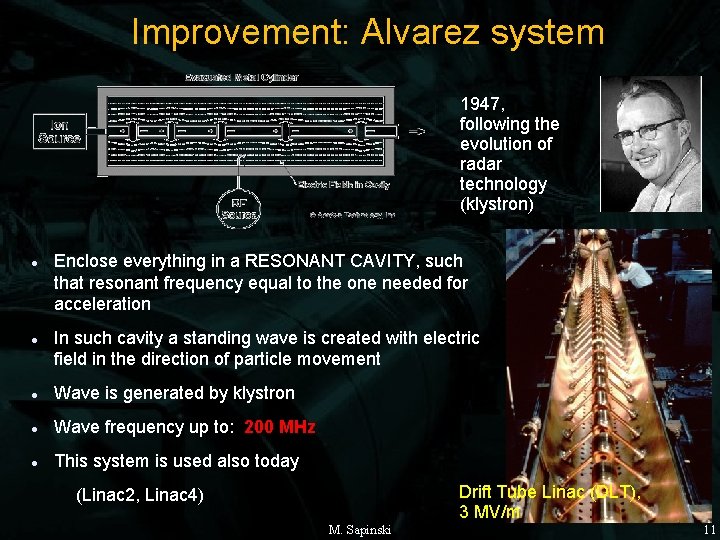
Improvement: Alvarez system 1947, following the evolution of radar technology (klystron) Enclose everything in a RESONANT CAVITY, such that resonant frequency equal to the one needed for acceleration In such cavity a standing wave is created with electric field in the direction of particle movement Wave is generated by klystron Wave frequency up to: 200 MHz This system is used also today Drift Tube Linac (DLT), 3 MV/m (Linac 2, Linac 4) M. Sapinski 11
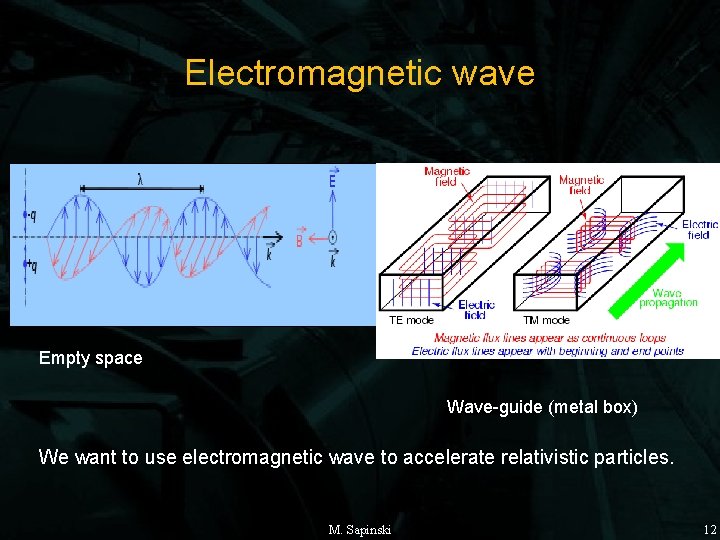
Electromagnetic wave Empty space Wave-guide (metal box) We want to use electromagnetic wave to accelerate relativistic particles. M. Sapinski 12
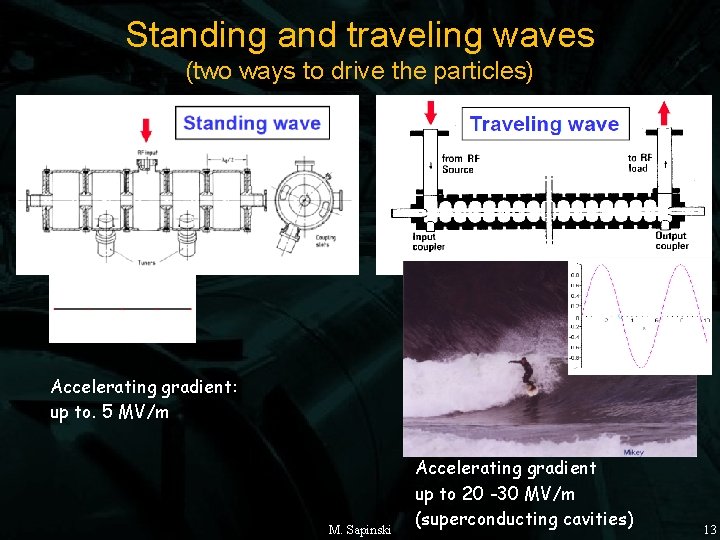
Standing and traveling waves (two ways to drive the particles) Accelerating gradient: up to. 5 MV/m M. Sapinski Accelerating gradient up to 20 -30 MV/m (superconducting cavities) 13
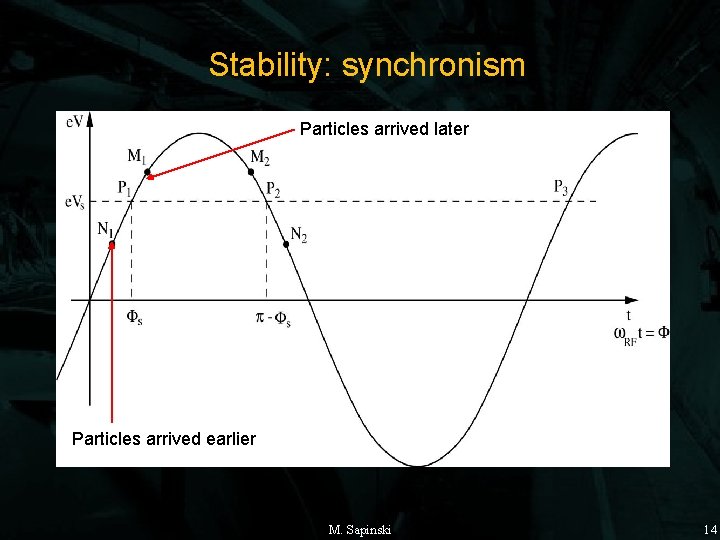
Stability: synchronism Particles arrived later Particles arrived earlier M. Sapinski 14
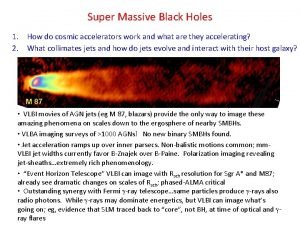
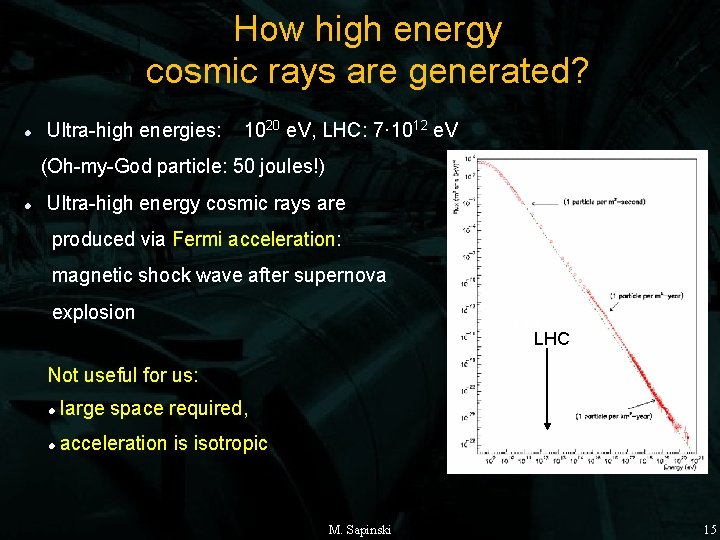
How high energy cosmic rays are generated? Ultra-high energies: 1020 e. V, LHC: 7· 1012 e. V (Oh-my-God particle: 50 joules!) Ultra-high energy cosmic rays are produced via Fermi acceleration: magnetic shock wave after supernova explosion LHC Not useful for us: large space required, acceleration is isotropic M. Sapinski 15
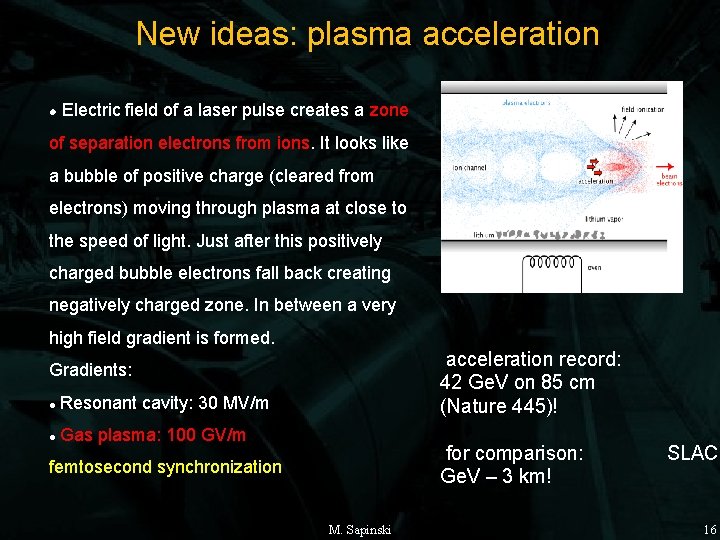
New ideas: plasma acceleration Electric field of a laser pulse creates a zone of separation electrons from ions. It looks like a bubble of positive charge (cleared from electrons) moving through plasma at close to the speed of light. Just after this positively charged bubble electrons fall back creating negatively charged zone. In between a very high field gradient is formed. acceleration record: 42 Ge. V on 85 cm (Nature 445)! Gradients: Resonant cavity: 30 MV/m Gas plasma: 100 GV/m for comparison: Ge. V – 3 km! femtosecond synchronization M. Sapinski SLAC: 16
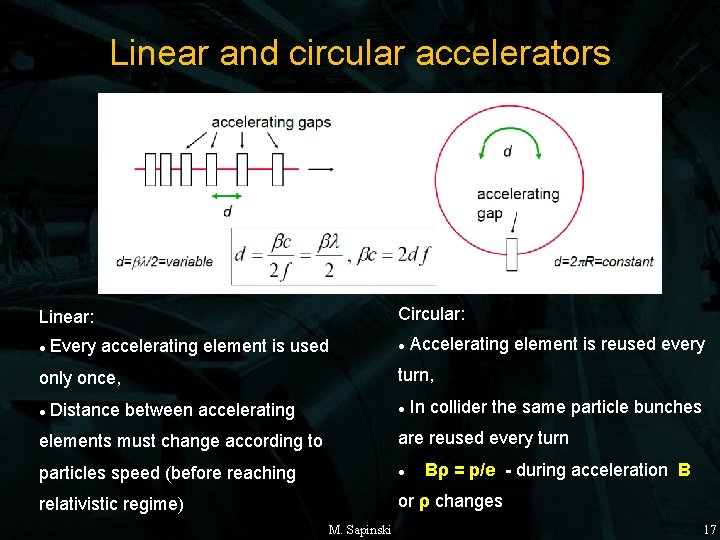
Linear and circular accelerators Circular: Linear: Every accelerating element is used Accelerating element is reused every turn, only once, Distance between accelerating In collider the same particle bunches elements must change according to are reused every turn particles speed (before reaching relativistic regime) or ρ changes M. Sapinski Bρ = p/e - during acceleration B 17
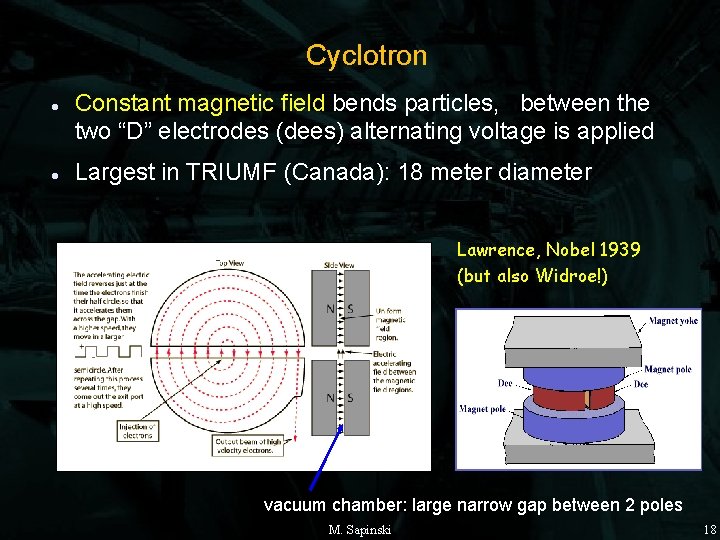
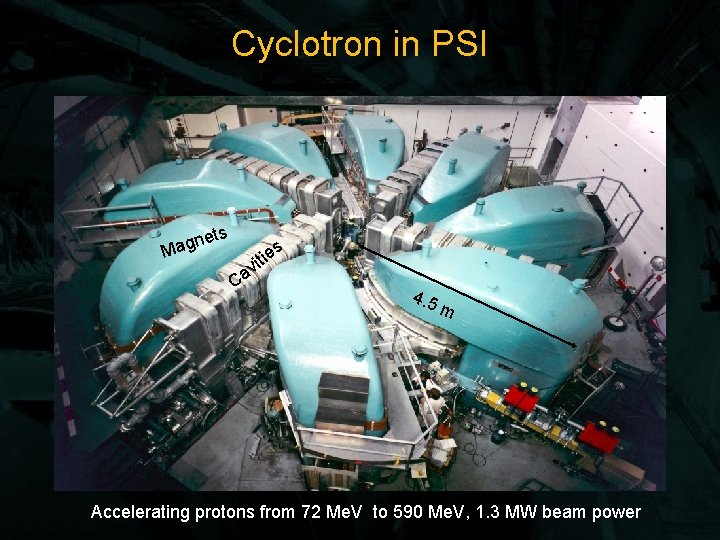
Cyclotron Constant magnetic field bends particles, between the two “D” electrodes (dees) alternating voltage is applied Largest in TRIUMF (Canada): 18 meter diameter Lawrence, Nobel 1939 (but also Widroe!) vacuum chamber: large narrow gap between 2 poles M. Sapinski 18
Cyclotron in PSI ts ne Mag s Ca ie vit 4. 5 m Accelerating protons from 72 Me. V to 590 Me. V, 1. 3 MW beam power
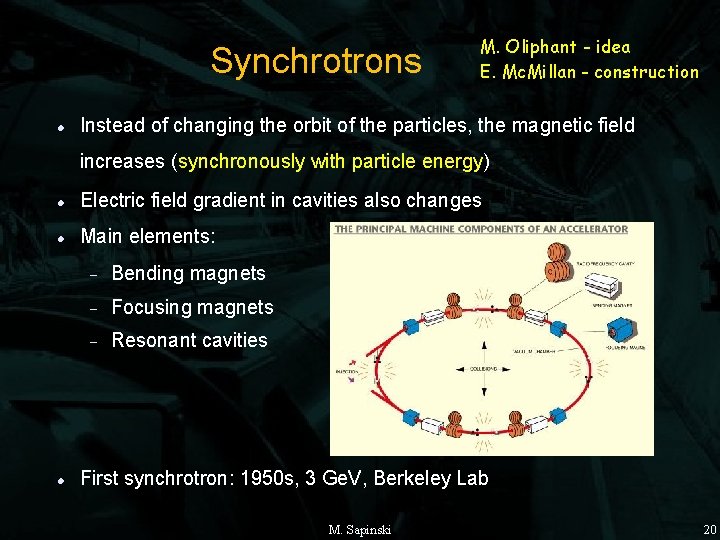
Synchrotrons M. Oliphant - idea E. Mc. Millan - construction Instead of changing the orbit of the particles, the magnetic field increases (synchronously with particle energy) Electric field gradient in cavities also changes Main elements: Bending magnets Focusing magnets Resonant cavities First synchrotron: 1950 s, 3 Ge. V, Berkeley Lab M. Sapinski 20
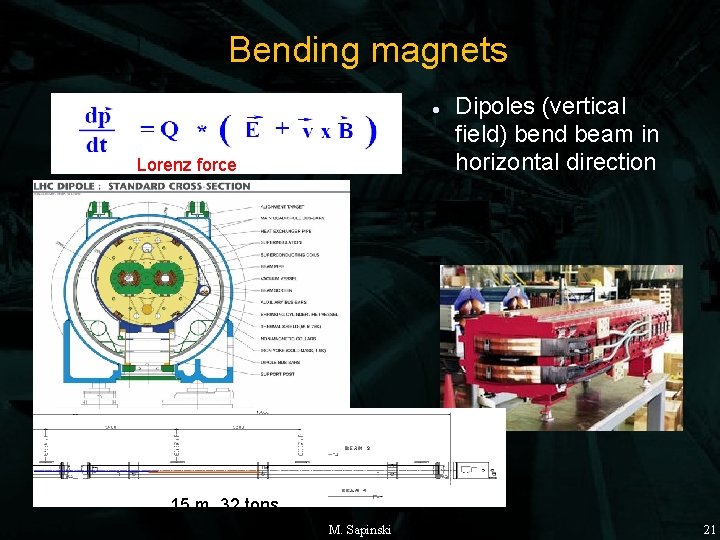
Bending magnets Lorenz force Dipoles (vertical field) bend beam in horizontal direction 15 m, 32 tons M. Sapinski 21
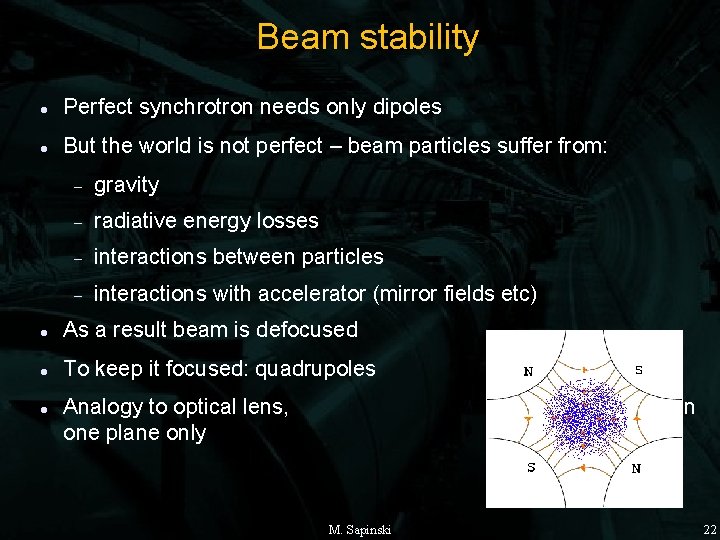
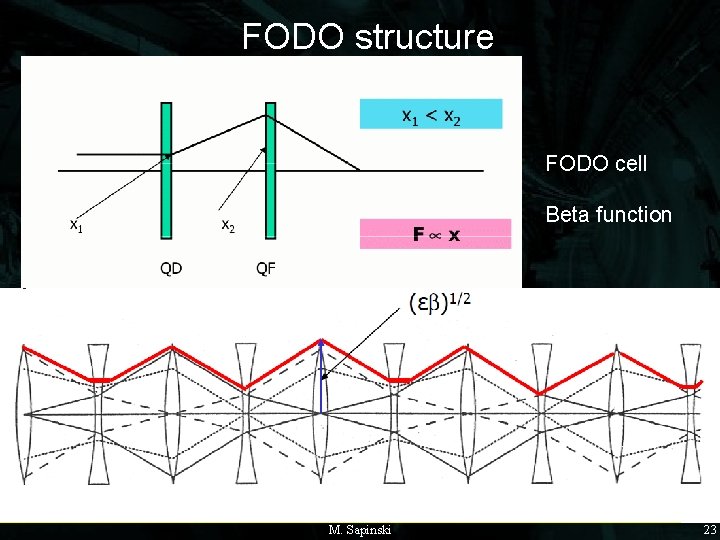
Beam stability Perfect synchrotron needs only dipoles But the world is not perfect – beam particles suffer from: gravity radiative energy losses interactions between particles interactions with accelerator (mirror fields etc) As a result beam is defocused To keep it focused: quadrupoles Analogy to optical lens, one plane only but in M. Sapinski 22
FODO structure FODO cell Beta function cela Fo. Do M. Sapinski 23
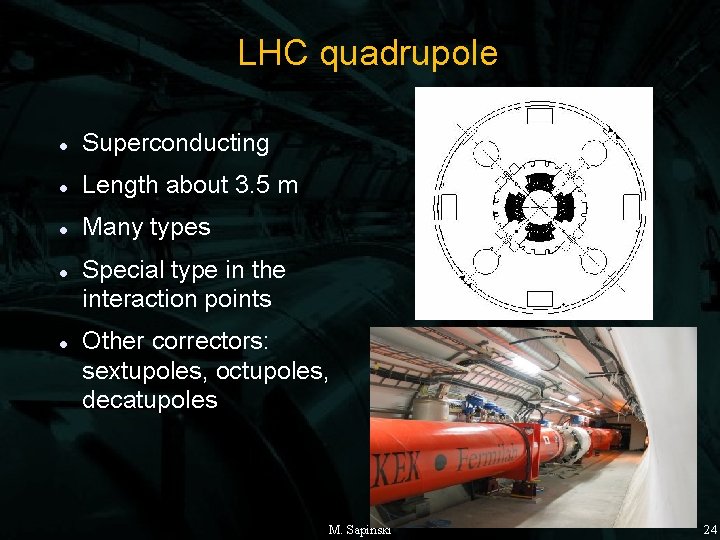
LHC quadrupole Superconducting Length about 3. 5 m Many types Special type in the interaction points Other correctors: sextupoles, octupoles, decatupoles M. Sapinski 24
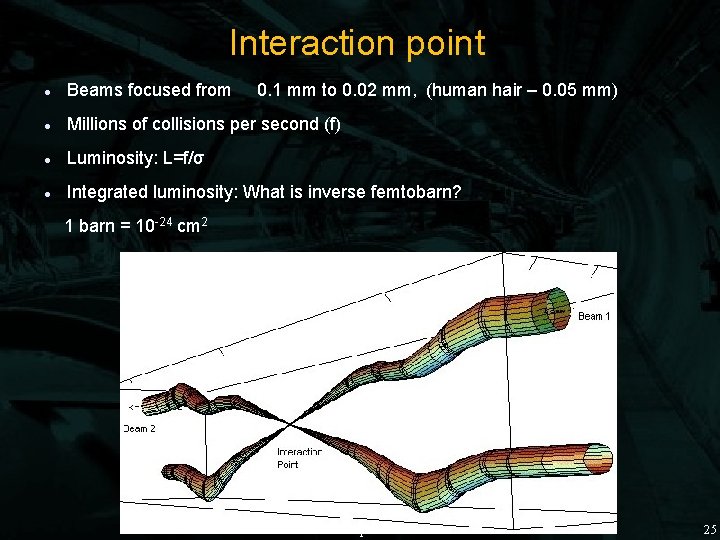
Interaction point Beams focused from 0. 1 mm to 0. 02 mm, (human hair – 0. 05 mm) Millions of collisions per second (f) Luminosity: L=f/σ Integrated luminosity: What is inverse femtobarn? 1 barn = 10 -24 cm 2 M. Sapinski 25
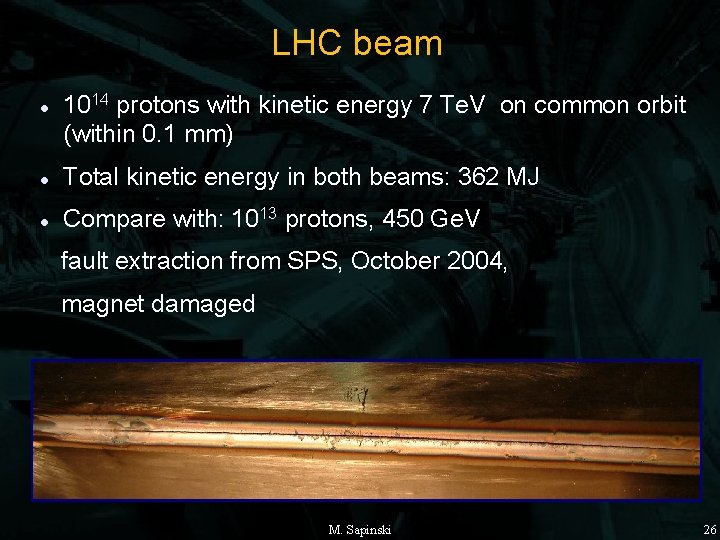
LHC beam 1014 protons with kinetic energy 7 Te. V on common orbit (within 0. 1 mm) Total kinetic energy in both beams: 362 MJ Compare with: 1013 protons, 450 Ge. V fault extraction from SPS, October 2004, magnet damaged M. Sapinski 26
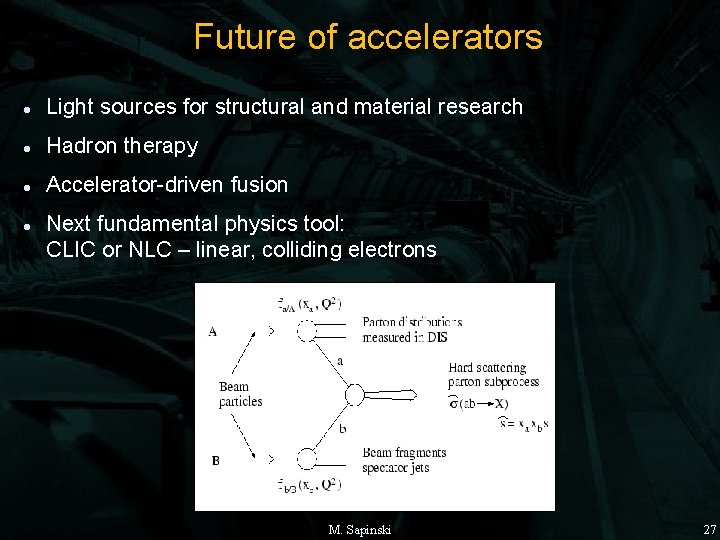
Future of accelerators Light sources for structural and material research Hadron therapy Accelerator-driven fusion Next fundamental physics tool: CLIC or NLC – linear, colliding electrons M. Sapinski 27
Summary Accelerators produce beams of high energy charged particles Particle sources – thermionic emission or plasma Acceleration methods: electrostatic, on electromagnetic wave (standing or traveling – resonant cavities), plasma acceleration, Fermi mechanism bunches Linear and circular accelerators Cyclotron: increase orbit radius with particle energy Synchrotron: increase magnetic field with particle energy Bending magnets (dipoles) and focusing magnets (quads) Collision point – luminosity After LHC: linear electron collider beam optics M. Sapinski 28