Introduction of Korea Asset Management Corporation July 2012
- Slides: 23
Introduction of Korea Asset Management Corporation July 2012
Contents 1. KAMCO in Brief 2. KAMCO’s Public Property Management & Development -with focus on real estates
1. KAMCO in Brief 1 1. Vision & Mission 2. KAMCO History 3. Ownership & Organization 4. Business Areas
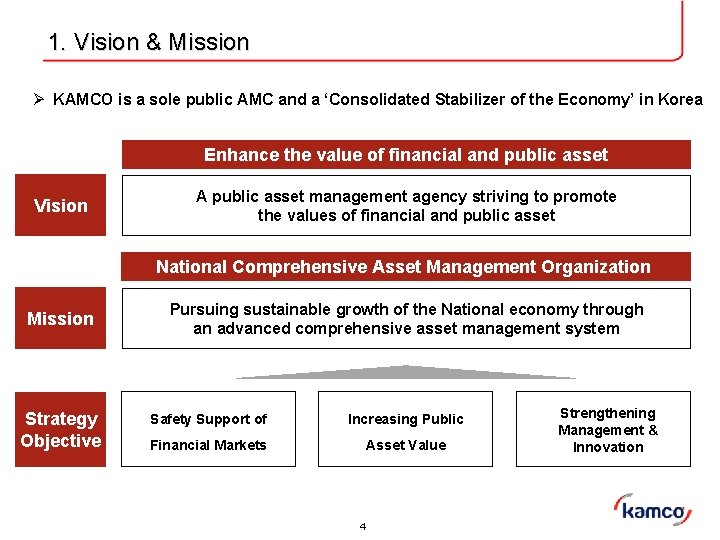
1. Vision & Mission Ø KAMCO is a sole public AMC and a ‘Consolidated Stabilizer of the Economy’ in Korea Enhance the value of financial and public asset Vision A public asset management agency striving to promote the values of financial and public asset National Comprehensive Asset Management Organization Mission Strategy Objective Pursuing sustainable growth of the National economy through an advanced comprehensive asset management system Safety Support of Increasing Public Financial Markets Asset Value 4 Strengthening Management & Innovation
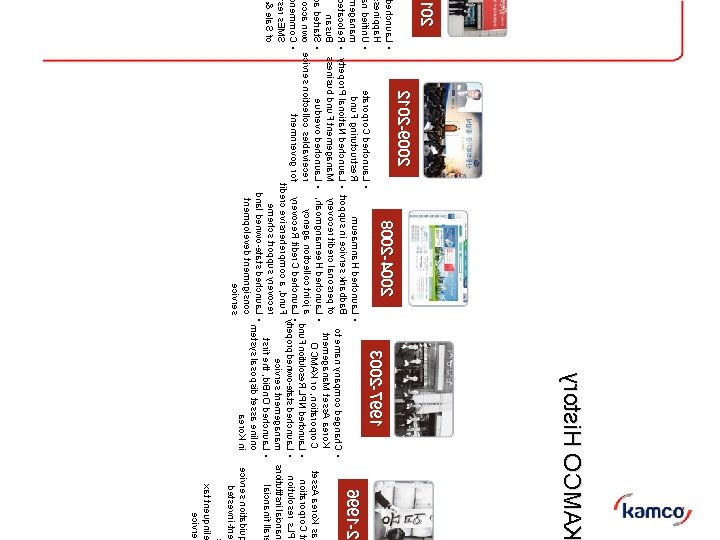
102 ehcnua. L • senippa. H n deifin. U eganam etacole. R nasu. B a detrat. S occa nwo nemmo. C ser s. EMS & ela. S fo 2102 -9002 8002 -4002 etaropro. C dehcnua. L • • mueamna. H dehcnua. L dnu. F gnirutcurtse. R • ytrepor. P lanoita. N dehcnua. L • troppus ni ecivres knabda. B yrevocer tiderc lanosrep fo ssenisub dnu. F tnemegana. M eudrevo dehcnua. L • , haomgnamee. H dehcnua. L • ycnega noitcelloc tnioj a ecivres noitcelloc selbaviecer yrevoce. R tider. C dehcnua. L tnemnrevog rof • tiderc evisneherpmoc a , dnu. F emehcs troppus yrevocer dnal denwo-etats dehcnua. L tnempoleved tnemngisnoc ecivres • • 6991 -2 xat tneuqnil ecivres noitadiu detsevni-tne tess. A aero. K sa noitaropro. C t • noituloser s. LP • snoitutitsni laicnanif llar • yrotsi. H OCMA 3002 -7991 ot eman ynapmoc degnah. C tnemegana. M tess. A aero. K • OCMAK ro , noitaropro. C dnu. F noitulose. R LPN dehcnua. L • y t r e p o r p d enwo-etats dehcnua. L ecivres tnemeganam tsrif eht , di. Bn. O dehcnua. L • m e t s y s l a s o p s i d t e s s a enilno aero. K ni 5
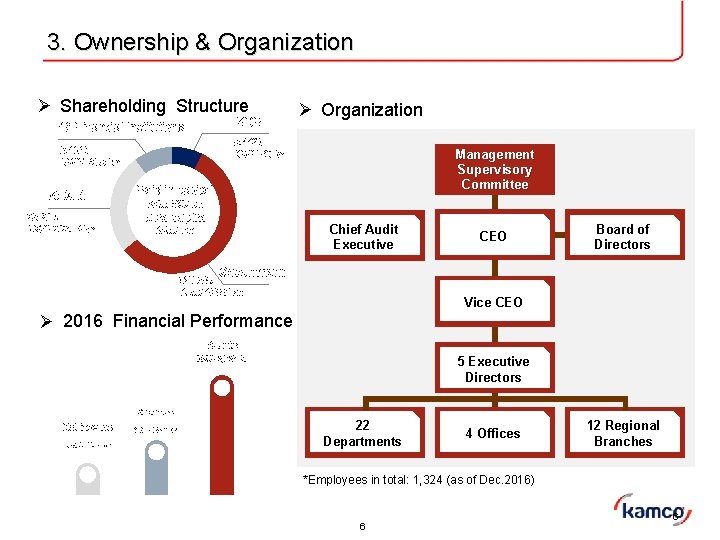
3. Ownership & Organization Ø Shareholding Structure KDB 16 Financial Institutions 8. 14% KRW 70 bn 9. 16% KRW 78. 8 bn KEXIM 25. 86% KRW 222. 4 bn Ø Organization Management Supervisory Committee Paid-in capital KRW 860 bn Legal capital Chief Audit Executive KRW I tn CEO Board of Directors Government 56. 84% KRW 488. 8 bn Vice CEO Ø 2016 Financial Performance Assets KRW 2, 522 bn 5 Executive Directors Revenue Net income KRW 109 bn KRW 347 bn 22 Departments 4 Offices 12 Regional Branches *Employees in total: 1, 324 (as of Dec. 2016) 6 6
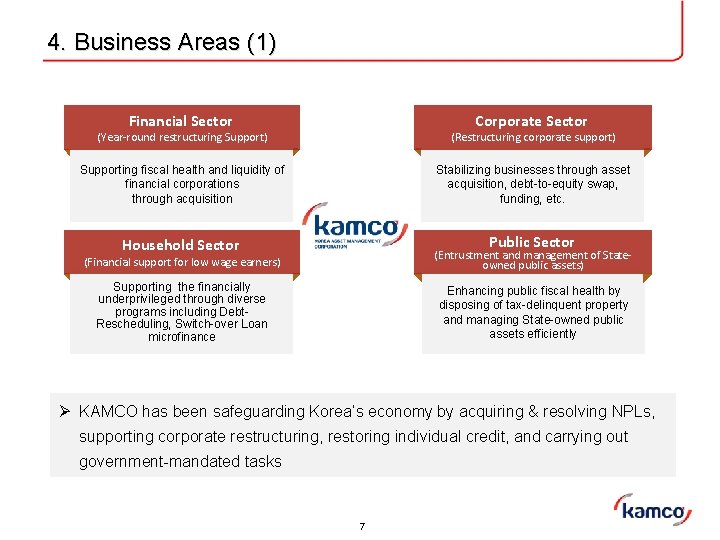
4. Business Areas (1) Financial Sector Corporate Sector (Year-round restructuring Support) (Restructuring corporate support) Supporting fiscal health and liquidity of financial corporations through acquisition Stabilizing businesses through asset acquisition, debt-to-equity swap, funding, etc. Household Sector KAMCO Public Sector (Financial support for low wage earners) (Entrustment and management of Stateowned public assets) Supporting the financially underprivileged through diverse programs including Debt. Rescheduling, Switch-over Loan microfinance Enhancing public fiscal health by disposing of tax-delinquent property and managing State-owned public assets efficiently Ø KAMCO has been safeguarding Korea’s economy by acquiring & resolving NPLs, supporting corporate restructuring, restoring individual credit, and carrying out government-mandated tasks 7
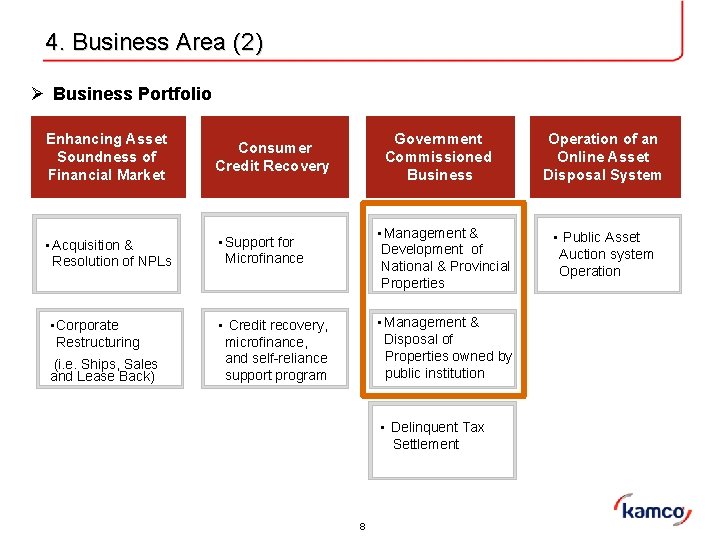
4. Business Area (2) Ø Business Portfolio Enhancing Asset Soundness of Financial Market Consumer Credit Recovery • Acquisition & Resolution of NPLs • Support for Microfinance • Corporate Restructuring (i. e. Ships, Sales and Lease Back) Government Commissioned Business • Management & Development of National & Provincial Properties • Management & Disposal of Properties owned by public institution • Credit recovery, microfinance, and self-reliance support program • Delinquent Tax Settlement 8 Operation of an Online Asset Disposal System • Public Asset Auction system Operation
2. KAMCO’s Public Property Management & Development 2 1. Public Property 2. Government Policy Change 3. KAMCO’s Role 4. Management of Public Property 5. Development of Public Property
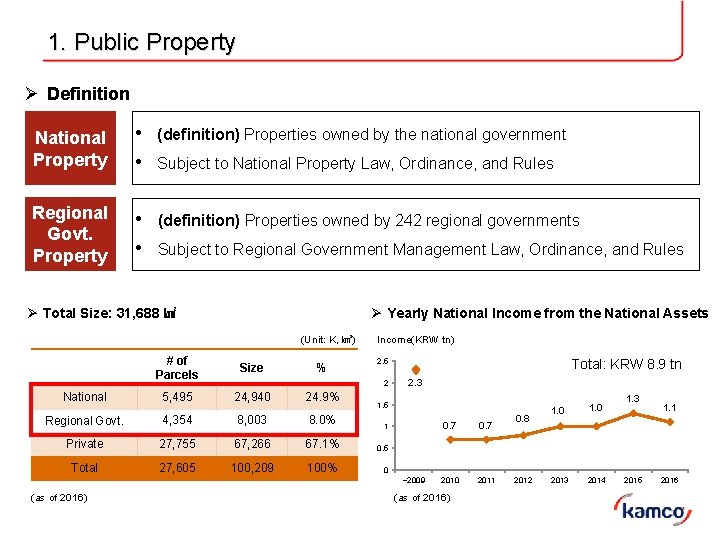
1. Public Property Ø Definition National Property • (definition) Properties owned by the national government • Subject to National Property Law, Ordinance, and Rules Regional Govt. Property • (definition) Properties owned by 242 regional governments • Subject to Regional Government Management Law, Ordinance, and Rules Ø Total Size: 31, 688 ㎢ Ø Yearly National Income from the National Assets (Unit: K, ㎢) National # of Parcels Size 5, 495 24, 940 % Income(KRW tn) 2 24. 9% Total: KRW 8. 9 tn 2. 5 2. 3 1. 5 Regional Govt. 4, 354 8, 003 8. 0% Private 27, 755 67, 266 67. 1% 0. 5 Total 27, 605 100, 209 100% 0 1 ~2009 (as of 2016) 0. 7 2010 2011 (as of 2016) 0. 8 2012 1. 0 2013 2014 1. 3 2015 1. 1 2016
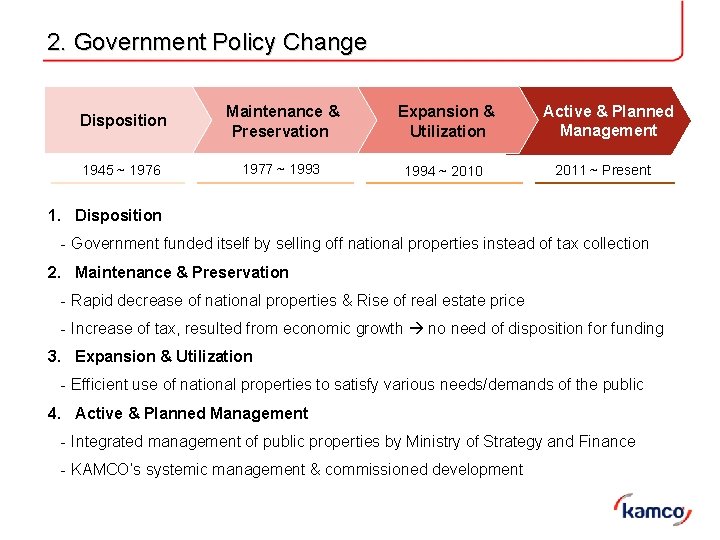
2. Government Policy Change Disposition Maintenance & Preservation Expansion & Utilization 1945 ~ 1976 1977 ~ 1993 1994 ~ 2010 Active & Planned Management 2011 ~ Present 1. Disposition - Government funded itself by selling off national properties instead of tax collection 2. Maintenance & Preservation - Rapid decrease of national properties & Rise of real estate price - Increase of tax, resulted from economic growth no need of disposition for funding 3. Expansion & Utilization - Efficient use of national properties to satisfy various needs/demands of the public 4. Active & Planned Management - Integrated management of public properties by Ministry of Strategy and Finance - KAMCO’s systemic management & commissioned development
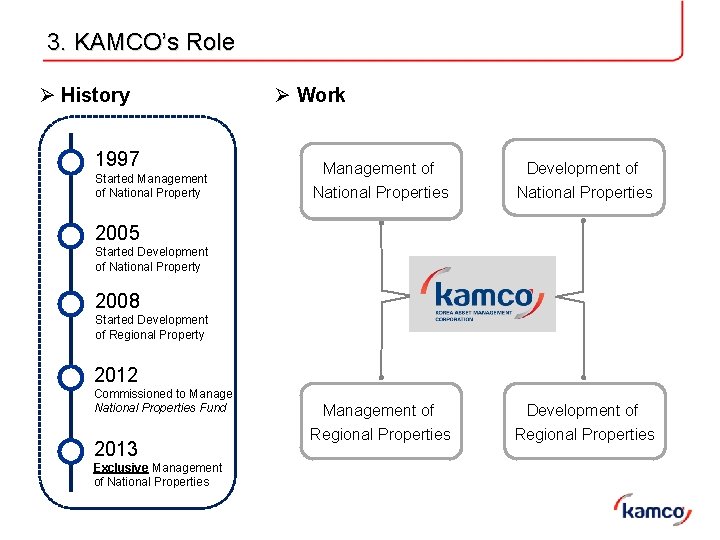
3. KAMCO’s Role Ø History 1997 Started Management of National Property Ø Work Management of Development of National Properties Management of Development of Regional Properties 2005 Started Development of National Property 2008 Started Development of Regional Property 2012 Commissioned to Manage National Properties Fund 2013 Exclusive Management of National Properties
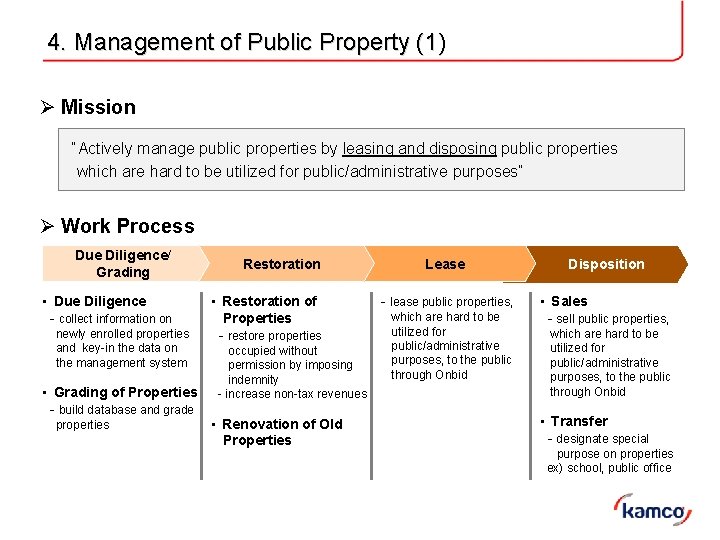
4. Management of Public Property (1) Ø Mission “Actively manage public properties by leasing and disposing public properties which are hard to be utilized for public/administrative purposes” Ø Work Process Due Diligence/ Grading • Due Diligence - collect information on newly enrolled properties and key-in the data on the management system • Grading of Properties - build database and grade properties Restoration • Restoration of Properties - restore properties occupied without permission by imposing indemnity - increase non-tax revenues • Renovation of Old Properties Lease Disposition - lease public properties, • Sales - sell public properties, which are hard to be utilized for public/administrative purposes, to the public through Onbid • Transfer - designate special purpose on properties ex) school, public office
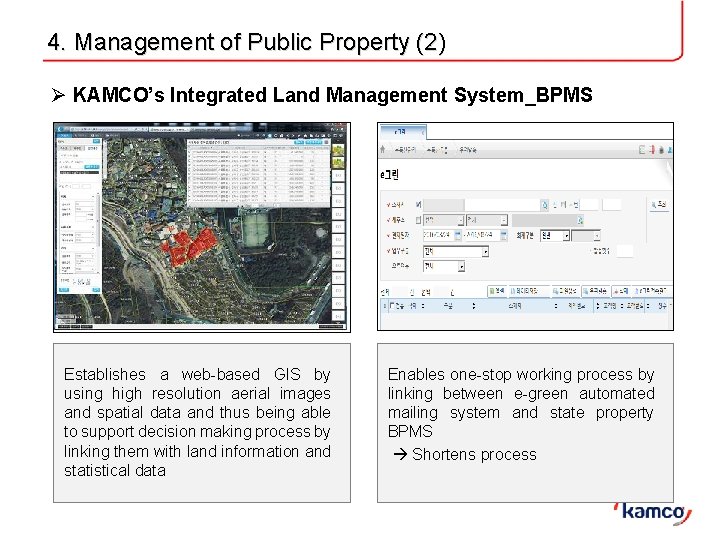
4. Management of Public Property (2) Ø KAMCO’s Integrated Land Management System_BPMS Establishes a web-based GIS by using high resolution aerial images and spatial data and thus being able to support decision making process by linking them with land information and statistical data Enables one-stop working process by linking between e-green automated mailing system and state property BPMS Shortens process
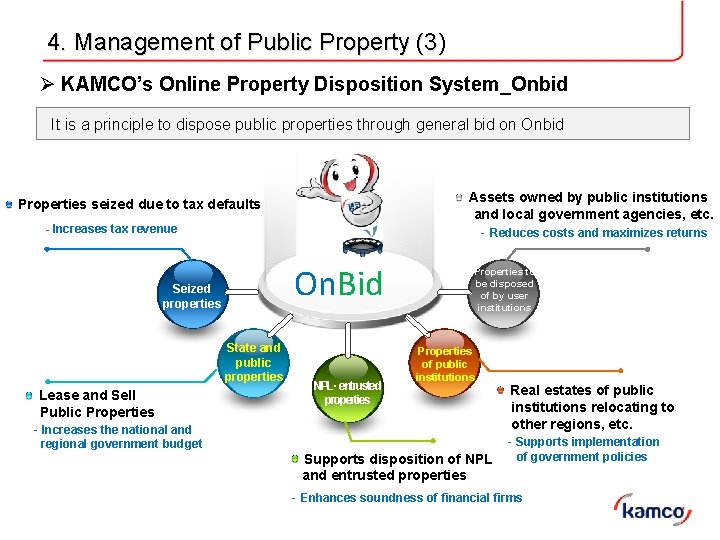
4. Management of Public Property (3) Ø KAMCO’s Online Property Disposition System_Onbid It is a principle to dispose public properties through general bid on Onbid Assets owned by public institutions and local government agencies, etc. Properties seized due to tax defaults - Increases tax revenue - Reduces costs and maximizes returns On. Bid Seized properties State and public properties Lease and Sell Public Properties - Increases the national and regional government budget NPL· entrusted properties Properties to be disposed of by user institutions Properties of public institutions Supports disposition of NPL and entrusted properties Real estates of public institutions relocating to other regions, etc. - Supports implementation of government policies - Enhances soundness of financial firms
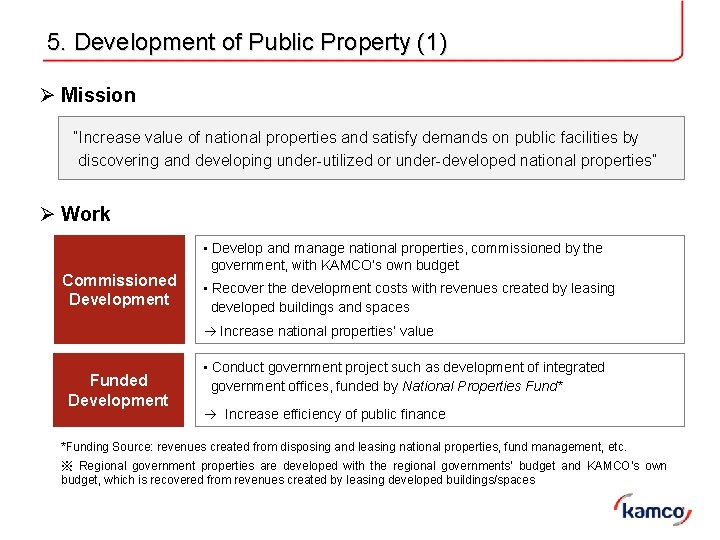
5. Development of Public Property (1) Ø Mission “Increase value of national properties and satisfy demands on public facilities by discovering and developing under-utilized or under-developed national properties” Ø Work Commissioned Development • Develop and manage national properties, commissioned by the government, with KAMCO’s own budget • Recover the development costs with revenues created by leasing developed buildings and spaces Increase national properties’ value Funded Development • Conduct government project such as development of integrated government offices, funded by National Properties Fund* Increase efficiency of public finance *Funding Source: revenues created from disposing and leasing national properties, fund management, etc. ※ Regional government properties are developed with the regional governments’ budget and KAMCO’s own budget, which is recovered from revenues created by leasing developed buildings/spaces
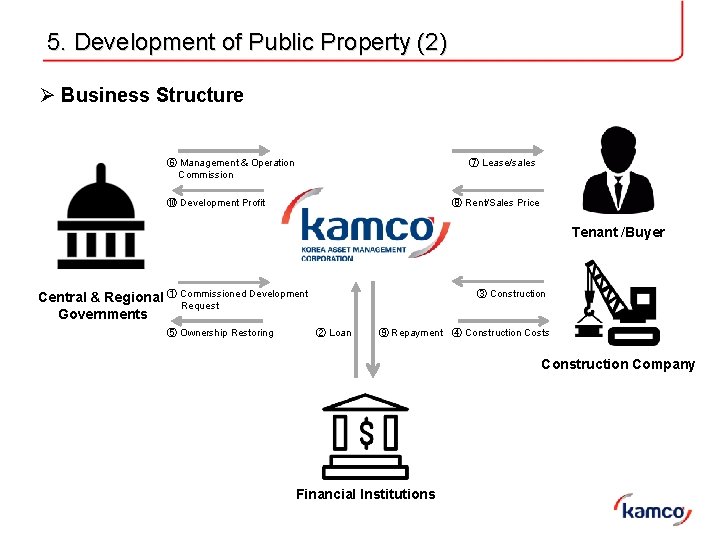
5. Development of Public Property (2) Ø Business Structure ⑥ Management & Operation Commission ⑦ Lease/sales ⑩ Development Profit ⑧ Rent/Sales Price Tenant /Buyer Development Central & Regional ① Commissioned Request Governments ⑤ Ownership Restoring ③ Construction ② Loan ⑨ Repayment ④ Construction Costs Construction Company Financial Institutions
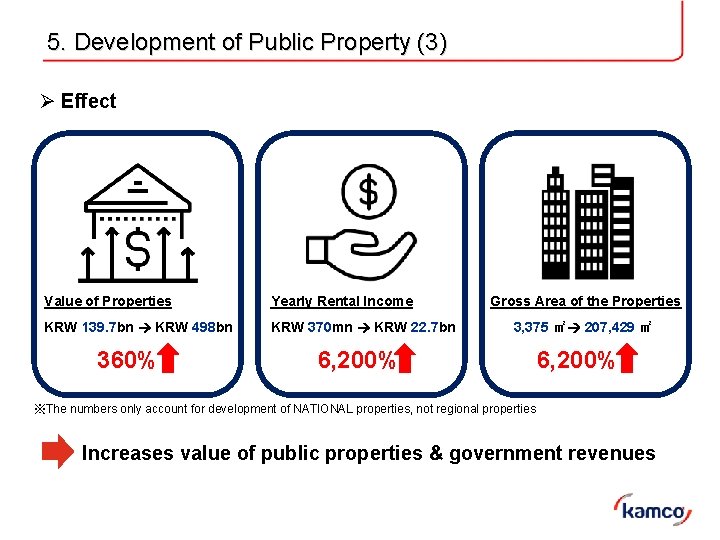
5. Development of Public Property (3) Ø Effect Value of Properties Yearly Rental Income KRW 139. 7 bn KRW 498 bn KRW 370 mn KRW 22. 7 bn 360% Gross Area of the Properties 3, 375 ㎡ 207, 429 ㎡ 6, 200% ※The numbers only account for development of NATIONAL properties, not regional properties Increases value of public properties & government revenues
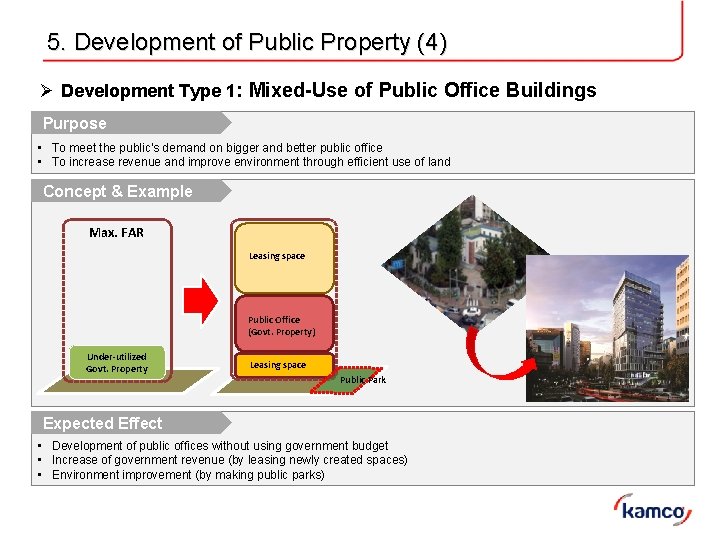
5. Development of Public Property (4) Ø Development Type 1: Mixed-Use of Public Office Buildings Purpose • To meet the public’s demand on bigger and better public office • To increase revenue and improve environment through efficient use of land Concept & Example Max. FAR Leasing space Public Office (Govt. Property) Under-utilized Govt. Property Leasing space Public Park Expected Effect • Development of public offices without using government budget • Increase of government revenue (by leasing newly created spaces) • Environment improvement (by making public parks)
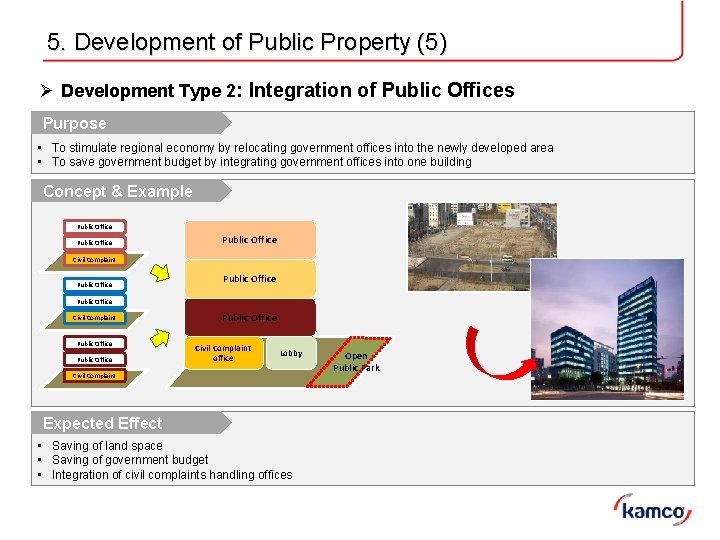
5. Development of Public Property (5) Ø Development Type 2: Integration of Public Offices Purpose • To stimulate regional economy by relocating government offices into the newly developed area • To save government budget by integrating government offices into one building Concept & Example Public Office Civil Complaint Public Office Public Office Civil Complaint office Lobby Civil Complaint Expected Effect • Saving of land space • Saving of government budget • Integration of civil complaints handling offices Open Public Park
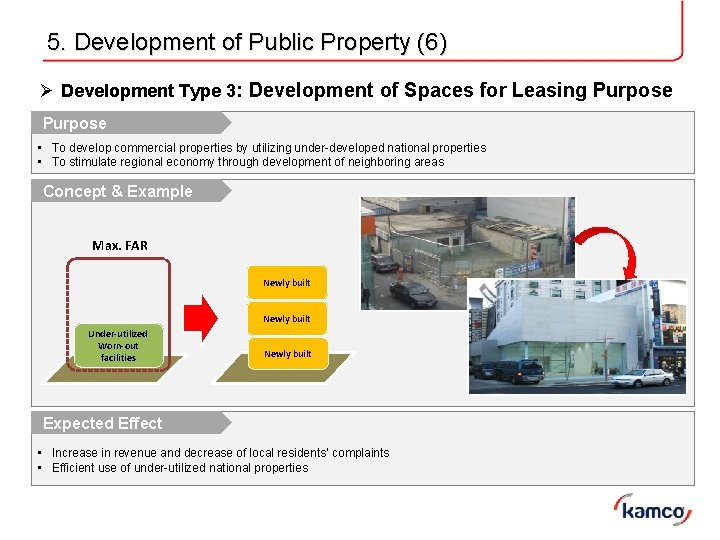
5. Development of Public Property (6) Ø Development Type 3: Development of Spaces for Leasing Purpose • To develop commercial properties by utilizing under-developed national properties • To stimulate regional economy through development of neighboring areas Concept & Example Max. FAR Newly built Under-utilized Worn-out facilities Newly built Expected Effect • Increase in revenue and decrease of local residents’ complaints • Efficient use of under-utilized national properties
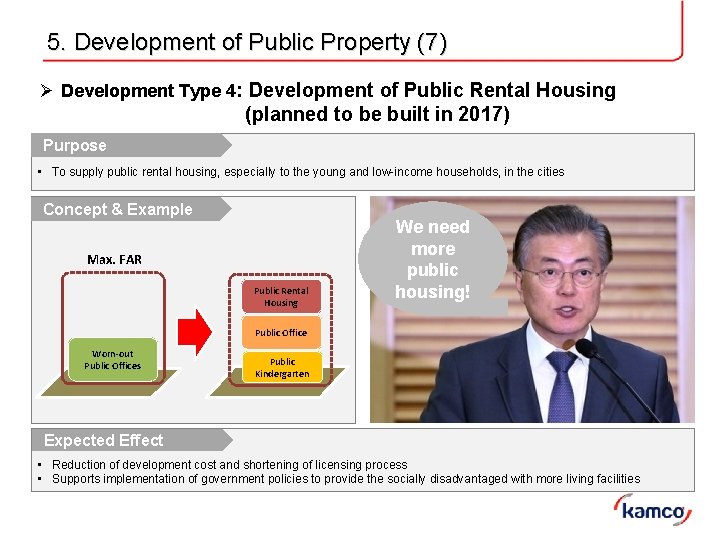
5. Development of Public Property (7) Ø Development Type 4: Development of Public Rental Housing (planned to be built in 2017) Purpose • To supply public rental housing, especially to the young and low-income households, in the cities Concept & Example Max. FAR Public Rental Housing We need more public housing! Public Office Worn-out Public Offices Public Kindergarten Expected Effect • Reduction of development cost and shortening of licensing process • Supports implementation of government policies to provide the socially disadvantaged with more living facilities
Thank You!