Interfaces F What is an Interface F Creating


- Slides: 25
Interfaces F What is an Interface? F Creating an Interface F Implementing F What an Interface is Marker Interface?
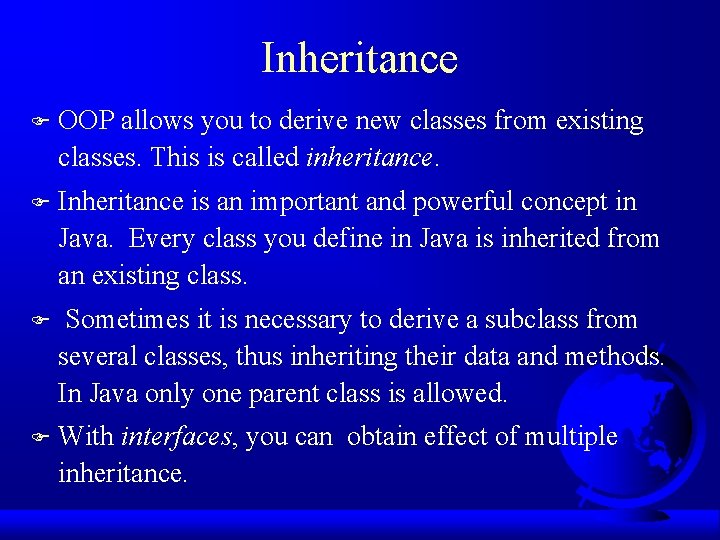
Inheritance F OOP allows you to derive new classes from existing classes. This is called inheritance. F Inheritance is an important and powerful concept in Java. Every class you define in Java is inherited from an existing class. F Sometimes it is necessary to derive a subclass from several classes, thus inheriting their data and methods. In Java only one parent class is allowed. F With interfaces, you can obtain effect of multiple inheritance.
What is an Interface? F An interface is a classlike construct that contains only constants and abstract methods. F Cannot be instantiated. Only classes that implements interfaces can be instantiated. However, final public static variables can be defined to interface types. F Why not just use abstract classes? Java does not permit multiple inheritance from classes, but permits implementation of multiple interfaces.
What is an Interface? Protocol for classes that completely separates specification/behaviour from implementation. F One class can implement many interfaces F One interface can be implemented by many classes F By providing the interface keyword, Java allows you to fully utilize the "one interface, multiple methods" aspect of polymorphism. F
Why an Interface? Normally, in order for a method to be called from one class to another, both classes need to be present at compile time so the Java compiler can check to ensure that the method signatures are compatible. F In a system like this, functionality gets pushed up higher and higher in the class hierarchy so that the mechanisms will be available to more and more subclasses. F Interfaces are designed to avoid this problem. F Interfaces are designed to support dynamic method resolution at run time. F
Why an Interface? Interfaces are designed to avoid this problem. F They disconnect the definition of a method or set of methods from the inheritance hierarchy. F Since interfaces are in a different hierarchy from classes, it is possible for classes that are unrelated in terms of the class hierarchy to implement the same interface. F This is where the real power of interfaces is realized. F
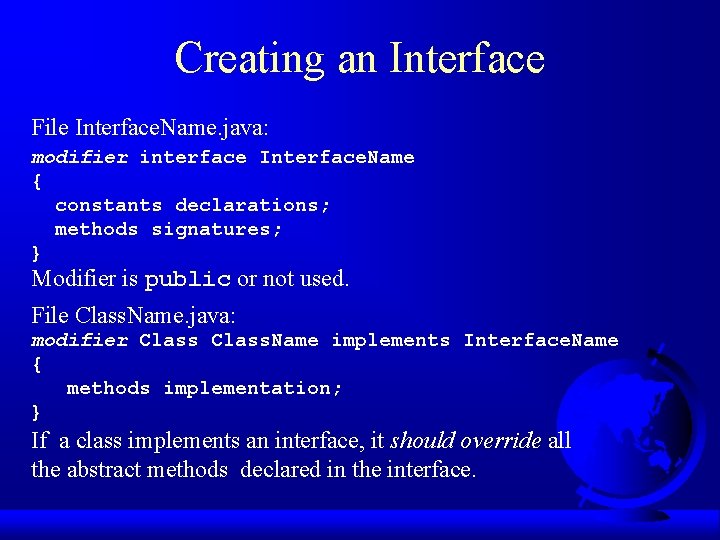
Creating an Interface File Interface. Name. java: modifier interface Interface. Name { constants declarations; methods signatures; } Modifier is public or not used. File Class. Name. java: modifier Class. Name implements Interface. Name { methods implementation; } If a class implements an interface, it should override all the abstract methods declared in the interface.
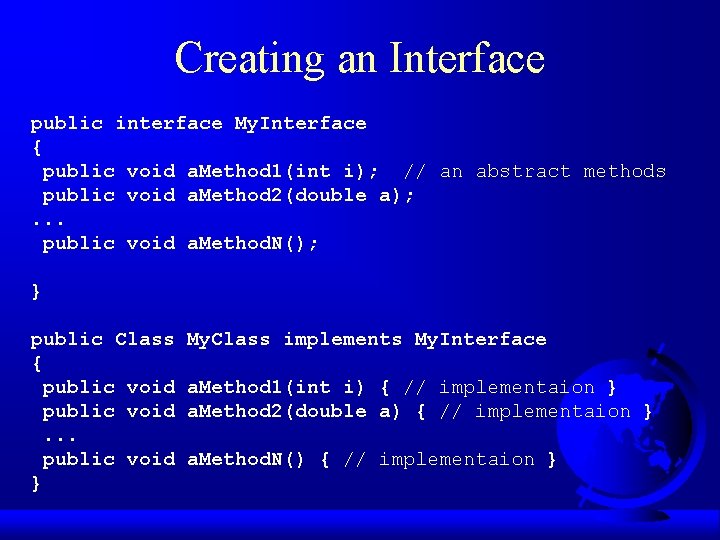
Creating an Interface public interface My. Interface { public void a. Method 1(int i); // an abstract methods public void a. Method 2(double a); . . . public void a. Method. N(); } public Class { public void. . . public void } My. Class implements My. Interface a. Method 1(int i) { // implementaion } a. Method 2(double a) { // implementaion } a. Method. N() { // implementaion }
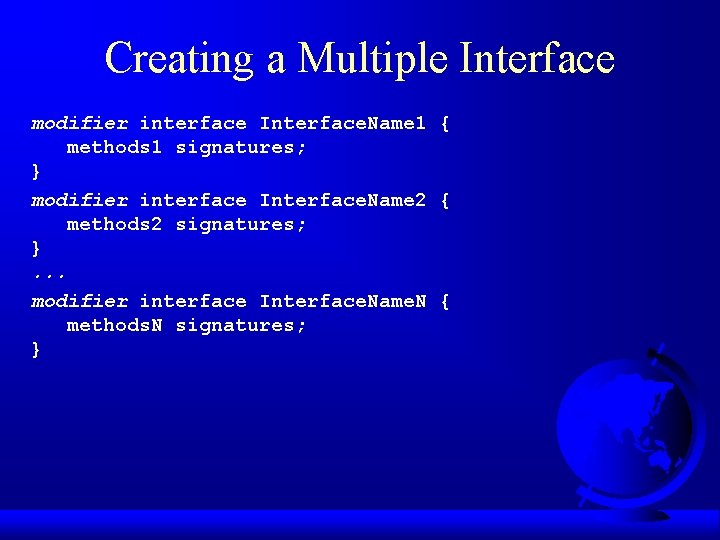
Creating a Multiple Interface modifier interface Interface. Name 1 { methods 1 signatures; } modifier interface Interface. Name 2 { methods 2 signatures; }. . . modifier interface Interface. Name. N { methods. N signatures; }
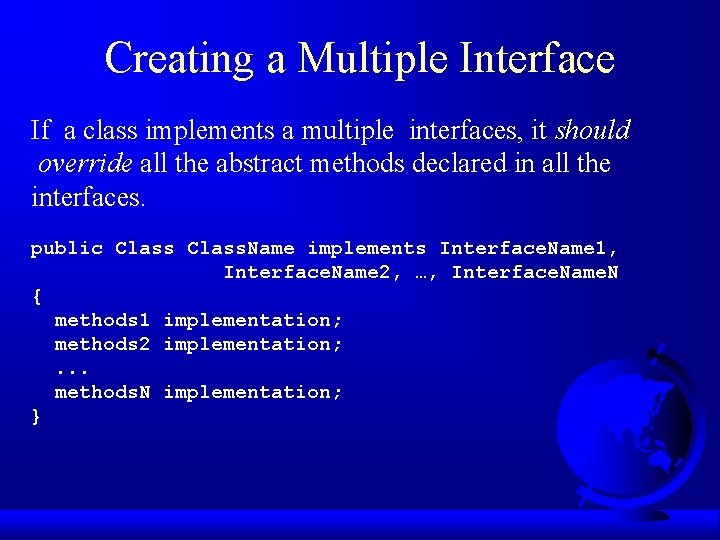
Creating a Multiple Interface If a class implements a multiple interfaces, it should override all the abstract methods declared in all the interfaces. public Class. Name implements Interface. Name 1, Interface. Name 2, …, Interface. Name. N { methods 1 implementation; methods 2 implementation; . . . methods. N implementation; }
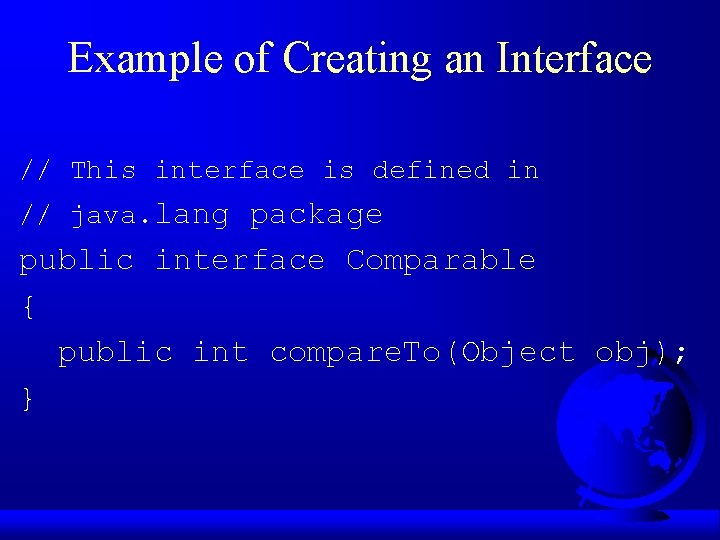
Example of Creating an Interface // This interface is defined in // java. lang package public interface Comparable { public int compare. To(Object obj); }
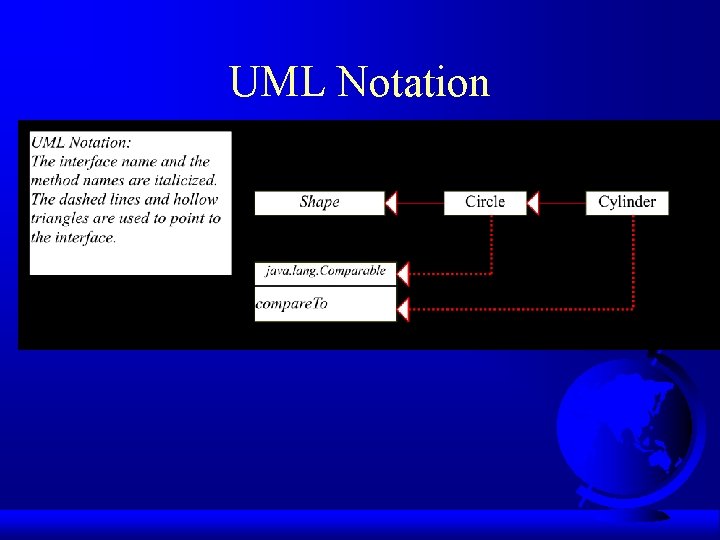
UML Notation
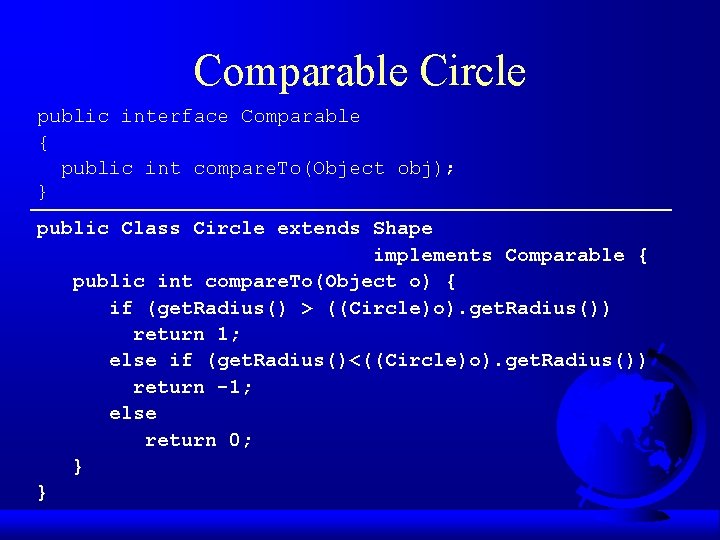
Comparable Circle public interface Comparable { public int compare. To(Object obj); } public Class Circle extends Shape implements Comparable { public int compare. To(Object o) { if (get. Radius() > ((Circle)o). get. Radius()) return 1; else if (get. Radius()<((Circle)o). get. Radius()) return -1; else return 0; } }
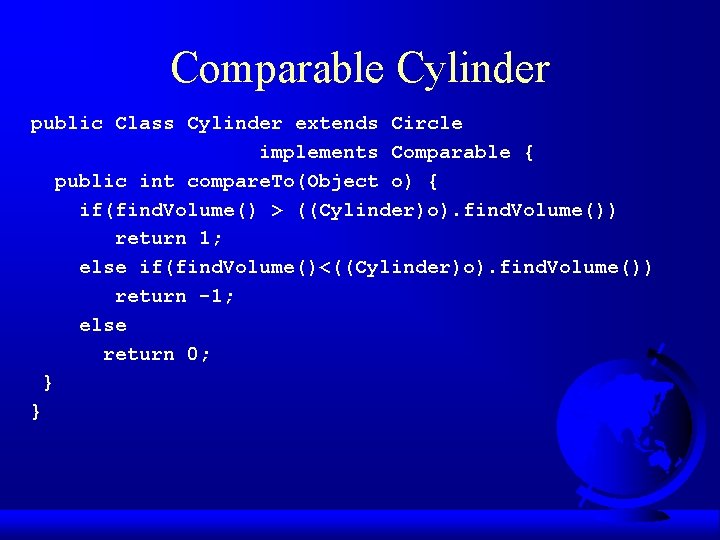
Comparable Cylinder public Class Cylinder extends Circle implements Comparable { public int compare. To(Object o) { if(find. Volume() > ((Cylinder)o). find. Volume()) return 1; else if(find. Volume()<((Cylinder)o). find. Volume()) return -1; else return 0; } }
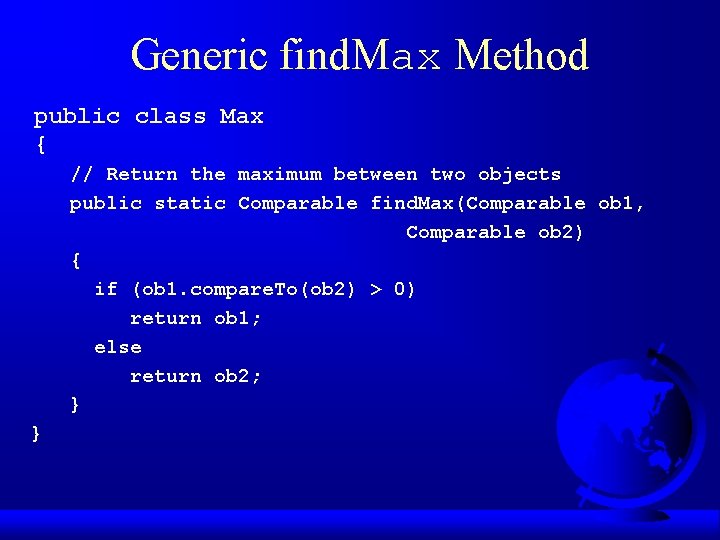
Generic find. Max Method public class Max { // Return the maximum between two objects public static Comparable find. Max(Comparable ob 1, Comparable ob 2) { if (ob 1. compare. To(ob 2) > 0) return ob 1; else return ob 2; } }
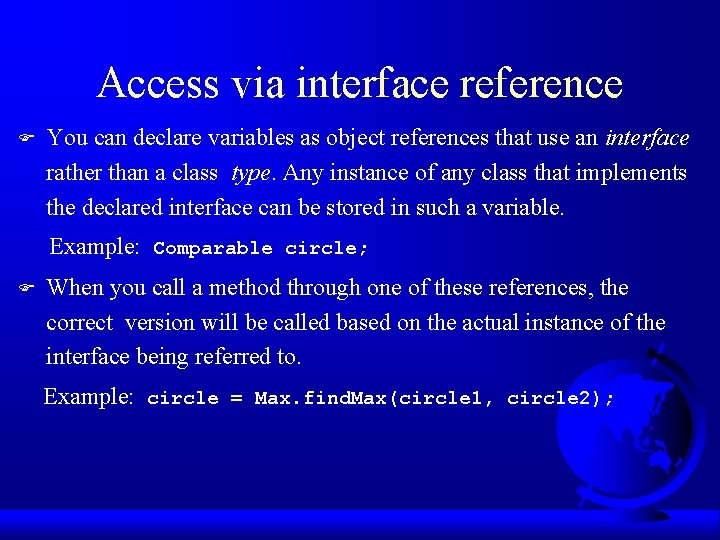
Access via interface reference F You can declare variables as object references that use an interface rather than a class type. Any instance of any class that implements the declared interface can be stored in such a variable. Example: Comparable circle; F When you call a method through one of these references, the correct version will be called based on the actual instance of the interface being referred to. Example: circle = Max. find. Max(circle 1, circle 2);
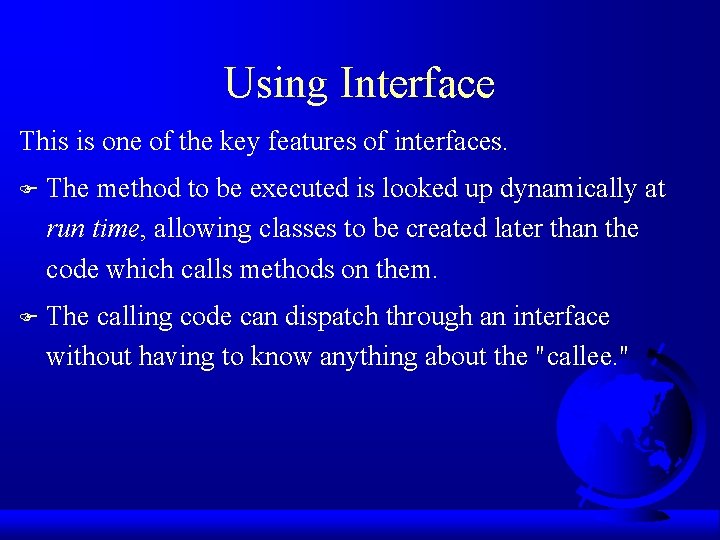
Using Interface This is one of the key features of interfaces. F The method to be executed is looked up dynamically at run time, allowing classes to be created later than the code which calls methods on them. F The calling code can dispatch through an interface without having to know anything about the "callee. "
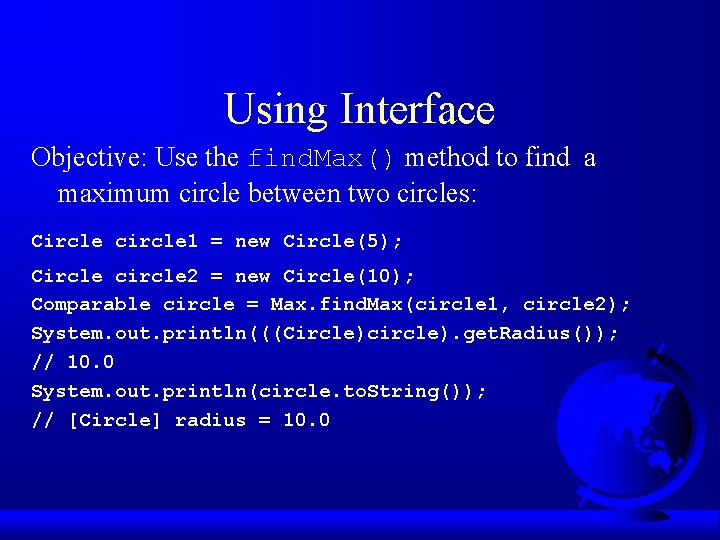
Using Interface Objective: Use the find. Max() method to find a maximum circle between two circles: Circle circle 1 = new Circle(5); Circle circle 2 = new Circle(10); Comparable circle = Max. find. Max(circle 1, circle 2); System. out. println(((Circle)circle). get. Radius()); // 10. 0 System. out. println(circle. to. String()); // [Circle] radius = 10. 0
Interfaces vs. Abstract Classes ¨ In an interface, the data must be constants; an abstract class can have all types of data. ¨ Each method in an interface has only a signature without implementation; ¨ An abstract class can have concrete methods. An abstract class must contain at least one abstract method or inherit from another abstract method.
Interfaces vs. Abstract Classes, cont. Since all the methods defined in an interface are abstract methods, Java does not require you to put the abstract modifier in the methods in an interface, but you must put the abstract modifier before an abstract method in an abstract class.
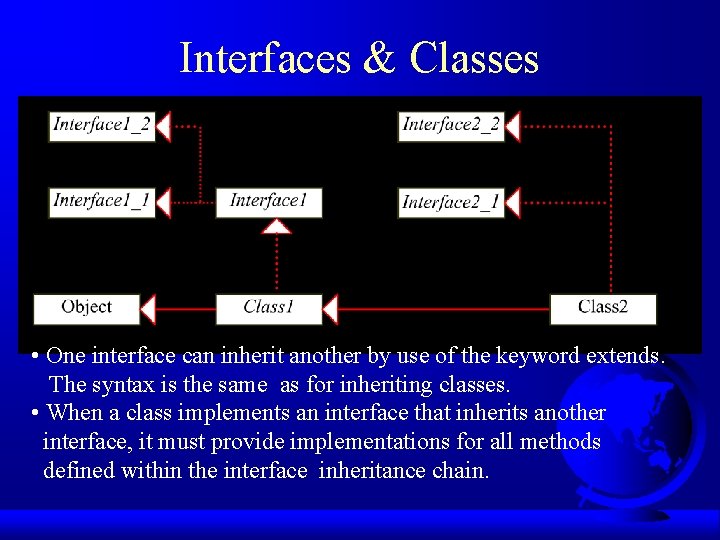
Interfaces & Classes • One interface can inherit another by use of the keyword extends. The syntax is the same as for inheriting classes. • When a class implements an interface that inherits another interface, it must provide implementations for all methods defined within the interface inheritance chain.
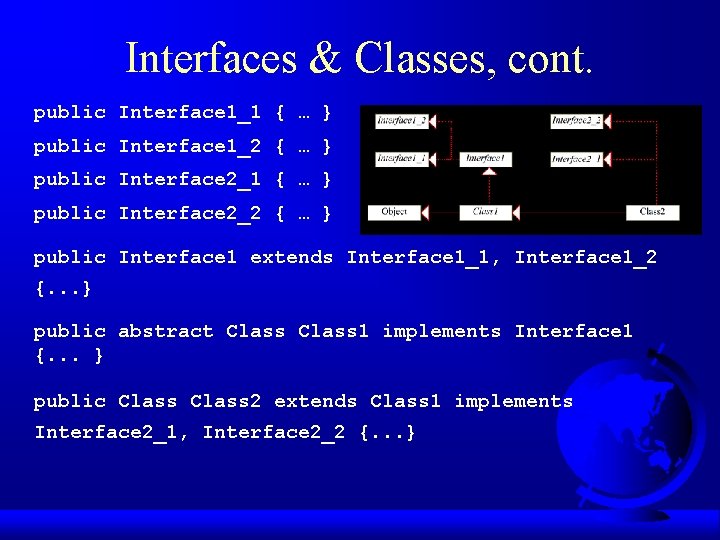
Interfaces & Classes, cont. public Interface 1_1 { … } public Interface 1_2 { … } public Interface 2_1 { … } public Interface 2_2 { … } public Interface 1 extends Interface 1_1, Interface 1_2 {. . . } public abstract Class 1 implements Interface 1 {. . . } public Class 2 extends Class 1 implements Interface 2_1, Interface 2_2 {. . . }
Interfaces vs. Absract Classes ¨ A strong is-a relationship that clearly describes a parent-child relationship should be modeled using classes. Example: a staff member is a person. ¨ A weak is-a relationship, also known as a-kind-of relationship, indicates that an object possesses a certain property. Example: all strings are comparable, so the String class implements the Comparable interface. ¨ The interface names are usually adjectives. You can also use interfaces to circumvent single inheritance restriction if multiple inheritance is desired. You have to design one as a superclass, and the others as interfaces.
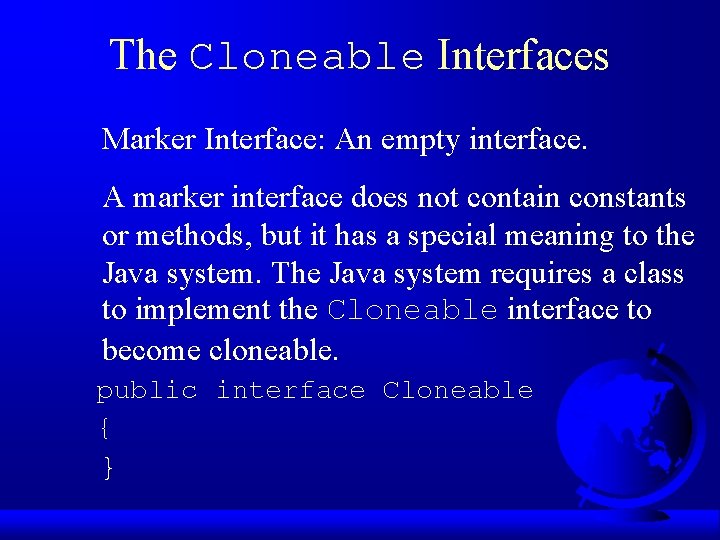
The Cloneable Interfaces Marker Interface: An empty interface. A marker interface does not contain constants or methods, but it has a special meaning to the Java system. The Java system requires a class to implement the Cloneable interface to become cloneable. public interface Cloneable { }
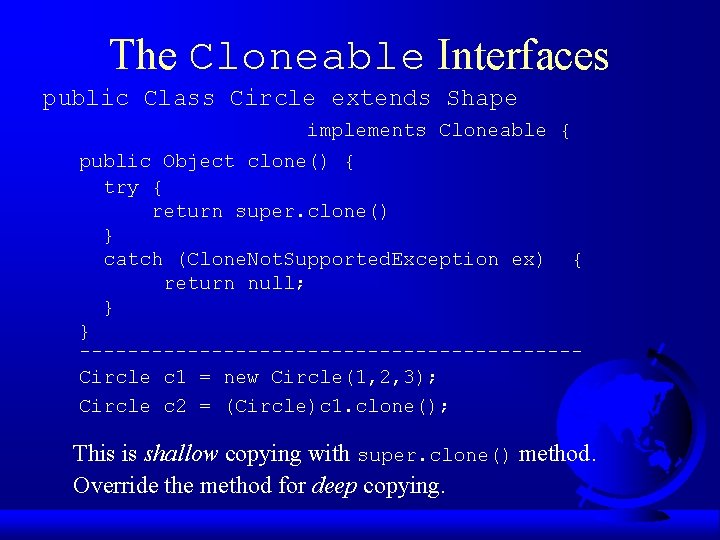
The Cloneable Interfaces public Class Circle extends Shape implements Cloneable { public Object clone() { try { return super. clone() } catch (Clone. Not. Supported. Exception ex) { return null; } } ---------------------Circle c 1 = new Circle(1, 2, 3); Circle c 2 = (Circle)c 1. clone(); This is shallow copying with super. clone() method. Override the method for deep copying.