
Global System for Mobile GSM Chapter 11 Wireless
Global System for Mobile (GSM) Chapter 11: Wireless Systems and Standards
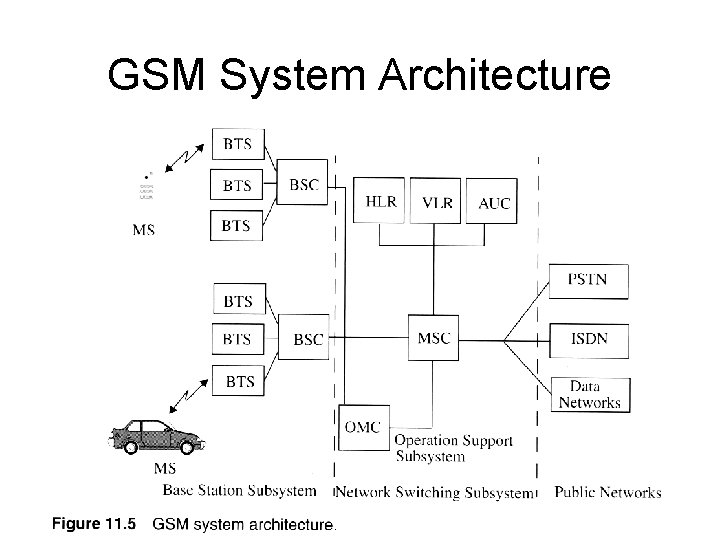
GSM System Architecture
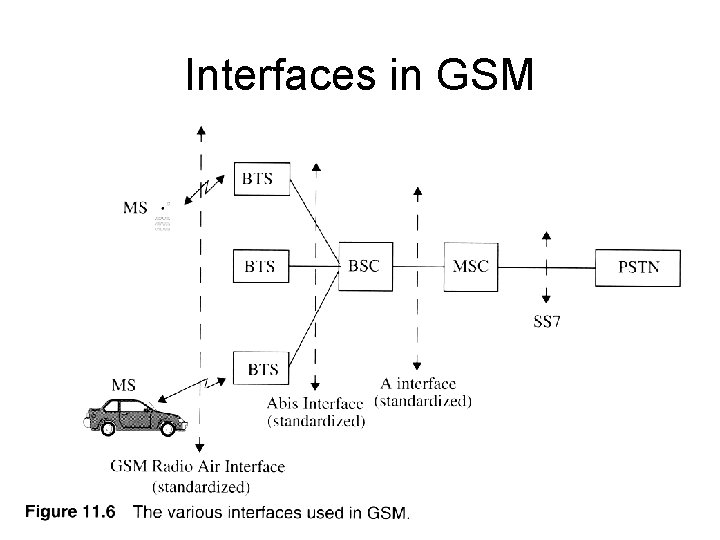
Interfaces in GSM
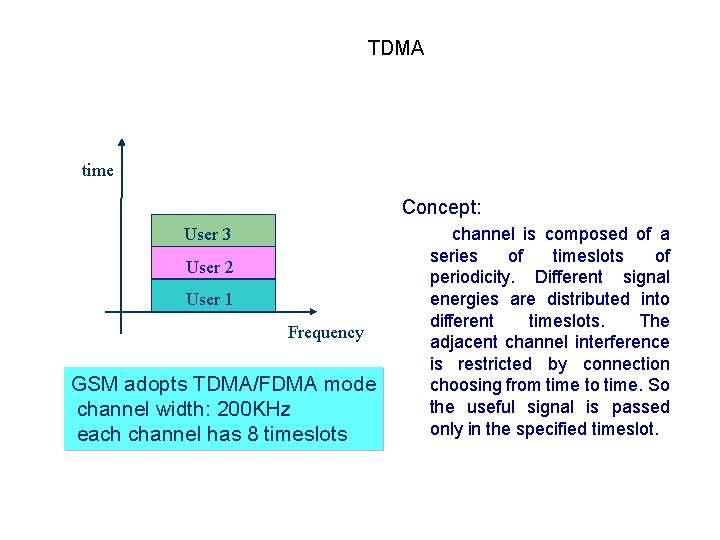
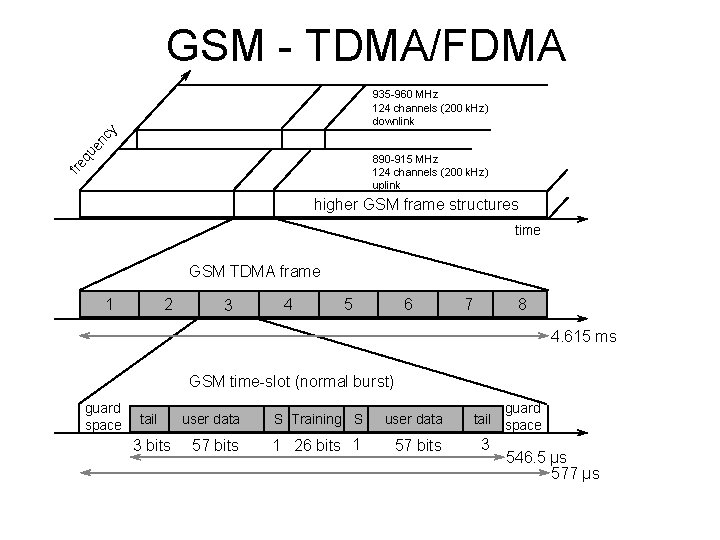
TDMA time Concept: User 3 User 2 User 1 Frequency GSM adopts TDMA/FDMA mode channel width: 200 KHz each channel has 8 timeslots channel is composed of a series of timeslots of periodicity. Different signal energies are distributed into different timeslots. The adjacent channel interference is restricted by connection choosing from time to time. So the useful signal is passed only in the specified timeslot.
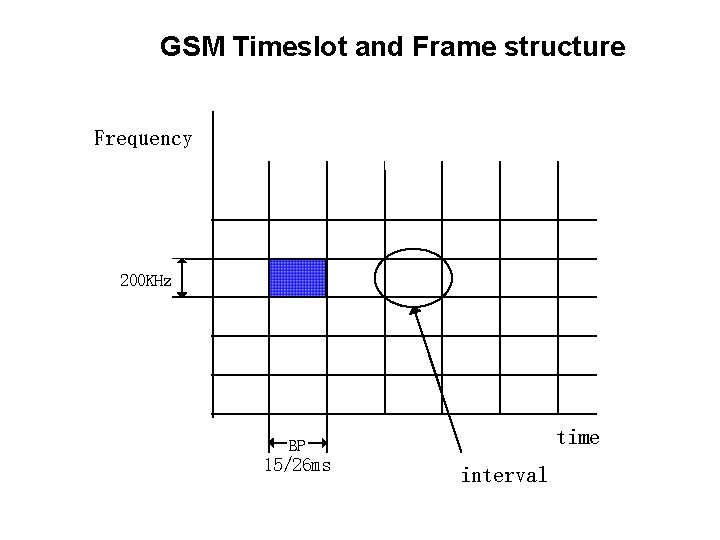
GSM Timeslot and Frame structure Frequency 200 KHz time BP 15/26 ms interval
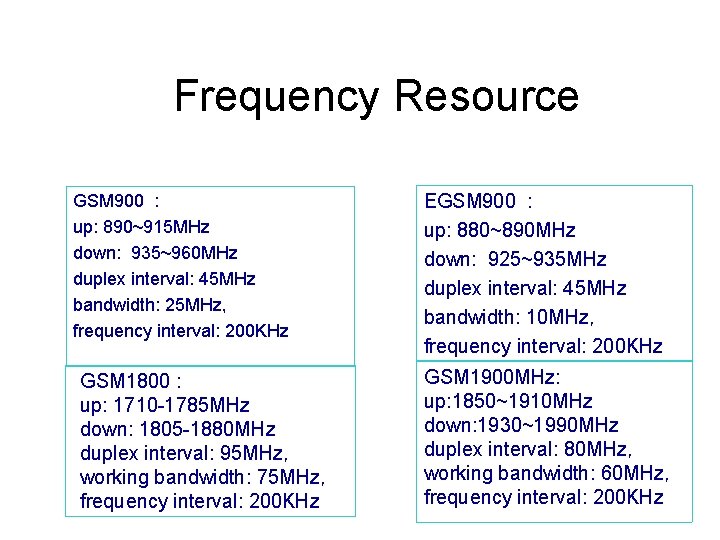
Frequency Resource GSM 900 : up: 890~915 MHz down: 935~960 MHz duplex interval: 45 MHz bandwidth: 25 MHz, frequency interval: 200 KHz GSM 1800 : up: 1710 -1785 MHz down: 1805 -1880 MHz duplex interval: 95 MHz, working bandwidth: 75 MHz, frequency interval: 200 KHz EGSM 900 : up: 880~890 MHz down: 925~935 MHz duplex interval: 45 MHz bandwidth: 10 MHz, frequency interval: 200 KHz GSM 1900 MHz: up: 1850~1910 MHz down: 1930~1990 MHz duplex interval: 80 MHz, working bandwidth: 60 MHz, frequency interval: 200 KHz
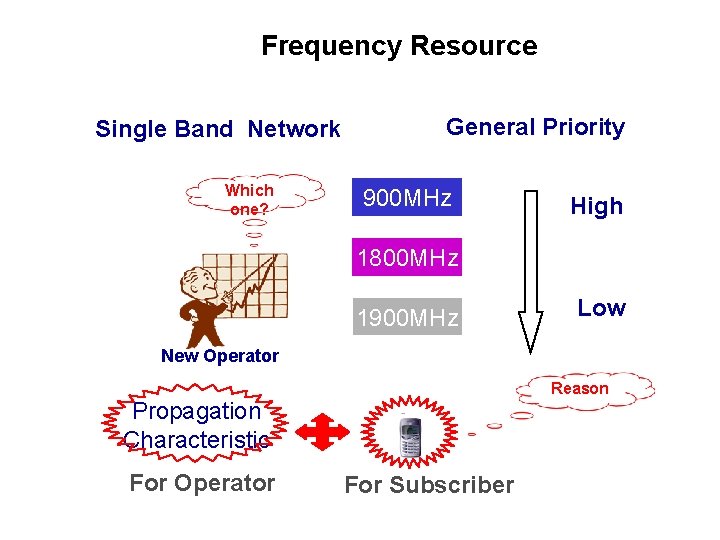
Frequency Resource Single Band Network Which one? General Priority 900 MHz High 1800 MHz 1900 MHz Low New Operator Reason Propagation Characteristic For Operator For Subscriber
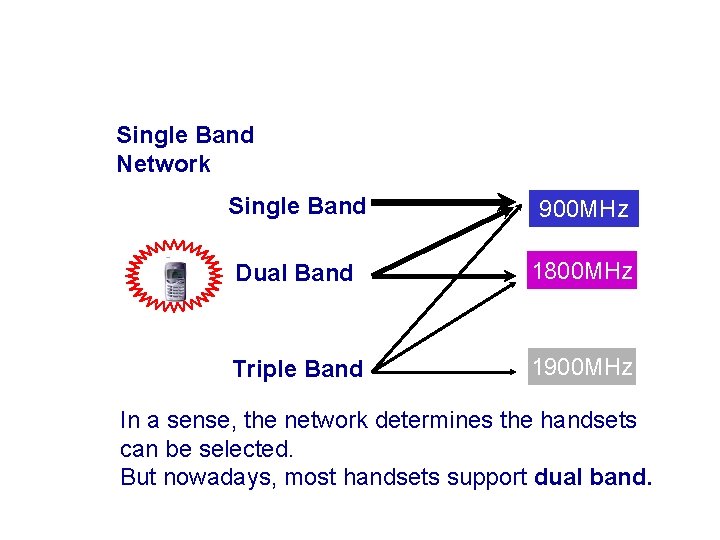
Frequency Resource Single Band Network Single Band 900 MHz Dual Band 1800 MHz Triple Band 1900 MHz In a sense, the network determines the handsets can be selected. But nowadays, most handsets support dual band.
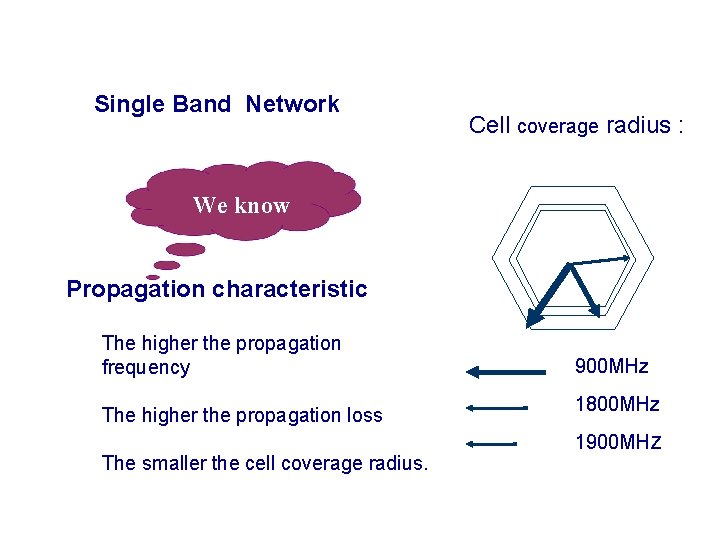
Frequency Resource Single Band Network Cell coverage radius : We know Propagation characteristic The higher the propagation frequency The higher the propagation loss The smaller the cell coverage radius. 900 MHz 1800 MHz 1900 MHz
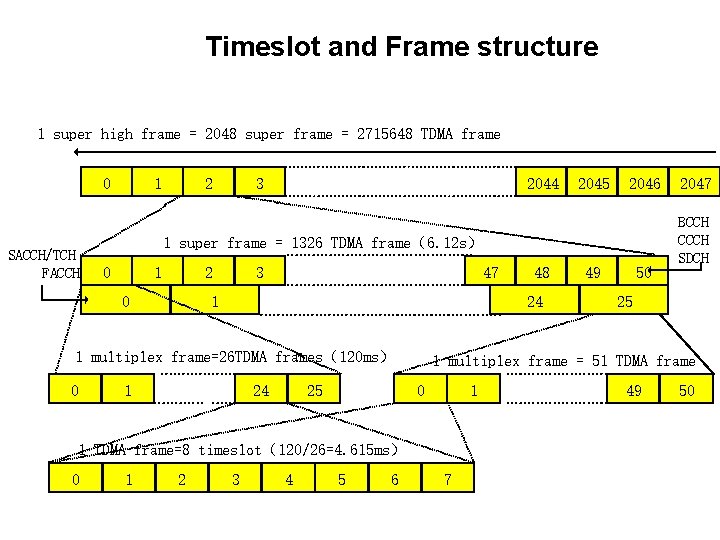
Timeslot and Frame structure 1 super high frame = 2048 super frame = 2715648 TDMA frame 0 SACCH/TCH FACCH 1 2 3 2044 0 1 2 3 47 1 1 24 25 2 3 4 0 5 6 49 50 2047 BCCH CCCH SDCH 25 1 multiplex frame = 51 TDMA frame 1 1 TDMA frame=8 timeslot(120/26=4. 615 ms) 1 48 24 1 multiplex frame=26 TDMA frames(120 ms) 0 2046 1 super frame = 1326 TDMA frame(6. 12 s) 0 0 2045 7 49 50
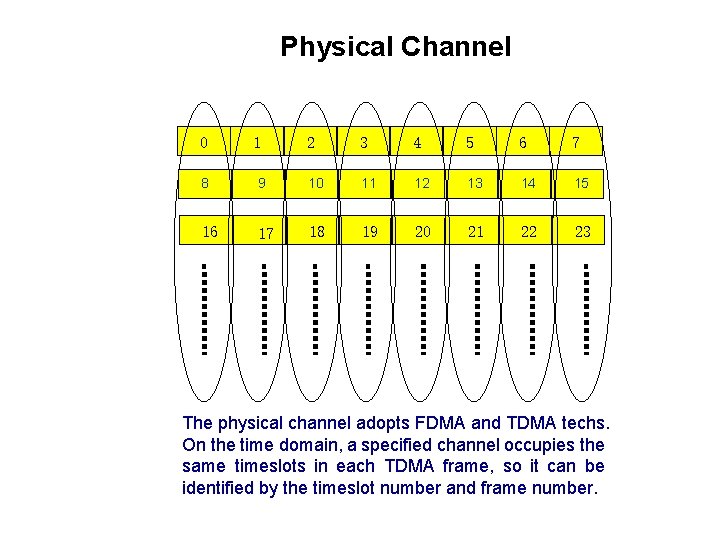
Physical Channel 0 1 2 3 4 5 6 7 8 9 10 11 12 13 14 15 16 17 18 19 20 21 22 23 The physical channel adopts FDMA and TDMA techs. On the time domain, a specified channel occupies the same timeslots in each TDMA frame, so it can be identified by the timeslot number and frame number.
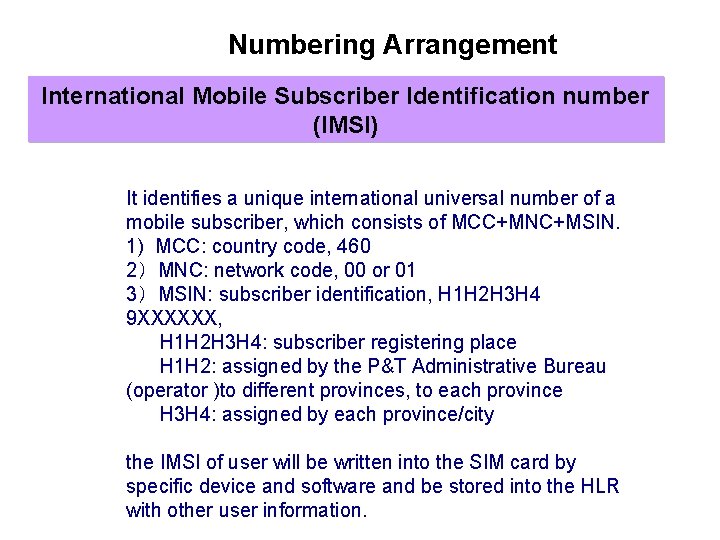
Numbering Arrangement International Mobile Subscriber Identification number (IMSI) It identifies a unique international universal number of a mobile subscriber, which consists of MCC+MNC+MSIN. 1) MCC: country code, 460 2)MNC: network code, 00 or 01 3)MSIN: subscriber identification, H 1 H 2 H 3 H 4 9 XXXXXX, H 1 H 2 H 3 H 4: subscriber registering place H 1 H 2: assigned by the P&T Administrative Bureau (operator )to different provinces, to each province H 3 H 4: assigned by each province/city the IMSI of user will be written into the SIM card by specific device and software and be stored into the HLR with other user information.
Numbering Arrangement Mobile Subscriber ISDN Number(MSISDN) It is the subscriber number commonly used. China uses the TDMA independent numbering plan: CC+NDC+ H 1 H 2 H 3 H 4 +ABC CC: country code, 86 NDC: network code, 135— 139, 130 H 1 H 2 H 3 H 4: HLR identification code ABCD: mobile subscriber number inside each HLR
Numbering Arrangement International Mobile Equipment Identification code (IMEI) It will uniquely identify a mobile station. It is a decimal number of 15 digits. Its structure is: TAC+FAC+SNR+SP TAC=model ratification code, 6 digits FAC=factory assembling code, 2 digits SNR=sequence code, 6 digits SP=reserved, 1 digit
Numbering Arrangement Mobile Subscriber Roaming Number (MSRN) The MSRN is temporarily distributed to the subscriber by the VLR according to the request by the HLR when this subscriber is called. The MSRN is released and can be assigned to other subscriber later. CC + NDC + 00 + M 1 M 2 M 3 + ABC CC: country code, 86 NDC: mobile network code, 135— 139, 130 M 1 M 2: same as the H 2 H 3 of MSISDN ABC: 000 -- 999
Numbering Arrangement Temporarily Mobile Subscriber Identification Number (TMSI) To insure the IMSI security, the VLR will assign a unique TMSI number for the accessed subscriber. It is used locally only and is a 4 -byte TMSI number BCD code.

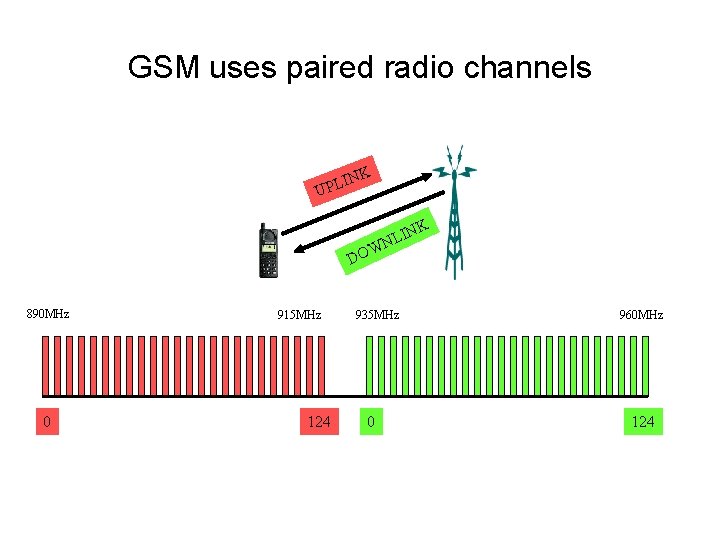
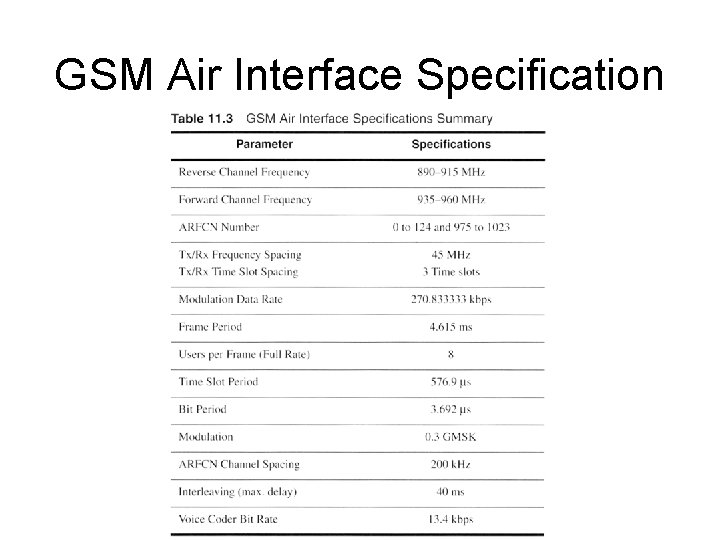
ARFCN Absolute Radio Frequency Channel Number 890 -915 MHz band for subscriber-to-base transmission(reverse link) 935 -960 MHz band for base-to-subscriber transmission(forward link) ARFCN denotes a forward and reverse channel pair which is separated in frequency by 45 MHz and each channel is time shared between as many as eight subscribers using TDMA
GSM uses paired radio channels INK L P U K IN NL W DO 890 MHz 0 915 MHz 124 935 MHz 0 960 MHz 124
GSM - TDMA/FDMA qu en cy 935 -960 MHz 124 channels (200 k. Hz) downlink fre 890 -915 MHz 124 channels (200 k. Hz) uplink higher GSM frame structures time GSM TDMA frame 1 2 3 4 5 6 7 8 4. 615 ms GSM time-slot (normal burst) guard space tail 3 bits user data S Training S user data 57 bits 1 26 bits 1 57 bits guard tail space 3 546. 5 µs 577 µs
GSM Air Interface Specification
LOGICAL CHANNELS TRAFFIC FULL RATE Bm 22. 8 Kb/S SIGNALLING HALF RATE Lm 11. 4 Kb/S BROADCAST FCCH SCH COMMON CONTROL DEDICATED CONTROL BCCH PCH FCCH -- FREQUENCY CORRECTION CHANNEL SCH -- SYNCHRONISATION CHANNEL BCCH -- BROADCAST CONTROL CHANNEL PCH -- PAGING CHANNEL RACH -- RANDOM ACCESS CHANNEL AGCH -- ACCESS GRANTED CHANNEL SDCCH -- STAND ALONE DEDICATED CONTROL CHANNEL SACCH -- SLOW ASSOCIATED CONTROL CHANNEL FACCH -- FAST ASSOCIATED CONTROL CHANNEL RACH AGCH SDCCH SACCH DOWN LINK ONLY UPLINK ONLY FACCH BOTH UP & DOWNLINKS

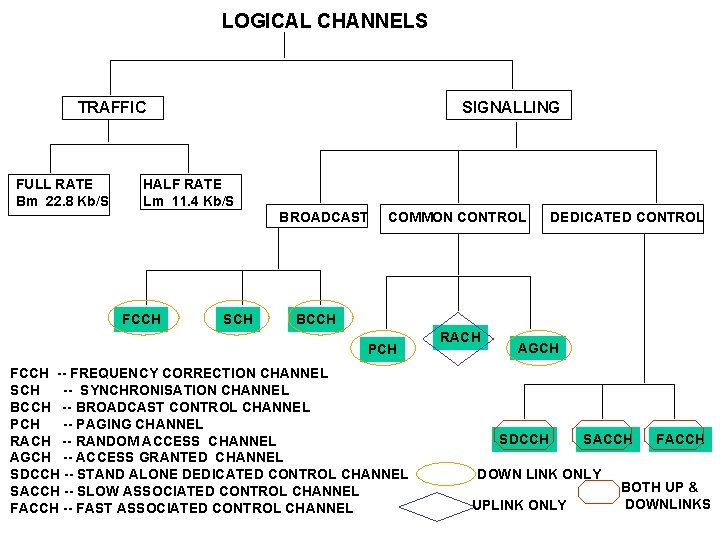
Channel Type-Summary 14. 4 Kbit/s FR TCH (TCH/F 14. 4) 9. 6 Kbit/s FR TCH(TCH/F 9. 6) Data CH TCH Voice CH 4. 8 Kbit/s FR TCH (TCH/F 4. 8) 4. 8 Kbit/s HR TCH (TCH/H 4. 8) FR Voice Traffic Channel (TCH/FS) Enhanced FR Traffic Channel (TCH/EFR) HR Traffic Channel (TCH/HS) channel BCH CCCH DCCH FCCH (down) SCH (down) BCCH (down) RACH (up) AGCH (down) PCH (down) SDCCH (both) FACCH (both) SACCH (both)
Traffic and Control channels Traffic channels carry digitally encoded user speech or user data and have identical functions and formats on both the forward and reverse link. Control channels carry signalling and synchronizing commands between the base station and mobile station. Certain types of Control channels are defined just forward or reverse.
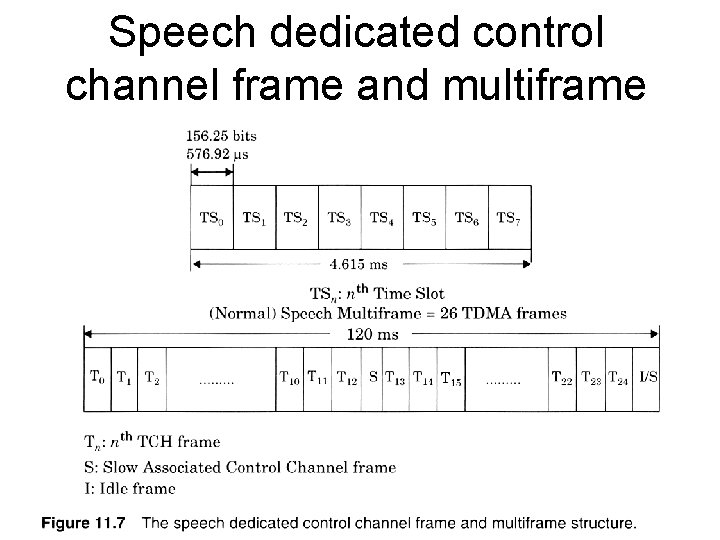
Speech dedicated control channel frame and multiframe
GSM Traffic Channels - TCH • GSM Traffic Channels may be either full-rate or half-rate and may carry either digitized speech or user data. • When transmitted as full-rate, user data is contained within one TS per frame. • When transmitted as half-rate, user data is mapped onto the same time slot, but is sent in alternate frames. That is two half-rate channel users would share the same time slot, but would alternately transmit during every other frame.
GSM TCH Continue. . • In the GSM standard, TCH data may not be sent in TS 0 within a TDMA frame on certain ARFCNs which serve as the broadcast station for each cell. • TCH data are broken up every thirteenth frame by either slow associated control channel (SACCH) data, or the idle frames. • The 26 th frame contains idle bit for the case when full-rate TCHs are used, and contains SACCH data when half-rate TCHs are used. • Full-TCH 22. 8 kbps, Half-TCH 11. 4 kbps.
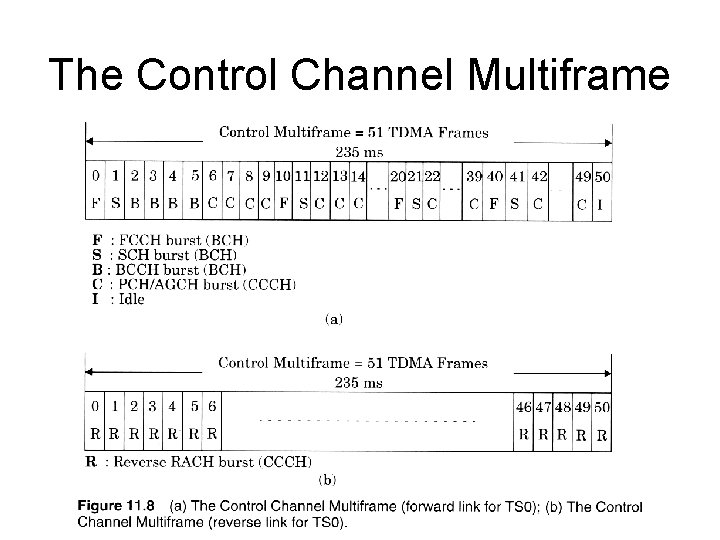
The Control Channel Multiframe
Broadcast Channels - BCHs • Broadcast channel operates on the forward link of a specific ARFCN within each cell, and transmits data only in the first time slot (TS 0) of certain GSM frames. • The other seven timeslots are available for TCH and DCCH data, or are filled by dummy bursts. Further more, all eight timeslots on all other ARFCNs within the cell are available for TCH and DCCH data. • BCH provides synchronization for all mobiles within the cell and is occasionally monitored by mobiles in neighboring cells so that received power and MAHO decisions may be made by out-of-cell users.
Broadcast Control Channel BCCH • Broadcast control channel (BCCH) is a base to mobile channel which provides general information about the network, the cell in which the mobile is currently located and the adjacent cells • BCCH also broadcast a list of channels that are currently in use within the cell. • Frame 2 to 5 in a control multiframe (4 out of every 51 frames) contain BCCH data. • Frame TS 0 may contains BCCH for specific frames, while for other specific frames TS 0 may contains FCCH or CCCHs.
Frequency correction channel (FCCH) FCCH is a special data burst which occupies TS 0 for the very first GSM frame (frame 0) and is repeated every ten frames within a control channel multi-frame. FCCH allows each subscriber unit to synchronize its internal frequency standard (local oscillator) to the exact frequency of the base station.
Synchronization channel (SCH) SCH is broadcast in TS 0 of the frame immediately following the FCCH frame and is used to identify the serving base station while allowing each mobile to frame synchronize with the base station. The frame number (FN), which ranges from 0 to 2, 715, 647, is sent with base station identity code (BSIC) during the SCH burst. The SCH is transmitted once every ten frames within the control channel multiframe.
Common Control Channels CCHs • On the broadcast (BCH) ARFCN, the CCH occupy TS 0 of every GSM frame that is not otherwise used by the BCH or the Idle frame. • CCCH are the most commonly used control channels and are used to page specific subscriber, assignaling channels to specific users, and receive mobile request for service. • Three types named: PCH, RACH and AGCH
Paging channel (PCH) • PCH provides paging signals from the base station to all mobiles in the cell, and notifies a specific mobile of an incoming call which originates from the PSTN. • PCH transmits the IMSI of the target subscriber, along with a request for acknowledgment from mobile unit on the RACH. • PCH may be used to provide cell broadcast ASCII text messages to all subscribers.
Random access channel (RACH) • RACH is a reverse link channel used by a subscriber unit to acknowledge a page from the PCH, and is also used by mobiles to originate a call. • All mobiles must request access or respond to PCH alert within TS 0 of a GSM frame. • In establishing service, the GSM base station must respond to the RACH transmission by allocating a channel and assigning a stand-alone dedicated control channel (SDCCH) for signaling during a call. • This connection is confirm by BS over the AGCH.
Access grant channel (AGCH) • AGCH is used by the base station to provide forward link communication to the mobile, and carries data which instructs the mobile to operate in a particular physical (time slot and ARFCN) with a particular dedicated control channel. • AGCH is used by the base station to respond to a RACH sent by a mobile station in a previous CCCH frame.
Dedicated Control Channels DCCHs • Stand-alone dedicated control channel (SDCCH) is a bi-directional channel allocated to a specific mobile for exchange of location update information and call set up information. • SDCCH ensures that the MS and the BS remain connected while BS and MSC verify the subscriber unit and allocate resources to the mobile.
Slow associated control channel (SACCH) • SACCH is a bi-directional channel used for exchanging control information between base and a mobile during the progress of a call set up procedure. The SACCH is associated with a particular traffic channel or stand alone dedicated control channel. • On the forward link, the SACCH is used to send slow but regular changing control information to the mobile, such as transmit power level instructions and specific timing advance instructions for each user on the ARFCN. • Reserve SACCH link carries information about the received signal strength and quality of TCH.
Fast associated control channel (FACCH) • Fast associated control channel (FACCH) is a bidirectional channel which is used for exchange of time critical information between mobile and base station during the progress of a call. The FACCH transmits control information by stealing capacity from the associated TCH. • The stealing is done by setting two special bits, called stealing bits, in a TCH forward channel burst. If the stealing bits are set, the time slot is known to contain FACCH data, not a TCH, for that frame.
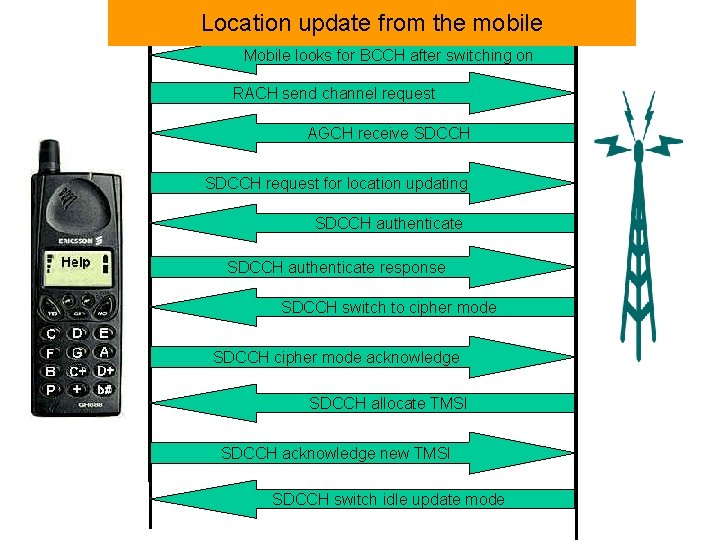
Location update from the mobile Mobile looks for BCCH after switching on RACH send channel request AGCH receive SDCCH request for location updating SDCCH authenticate response SDCCH switch to cipher mode SDCCH cipher mode acknowledge SDCCH allocate TMSI SDCCH acknowledge new TMSI SDCCH switch idle update mode
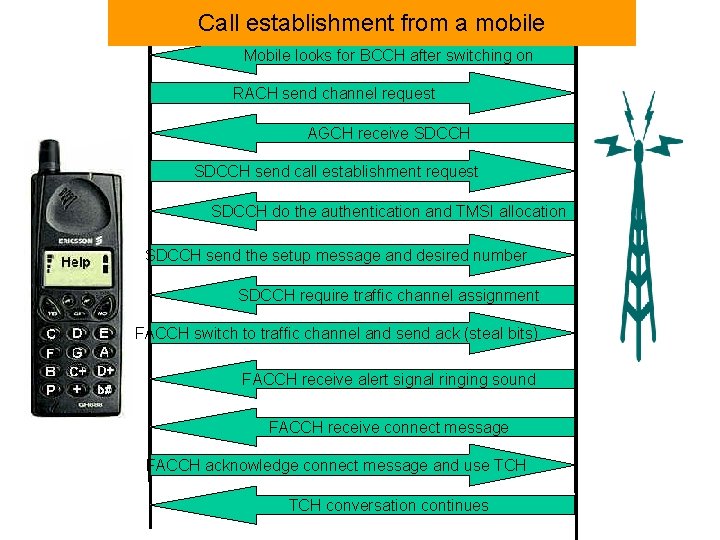
Call establishment from a mobile Mobile looks for BCCH after switching on RACH send channel request AGCH receive SDCCH send call establishment request SDCCH do the authentication and TMSI allocation SDCCH send the setup message and desired number SDCCH require traffic channel assignment FACCH switch to traffic channel and send ack (steal bits) FACCH receive alert signal ringing sound FACCH receive connect message FACCH acknowledge connect message and use TCH conversation continues
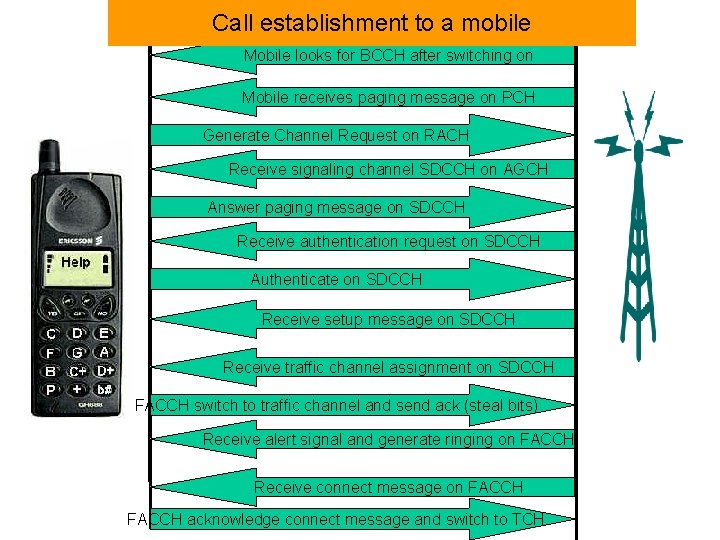
Call establishment to a mobile Mobile looks for BCCH after switching on Mobile receives paging message on PCH Generate Channel Request on RACH Receive signaling channel SDCCH on AGCH Answer paging message on SDCCH Receive authentication request on SDCCH Authenticate on SDCCH Receive setup message on SDCCH Receive traffic channel assignment on SDCCH FACCH switch to traffic channel and send ack (steal bits) Receive alert signal and generate ringing on FACCH Receive connect message on FACCH acknowledge connect message and switch to TCH

Thank you
- Slides: 42