Integration Risk Optimization Models and Algorithms Vladimir ZASLAVSKY



- Slides: 38
Integration Risk Optimization Models and Algorithms Vladimir ZASLAVSKY Head of Department of Mathematical Methods in Ecology and Economic Research Faculty of Cybernetics National Taras Shevchenko University of Kiev Velingrad, 2006 1
System analysis and risk management • Risk management and safety providing are system problems that concern different countries and unite industrial regions, depend on technical conditions of enterprises and influence on economy and ecology. • Harmful attitude connecting with human activity to nature and its resources has a great negative influence on ecology, land water resources and requires more and more financial expenses for risk reduction, reconstruction and prevention of technical and ecological cataclysms. Velingrad, 2006 2
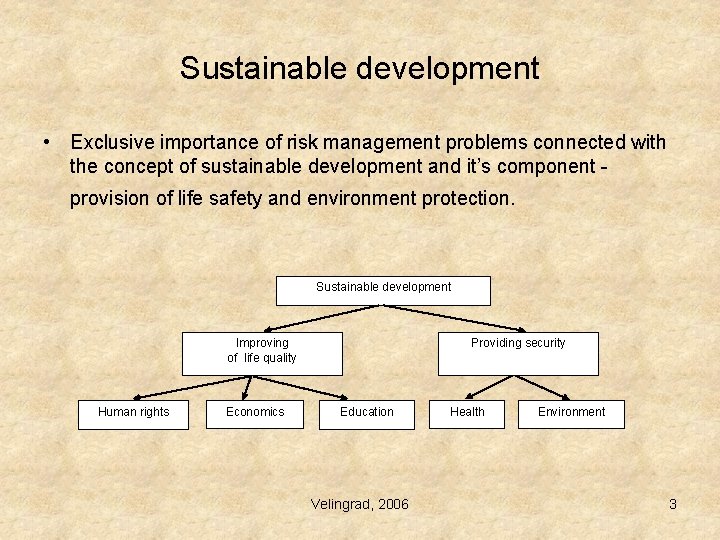
Sustainable development • Exclusive importance of risk management problems connected with the concept of sustainable development and it’s component provision of life safety and environment protection. Sustainable development Improving of life quality Human rights Economics Providing security Education Velingrad, 2006 Health Environment 3
System analysis and risk definition Velingrad, 2006 4
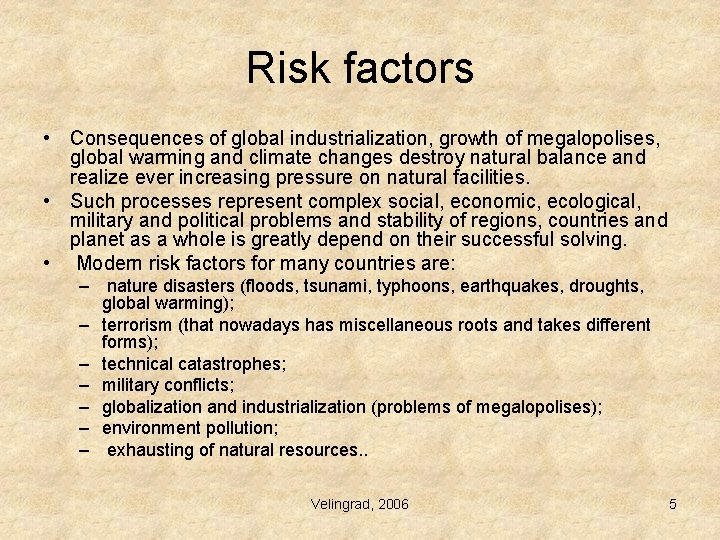
Risk factors • Consequences of global industrialization, growth of megalopolises, global warming and climate changes destroy natural balance and realize ever increasing pressure on natural facilities. • Such processes represent complex social, economic, ecological, military and political problems and stability of regions, countries and planet as a whole is greatly depend on their successful solving. • Modern risk factors for many countries are: – nature disasters (floods, tsunami, typhoons, earthquakes, droughts, global warming); – terrorism (that nowadays has miscellaneous roots and takes different forms); – technical catastrophes; – military conflicts; – globalization and industrialization (problems of megalopolises); – environment pollution; – exhausting of natural resources. . Velingrad, 2006 5
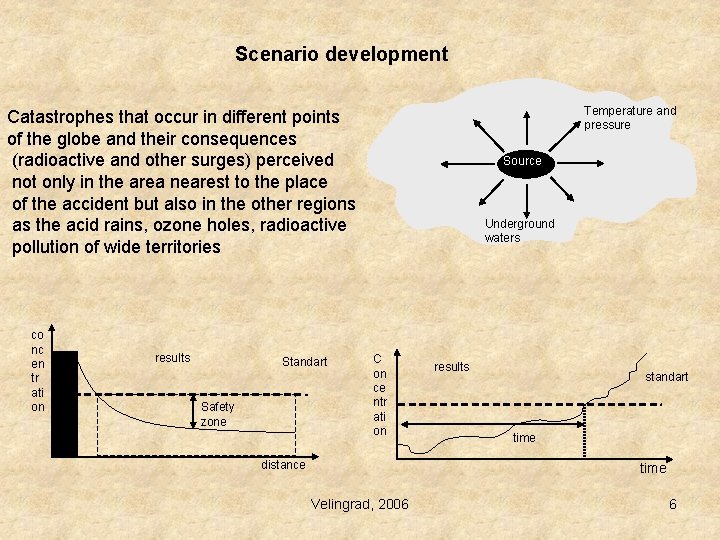
Scenario development Temperature and pressure Catastrophes that occur in different points of the globe and their consequences (radioactive and other surges) perceived not only in the area nearest to the place of the accident but also in the other regions as the acid rains, ozone holes, radioactive pollution of wide territories co nc en tr ati on results Standart Safety zone Source Underground waters C on ce ntr ati on distance results standart time Velingrad, 2006 6
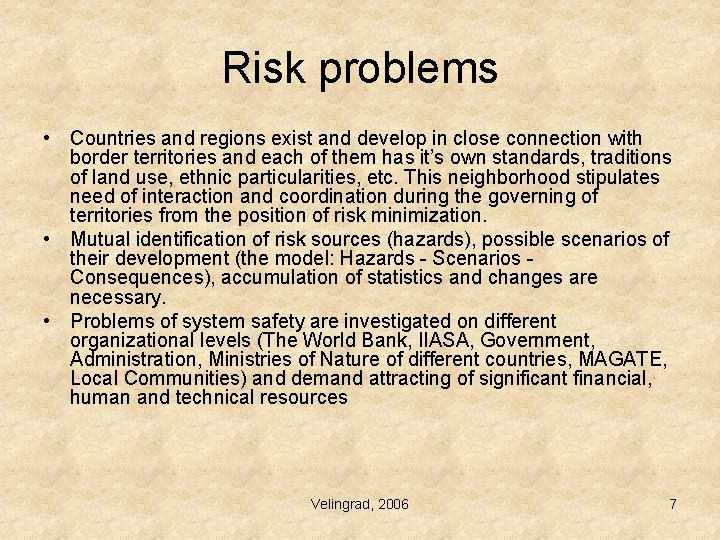
Risk problems • Countries and regions exist and develop in close connection with border territories and each of them has it’s own standards, traditions of land use, ethnic particularities, etc. This neighborhood stipulates need of interaction and coordination during the governing of territories from the position of risk minimization. • Mutual identification of risk sources (hazards), possible scenarios of their development (the model: Hazards - Scenarios Consequences), accumulation of statistics and changes are necessary. • Problems of system safety are investigated on different organizational levels (The World Bank, IIASA, Government, Administration, Ministries of Nature of different countries, MAGATE, Local Communities) and demand attracting of significant financial, human and technical resources Velingrad, 2006 7
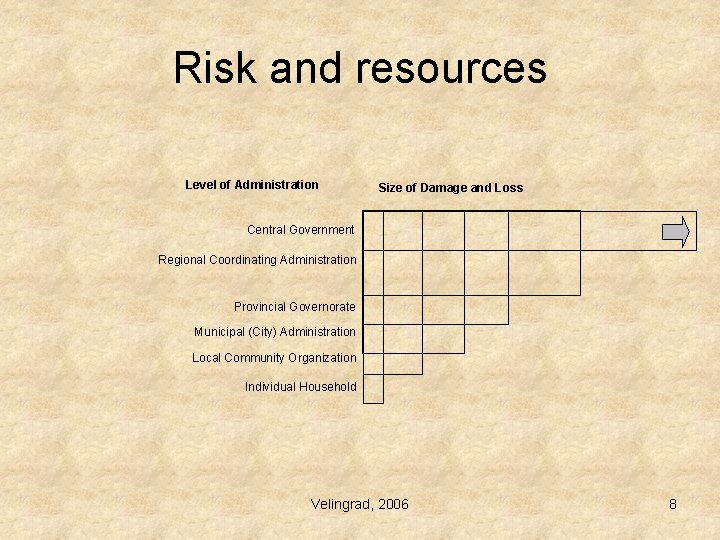
Risk and resources Level of Administration Size of Damage and Loss Central Government Regional Coordinating Administration Provincial Governorate Municipal (City) Administration Local Community Organization Individual Household Velingrad, 2006 8
Risk and decision making • • On each management level it’s necessary to evaluate scales of the damages and losses, to have real and adequate cards of risk regions and classification of dangerous objects. System approach to risk investigation and hazards ranking (taking into account uncertainties) is very important along with understanding the fact that they can be interconnected, affect one another thus intensifying the negative effect. The core question in provision of safety and security and liquidation of accidents’ consequences is responsibility for decisions. Taking the responsible decisions should be collegiate and weighted. Experts should consider all possible scenarios of events’ development, clearly understand the consequences of each of them and their influence on safety and life quality, because the human safety is considered today as main criteria. Significant risks to regional safety are also brought by terrorism. They objectively-real and recently become more often and their prevention requires new approaches. Therefore it’s necessary to establish automated protection systems and organize trained personnel to provide safety of critical infrastructure objects. Velingrad, 2006 9
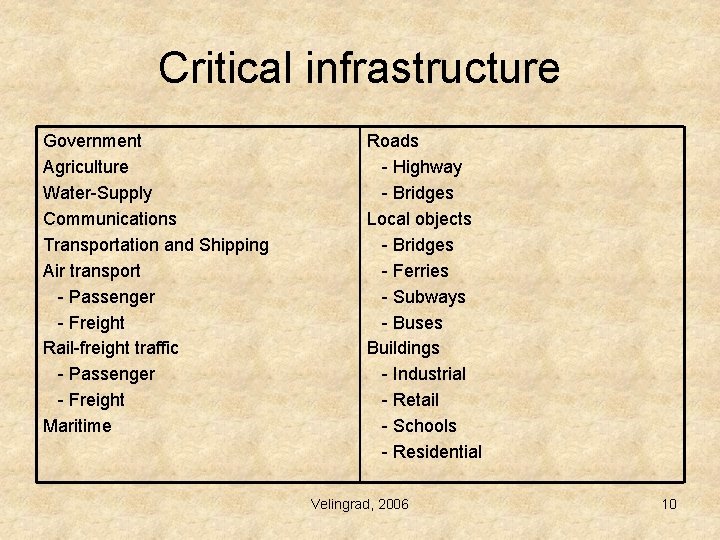
Critical infrastructure Government Agriculture Water-Supply Communications Transportation and Shipping Air transport - Passenger - Freight Rail-freight traffic - Passenger - Freight Maritime Roads - Highway - Bridges Local objects - Bridges - Ferries - Subways - Buses Buildings - Industrial - Retail - Schools - Residential Velingrad, 2006 10
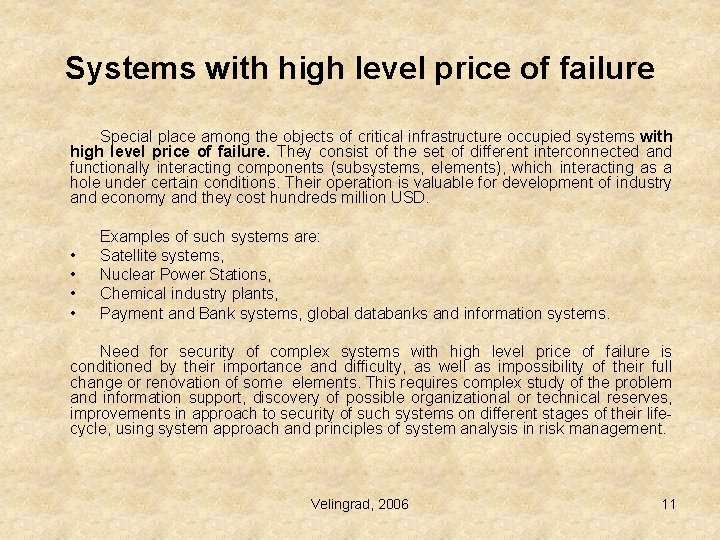
Systems with high level price of failure Special place among the objects of critical infrastructure occupied systems with high level price of failure. They consist of the set of different interconnected and functionally interacting components (subsystems, elements), which interacting as a hole under certain conditions. Their operation is valuable for development of industry and economy and they cost hundreds million USD. • • Examples of such systems are: Satellite systems, Nuclear Power Stations, Chemical industry plants, Payment and Bank systems, global databanks and information systems. Need for security of complex systems with high level price of failure is conditioned by their importance and difficulty, as well as impossibility of their full change or renovation of some elements. This requires complex study of the problem and information support, discovery of possible organizational or technical reserves, improvements in approach to security of such systems on different stages of their lifecycle, using system approach and principles of system analysis in risk management. Velingrad, 2006 11
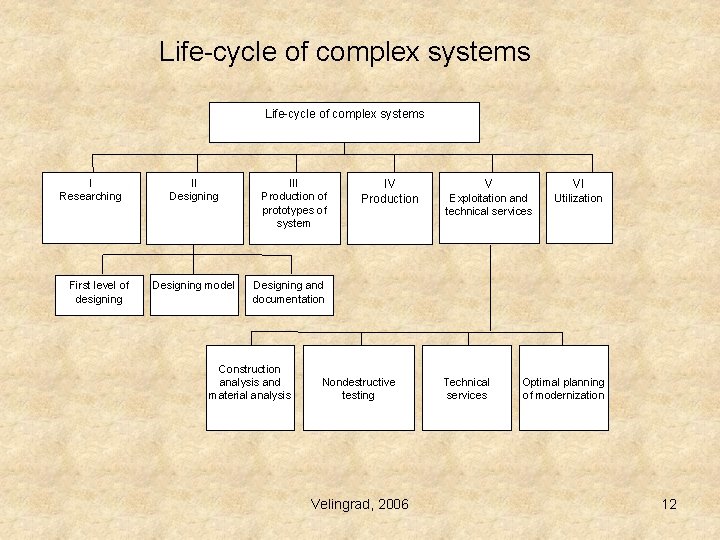
Life-cycle of complex systems I Researching First level of designing II Designing model III Production of prototypes of system IV Production V VI Exploitation and technical services Utilization Designing and documentation Construction analysis and material analysis Nondestructive testing Velingrad, 2006 Technical services Optimal planning of modernization 12
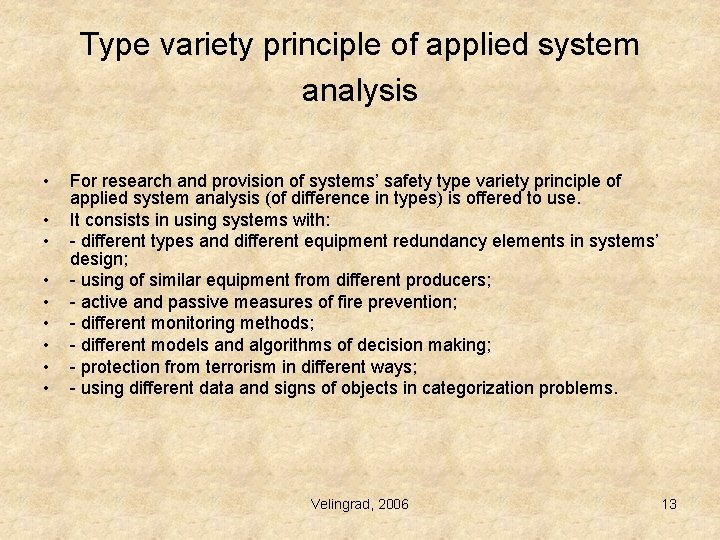
Type variety principle of applied system analysis • • • For research and provision of systems’ safety type variety principle of applied system analysis (of difference in types) is offered to use. It consists in using systems with: - different types and different equipment redundancy elements in systems’ design; - using of similar equipment from different producers; - active and passive measures of fire prevention; - different monitoring methods; - different models and algorithms of decision making; - protection from terrorism in different ways; - using different data and signs of objects in categorization problems. Velingrad, 2006 13
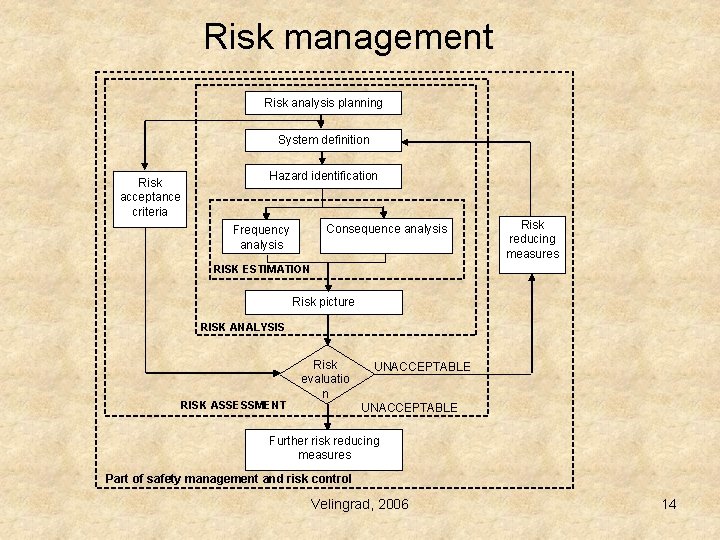
Risk management Risk analysis planning System definition Risk acceptance criteria Hazard identification Consequence analysis Frequency analysis Risk reducing measures RISK ESTIMATION Risk picture RISK ANALYSIS RISK ASSESSMENT Risk evaluatio n UNACCEPTABLE Further risk reducing measures Part of safety management and risk control Velingrad, 2006 14
1. Mathematical models for risk management Velingrad, 2006 15
Mathematical models for risk management Velingrad, 2006 16
2. Optimization of complex of methods for nondestructive testing (NDT) • Application of optimal complex of nondestructive testing (NDT) methods can contribute significantly to the extension of life expectation, reliability and, finally, safety, especially for very complex systems like nuclear power plants, ground rocket complexes, etc. • The NPP is a complex system and its safety is related to the safety of each of the system elements. Safety of power supply systems occupies one of the most important roles in the NPP safety, because cables are potential source of fire. • This article deals with the task of complex optimization of NDT methods and contains the idea to detect the set of possible and dangerous defects for NPP power system cables taking into account the criteria of defect detection and efficiency level. The application of multilevel one-criterion task of discrete programming is presented and discussed. Efficiency of complex application of NDT methods depends on scheme of testing organization, planning, data acquisition and processing and personnel qualification. Velingrad, 2006 17
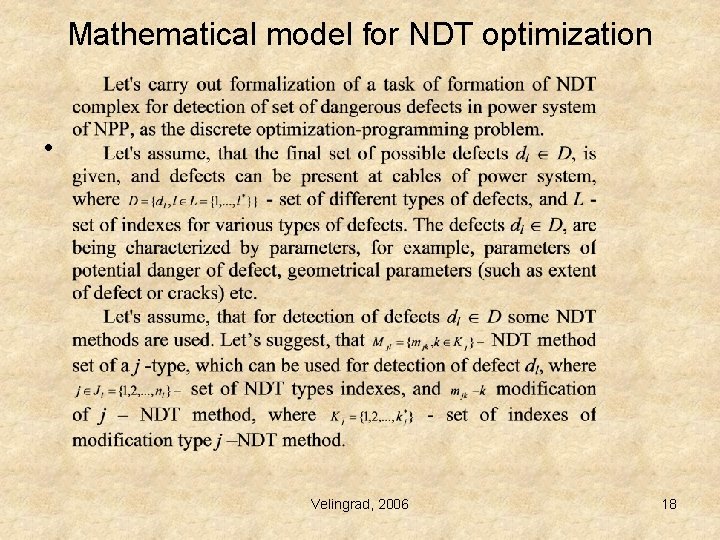
Mathematical model for NDT optimization • Velingrad, 2006 18
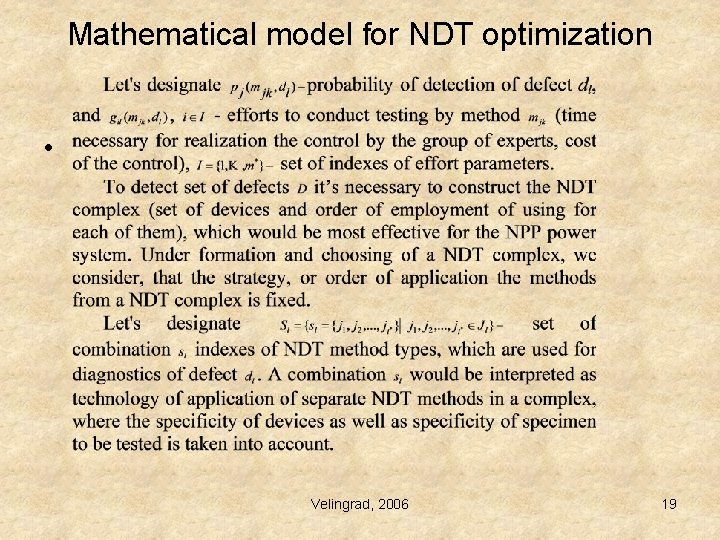
Mathematical model for NDT optimization • Velingrad, 2006 19
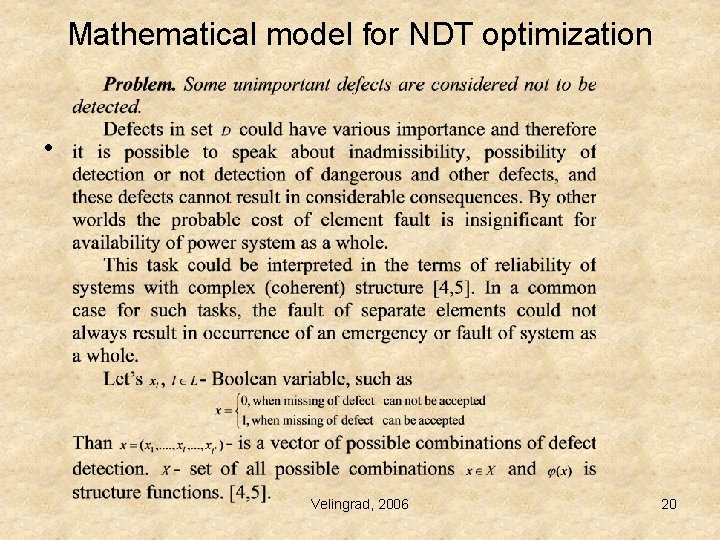
Mathematical model for NDT optimization • Velingrad, 2006 20
Mathematical model for NDT optimization • Velingrad, 2006 21
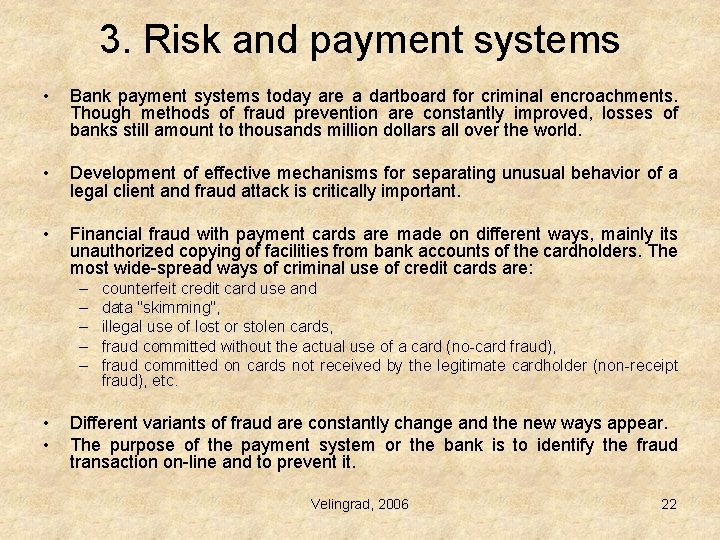
3. Risk and payment systems • Bank payment systems today are a dartboard for criminal encroachments. Though methods of fraud prevention are constantly improved, losses of banks still amount to thousands million dollars all over the world. • Development of effective mechanisms for separating unusual behavior of a legal client and fraud attack is critically important. • Financial fraud with payment cards are made on different ways, mainly its unauthorized copying of facilities from bank accounts of the cardholders. The most wide-spread ways of criminal use of credit cards are: – – – • • counterfeit credit card use and data "skimming", illegal use of lost or stolen cards, fraud committed without the actual use of a card (no-card fraud), fraud committed on cards not received by the legitimate cardholder (non-receipt fraud), etc. Different variants of fraud are constantly change and the new ways appear. The purpose of the payment system or the bank is to identify the fraud transaction on-line and to prevent it. Velingrad, 2006 22
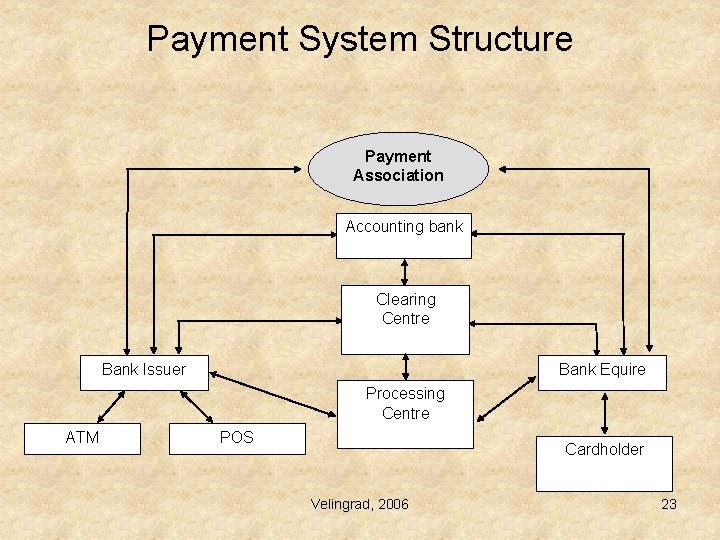
Payment System Structure Payment Association Accounting bank Clearing Centre Bank Issuer Bank Equire Processing Centre ATM POS Cardholder Velingrad, 2006 23
Risks in Payment System Every payment system (PS) is characterized by high level of risk in its different domains, caused by: • great volume and number of operations, • complex relations between its members, • ever increasing speed of data transmission. In order to control risks PS should develop and use mathematical models, which enable to determine hazardous situations in PS, establish scenario of their development and evaluate consequences of their realization. Velingrad, 2006 24
Problem definition Velingrad, 2006 25
Problem analysis A variety of methods can be applied for solving represented problem. The most simple method, which was used in the first transactions monitoring systems, is creation of a set of rules describing fraud transactions and establishment of thresholds for different parameters of transaction. Such methods are rather simple, but they have obvious disadvantages: • they detect only fixed suspicious situations established beforehand don’t take into account mutable nature of fraud; • they don’t take into account individual characteristics of cardholders’ behaviour. • control of such system of rules is rather complex task for the expert. Using of contemporary methods of neural nets, fuzzy logic, theory of probability and math statistic and other data mining methods is more effective for automatically creation of fraudulent transaction patterns on the basis of transaction’s history, their updating and verifying all new transactions. We propose to use one of the neural nets algorithms – the Self Organizing Maps (SOM) – for analysis of transactional data and detection of fraudulent behaviour. Velingrad, 2006 26
Transactions classification principle Velingrad, 2006 27
Transactions classification principle Velingrad, 2006 28
Transactions analysis with SOM. Main principles Velingrad, 2006 29
Testing hypotheses Velingrad, 2006 30
Creation of cardholder profile Velingrad, 2006 31
Creation of cardholder profile Velingrad, 2006 32
Creation of cardholder profile Velingrad, 2006 33
Calculation the transaction similarity rate to profile Velingrad, 2006 34
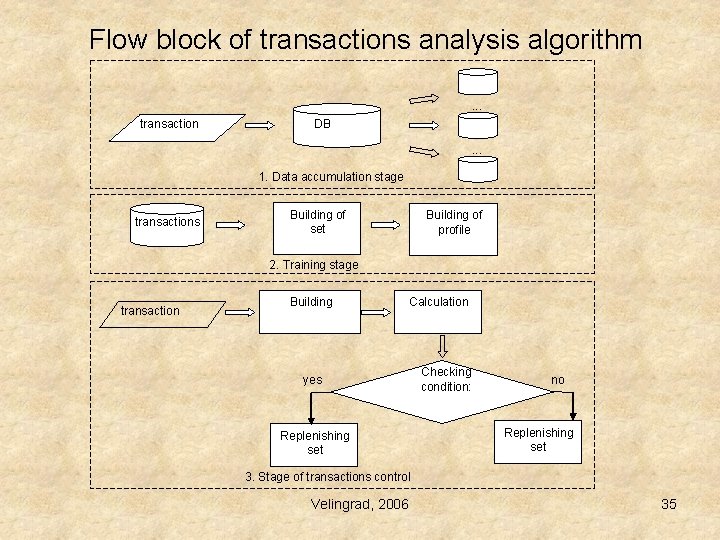
Flow block of transactions analysis algorithm. . . transaction DB. . . 1. Data accumulation stage transactions Building of set Building of profile 2. Training stage transaction Building Calculation yes Replenishing set Checking condition: no Replenishing set 3. Stage of transactions control Velingrad, 2006 35
Algorithm Velingrad, 2006 36
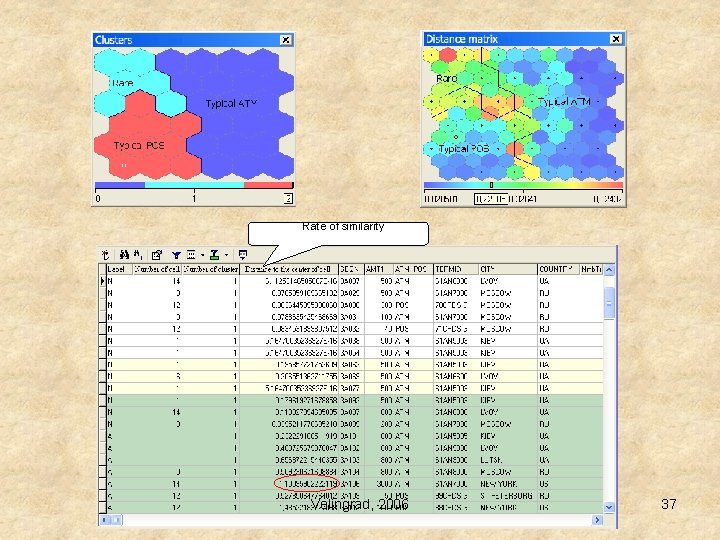
Rate of similarity Velingrad, 2006 37
? Questions ? Velingrad, 2006 39