Integrated Food Safety Centers of Excellence Data Driven
- Slides: 33
Integrated Food Safety Centers of Excellence: Data Driven Best Practices National Association of Environmental Health Annual Educational Conference & Exhibition Orlando, FL July 14, 2015 Presented By: David Dekevich, MPH – Central Office Melissa Brock, REHP – Brevard County Dana Grissom – Okaloosa County 1
Outline » Integrated Food Safety Centers of Excellence (Co. E) » Council to Improve Foodborne Outbreak Response (CIFOR) Toolkit Evaluation » Brevard County Evaluation and Implementations » Okaloosa County Evaluation and Implementations 2
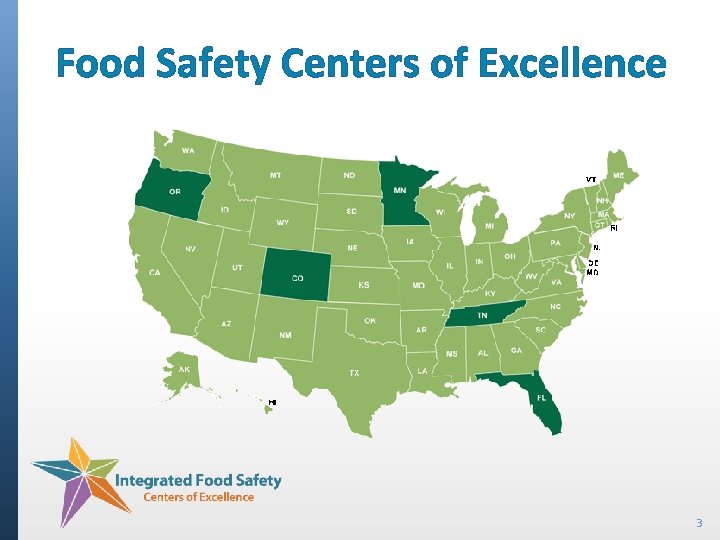
Food Safety Centers of Excellence 3
Mission » Serve as a resource for local, state, and federal public health professionals who respond to foodborne illness and outbreaks 4
Main Activity Areas » Strengthen surveillance and outbreak investigations » Analyze timeliness and effectiveness of responses » Train public health staff in proven investigation techniques » Educate future food safety workers » Improve capacity of information systems » Evaluate and communicate best practices 5
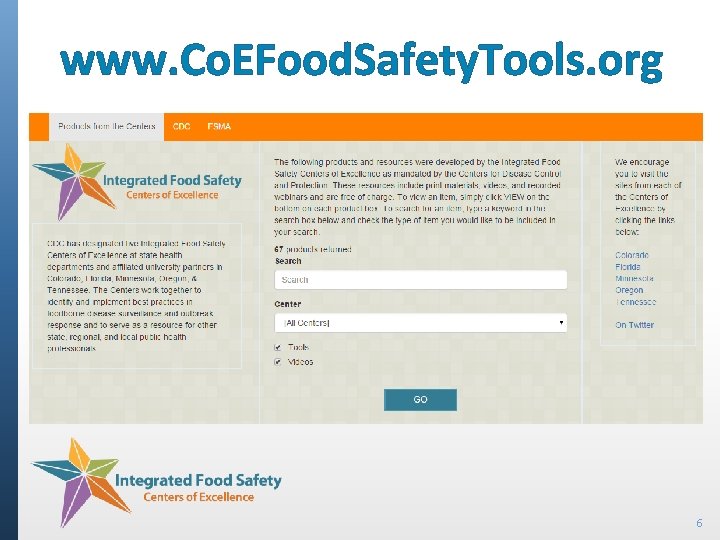
www. Co. EFood. Safety. Tools. org 6
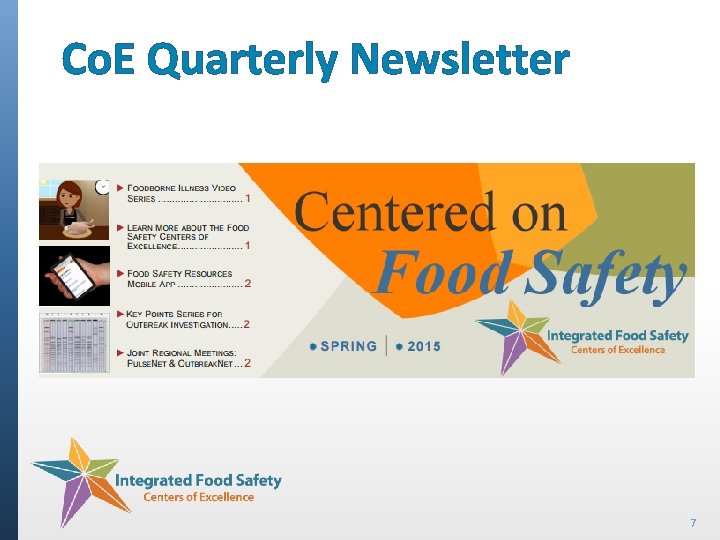
Co. E Quarterly Newsletter 7
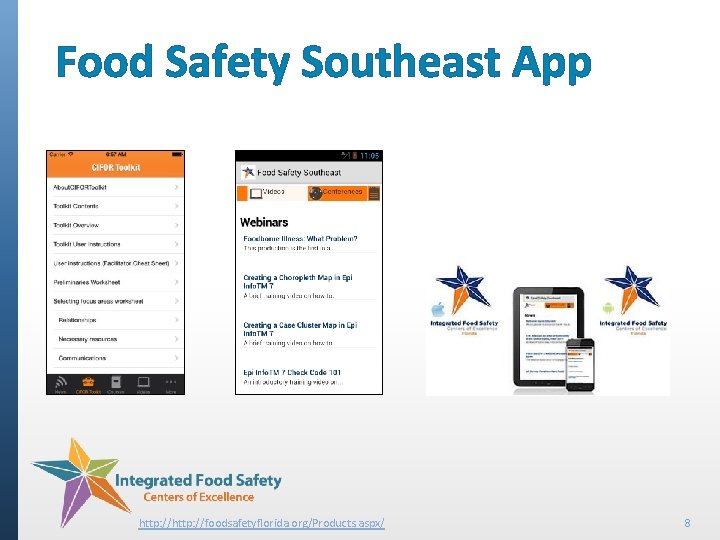
Food Safety Southeast App http: //foodsafetyflorida. org/Products. aspx/ 8
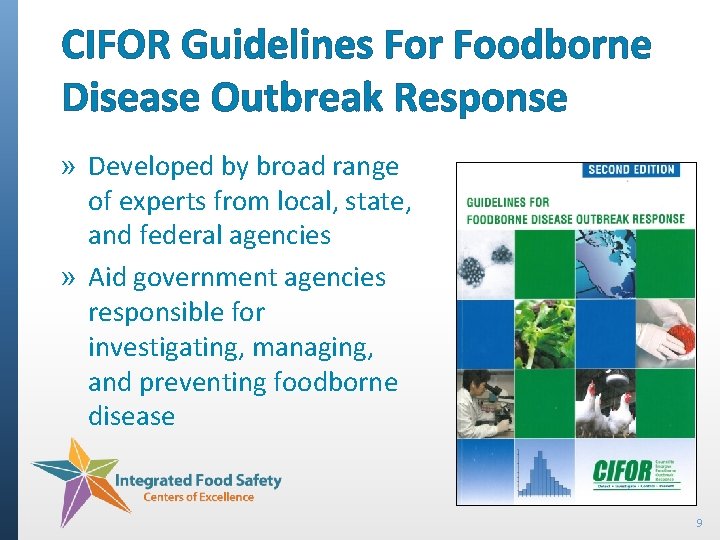
CIFOR Guidelines For Foodborne Disease Outbreak Response » Developed by broad range of experts from local, state, and federal agencies » Aid government agencies responsible for investigating, managing, and preventing foodborne disease 9
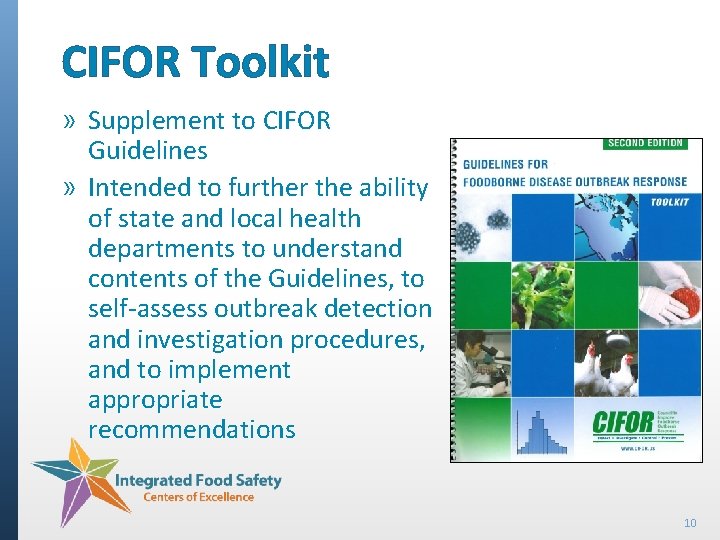
CIFOR Toolkit » Supplement to CIFOR Guidelines » Intended to further the ability of state and local health departments to understand contents of the Guidelines, to self-assess outbreak detection and investigation procedures, and to implement appropriate recommendations 10
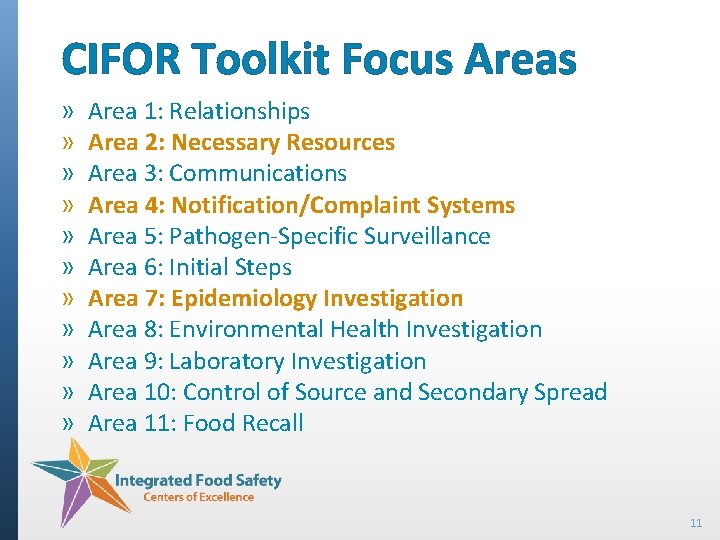
CIFOR Toolkit Focus Areas » » » Area 1: Relationships Area 2: Necessary Resources Area 3: Communications Area 4: Notification/Complaint Systems Area 5: Pathogen-Specific Surveillance Area 6: Initial Steps Area 7: Epidemiology Investigation Area 8: Environmental Health Investigation Area 9: Laboratory Investigation Area 10: Control of Source and Secondary Spread Area 11: Food Recall 11
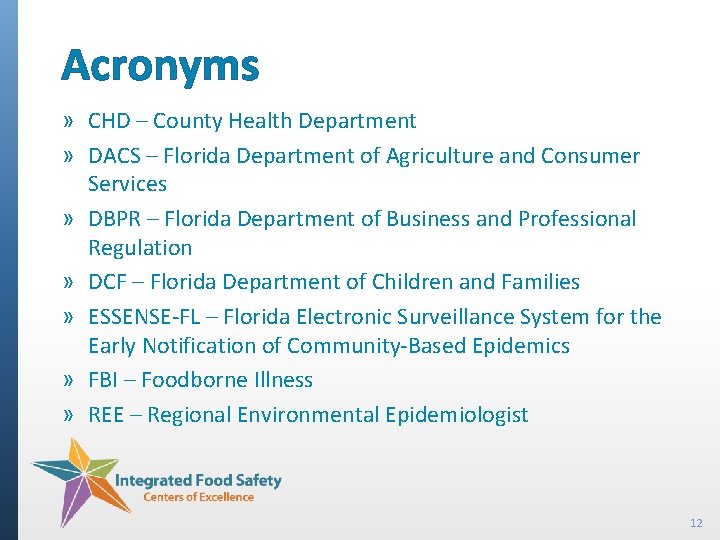
Acronyms » CHD – County Health Department » DACS – Florida Department of Agriculture and Consumer Services » DBPR – Florida Department of Business and Professional Regulation » DCF – Florida Department of Children and Families » ESSENSE-FL – Florida Electronic Surveillance System for the Early Notification of Community-Based Epidemics » FBI – Foodborne Illness » REE – Regional Environmental Epidemiologist 12
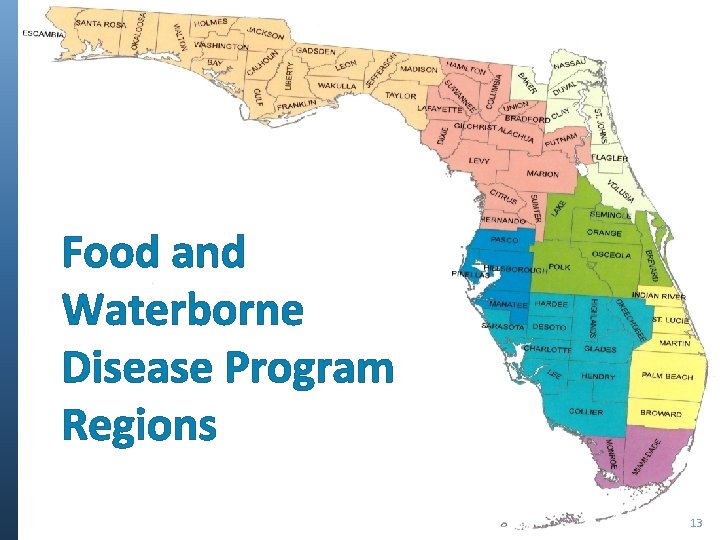
Food and Waterborne Disease Program Regions 13
Brevard County Melissa Brock, REHP Environmental Health Director Florida Department of Health 14
Focus Areas » Area 2: Necessary Resources ˃ Goal: Assess access to personnel, supplies, equipment, documents, and references to initiate a rapid and effective outbreak response. » Area 4: Notification/Complaint Systems ˃ Goal: Assess receipt and processing of individual reports of possible FBI from the public that allows timely follow up of possible food safety problems and cluster detection. » Area 7: Epidemiology Investigation ˃ Goal: Assess the ability of staff collect, analyze, and interpret exposure information, persons at risk, modes of transmission, and vehicle of outbreak. 15
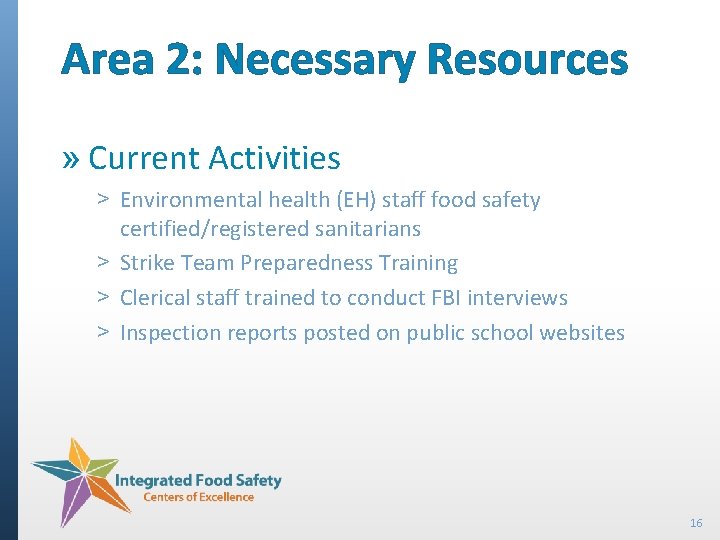
Area 2: Necessary Resources » Current Activities ˃ Environmental health (EH) staff food safety certified/registered sanitarians ˃ Strike Team Preparedness Training ˃ Clerical staff trained to conduct FBI interviews ˃ Inspection reports posted on public school websites 16
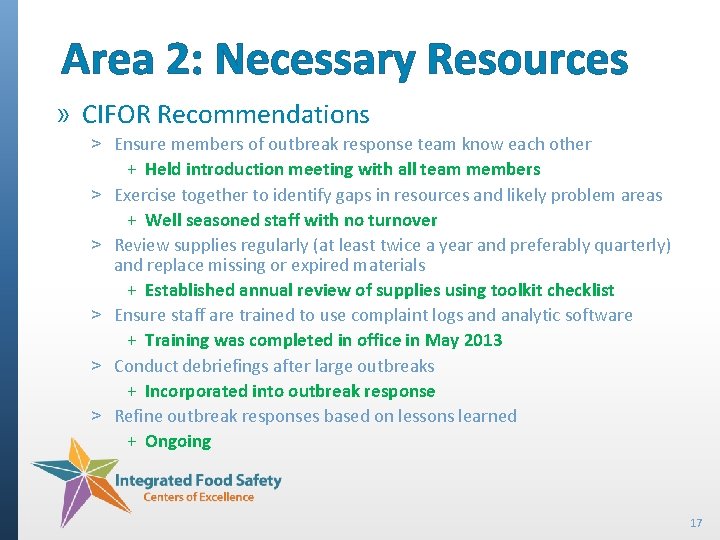
Area 2: Necessary Resources » CIFOR Recommendations ˃ Ensure members of outbreak response team know each other + Held introduction meeting with all team members ˃ Exercise together to identify gaps in resources and likely problem areas + Well seasoned staff with no turnover ˃ Review supplies regularly (at least twice a year and preferably quarterly) and replace missing or expired materials + Established annual review of supplies using toolkit checklist ˃ Ensure staff are trained to use complaint logs and analytic software + Training was completed in office in May 2013 ˃ Conduct debriefings after large outbreaks + Incorporated into outbreak response ˃ Refine outbreak responses based on lessons learned + Ongoing 17
Area 4: Notification/Complaint Systems » Current Activities ˃ Established procedures for collecting FBI complaints, walkins, telephone, online complaint form, and poison control ˃ Local CHD website has information on reporting FBI and link to online complaint form on the EH site ˃ Collect complaint information on statewide tri-agency form ˃ Completed complaint forms are sent to local epidemiologist and regional foodborne epidemiologist for surveillance ˃ Regulatory agencies receive copy of complaint forms without confidential information for follow up 18
Area 4: Notification/Complaint Systems » CIFOR Recommendations ˃ Routinely distribute press releases regarding food safety that include telephone numbers and website addresses to encourage reporting by the public + Follow statewide press releases. Strong relationships with provider community, hospital infection control staff, 24/7 contact availability. ˃ Compile interview data in a single database to facilitate examination of reports for exposure clustering, trends, or commonalities + Created new common use spreadsheet and placed on share drive ˃ Check complaint information against national databases (ex. USDA Consumer Complaint Monitoring System) to identify cases with similar characteristics + Ongoing 19
Area 7: Epidemiology Investigation » Current Activities ˃ Have established policies and procedures for enteric and notifiable diseases ˃ Have established policies and procedures for FBI outbreaks ˃ Staff trained in conducting epidemiological interviews of diseases ˃ Use questionnaires provided by the state for all diseases ˃ Utilize regional resources for development of questionnaires specific to FBI outbreak investigations 20
Area 7: Epidemiology Investigation » CIFOR Recommendations ˃ Exercise outbreak response teams together + Suggestion of Epi staff ride along with EH staff for EH Field Assessment orientation ˃ Participate in debriefings after outbreak investigations with all team members to identify lessons learned. + Ongoing 21
Okaloosa County Dana Grissom Environmental Health & Epidemiology Section Chief Florida Department of Health 22
Focus Areas » Area 2: Necessary Resources ˃ Goal: Assess access to personnel, supplies, equipment, documents, and references to initiate a rapid and effective outbreak response. » Area 4: Notification/Complaint Systems ˃ Goal: Assess receipt and processing of individual reports of possible FBIs from the public that allows timely follow up of possible food safety problems and cluster detection. » Area 7: Epidemiology Investigation ˃ Goal: Assess the ability of staff collect, analyze, and interpret exposure information, persons at risk, modes of transmission, and vehicle of outbreak. 23
Area 2: Necessary Resources » Current Activities Internal strike teams skilled in Epi and EH Coordination with state public health laboratory FIRST, IFIRST 2 training for Epi and EH staff Surge capacity staff members Epi Go Kits available Bad Bug 2012 Exercise conducted on June 8, 2015 to provide increased knowledge and skills in disease investigation and client interviewing for surge personnel ˃ Environmental Epidemiologist position hired on February 15, 2013 to bridge Epi and EH ˃ ˃ ˃ 24
Area 2: Necessary Resources » CIFOR Recommendations ˃ Review supplies regularly and replace missing or expired materials (recommend twice per year and preferably quarterly) + Created several Local Epi Response Teams (LERT) with go kits for each team + Go kits are inventoried on a quarterly basis + Supplies are replaced as needed ˃ Obtain tools to analyze outbreak data – Epi Info™ 7 + Epi staff attended Centers of Excellence Epi Info™ 7 Workshop held October 24, 2013 + Epi intern produced templates for reportable diseases 25
Area 2: Necessary Resources » CIFOR Recommendations Cont’d ˃ Training in outbreak tools + Okaloosa held a Epi Symposium on March 6, 2015 for EH and Epi personnel from Region 1 ˃ Provide job descriptions for surge capacity personnel + LERT team members are required to complete Basic Epi Skills Training with DOH-Okaloosa Epi Staff + FIRST, IFIRST 1, and IFIRST 2 required for LERT team members ˃ Involve agency staff in disease outbreak response that might normally be involved in FBI response + LERT teams include EH, Epi, School Health, Preparedness, and MRC volunteers and can be utilized as needed + Epi and EH staff are currently linked under a single Section Chief and the Environmental Epi position acts as an EH supervisor and Epi Team Lead 26
Area 4: Notification/Complaint Systems » Current Activities ˃ ˃ ˃ ˃ ˃ Coordination with Regional Environmental Epidemiologist (REE) Receive health updates from medical providers Public Information Officer conducts press releases if needed Contacts with DCF, DACS, and DBPR Communication with Infection Control Nurses at Local Hospitals Database for complaints and can cross reference to determine clusters Respond to complaints within 24 hours or next business day EH may receive complaints and forward to Epi for investigation Epi On Call 24/7 phone access to Epi Complaint link on DOH-Okaloosa website 27
Area 4: Notification/Complaint Systems » CIFOR Recommendations ˃ Continue and strengthen coordination with infection control nurses at local hospitals + Epi meets with hospital ICPs (Infection Control Practitioners) and military public health annually + North Okaloosa Medical Center joined ESSENCE-FL reporting Feb 25, 2015 ˃ Continue relationship with DBPR, DACS, DCF + Coordination with DCF on outbreaks in childcare centers + Constant communication with DBPR and DACS, including joint investigations on FBI complaints – DACS: Shellfish tag and fish invoice retrieval – DBPR: Joint investigations at restaurants 28
Area 4: Notification/Complaint Systems » CIFOR Recommendations ˃ Continue to review complaint procedures to make sure each complaint is investigated + Environmental Epi Position is primarily assigned all food and waterborne complaints + Dedicated folder for all food and waterborne illness complaints filed by name of restaurant and date of complaint – Allows for surveillance and quick identification of clusters + Standard operating procedures designed for food and waterborne complaint investigation + All food and waterborne complaints are interviewed utilizing triagency FBI complaint form and forwarded to responsible regulatory agency (DBPR, DACS, DOH, DCF etc. ) ˃ Continued Coordination with REE + All tri-agency forms for food and waterborne complaints are forwarded to REE + Produces comprehensive reports on foodborne outbreak investigations 29
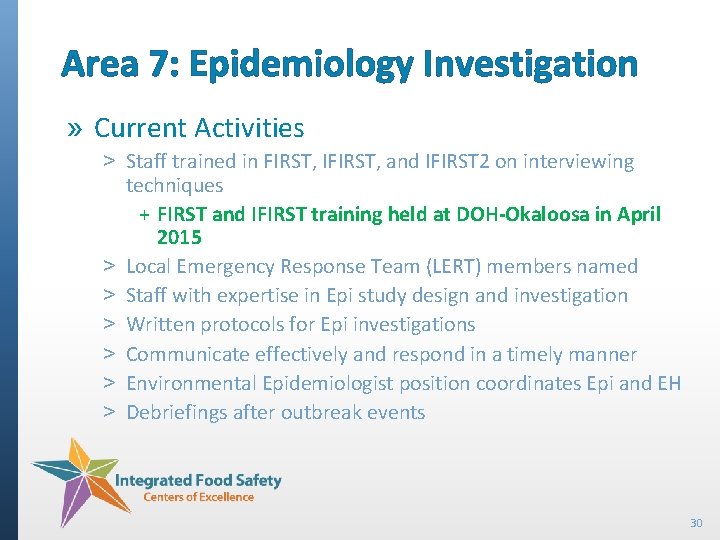
Area 7: Epidemiology Investigation » Current Activities ˃ Staff trained in FIRST, IFIRST, and IFIRST 2 on interviewing techniques + FIRST and IFIRST training held at DOH-Okaloosa in April 2015 ˃ Local Emergency Response Team (LERT) members named ˃ Staff with expertise in Epi study design and investigation ˃ Written protocols for Epi investigations ˃ Communicate effectively and respond in a timely manner ˃ Environmental Epidemiologist position coordinates Epi and EH ˃ Debriefings after outbreak events 30
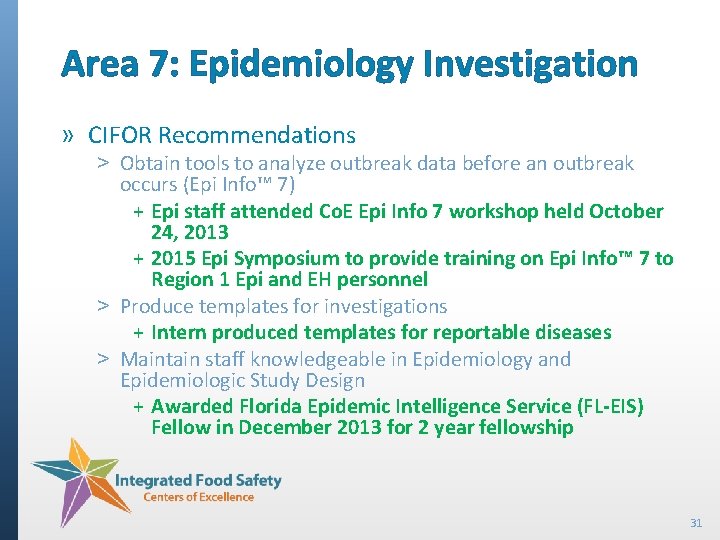
Area 7: Epidemiology Investigation » CIFOR Recommendations ˃ Obtain tools to analyze outbreak data before an outbreak occurs (Epi Info™ 7) + Epi staff attended Co. E Epi Info 7 workshop held October 24, 2013 + 2015 Epi Symposium to provide training on Epi Info™ 7 to Region 1 Epi and EH personnel ˃ Produce templates for investigations + Intern produced templates for reportable diseases ˃ Maintain staff knowledgeable in Epidemiology and Epidemiologic Study Design + Awarded Florida Epidemic Intelligence Service (FL-EIS) Fellow in December 2013 for 2 year fellowship 31
Questions? 32
Contact Information David Dekevich, MPH Florida Center of Excellence Liaison Bureau of Epidemiology Florida Department of Health 850 -245 -4444 ext. 2437 David. Dekevich@flhealth. gov Dana Grissom Environmental Health & Epidemiology Section Chief Okaloosa County Florida Department of Health 850 -689 -7859 ext. 1110 Dana. Grissom@flhealth. gov Melissa Brock, REHP Environmental Health Director Brevard County Florida Department of Health 321 -633 -2100 ext. 52322 Melissa. Brock@flhealth. gov Florida Integrated Food Safety Co. E www. Food. Safety. Florida. org www. CDC. gov/Food. Safety/Centers www. Co. EFood. Safety. Tools. org @Food. Safety. Co. E 33