Instrument for Preaccession Assistance for Rural Development IPARD





- Slides: 25
Instrument for Pre-accession Assistance for Rural Development IPARD Pia Primec Ptuj, 16. 7. 2008
Content of the presentation 1. SAPARD - Special accession programme for agriculture and rural development – 2000 -2006 2. Instrument for Pre-accession – IPA - (IPARD) - 2007 -2013 2
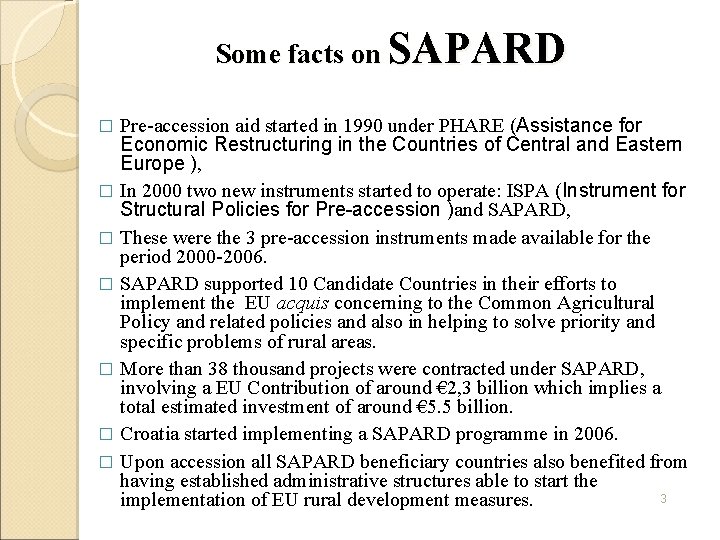
Some facts on SAPARD Pre-accession aid started in 1990 under PHARE (Assistance for Economic Restructuring in the Countries of Central and Eastern Europe ), � In 2000 two new instruments started to operate: ISPA (Instrument for Structural Policies for Pre-accession )and SAPARD, � These were the 3 pre-accession instruments made available for the period 2000 -2006. � SAPARD supported 10 Candidate Countries in their efforts to implement the EU acquis concerning to the Common Agricultural Policy and related policies and also in helping to solve priority and specific problems of rural areas. � More than 38 thousand projects were contracted under SAPARD, involving a EU Contribution of around € 2, 3 billion which implies a total estimated investment of around € 5. 5 billion. � Croatia started implementing a SAPARD programme in 2006. � Upon accession all SAPARD beneficiary countries also benefited from having established administrative structures able to start the 3 implementation of EU rural development measures. �
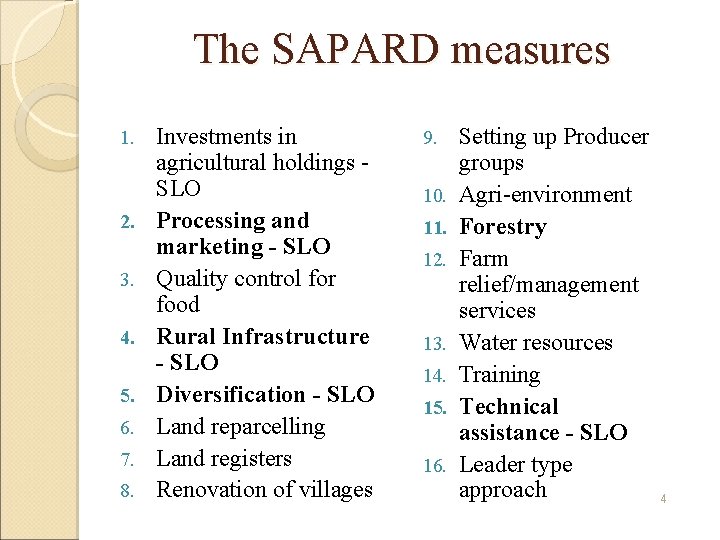
The SAPARD measures 1. 2. 3. 4. 5. 6. 7. 8. Investments in agricultural holdings - SLO Processing and marketing - SLO Quality control for food Rural Infrastructure - SLO Diversification - SLO Land reparcelling Land registers Renovation of villages 9. 10. 11. 12. 13. 14. 15. 16. Setting up Producer groups Agri-environment Forestry Farm relief/management services Water resources Training Technical assistance - SLO Leader type approach 4
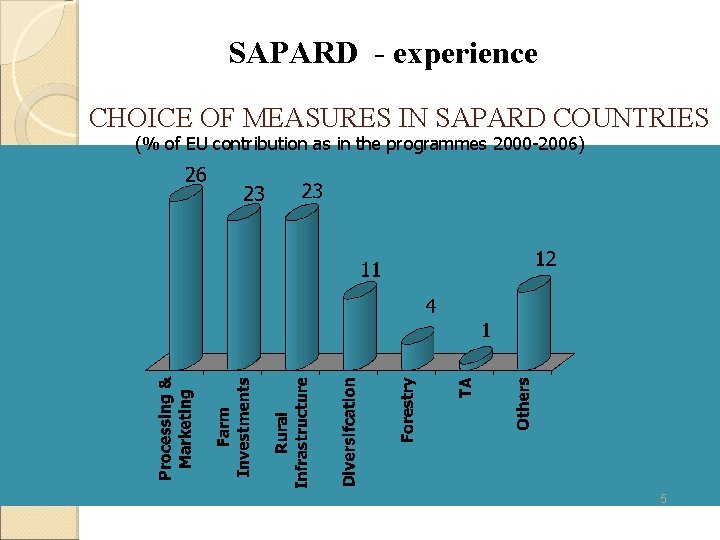
SAPARD - experience CHOICE OF MEASURES IN SAPARD COUNTRIES (% of EU contribution as in the programmes 2000 -2006) 5
SAPARD - current situation � Contracting was finished mid 2004 � 2006 was the last year of financial execution for new MS � All MS had to submitt final reports and ex-post evaluation reports till 31. 12. 2007 (with exception of Romania, Bolgaria and Croatia) 6
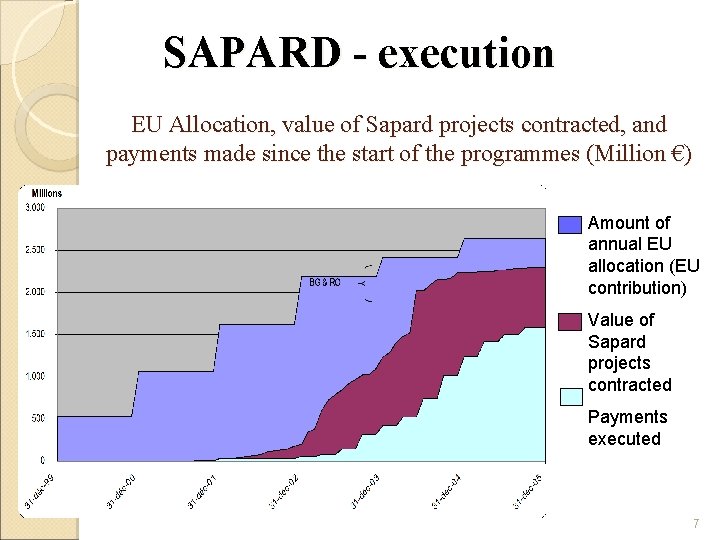
SAPARD - execution EU Allocation, value of Sapard projects contracted, and payments made since the start of the programmes (Million €) Amount of annual EU allocation (EU contribution) Value of Sapard projects contracted Payments executed 7
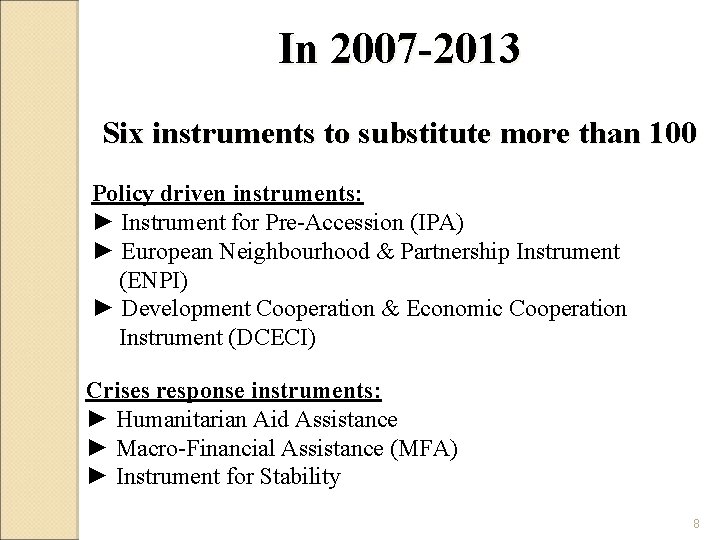
In 2007 -2013 Six instruments to substitute more than 100 Policy driven instruments: ► Instrument for Pre-Accession (IPA) ► European Neighbourhood & Partnership Instrument (ENPI) ► Development Cooperation & Economic Cooperation Instrument (DCECI) Crises response instruments: ► Humanitarian Aid Assistance ► Macro-Financial Assistance (MFA) ► Instrument for Stability 8
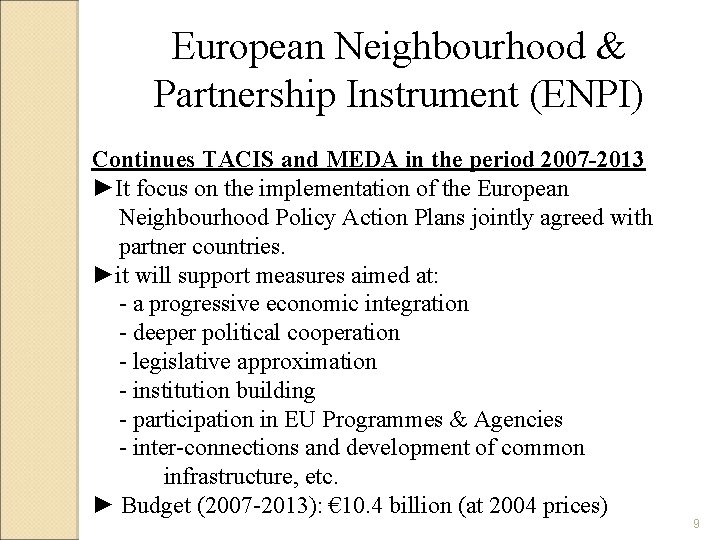
European Neighbourhood & Partnership Instrument (ENPI) Continues TACIS and MEDA in the period 2007 -2013 ►It focus on the implementation of the European Neighbourhood Policy Action Plans jointly agreed with partner countries. ►it will support measures aimed at: - a progressive economic integration - deeper political cooperation - legislative approximation - institution building - participation in EU Programmes & Agencies - inter-connections and development of common infrastructure, etc. ► Budget (2007 -2013): € 10. 4 billion (at 2004 prices) 9
What is IPA ? � IPA is an integrated Pre-Accession Instrument to assist candidate and potential candidate countries � It replaces 5 different programmes and instruments: Phare, ISPA, SAPARD, CARDS and Turkey preaccession instruments � It will ensure: ◦ Higher level of coherence and co-ordination of EU Assistance and ◦ better preparation for Structural, Cohesion and Rural development Funds through progressive emulation of EU funds rules � Financial envelope allocated for the period 2007– 2013: 11, 565 billion € 10
Instrument for Pre-accession (IPA) overall objective: „The Community shall assist the potential and candidate countries in progressive alignment with the standards and policies of the European Union, including where appropriate the acquis communautaire, with a view to membership. “ 11
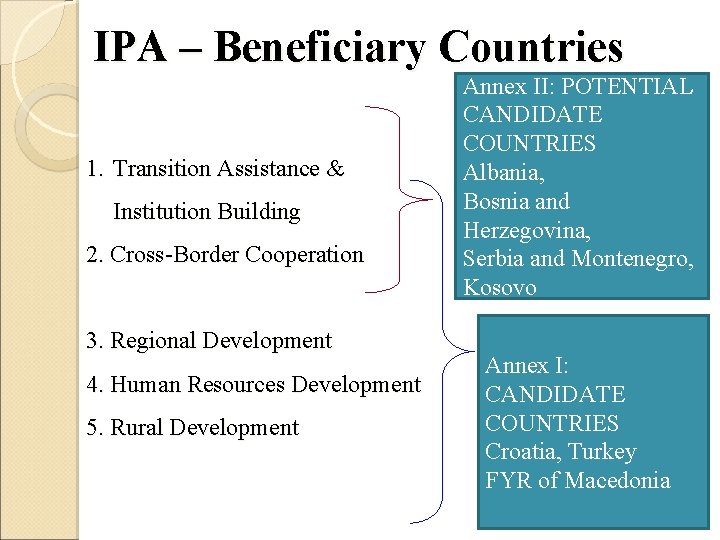
IPA – Beneficiary Countries 1. Transition Assistance & Institution Building 2. Cross-Border Cooperation 3. Regional Development 4. Human Resources Development 5. Rural Development Annex II: POTENTIAL CANDIDATE COUNTRIES Albania, Bosnia and Herzegovina, Serbia and Montenegro, Kosovo Annex I: CANDIDATE COUNTRIES Croatia, Turkey FYR of Macedonia 12
IPA – Policy framework and Programming Multi-annual Indicative Financial Framework (MIFF) establishes the financial allocation between countries and components Multi-annual Indicative Planning Document (MIPD) establishes strategies for each country for the IPA components, based on the priorities set in the Accession Partnership and the Regular Reports Components Transition & Institution Building Regional & Cross-Border Co-op Regional Development Human Resources Development Rural Development IPARD 13
What is IPARD? �Instrument for Pre-acession Assistance for Rural Development �It will contribute to the: �implementation of the acquis communautaire concerning the Common Agricultural Policy �sustainable adaptation of the agricultural sector and rural areas in the candidate country �IPARD = SAPARD
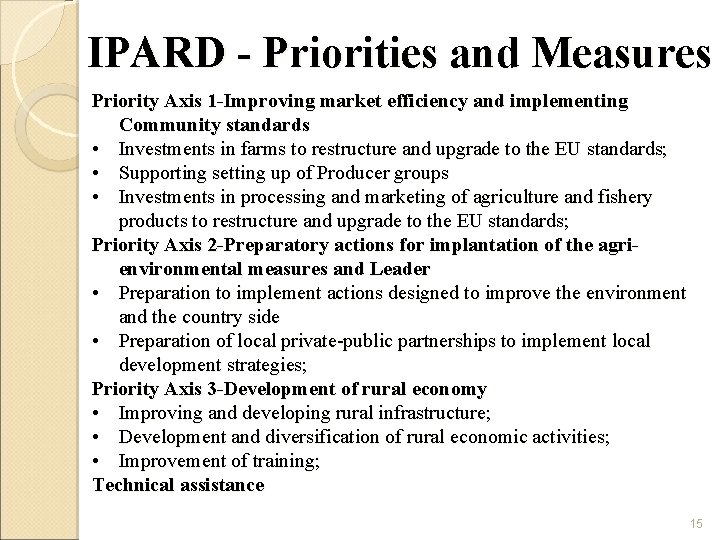
IPARD - Priorities and Measures Priority Axis 1 -Improving market efficiency and implementing Community standards • Investments in farms to restructure and upgrade to the EU standards; • Supporting setting up of Producer groups • Investments in processing and marketing of agriculture and fishery products to restructure and upgrade to the EU standards; Priority Axis 2 -Preparatory actions for implantation of the agrienvironmental measures and Leader • Preparation to implement actions designed to improve the environment and the country side • Preparation of local private-public partnerships to implement local development strategies; Priority Axis 3 -Development of rural economy • Improving and developing rural infrastructure; • Development and diversification of rural economic activities; • Improvement of training; Technical assistance 15
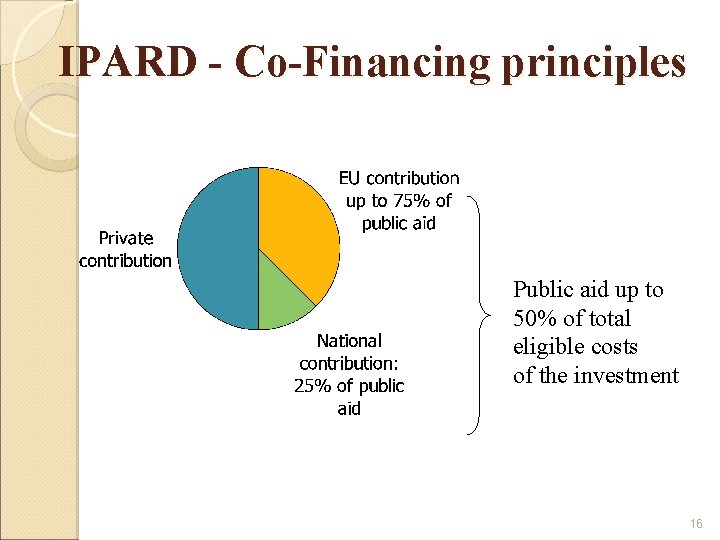
IPARD - Co-Financing principles Public aid up to 50% of total eligible costs of the investment 16
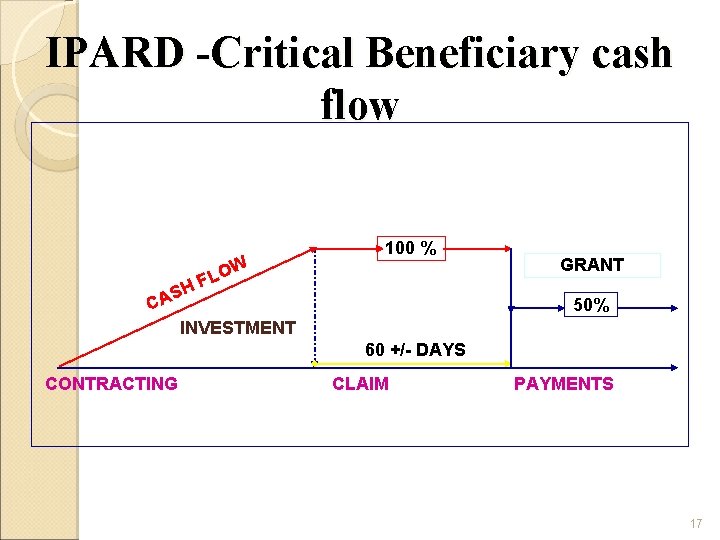
IPARD -Critical Beneficiary cash flow W 100 % LO F H S CA GRANT 50% INVESTMENT 60 +/- DAYS CONTRACTING CLAIM PAYMENTS 17
IPARD basic conditions IPARD Programme has to be approved by a Commission Decision; 2. Managing Authority – National institution – Ministry, …; 3. National Fund under the National Authorizing Officer’s responsibility; 4. Nationally accredited IPARD Agency to which the management of aid was conferred via a Commission Decision. 18
IPARD – what has to be done? �Establishing national structures able to define strategies, programmes, management and monitoring conditions for IPARD type programmes; �Enhancing the knowledge and the transparency of the Agricultural and Rural situation (rural census, farm register, land cadastre, price statistics, sector analysis for the more important agricultural sectors, etc); �Starting the definition of a National Strategy for Rural Development involving other public bodies 19 and the relevant civil society partners;
What else has to be done to benefit from IPARD? �The main public bodies that must be involved in preparation of IPARD programme: ◦ Veterinary authorities, ◦ Environmental authorities. �Support the organization of the civil society partners, namely: ◦ Farmers, ◦ Food processors, ◦ Environment and, ◦ Local rural development associations. 20
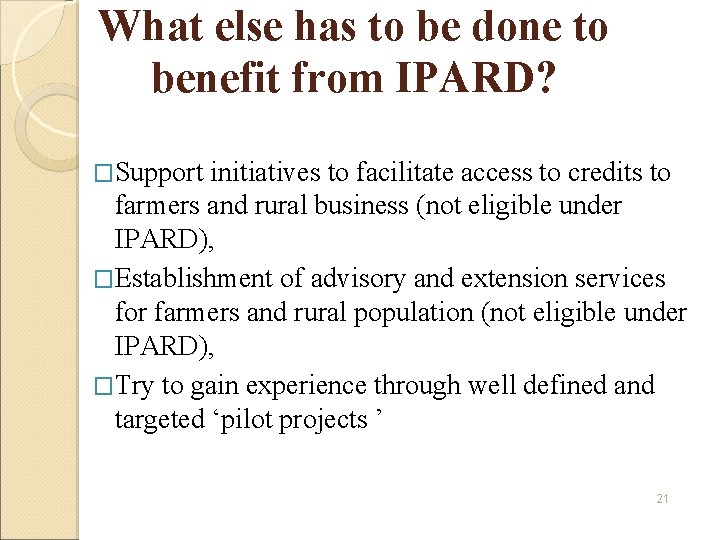
What else has to be done to benefit from IPARD? �Support initiatives to facilitate access to credits to farmers and rural business (not eligible under IPARD), �Establishment of advisory and extension services for farmers and rural population (not eligible under IPARD), �Try to gain experience through well defined and targeted ‘pilot projects ’ 21
What else has to be done to benefit from IPARD? �Make use of all possible types of support, namely: ◦ National resources, ◦ IPA - Institution Building Component, ◦ TAIEX, ◦ IFI’s (World Bank, EBRD, etc. ) ◦ FAO, and other possible bilateral and multilateral support. 22
IPARD – implementation pay attention to: � Need to improve the programming exercise by: ◦ Enhancing the knowledge of the Agricultural and Rural situation of the country concerned, (in depth sector analyses for the main sectors to be supported must be carried out) ◦ Better targeting the final beneficiaries of investment measures to those that have the possibility of having the capacity to compete in the EU and cannot make the necessary change using only their own funds. � Addressing the rural credits issues from the beginning of the exercise. � Addressing the advisory services issues in advance. 23
Example – Croatia �Prepared the IPARD programme already in 2007 �Programme confirmed by the EU Commisinon on 25. 2. 2008 �All 3 main priorities with 6 of all 9 measures are included �Beneficiaries are farmers, manufactures and companies �Contracting autority: Upravna direkcija SAPARD/IPARD
�Thank you for your attention! 25