
European Union Instrument For Pre Accession Assistance IPA





- Slides: 47
European Union / Instrument For Pre. Accession Assistance (IPA) Energy Sector Technical Assistance Project TRAINING FOR ESCOs PART F: ESCO Project Development and Contracting S 6. 6: Energy Performance Contacts in an Advanced ESCO Market <Place, date> ESKI Bu proje Avrupa Birliği ve Türkiye Cumhuriyeti tarafından ortaklaşa finanse edilmektedir. - -
Content of the presentation Bu proje Avrupa Birliği ve Türkiye Cumhuriyeti tarafından ortaklaşa finanse edilmektedir. 1. Combination of different EPC models 2. Sophisticated Lease Contracts 3. Mitigated Financial Risk ESCO model 4. Financing of EE projects by Specialized Private Energy Service Providers 5. Complex Energy Supply/Purchase Contracts - 2 - S 6. 7
Content of the presentation Bu proje Avrupa Birliği ve Türkiye Cumhuriyeti tarafından ortaklaşa finanse edilmektedir. 1. Combination of different EPC models 2. Sophisticated Lease Contracts 3. Mitigated Financial Risk ESCO model 4. Financing of EE projects by Specialized Private Energy Service Providers 5. Complex Energy Supply/Purchase Contracts - 3 - S 6. 7
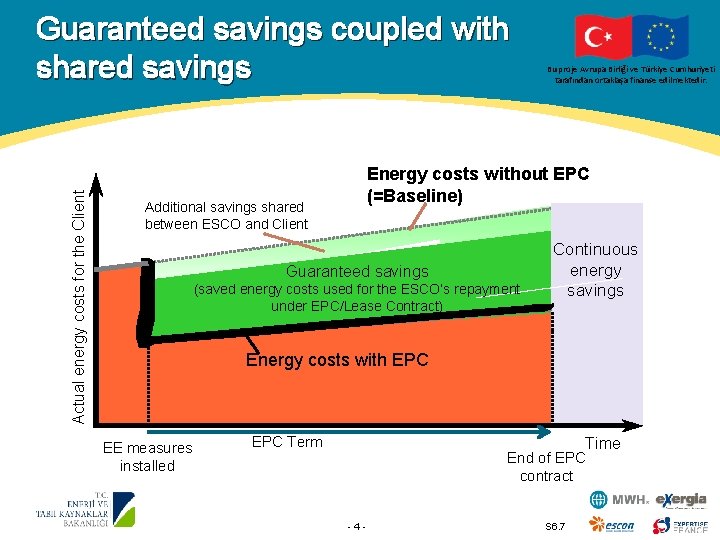
Actual energy costs for the Client Guaranteed savings coupled with shared savings Bu proje Avrupa Birliği ve Türkiye Cumhuriyeti tarafından ortaklaşa finanse edilmektedir. Energy costs without EPC (=Baseline) Additional savings shared between ESCO and Client Guaranteed savings (saved energy costs used for the ESCO’s repayment under EPC/Lease Contract) Continuous energy savings Energy costs with EPC EE measures installed EPC Term Time End of EPC contract - 4 - S 6. 7
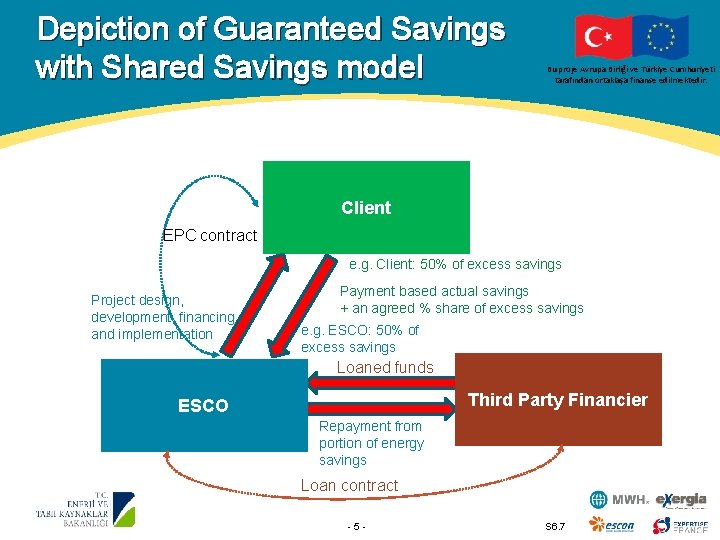
Depiction of Guaranteed Savings with Shared Savings model Bu proje Avrupa Birliği ve Türkiye Cumhuriyeti tarafından ortaklaşa finanse edilmektedir. Client EPC contract e. g. Client: 50% of excess savings Project design, development, financing and implementation Payment based actual savings + an agreed % share of excess savings e. g. ESCO: 50% of excess savings Loaned funds Third Party Financier ESCO Repayment from portion of energy savings Loan contract - 5 - S 6. 7
Lease Contract with shared savings ff ESCO e. g. Bu proje Avrupa Birliği ve Türkiye Cumhuriyeti tarafından ortaklaşa finanse edilmektedir. - Le a - De ses EE sign ass a n d in et mea - M& sure stall s EE V s - O& M 50% o Rensavin f exces s tal gs Payment for EE asset pa savi yments ngs bas e. g. 50 % o ed o an a f n s v a ervifiing excess gree e d % ds en sha ergy + re o f ex Sale of EE cess ene asset rgy savi ngs Client Equipment Supplier - 6 - S 6. 7
Content of the presentation Bu proje Avrupa Birliği ve Türkiye Cumhuriyeti tarafından ortaklaşa finanse edilmektedir. 1. Combination of different EPC models 2. Sophisticated Lease Contracts 3. Mitigated Financial Risk ESCO model 4. Financing of EE projects by Specialized Private Energy Service Providers 5. Complex Energy Supply/Purchase Contracts - 7 - S 6. 7
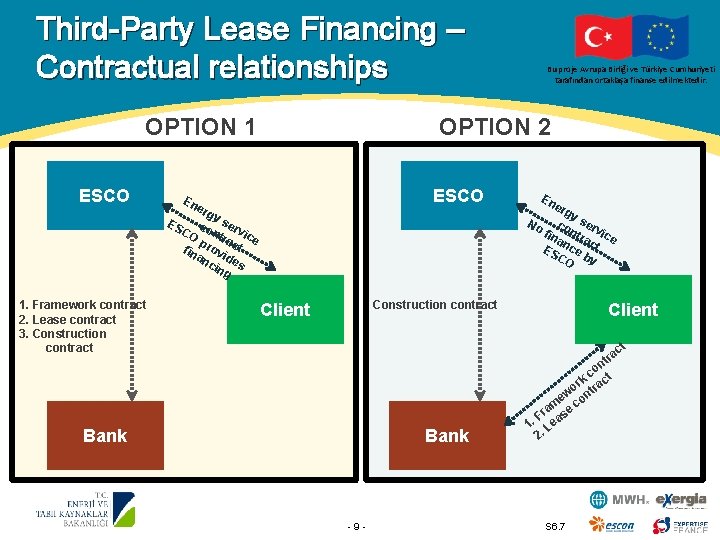
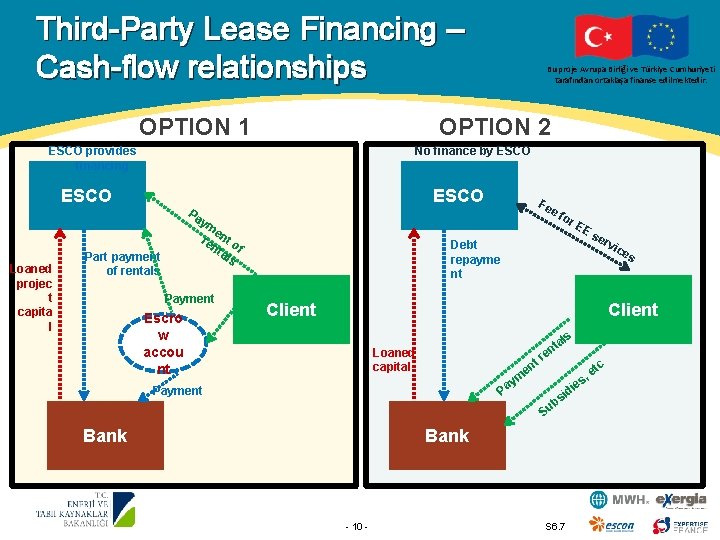
Third-Party Lease Financing – Main Features Bu proje Avrupa Birliği ve Türkiye Cumhuriyeti tarafından ortaklaşa finanse edilmektedir. • The ESCO designs and install the EE measures, assumes the performance risk (plus O&M responsibilities). • The ESCO guarantees the energy savings agreed and payment rentals depend on the level of verified savings. • The ESCO or the Client may arrange for the financing. • If financing is provided by the ESCO, the bank takes over financial and administrative services and risks and concludes a framework and lease contract either with the ESCO (with the bank controlling the disbursement of the project receivables). • If financing is provided by the Client, the bank enters into the framework and lease contracts with the Client. • In either case, the bank enters into a construction contract with the ESCO for the EE investments to be installed at the Client’s premises. - 8 - S 6. 7
Third-Party Lease Financing – Contractual relationships Bu proje Avrupa Birliği ve Türkiye Cumhuriyeti tarafından ortaklaşa finanse edilmektedir. OPTION 2 OPTION 1 ff ESCO 1. Framework contract 2. Lease contract 3. Construction contract ESCO En erg ys ES e CO cont rvic r e a p fin rovi ct an de cin s g En e No rg y co serv fin ntr ice ac a ES nce t CO by Construction contract Client ct tra Bank - 9 - n co t k c or tra w e con m a e Fr as. 1 Le 2. S 6. 7
Third-Party Lease Financing – Cash-flow relationships Bu proje Avrupa Birliği ve Türkiye Cumhuriyeti tarafından ortaklaşa finanse edilmektedir. OPTION 2 OPTION 1 ESCO provides financing No finance by ESCO ff ESCO Pa Fe ef ym Loaned projec t capita l e re nt o nt f als Part payment of rentals Payment Escro w accou nt or EE Debt repayme nt se rvi ce s Client s Loaned capital t en l ta n re ym ie id s b Pa Payment Su Bank - 10 - c et , s S 6. 7
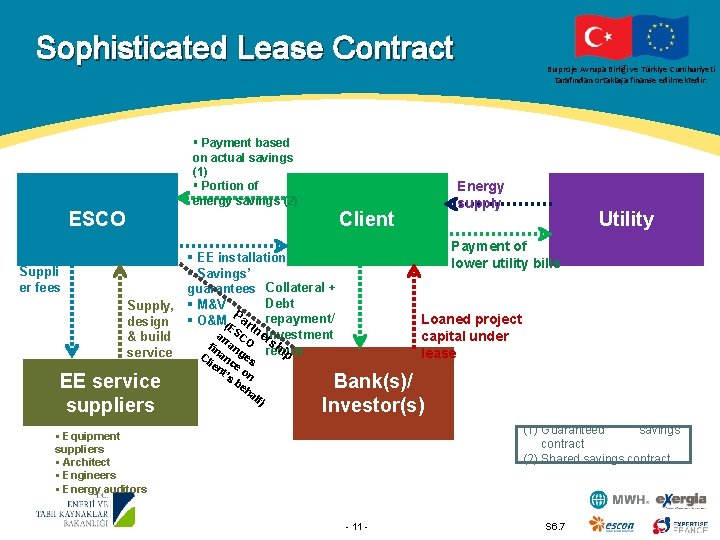
Sophisticated Lease Contract § Payment based on actual savings (1) § Portion of energy savings (2) ESCO Suppli er fees Energy supply Client s be ha lf) Utility Payment of lower utility bills § EE installation § Savings’ guarantees Collateral + Debt Supply, § M&V Pa design § O&M(E rtn repayment/ ar SC er. Investment & build sh fin ran O ip service Cl an ges return ie ce nt s ’ on EE service suppliers Bu proje Avrupa Birliği ve Türkiye Cumhuriyeti tarafından ortaklaşa finanse edilmektedir. Loaned project capital under lease Bank(s)/ Investor(s) (1) Guaranteed savings contract (2) Shared savings contract § Equipment suppliers § Architect § Engineers § Energy auditors - 11 - S 6. 7
Content of the presentation Bu proje Avrupa Birliği ve Türkiye Cumhuriyeti tarafından ortaklaşa finanse edilmektedir. 1. Combination of different EPC models 2. Sophisticated Lease Contracts 3. Mitigated Financial Risk ESCO model 4. Financing of EE projects by Specialized Private Energy Service Providers 5. Complex Energy Supply/Purchase Contracts - 12 - S 6. 7
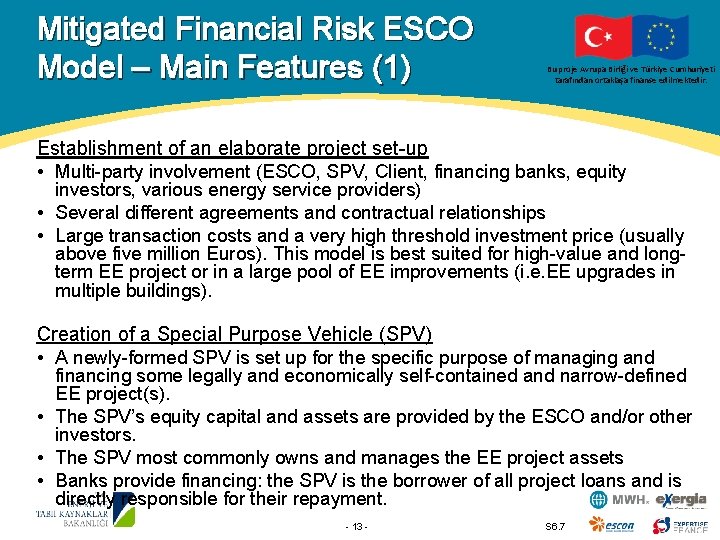
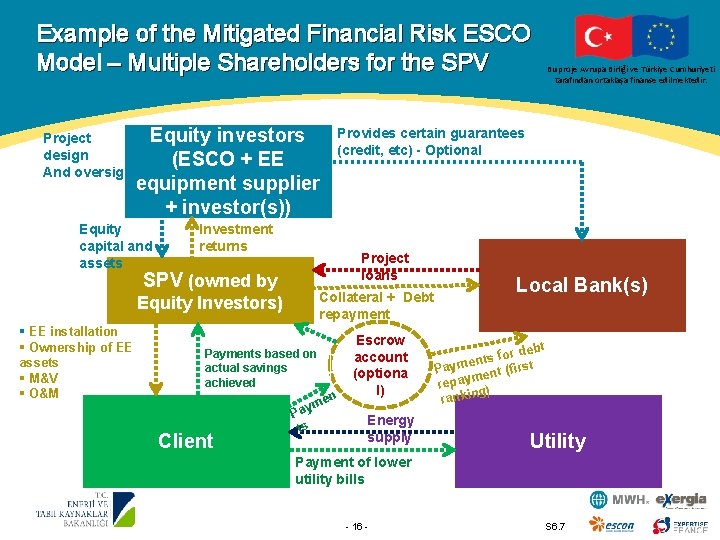
Mitigated Financial Risk ESCO Model – Main Features (1) Bu proje Avrupa Birliği ve Türkiye Cumhuriyeti tarafından ortaklaşa finanse edilmektedir. Establishment of an elaborate project set-up • Multi-party involvement (ESCO, SPV, Client, financing banks, equity investors, various energy service providers) • Several different agreements and contractual relationships • Large transaction costs and a very high threshold investment price (usually above five million Euros). This model is best suited for high-value and longterm EE project or in a large pool of EE improvements (i. e. EE upgrades in multiple buildings). Creation of a Special Purpose Vehicle (SPV) • A newly-formed SPV is set up for the specific purpose of managing and financing some legally and economically self-contained and narrow-defined EE project(s). • The SPV’s equity capital and assets are provided by the ESCO and/or other investors. • The SPV most commonly owns and manages the EE project assets • Banks provide financing: the SPV is the borrower of all project loans and is directly responsible for their repayment. - 13 - S 6. 7
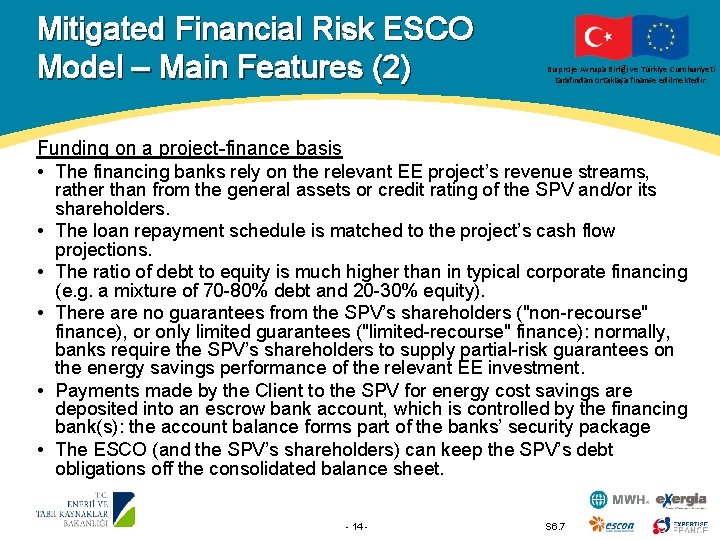
Mitigated Financial Risk ESCO Model – Main Features (2) Bu proje Avrupa Birliği ve Türkiye Cumhuriyeti tarafından ortaklaşa finanse edilmektedir. Funding on a project-finance basis • The financing banks rely on the relevant EE project’s revenue streams, • • • rather than from the general assets or credit rating of the SPV and/or its shareholders. The loan repayment schedule is matched to the project’s cash flow projections. The ratio of debt to equity is much higher than in typical corporate financing (e. g. a mixture of 70 -80% debt and 20 -30% equity). There are no guarantees from the SPV’s shareholders ("non-recourse" finance), or only limited guarantees ("limited-recourse" finance): normally, banks require the SPV’s shareholders to supply partial-risk guarantees on the energy savings performance of the relevant EE investment. Payments made by the Client to the SPV for energy cost savings are deposited into an escrow bank account, which is controlled by the financing bank(s): the account balance forms part of the banks’ security package The ESCO (and the SPV’s shareholders) can keep the SPV’s debt obligations off the consolidated balance sheet. - 14 - S 6. 7
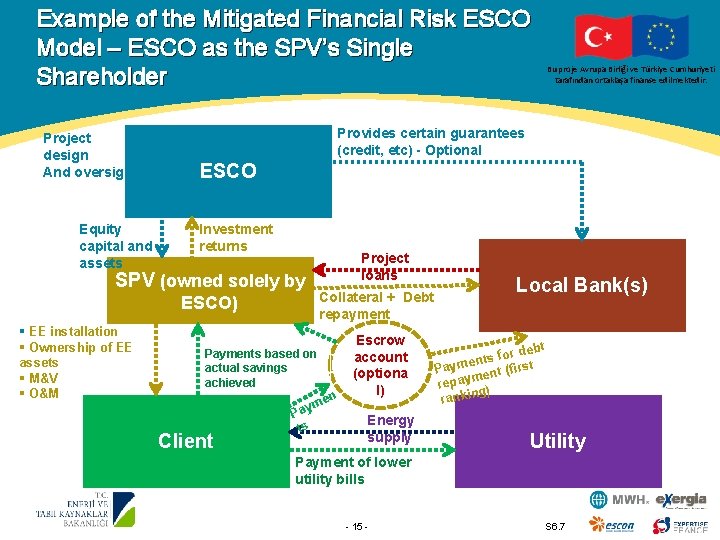
Example of the Mitigated Financial Risk ESCO Model – ESCO as the SPV’s Single Shareholder Project design And oversight Equity capital and assets Provides certain guarantees (credit, etc) - Optional ESCO Investment returns SPV (owned solely by ESCO) § EE installation § Ownership of EE assets § M&V § O&M Bu proje Avrupa Birliği ve Türkiye Cumhuriyeti tarafından ortaklaşa finanse edilmektedir. Payments based on actual savings achieved Client Project loans Collateral + Debt repayment en ym a P ts Escrow account (optiona l) Energy supply Local Bank(s) t r deb o f s t en Paym ent (first m repay ) g rankin Utility Payment of lower utility bills - 15 - S 6. 7
Example of the Mitigated Financial Risk ESCO Model – Multiple Shareholders for the SPV Equity investors (ESCO + EE equipment supplier + investor(s)) Project design And oversight Equity capital and assets Project loans Collateral + Debt repayment Equity Investors) § EE installation § Ownership of EE assets § M&V § O&M Provides certain guarantees (credit, etc) - Optional Investment returns SPV (owned by Payments based on actual savings achieved Client Bu proje Avrupa Birliği ve Türkiye Cumhuriyeti tarafından ortaklaşa finanse edilmektedir. en ym a P ts Escrow account (optiona l) Energy supply Local Bank(s) t r deb o f s t en Paym ent (first m repay ) g rankin Utility Payment of lower utility bills - 16 - S 6. 7
Mitigated Financial Risk ESCO Model - Pros and Cons (1) Bu proje Avrupa Birliği ve Türkiye Cumhuriyeti tarafından ortaklaşa finanse edilmektedir. Advantages • Clients can fund EE improvements without making any upfront investment. • EE projects are evaluated and implemented on a project performance basis and performance is related to energy savings actually received by the Client. • Project’s performance risks rest exclusively within the SPV. • Project risks are shared by diversification through the allocation and division of risks between multiple parties. • The employment of the SPV structure effectively limits shareholders’ liabilities to the amount of their capital contributions. • The SPV’s shareholders have a tangible incentive to make best use of the EE measures and upgrades to be installed so as to increase their profit margin. - 17 - S 6. 7
Mitigated Financial Risk ESCO Model - Pros and Cons (2) Bu proje Avrupa Birliği ve Türkiye Cumhuriyeti tarafından ortaklaşa finanse edilmektedir. BUT: • The relevant EE market coupled with the domestic banking sector must have reached a considerable level of maturity in order to support the implementation of this model. • It is not appropriate for small-scale EE projects. • Transaction costs are high, since, many different contracts are required to be negotiated and agreed upon among the various participating actors. • As financing is mainly secured on receivables accruing from the introduction of EE improvements, the uncertainties in the exact energy cost savings that will be achieved through some given EE project(s) could substantially raise the cost of borrowing. • The execution of this model depends on the vagaries of the domestic energy, banking, industrial and commercial sectors given that any economic downturns could unfavourably affect its practical implementation. - 18 - S 6. 7
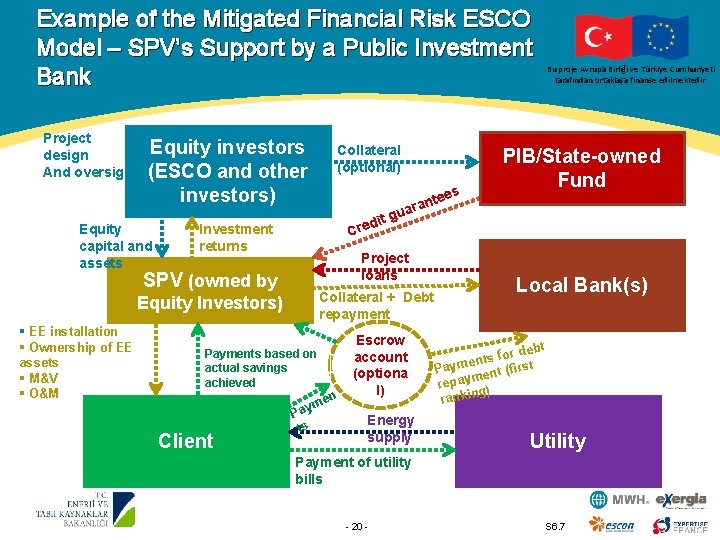
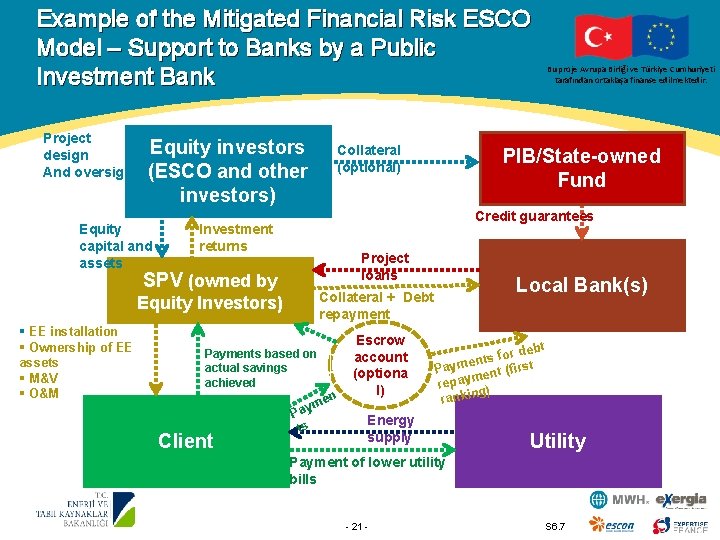
Mitigated Financial Risk ESCO Model with State-backed Support Bu proje Avrupa Birliği ve Türkiye Cumhuriyeti tarafından ortaklaşa finanse edilmektedir. • This model can be complemented with the use of partial risk guarantee mechanisms, which are backed with public funds. • Such a structure in essence works in the same manner as the scheme described above: Ø The ESCO sets up - with its own funds - an SPV, Ø The SPV is responsible for the delivery of the agreed energy savings and takes loans from commercial banks, normally on a project finance basis, Ø Loan repayments are secured on the revenues generated from these savings. • The major innovation of this version lies in that a Public Investment Bank (PIB) is heavily involved from the outset, which acts as the relevant EE project’s ultimate guarantor and supervisor: Ø the PIB issues irrevocable loan guarantees to the SPV, backed by government funds, to support the implementation of eligible EE projects, or Ø the PIB gives credit guarantees directly to the banks financing the relevant EE investment through the SPV (e. g. up to 80 -90% of the loan amounts; these guarantees are further reduced in the course of the project’s implementation). - 19 - S 6. 7
Example of the Mitigated Financial Risk ESCO Model – SPV’s Support by a Public Investment Bank Project design And oversight Equity investors (ESCO and other investors) Equity capital and assets Investment returns Project loans Collateral + Debt repayment Equity Investors) Payments based on actual savings achieved Client en ym a P ts ees PIB/State-owned Fund nt ara t gu di Cre SPV (owned by § EE installation § Ownership of EE assets § M&V § O&M Collateral (optional) Bu proje Avrupa Birliği ve Türkiye Cumhuriyeti tarafından ortaklaşa finanse edilmektedir. Escrow account (optiona l) Energy supply Local Bank(s) t r deb o f s t en Paym ent (first m repay ) g rankin Utility Payment of utility bills - 20 - S 6. 7
Example of the Mitigated Financial Risk ESCO Model – Support to Banks by a Public Investment Bank Project design And oversight Equity investors (ESCO and other investors) Equity capital and assets Project loans Local Bank(s) Collateral + Debt repayment Equity Investors) Payments based on actual savings achieved Client PIB/State-owned Fund Credit guarantees Investment returns SPV (owned by § EE installation § Ownership of EE assets § M&V § O&M Collateral (optional) Bu proje Avrupa Birliği ve Türkiye Cumhuriyeti tarafından ortaklaşa finanse edilmektedir. en ym a P ts Escrow account (optiona l) t r deb o f s t en Paym ent (first m repay ) g rankin Energy supply Utility Payment of lower utility bills - 21 - S 6. 7
Mitigated Financial Risk ESCO Model and State -backed Support – Pros and Cons (1) Bu proje Avrupa Birliği ve Türkiye Cumhuriyeti tarafından ortaklaşa finanse edilmektedir. Advantages • The likelihood of such a scheme failing is very low, due to the PIBbacked guarantees. • EE projects are more commercially attractive for private banks. • As project performance is usually measured by the ESCO and the PIB teams, banks do not need to establish dedicated teams for EE investment from the outset. • The Government - through the PIB - has an active role in this scheme. • This structure can facilitate the use of umbrella public guarantees and loans for a pool of projects. • The implementation of this scheme can increase the penetration of EE equipment vendors, suppliers and manufacturers in the market, as ESCOs. - 22 - S 6. 7
Mitigated Financial Risk ESCO Model and State -backed Support – Pros and Cons (2) Bu proje Avrupa Birliği ve Türkiye Cumhuriyeti tarafından ortaklaşa finanse edilmektedir. BUT: • Strong and consistent Government support is required and the assistance provided must be designed and executed with diligence and care. • The PIB must be given significant responsibility and adequate lines of credit over a certain period of time. • The provision of guarantees by the PIB does not place such a scheme out of market-based mechanisms: the SPV’s shareholders will still need to endow the SPV with a sufficient asset base and satisfy loan conditions that are commercially viable. - 23 - S 6. 7
Content of the presentation Bu proje Avrupa Birliği ve Türkiye Cumhuriyeti tarafından ortaklaşa finanse edilmektedir. 1. Combination of different EPC models 2. Sophisticated Lease Contracts 3. Mitigated Financial Risk ESCO model 4. Financing of EE projects by Specialized Private Energy Service Providers 5. Complex Energy Supply/Purchase Contracts - 24 - S 6. 7
Financing by Specialized Energy Service Provider – Main features Bu proje Avrupa Birliği ve Türkiye Cumhuriyeti tarafından ortaklaşa finanse edilmektedir. • A Client does not pay any of the initial cost of any EE improvements, but instead enters into specific and standardized contractual arrangements with a specialized provider of energy services, who: Ø handles the first-cost hurdle by advancing 100% of the capital to finance any agreed EE improvements; and Ø owns the resultant EE improvements. • In return, the Client pays the energy service provider over time on the basis of a pre-agreed yardstick, such as, for example: Ø on a cost-per-avoided-unit-of-energy basis; Ø a floating percentage of the host customer’s actual utility rate; or Ø any agreed-upon historical energy costs. • The ESCO provides expert assistance to the energy service provider. - 25 - S 6. 7
Energy Service Agreements (ESAs) – Main Features Bu proje Avrupa Birliği ve Türkiye Cumhuriyeti tarafından ortaklaşa finanse edilmektedir. • A third party (ESA provider) implements EE measures for a Client who then pays for those measures through the resulting energy savings. • The ESA provider furnishes the end-to-end delivery of energy efficiency: he designs, constructs, operates and maintains the EE measures. • The ESA provider works with ESCOs to determine the client’s energy consumption baseline and to formulate the necessary EE measures. • The ESA provider sets up a SPV, which manages the complexities of each single project/Client and holds ownership of the EE asset(s) used. • The ESCO normally provides energy savings guarantees to the - 26 - S 6. 7
ESAs - Payments Bu proje Avrupa Birliği ve Türkiye Cumhuriyeti tarafından ortaklaşa finanse edilmektedir. • The Client continues to pay its utility bill, which is much lower than its average bill prior to the project. • The ESA provider is compensated based on the extent of the volume of power saved, measured against a dynamic projected baseline: the Client receives a bill from the ESA provider, which charges the Client for the kw/h savings produced by the EE measures at a pre-negotiated rate that is lower than the per kw/h tariff rate charged by the utility. • An escalation rate for this kw/h charge is built into the ESA to reflect expected increases in utility rates over time. • The Client may also pay fees to cover operation and maintenance costs, including energy costs, and to repay capital and implementation cost. - 27 - S 6. 7
Depiction of Energy Service Agreement (ESA) Project design and oversight § Installs EE assets § Performs M&V § Guarantees energy savings ESA Developer Equity capital and assets Investmen t returns Project loans SPV (owned by ESCO Performanc e payments Payments based on actual savings achieved + ESA charges Client Bu proje Avrupa Birliği ve Türkiye Cumhuriyeti tarafından ortaklaşa finanse edilmektedir. ESA Developer) § Provides energy savings § Responsible for O&M Bank(s) Collateral + Debt repayment Energy supply Utility Payment of lower utility bills - 28 - S 6. 7
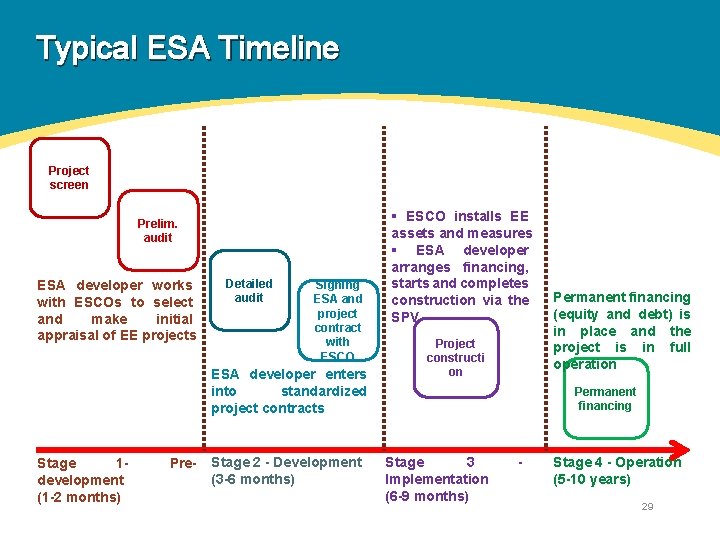
Typical ESA Timeline • fff Project screen Prelim. audit ESA developer works with ESCOs to select and make initial appraisal of EE projects Detailed audit Signing ESA and project contract with ESCO ESA developer enters into standardized project contracts Stage 1 development (1 -2 months) Pre- Stage 2 - Development (3 -6 months) § ESCO installs EE assets and measures § ESA developer arranges financing, starts and completes construction via the SPV Project constructi on Permanent financing (equity and debt) is in place and the project is in full operation Permanent financing Stage 3 Implementation (6 -9 months) - Stage 4 - Operation (5 -10 years) 29
ESAs: Pros and Cons (1) Bu proje Avrupa Birliği ve Türkiye Cumhuriyeti tarafından ortaklaşa finanse edilmektedir. Advantages: • No or reduced up-front investment by the Client. • All project performance risks (including the level of actual energy savings) are transferred to the ESA provider. • The ESA provider is incentivised to maximise energy savings; he guarantees savings or the Client only pays for the output of the EE asset(s). • Overcoming of split incentive problem: ESA payments made by the Client can be passed on to tenants in multi-tenancy buildings. • An ESA is normally structured as an off-balance sheet transaction. • Payments made by Client are tax deductible (operating expense) - 30 - S 6. 7
ESAs: Pros and Cons (2) Bu proje Avrupa Birliği ve Türkiye Cumhuriyeti tarafından ortaklaşa finanse edilmektedir. BUT: • ESAs are complex multi-party financing arrangements. • Higher cost than using other finance options in isolation, due to transfer of risks to the ESA provider, who must also pay for the up-front project costs. • The Client takes some of the utility bill price risk: that utility rate tariffs will increase more slowly than the escalation rate). • ESA providers will generally not undertake projects that do not require significant on-going maintenance. • Long-term financing agreement: future owners of the Client’s site must either buy -out the ESA contract or adopt it themselves • ESAs are typically only available for large projects and are usually targeted at large energy users. - 31 - S 6. 7
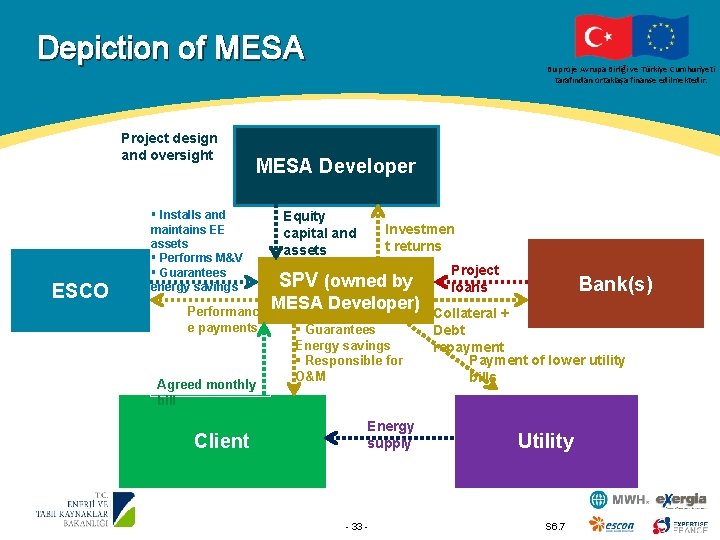
Management Energy Service Agreements (MESAs) – Main Features Bu proje Avrupa Birliği ve Türkiye Cumhuriyeti tarafından ortaklaşa finanse edilmektedir. • Similar structure to the ESA model. • Major difference: the MESA provider takes over responsibility for paying the Client’s utility bill. • The MESA provider and the Client agree to a monthly MESA bill amount based on historical consumption, specific inputs (e. g. occupancy rate, weather) and the forecast energy savings. The forecast savings are charged at a lower rate than the utility’s tariff rates to the Client. • The MESA provider charges the guaranteed monthly bill amount, which includes the MESA charges. • An escalation factor is built into the agreed monthly bill to protect the MESA provider from utility rate increases; but if rates on tariffs increase faster than the escalation factor, the MESA provider has to pay the difference. • Each billing cycle, the MESA provider pays the Client’s utility bill and invoices the Client for the guaranteed monthly bill amount: the difference between the guaranteed monthly bill and the utility bill is the MESA provider’s revenue. - 32 S 6. 7
Depiction of MESA Project design and oversight ESCO MESA Developer § Installs and maintains EE assets § Performs M&V § Guarantees energy savings Performanc e payments Agreed monthly bill Client Bu proje Avrupa Birliği ve Türkiye Cumhuriyeti tarafından ortaklaşa finanse edilmektedir. Equity capital and assets Investmen t returns SPV (owned by MESA Developer) § Guarantees Energy savings § Responsible for O&M Energy supply - 33 - Project loans Bank(s) Collateral + Debt repayment Payment of lower utility bills Utility S 6. 7
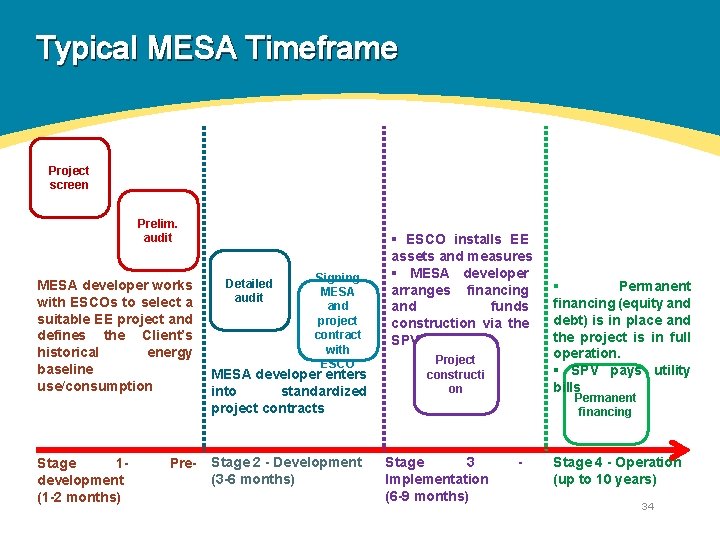
Typical MESA Timeframe • fff Project screen Prelim. audit MESA developer works with ESCOs to select a suitable EE project and defines the Client’s historical energy baseline use/consumption Stage 1 development (1 -2 months) Pre- Detailed audit Signing MESA and project contract with ESCO MESA developer enters into standardized project contracts Stage 2 - Development (3 -6 months) § ESCO installs EE assets and measures § MESA developer arranges financing and funds construction via the SPV Project constructi on Stage 3 Implementation (6 -9 months) § Permanent financing (equity and debt) is in place and the project is in full operation. § SPV pays utility bills Permanent financing - Stage 4 - Operation (up to 10 years) 34
MESAs - Pros and Cons (1) Bu proje Avrupa Birliği ve Türkiye Cumhuriyeti tarafından ortaklaşa finanse edilmektedir. Advantages: • No capital outlay by the Client. • The Client outsources its energy payments, which becomes the MESA developer’s responsibility. • It incentivizes the MESA provider to pursue deeper and more effective EE measures. • The Client pays a guaranteed bill amount each month that is much less than he paid before the MESA. • Both performance risk and the utility bill price risk are borne by the MESA Developer. • Simplification of the payment of utility bills: the MESA provider can implement EE measures for electricity, gas and water, and take over all three utility bills so that the Client just has to pay one bill instead of six (i. e. three utility bills and three MESA bills). • A MESA can be applied in a multitude of different properties or facilities (i. e. retail stores, warehouses, distribution centres, corporate offices) and can be executed regardless of whether the relevant property or facility is leased or owned. • The Client’s service payments to the MESA provider may be more readily passed through to tenants under existing lease terms. • Potential off-balance sheet treatment. - 35 - S 6. 7
MESAs - Pros and Cons (2) Bu proje Avrupa Birliği ve Türkiye Cumhuriyeti tarafından ortaklaşa finanse edilmektedir. Disadvantages: • The same as those in the ESA model. • Higher transaction costs: in a MESA arrangement, additional costs need to be incurred so as to monitor and calculate the energy savings achieved by comparing actual energy consumption of any EE improvement to a calculated and agreed-upon benchmark, which potentially requires an independent auditor to verify the energy savings achieved. • Negotiation costs are also high, as typical deals have a negotiation period of 9 -24 months. • MESA is a relatively new structure, which has not been widely tested: its implementation requires significant stakeholders’ education, which can lengthen the sales and project development cycle on proposed projects. - 36 - S 6. 7
Content of the presentation Bu proje Avrupa Birliği ve Türkiye Cumhuriyeti tarafından ortaklaşa finanse edilmektedir. 1. Combination of different EPC models 2. Sophisticated Lease Contracts 3. Mitigated Financial Risk ESCO model 4. Financing of EE projects by Specialized Private Energy Service Providers 5. Complex Energy Supply/Purchase Contracts - 37 - S 6. 7
Complex Energy Supply/Purchase Contracts – Main Features Bu proje Avrupa Birliği ve Türkiye Cumhuriyeti tarafından ortaklaşa finanse edilmektedir. • The ESC/EPA is part of a wider elaborate scheme to reduce energy costs through deep and comprehensive EE improvements. • Long-term capital and assets are dedicated for some EE investment(s): often, EE projects are bundled together to achieve economies of scale. • Several different groups of parties are involved, each of whom has its own rights and responsibilities. • Project risks are specifically apportioned between each participant in the scheme. • Energy utilities, which are subject to demand side management obligations, play a key role in the implementation of the relevant EE project. • The ESC/EPA has a long duration (20 years and more). - 38 - S 6. 7
Energy Supply/Purchase Contracts as Part of a Utility’s Demand Side Management Obligations Bu proje Avrupa Birliği ve Türkiye Cumhuriyeti tarafından ortaklaşa finanse edilmektedir. Electricity utilities in the USA have offered EE PPAs to reduce energy consumption through demand -side management (DSM) bidding programs or standard offer programs. Bidding programs • A utility solicits competitive bids from ESCOs or customers to provide energy savings at a specified price for a fixed period of time and for a specified market and/or area. The winning bidders are paid based on the savings achieved. The utility negotiates a multi-year contract with winning bidders that indicates - the size of contract (MWh or MW savings’ goal), - the time period over which savings from customers must be acquired, - - the payment schedule, - what EE measures can be used and how savings will be verified, - target markets (e. g. commercial buildings in a given geographic area), - consequences for failure to meet contract terms (e. g. penalties for non-performance). Standard offer programs • The utility offers a set price per kilowatt-hour for every unit of energy that customers or ESCOs can document as saved. • Multiple prices can be offered for different sources of savings (i. e. , different prices for lighting, heating and cooling, etc). - 39 - S 6. 7
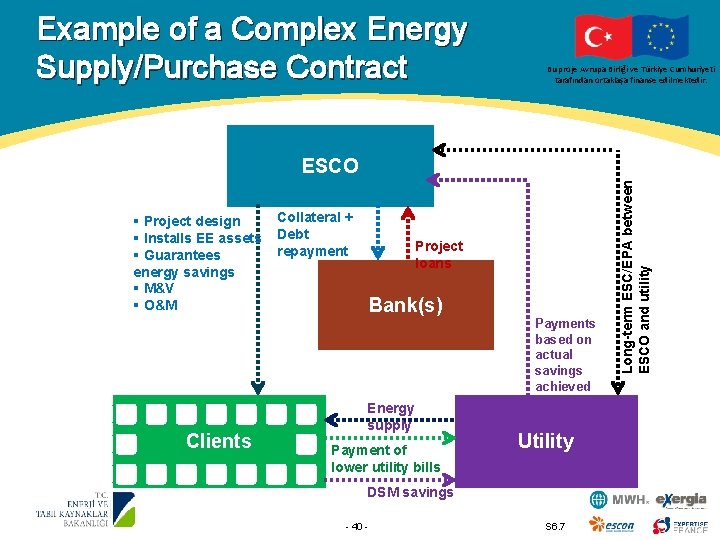
Example of a Complex Energy Supply/Purchase Contract Bu proje Avrupa Birliği ve Türkiye Cumhuriyeti tarafından ortaklaşa finanse edilmektedir. § Project design § Installs EE assets § Guarantees energy savings § M&V § O&M Collateral + Debt repayment Project loans Bank(s) Payments based on actual savings achieved Clients Energy supply Payment of lower utility bills Utility DSM savings - 40 - S 6. 7 Long-term ESC/EPA between ESCO and utility ESCO
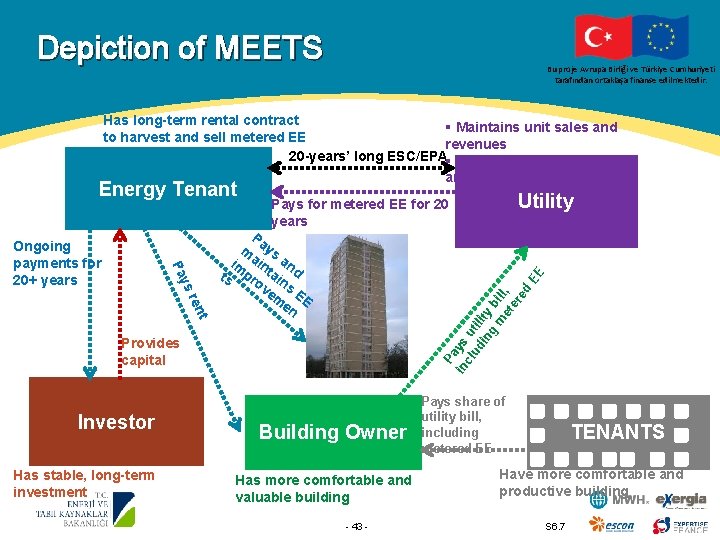
Metered Energy Efficiency Transaction Structure (MEETS) - Working Bu proje Avrupa Birliği ve Türkiye Cumhuriyeti tarafından ortaklaşa finanse edilmektedir. • An energy developer (“Energy Tenant”) delivers the capital financing required to make substantial efficiency upgrades to a building/facility and to operate and maintain them: Financing may be provided by the Energy Tenant itself or by outside investors. • The Energy Tenant secures the rights in the building with a long-term lease (the energy tenancy) that he signs with the building owner. • At the end of the “energy tenancy”, the ownership of all EE improvements is transferred to the building owner. • The Energy Tenant enters into a long-term Power Purchase Agreement (PPA) (e. g. 20 -30 years) with the utility for the metered EE improvements “harvested” by the EE upgrades: the length of the PPA matches the duration of the energy tenancy. • The utility meters traditional energy use via the existing energy meter. • Energy savings below a dynamic baseline are measured with a proprietary metering system; each year in the future, energy savings below this baseline are measured. • Under the PPA, the utility (with regulatory approval) agrees to pay the Energy - 41 - S 6. 7
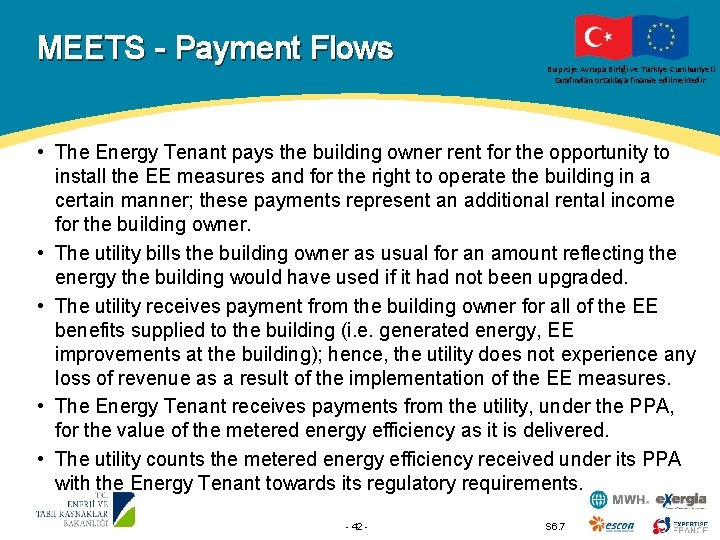
MEETS - Payment Flows Bu proje Avrupa Birliği ve Türkiye Cumhuriyeti tarafından ortaklaşa finanse edilmektedir. • The Energy Tenant pays the building owner rent for the opportunity to install the EE measures and for the right to operate the building in a certain manner; these payments represent an additional rental income for the building owner. • The utility bills the building owner as usual for an amount reflecting the energy the building would have used if it had not been upgraded. • The utility receives payment from the building owner for all of the EE benefits supplied to the building (i. e. generated energy, EE improvements at the building); hence, the utility does not experience any loss of revenue as a result of the implementation of the EE measures. • The Energy Tenant receives payments from the utility, under the PPA, for the value of the metered energy efficiency as it is delivered. • The utility counts the metered energy efficiency received under its PPA with the Energy Tenant towards its regulatory requirements. - 42 - S 6. 7
Depiction of MEETS Bu proje Avrupa Birliği ve Türkiye Cumhuriyeti tarafından ortaklaşa finanse edilmektedir. Has long-term rental contract § Maintains unit sales and to harvest and sell metered EE revenues 20 -years’ long ESC/EPA§ Meters traditional energy Energy Tenant EE Pa m ys im ain an ts pro tain d ve s E m E en Has stable, long-term investment in Provides capital Investor Utility Pays for metered EE for 20 years Pa y cl s u ud til in ity g m bill et , er ed t en r ys Pa Ongoing payments for 20+ years and EE Building Owner Has more comfortable and valuable building - 43 - Pays share of utility bill, including metered EE TENANTS Have more comfortable and productive building S 6. 7
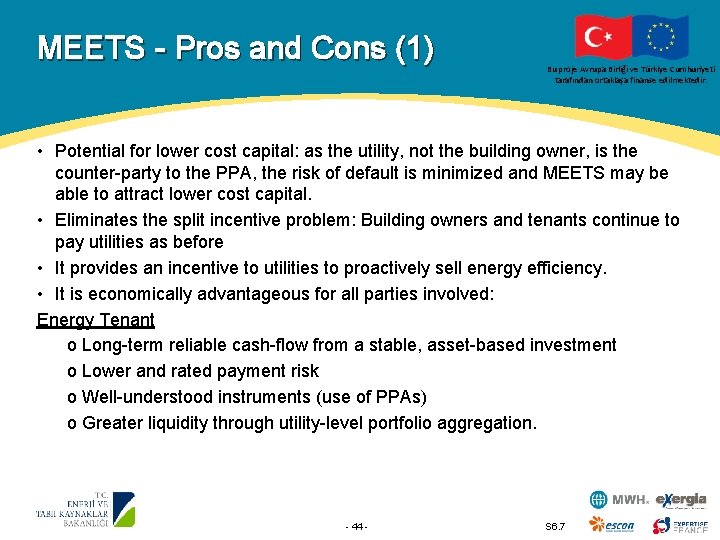
MEETS - Pros and Cons (1) Bu proje Avrupa Birliği ve Türkiye Cumhuriyeti tarafından ortaklaşa finanse edilmektedir. • Potential for lower cost capital: as the utility, not the building owner, is the counter-party to the PPA, the risk of default is minimized and MEETS may be able to attract lower cost capital. • Eliminates the split incentive problem: Building owners and tenants continue to pay utilities as before • It provides an incentive to utilities to proactively sell energy efficiency. • It is economically advantageous for all parties involved: Energy Tenant o Long-term reliable cash-flow from a stable, asset-based investment o Lower and rated payment risk o Well-understood instruments (use of PPAs) o Greater liquidity through utility-level portfolio aggregation. - 44 - S 6. 7
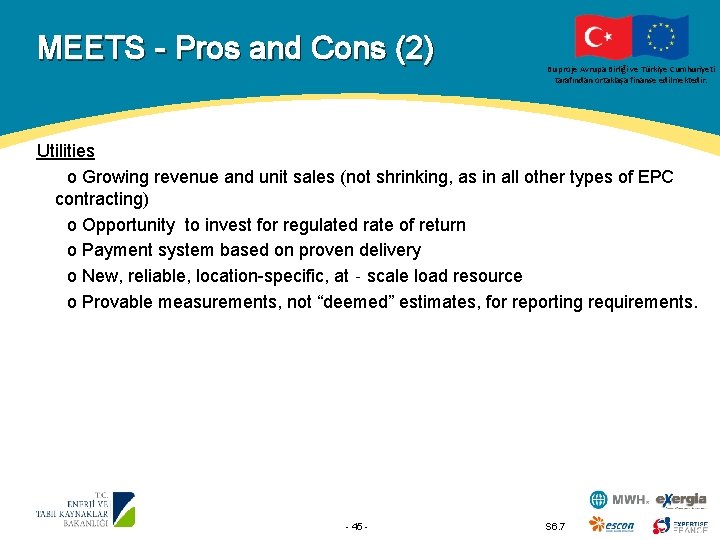
MEETS - Pros and Cons (2) Bu proje Avrupa Birliği ve Türkiye Cumhuriyeti tarafından ortaklaşa finanse edilmektedir. Utilities o Growing revenue and unit sales (not shrinking, as in all other types of EPC contracting) o Opportunity to invest for regulated rate of return o Payment system based on proven delivery o New, reliable, location-specific, at‐scale load resource o Provable measurements, not “deemed” estimates, for reporting requirements. - 45 - S 6. 7
MEETS - Pros and Cons (3) Bu proje Avrupa Birliği ve Türkiye Cumhuriyeti tarafından ortaklaşa finanse edilmektedir. Building Owners o More valuable building based on outside investment. o No owner capital placed at risk. o Additional rent and free cash-flow for use of their building as an energy efficiency investment vehicle. o Benefit of deeper investments in a building with upgrades and updating of the building’s systems. BUT • Uncertainties about the metering system: Investors and utilities must be satisfied with the accuracy of the metered savings below the dynamic baseline. • Energy costs utilities will cover: MEETS requires a significant change to utilities’ regulated business model. Utilities’ uncertainties about the accuracy of the dynamic baseline will impact the cost of energy via the PPA they will be willing to purchase. � • Utilities will have difficulty purchasing efficiency for fuels they do not provide. • Investors/ energy Tenant must be willing to assume the performance risk of the project. - 46 - S 6. 7
European Union / Instrument For Pre. Accession Assistance (IPA) Energy Sector Technical Assistance Project Thank you <Name, company> - - ESKIAvrupa Birliği ve Türkiye Cumhuriyeti Bu proje tarafından ortaklaşa finanse edilmektedir.