Innovation and Entrepreneurship According to Drucker Dr Larry

- Slides: 49
Innovation and Entrepreneurship According to Drucker Dr. Larry Stapleton Millikin University 1
Topics we will cover 1. Systematic Entrepreneurship 2. Why is Innovation more than a Bright Idea 3. 7 sources of Innovative Opportunity 4. Principles of Innovation 5. Entrepreneurial Management 6. Entrepreneurial Business 7. Entrepreneurship in the Service Institution 8. New Venture 9. Entrepreneurial Strategies 2
How do you define? How do you define entrepreneurship? How does it differ from traditional business? How do you define Innovation? Where does innovation come from? Sources 3
Systematic Entrepreneurship is the means to recognize and detect an opportunity. (Drucker) Then how to apply good management practices to take advantage of the opportunity thru application of innovation. Innovation is the source that allows the entrepreneur to take advantage of the opportunity. Not all innovation relates to something no one has ever done before. It could be applying an existing approach(s) better than anyone else or applying a non traditional way of doing something. What is Systematic Entrepreneurship? J. B. Say, 1800 4
Why Innovation is more than a Bright Idea. Is entrepreneurship and innovation restricted to small startup businesses? Do entrepreneurs make more risky decisions than traditional decision makers? What are some examples of French Innovation? Is the French form of health care an Innovation? 5
Forms of Innovation Product Innovation • a good or a service that is new or significantly improved • technical, materials, software or user-friendliness Process Innovation • new or significantly improved production or delivery method • technology, equipment, software Marketing Innovation • product design, packaging, placement, promotion or pricing Organizational Innovation • business organization, practice, external relationships 6
Social Innovation Definition Té –Traiteur Ethique is a WISE operating in the high-end catering industry, which improves the employability of people structurally Excluded from the job market by offering them a job opportunity, Training and social support. The Môm’artre network creates new kinds of spaces for after-school childcare, helping children to develop mainly through art. It is a network of associations with eight childcare centers, in Paris and French cities such as Arles and Nimes. Social Innovations in EU 7
Examples of Innovation What are some examples of Innovation? Which aspect of the company do they impact? How do your innovation examples differ from a process improvement? Take 5 minutes and write them down 8
Sources of Innovation 9
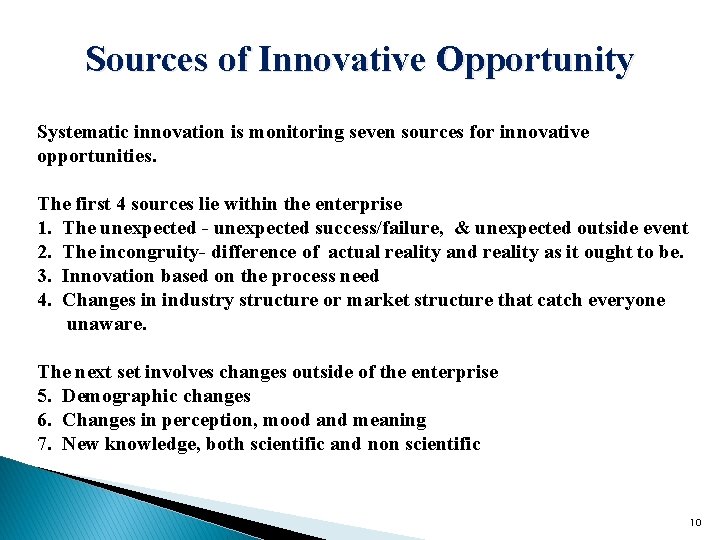
Sources of Innovative Opportunity Systematic innovation is monitoring seven sources for innovative opportunities. The first 4 sources lie within the enterprise 1. The unexpected - unexpected success/failure, & unexpected outside event 2. The incongruity- difference of actual reality and reality as it ought to be. 3. Innovation based on the process need 4. Changes in industry structure or market structure that catch everyone unaware. The next set involves changes outside of the enterprise 5. Demographic changes 6. Changes in perception, mood and meaning 7. New knowledge, both scientific and non scientific 10
Source 1: The Unexpected Success The Unexpected Failure The Unexpected Outside Event 11
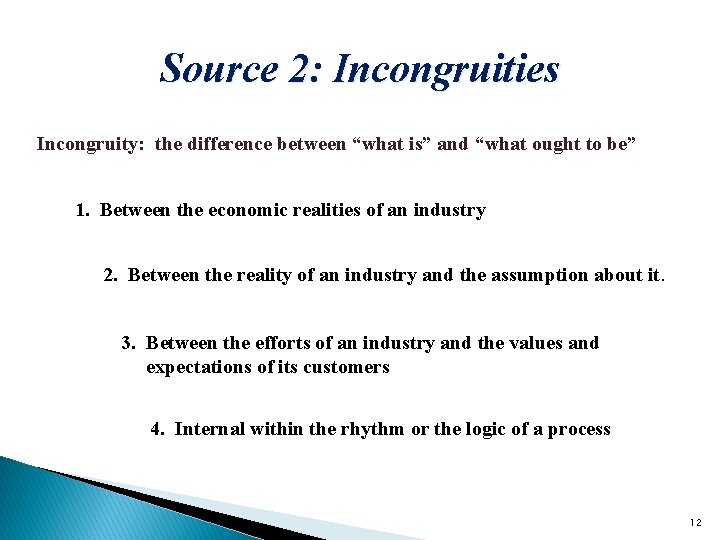
Source 2: Incongruities Incongruity: the difference between “what is” and “what ought to be” 1. Between the economic realities of an industry 2. Between the reality of an industry and the assumption about it. 3. Between the efforts of an industry and the values and expectations of its customers 4. Internal within the rhythm or the logic of a process 12
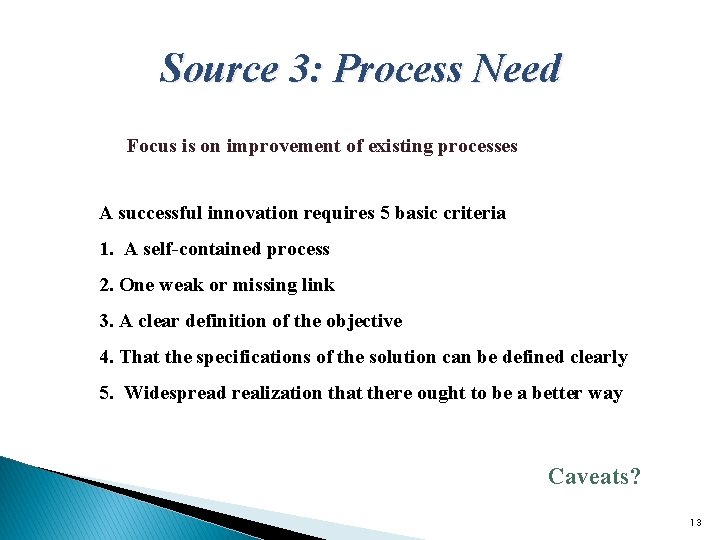
Source 3: Process Need Focus is on improvement of existing processes A successful innovation requires 5 basic criteria 1. A self-contained process 2. One weak or missing link 3. A clear definition of the objective 4. That the specifications of the solution can be defined clearly 5. Widespread realization that there ought to be a better way Caveats? 13
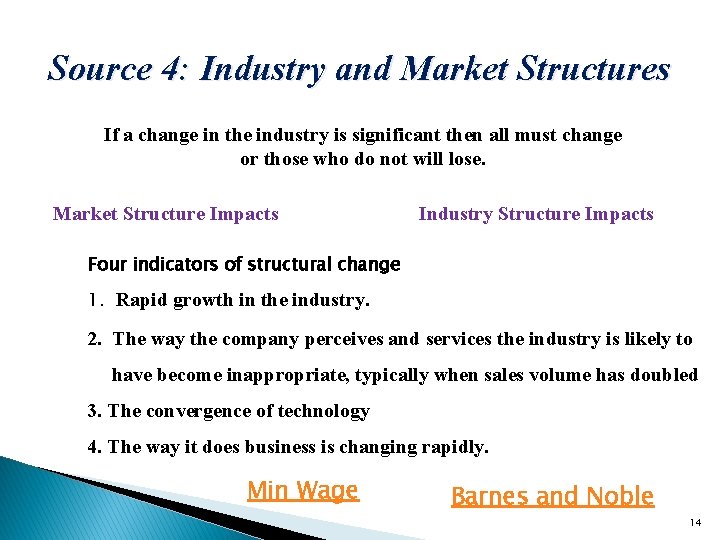
Source 4: Industry and Market Structures If a change in the industry is significant then all must change or those who do not will lose. Market Structure Impacts Industry Structure Impacts Four indicators of structural change 1. Rapid growth in the industry. 2. The way the company perceives and services the industry is likely to have become inappropriate, typically when sales volume has doubled 3. The convergence of technology 4. The way it does business is changing rapidly. Min Wage Barnes and Noble 14
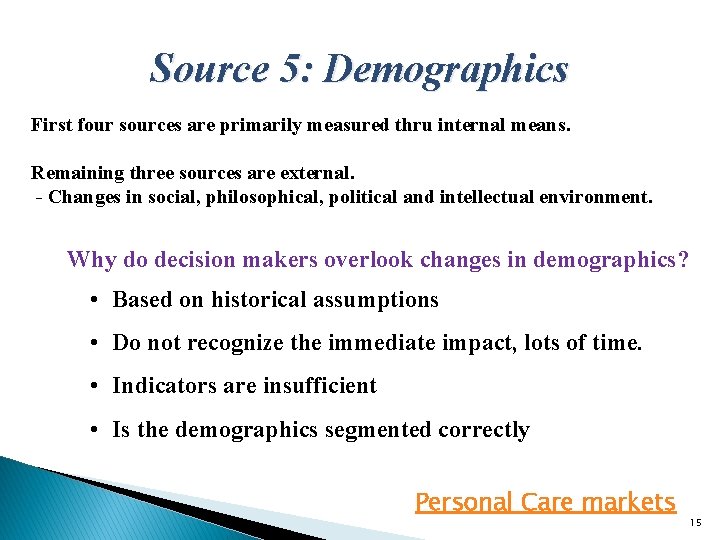
Source 5: Demographics First four sources are primarily measured thru internal means. Remaining three sources are external. - Changes in social, philosophical, political and intellectual environment. Why do decision makers overlook changes in demographics? • Based on historical assumptions • Do not recognize the immediate impact, lots of time. • Indicators are insufficient • Is the demographics segmented correctly Personal Care markets 15
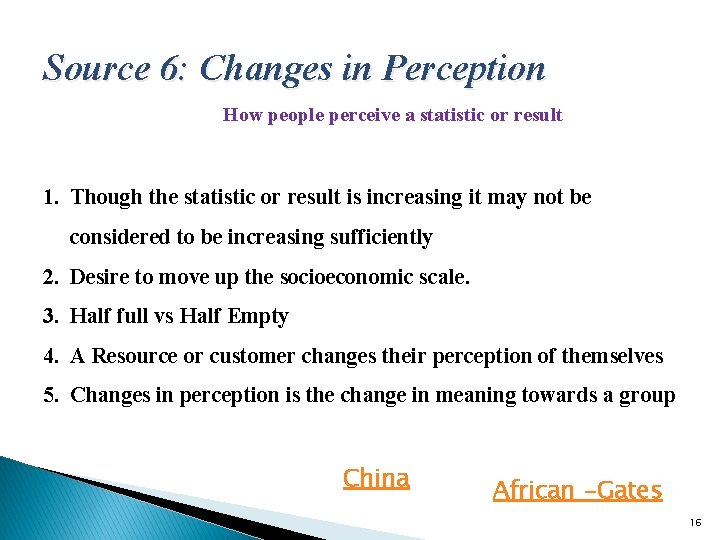
Source 6: Changes in Perception How people perceive a statistic or result 1. Though the statistic or result is increasing it may not be considered to be increasing sufficiently 2. Desire to move up the socioeconomic scale. 3. Half full vs Half Empty 4. A Resource or customer changes their perception of themselves 5. Changes in perception is the change in meaning towards a group China African -Gates 16
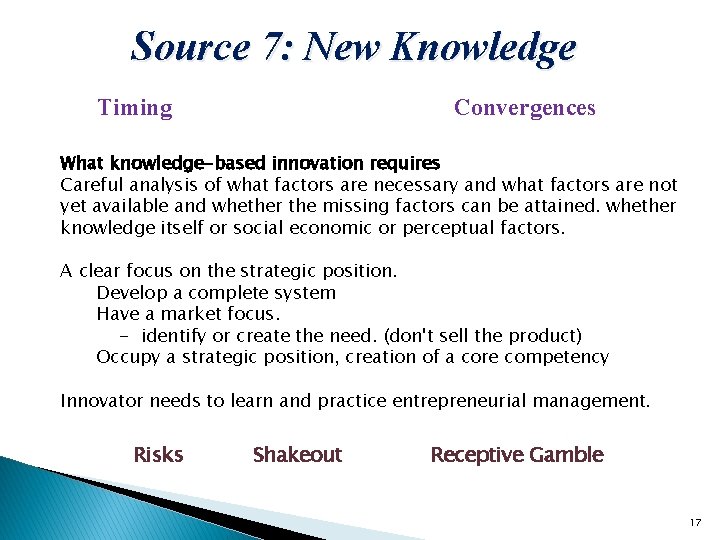
Source 7: New Knowledge Timing Convergences What knowledge-based innovation requires Careful analysis of what factors are necessary and what factors are not yet available and whether the missing factors can be attained. whether knowledge itself or social economic or perceptual factors. A clear focus on the strategic position. Develop a complete system Have a market focus. - identify or create the need. (don't sell the product) Occupy a strategic position, creation of a core competency Innovator needs to learn and practice entrepreneurial management. Risks Shakeout Receptive Gamble 17
Examples Using the examples you and your classmates defined earlier, what source(s) would you say best describes how they were developed. If you have thought of a new example then define which source best fits. Take 10 minutes 18
Entrepreneurial Management 19
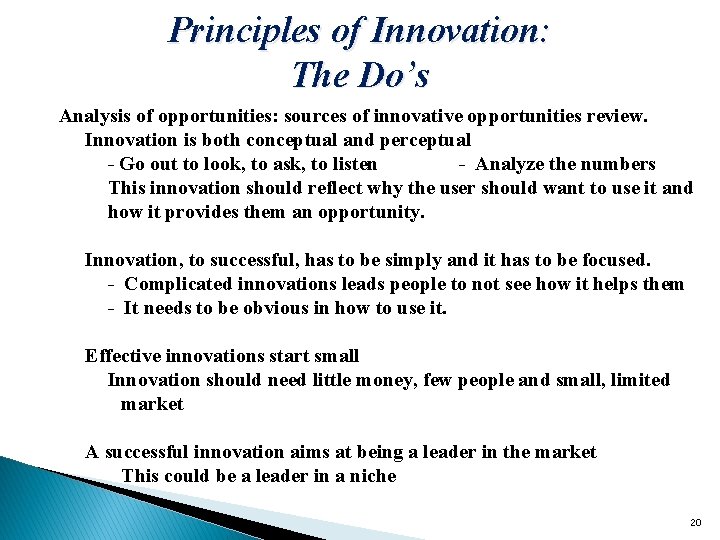
Principles of Innovation: The Do’s Analysis of opportunities: sources of innovative opportunities review. Innovation is both conceptual and perceptual - Go out to look, to ask, to listen - Analyze the numbers This innovation should reflect why the user should want to use it and how it provides them an opportunity. Innovation, to successful, has to be simply and it has to be focused. - Complicated innovations leads people to not see how it helps them - It needs to be obvious in how to use it. Effective innovations start small Innovation should need little money, few people and small, limited market A successful innovation aims at being a leader in the market This could be a leader in a niche 20
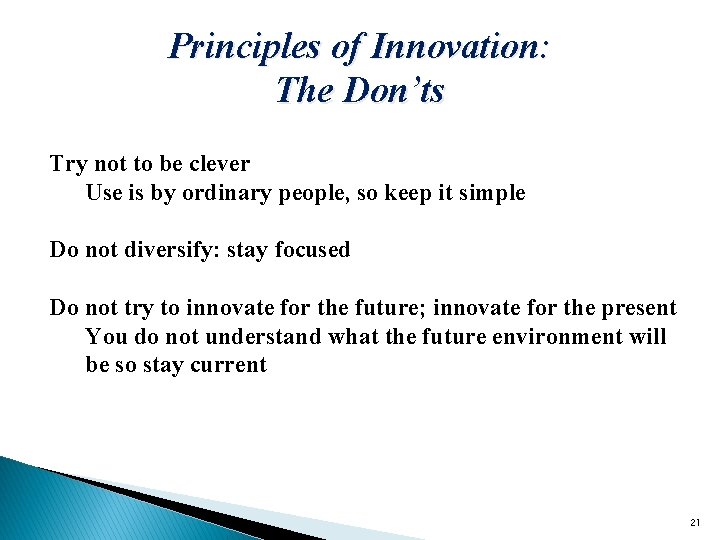
Principles of Innovation: The Don’ts Try not to be clever Use is by ordinary people, so keep it simple Do not diversify: stay focused Do not try to innovate for the future; innovate for the present You do not understand what the future environment will be so stay current 21
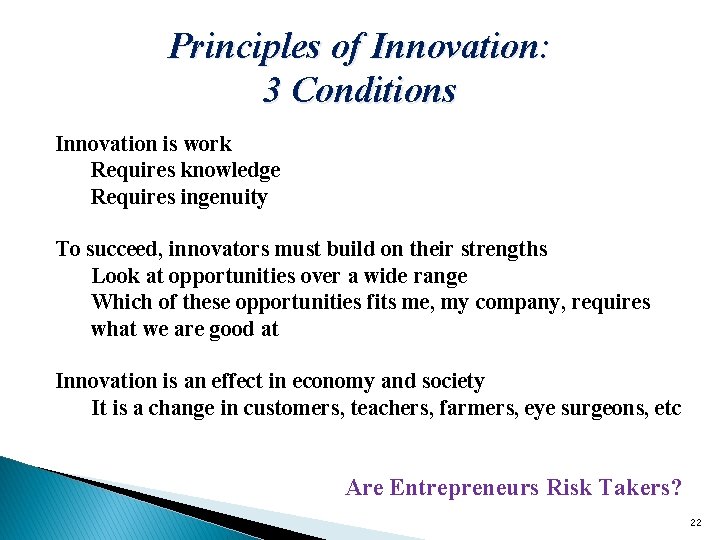
Principles of Innovation: 3 Conditions Innovation is work Requires knowledge Requires ingenuity To succeed, innovators must build on their strengths Look at opportunities over a wide range Which of these opportunities fits me, my company, requires what we are good at Innovation is an effect in economy and society It is a change in customers, teachers, farmers, eye surgeons, etc Are Entrepreneurs Risk Takers? 22
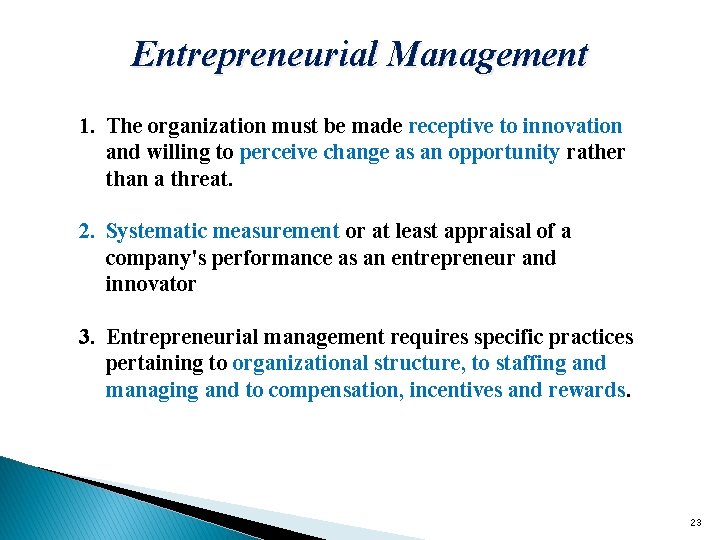
Entrepreneurial Management 1. The organization must be made receptive to innovation and willing to perceive change as an opportunity rather than a threat. 2. Systematic measurement or at least appraisal of a company's performance as an entrepreneur and innovator 3. Entrepreneurial management requires specific practices pertaining to organizational structure, to staffing and managing and to compensation, incentives and rewards. 23
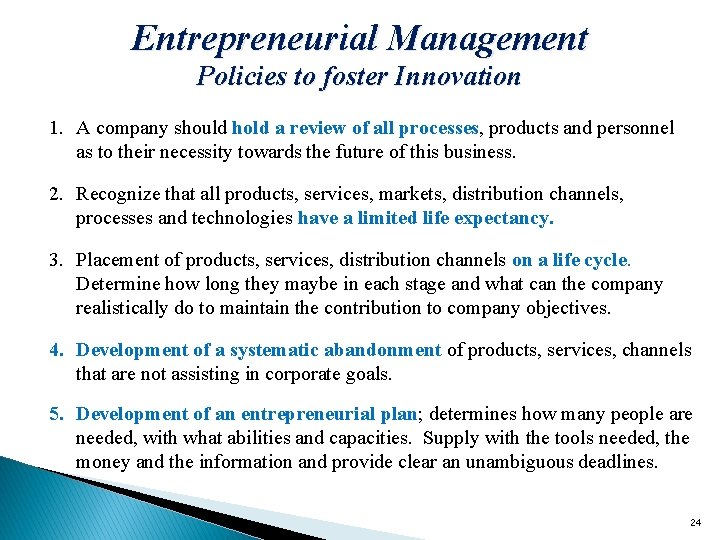
Entrepreneurial Management Policies to foster Innovation 1. A company should hold a review of all processes, products and personnel as to their necessity towards the future of this business. 2. Recognize that all products, services, markets, distribution channels, processes and technologies have a limited life expectancy. 3. Placement of products, services, distribution channels on a life cycle. Determine how long they maybe in each stage and what can the company realistically do to maintain the contribution to company objectives. 4. Development of a systematic abandonment of products, services, channels that are not assisting in corporate goals. 5. Development of an entrepreneurial plan; determines how many people are needed, with what abilities and capacities. Supply with the tools needed, the money and the information and provide clear an unambiguous deadlines. 24
Entrepreneurial Management Practices 1. Focusing managerial vision on opportunity 2. Hold a two day "show and tell" on how some managers are implementing innovation. 3. A member of top management meeting informally with Junior staff from Research, engineering, mfg, marketing and accounting and other departments to listen, not talk, about opportunities Culture starts at the top and must be demonstrated 25
Entrepreneurial Management Measuring Innovative Performance Steps: 1. Create feedback on results to expectations for each innovative process 2. Develop a systematic review of innovative efforts all together 3. Judging the company's total innovative performance against the company's innovative objectives, against its performance and standing in the market, and against its performance as a business altogether 26
Entrepreneurial Management Organization Structures 1. Separate the new from the existing units 2. There needs to be someone in top management who has responsibility for these innovative groups. 3. Keep separate so that traditional metrics are not used 4. Tie compensation to success in implementing success 5. A person or component group should be held clearly accountable 27
Entrepreneurial Management Staffing Do’s 1. Seek out someone who has the behaviors, policies and practices that will work towards nurturing an idea. 2. To gain success you need to define the positions and skills needed and place people who fit those skills. Not just anyone you is available 3. One needs to consider personalities as the culture of the organization must fit that of innovation. Don’ts 1. Do not mix managerial units and entrepreneurial ones 2. Innovative efforts that take the existing business out of its own field are rarely successful 3. Almost always futile to avoid making one's own business entrepreneurial by "buying in". 28
Service Institution Entrepreneurship Why do Non- For Profits need innovation more than For-Profit Institution 1. The public sector is based on a budget rather than being paid out its results. 2. Dependent on a multitude of constituents 3. They perceive their mission as a moral one which does good. Focus is on Maximization rather than optimization Most Innovation in the private sector comes from new ventures 29
Service Institution Policies 1. Need a clear definition of its mission 2. Realistic statement of goals 3. Failure to achieve objectives should be considered an indication that the objective is wrong 4. Build into policies the constant search for innovative opportunity 30
The New Venture Entrepreneurial Management in the New Venture requirements. 1. A focus on the market 2. Financial foresight, and planning for cash flow and capital needs. 3. Building a top management team long before the new venture actually needs one. 4. The founding entrepreneur must make a decision in respect to their own role, area of work, and relationships. 31
The New Venture For existing businesses the focus is on entrepreneurial. For new ventures the focus is on Management WHY? 32
The New Venture Market focus The innovator needs to recognize and consider applications and markets beyond the original intent of the product and/or service. Failure to make this recognition and willingness to pursue it will result in competitors entering the market and gaining the majority of the market share. What is Market focused and how do we apply it? 33
The New Venture Financial Foresight Most companies focus on revenue and profit. Isn’t that what you should be looking at? Why should I focus on available cash? How does this differ from revenue and profit? Perceived vs actual 34
The New Venture Management Team I am the founder so why should I build a management team to be successful? When should I form a team? How do I form a team? Policies and Procedures 35
The New Venture Where do I fit How does the founder fit into the management team? How will they determine? Is there a need for outside help? What are you good at? 36
Entrepreneurial Strategies 37
Entrepreneurial Strategy: Fustest with the Mostest Focus is on attaining a permanent leadership position in the market. 1. An ambitious aim 2. Creating a new market or industry 3. Creating a highly unconventional process 4. Requires thought and careful analysis 5. Exploitation of the right economic and political conditions 6. Once the new market has been established the innovator must remain focused to retain the leadership role. 7. Prices must be cut to retain leadership thru value and to reduce the opportunity for competitors. Apple and Samsung 38
Entrepreneurial Strategy: Creative Imitation Revision of an existing product or market so that it better meets the needs and desires of the market. Can result when you define a market but fail to retain the leadership noted in Fustest with the Mostest. Strategy is less risky than Fustest with the Mostest because someone else has established the market. The issue with this strategy is that the market needs is an ever moving target, as such your strategy must be to recognize this movement and provide what it wants. market focused and market driven 39
Entrepreneurial Strategy: Entrepreneurial Judo Take advantage of their weakness by recognition of their habits. There are 5 common bad habits that enable newcomers to use entrepreneurial judo. 1. Not invented here: 2. Focus your attention only on the "cream" of the market. 3. Quality defined as a level of complexity or what the supplier puts into the product 4. Delusion of a premium price 5. Maximization versus optimization Where do we start? 40
Entrepreneurial Strategy: Ecological Niches Seeks control rather than market leadership Strategies 1. Toll Gate: • Consequence is much higher than cost of product or service 2. Specialty Skill: • A unique skill that creates an input into the final product/service. 3. Specialty Market: • Has specialized knowledge of a market Personal Care Markets Product, service or knowledge that is essential to the process or market 41
Entrepreneurial Strategy: Changing Values and Characteristics 1. Creating Customer utility • Recognition of and satisfaction of what the customer truly wants. 2. Pricing • Price the action not just the item 3. The Customer reality • Customers are rational by considering the constraints and factors which go into the buying process. • These constraints and factors are the buyers reality. • To sell to a buyer you must understand these constraints and factors. • Limitations of money, space, knowledge, technology and more 42
Entrepreneurial Strategy: Changing Values and Characteristics 4. Delivering Value to the customer • Recognition of what is important to the customer • Identification and communication of the value the supplier provides to the customer • This advantage or value must be viewed from the consumers perspective not that of the supplier. • Sometimes this is brooding the definition of what is to be provided. • This may seem to go against the niche philosophy, but remember that one of the disadvantages is that you might not see opportunities if you are too focused • So is price the only measure of value. • Value or is it utility, what is the difference? 43
Cases 44
Case Study: Legos Describe which innovation sources are used in the case. Discuss which strategy do you think were used. Do you think that the innovation source or strategy changed as the product matured? Legos 45
Large Company Innovation Why did each company wish to instill innovation into their companies? What methods did each employ? What factors did they feel needed to be changed to create an innovative culture. Large Company Innovation 46
Case Study: Engineering How do these cases relate to the sources and strategies presented by Drucker? Mini cases - Engineering 47
Failures in Innovation - New Coke - Technology Failures - Boeing 787 Dreamliner 48
My Experience with Innovation • Deployable Flight Incident Recorder (crush material) • Display viewing using a Fresnel lens • Use of MS Project to enhance communication for group projects • Use of supplier linked computers for ordering material. 49