Ingate Dialogic SIP Trunking Ingate Product Training Common
- Slides: 24
Ingate & Dialogic SIP Trunking
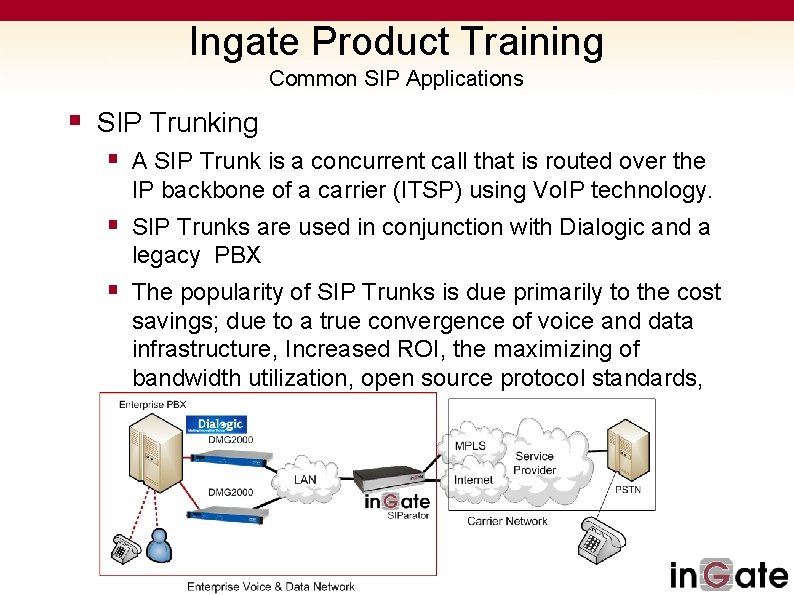
Ingate Product Training Common SIP Applications § SIP Trunking § A SIP Trunk is a concurrent call that is routed over the IP backbone of a carrier (ITSP) using Vo. IP technology. § SIP Trunks are used in conjunction with Dialogic and a legacy PBX § The popularity of SIP Trunks is due primarily to the cost savings; due to a true convergence of voice and data infrastructure, Increased ROI, the maximizing of bandwidth utilization, open source protocol standards, and more.
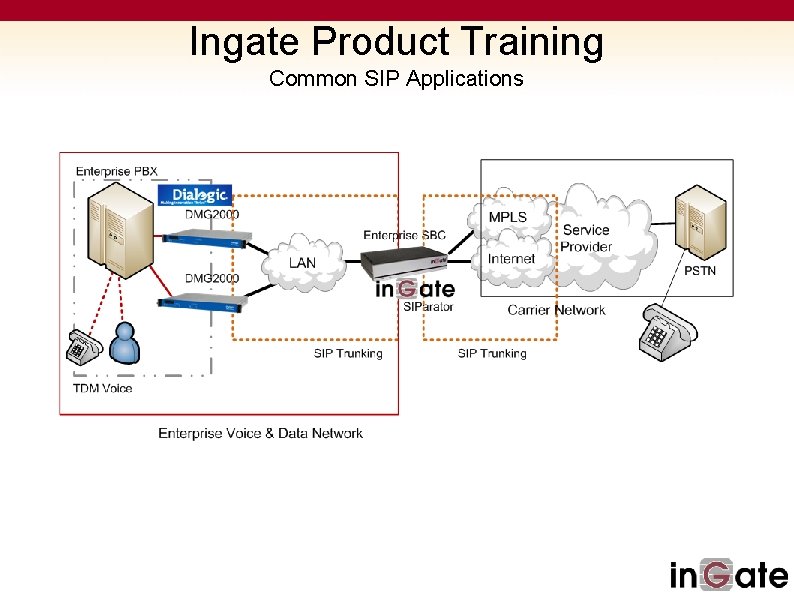
Ingate Product Training Common SIP Applications
Common SIP Deployment Issues
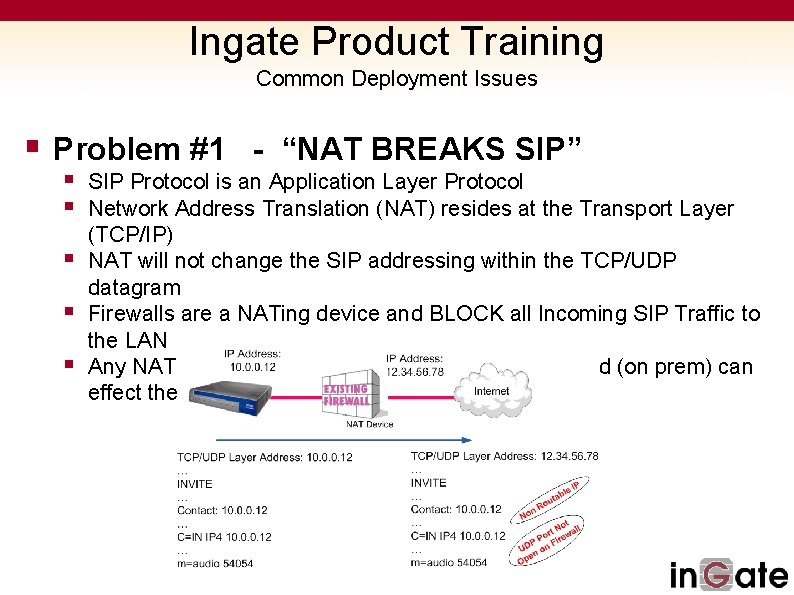
Ingate Product Training Common Deployment Issues § Problem #1 - “NAT BREAKS SIP” § SIP Protocol is an Application Layer Protocol § Network Address Translation (NAT) resides at the Transport Layer § § § (TCP/IP) NAT will not change the SIP addressing within the TCP/UDP datagram Firewalls are a NATing device and BLOCK all Incoming SIP Traffic to the LAN Any NAT device, either Far End (remote) or Near End (on prem) can effect the call
Ingate Product Training Common Deployment Issues § Ingate Benefits - “NAT BREAKS SIP” § Ingate products are ICSA Certified Vo. IP Firewalls § Ingate have a SIP Proxy, SIP B 2 BUA and NAT working together § Ingate SIParator can bring enhance the SIP capabilities and SIP security of an existing Firewall § Ingate can provide “Far End NAT Traversal” functionality § What Other IP-PBXs Vendors Do § Most all IP-PBX vendors recommend the use of some sort of “SIP-Aware Firewall” for deployment § Other recommend the use of Port Forwarding, to forward Port 5060 and a thousand other Ports to the
Ingate Product Training Common Deployment Issues § Problem #2 – SIP Interoperability § Not all SIP is the same § One vendors implementation may not be the same as another § There are many SIP components and extensions that may be § supported on one vendors equipment and not on another SIP Protocol is an open standard and can be left to interpretation by each vendor § Examples § Use of REFER Method is not typically supported by ITSP § Use of INVITE with Replaces Header is not typically supported by § § § ITSP Some ITSPs don’t like SDP with “a=Inactive” attribute ENUM SIP URI Delivery is supported by some and not by others Various TO and FROM Header conformances
Ingate Product Training Common Deployment Issues § Ingate Benefits – SIP Interoperability § In General, § Can rewrite headers commonly needing changed between § § vendors Provide SIP Protocol error checking and fixes Protocol nonconformances Routing Rules and Policies to direct traffic Contains extensive list of features devoted to SIP nonconformances customization SIP Connect Compliant Interface § Ingate contains a B 2 BUA § Separates the call between the two parties, helping separate two § different implementations of SIP Provides Client or Server User Accounts for Registration and Authentication
Ingate Product Training Common Deployment Issues § Problem #3 – SIP Security § SIP is written in clear text within the datagram of a UDP or TCP Transport. § Confidential User/SIP URI Information § A SIP URI is like an Email Address, once someone has it, they who you are and where you are located. § Some malicious uses like Do. S Attacks, SPIT Attacks, Intrusion of Services, Toll Fraud, Tele-markers and more. § Called and Calling Party Number Information § Private LAN Network Address Scheme § Giving away the confidential Private IP Address scheme of the internal LAN network, gives malicious attackers knowledge of the internal configuration of the Enterprise. § The Port being used on the device, gives malicious attackers where to direct traffic § Media Attributes § Easy to see what Media is being negotiated and where its going, Eavesdropping and Hijacking
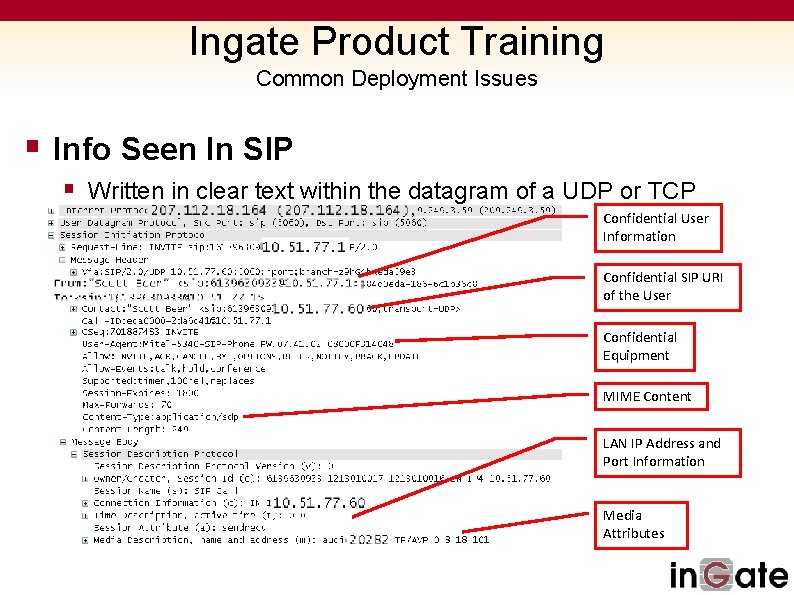
Ingate Product Training Common Deployment Issues § Info Seen In SIP § Written in clear text within the datagram of a UDP or TCP Transport. Confidential User Information Confidential SIP URI of the User Confidential Equipment MIME Content LAN IP Address and Port Information Media Attributes
Ingate Product Training Common Deployment Issues § Common SIP Attacks § Intrusion of Services § Devices attempting Register with a IP-PBX in an attempt to look like an IP-PBX extension and gain IP-PBX services § SPIT (SPAM over Internet Telephony) § Toll Fraud § A form of an Intrusion of Service, where malicious attempts to send INVITEs to an IP-PBX to gain access to PSTN Gateways and SIP Trunking to call the PSTN § Denial of Service § INVITE (or any SIP Request) Flood in an attempt to slow services or disrupt services § Or any UDP or TCP traffic directed at a SIP Service on SIP Ports § Indirect Security Breaches § Private LAN IP Address and User Information
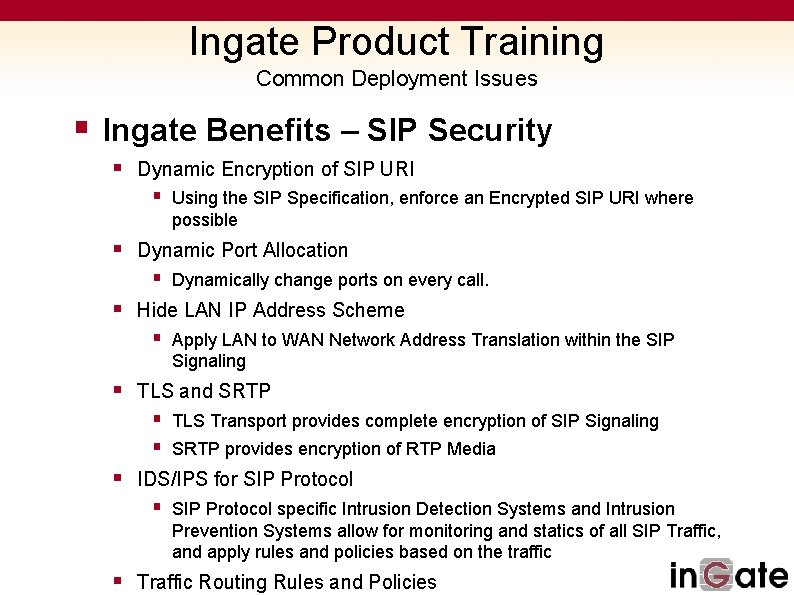
Ingate Product Training Common Deployment Issues § Ingate Benefits – SIP Security § Dynamic Encryption of SIP URI § Using the SIP Specification, enforce an Encrypted SIP URI where possible § Dynamic Port Allocation § Dynamically change ports on every call. § Hide LAN IP Address Scheme § Apply LAN to WAN Network Address Translation within the SIP Signaling § TLS and SRTP § TLS Transport provides complete encryption of SIP Signaling § SRTP provides encryption of RTP Media § IDS/IPS for SIP Protocol § SIP Protocol specific Intrusion Detection Systems and Intrusion Prevention Systems allow for monitoring and statics of all SIP Traffic, and apply rules and policies based on the traffic § Traffic Routing Rules and Policies
Ingate & Dialogic Deployment
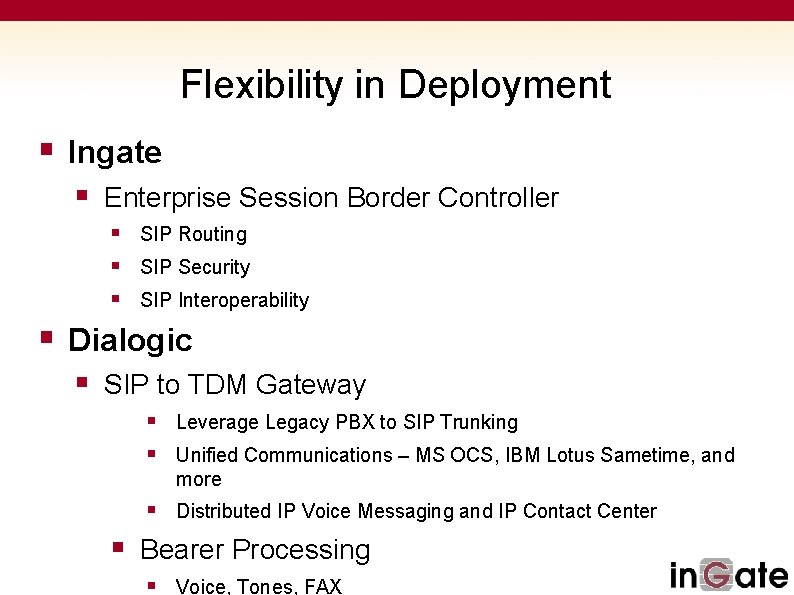
Flexibility in Deployment § Ingate § Enterprise Session Border Controller § SIP Routing § SIP Security § SIP Interoperability § Dialogic § SIP to TDM Gateway § Leverage Legacy PBX to SIP Trunking § Unified Communications – MS OCS, IBM Lotus Sametime, and more § Distributed IP Voice Messaging and IP Contact Center § Bearer Processing § Voice, Tones, FAX
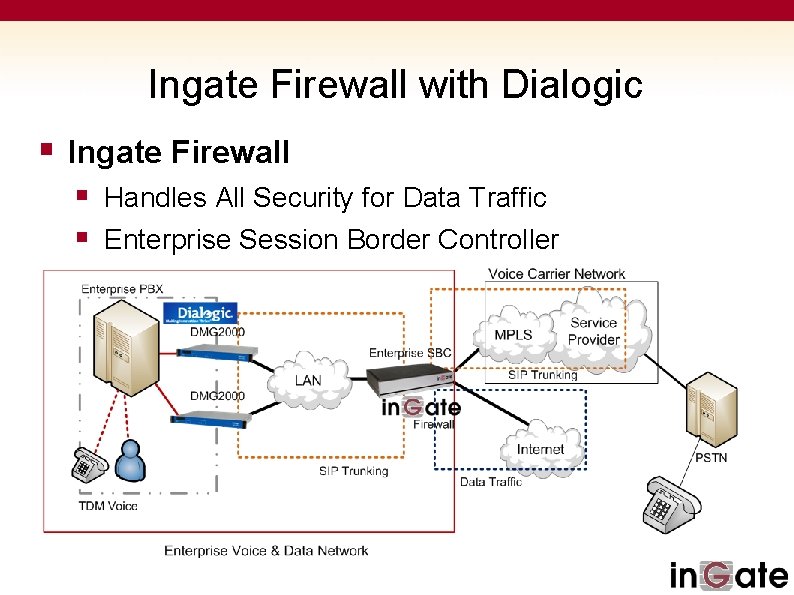
Ingate Firewall with Dialogic § Ingate Firewall § Handles All Security for Data Traffic § Enterprise Session Border Controller
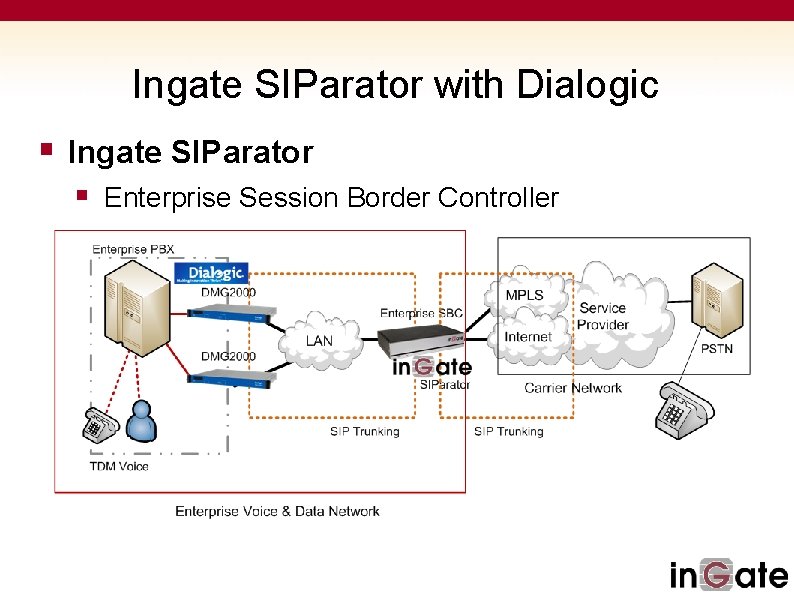
Ingate SIParator with Dialogic § Ingate SIParator § Enterprise Session Border Controller
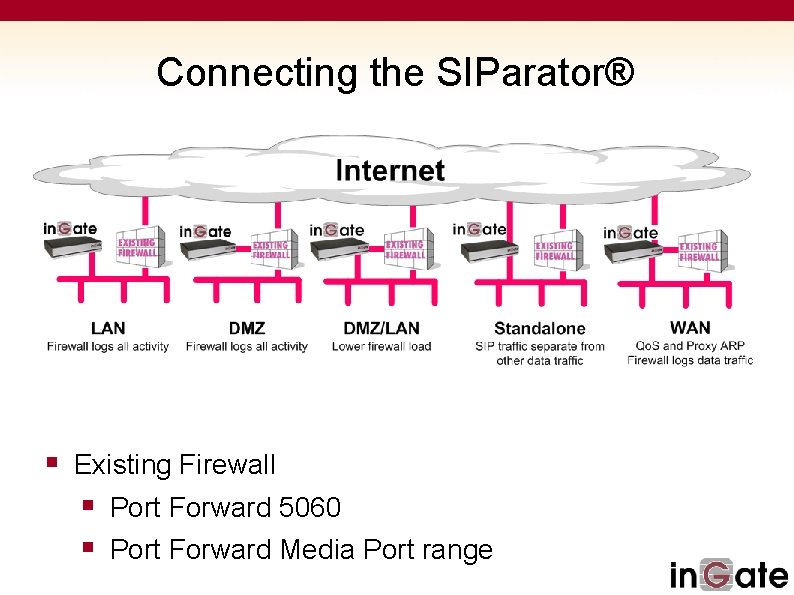
Connecting the SIParator® § Existing Firewall § Port Forward 5060 § Port Forward Media Port range
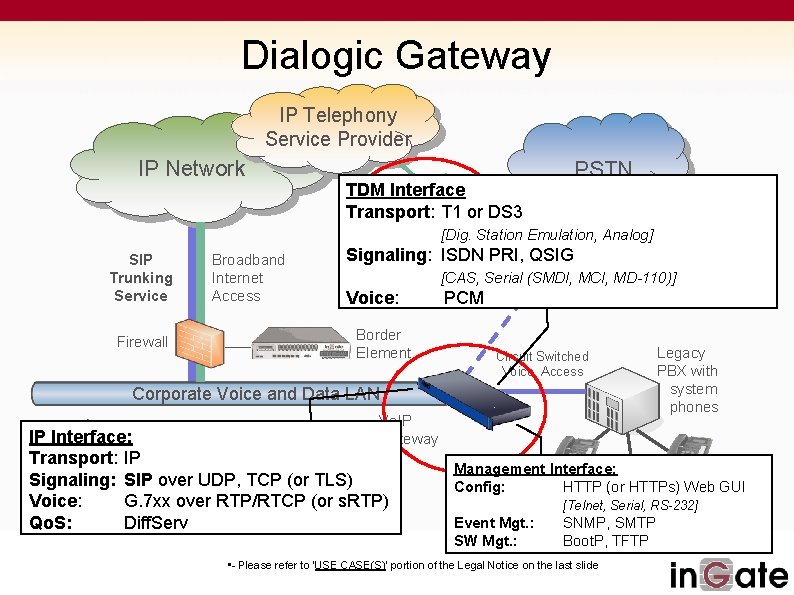
Dialogic Gateway IP Telephony Service Provider IP Network SIP Trunking Service Firewall Broadband Internet Access TDM Interface Transport: T 1 or DS 3 PSTN [Dig. Station Emulation, Analog] Service Provider Signaling: Circuit Switched Gateway. ISDN PRI, QSIG Voice Access [CAS, Serial (SMDI, MCI, MD-110)] Voice: Border Element (Optional) PCM Circuit Switched Voice Access Corporate Voice and Data LAN Vo. IP Gateway IP Interface: Transport: IP Signaling: SIP over UDP, TCP (or TLS) Voice: G. 7 xx over RTP/RTCP (or s. RTP) Qo. S: Diff. Serv Legacy PBX with system phones Management Interface: Config: HTTP (or HTTPs) Web GUI [Telnet, Serial, RS-232] Event Mgt. : SW Mgt. : SNMP, SMTP Boot. P, TFTP • - Please refer to ‘USE CASE(S)’ portion of the Legal Notice on the last slide
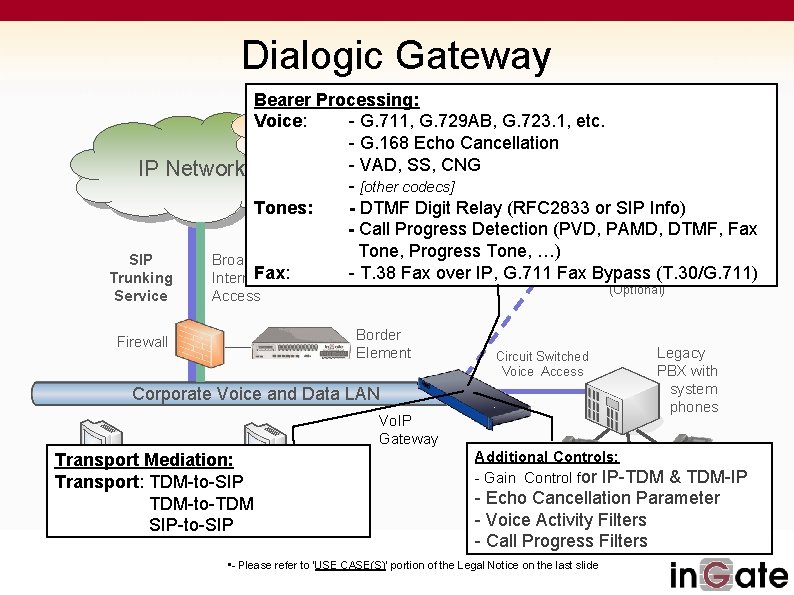
Dialogic Gateway Bearer Processing: IP Telephony Voice: - G. 711, G. 729 AB, G. 723. 1, etc. Service Provider - G. 168 Echo Cancellation - VAD, SS, CNG IP Network PSTN - [other codecs] Tones: - DTMF Digit Relay (RFC 2833 or SIP Info) - Call Progress Detection (PVD, PAMD, DTMF, Fax Service Provider Tone, Progress Tone, …) Circuit Switched Gateway Broadband SIP Voice Access Fax: - T. 38 Fax over IP, G. 711 Fax Bypass (T. 30/G. 711) Internet Trunking Service (Optional) Access Border Element Firewall Circuit Switched Voice Access Corporate Voice and Data LAN Vo. IP Gateway Transport Mediation: Transport: TDM-to-SIP TDM-to-TDM SIP-to-SIP Legacy PBX with system phones Additional Controls: - Gain Control for IP-TDM & TDM-IP - Echo Cancellation Parameter - Voice Activity Filters - Call Progress Filters • - Please refer to ‘USE CASE(S)’ portion of the Legal Notice on the last slide
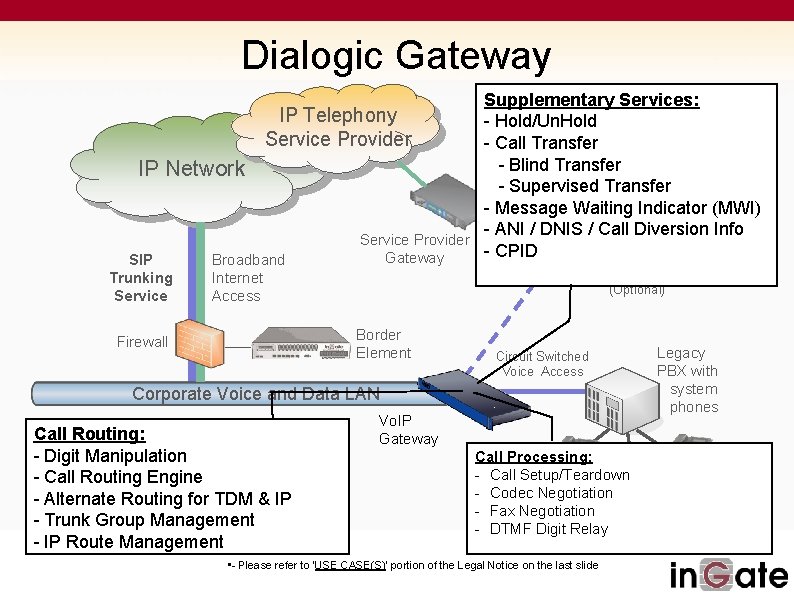
Dialogic Gateway Supplementary Services: IP Telephony - Hold/Un. Hold Service Provider - Call Transfer - Blind Transfer IP Network PSTN - Supervised Transfer - Message Waiting Indicator (MWI) - ANI / DNIS / Call Diversion Info Service Provider - CPID Circuit Switched Gateway Broadband SIP Trunking Service Voice Access (Optional) Internet Access Border Element Firewall Circuit Switched Voice Access Corporate Voice and Data LAN Call Routing: - Digit Manipulation - Call Routing Engine - Alternate Routing for TDM & IP - Trunk Group Management - IP Route Management Vo. IP Gateway Call Processing: - Call Setup/Teardown - Codec Negotiation - Fax Negotiation - DTMF Digit Relay • - Please refer to ‘USE CASE(S)’ portion of the Legal Notice on the last slide Legacy PBX with system phones
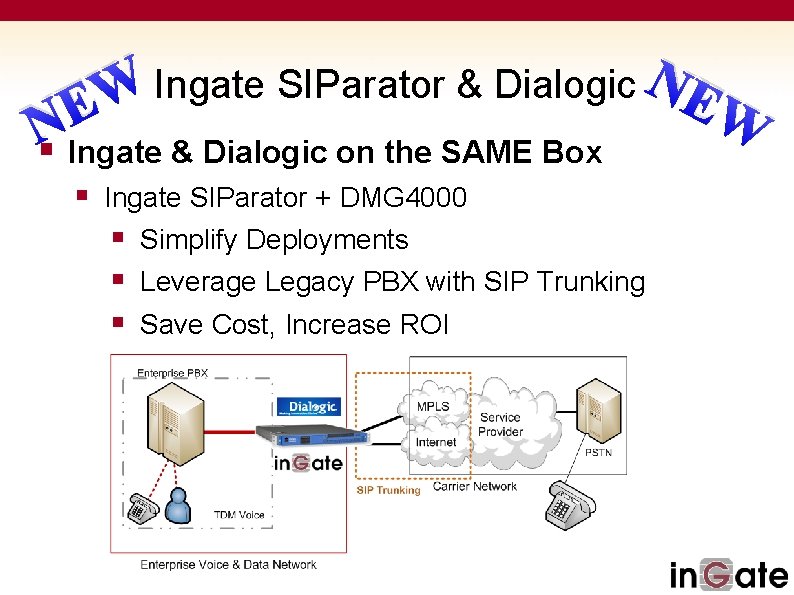
N Ingate SIParator & Dialogic E W E N § Ingate & Dialogic on the SAME Box § Ingate SIParator + DMG 4000 § Simplify Deployments § Leverage Legacy PBX with SIP Trunking § Save Cost, Increase ROI W
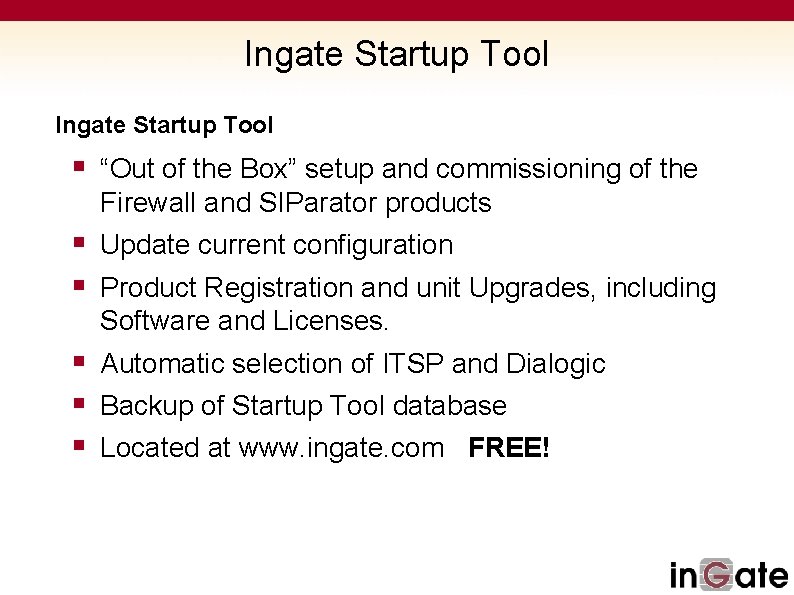
Ingate Startup Tool § “Out of the Box” setup and commissioning of the Firewall and SIParator products § Update current configuration § Product Registration and unit Upgrades, including Software and Licenses. § Automatic selection of ITSP and Dialogic § Backup of Startup Tool database § Located at www. ingate. com FREE!
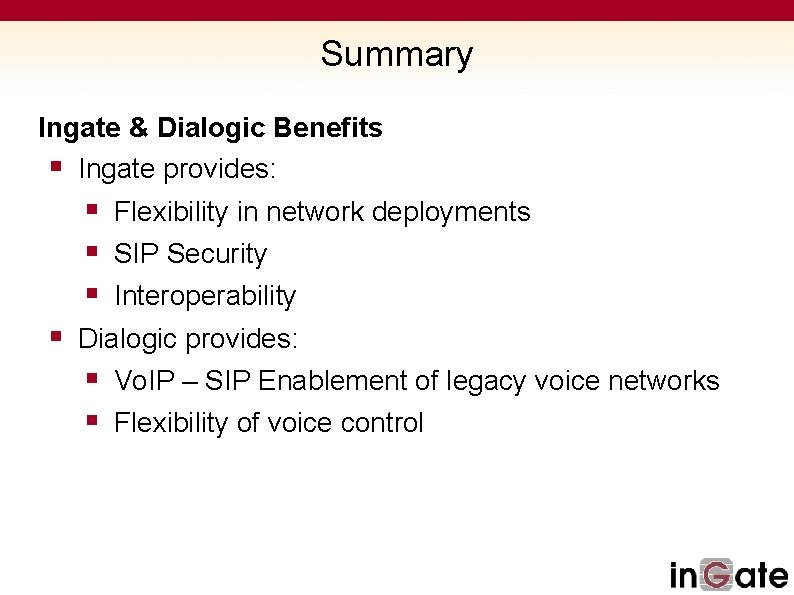
Summary Ingate & Dialogic Benefits § Ingate provides: § Flexibility in network deployments § SIP Security § Interoperability § Dialogic provides: § Vo. IP – SIP Enablement of legacy voice networks § Flexibility of voice control
THE END