INF 212 ANALYSIS OF PROG LANGS FUNKTIONAL PROGRAMMING
- Slides: 18
INF 212 ANALYSIS OF PROG. LANGS FUNKTIONAL PROGRAMMING -- MONADS Instructors: Crista Lopes Copyright © Instructors.
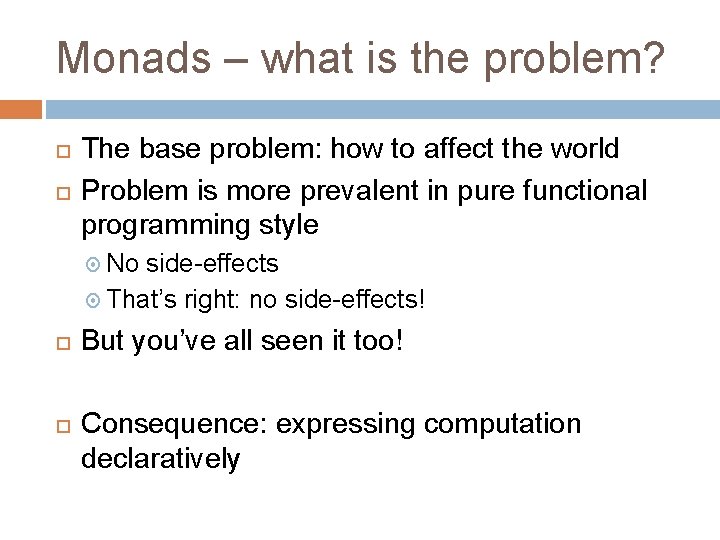
Monads – what is the problem? The base problem: how to affect the world Problem is more prevalent in pure functional programming style No side-effects That’s right: no side-effects! But you’ve all seen it too! Consequence: expressing computation declaratively
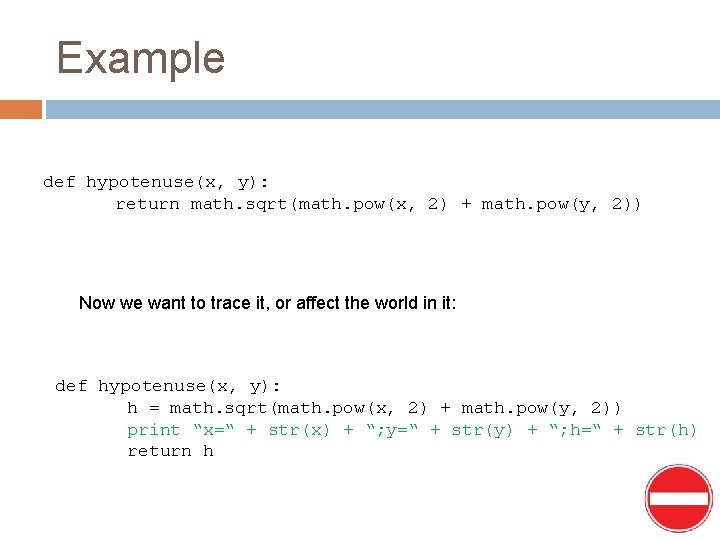
Example def hypotenuse(x, y): return math. sqrt(math. pow(x, 2) + math. pow(y, 2)) Now we want to trace it, or affect the world in it: def hypotenuse(x, y): h = math. sqrt(math. pow(x, 2) + math. pow(y, 2)) print “x=“ + str(x) + “; y=“ + str(y) + “; h=“ + str(h) return h
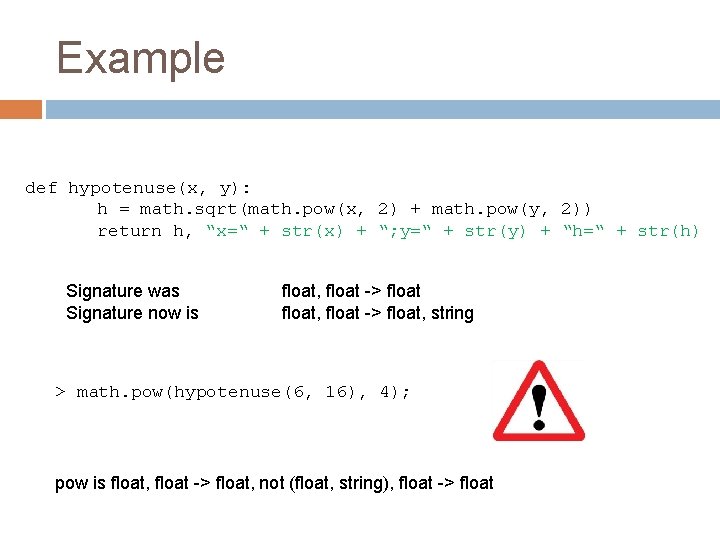
Example def hypotenuse(x, y): h = math. sqrt(math. pow(x, 2) + math. pow(y, 2)) return h, “x=“ + str(x) + “; y=“ + str(y) + “h=“ + str(h) Signature was Signature now is float, float -> float, string > math. pow(hypotenuse(6, 16), 4); pow is float, float -> float, not (float, string), float -> float
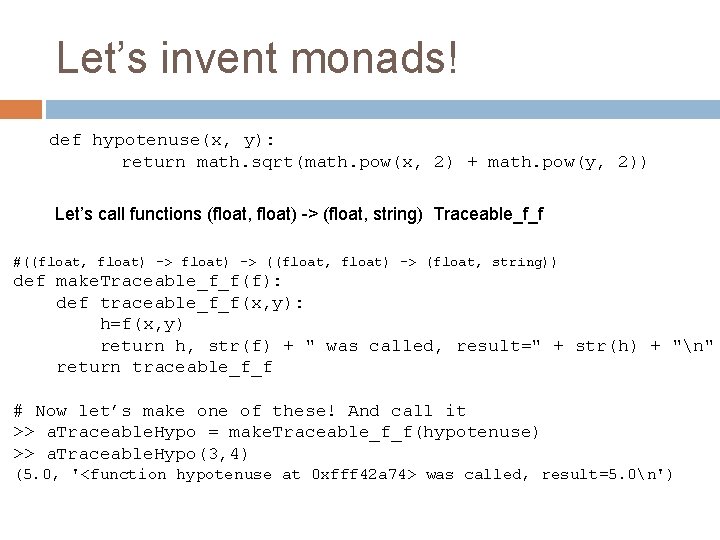
Let’s invent monads! def hypotenuse(x, y): return math. sqrt(math. pow(x, 2) + math. pow(y, 2)) Let’s call functions (float, float) -> (float, string) Traceable_f_f #((float, float) -> (float, string)) def make. Traceable_f_f(f): def traceable_f_f(x, y): h=f(x, y) return h, str(f) + " was called, result=" + str(h) + "n" return traceable_f_f # Now let’s make one of these! And call it >> a. Traceable. Hypo = make. Traceable_f_f(hypotenuse) >> a. Traceable. Hypo(3, 4) (5. 0, '<function hypotenuse at 0 xfff 42 a 74> was called, result=5. 0n')
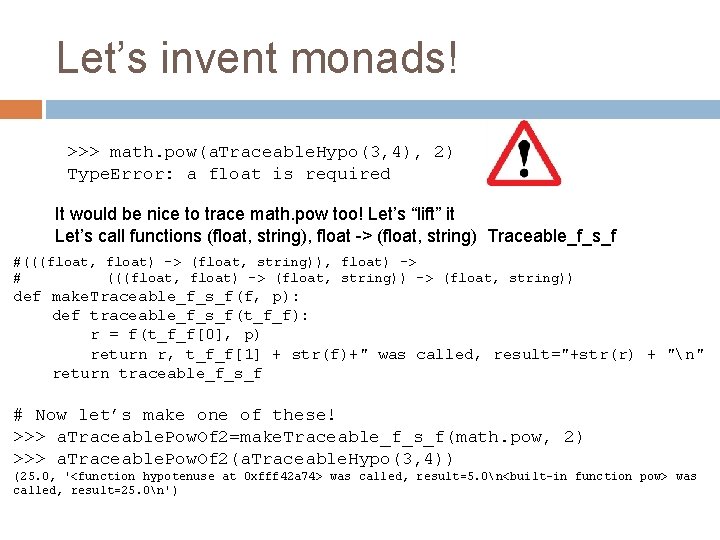
Let’s invent monads! >>> math. pow(a. Traceable. Hypo(3, 4), 2) Type. Error: a float is required It would be nice to trace math. pow too! Let’s “lift” it Let’s call functions (float, string), float -> (float, string) Traceable_f_s_f #(((float, float) -> (float, string)), float) -> # (((float, float) -> (float, string)) def make. Traceable_f_s_f(f, p): def traceable_f_s_f(t_f_f): r = f(t_f_f[0], p) return r, t_f_f[1] + str(f)+" was called, result="+str(r) + "n" return traceable_f_s_f # Now let’s make one of these! >>> a. Traceable. Pow. Of 2=make. Traceable_f_s_f(math. pow, 2) >>> a. Traceable. Pow. Of 2(a. Traceable. Hypo(3, 4)) (25. 0, '<function hypotenuse at 0 xfff 42 a 74> was called, result=5. 0n<built-in function pow> was called, result=25. 0n')
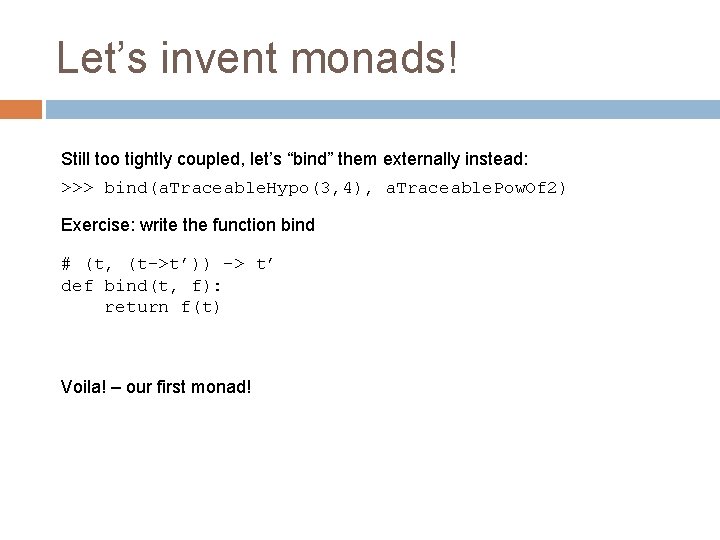
Let’s invent monads! Still too tightly coupled, let’s “bind” them externally instead: >>> bind(a. Traceable. Hypo(3, 4), a. Traceable. Pow. Of 2) Exercise: write the function bind # (t, (t->t’)) -> t’ def bind(t, f): return f(t) Voila! – our first monad!
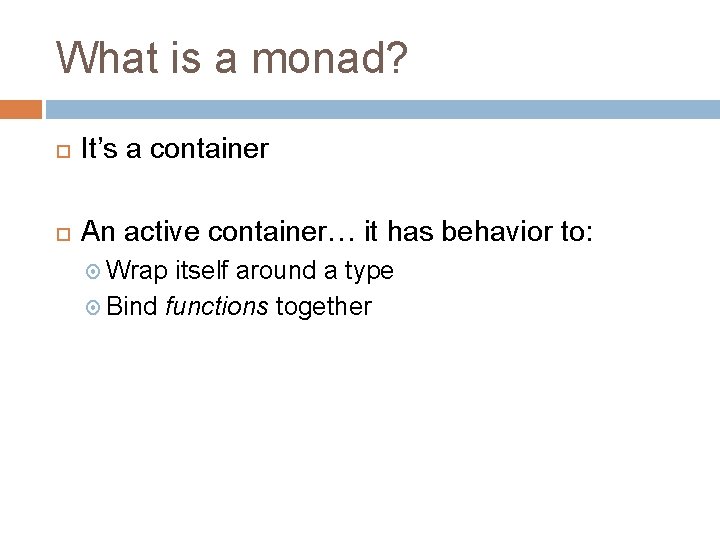
What is a monad? It’s a container An active container… it has behavior to: Wrap itself around a type Bind functions together
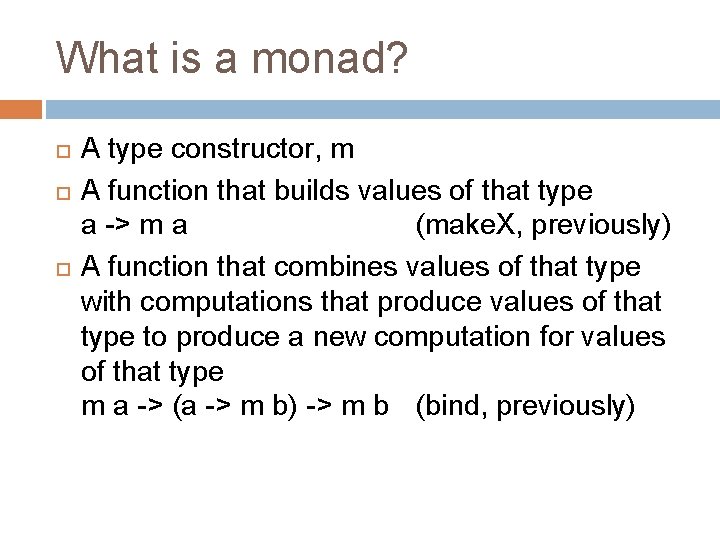
What is a monad? A type constructor, m A function that builds values of that type a -> m a (make. X, previously) A function that combines values of that type with computations that produce values of that type to produce a new computation for values of that type m a -> (a -> m b) -> m b (bind, previously)
Kinds of monads In Haskell Identity Maybe Error List IO State Reader Writer Continuation
Identity monad Simple function application bind(x, f) = f(x)
Maybe monad Functions that return either a value of a certain type (Something) or no value at all (Nothing) Nothing values stop the computation; Something values get passed on A nice alternative to exceptions!
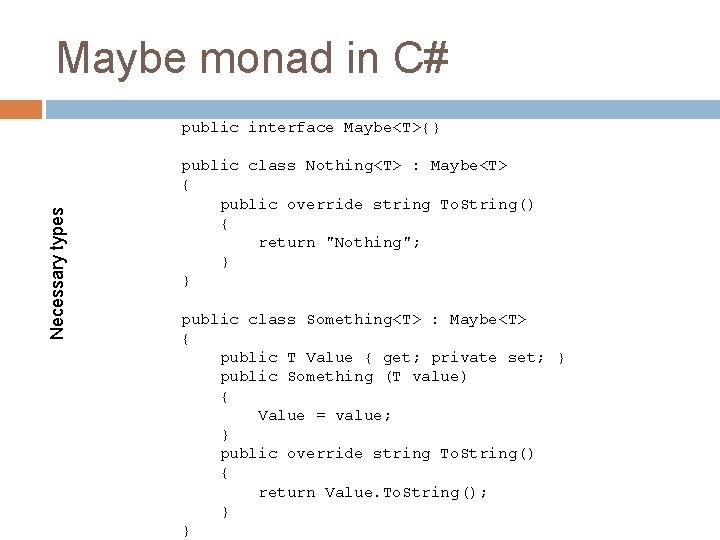
Maybe monad in C# Necessary types public interface Maybe<T>{} public class Nothing<T> : Maybe<T> { public override string To. String() { return "Nothing"; } } public class Something<T> : Maybe<T> { public T Value { get; private set; } public Something (T value) { Value = value; } public override string To. String() { return Value. To. String(); } }
Maybe monad in C# Next, we need 2 operations: One to construct Maybe’s One to bind Maybe’s to the rest of the computation
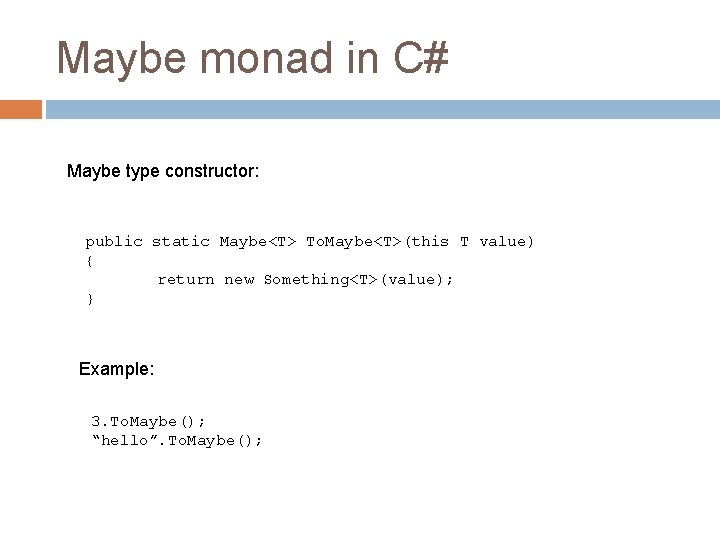
Maybe monad in C# Maybe type constructor: public static Maybe<T> To. Maybe<T>(this T value) { return new Something<T>(value); } Example: 3. To. Maybe(); “hello”. To. Maybe();
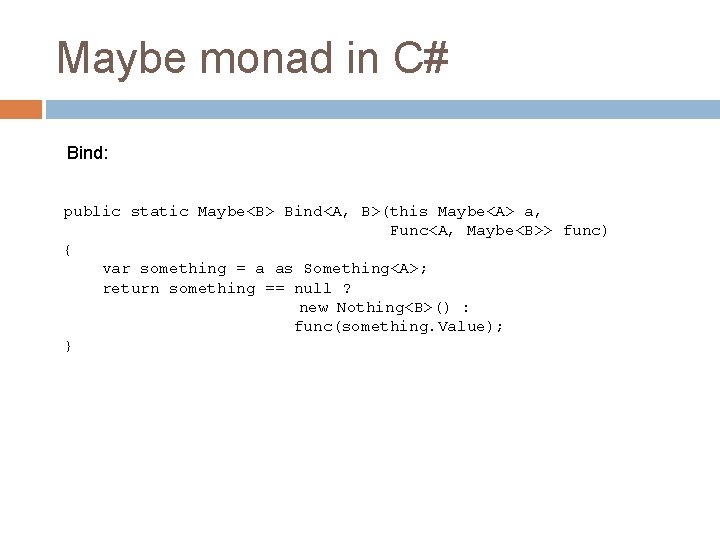
Maybe monad in C# Bind: public static Maybe<B> Bind<A, B>(this Maybe<A> a, Func<A, Maybe<B>> func) { var something = a as Something<A>; return something == null ? new Nothing<B>() : func(something. Value); }
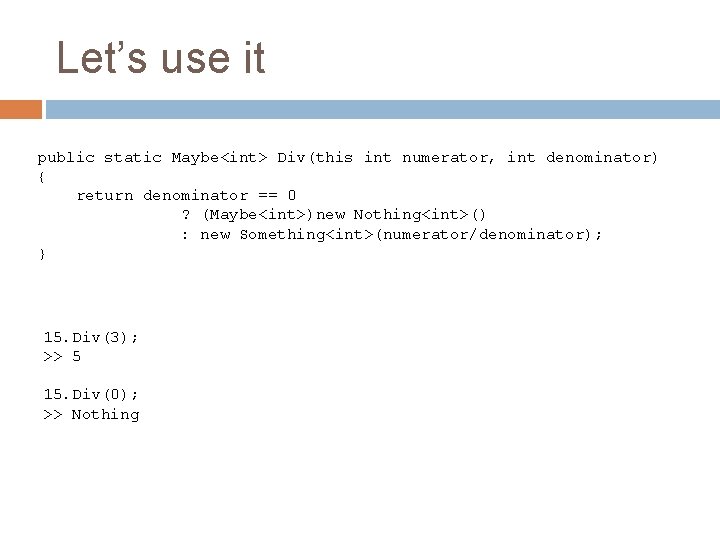
Let’s use it public static Maybe<int> Div(this int numerator, int denominator) { return denominator == 0 ? (Maybe<int>)new Nothing<int>() : new Something<int>(numerator/denominator); } 15. Div(3); >> 5 15. Div(0); >> Nothing
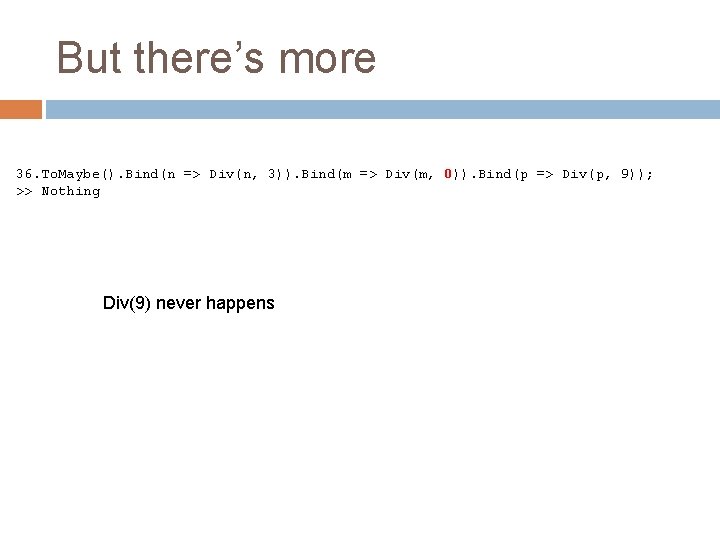
But there’s more 36. To. Maybe(). Bind(n => Div(n, 3)). Bind(m => Div(m, 0)). Bind(p => Div(p, 9)); >> Nothing Div(9) never happens