Implementing a Just and Learning Culture at Mersey



- Slides: 20
Implementing a Just and Learning Culture at Mersey Care NHS FT JOE RAFFERTY, Chief Executive AMANDA OATES, Executive Director of Workforce,
Mersey Care Just and Learning Culture For us at Mersey Care, a Just and Learning Culture can be seen as an environment where we put equal emphasis on accountability and learning. It’s a culture that instinctively asks in the case of an adverse event: "what was responsible, not who is responsible". It’s not finger-pointing and it’s not blame-seeking. That said, a Just and Learning Culture is not the same as an uncritically tolerant culture where anything goes - that would be as inexcusable as a blame culture. To create the best safety culture – staff need to feel safe themselves
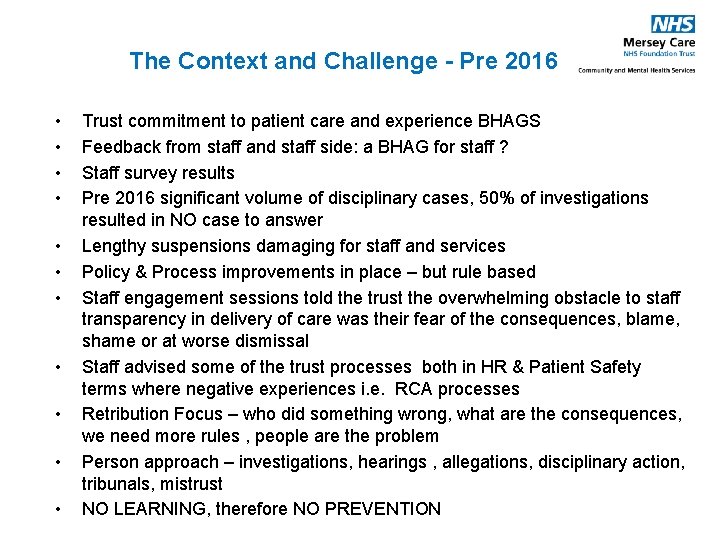
The Context and Challenge - Pre 2016 • • • Trust commitment to patient care and experience BHAGS Feedback from staff and staff side: a BHAG for staff ? Staff survey results Pre 2016 significant volume of disciplinary cases, 50% of investigations resulted in NO case to answer Lengthy suspensions damaging for staff and services Policy & Process improvements in place – but rule based Staff engagement sessions told the trust the overwhelming obstacle to staff transparency in delivery of care was their fear of the consequences, blame, shame or at worse dismissal Staff advised some of the trust processes both in HR & Patient Safety terms where negative experiences i. e. RCA processes Retribution Focus – who did something wrong, what are the consequences, we need more rules , people are the problem Person approach – investigations, hearings , allegations, disciplinary action, tribunals, mistrust NO LEARNING, therefore NO PREVENTION
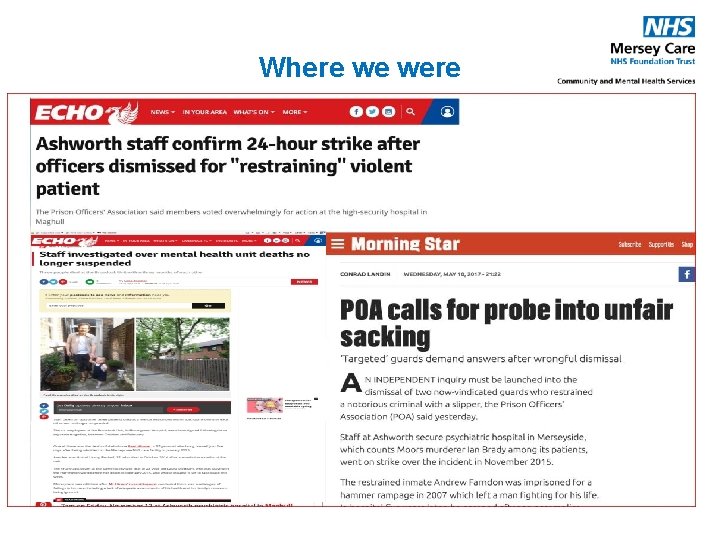
Where we were
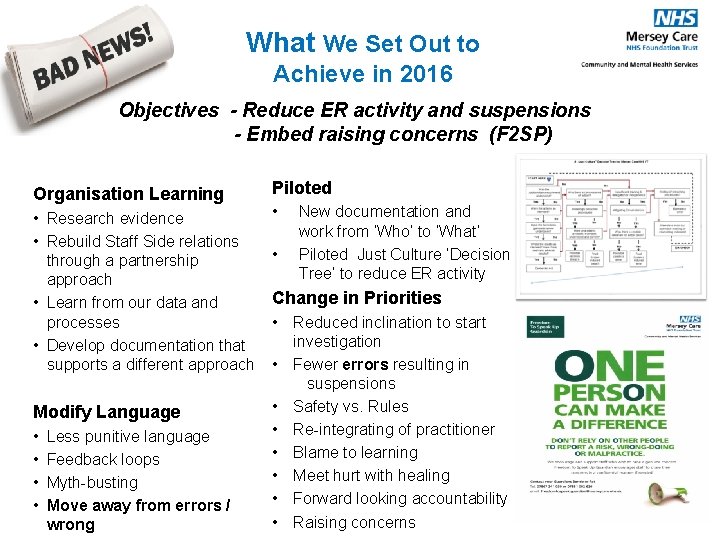
What We Set Out to Achieve in 2016 Objectives - Reduce ER activity and suspensions - Embed raising concerns (F 2 SP) Organisation Learning • Research evidence • Rebuild Staff Side relations through a partnership approach • Learn from our data and processes • Develop documentation that supports a different approach Modify Language • • Less punitive language Feedback loops Myth-busting Move away from errors / wrong Piloted • • New documentation and work from ‘Who’ to ‘What’ Piloted Just Culture ‘Decision Tree’ to reduce ER activity Change in Priorities • Reduced inclination to start investigation • Fewer errors resulting in suspensions • Safety vs. Rules • Re-integrating of practitioner • Blame to learning • Meet hurt with healing • Forward looking accountability • Raising concerns
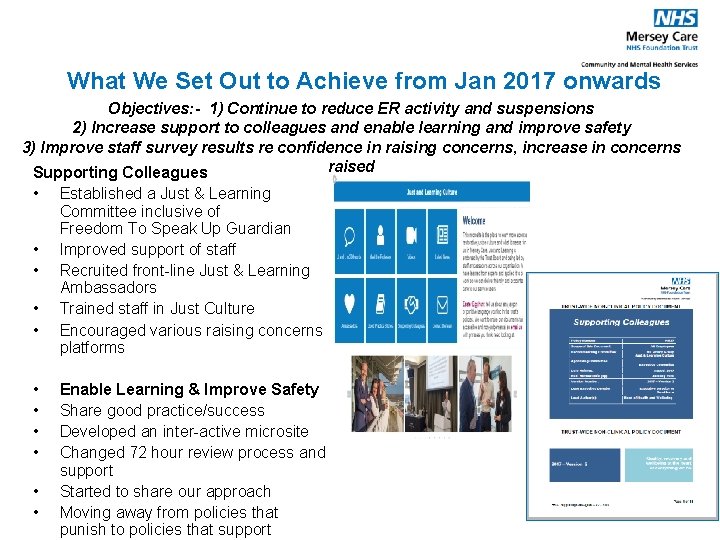
What We Set Out to Achieve from Jan 2017 onwards Objectives: - 1) Continue to reduce ER activity and suspensions 2) Increase support to colleagues and enable learning and improve safety 3) Improve staff survey results re confidence in raising concerns, increase in concerns raised Supporting Colleagues • • • Established a Just & Learning Committee inclusive of Freedom To Speak Up Guardian Improved support of staff Recruited front-line Just & Learning Ambassadors Trained staff in Just Culture Encouraged various raising concerns platforms Enable Learning & Improve Safety Share good practice/success Developed an inter-active microsite Changed 72 hour review process and support Started to share our approach Moving away from policies that punish to policies that support
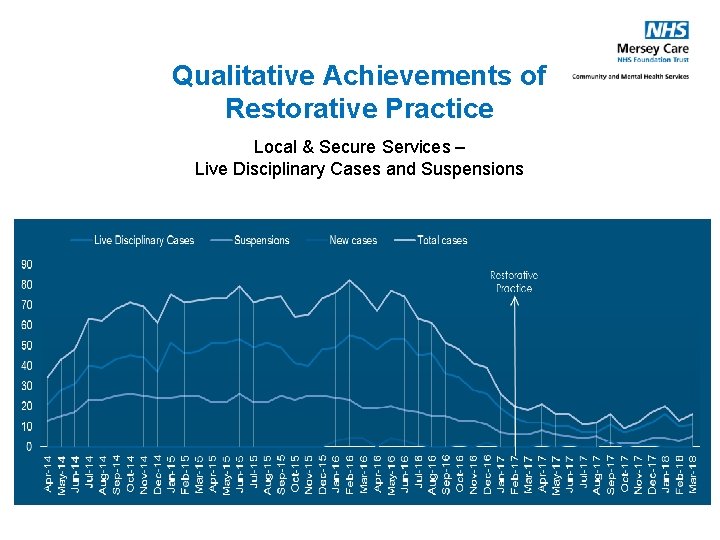
Qualitative Achievements of Restorative Practice Local & Secure Services – Live Disciplinary Cases and Suspensions
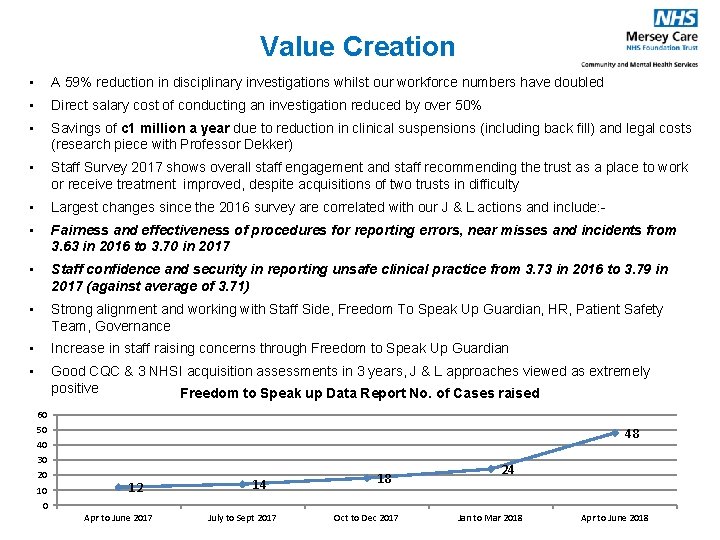
Value Creation • A 59% reduction in disciplinary investigations whilst our workforce numbers have doubled • Direct salary cost of conducting an investigation reduced by over 50% • Savings of c 1 million a year due to reduction in clinical suspensions (including back fill) and legal costs (research piece with Professor Dekker) • Staff Survey 2017 shows overall staff engagement and staff recommending the trust as a place to work or receive treatment improved, despite acquisitions of two trusts in difficulty • Largest changes since the 2016 survey are correlated with our J & L actions and include: - • Fairness and effectiveness of procedures for reporting errors, near misses and incidents from 3. 63 in 2016 to 3. 70 in 2017 • Staff confidence and security in reporting unsafe clinical practice from 3. 73 in 2016 to 3. 79 in 2017 (against average of 3. 71) • Strong alignment and working with Staff Side, Freedom To Speak Up Guardian, HR, Patient Safety Team, Governance • Increase in staff raising concerns through Freedom to Speak Up Guardian • Good CQC & 3 NHSI acquisition assessments in 3 years, J & L approaches viewed as extremely positive Freedom to Speak up Data Report No. of Cases raised 60 50 48 40 30 20 10 12 14 18 24 0 Apr to June 2017 July to Sept 2017 Oct to Dec 2017 Jan to Mar 2018 Apr to June 2018
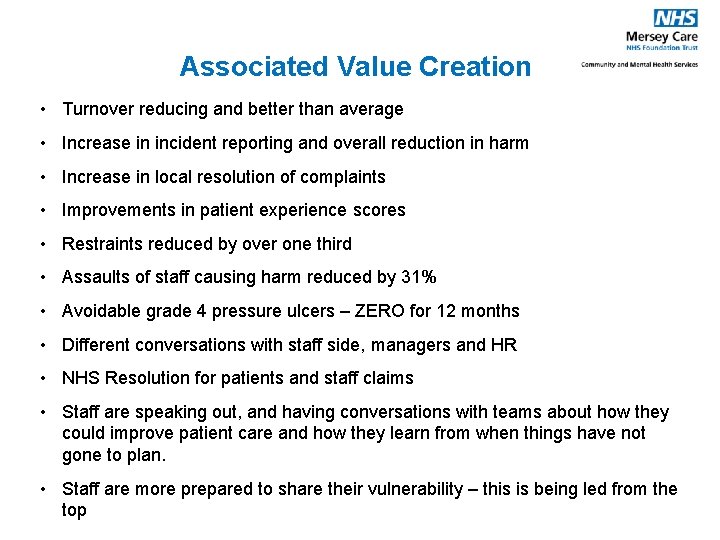
Associated Value Creation • Turnover reducing and better than average • Increase in incident reporting and overall reduction in harm • Increase in local resolution of complaints • Improvements in patient experience scores • Restraints reduced by over one third • Assaults of staff causing harm reduced by 31% • Avoidable grade 4 pressure ulcers – ZERO for 12 months • Different conversations with staff side, managers and HR • NHS Resolution for patients and staff claims • Staff are speaking out, and having conversations with teams about how they could improve patient care and how they learn from when things have not gone to plan. • Staff are more prepared to share their vulnerability – this is being led from the top
Another Challenge Can We Replicate in former Liverpool Community Health? Pre Transfer – • 111 disciplinary investigations in one year • Staff too frightened to report incidents • Fear at every level of the organisation • Staff ostracised for reporting incidents • Reporting incidents was seen as a negative • Staff demoralised and felt worthless • Poor retention, recruitment and staff wellbeing. Post Transfer – • Reduction in disciplinary investigations- now 2 current cases • High level of reporting • Staff understand significance in reporting incidents re patient safety and quality • Open channels of communication between executive level and front line staff • Increased staff morale and feeling valued. • Improved retention and recruitment/opportunities for staff • Sickness absence from 9% to 6% means 49 extra nurses a day
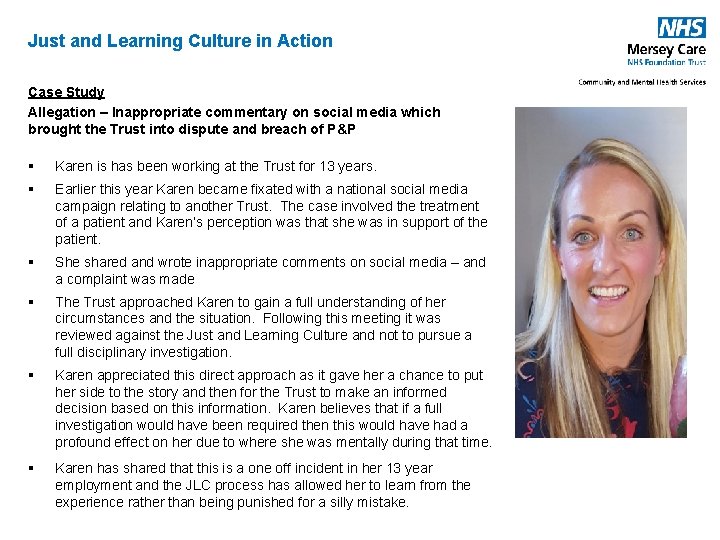
Just and Learning Culture in Action Case Study Allegation – Inappropriate commentary on social media which brought the Trust into dispute and breach of P&P § Karen is has been working at the Trust for 13 years. § Earlier this year Karen became fixated with a national social media campaign relating to another Trust. The case involved the treatment of a patient and Karen’s perception was that she was in support of the patient. § She shared and wrote inappropriate comments on social media – and a complaint was made § The Trust approached Karen to gain a full understanding of her circumstances and the situation. Following this meeting it was reviewed against the Just and Learning Culture and not to pursue a full disciplinary investigation. § Karen appreciated this direct approach as it gave her a chance to put her side to the story and then for the Trust to make an informed decision based on this information. Karen believes that if a full investigation would have been required then this would have had a profound effect on her due to where she was mentally during that time. § Karen has shared that this is a one off incident in her 13 year employment and the JLC process has allowed her to learn from the experience rather than being punished for a silly mistake.
Just and Learning Culture in Action Case Study Allegation – various allegatiosn that staff member has acted inappropriately by taking contraband items into a secure environments. Initial decision making process: The taking of prohibited items into a secure environment is prohibited and was potentially considered gross misconduct. Staff member was immediately restricted from patient contact and placed in a off ward placement (we did not suspend until we fully understood the facts). Investigation findings (brief summary): Reported that staff member had breached security controls for the environment in which they work. Evidence showed that staff member had received the necessary training regarding the taking of prohibited items onto ward areas. Staff member interviewed and denied such behaviours. On second interview they did not recall being interviewed first time so this raised questions about memory ability and general well being. OH referral made. OH believe that staff member has an undiagnosed disorder. Case review : Health issues via capability, and role change required (employee has a memory issue and realistically cannot do their normal role any longer - supported by OH and Union).
Just and Learning Culture in Action • Mersey Care was the victim of a fraud (£ 0. 904 m) • Fraudsters used sophisticated techniques to deceive staff by impersonating both Mersey Care and Kier (building contractor). This allowed the fraudster to gain key pieces of information. • On review established there where controls and procedures in place, however human error occurred. We reviewed this from a contributory factor approach not a direct cause approach. The individual was supported. • In response to the fraud the trust has increased controls: Ø Enhanced the procedure around supplier amendments Ø Reviewed the authorisation process for supplier changes Ø Reviewed system access Ø Introduced checks on payment to suppliers Ø A review of all recent changes to bank details • Additional training has been provided to all finance staff. • Review of the procedure note to include the controls identified above.
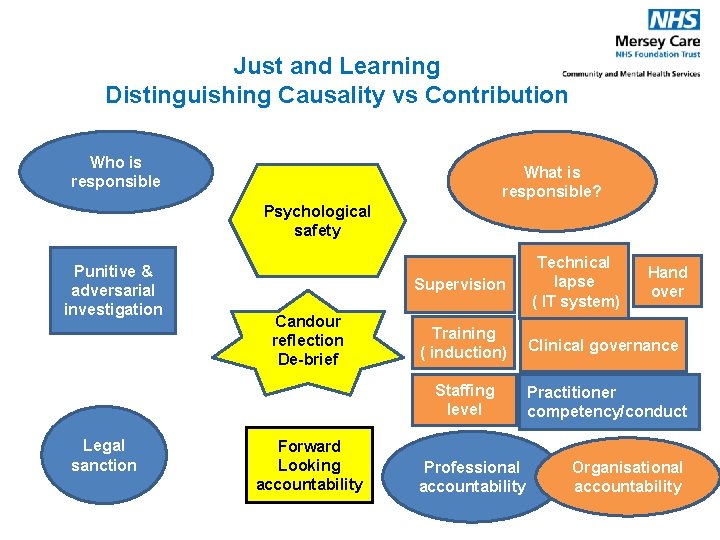
Just and Learning Distinguishing Causality vs Contribution Who is responsible What is responsible? Psychological safety Punitive & adversarial investigation Legal sanction Supervision Candour reflection De-brief Forward Looking accountability Technical lapse ( IT system) Hand over Training ( induction) Clinical governance Staffing level Practitioner competency/conduct Professional accountability Organisational accountability
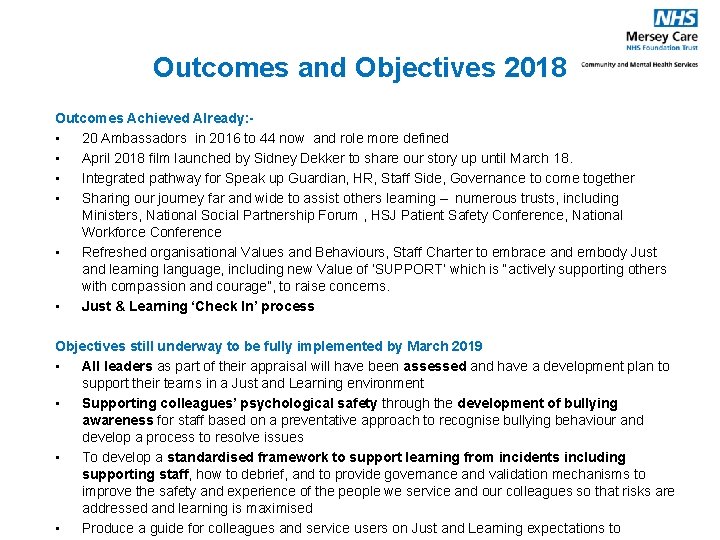
Outcomes and Objectives 2018 Outcomes Achieved Already: • 20 Ambassadors in 2016 to 44 now and role more defined • April 2018 film launched by Sidney Dekker to share our story up until March 18. • Integrated pathway for Speak up Guardian, HR, Staff Side, Governance to come together • Sharing our journey far and wide to assist others learning – numerous trusts, including Ministers, National Social Partnership Forum , HSJ Patient Safety Conference, National Workforce Conference • Refreshed organisational Values and Behaviours, Staff Charter to embrace and embody Just and learning language, including new Value of ‘SUPPORT’ which is “actively supporting others with compassion and courage”, to raise concerns. • Just & Learning ‘Check In’ process Objectives still underway to be fully implemented by March 2019 • All leaders as part of their appraisal will have been assessed and have a development plan to support their teams in a Just and Learning environment • Supporting colleagues’ psychological safety through the development of bullying awareness for staff based on a preventative approach to recognise bullying behaviour and develop a process to resolve issues • To develop a standardised framework to support learning from incidents including supporting staff, how to debrief, and to provide governance and validation mechanisms to improve the safety and experience of the people we service and our colleagues so that risks are addressed and learning is maximised • Produce a guide for colleagues and service users on Just and Learning expectations to
Sharing our Learning and Story
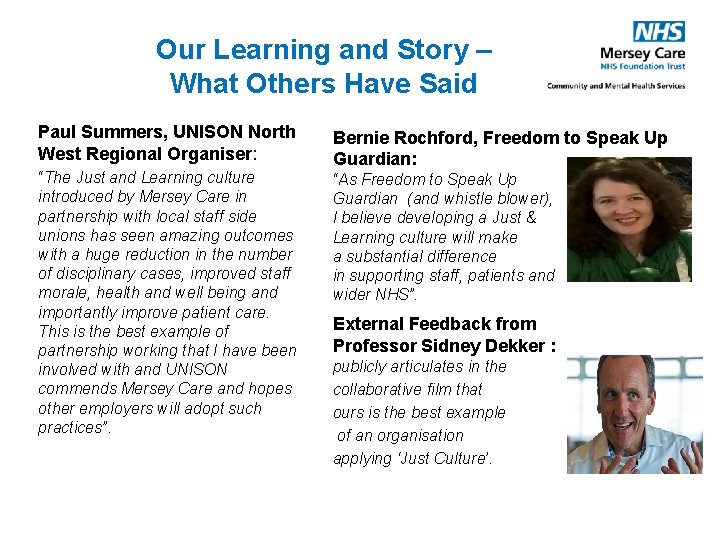
Our Learning and Story – What Others Have Said Paul Summers, UNISON North West Regional Organiser: “The Just and Learning culture introduced by Mersey Care in partnership with local staff side unions has seen amazing outcomes with a huge reduction in the number of disciplinary cases, improved staff morale, health and well being and importantly improve patient care. This is the best example of partnership working that I have been involved with and UNISON commends Mersey Care and hopes other employers will adopt such practices”. Bernie Rochford, Freedom to Speak Up Guardian: “As Freedom to Speak Up Guardian (and whistle blower), I believe developing a Just & Learning culture will make a substantial difference in supporting staff, patients and wider NHS”. External Feedback from Professor Sidney Dekker : publicly articulates in the collaborative film that ours is the best example of an organisation applying ‘Just Culture’.
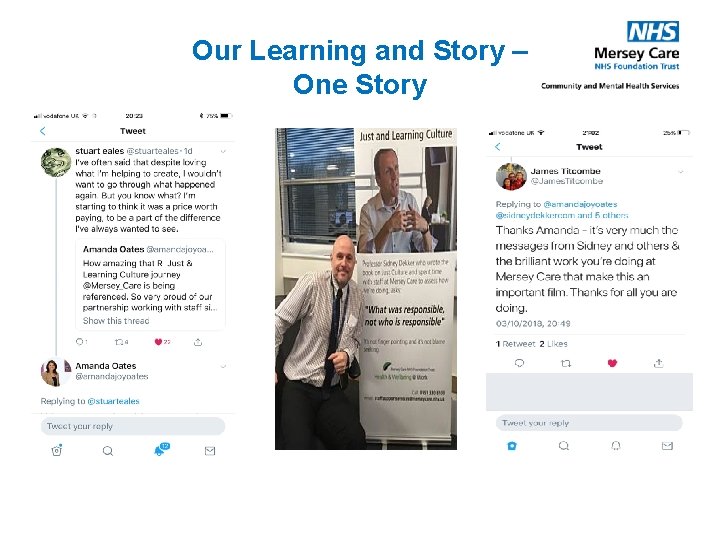
Our Learning and Story – One Story
Questions? http: //sidneydekker. com/just-culture/