
The Emergence of a Just Culture Where We


- Slides: 28
The Emergence of a Just Culture Where We Were Where We May Be Where We Need to Go
Why Errors Occur in Healthcare u Patients as Individuals u Complexity u Coordination of Care with Other Departments u Lack of Standardized Processes u Communication Issues u Hierarchal Structures
Why Errors Occur in Healthcare u Autonomous disciplines – Silo thinking u Patient Acuity, Volume, and Workload u Hand-Offs u Staff Recruitment/Retention u Human characteristics u External Factors
External Factors Limiting Performance u Stress u Time pressures u Distraction u Goal Conflicts u Environment – noise u Level of training
Human Side of Medical Error u Long term memory vs Working memory u Chunking information u Storage and retrieval methods of information u Limitation of attention u Automatic and well established routines u Playing the odds – humans as risk takers; cutting corners
How Do Organizations Deal with Error? u Punitive u Blame 1990’s u Just Culture – prior to 1990’s Free Culture – mid to late Culture – new millennium
Characteristics of Punitive Cultures u u Expectation was for perfect performance Individual workers held solely accountable for patient outcomes Workers involved in error were counseled or disciplined – who touched it last? Disciplinary actions often based on amount of harm
Punitive Process for Dealing with Error u Focus on perceived individual weaknesses u Retraining, education, and vigilance u Improvement strategies – follow the five rights u Procedural violations unacceptable u Weed out “bad practitioners”
Effects of Punitive Environments u Errors driven underground u. Fear of retribution, employment loss u. Fear of license termination u. Embarrassment u Workarounds developed u No reporting of near misses or errors waiting to happen u No news is good news mentality u Top down management of error
Why Punitive Environments Don’t Work u Change occurring from measures that involve sanctions, threats, or appeals is not sustainable u Threats and sanctions are de-motivating and inhibit safety progress u The precipitating causes of medical error are only the last links in the chain of events and are the least manageable u If punitive systems had worked, there would be no conversation
So why do we place blame? u Individuals as “free agents” – isolation u Captains of our own fate u Actions are seen as voluntary and within our control u Traditionally, we have blamed clinicians who have been involved in error with being careless or incompetent
Is Blame Appropriate? “Experience suggests that the majority of unsafe acts - perhaps 90 percent or more- fall into the blameless category. ” Managing the Risks of Organizational Accidents- Reason
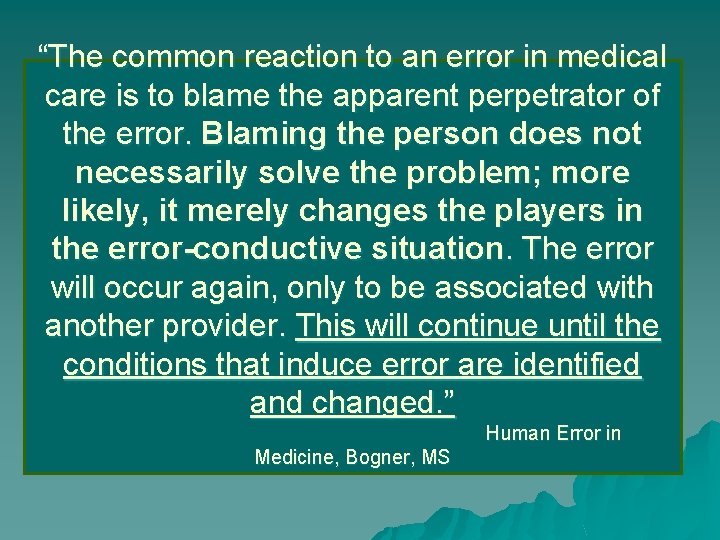
“The common reaction to an error in medical care is to blame the apparent perpetrator of the error. Blaming the person does not necessarily solve the problem; more likely, it merely changes the players in the error-conductive situation. The error will occur again, only to be associated with another provider. This will continue until the conditions that induce error are identified and changed. ” Human Error in Medicine, Bogner, MS
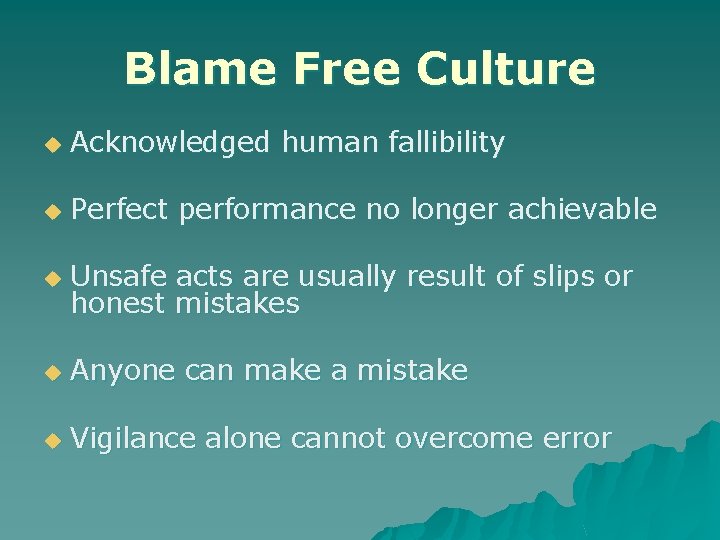
Blame Free Culture u Acknowledged human fallibility u Perfect performance no longer achievable u Unsafe acts are usually result of slips or honest mistakes u Anyone can make a mistake u Vigilance alone cannot overcome error
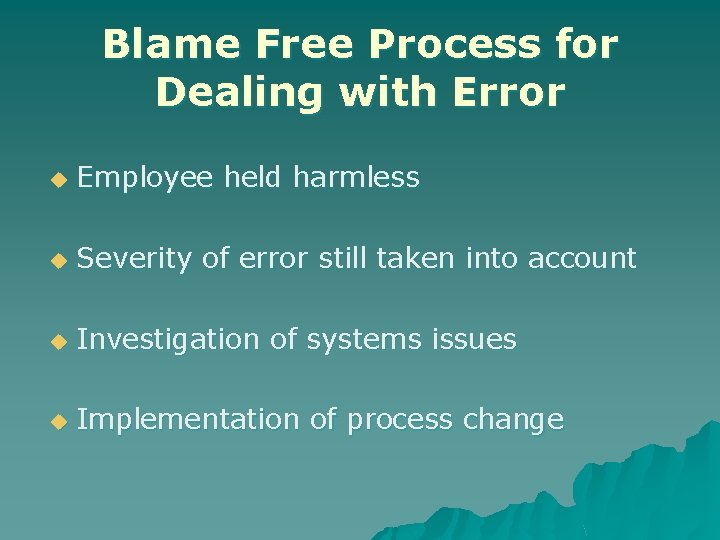
Blame Free Process for Dealing with Error u Employee held harmless u Severity of error still taken into account u Investigation of systems issues u Implementation of process change
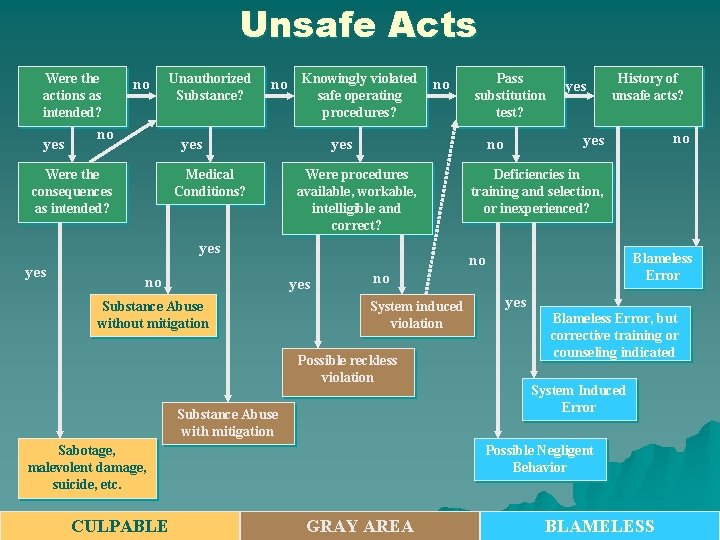
Unsafe Acts Were the actions as intended? yes no no Unauthorized Substance? no Knowingly violated no safe operating procedures? yes Were the consequences as intended? Medical Conditions? yes Were procedures available, workable, intelligible and correct? no System induced violation Substance Abuse with mitigation Sabotage, malevolent damage, suicide, etc. no Deficiencies in training and selection, or inexperienced? Blameless Error no Possible reckless violation CULPABLE History of unsafe acts? no yes Substance Abuse without mitigation yes no yes Pass substitution test? yes Blameless Error, but corrective training or counseling indicated System Induced Error Possible Negligent Behavior GRAY AREA BLAMELESS
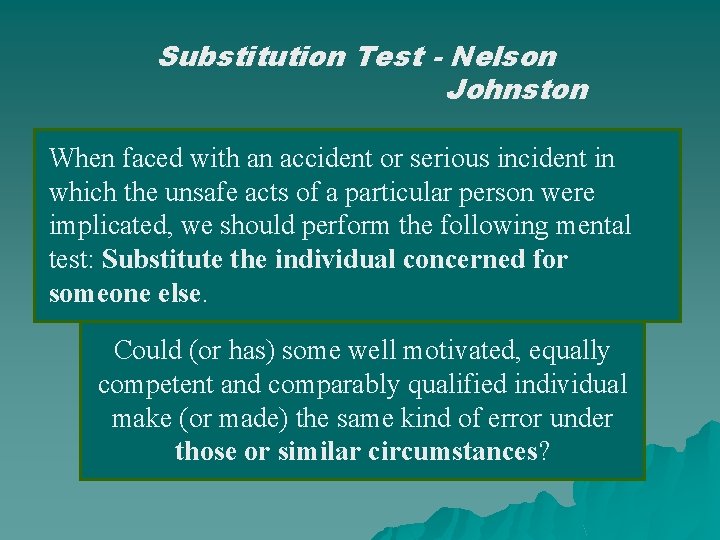
Substitution Test - Nelson Johnston When faced with an accident or serious incident in which the unsafe acts of a particular person were implicated, we should perform the following mental test: Substitute the individual concerned for someone else. Could (or has) some well motivated, equally competent and comparably qualified individual make (or made) the same kind of error under those or similar circumstances?
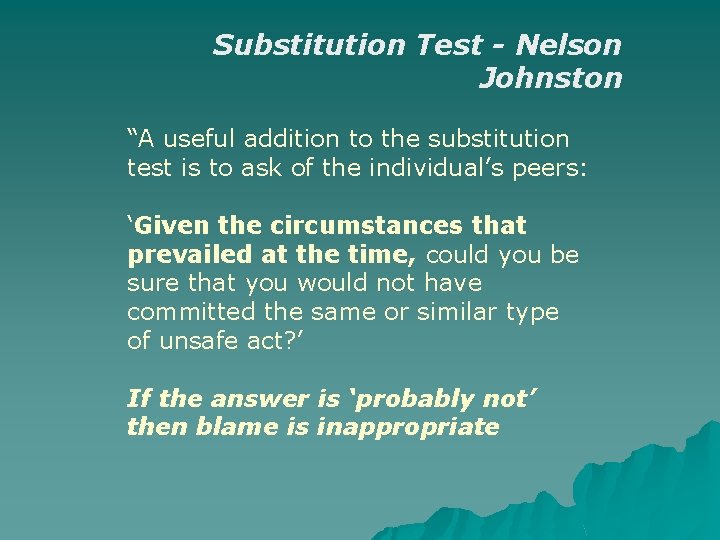
Substitution Test - Nelson Johnston “A useful addition to the substitution test is to ask of the individual’s peers: ‘Given the circumstances that prevailed at the time, could you be sure that you would not have committed the same or similar type of unsafe act? ’ If the answer is ‘probably not’ then blame is inappropriate
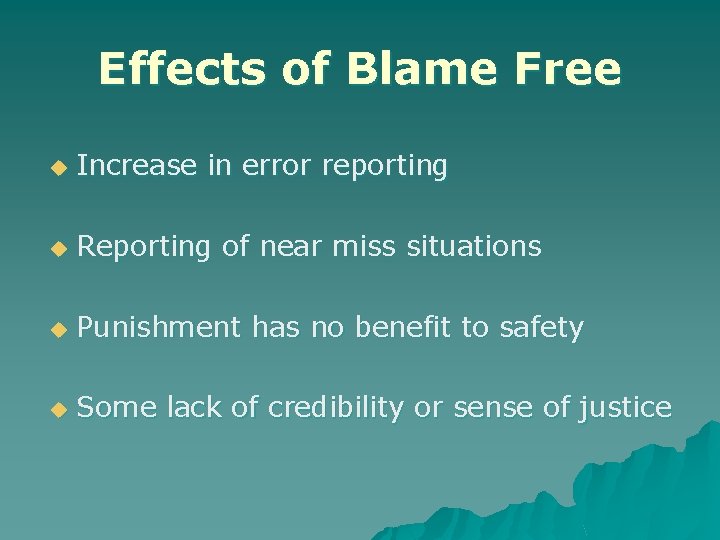
Effects of Blame Free u Increase in error reporting u Reporting of near miss situations u Punishment has no benefit to safety u Some lack of credibility or sense of justice
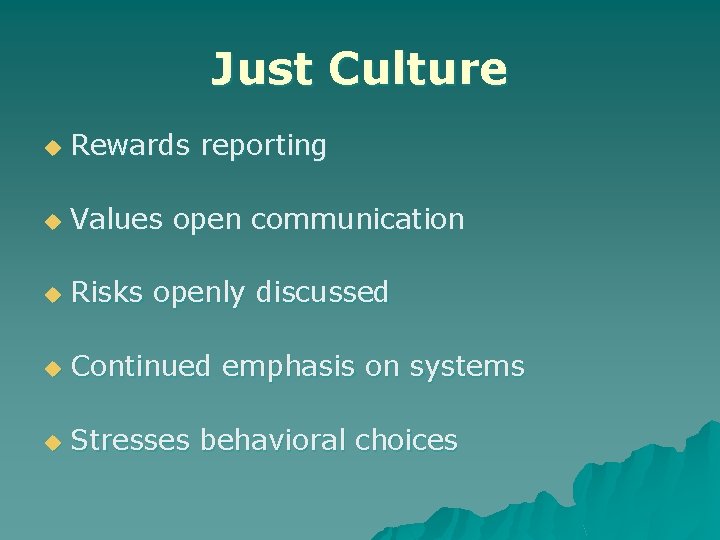
Just Culture u Rewards reporting u Values open communication u Risks openly discussed u Continued emphasis on systems u Stresses behavioral choices
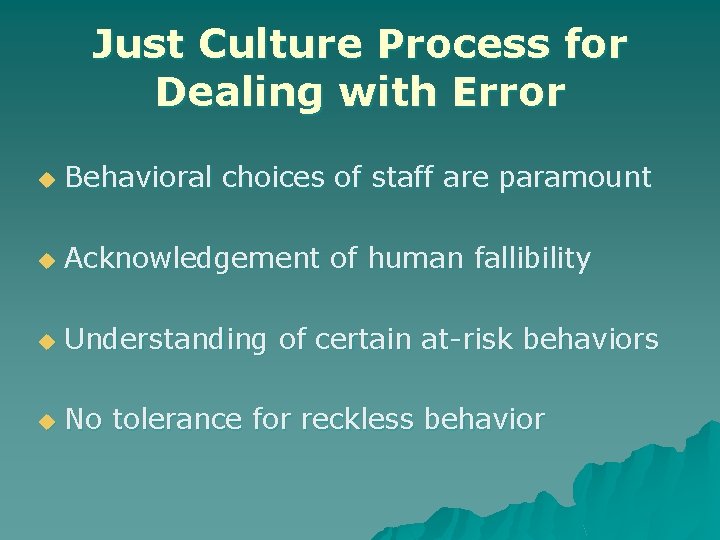
Just Culture Process for Dealing with Error u Behavioral choices of staff are paramount u Acknowledgement of human fallibility u Understanding of certain at-risk behaviors u No tolerance for reckless behavior
Human Error Unintended human act that does not achieve the desired goal A planned action is not carried out as intended Use of a wrong plan No discipline because no intent
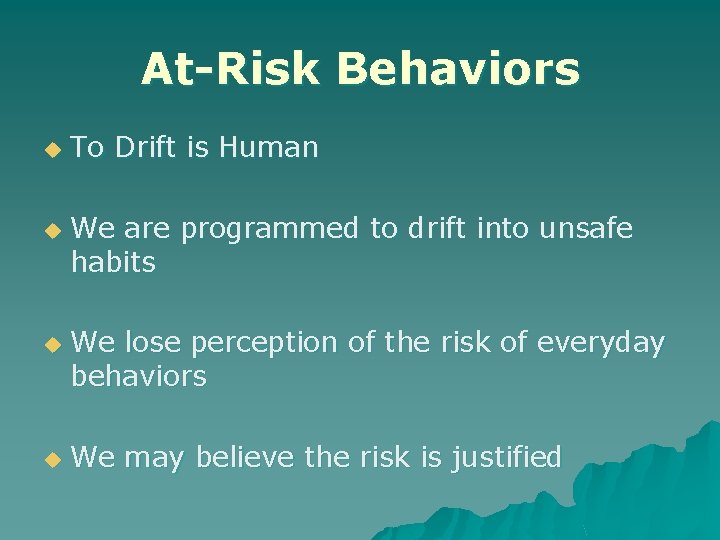
At-Risk Behaviors u u To Drift is Human We are programmed to drift into unsafe habits We lose perception of the risk of everyday behaviors We may believe the risk is justified
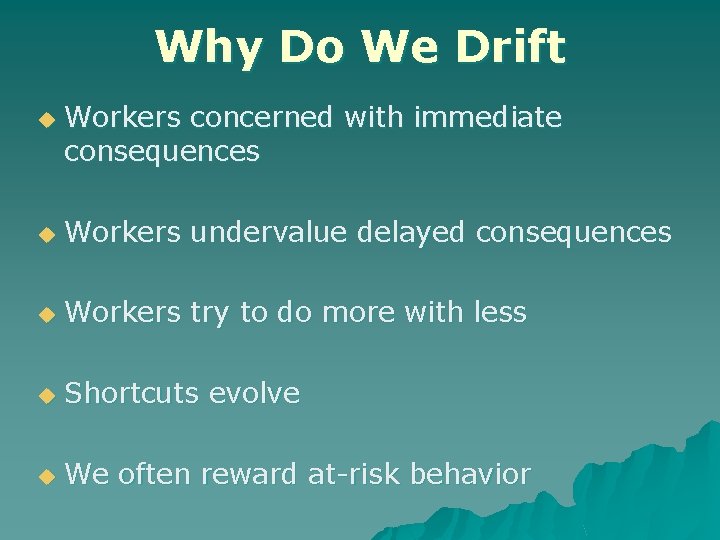
Why Do We Drift u Workers concerned with immediate consequences u Workers undervalue delayed consequences u Workers try to do more with less u Shortcuts evolve u We often reward at-risk behavior
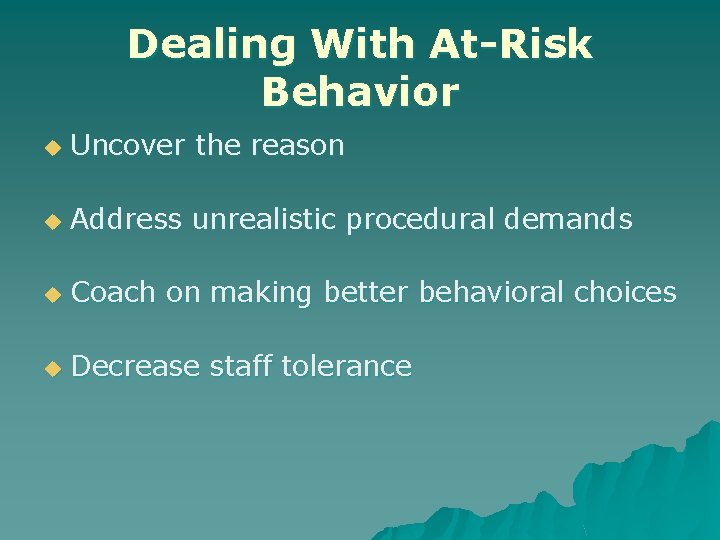
Dealing With At-Risk Behavior u Uncover the reason u Address unrealistic procedural demands u Coach on making better behavioral choices u Decrease staff tolerance
Reckless Behavior u Worker always perceives the risk u Understands the risk is substantial u Behave intentionally with no justification u Knows that others are acting differently u Makes a conscious choice to disregard the risks for subjective reasons u Behavior is blameworthy
Effects of Just Cultures u Continued reporting of error and near miss u Continued system investigation u Continued process improvement u Peer pressure to develop, implement, and follow realistic standards of practice
Just Culture Accountability u Accountability for things you have control over u Managers – systems design, procedures u Employees – behavioral choices, highlighting unworkable procedures u Manager and peers as coach; observe daily behaviors u Eliminate rewards for at-risk behaviors u Focus is on how to prevent the next error