Implementation of Recognition of Prior Learning RPL in





- Slides: 18
Implementation of Recognition of Prior Learning (RPL) in Higher Education Presentation at the 19 th Public Sector Trainers’ Forum (PSTF) Conference Breakaway Session 3. 1 Dr Amani Saidi 16 October 2017
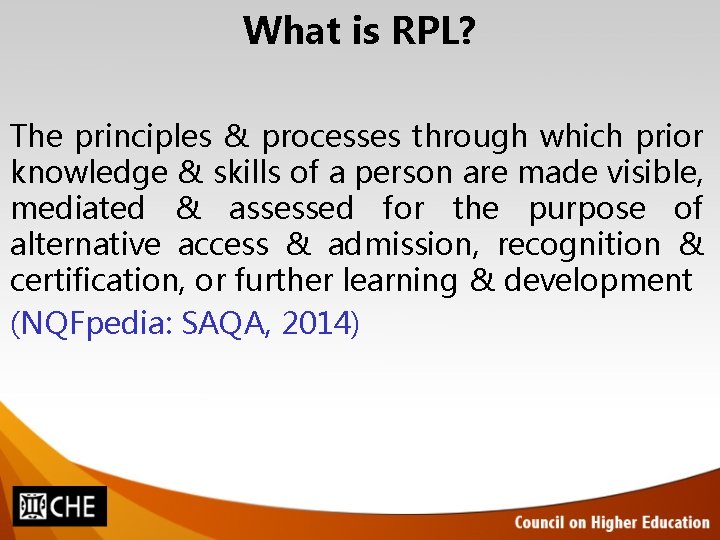
What is RPL? The principles & processes through which prior knowledge & skills of a person are made visible, mediated & assessed for the purpose of alternative access & admission, recognition & certification, or further learning & development (NQFpedia: SAQA, 2014)
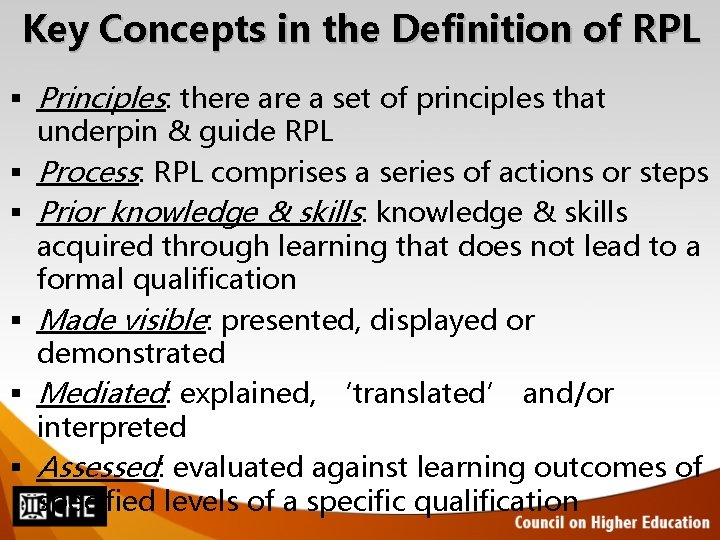
Key Concepts in the Definition of RPL § Principles: there a set of principles that underpin & guide RPL § Process: RPL comprises a series of actions or steps § Prior knowledge & skills: knowledge & skills acquired through learning that does not lead to a formal qualification § Made visible: presented, displayed or demonstrated § Mediated: explained, ‘translated’ and/or interpreted § Assessed: evaluated against learning outcomes of specified levels of a specific qualification
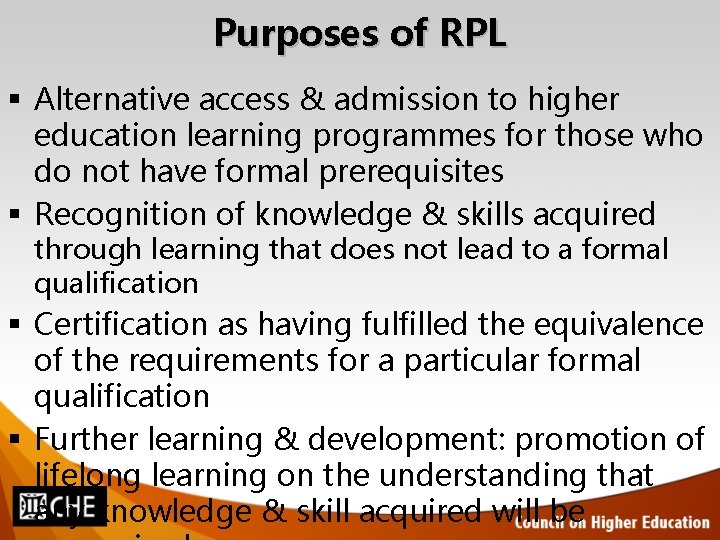
Purposes of RPL § Alternative access & admission to higher education learning programmes for those who do not have formal prerequisites § Recognition of knowledge & skills acquired through learning that does not lead to a formal qualification § Certification as having fulfilled the equivalence of the requirements for a particular formal qualification § Further learning & development: promotion of lifelong learning on the understanding that any knowledge & skill acquired will be
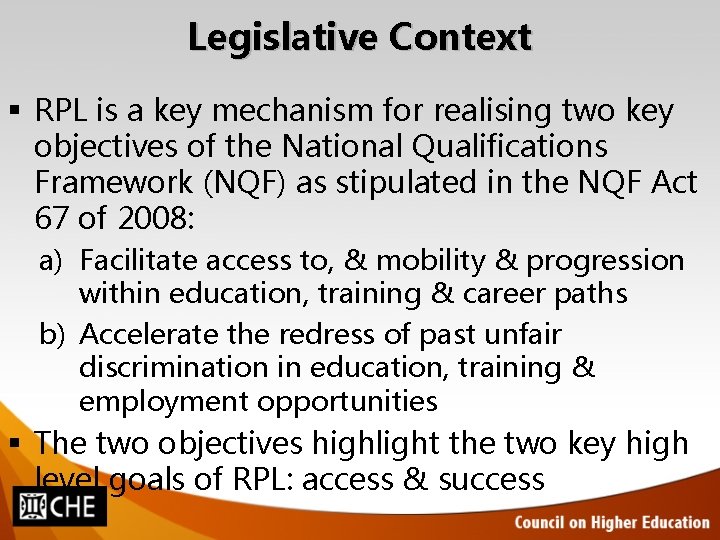
Legislative Context § RPL is a key mechanism for realising two key objectives of the National Qualifications Framework (NQF) as stipulated in the NQF Act 67 of 2008: a) Facilitate access to, & mobility & progression within education, training & career paths b) Accelerate the redress of past unfair discrimination in education, training & employment opportunities § The two objectives highlight the two key high level goals of RPL: access & success
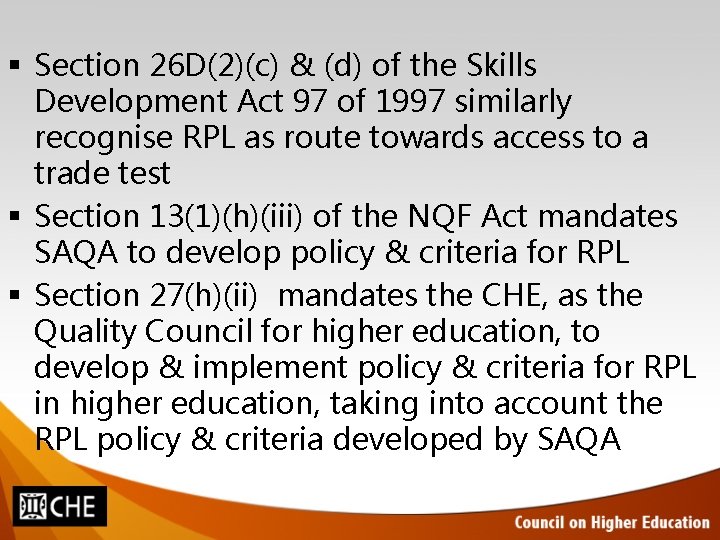
§ Section 26 D(2)(c) & (d) of the Skills Development Act 97 of 1997 similarly recognise RPL as route towards access to a trade test § Section 13(1)(h)(iii) of the NQF Act mandates SAQA to develop policy & criteria for RPL § Section 27(h)(ii) mandates the CHE, as the Quality Council for higher education, to develop & implement policy & criteria for RPL in higher education, taking into account the RPL policy & criteria developed by SAQA
RPL Policy Environment § SAQA published the first RPL policy in 2002, based on the provisions of the SAQA Act 58 of 1995 § Following the repeal of the SAQA Act by the NQF Act 27 of 2008, SAQA published the National Policy for the Implementation of RPL in 2013 § The WP for PSET, also published in 2013, identifies RPL as key to redressing past injustices & recognising competence gained through practical workplace learning &
§ The WP for PSET lamented the lack of common understanding of , & approach to RPL across the PSET § In 2016, the DHET published the RPL Coordination Policy to provide a strong enabling policy environment for the further development & implementation of RPL across the PSET. § It sought to speed up implementation of RPL by: a) b) c) Establishing a national coordination mechanism Establishing funding mechanism Specifying roles & responsibilities of various NQF bodies & education institutions
Responsibilities of the CHE § Both SAQA’s National RPL Implementation Policy, and DHET’s RPL Coordination Policy assign important roles & responsibilities to the CHE as the QC for higher education § These include: a) Develop an RPL policy for the higher education sector, taking into account the national policies b) Promote & monitor the implementation of RPL within the higher education sector c) Report on the progress being made in the implementation of RPL
Development of the RPL Policy for HE • Process started in 2014 & ended with publication of the policy in 2016 - Long & winded process - Extensively consultative - Process was overseen by a reference group - Approved by the HEQC & the CHE Council § Workshops for public universities & the private HEIs were held to ensure that there is common understanding of the principles & processes
Key Principles of the Policy § Opening up of access to higher education § Redress of the past injustices § RPL as a specialised pedagogical process, & not just a simple assessment process § Developmental & incremental approach to the implementation of RPL § Appreciation of the different contexts for implementing RPL § Acknowledgement of the dynamic nature of knowledge & skills
Key Process Directives of the Policy § Institutions to develop their own processes & procedures within the framework set by the CHE policy § Institutions to train staff to conduct RPL assessments § RPL assessment should be undertaken by the academic staff in each discipline/subject § Use credible assessment tools § Institutions to ensure that there adequate administrative & technical support systems for fair, credible, reliable & transparent RPL processes
§ Institutions to make provisions for conducting RPL assessments in languages that the candidates are most proficient in § Institutions to ensure that there is internal quality assurance mechanism for RPL § Institutions to ensure that the CHE is involved to provide external quality assurance where more than 10% of a cohort of students are admitted through RPL
Promotion of RPL in HE § The various QA functions of the CHE require institutions to indicate in the Self-Evaluation Reports (SER) the progress they are making in terms of implementation of RPL § The CHE analyses this information to get a picture of RPL implementation § We similarly collect information through our support desk, which is also analysed to establish the state of play regarding RPL implementation
Emerging Trends & Patterns § Majority of institutions implement RPL but to varying extents § Private HEIs have shown more interest in implementing RPL than public universities § In private HEIs RPL is more for undergraduate programmes, while in public universities it is more for postgraduate programmes § Within institutions, RPL is more prevalent in generic programmes than in specialised professional programmes
§ There is general resistance to RPL by academics who have been in the system for long: they see it as diluting quality § Most institutions do not have adequate administrative & technical support systems for RPL: therefore can only process few RPL applications at a particular time § Some institutions, especially the private HEIs, charge prohibitive amounts of admin fees for RPL: another barrier
Conclusion • There is now more awareness of RPL in the higher education sector • Implementation is taking place, but not at a scale that we would have all wished at this stage • Challenges: a) Resistance by senior academics, particularly in public universities b) Not many academics have competence for RPL c) Cost constraints: exorbitant fees to cover costs have become another barrier
Thank you