Identification ZKIP 1 Contents Introduction Passwords ChallengeResponse ZKIP

- Slides: 25
Identification & ZKIP 1
Contents � Introduction � Passwords � Challenge-Response � ZKIP 2
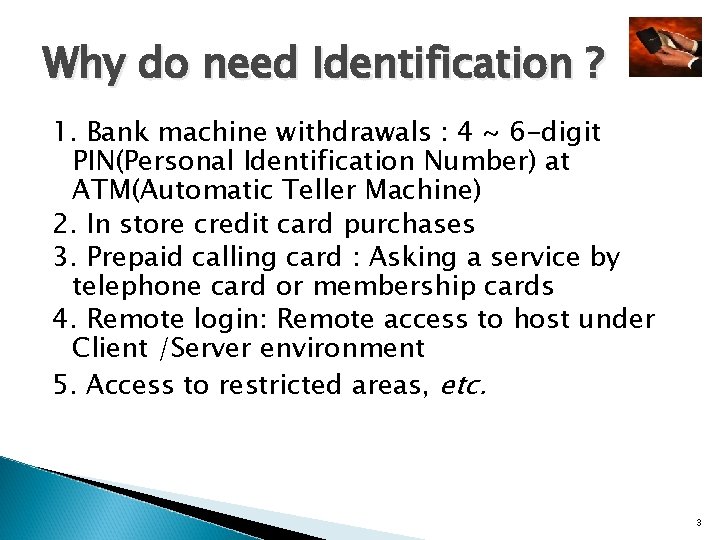
Why do need Identification ? 1. Bank machine withdrawals : 4 ~ 6 -digit PIN(Personal Identification Number) at ATM(Automatic Teller Machine) 2. In store credit card purchases 3. Prepaid calling card : Asking a service by telephone card or membership cards 4. Remote login: Remote access to host under Client /Server environment 5. Access to restricted areas, etc. 3
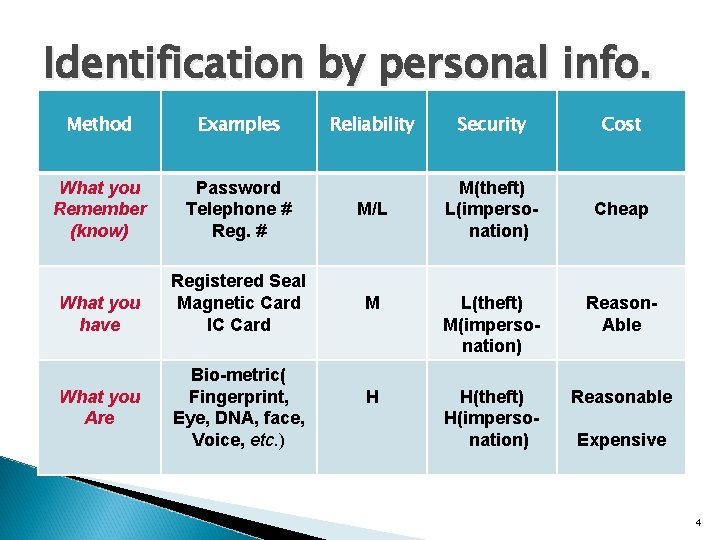
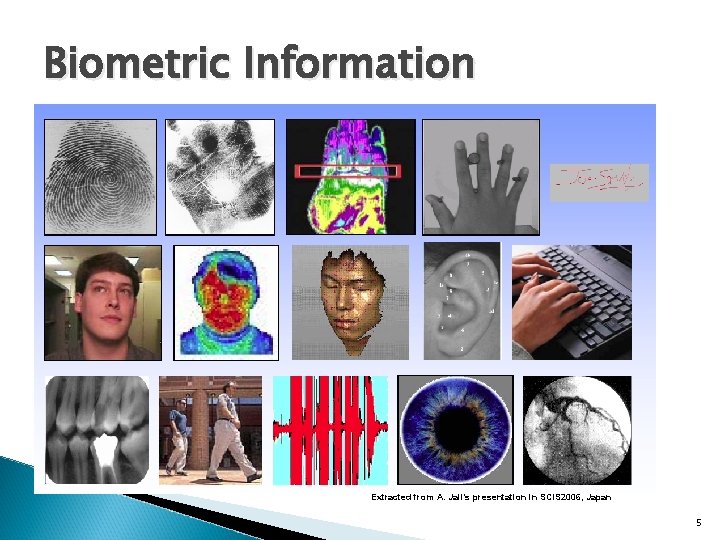
Identification by personal info. Method Examples What you Remember (know) What you have What you Are Reliability Security Cost Password Telephone # Reg. # M/L M(theft) L(impersonation) Cheap Registered Seal Magnetic Card IC Card M L(theft) M(impersonation) Reason. Able H H(theft) H(impersonation) Reasonable Bio-metric( Fingerprint, Eye, DNA, face, Voice, etc. ) Expensive 4
Biometric Information Extracted from A. Jail’s presentation in SCIS 2006, Japan 5
Way of Identification � Password-based scheme (weak authentication) ◦ crypt passwd under UNIX ◦ one-time password � Challenge-Response scheme (strong authentication) ◦ Symmetric cryptosystem ◦ MAC(keyed-hash) function ◦ Asymmetric cryptosystem � Cryptographic Protocols ◦ Fiat-Shamir identification protocol ◦ Schnorr identification protocol, etc 6
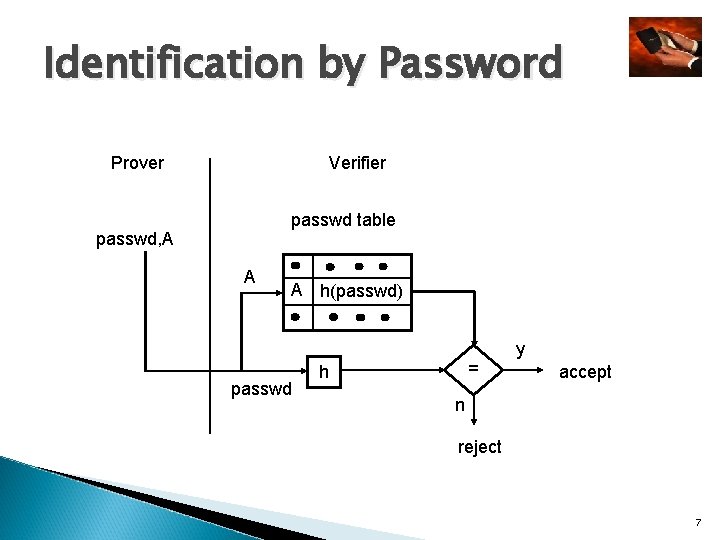
Identification by Password Prover Verifier passwd table passwd, A A A h(passwd) passwd = h y accept n reject 7
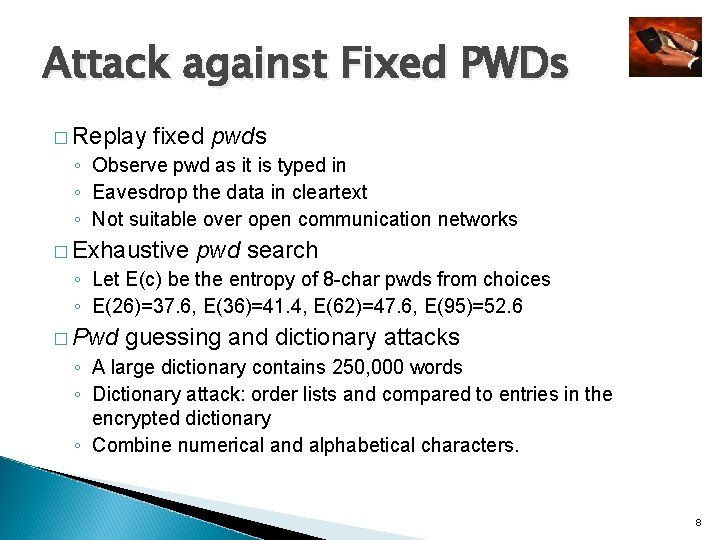
Attack against Fixed PWDs � Replay fixed pwds ◦ Observe pwd as it is typed in ◦ Eavesdrop the data in cleartext ◦ Not suitable over open communication networks � Exhaustive pwd search ◦ Let E(c) be the entropy of 8 -char pwds from choices ◦ E(26)=37. 6, E(36)=41. 4, E(62)=47. 6, E(95)=52. 6 � Pwd guessing and dictionary attacks ◦ A large dictionary contains 250, 000 words ◦ Dictionary attack: order lists and compared to entries in the encrypted dictionary ◦ Combine numerical and alphabetical characters. 8
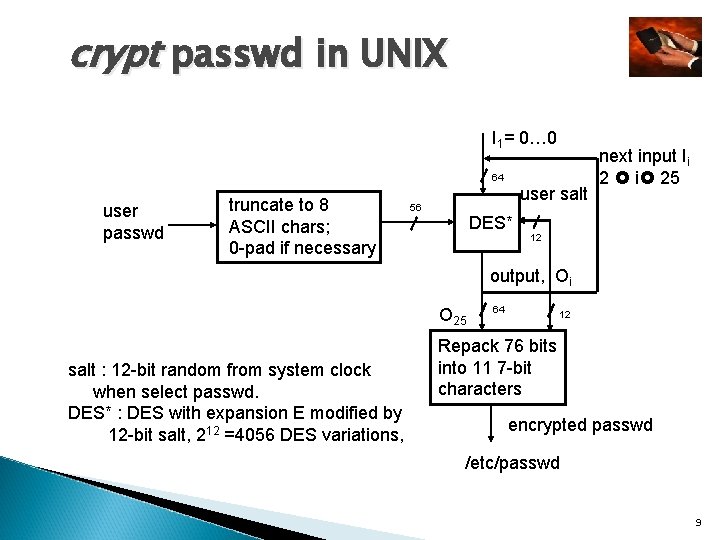
crypt passwd in UNIX I 1= 0… 0 64 user passwd truncate to 8 ASCII chars; 0 -pad if necessary user salt 56 DES* next input Ii 2 i 25 12 output, Oi O 25 salt : 12 -bit random from system clock when select passwd. DES* : DES with expansion E modified by 12 -bit salt, 212 =4056 DES variations, 64 12 Repack 76 bits into 11 7 -bit characters encrypted passwd /etc/passwd 9
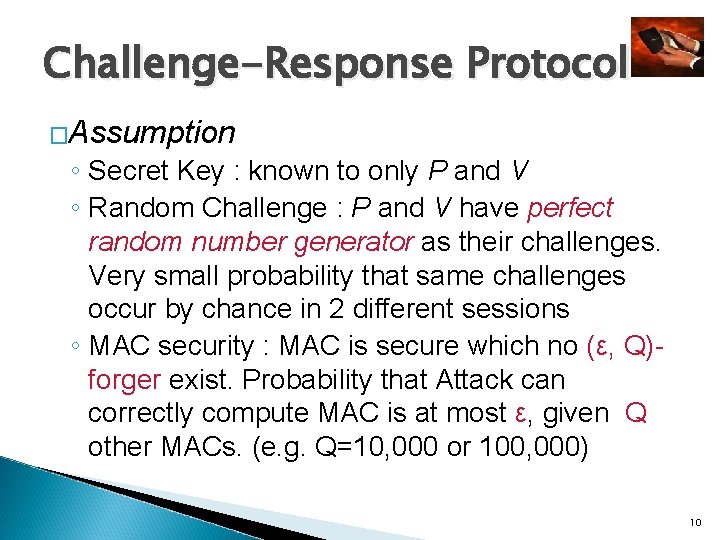
Challenge-Response Protocol �Assumption ◦ Secret Key : known to only P and V ◦ Random Challenge : P and V have perfect random number generator as their challenges. Very small probability that same challenges occur by chance in 2 different sessions ◦ MAC security : MAC is secure which no (ε, Q)forger exist. Probability that Attack can correctly compute MAC is at most ε, given Q other MACs. (e. g. Q=10, 000 or 100, 000) 10
Challenge-Response Scheme(I) ü Using Symmetric Cryptosystem K V P x y=e. K(x) random challenge, x y y’=e. K(x) y=y’ ? q q Vulnerable to parallel session attack (man-in-the-middle). Need to change x to be ID(V)||r 11
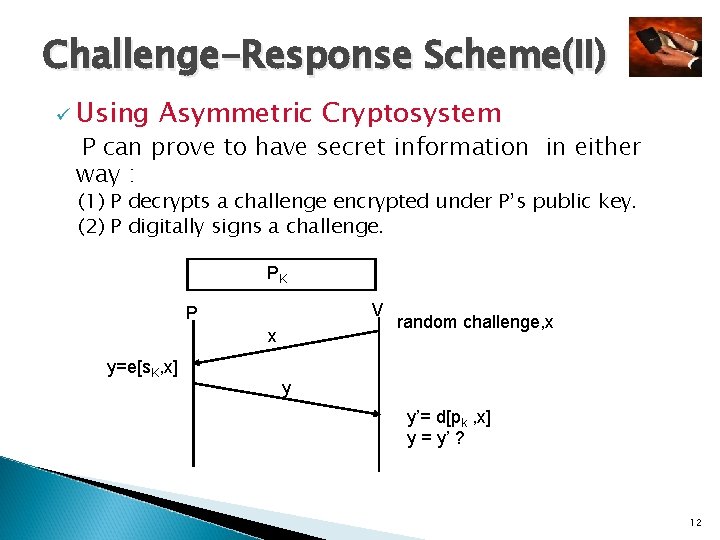
Challenge-Response Scheme(II) ü Using Asymmetric Cryptosystem P can prove to have secret information in either way : (1) P decrypts a challenge encrypted under P’s public key. (2) P digitally signs a challenge. PK V P x y=e[s. K, x] random challenge, x y y’= d[pk , x] y = y’ ? 12
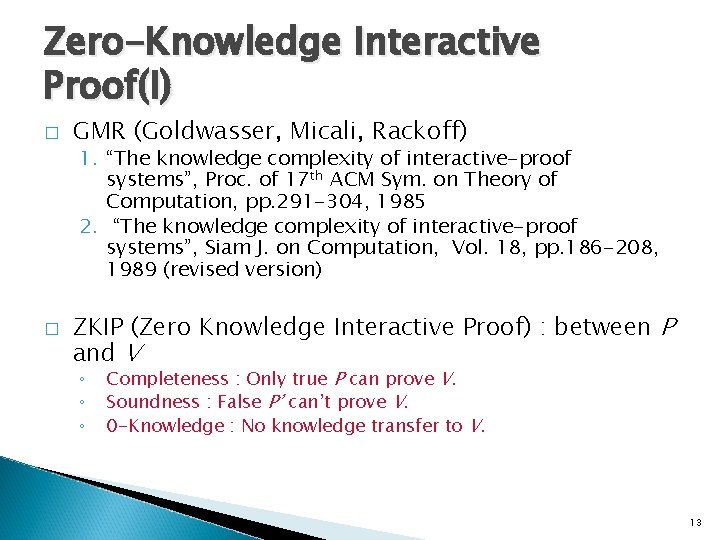
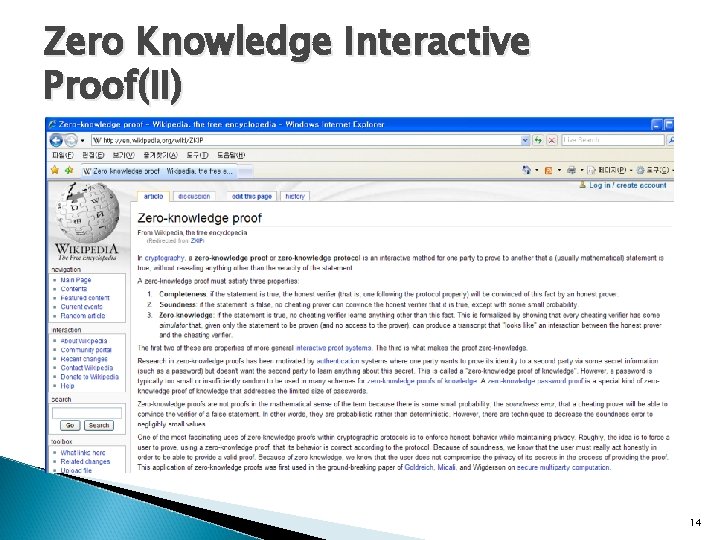
Zero-Knowledge Interactive Proof(I) � GMR (Goldwasser, Micali, Rackoff) 1. “The knowledge complexity of interactive-proof systems”, Proc. of 17 th ACM Sym. on Theory of Computation, pp. 291 -304, 1985 2. “The knowledge complexity of interactive-proof systems”, Siam J. on Computation, Vol. 18, pp. 186 -208, 1989 (revised version) � ZKIP (Zero Knowledge Interactive Proof) : between P and V ◦ ◦ ◦ Completeness : Only true P can prove V. Soundness : False P’ can’t prove V. 0 -Knowledge : No knowledge transfer to V. 13
Zero Knowledge Interactive Proof(II) 14
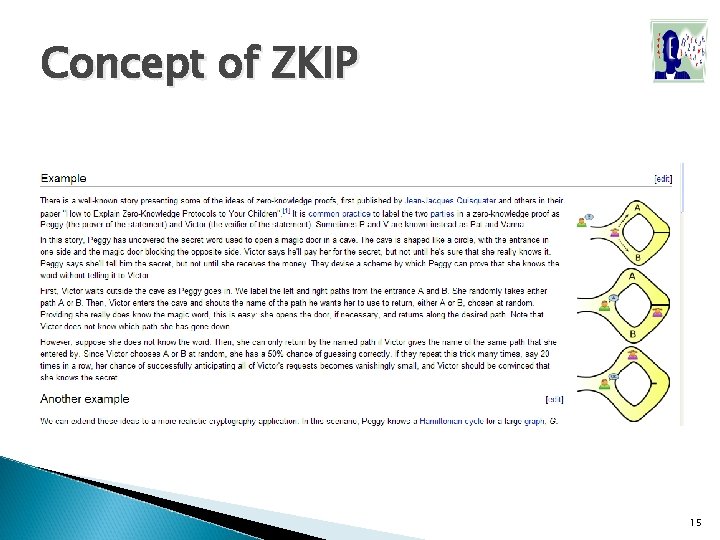
Concept of ZKIP 15
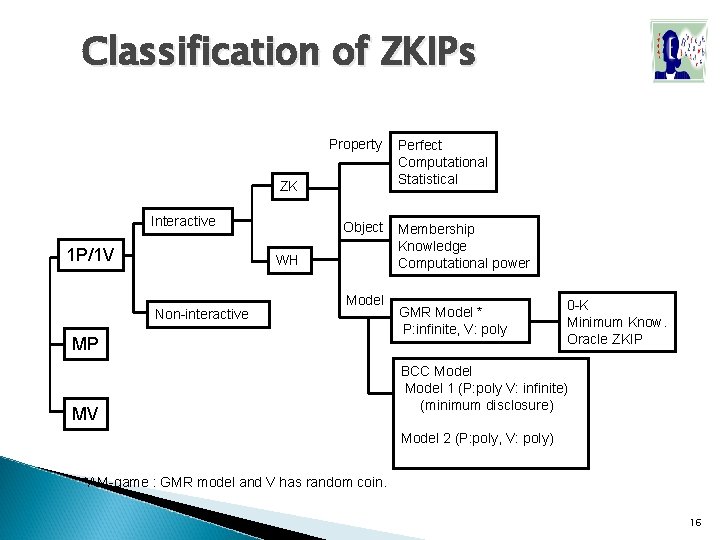
Classification of ZKIPs Property ZK Interactive 1 P/1 V Object WH Non-interactive Model MP MV Perfect Computational Statistical Membership Knowledge Computational power GMR Model * P: infinite, V: poly 0 -K Minimum Know. Oracle ZKIP BCC Model 1 (P: poly V: infinite) (minimum disclosure) Model 2 (P: poly, V: poly) *AM-game : GMR model and V has random coin. 16
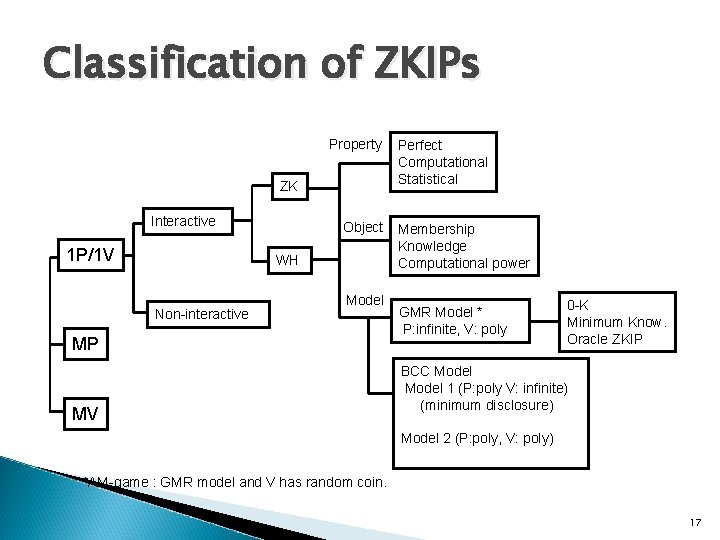
Classification of ZKIPs Property ZK Interactive 1 P/1 V Object WH Non-interactive Model MP MV Perfect Computational Statistical Membership Knowledge Computational power GMR Model * P: infinite, V: poly 0 -K Minimum Know. Oracle ZKIP BCC Model 1 (P: poly V: infinite) (minimum disclosure) Model 2 (P: poly, V: poly) *AM-game : GMR model and V has random coin. 17
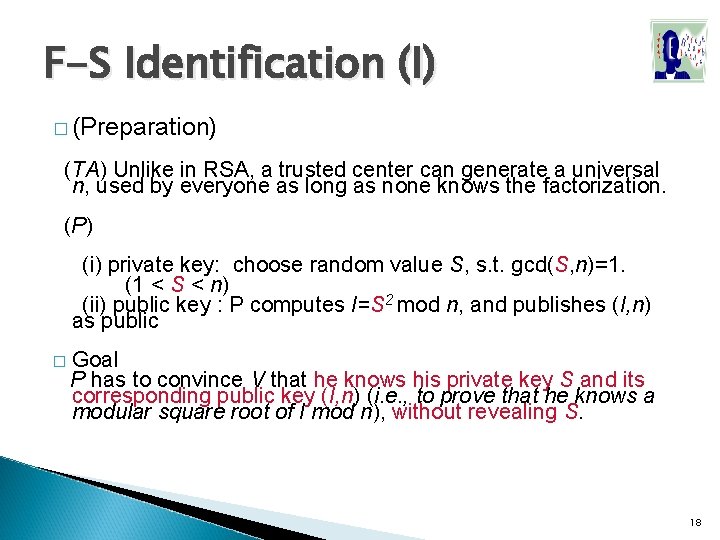
F-S Identification (I) � (Preparation) (TA) Unlike in RSA, a trusted center can generate a universal n, used by everyone as long as none knows the factorization. (P) (i) private key: choose random value S, s. t. gcd(S, n)=1. (1 < S < n) (ii) public key : P computes I=S 2 mod n, and publishes (I, n) as public � Goal P has to convince V that he knows his private key S and its corresponding public key (I, n) (i. e. , to prove that he knows a modular square root of I mod n), without revealing S. 18
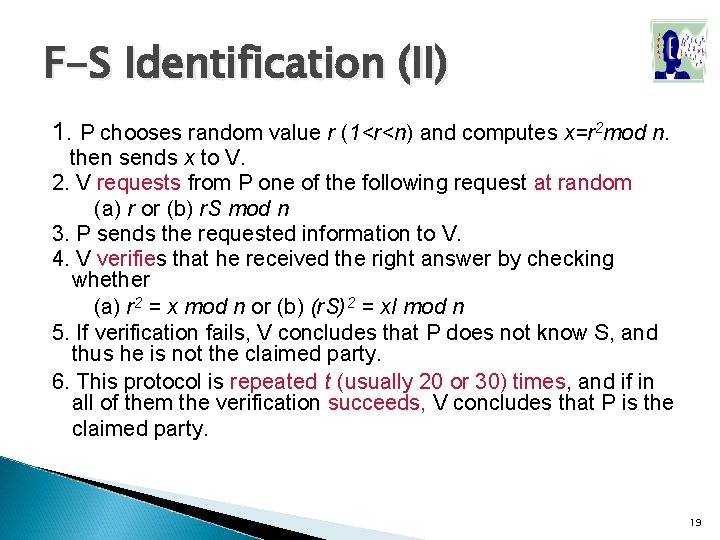
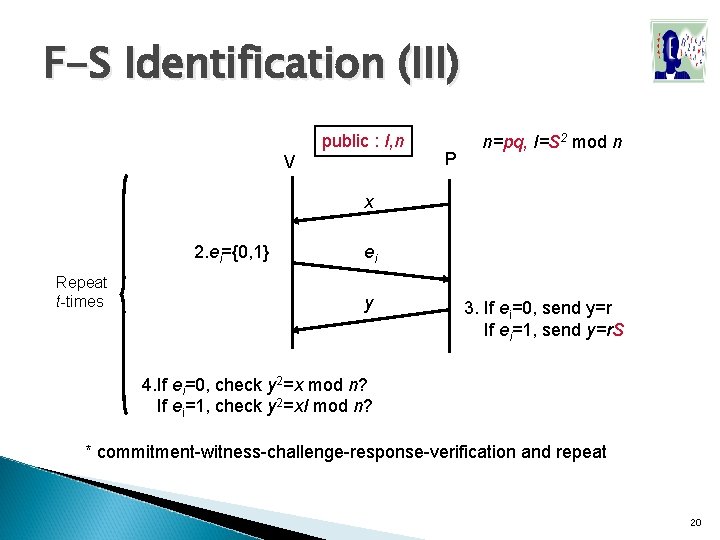
F-S Identification (II) 1. P chooses random value r (1<r<n) and computes x=r 2 mod n. then sends x to V. 2. V requests from P one of the following request at random (a) r or (b) r. S mod n 3. P sends the requested information to V. 4. V verifies that he received the right answer by checking whether (a) r 2 = x mod n or (b) (r. S)2 = x. I mod n 5. If verification fails, V concludes that P does not know S, and thus he is not the claimed party. 6. This protocol is repeated t (usually 20 or 30) times, and if in all of them the verification succeeds, V concludes that P is the claimed party. 19
F-S Identification (III) public : I, n V P n=pq, I=S 2 mod n x 2. ei={0, 1} Repeat t-times ei y 3. If ei=0, send y=r If ei=1, send y=r. S 4. If ei=0, check y 2=x mod n? If ei=1, check y 2=x. I mod n? * commitment-witness-challenge-response-verification and repeat 20
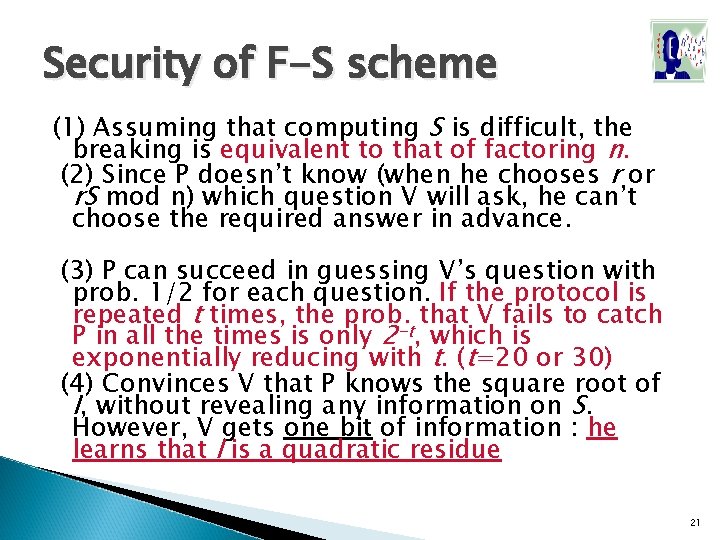
Security of F-S scheme (1) Assuming that computing S is difficult, the breaking is equivalent to that of factoring n. (2) Since P doesn’t know (when he chooses r or r. S mod n) which question V will ask, he can’t choose the required answer in advance. (3) P can succeed in guessing V’s question with prob. 1/2 for each question. If the protocol is repeated t times, the prob. that V fails to catch P in all the times is only 2 -t, which is exponentially reducing with t. (t=20 or 30) (4) Convinces V that P knows the square root of I, without revealing any information on S. However, V gets one bit of information : he learns that I is a quadratic residue 21
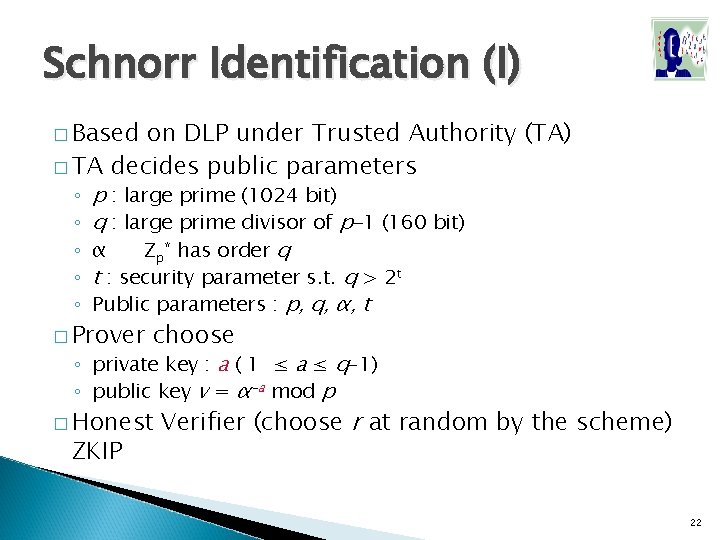
Schnorr Identification (I) � Based on DLP under Trusted Authority (TA) � TA decides public parameters ◦ ◦ ◦ p : large prime (1024 bit) q : large prime divisor of p-1 (160 bit) α Zp* has order q t : security parameter s. t. q > 2 t Public parameters : p, q, α, t � Prover choose ◦ private key : a ( 1 ≤ a ≤ q-1) ◦ public key v = α–a mod p � Honest ZKIP Verifier (choose r at random by the scheme) 22
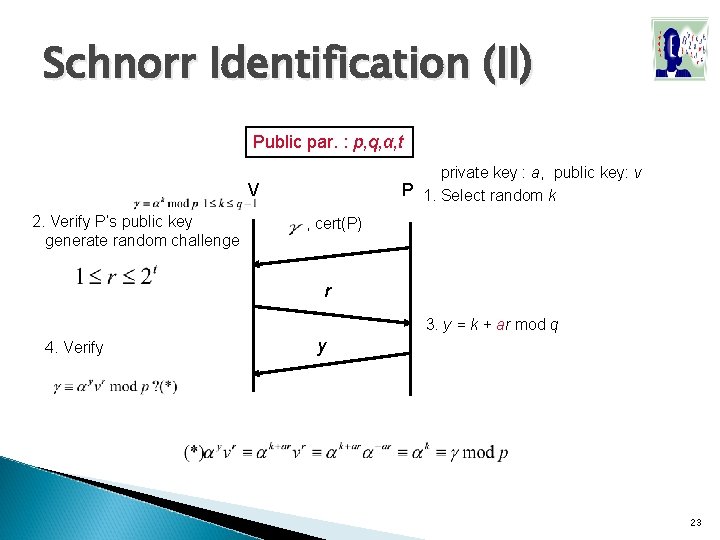
Schnorr Identification (II) Public par. : p, q, α, t private key : a, public key: v P 1. Select random k V 2. Verify P’s public key generate random challenge , cert(P) r 3. y = k + ar mod q 4. Verify y 23
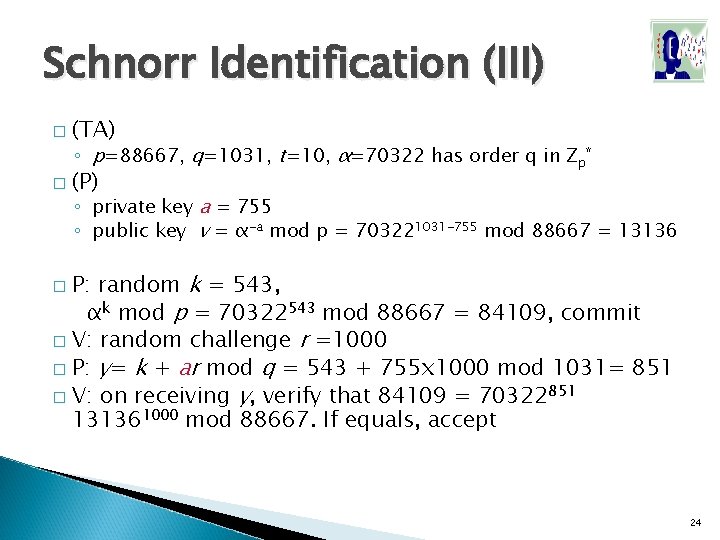
Schnorr Identification (III) � (TA) ◦ p=88667, q=1031, t=10, α=70322 has order q in Zp* � (P) ◦ private key a = 755 ◦ public key v = α-a mod p = 703221031 -755 mod 88667 = 13136 P: random k = 543, αk mod p = 70322543 mod 88667 = 84109, commit � V: random challenge r =1000 � P: y= k + ar mod q = 543 + 755 x 1000 mod 1031= 851 � V: on receiving y, verify that 84109 = 70322851 131361000 mod 88667. If equals, accept � 24
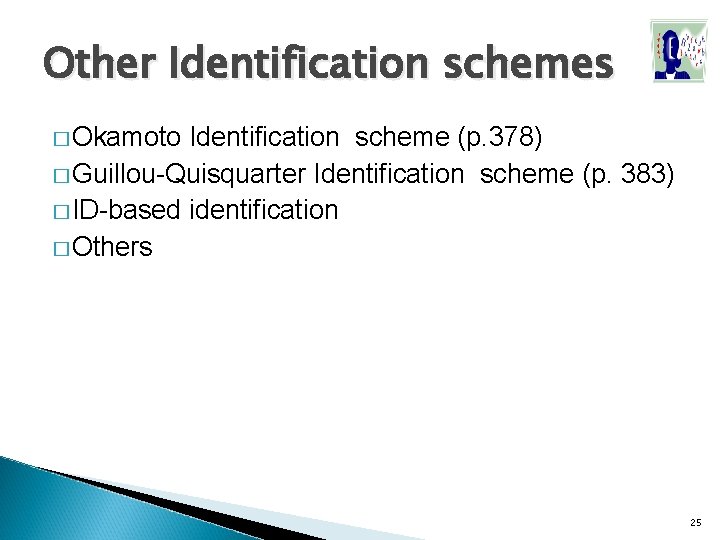
Other Identification schemes � Okamoto Identification scheme (p. 378) � Guillou-Quisquarter Identification scheme (p. 383) � ID-based identification � Others 25