ICS 321 Data Storage Retrieval Overview of Query

- Slides: 16
ICS 321 Data Storage & Retrieval Overview of Query Processing Prof. Lipyeow Lim Information & Computer Science Department University of Hawaii at Manoa Lipyeow Lim -- University of Hawaii at Manoa 1
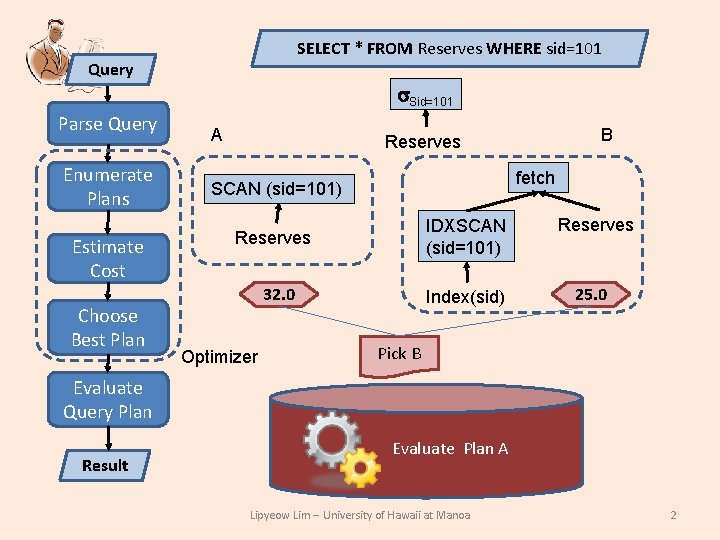
SELECT * FROM Reserves WHERE sid=101 Query Sid=101 Parse Query Enumerate Plans Estimate Cost Choose Best Plan A B Reserves fetch SCAN (sid=101) Reserves 32. 0 Optimizer IDXSCAN (sid=101) Reserves Index(sid) 25. 0 Pick B Evaluate Query Plan Result Evaluate Plan A Lipyeow Lim -- University of Hawaii at Manoa 2
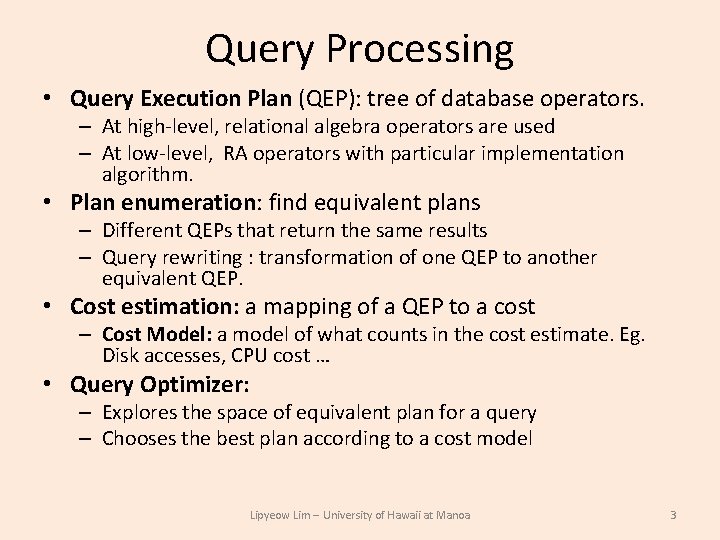
Query Processing • Query Execution Plan (QEP): tree of database operators. – At high-level, relational algebra operators are used – At low-level, RA operators with particular implementation algorithm. • Plan enumeration: find equivalent plans – Different QEPs that return the same results – Query rewriting : transformation of one QEP to another equivalent QEP. • Cost estimation: a mapping of a QEP to a cost – Cost Model: a model of what counts in the cost estimate. Eg. Disk accesses, CPU cost … • Query Optimizer: – Explores the space of equivalent plan for a query – Chooses the best plan according to a cost model Lipyeow Lim -- University of Hawaii at Manoa 3
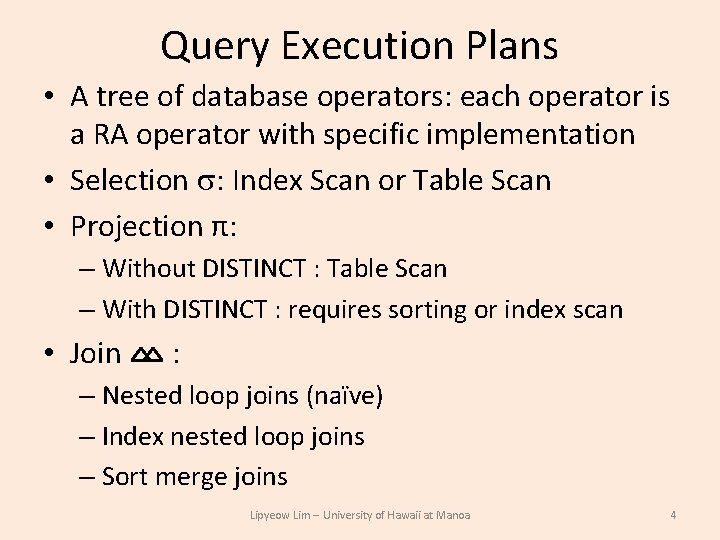
Query Execution Plans • A tree of database operators: each operator is a RA operator with specific implementation • Selection : Index Scan or Table Scan • Projection π: – Without DISTINCT : Table Scan – With DISTINCT : requires sorting or index scan • Join : – Nested loop joins (naïve) – Index nested loop joins – Sort merge joins Lipyeow Lim -- University of Hawaii at Manoa 4
Enumerating Plans: Access Paths • An access path is a method of retrieving tuples. Eg. Given a query with a selection condition: – File or table scan – Index scan • Index matching problem: given a selection condition, which indexes can be used for the selection, i. e. , matches the selection ? – Selection condition normalized to conjunctive normal form (CNF), where each term is a conjunct – Eg. (day<8/9/94 AND rname=‘Paul’) OR bid=5 OR sid=3 – CNF: (day<8/9/94 OR bid=5 OR sid=3 ) AND (rname=‘Paul’ OR bid=5 OR sid=3) Lipyeow Lim -- University of Hawaii at Manoa 5
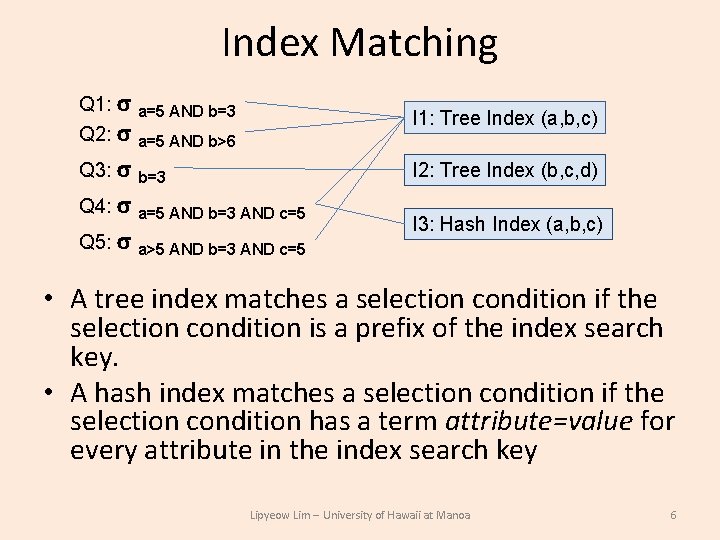
Index Matching Q 1: Q 2: a=5 AND b=3 I 1: Tree Index (a, b, c) a=5 AND b>6 Q 3: b=3 Q 4: a=5 AND b=3 AND c=5 Q 5: a>5 AND b=3 AND c=5 I 2: Tree Index (b, c, d) I 3: Hash Index (a, b, c) • A tree index matches a selection condition if the selection condition is a prefix of the index search key. • A hash index matches a selection condition if the selection condition has a term attribute=value for every attribute in the index search key Lipyeow Lim -- University of Hawaii at Manoa 6
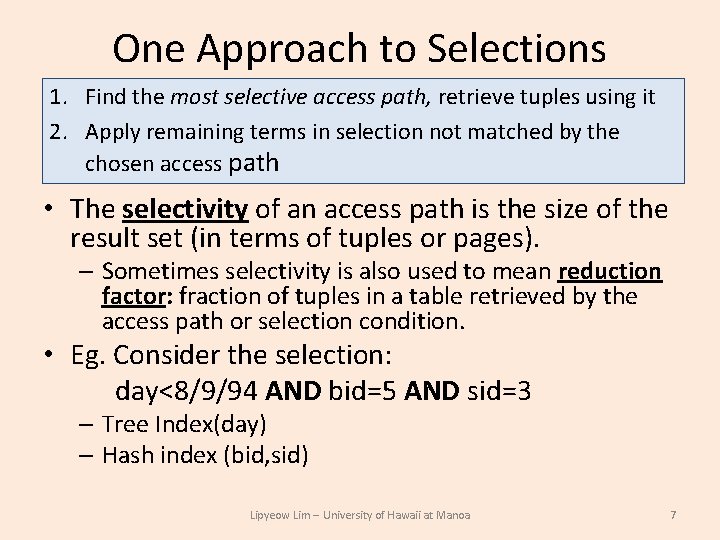
One Approach to Selections 1. Find the most selective access path, retrieve tuples using it 2. Apply remaining terms in selection not matched by the chosen access path • The selectivity of an access path is the size of the result set (in terms of tuples or pages). – Sometimes selectivity is also used to mean reduction factor: fraction of tuples in a table retrieved by the access path or selection condition. • Eg. Consider the selection: day<8/9/94 AND bid=5 AND sid=3 – Tree Index(day) – Hash index (bid, sid) Lipyeow Lim -- University of Hawaii at Manoa 7
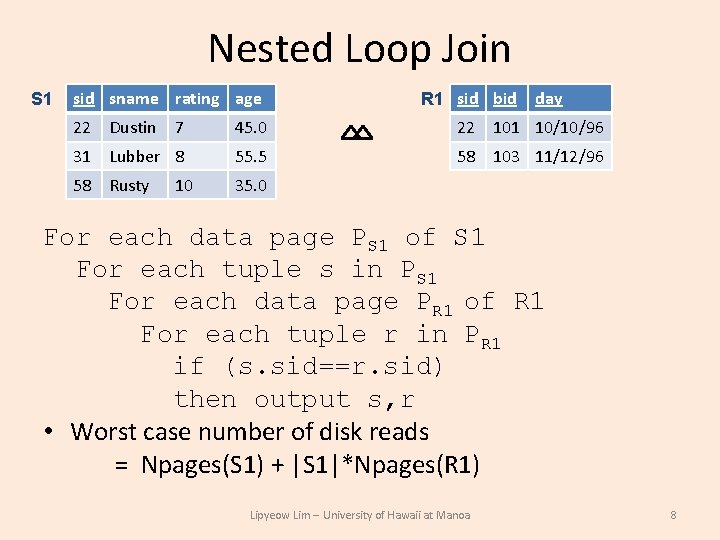
Nested Loop Join S 1 sid sname rating age R 1 sid bid day 7 45. 0 22 101 10/10/96 31 Lubber 8 55. 5 58 103 11/12/96 58 Rusty 35. 0 22 Dustin 10 For each data page PS 1 of S 1 For each tuple s in PS 1 For each data page PR 1 of R 1 For each tuple r in PR 1 if (s. sid==r. sid) then output s, r • Worst case number of disk reads = Npages(S 1) + |S 1|*Npages(R 1) Lipyeow Lim -- University of Hawaii at Manoa 8
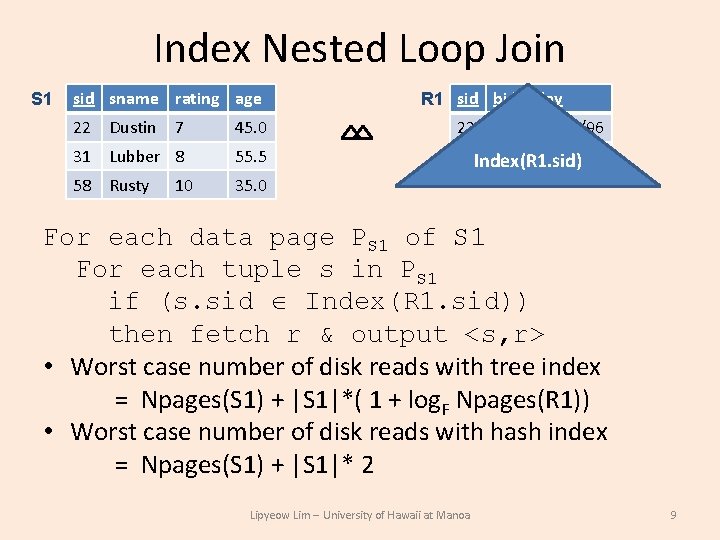
Index Nested Loop Join S 1 sid sname rating age R 1 sid bid day 7 45. 0 22 101 10/10/96 31 Lubber 8 55. 5 58 Index(R 1. sid) 103 11/12/96 58 Rusty 35. 0 22 Dustin 10 For each data page PS 1 of S 1 For each tuple s in PS 1 if (s. sid Index(R 1. sid)) then fetch r & output <s, r> • Worst case number of disk reads with tree index = Npages(S 1) + |S 1|*( 1 + log. F Npages(R 1)) • Worst case number of disk reads with hash index = Npages(S 1) + |S 1|* 2 Lipyeow Lim -- University of Hawaii at Manoa 9
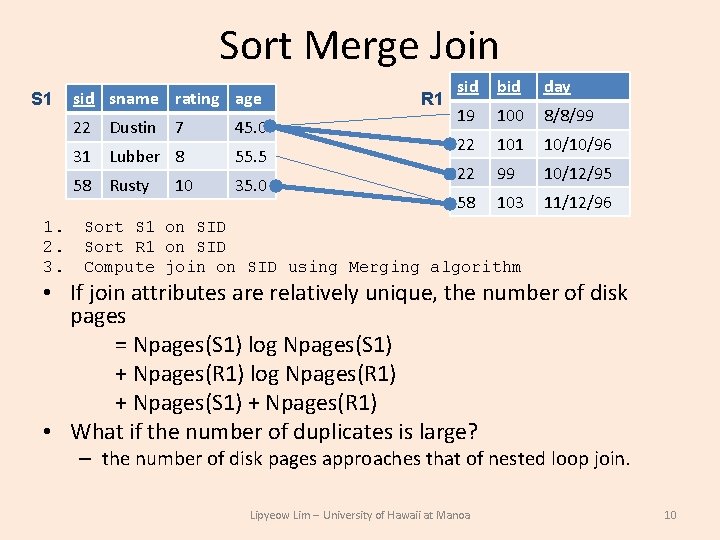
Sort Merge Join S 1 sid sname rating age 22 Dustin 1. 2. 3. 7 45. 0 31 Lubber 8 55. 5 58 Rusty 35. 0 10 R 1 sid bid day 19 100 8/8/99 22 101 10/10/96 22 99 10/12/95 58 103 11/12/96 Sort S 1 on SID Sort R 1 on SID Compute join on SID using Merging algorithm • If join attributes are relatively unique, the number of disk pages = Npages(S 1) log Npages(S 1) + Npages(R 1) log Npages(R 1) + Npages(S 1) + Npages(R 1) • What if the number of duplicates is large? – the number of disk pages approaches that of nested loop join. Lipyeow Lim -- University of Hawaii at Manoa 10
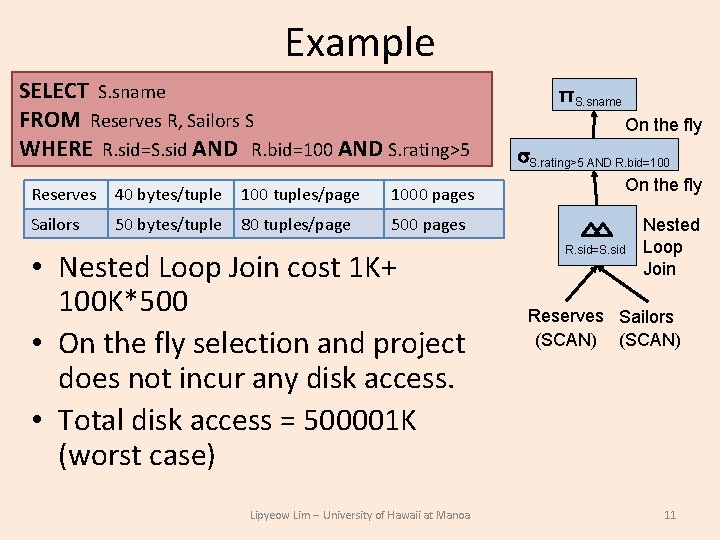
Example SELECT S. sname FROM Reserves R, Sailors S WHERE R. sid=S. sid AND R. bid=100 AND S. rating>5 Reserves 40 bytes/tuple 100 tuples/page 1000 pages Sailors 50 bytes/tuple 80 tuples/page 500 pages • Nested Loop Join cost 1 K+ 100 K*500 • On the fly selection and project does not incur any disk access. • Total disk access = 500001 K (worst case) Lipyeow Lim -- University of Hawaii at Manoa πS. sname On the fly S. rating>5 AND R. bid=100 On the fly R. sid=S. sid Nested Loop Join Reserves Sailors (SCAN) 11
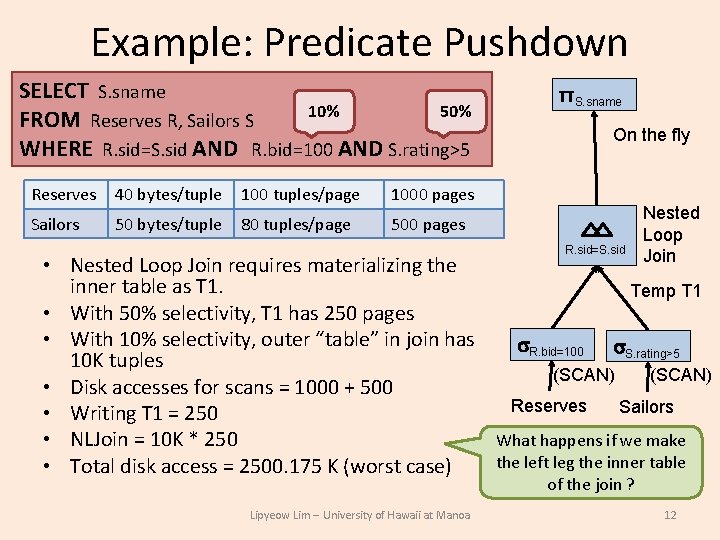
Example: Predicate Pushdown SELECT S. sname 10% 50% FROM Reserves R, Sailors S WHERE R. sid=S. sid AND R. bid=100 AND S. rating>5 Reserves 40 bytes/tuple 100 tuples/page 1000 pages Sailors 50 bytes/tuple 80 tuples/page 500 pages • Nested Loop Join requires materializing the inner table as T 1. • With 50% selectivity, T 1 has 250 pages • With 10% selectivity, outer “table” in join has 10 K tuples • Disk accesses for scans = 1000 + 500 • Writing T 1 = 250 • NLJoin = 10 K * 250 • Total disk access = 2500. 175 K (worst case) Lipyeow Lim -- University of Hawaii at Manoa πS. sname On the fly R. sid=S. sid Nested Loop Join Temp T 1 R. bid=100 S. rating>5 (SCAN) Reserves (SCAN) Sailors What happens if we make the left leg the inner table of the join ? 12
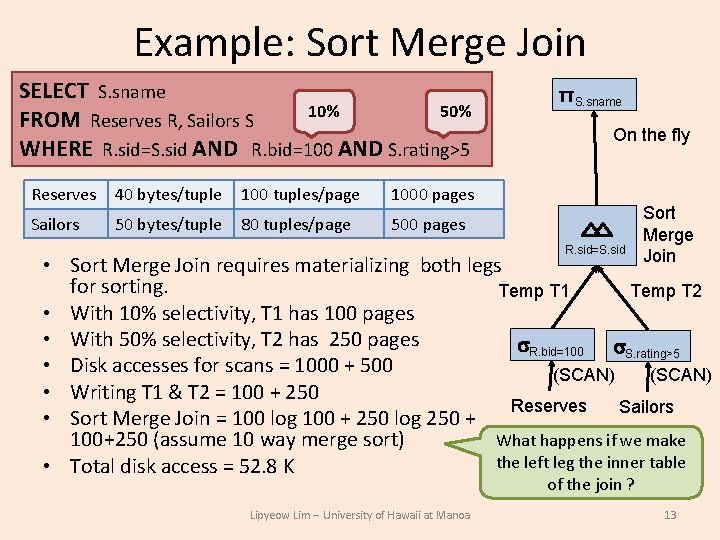
Example: Sort Merge Join SELECT S. sname 10% 50% FROM Reserves R, Sailors S WHERE R. sid=S. sid AND R. bid=100 AND S. rating>5 Reserves 40 bytes/tuple 100 tuples/page 1000 pages Sailors 50 bytes/tuple 80 tuples/page 500 pages πS. sname On the fly R. sid=S. sid Sort Merge Join • Sort Merge Join requires materializing both legs for sorting. Temp T 1 Temp T 2 • With 10% selectivity, T 1 has 100 pages • With 50% selectivity, T 2 has 250 pages R. bid=100 S. rating>5 • Disk accesses for scans = 1000 + 500 (SCAN) • Writing T 1 & T 2 = 100 + 250 Reserves Sailors • Sort Merge Join = 100 log 100 + 250 log 250 + 100+250 (assume 10 way merge sort) What happens if we make the left leg the inner table • Total disk access = 52. 8 K of the join ? Lipyeow Lim -- University of Hawaii at Manoa 13
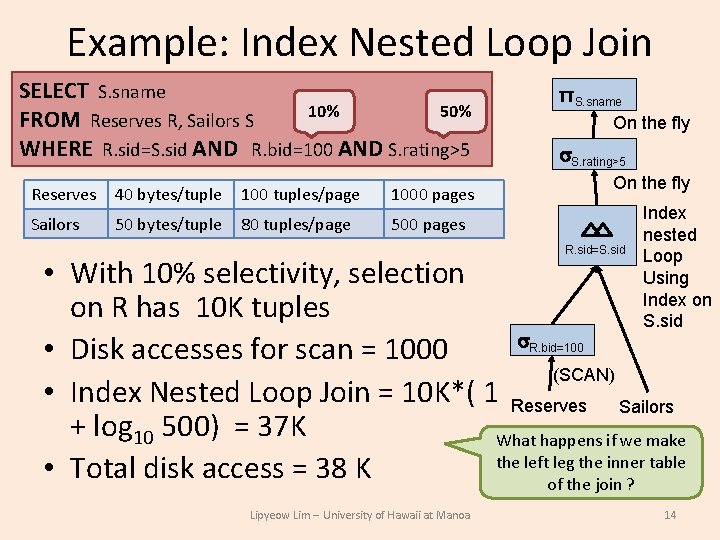
Example: Index Nested Loop Join SELECT S. sname 10% 50% FROM Reserves R, Sailors S WHERE R. sid=S. sid AND R. bid=100 AND S. rating>5 Reserves 40 bytes/tuple 100 tuples/page 1000 pages Sailors 50 bytes/tuple 80 tuples/page 500 pages πS. sname On the fly S. rating>5 On the fly R. sid=S. sid Index nested Loop Using Index on S. sid • With 10% selectivity, selection on R has 10 K tuples • Disk accesses for scan = 1000 (SCAN) • Index Nested Loop Join = 10 K*( 1 Reserves Sailors + log 10 500) = 37 K What happens if we make the left leg the inner table • Total disk access = 38 K of the join ? R. bid=100 Lipyeow Lim -- University of Hawaii at Manoa 14
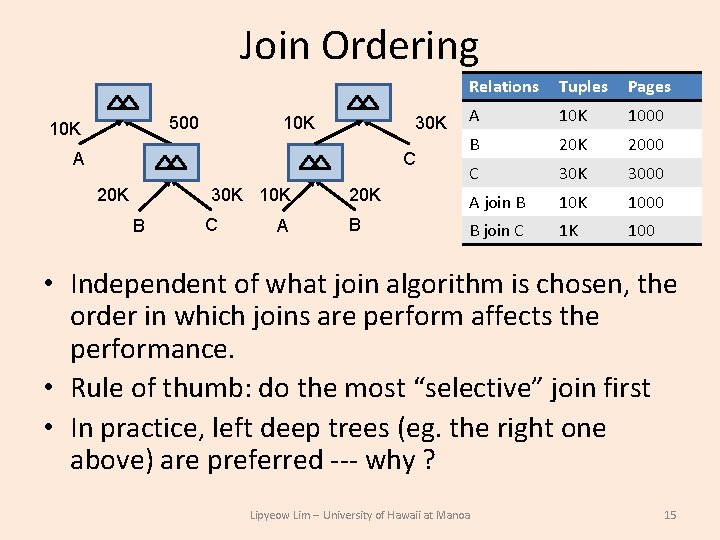
Join Ordering 500 10 K Relations Tuples Pages A 10 K 1000 B 20 K 2000 C 30 K 3000 20 K A join B 10 K 1000 B B join C 1 K 100 10 K 30 K A C 20 K 30 K 10 K B C A • Independent of what join algorithm is chosen, the order in which joins are perform affects the performance. • Rule of thumb: do the most “selective” join first • In practice, left deep trees (eg. the right one above) are preferred --- why ? Lipyeow Lim -- University of Hawaii at Manoa 15
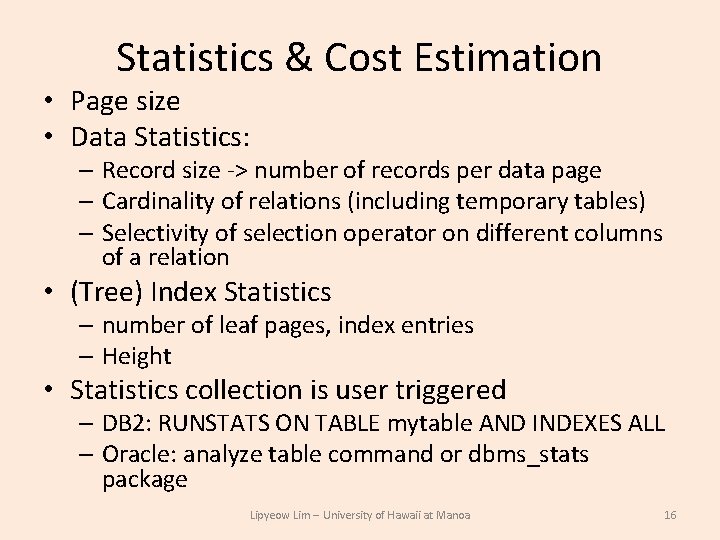
Statistics & Cost Estimation • Page size • Data Statistics: – Record size -> number of records per data page – Cardinality of relations (including temporary tables) – Selectivity of selection operator on different columns of a relation • (Tree) Index Statistics – number of leaf pages, index entries – Height • Statistics collection is user triggered – DB 2: RUNSTATS ON TABLE mytable AND INDEXES ALL – Oracle: analyze table command or dbms_stats package Lipyeow Lim -- University of Hawaii at Manoa 16