
ICS 321 Data Storage Retrieval The Relational Model

- Slides: 21
ICS 321 Data Storage & Retrieval The Relational Model of Data (i) Prof. Lipyeow Lim Information & Computer Science Department University of Hawaii at Manoa Lipyeow Lim -- University of Hawaii at Manoa 1
Data Models A data model is a collection of concepts for describing data • Structure of the data. – More of a conceptual model rather than a physical data model. Eg. Arrays, objects in C/C++ • Operations on the data – Queries and modifications only • Constraints on the data – Limitations on the data. Eg. Data type etc. Examples: the relational model and the semistructured model (XML) Lipyeow Lim -- University of Hawaii at Manoa 2
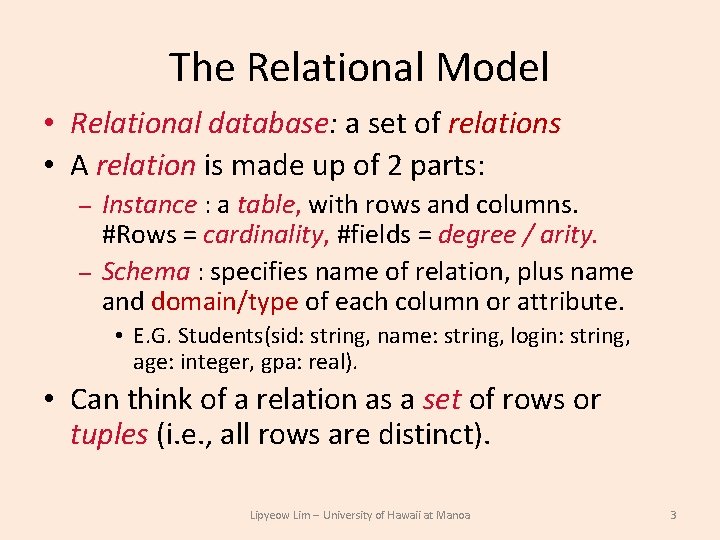
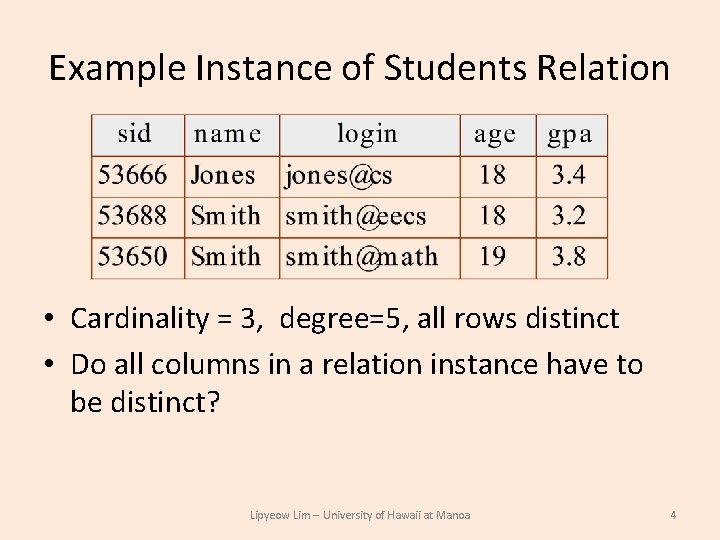
The Relational Model • Relational database: a set of relations • A relation is made up of 2 parts: – – Instance : a table, with rows and columns. #Rows = cardinality, #fields = degree / arity. Schema : specifies name of relation, plus name and domain/type of each column or attribute. • E. G. Students(sid: string, name: string, login: string, age: integer, gpa: real). • Can think of a relation as a set of rows or tuples (i. e. , all rows are distinct). Lipyeow Lim -- University of Hawaii at Manoa 3
Example Instance of Students Relation • Cardinality = 3, degree=5, all rows distinct • Do all columns in a relation instance have to be distinct? Lipyeow Lim -- University of Hawaii at Manoa 4
Relational Query Languages • The relational model supports simple, powerful querying of data. • Queries are written declaratively in SQL, and the DBMS finds an efficient execution plan. • Query Languages != programming languages! • Two mathematical query languages – Relational Algebra: More operational, useful for representing query execution plans. – Relational Calculus: More declarative Lipyeow Lim -- University of Hawaii at Manoa 5
Preliminaries • A query takes relation instances as input and outputs a relation instance. • Positional vs. named-field notation: Named-field notation more readable. – Both used in SQL – Field names in query results are `inherited’ from input relations R 1 sid bid 22 101 10/10/96 58 103 11/12/96 S 1 sid sname rating age 22 Dustin – • “Sailors” and “Reserves” relations for our examples. day S 2 7 45. 0 31 Lubber 8 55. 5 58 Rusty 35. 0 10 sid sname rating age 28 Yuppy 9 35. 0 31 Lubber 8 55. 5 44 Guppy 5 35. 0 58 Rusty 10 35. 0 Lipyeow Lim -- University of Hawaii at Manoa 6
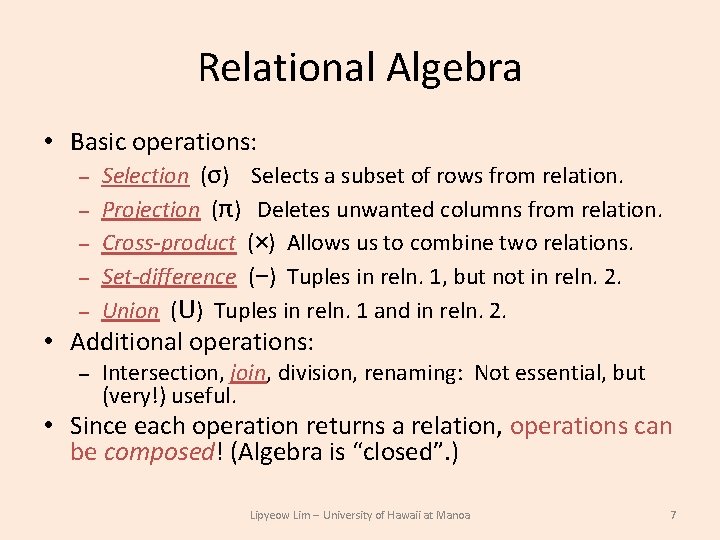
Relational Algebra • Basic operations: – Selection (σ) Selects a subset of rows from relation. – Projection (π) Deletes unwanted columns from relation. – Cross-product (×) Allows us to combine two relations. – Set-difference (−) Tuples in reln. 1, but not in reln. 2. – Union (U) Tuples in reln. 1 and in reln. 2. • Additional operations: – Intersection, join, division, renaming: Not essential, but (very!) useful. • Since each operation returns a relation, operations can be composed! (Algebra is “closed”. ) Lipyeow Lim -- University of Hawaii at Manoa 7
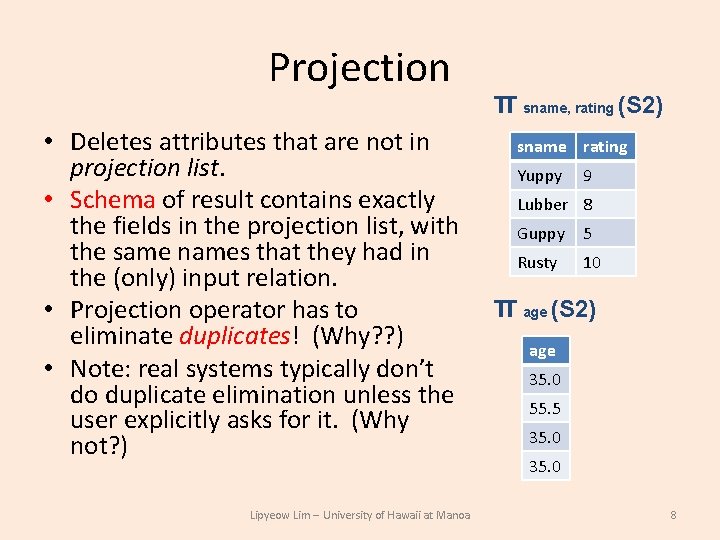
Projection • Deletes attributes that are not in projection list. • Schema of result contains exactly the fields in the projection list, with the same names that they had in the (only) input relation. • Projection operator has to eliminate duplicates! (Why? ? ) • Note: real systems typically don’t do duplicate elimination unless the user explicitly asks for it. (Why not? ) Lipyeow Lim -- University of Hawaii at Manoa π sname, rating (S 2) sname rating Yuppy 9 Lubber 8 Guppy 5 Rusty 10 π age (S 2) age 35. 0 55. 5 35. 0 8
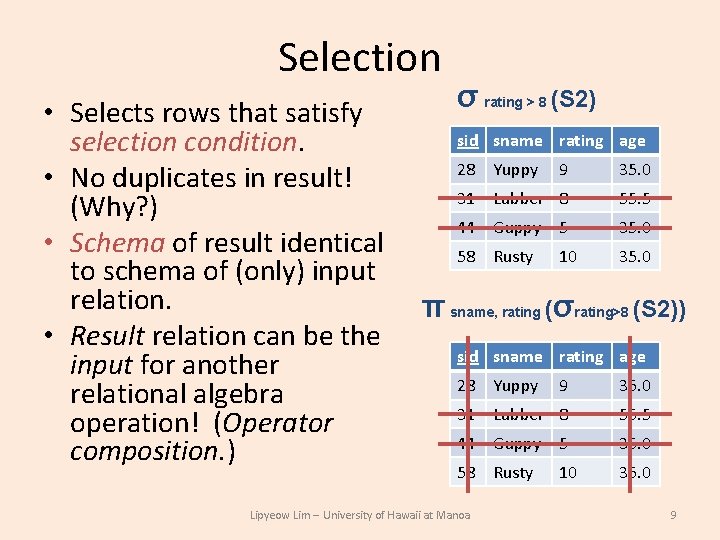
Selection • Selects rows that satisfy selection condition. • No duplicates in result! (Why? ) • Schema of result identical to schema of (only) input relation. • Result relation can be the input for another relational algebra operation! (Operator composition. ) σ rating > 8 (S 2) sid sname rating age 28 Yuppy 9 35. 0 31 Lubber 8 55. 5 44 Guppy 5 35. 0 58 Rusty 10 35. 0 π sname, rating (σrating>8 (S 2)) sid sname rating age 28 Yuppy 9 35. 0 31 Lubber 8 55. 5 44 Guppy 5 35. 0 58 Rusty 10 35. 0 Lipyeow Lim -- University of Hawaii at Manoa 9
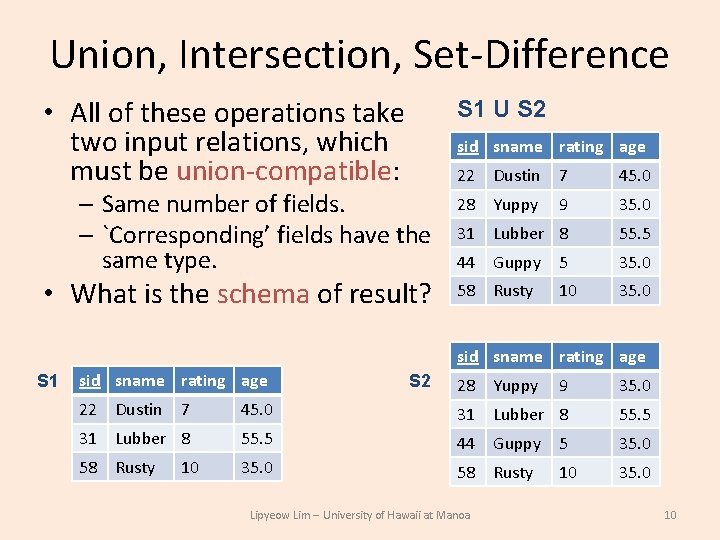
Union, Intersection, Set-Difference • All of these operations take two input relations, which must be union-compatible: S 1 U S 2 sid sname rating age – Same number of fields. – `Corresponding’ fields have the same type. • What is the schema of result? 22 Dustin 7 45. 0 28 Yuppy 9 35. 0 31 Lubber 8 55. 5 44 Guppy 5 35. 0 58 Rusty 10 35. 0 sid sname rating age S 1 sid sname rating age 22 Dustin S 2 28 Yuppy 9 35. 0 7 45. 0 31 Lubber 8 55. 5 44 Guppy 5 35. 0 58 Rusty 10 35. 0 10 Lipyeow Lim -- University of Hawaii at Manoa 10
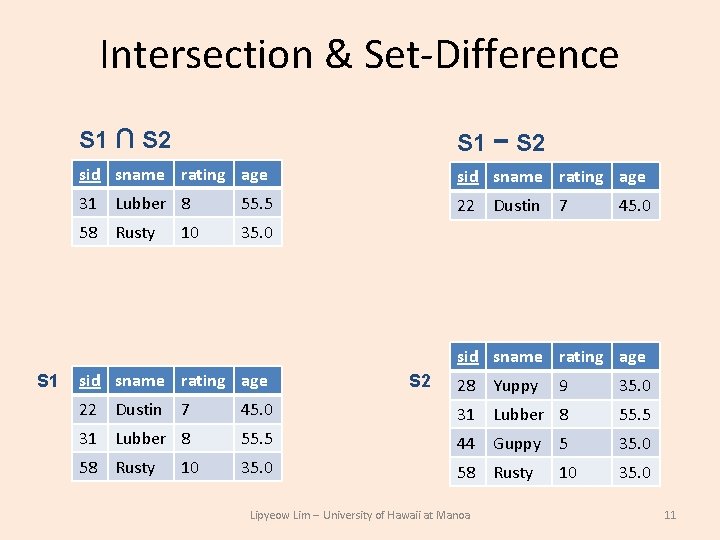
Intersection & Set-Difference S 1 ∩ S 2 S 1 − S 2 sid sname rating age 31 Lubber 8 55. 5 22 Dustin 58 Rusty 35. 0 10 7 45. 0 sid sname rating age S 1 sid sname rating age 22 Dustin S 2 28 Yuppy 9 35. 0 7 45. 0 31 Lubber 8 55. 5 44 Guppy 5 35. 0 58 Rusty 10 35. 0 10 Lipyeow Lim -- University of Hawaii at Manoa 11
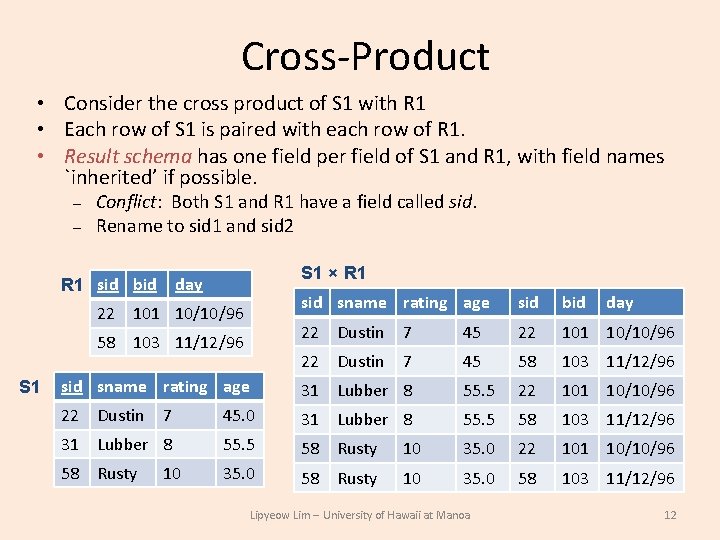
Cross-Product • Consider the cross product of S 1 with R 1 • Each row of S 1 is paired with each row of R 1. • Result schema has one field per field of S 1 and R 1, with field names `inherited’ if possible. – – Conflict: Both S 1 and R 1 have a field called sid. Rename to sid 1 and sid 2 R 1 sid bid S 1 × R 1 day 22 101 10/10/96 58 103 11/12/96 S 1 sid sname rating age sid bid day 22 Dustin 7 45 22 101 10/10/96 22 Dustin 7 45 58 103 11/12/96 sid sname rating age 31 Lubber 8 55. 5 22 101 10/10/96 22 Dustin 7 45. 0 31 Lubber 8 55. 5 58 103 11/12/96 31 Lubber 8 55. 5 58 Rusty 10 35. 0 22 101 10/10/96 58 Rusty 35. 0 58 Rusty 10 35. 0 58 103 11/12/96 10 Lipyeow Lim -- University of Hawaii at Manoa 12
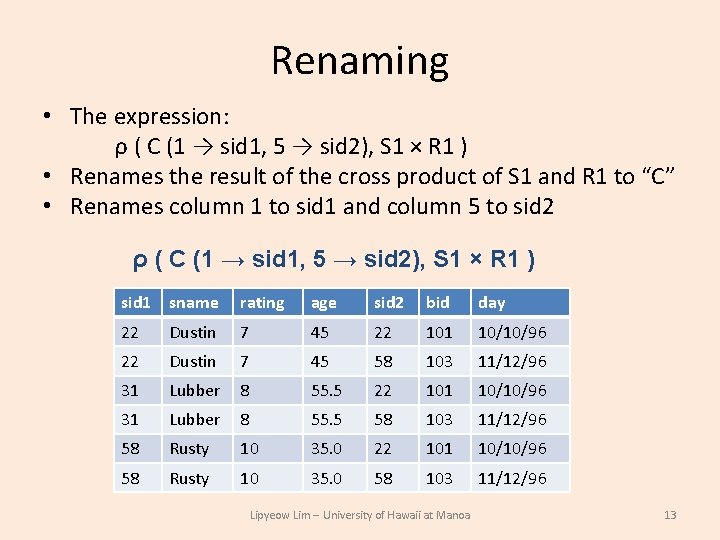
Renaming • The expression: ρ ( C (1 → sid 1, 5 → sid 2), S 1 × R 1 ) • Renames the result of the cross product of S 1 and R 1 to “C” • Renames column 1 to sid 1 and column 5 to sid 2 ρ ( C (1 → sid 1, 5 → sid 2), S 1 × R 1 ) sid 1 sname rating age sid 2 bid day 22 Dustin 7 45 22 101 10/10/96 22 Dustin 7 45 58 103 11/12/96 31 Lubber 8 55. 5 22 101 10/10/96 31 Lubber 8 55. 5 58 103 11/12/96 58 Rusty 10 35. 0 22 101 10/10/96 58 Rusty 10 35. 0 58 103 11/12/96 Lipyeow Lim -- University of Hawaii at Manoa 13
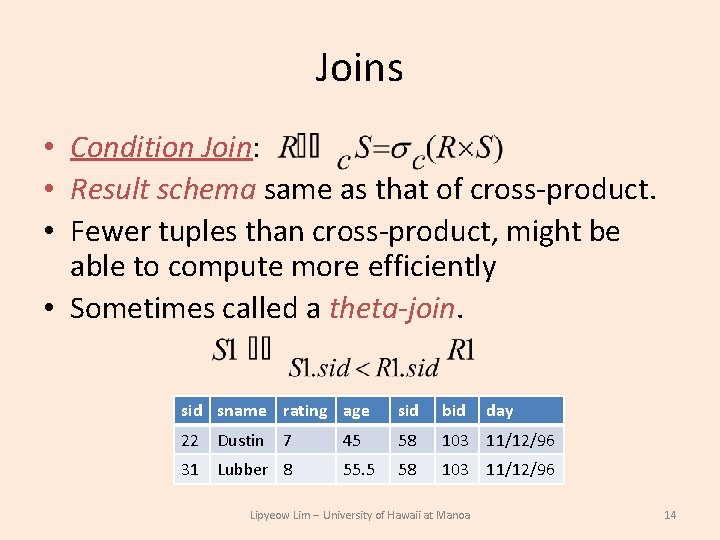
Joins • Condition Join: • Result schema same as that of cross-product. • Fewer tuples than cross-product, might be able to compute more efficiently • Sometimes called a theta-join. sid sname rating age sid bid 22 Dustin 45 58 103 11/12/96 55. 5 58 103 11/12/96 7 31 Lubber 8 Lipyeow Lim -- University of Hawaii at Manoa day 14
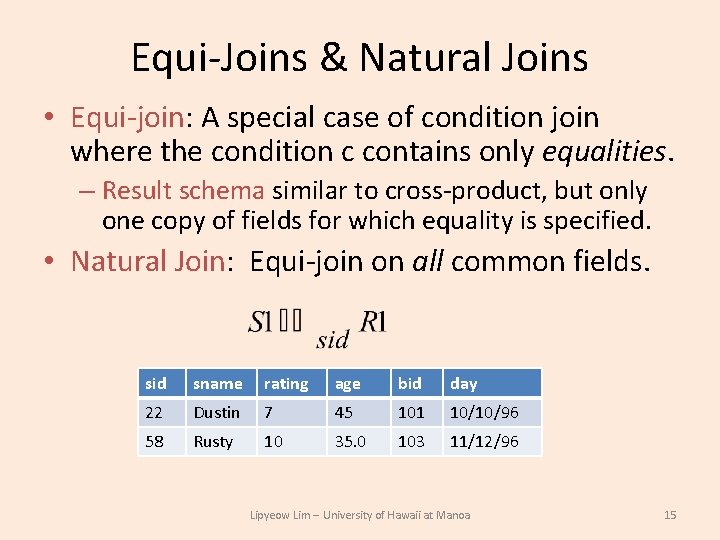
Equi-Joins & Natural Joins • Equi-join: A special case of condition join where the condition c contains only equalities. – Result schema similar to cross-product, but only one copy of fields for which equality is specified. • Natural Join: Equi-join on all common fields. sid sname rating age bid day 22 Dustin 7 45 101 10/10/96 58 Rusty 10 35. 0 103 11/12/96 Lipyeow Lim -- University of Hawaii at Manoa 15
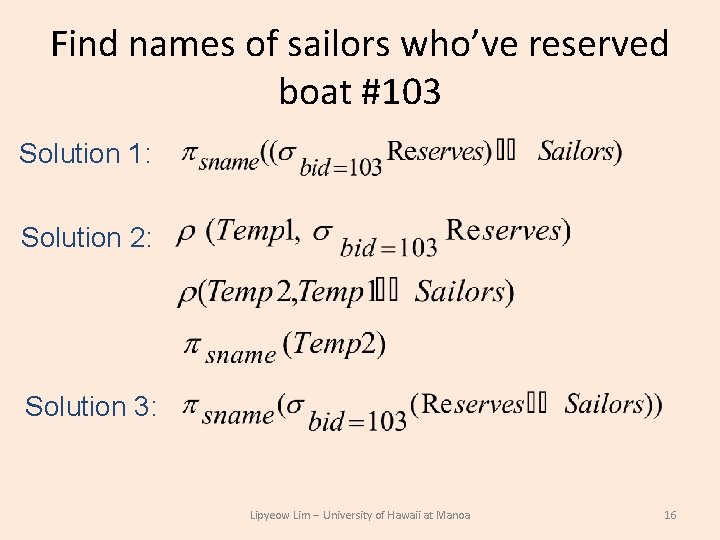
Find names of sailors who’ve reserved boat #103 Solution 1: Solution 2: Solution 3: Lipyeow Lim -- University of Hawaii at Manoa 16
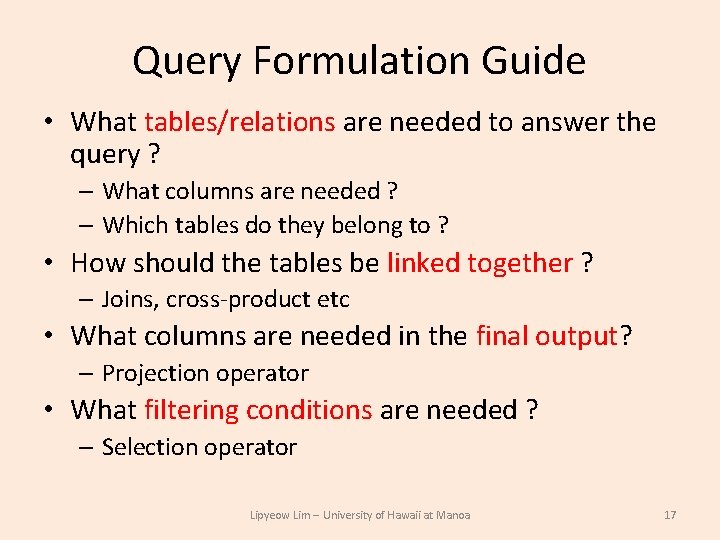
Query Formulation Guide • What tables/relations are needed to answer the query ? – What columns are needed ? – Which tables do they belong to ? • How should the tables be linked together ? – Joins, cross-product etc • What columns are needed in the final output? – Projection operator • What filtering conditions are needed ? – Selection operator Lipyeow Lim -- University of Hawaii at Manoa 17
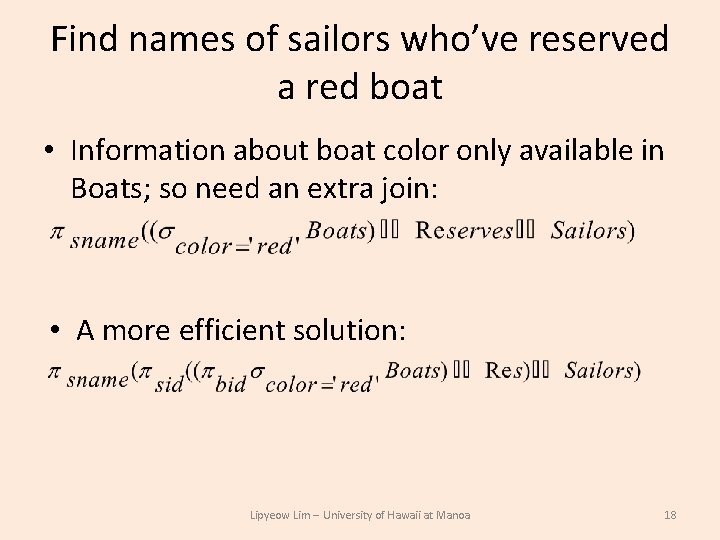
Find names of sailors who’ve reserved a red boat • Information about boat color only available in Boats; so need an extra join: • A more efficient solution: Lipyeow Lim -- University of Hawaii at Manoa 18
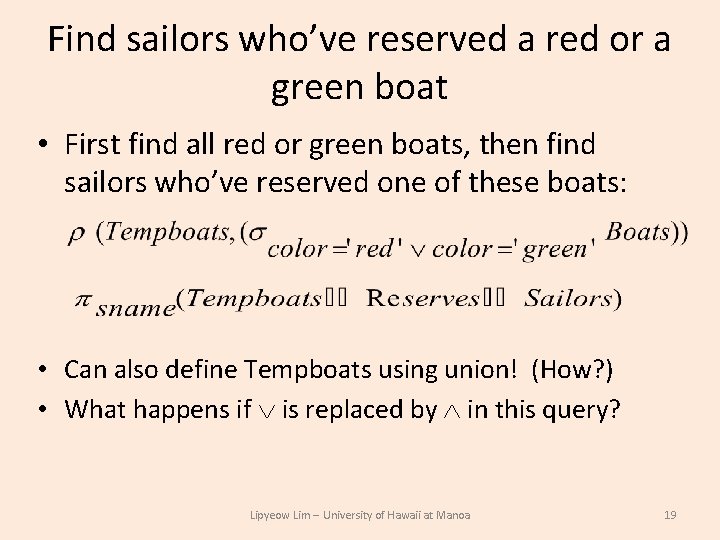
Find sailors who’ve reserved a red or a green boat • First find all red or green boats, then find sailors who’ve reserved one of these boats: • Can also define Tempboats using union! (How? ) • What happens if is replaced by in this query? Lipyeow Lim -- University of Hawaii at Manoa 19
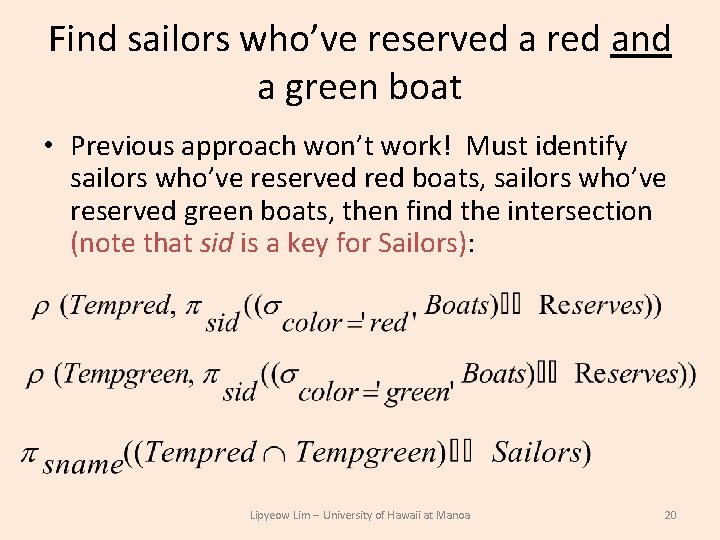
Find sailors who’ve reserved a red and a green boat • Previous approach won’t work! Must identify sailors who’ve reserved red boats, sailors who’ve reserved green boats, then find the intersection (note that sid is a key for Sailors): Lipyeow Lim -- University of Hawaii at Manoa 20
Summary • The Relational Data Model • Two theoretical relational query languages: relational algebra & relational calculus • Relational Algebra (RA) operators: selection, projection, cross-product, set difference, union, intersection, join, division, renaming • Operators are closed and can be composed • RA is more operational and could be used as internal representation for query evaluation plans. • For the same query, the RA expression is not unique. • Query optimizer can choose the most efficient version. Lipyeow Lim -- University of Hawaii at Manoa 21