
ICS 321 Data Storage Retrieval The Database Language
ICS 321 Data Storage & Retrieval The Database Language SQL (i) Asst. Prof. Lipyeow Lim Information & Computer Science Department University of Hawaii at Manoa Lipyeow Lim -- University of Hawaii at Manoa 1
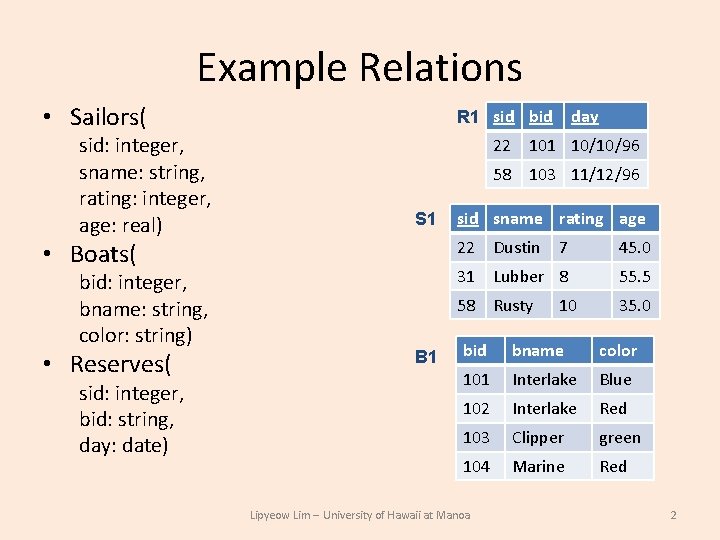
Example Relations • Sailors( sid: integer, sname: string, rating: integer, age: real) R 1 sid bid 22 101 10/10/96 58 103 11/12/96 S 1 • Reserves( sid: integer, bid: string, day: date) sid sname rating age 22 Dustin • Boats( bid: integer, bname: string, color: string) day B 1 7 45. 0 31 Lubber 8 55. 5 58 Rusty 35. 0 10 bid bname color 101 Interlake Blue 102 Interlake Red 103 Clipper green 104 Marine Red Lipyeow Lim -- University of Hawaii at Manoa 2
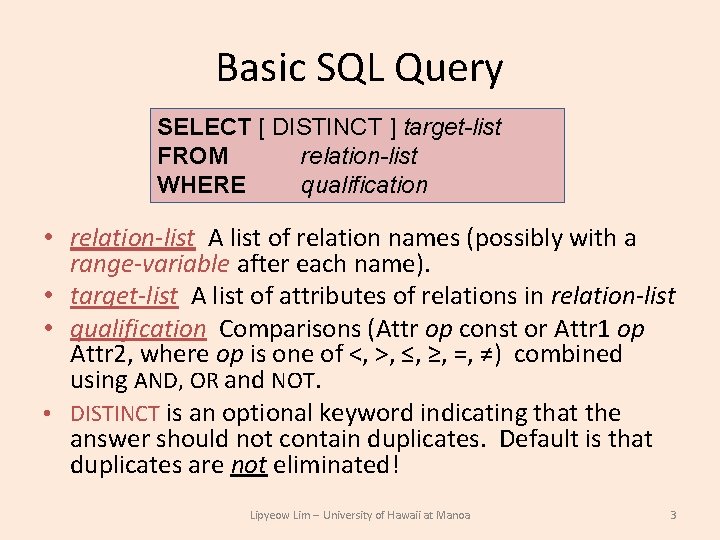
Basic SQL Query SELECT [ DISTINCT ] target-list FROM relation-list WHERE qualification • relation-list A list of relation names (possibly with a range-variable after each name). • target-list A list of attributes of relations in relation-list • qualification Comparisons (Attr op const or Attr 1 op Attr 2, where op is one of <, >, ≤, ≥, =, ≠) combined using AND, OR and NOT. • DISTINCT is an optional keyword indicating that the answer should not contain duplicates. Default is that duplicates are not eliminated! Lipyeow Lim -- University of Hawaii at Manoa 3
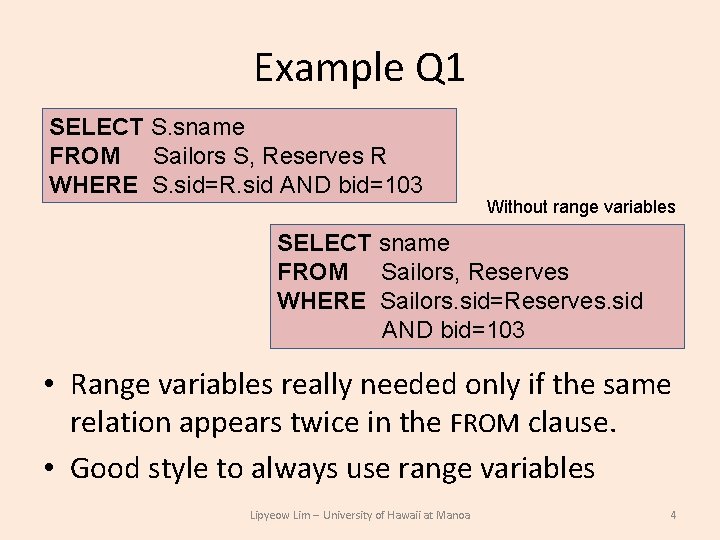
Example Q 1 SELECT S. sname FROM Sailors S, Reserves R WHERE S. sid=R. sid AND bid=103 Without range variables SELECT sname FROM Sailors, Reserves WHERE Sailors. sid=Reserves. sid AND bid=103 • Range variables really needed only if the same relation appears twice in the FROM clause. • Good style to always use range variables Lipyeow Lim -- University of Hawaii at Manoa 4
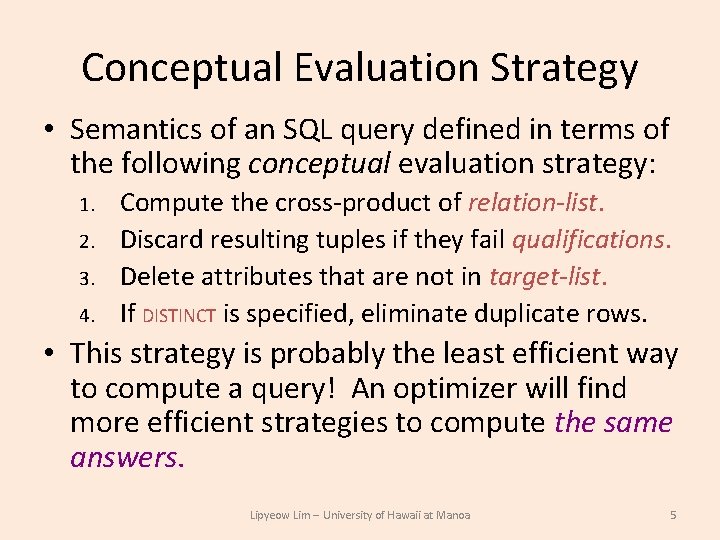
Conceptual Evaluation Strategy • Semantics of an SQL query defined in terms of the following conceptual evaluation strategy: 1. 2. 3. 4. Compute the cross-product of relation-list. Discard resulting tuples if they fail qualifications. Delete attributes that are not in target-list. If DISTINCT is specified, eliminate duplicate rows. • This strategy is probably the least efficient way to compute a query! An optimizer will find more efficient strategies to compute the same answers. Lipyeow Lim -- University of Hawaii at Manoa 5
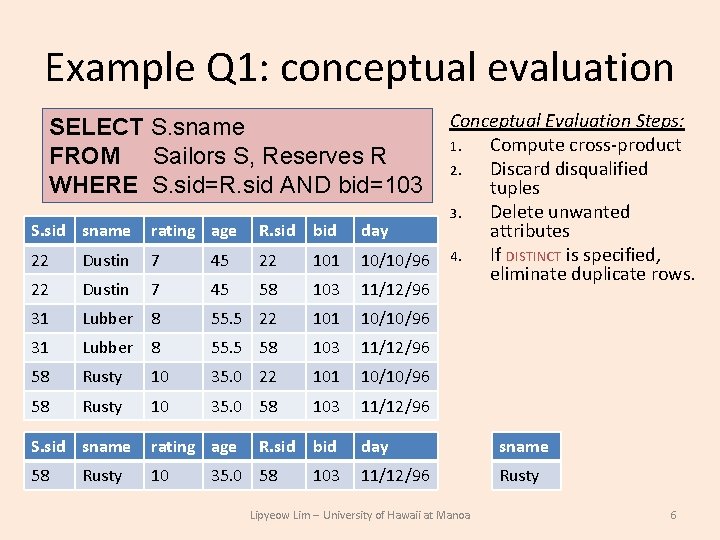
Example Q 1: conceptual evaluation Conceptual Evaluation Steps: 1. Compute cross-product 2. Discard disqualified tuples 3. Delete unwanted day attributes If DISTINCT is specified, 10/10/96 4. eliminate duplicate rows. SELECT S. sname FROM Sailors S, Reserves R WHERE S. sid=R. sid AND bid=103 S. sid sname rating age R. sid bid 22 Dustin 7 45 22 101 22 Dustin 7 45 58 103 31 Lubber 8 55. 5 22 101 10/10/96 31 Lubber 8 55. 5 58 103 11/12/96 58 Rusty 10 35. 0 22 101 10/10/96 58 Rusty 10 35. 0 58 103 11/12/96 S. sid sname rating age 58 10 Rusty R. sid bid 35. 0 58 103 11/12/96 day sname 11/12/96 Rusty Lipyeow Lim -- University of Hawaii at Manoa 6
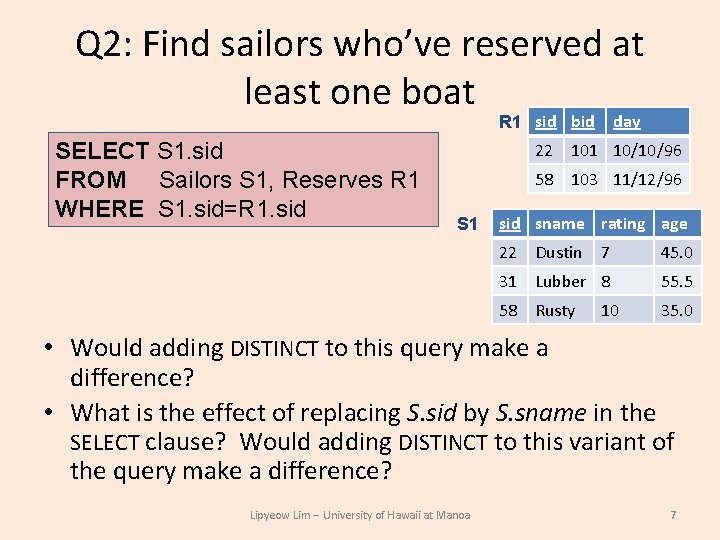
Q 2: Find sailors who’ve reserved at least one boat R 1 sid bid SELECT S 1. sid FROM Sailors S 1, Reserves R 1 WHERE S 1. sid=R 1. sid day 22 101 10/10/96 58 103 11/12/96 S 1 sid sname rating age 22 Dustin 7 45. 0 31 Lubber 8 55. 5 58 Rusty 35. 0 10 • Would adding DISTINCT to this query make a difference? • What is the effect of replacing S. sid by S. sname in the SELECT clause? Would adding DISTINCT to this variant of the query make a difference? Lipyeow Lim -- University of Hawaii at Manoa 7
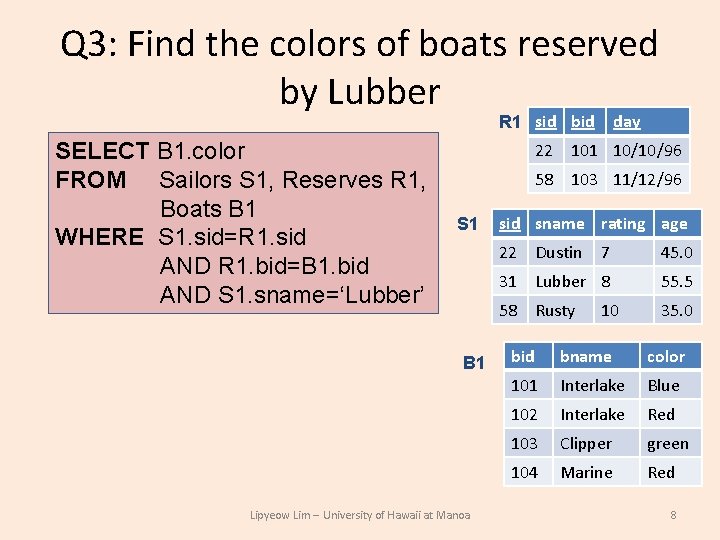
Q 3: Find the colors of boats reserved by Lubber R 1 sid bid SELECT B 1. color FROM Sailors S 1, Reserves R 1, Boats B 1 WHERE S 1. sid=R 1. sid AND R 1. bid=B 1. bid AND S 1. sname=‘Lubber’ day 22 101 10/10/96 58 103 11/12/96 S 1 sid sname rating age 22 Dustin B 1 Lipyeow Lim -- University of Hawaii at Manoa 7 45. 0 31 Lubber 8 55. 5 58 Rusty 35. 0 10 bid bname color 101 Interlake Blue 102 Interlake Red 103 Clipper green 104 Marine Red 8
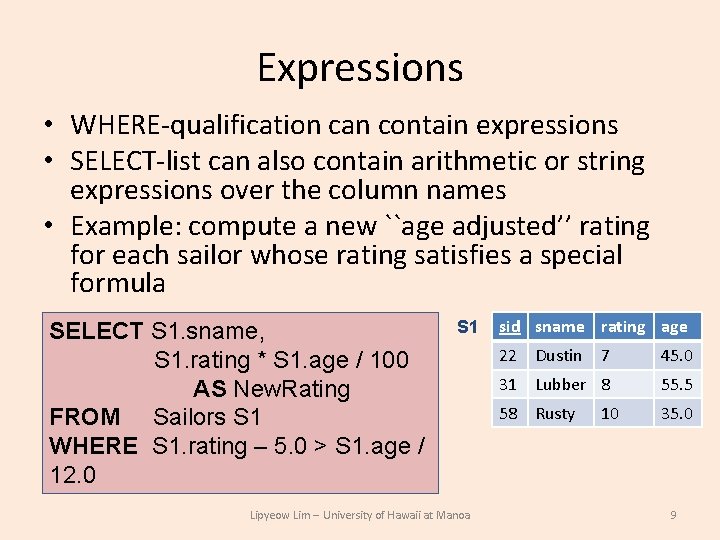
Expressions • WHERE-qualification can contain expressions • SELECT-list can also contain arithmetic or string expressions over the column names • Example: compute a new ``age adjusted’’ rating for each sailor whose rating satisfies a special formula SELECT S 1. sname, S 1. rating * S 1. age / 100 AS New. Rating FROM Sailors S 1 WHERE S 1. rating – 5. 0 > S 1. age / 12. 0 S 1 Lipyeow Lim -- University of Hawaii at Manoa sid sname rating age 22 Dustin 7 45. 0 31 Lubber 8 55. 5 58 Rusty 35. 0 10 9
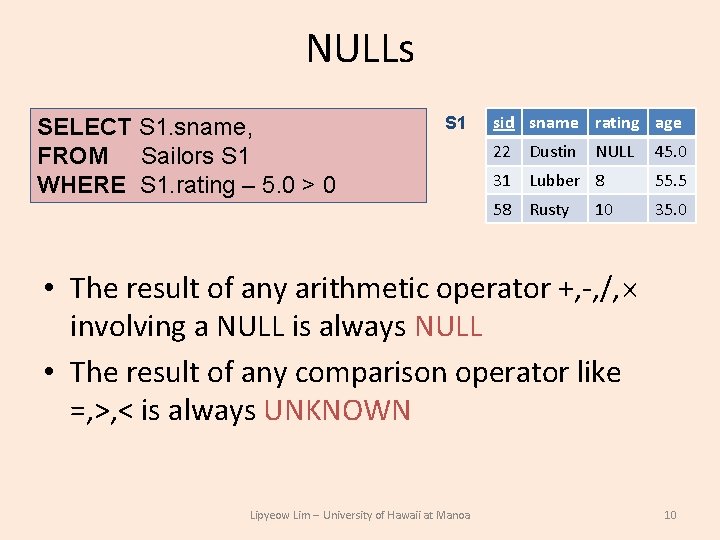
NULLs SELECT S 1. sname, FROM Sailors S 1 WHERE S 1. rating – 5. 0 > 0 S 1 sid sname rating age 22 Dustin NULL 45. 0 31 Lubber 8 55. 5 58 Rusty 35. 0 10 • The result of any arithmetic operator +, -, /, involving a NULL is always NULL • The result of any comparison operator like =, >, < is always UNKNOWN Lipyeow Lim -- University of Hawaii at Manoa 10
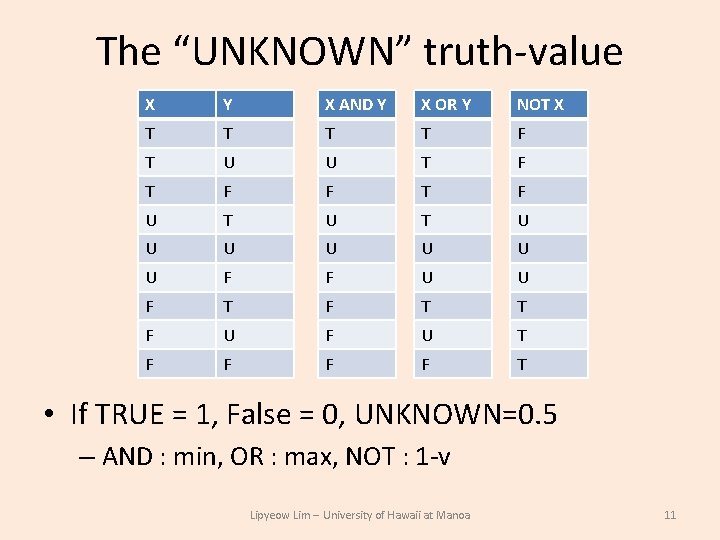
The “UNKNOWN” truth-value X Y X AND Y X OR Y NOT X T T F T U U T F F T F U T U U U U F F U U F T T F U T F F T • If TRUE = 1, False = 0, UNKNOWN=0. 5 – AND : min, OR : max, NOT : 1 -v Lipyeow Lim -- University of Hawaii at Manoa 11
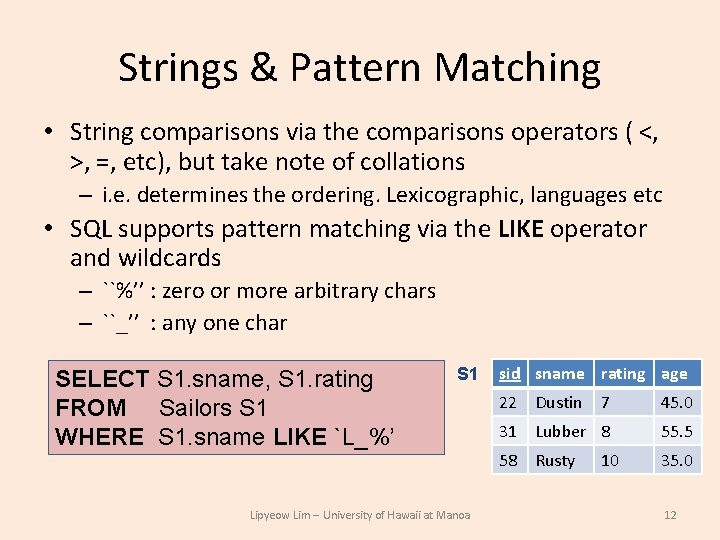
Strings & Pattern Matching • String comparisons via the comparisons operators ( <, >, =, etc), but take note of collations – i. e. determines the ordering. Lexicographic, languages etc • SQL supports pattern matching via the LIKE operator and wildcards – ``%’’ : zero or more arbitrary chars – ``_’’ : any one char SELECT S 1. sname, S 1. rating FROM Sailors S 1 WHERE S 1. sname LIKE `L_%’ S 1 Lipyeow Lim -- University of Hawaii at Manoa sid sname rating age 22 Dustin 7 45. 0 31 Lubber 8 55. 5 58 Rusty 35. 0 10 12
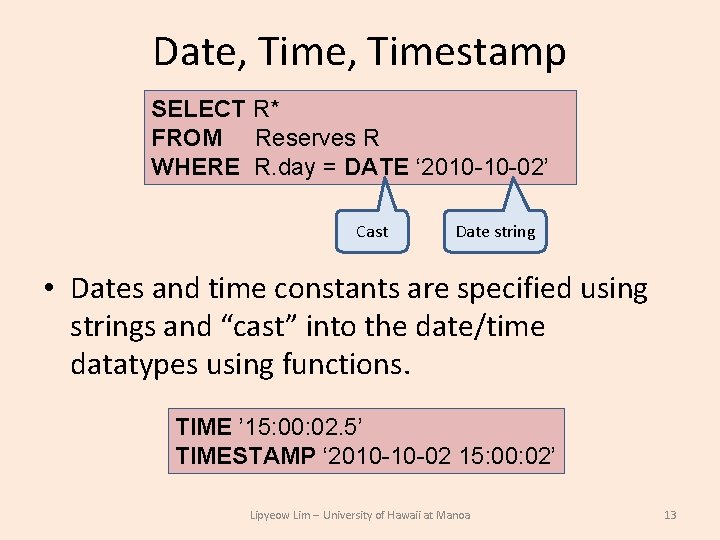
Date, Timestamp SELECT R* FROM Reserves R WHERE R. day = DATE ‘ 2010 -10 -02’ Cast Date string • Dates and time constants are specified using strings and “cast” into the date/time datatypes using functions. TIME ’ 15: 00: 02. 5’ TIMESTAMP ‘ 2010 -10 -02 15: 00: 02’ Lipyeow Lim -- University of Hawaii at Manoa 13
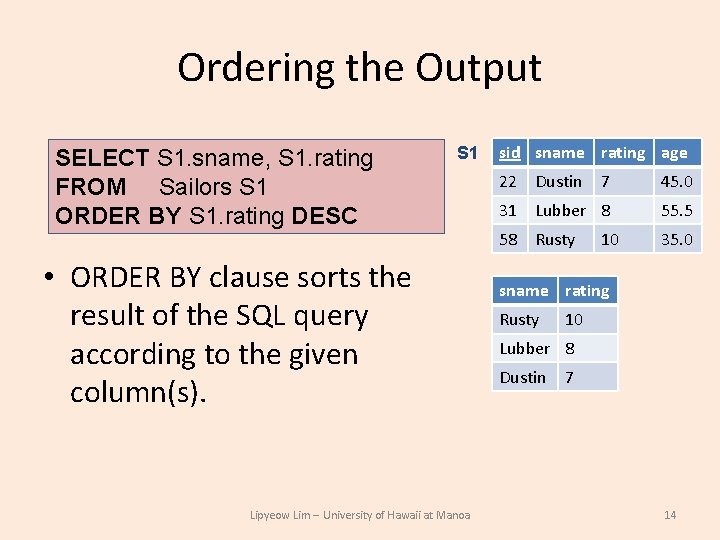
Ordering the Output SELECT S 1. sname, S 1. rating FROM Sailors S 1 ORDER BY S 1. rating DESC S 1 • ORDER BY clause sorts the result of the SQL query according to the given column(s). Lipyeow Lim -- University of Hawaii at Manoa sid sname rating age 22 Dustin 7 45. 0 31 Lubber 8 55. 5 58 Rusty 35. 0 10 sname rating Rusty 10 Lubber 8 Dustin 7 14
- Slides: 14