ICS 123 Architectural Styles ICS 123 Richard N


- Slides: 31
ICS 123 Architectural Styles ICS 123 Richard N. Taylor and Eric M. Dashofy UC Irvine http: //www. isr. uci. edu/classes/ics 123 s 02/ * with very special thanks to David S. Rosenblum for the use of his materials. .
Architectural Styles Topic 3 Architectural Styles ICS 123 • “A set of design rules that identify the kinds of components and connectors that may be used to compose a system or subsystem, together with local or global constraints on the way the composition is done” (Shaw & Clements, 1996) • A set of constraints you put on your development to elicit desirable properties from your software architecture. – Constraints may be: » Topological » Behavioral » Communication-oriented » etc. 2
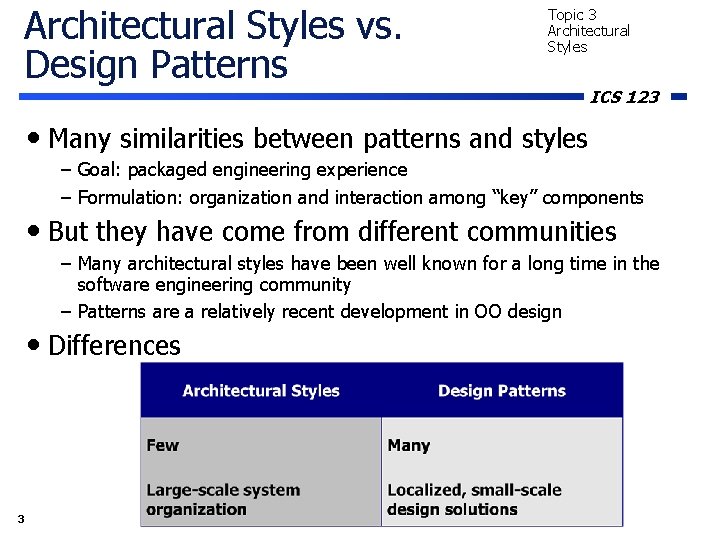
Architectural Styles vs. Design Patterns Topic 3 Architectural Styles ICS 123 • Many similarities between patterns and styles – Goal: packaged engineering experience – Formulation: organization and interaction among “key” components • But they have come from different communities – Many architectural styles have been well known for a long time in the software engineering community – Patterns are a relatively recent development in OO design • Differences 3
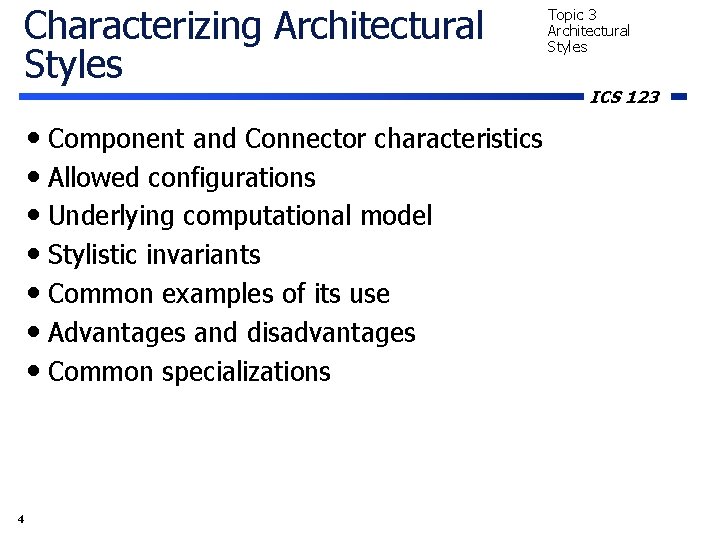
Characterizing Architectural Styles • Component and Connector characteristics • Allowed configurations • Underlying computational model • Stylistic invariants • Common examples of its use • Advantages and disadvantages • Common specializations 4 Topic 3 Architectural Styles ICS 123
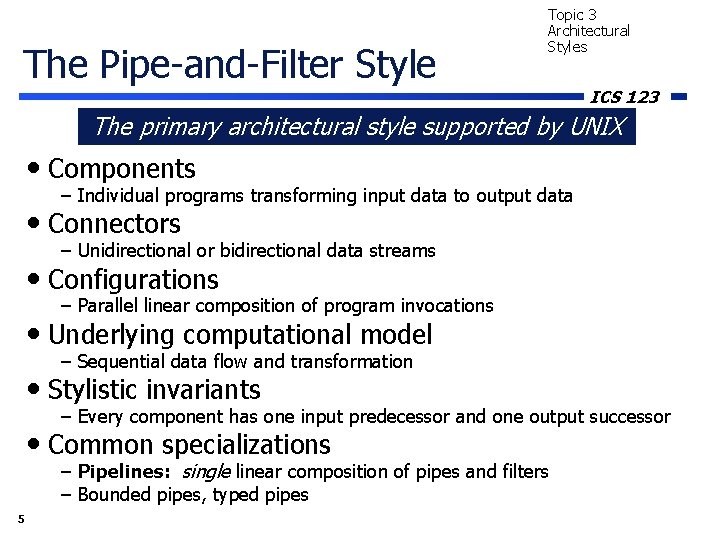
The Pipe-and-Filter Style Topic 3 Architectural Styles ICS 123 The primary architectural style supported by UNIX • Components – Individual programs transforming input data to output data • Connectors – Unidirectional or bidirectional data streams • Configurations – Parallel linear composition of program invocations • Underlying computational model – Sequential data flow and transformation • Stylistic invariants – Every component has one input predecessor and one output successor • Common specializations – Pipelines: single linear composition of pipes and filters – Bounded pipes, typed pipes 5
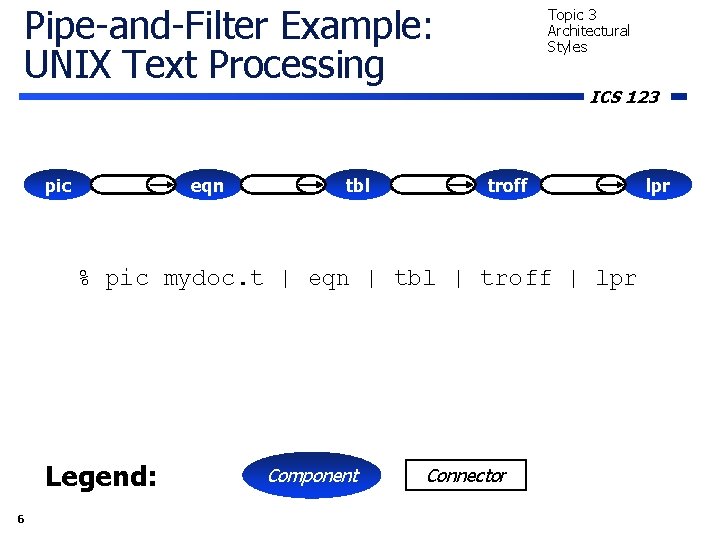
Pipe-and-Filter Example: UNIX Text Processing pic eqn tbl Topic 3 Architectural Styles ICS 123 troff % pic mydoc. t | eqn | tbl | troff | lpr Legend: 6 Component Connector lpr
Pipe-and-Filter Advantages and Disadvantages Topic 3 Architectural Styles ICS 123 • Advantages – – – Simplicity: Simple, intuitive, efficient composition of components Reusability: High potential for reuse of components Evolvability: Changing architectures is trivial Efficiency: Limited amount of concurrency (contrast batch-sequential) Consistency: All components have the same interfaces, only one type of connector – Distributability: Byte streams can be sent across networks • Disadvantages – – 7 Batch-oriented processing Must agree on lowest-common-denominator data format Does not guarantee semantics Limited application domain: stateless data transformation
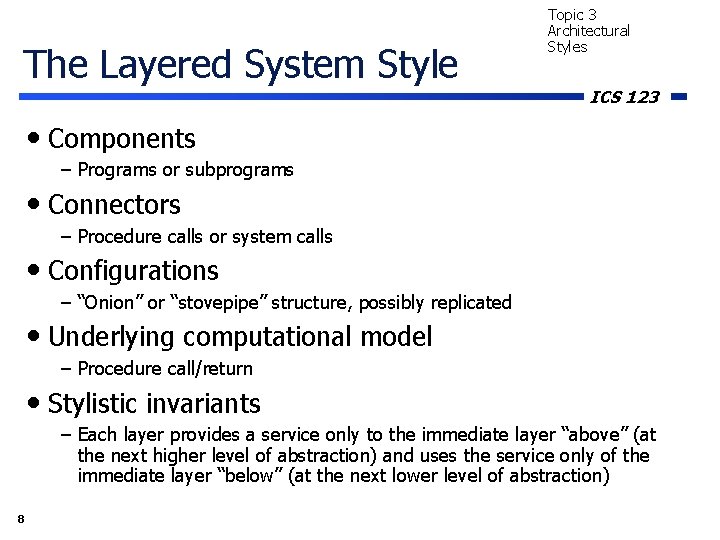
The Layered System Style Topic 3 Architectural Styles ICS 123 • Components – Programs or subprograms • Connectors – Procedure calls or system calls • Configurations – “Onion” or “stovepipe” structure, possibly replicated • Underlying computational model – Procedure call/return • Stylistic invariants – Each layer provides a service only to the immediate layer “above” (at the next higher level of abstraction) and uses the service only of the immediate layer “below” (at the next lower level of abstraction) 8
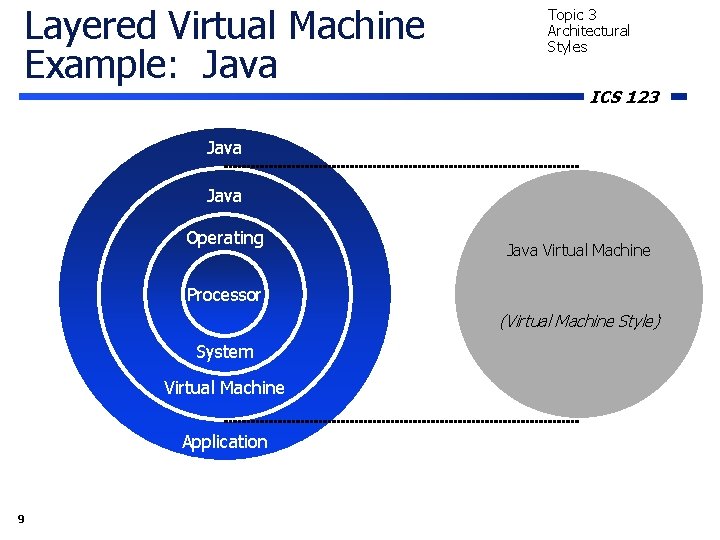
Layered Virtual Machine Example: Java Topic 3 Architectural Styles ICS 123 Java Operating Java Virtual Machine Processor (Virtual Machine Style) System Virtual Machine Application 9
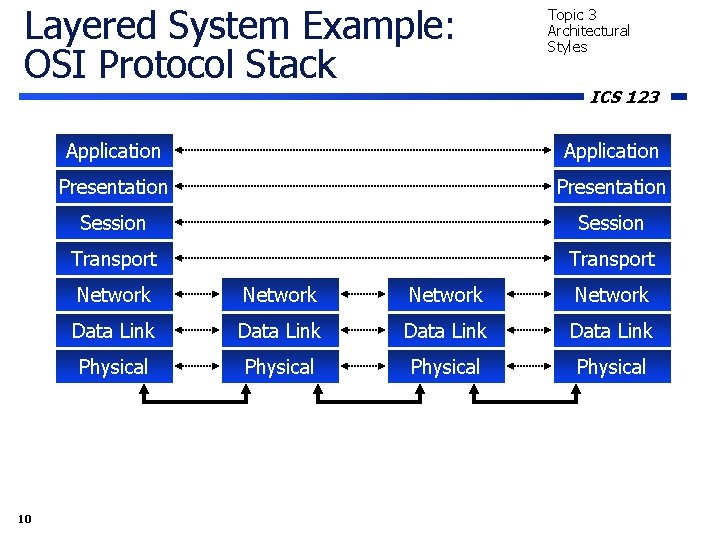
Layered System Example: OSI Protocol Stack 10 Topic 3 Architectural Styles ICS 123 Application Presentation Session Transport Network Data Link Physical
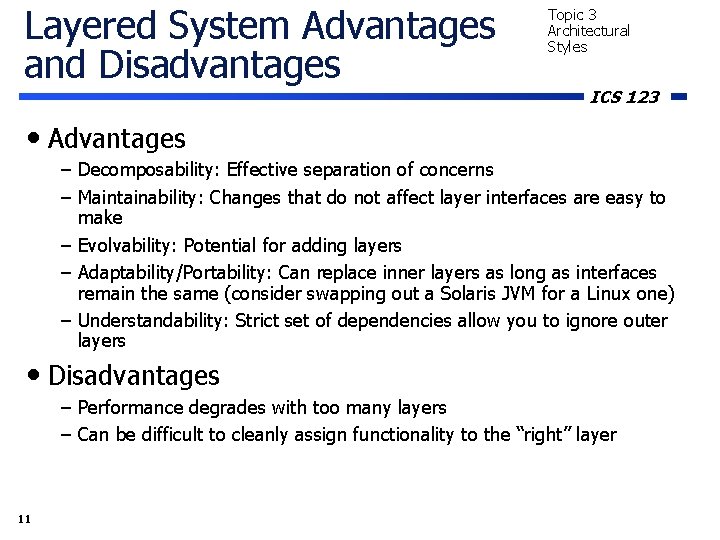
Layered System Advantages and Disadvantages Topic 3 Architectural Styles ICS 123 • Advantages – Decomposability: Effective separation of concerns – Maintainability: Changes that do not affect layer interfaces are easy to make – Evolvability: Potential for adding layers – Adaptability/Portability: Can replace inner layers as long as interfaces remain the same (consider swapping out a Solaris JVM for a Linux one) – Understandability: Strict set of dependencies allow you to ignore outer layers • Disadvantages – Performance degrades with too many layers – Can be difficult to cleanly assign functionality to the “right” layer 11
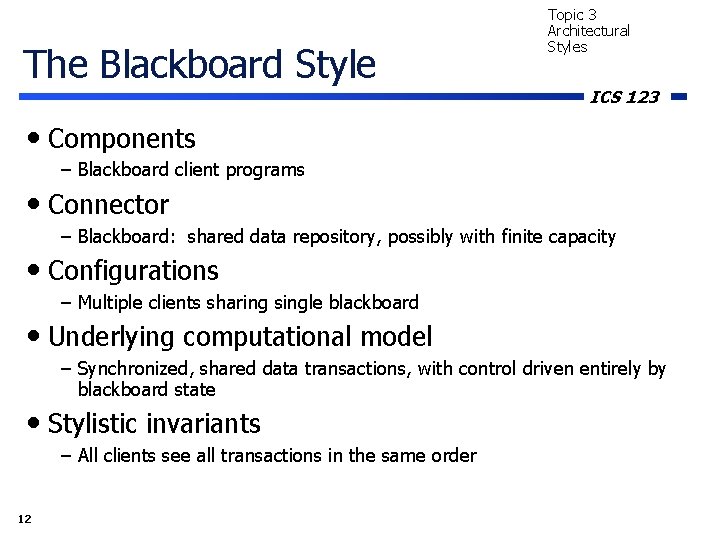
The Blackboard Style Topic 3 Architectural Styles ICS 123 • Components – Blackboard client programs • Connector – Blackboard: shared data repository, possibly with finite capacity • Configurations – Multiple clients sharing single blackboard • Underlying computational model – Synchronized, shared data transactions, with control driven entirely by blackboard state • Stylistic invariants – All clients see all transactions in the same order 12
Blackboard Example: A Chat Room Chat Participant Topic 3 Architectural Styles ICS 123 Chat Participant Chat Transcript Chat Participant 13 Chat Participant
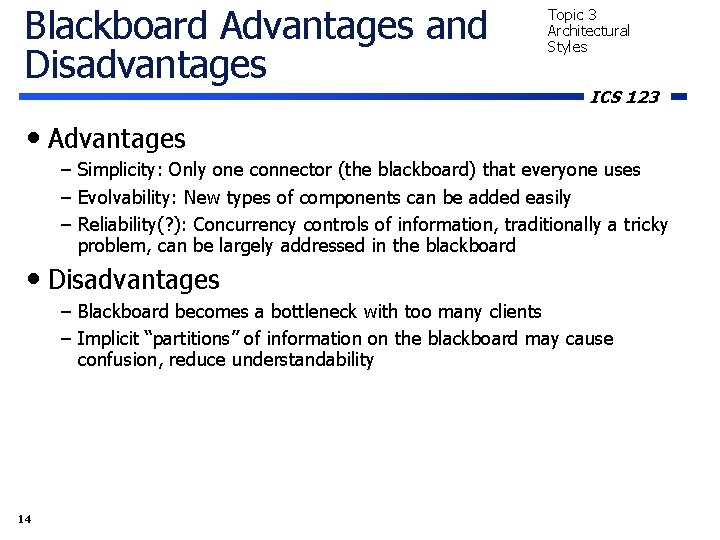
Blackboard Advantages and Disadvantages Topic 3 Architectural Styles ICS 123 • Advantages – Simplicity: Only one connector (the blackboard) that everyone uses – Evolvability: New types of components can be added easily – Reliability(? ): Concurrency controls of information, traditionally a tricky problem, can be largely addressed in the blackboard • Disadvantages – Blackboard becomes a bottleneck with too many clients – Implicit “partitions” of information on the blackboard may cause confusion, reduce understandability 14
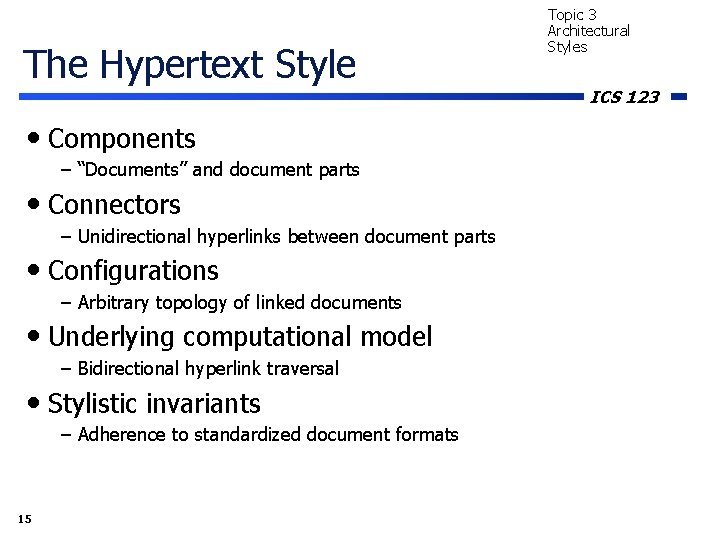
The Hypertext Style • Components – “Documents” and document parts • Connectors – Unidirectional hyperlinks between document parts • Configurations – Arbitrary topology of linked documents • Underlying computational model – Bidirectional hyperlink traversal • Stylistic invariants – Adherence to standardized document formats 15 Topic 3 Architectural Styles ICS 123
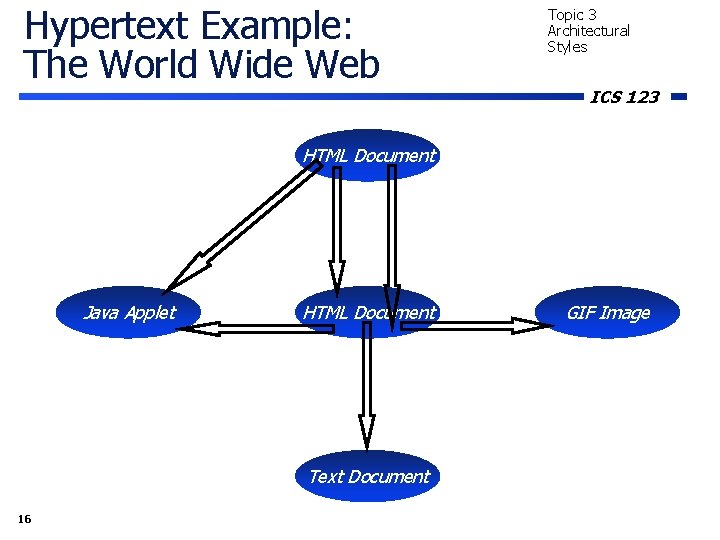
Hypertext Example: The World Wide Web Topic 3 Architectural Styles ICS 123 HTML Document Java Applet HTML Document Text Document 16 GIF Image
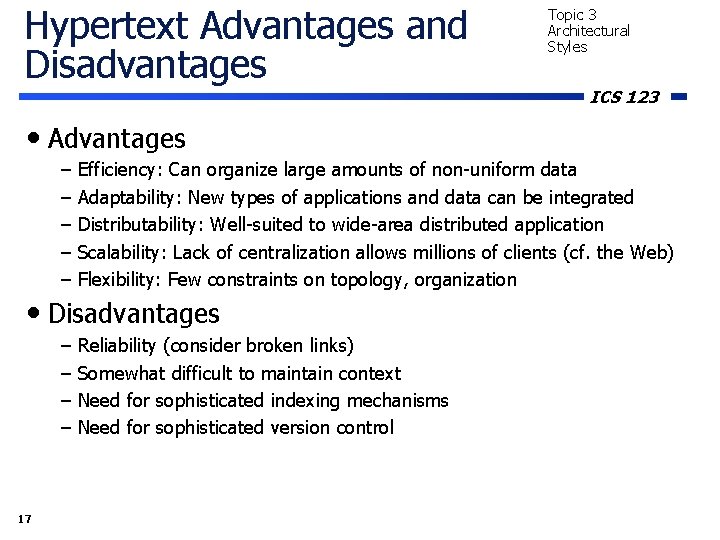
Hypertext Advantages and Disadvantages Topic 3 Architectural Styles ICS 123 • Advantages – – – Efficiency: Can organize large amounts of non-uniform data Adaptability: New types of applications and data can be integrated Distributability: Well-suited to wide-area distributed application Scalability: Lack of centralization allows millions of clients (cf. the Web) Flexibility: Few constraints on topology, organization • Disadvantages – – 17 Reliability (consider broken links) Somewhat difficult to maintain context Need for sophisticated indexing mechanisms Need for sophisticated version control
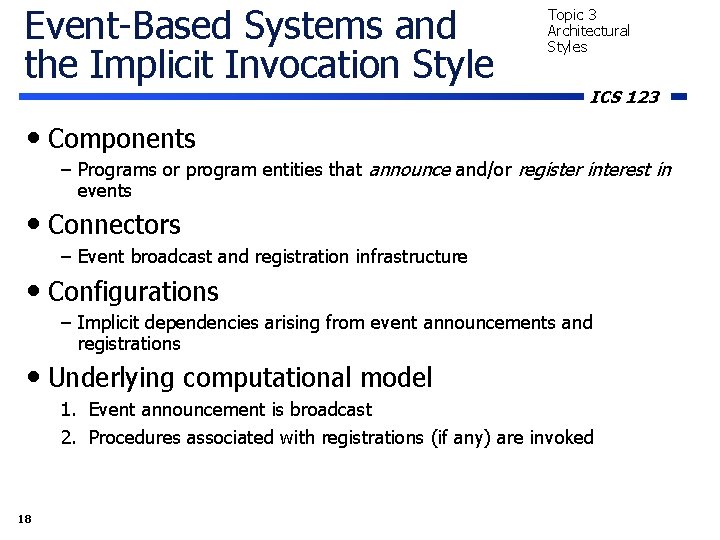
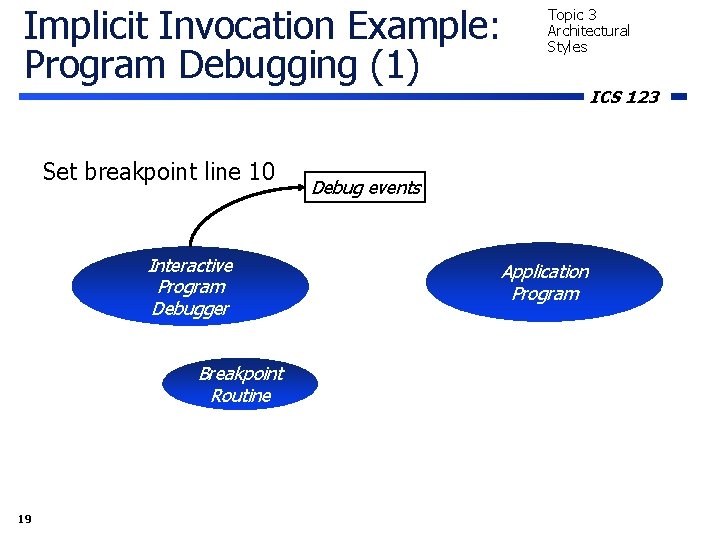
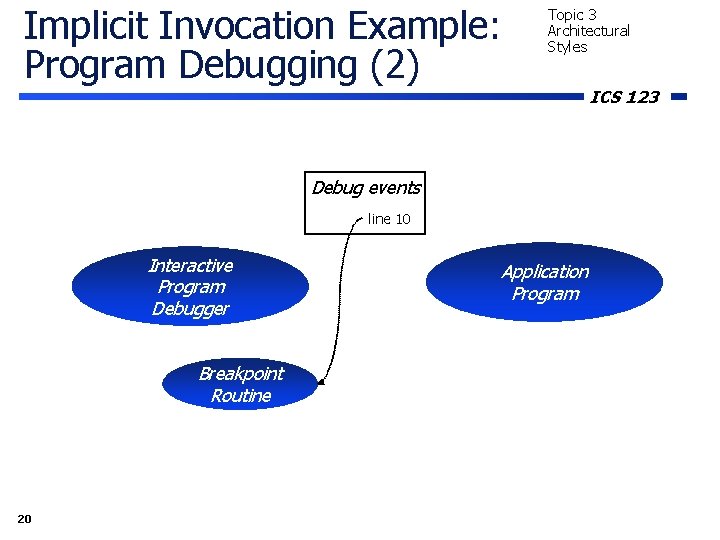
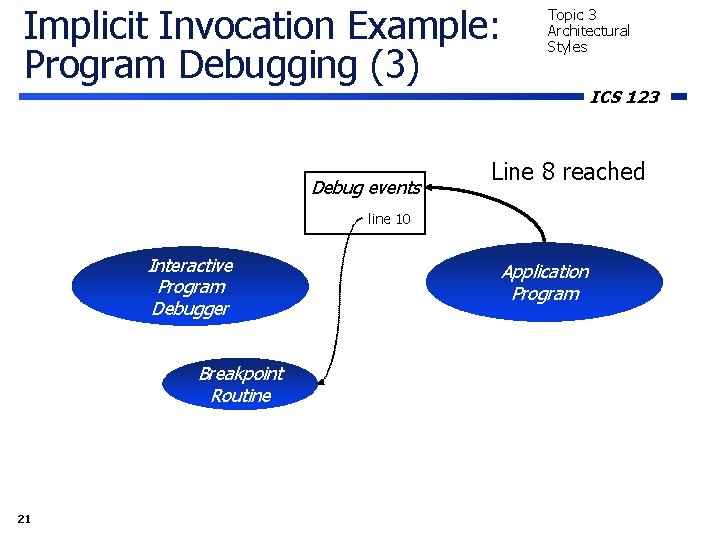
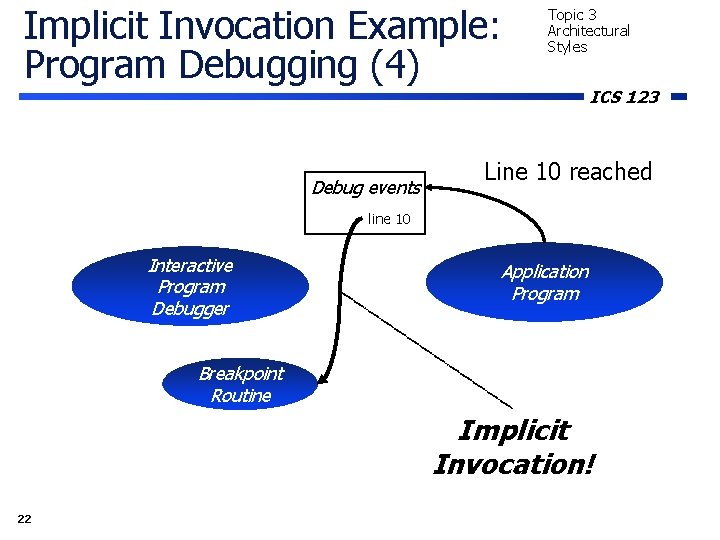
Event-Based Systems and the Implicit Invocation Style Topic 3 Architectural Styles ICS 123 • Components – Programs or program entities that announce and/or register interest in events • Connectors – Event broadcast and registration infrastructure • Configurations – Implicit dependencies arising from event announcements and registrations • Underlying computational model 1. Event announcement is broadcast 2. Procedures associated with registrations (if any) are invoked 18
Implicit Invocation Example: Program Debugging (1) Set breakpoint line 10 Interactive Program Debugger Breakpoint Routine 19 Topic 3 Architectural Styles Debug events Application Program ICS 123
Implicit Invocation Example: Program Debugging (2) Topic 3 Architectural Styles Debug events line 10 Interactive Program Debugger Breakpoint Routine 20 Application Program ICS 123
Implicit Invocation Example: Program Debugging (3) Debug events Topic 3 Architectural Styles Line 8 reached line 10 Interactive Program Debugger Breakpoint Routine 21 ICS 123 Application Program
Implicit Invocation Example: Program Debugging (4) Debug events Topic 3 Architectural Styles ICS 123 Line 10 reached line 10 Interactive Program Debugger Application Program Breakpoint Routine Implicit Invocation! 22
Implicit Invocation Advantages & Disadvantages Topic 3 Architectural Styles ICS 123 • Advantages – – Reusability: Components can be put in almost any context Distributability: Events are independent and can travel across the network Interoperability: Components may be very heterogeneous Visibility: Events are a reified form of communication that can be logged and viewed – Robustness: Components in this style generally have to be written to tolerate failure or unexpected circumstances well • Disadvantages – Reliability: Components announcing events have no guarantee of getting a response – Simplicity: Components announcing events have no control over the order of responses, so they must be robust enough to handle this – Understandability: Difficult to reason about the behavior of an announcing component independently of the components that register for its events – Event abstraction does not cleanly lend itself to data exchange 23
Distributed Peer-to-Peer Systems Topic 3 Architectural Styles ICS 123 • Components – Independently developed objects and programs offering public operations or services • Connectors – Remote procedure call (RPC) over computer networks • Configurations – Transient or persistent connections between cooperating components • Underlying computational model – Synchronous or asynchronous invocation of operations or services • Stylistic invariants – Communications are point-to-point 24
Client/Server Systems Topic 3 Architectural Styles ICS 123 • Client/Server systems are the most common specialization (restriction) of the peer-to-peer style • One component is a server offering a service • The other components are clients using the service • Server implementation is transparent but can be centralized or distributed, single-threaded or multithreaded – Single interface point with physically distributed implementation – Dynamic, transparent selection from among multiple interface points 25
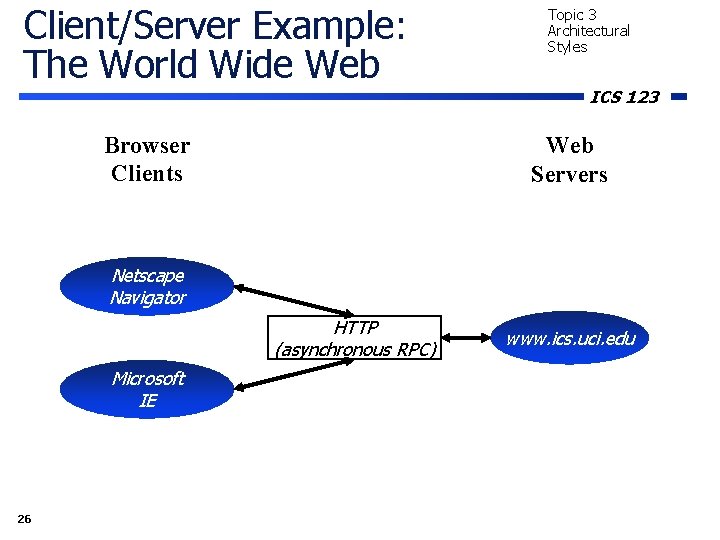
Client/Server Example: The World Wide Web Browser Clients Topic 3 Architectural Styles ICS 123 Web Servers Netscape Navigator HTTP (asynchronous RPC) Microsoft IE 26 www. ics. uci. edu
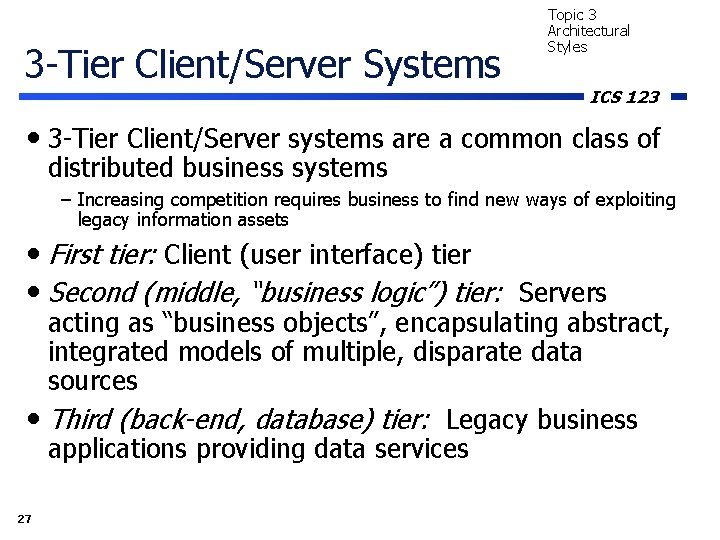
3 -Tier Client/Server Systems Topic 3 Architectural Styles ICS 123 • 3 -Tier Client/Server systems are a common class of distributed business systems – Increasing competition requires business to find new ways of exploiting legacy information assets • First tier: Client (user interface) tier • Second (middle, “business logic”) tier: Servers acting as “business objects”, encapsulating abstract, integrated models of multiple, disparate data sources • Third (back-end, database) tier: Legacy business applications providing data services 27
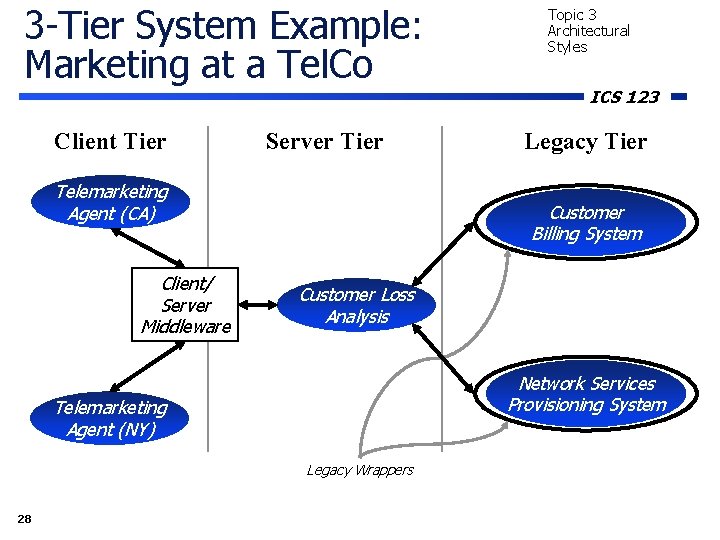
3 -Tier System Example: Marketing at a Tel. Co Client Tier Server Tier Telemarketing Agent (CA) Client/ Server Middleware ICS 123 Legacy Tier Customer Billing System Customer Loss Analysis Network Services Provisioning System Telemarketing Agent (NY) Legacy Wrappers 28 Topic 3 Architectural Styles
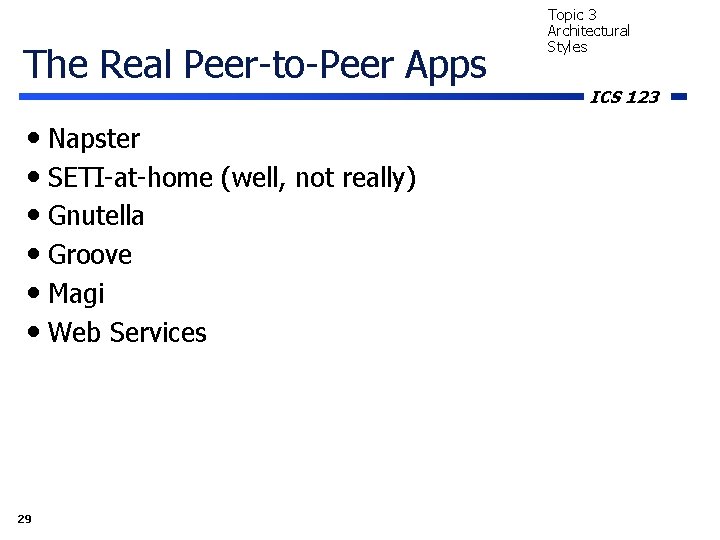
The Real Peer-to-Peer Apps • Napster • SETI-at-home (well, not really) • Gnutella • Groove • Magi • Web Services 29 Topic 3 Architectural Styles ICS 123
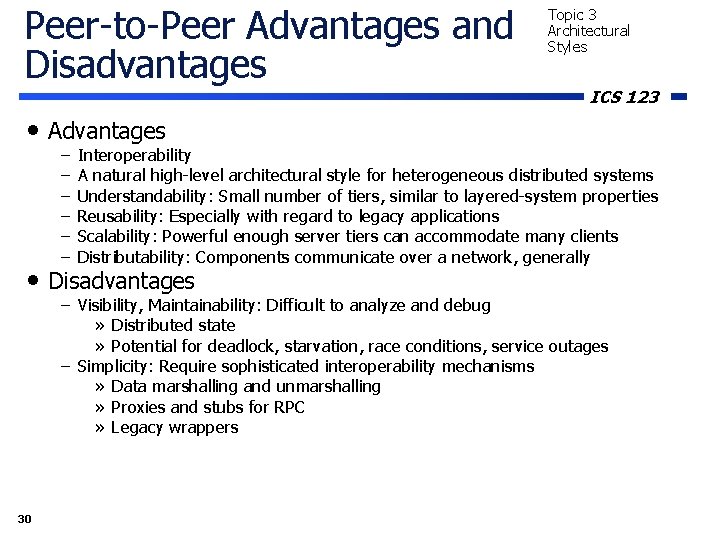
Peer-to-Peer Advantages and Disadvantages Topic 3 Architectural Styles ICS 123 • Advantages – – – Interoperability A natural high-level architectural style for heterogeneous distributed systems Understandability: Small number of tiers, similar to layered-system properties Reusability: Especially with regard to legacy applications Scalability: Powerful enough server tiers can accommodate many clients Distributability: Components communicate over a network, generally • Disadvantages – Visibility, Maintainability: Difficult to analyze and debug » Distributed state » Potential for deadlock, starvation, race conditions, service outages – Simplicity: Require sophisticated interoperability mechanisms » Data marshalling and unmarshalling » Proxies and stubs for RPC » Legacy wrappers 30
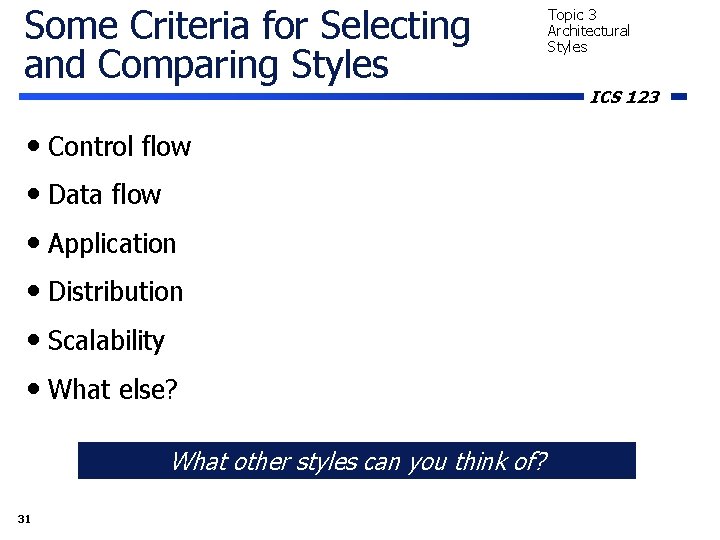
Some Criteria for Selecting and Comparing Styles • Control flow • Data flow • Application • Distribution • Scalability • What else? What other styles can you think of? 31 Topic 3 Architectural Styles ICS 123