Human Resource Management CHAPTER 1 INTRODUCTION TO HUMAN
- Slides: 46
Human Resource Management
CHAPTER 1: INTRODUCTION TO HUMAN RESOURCE MANAGEMENT
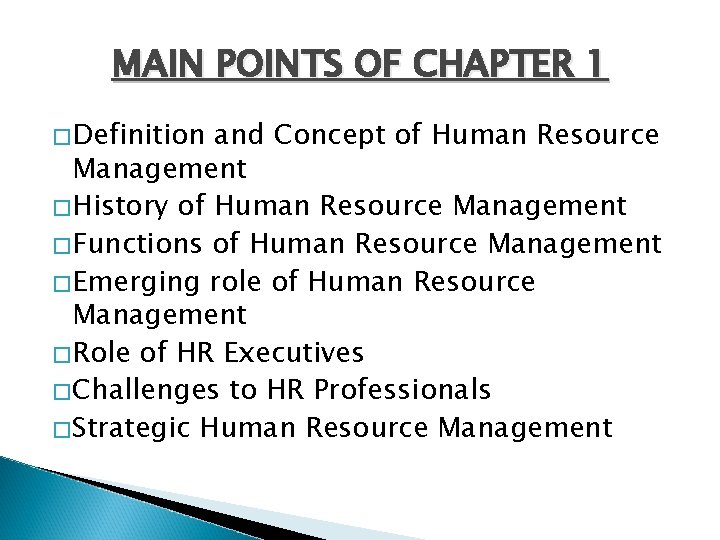
MAIN POINTS OF CHAPTER 1 �Definition and Concept of Human Resource Management �History of Human Resource Management �Functions of Human Resource Management �Emerging role of Human Resource Management �Role of HR Executives �Challenges to HR Professionals �Strategic Human Resource Management
HRM Meaning and Definition Human Resource Management is also a function of management, concerned with hiring, motivating and maintaining people in an organisation. It focuses on people in the organisation.
HRM Meaning and Definition Organisations does not only consist of building, machines or inventories. It is people they manage and staff the organisation HRM applies management principles in procuring, developing, maintaining people in the organisation. Aims at integrated decision making and decisions on different aspects of employees are consistent with other HR decisions HR Decisions must influence effectiveness of the organisation leading to better service to customer and high quality product and services at reasonable price. It is not confined to business establishment only, HRM is applicable also to the non business organisation, like government department, education, health care etc.
Definition Human Resource Management is a series of integrated decisions that form the employment relationship; their quality contributes to the ability of the organisations and the employees to achieve their objectives. - Milkovich and Boudreau
Definition Human Resource Management is concerned with the people dimension in management. Since every organisation is made up of people, acquiring their services, developing their skills, motivating them to higher levels of performance and ensuring that they continue to maintain their commitment to the organisation are essential to achieving organisational objectives. This is true regardless of the type of organisation – government, business, education, health, recreation or social action. - David A. Decenzo and Stephen P. Robbins
Definition Human Resource Management is the planning, organising, directing and controlling of the procurement, development, compensation, integration, maintenance and separation of human resources to the end that individual, organisational, and social objectives are accomplished. - Edwin B. Flippo
HUMAN RESOURCE MANAGEMENT Management is concerned with accomplishment of objectives by utilizing physical & financial resources through the efforts of human resources. “Personnel/Human resource management is the function performed in organizations that facilitates the most effective use of people (employees) to achieve organizational goals & individual goals. ” Invancevich and Glueck
Basic Concepts
Human resource management is………. . . Managing (planning , organizing , directing & controlling) the functions of employing, developing & compensating human resources resulting in creating & developing human relations & utilization of human resources with a view to contribute proportionately to organisational, individual and social goals. Process of managing human talent to achieve an organizations objectives. “In many fast-growing economies it is easier to access money & technology than good people”.
Human resource management is………. . . Managing (planning , organizing , directing & controlling) the functions of employing, developing & compensating human resources resulting in creating & developing human relations & utilization of human resources with a view to contribute proportionately to organisational, individual and social goals. Process of managing human talent to achieve an organizations objectives. “In many fast-growing economies it is easier to access money & technology than good people”.
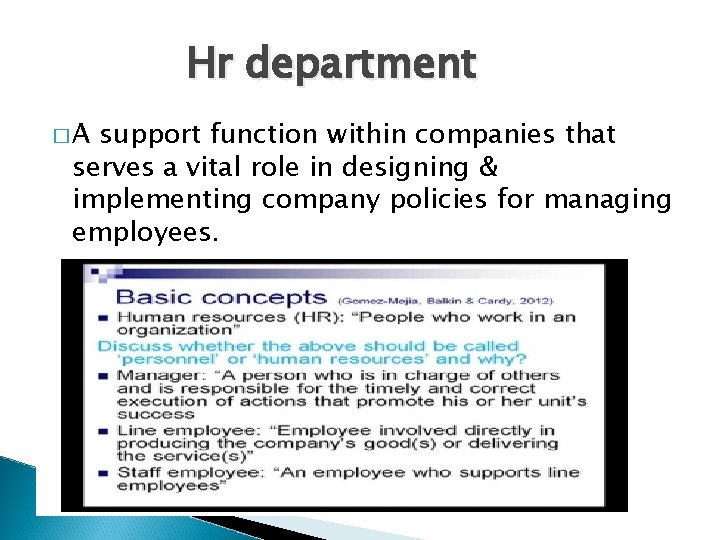
Hr department �A support function within companies that serves a vital role in designing & implementing company policies for managing employees.
Why study HRM � Whether to plan to work in HR department or not –staffing the organisation, designing jobs & teams, developing skillful employees, identifying approaches for improving performance, rewarding employee success …. labelled HRM issues are as relevant to line managers as to HR department. � Knowledge about systems and practices available to help build a skilled & motivated workforce.
Why study hrm… Awareness of economic, social & legal issues that facilitate or constrain efforts to achieve organisational goals. Employee skills, knowledge, abilities most distinctive & renewable resources Integral part of every managers job “YOU CAN GET CAPITAL & ERECT BUILDINGS , BUT IT TAKES PEOPLE TO BUILD A BUSINESS”
Nature of HRM Pervasive force – all organisations, all levels Integrating mechanism Action oriented – record keeping, written rules Individual oriented People oriented Future oriented Continuous function Development oriented Comprehensive function Auxiliary service Inter-disciplinary function
History of HRM � Industrial revolution � Scientific Management � Trade Unionism � Human Relations Movement/Human Resource Approach
Industrial revolution � Machines brought in, technology made progress � Jobs fragmented, worker did small portion of total job � Specialisation increased, speed , effieciency but left workers dull, boring, monotonous jobs. � Workers treated like “glorified machine tools”. � Employers keen to meet production targets � Little or no government protection
Scientific management To improve efficiency & speed FW Taylor advocated scientific management. Systematic analysis & breakdown of work into its smallest mechanical elements & rearranging them into most efficient combination. Individuals. . perfectly matched physically, mentally to requirements of task. Exclude overqualified Supervisor to train carefully, ensure they performed task as specified by prior scientific analysis. Differential piece rate system
Trade unionism � Workers joined hands to protect against exploitative tendencies of employers, unfair labor practices through unions. � Unions tried to improve workers through collective bargaining, resolving grievances of workers relating to working conditions, pay & benefits, disciplinary actions etc.
Human relations movement Hawthrone experiments by Elton Mayo demonstarted employee productivity was affected not only by way job is designed & economical rewards but by certain social & psychological factors as well. This movement led to wide scale implementation of behavioral science techniques in industry. . supervisory training progremmes emphasizing support & concern for workers, programmes to stengthen bond between labour & management. . Counselling programmes Rise of unionism
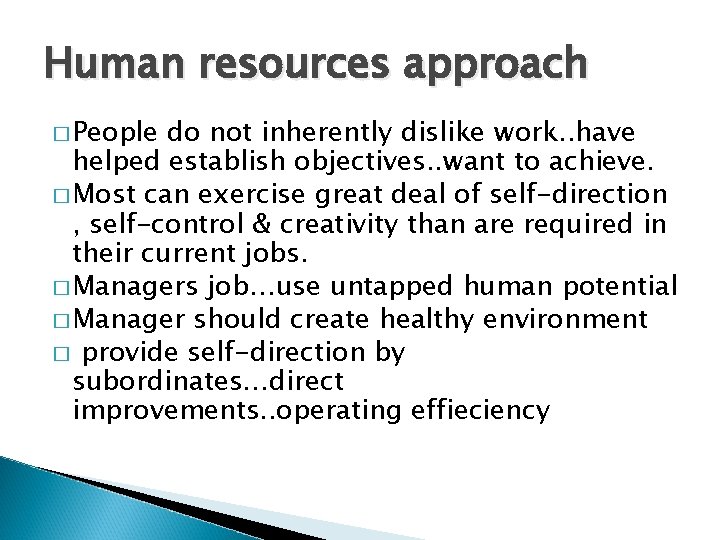
Human resources approach � Workers are unique in their own way. . having individual needs. � Trend towards treating employees as resources or assets emerged. � Assumes that job or the task itself is primary source of satisfaction & motivation to employees. � Emphasis on individual involvement in decisions made in organistion
Human resources approach � People do not inherently dislike work. . have helped establish objectives. . want to achieve. � Most can exercise great deal of self-direction , self-control & creativity than are required in their current jobs. � Managers job…use untapped human potential � Manager should create healthy environment � provide self-direction by subordinates…direct improvements. . operating effieciency
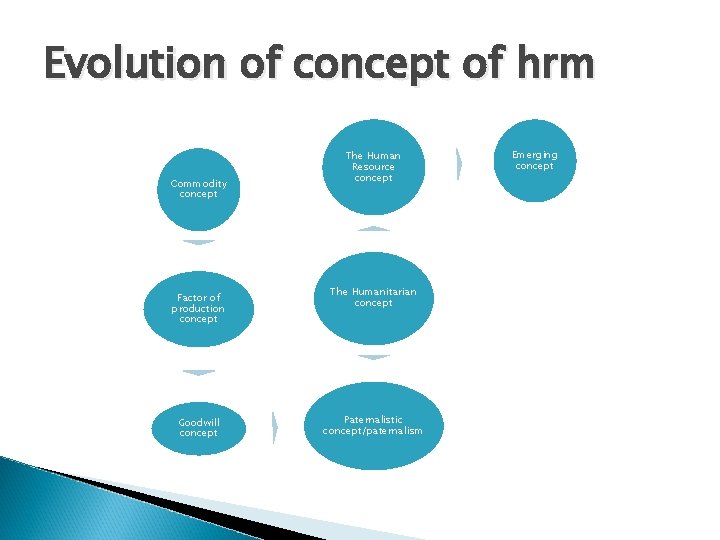
Evolution of concept of hrm Commodity concept Factor of production concept Goodwill concept The Human Resource concept The Humanitarian concept Paternalistic concept/paternalism Emerging concept
de
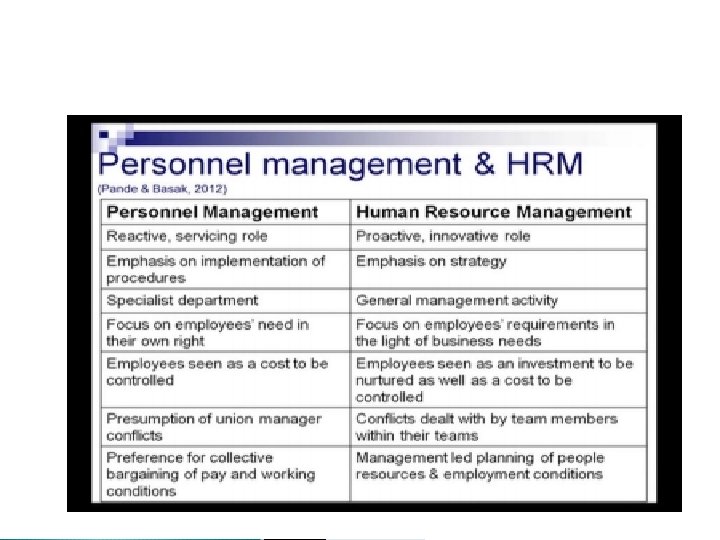
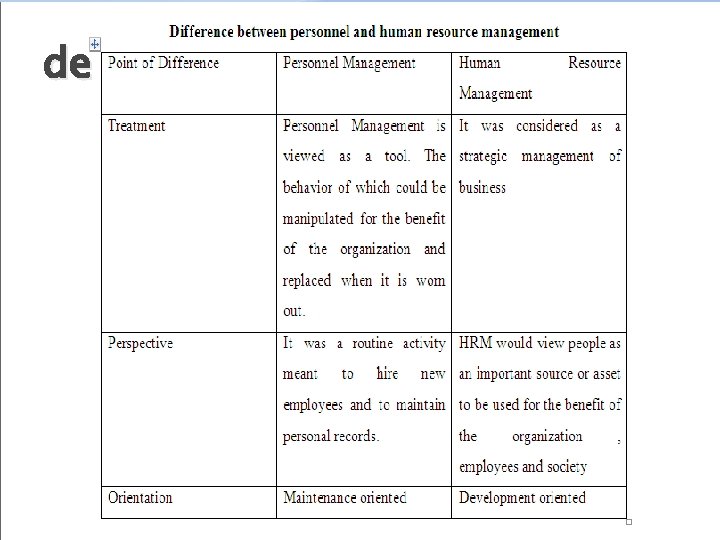
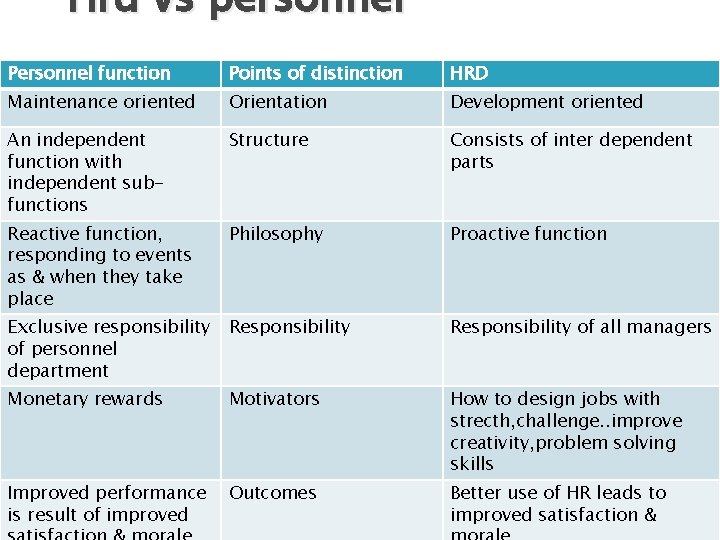
Hrd vs personnel Personnel function Points of distinction HRD Maintenance oriented Orientation Development oriented An independent function with independent subfunctions Structure Consists of inter dependent parts Reactive function, responding to events as & when they take place Philosophy Proactive function Exclusive responsibility of personnel department Responsibility of all managers Monetary rewards Motivators How to design jobs with strecth, challenge. . improve creativity, problem solving skills Improved performance is result of improved Outcomes Better use of HR leads to improved satisfaction &
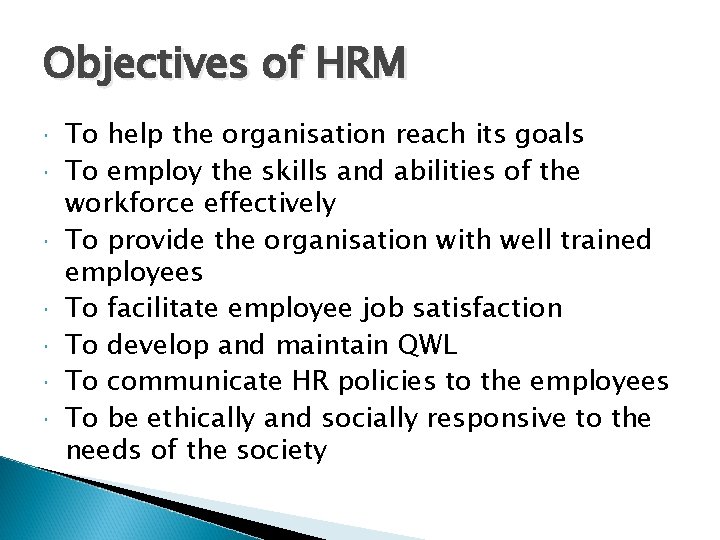
Objectives of HRM To help the organisation reach its goals To employ the skills and abilities of the workforce effectively To provide the organisation with well trained employees To facilitate employee job satisfaction To develop and maintain QWL To communicate HR policies to the employees To be ethically and socially responsive to the needs of the society
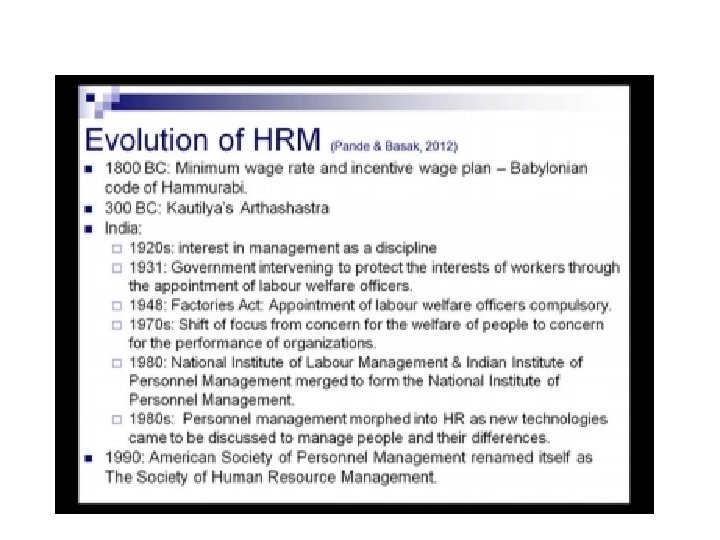
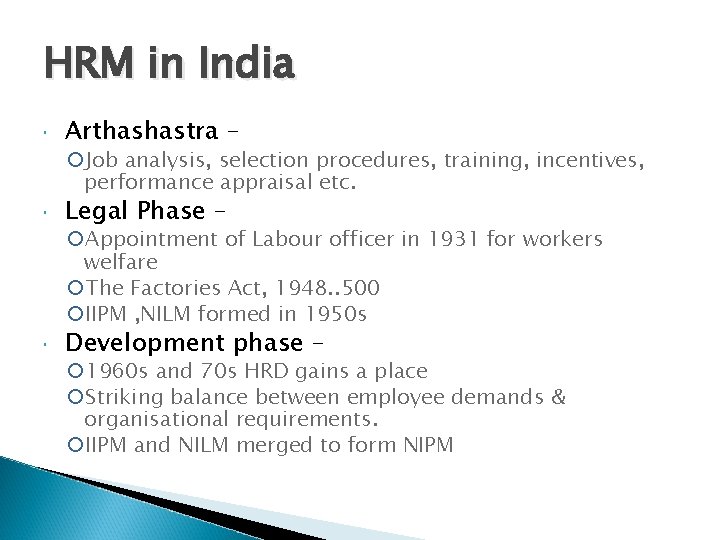
HRM in India Arthashastra – Job analysis, selection procedures, training, incentives, performance appraisal etc. Legal Phase – Appointment of Labour officer in 1931 for workers welfare The Factories Act, 1948. . 500 IIPM , NILM formed in 1950 s Development phase – 1960 s and 70 s HRD gains a place Striking balance between employee demands & organisational requirements. IIPM and NILM merged to form NIPM
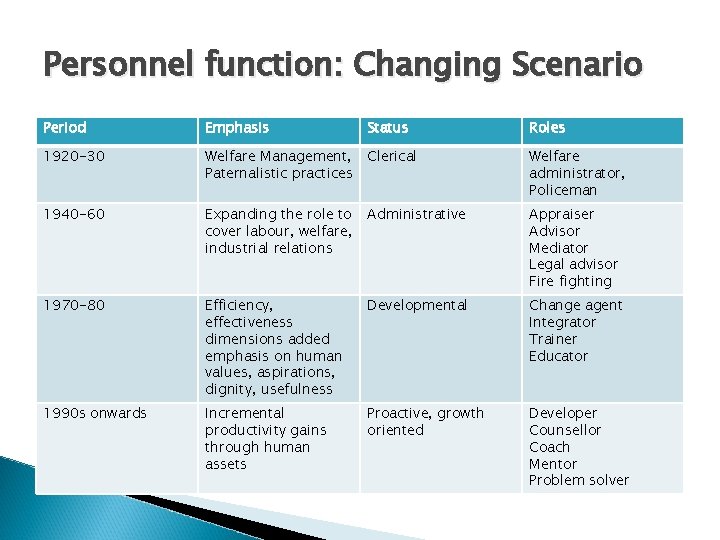
Personnel function: Changing Scenario Period Emphasis Status Roles 1920 -30 Welfare Management, Paternalistic practices Clerical Welfare administrator, Policeman 1940 -60 Expanding the role to cover labour, welfare, industrial relations Administrative Appraiser Advisor Mediator Legal advisor Fire fighting 1970 -80 Efficiency, effectiveness dimensions added emphasis on human values, aspirations, dignity, usefulness Developmental Change agent Integrator Trainer Educator 1990 s onwards Incremental productivity gains through human assets Proactive, growth oriented Developer Counsellor Coach Mentor Problem solver
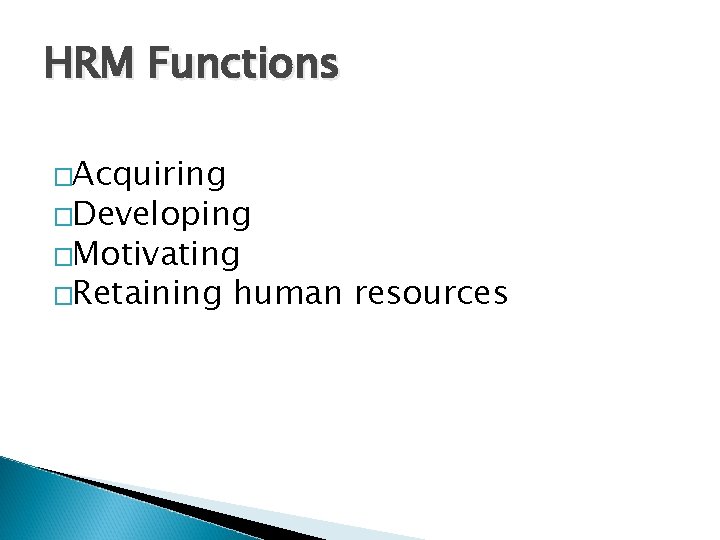
HRM Functions �Acquiring �Developing �Motivating �Retaining human resources
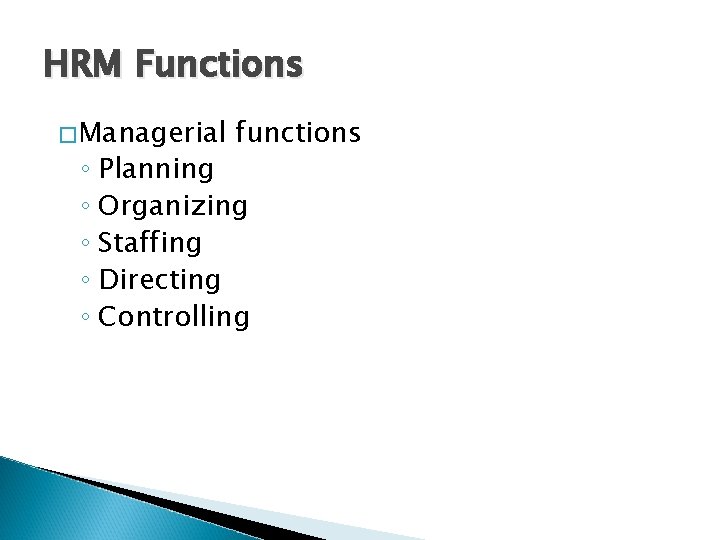
HRM Functions �Managerial functions ◦ Planning ◦ Organizing ◦ Staffing ◦ Directing ◦ Controlling
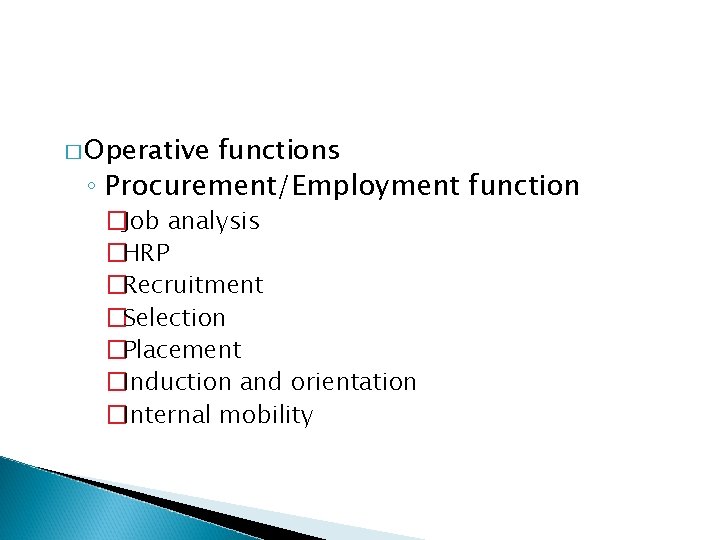
� Operative functions ◦ Procurement/Employment function �Job analysis �HRP �Recruitment �Selection �Placement �Induction and orientation �Internal mobility
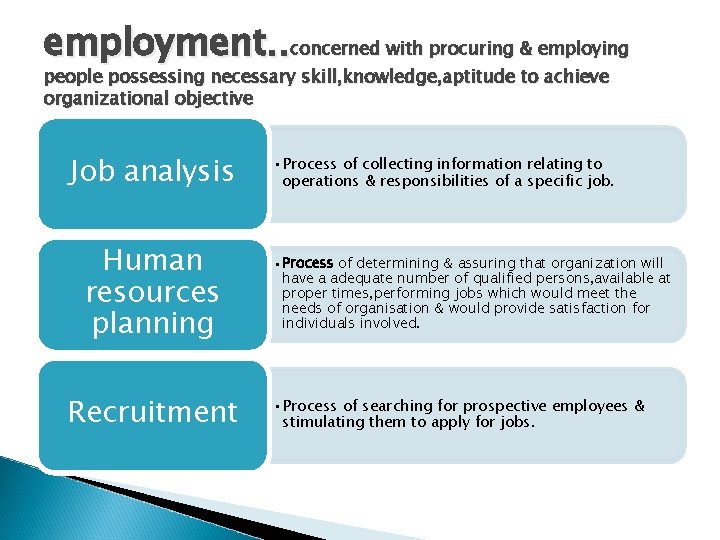
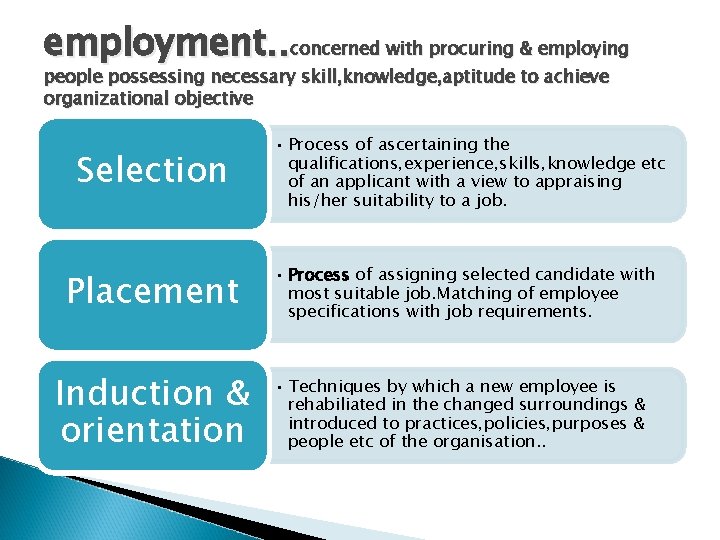
employment. . concerned with procuring & employing people possessing necessary skill, knowledge, aptitude to achieve organizational objective Job analysis Human resources planning Recruitment • Process of collecting information relating to operations & responsibilities of a specific job. • Process of determining & assuring that organization will have a adequate number of qualified persons, available at proper times, performing jobs which would meet the needs of organisation & would provide satisfaction for individuals involved. • Process of searching for prospective employees & stimulating them to apply for jobs.
employment. . concerned with procuring & employing people possessing necessary skill, knowledge, aptitude to achieve organizational objective Selection • Process of ascertaining the qualifications, experience, skills, knowledge etc of an applicant with a view to appraising his/her suitability to a job. Placement • Process of assigning selected candidate with most suitable job. Matching of employee specifications with job requirements. Induction & orientation • Techniques by which a new employee is rehabiliated in the changed surroundings & introduced to practices, policies, purposes & people etc of the organisation. .
◦ Human Resource Development �Training �Performance appraisal �Executive/management development �Career Planning and development �Organizational development
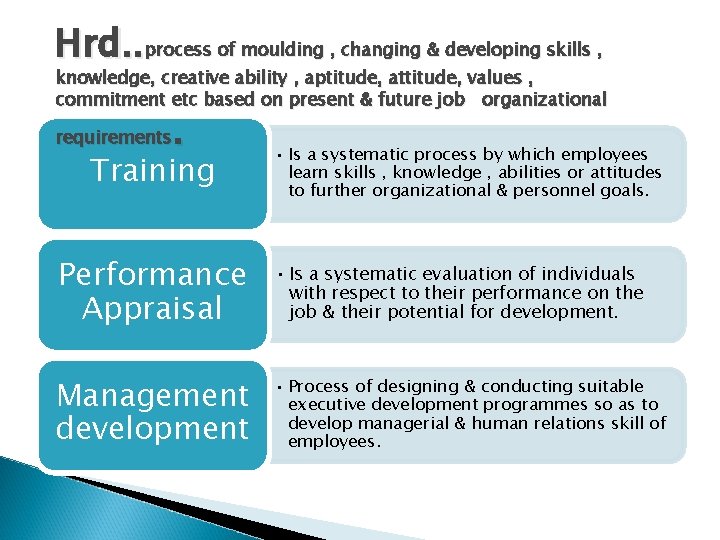
Hrd. . process of moulding , changing & developing skills , knowledge, creative ability , aptitude, attitude, values , commitment etc based on present & future job organizational . requirements Training • Is a systematic process by which employees learn skills , knowledge , abilities or attitudes to further organizational & personnel goals. Performance Appraisal • Is a systematic evaluation of individuals with respect to their performance on the job & their potential for development. Management development • Process of designing & conducting suitable executive development programmes so as to develop managerial & human relations skill of employees.
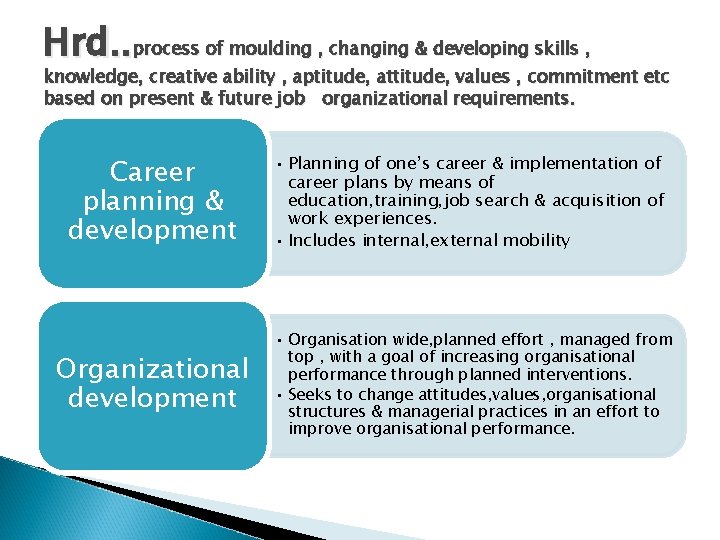
Hrd. . process of moulding , changing & developing skills , knowledge, creative ability , aptitude, attitude, values , commitment etc based on present & future job organizational requirements. Career planning & development • Planning of one’s career & implementation of career plans by means of education, training, job search & acquisition of work experiences. • Includes internal, external mobility Organizational development • Organisation wide, planned effort , managed from top , with a goal of increasing organisational performance through planned interventions. • Seeks to change attitudes, values, organisational structures & managerial practices in an effort to improve organisational performance.
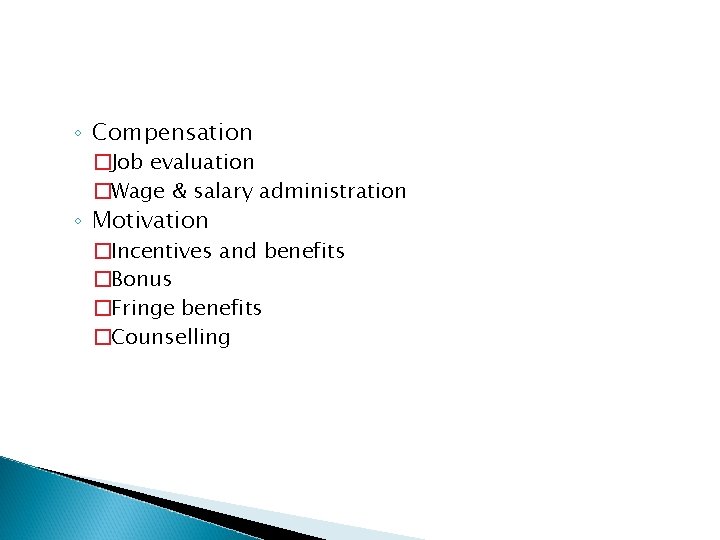
◦ Compensation �Job evaluation �Wage & salary administration ◦ Motivation �Incentives and benefits �Bonus �Fringe benefits �Counselling
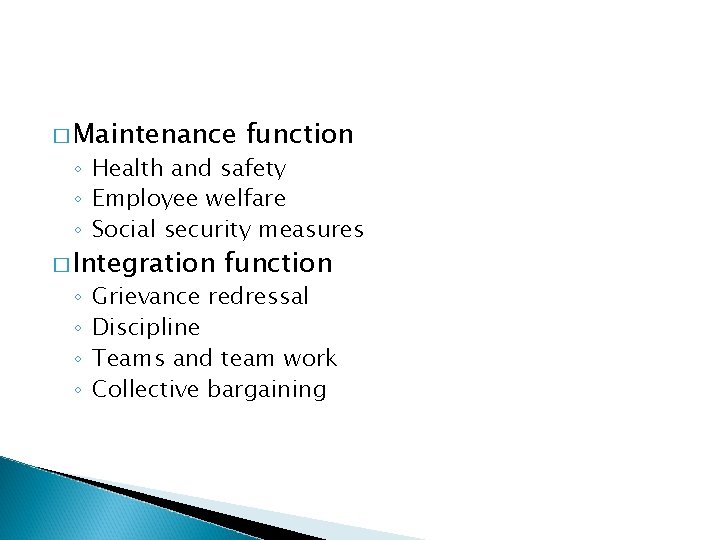
� Maintenance function ◦ Health and safety ◦ Employee welfare ◦ Social security measures � Integration ◦ ◦ function Grievance redressal Discipline Teams and team work Collective bargaining
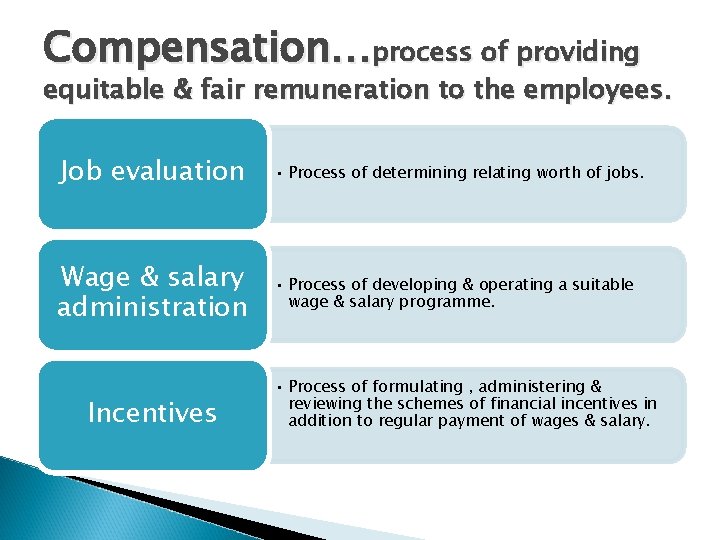
Compensation…process of providing equitable & fair remuneration to the employees. Job evaluation • Process of determining relating worth of jobs. Wage & salary administration • Process of developing & operating a suitable wage & salary programme. Incentives • Process of formulating , administering & reviewing the schemes of financial incentives in addition to regular payment of wages & salary.
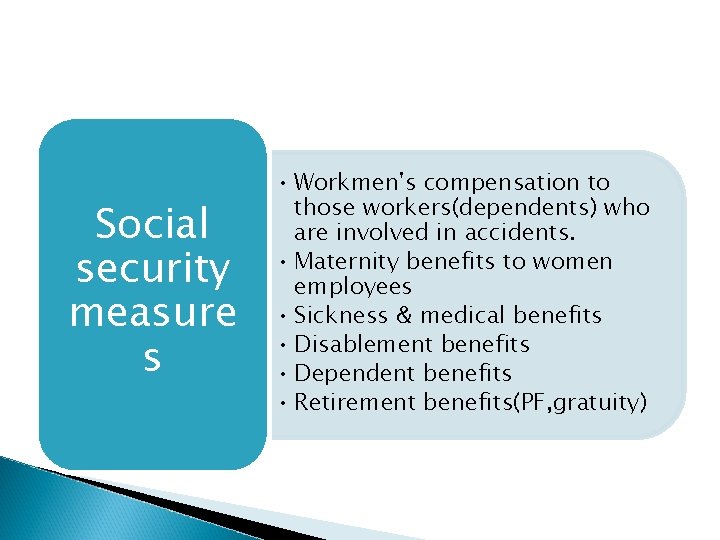
Social security measure s • Workmen's compensation to those workers(dependents) who are involved in accidents. • Maternity benefits to women employees • Sickness & medical benefits • Disablement benefits • Dependent benefits • Retirement benefits(PF, gratuity)
� Human relations: process of interaction among human beings � Effectiveness of HRM: 1. Organization health 2. Human resource accounting 3. Human resource audit 4. Human resources research.
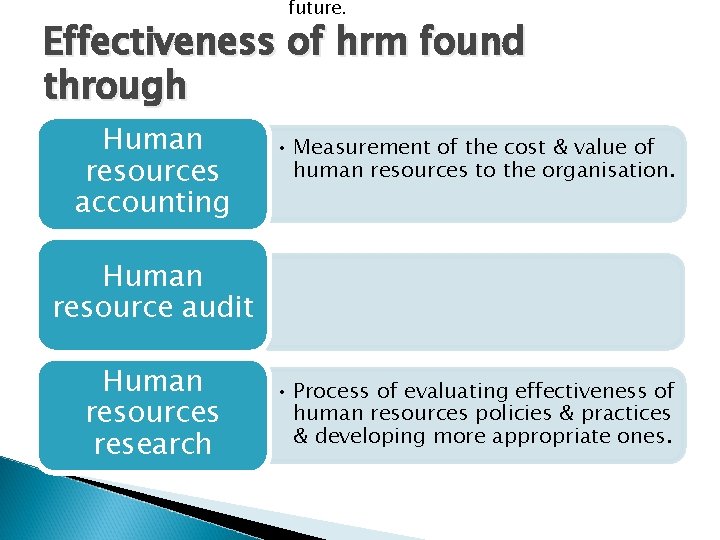
future. Effectiveness of hrm found through Human resources accounting • Measurement of the cost & value of human resources to the organisation. Human resource audit Human resources research • Process of evaluating effectiveness of human resources policies & practices & developing more appropriate ones.
Line manager � Refers to individuals who are responsible for supervising & directing the efforts of a group of employees to perform tasks that are directly related to the creation & delivery of a company’s products or services.