HSC PDHPE CQ 1 DP 2 CQ 1


- Slides: 62
HSC PDHPE – CQ 1 DP 2 CQ 1 – How does training affect performance?
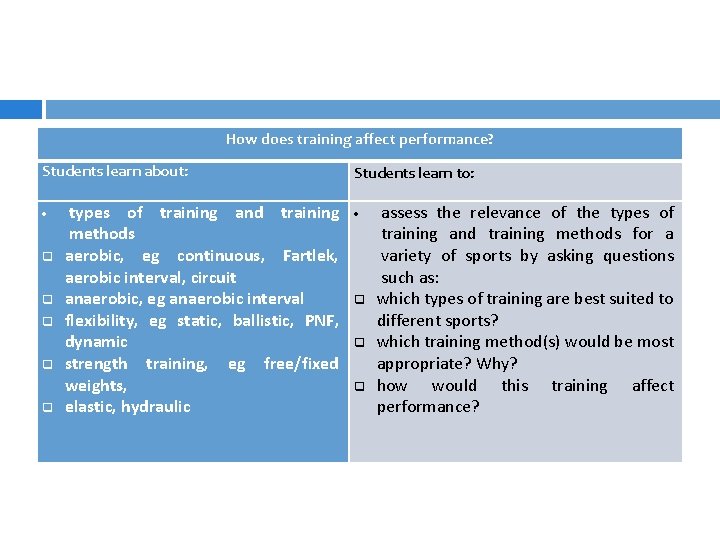
How does training affect performance? Students learn about: q q q types of training and training methods aerobic, eg continuous, Fartlek, aerobic interval, circuit anaerobic, eg anaerobic interval flexibility, eg static, ballistic, PNF, dynamic strength training, eg free/fixed weights, elastic, hydraulic Students learn to: q q q assess the relevance of the types of training and training methods for a variety of sports by asking questions such as: which types of training are best suited to different sports? which training method(s) would be most appropriate? Why? how would this training affect performance?
2. types of training and training methods
2. types of training and training methods For athletes to be prepared to perform they need to train. Coaches and athletes need to understand that there are various types of training that are specifically designed to develop aerobic capacity, strength and flexibility, and that each is closely linked to the energy systems and principles of training.
Ø Aerobic training The two most common training methods used for developing aerobic fitness are continuous training and aerobic interval training.
Continuous training
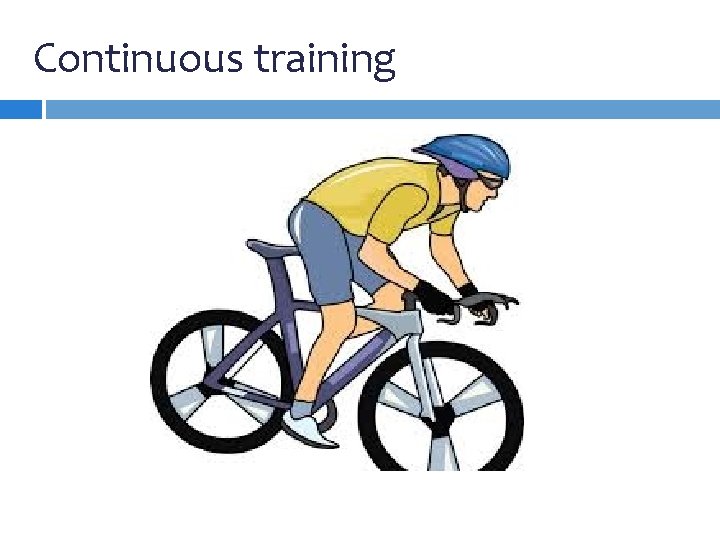
Continuous training The most common form of aerobic training is called continuous training. In this form of training, the heart rate is elevated and maintained by using jogging, power walking, cycling, swimming, aerobic floor classes, or any other form of exercise that elevates the heart rate. It should be performed continuously for a minimum of 20 minutes. Continuous training is generally of a long duration and moderate intensity: 70– 85% of maximum heart rate for 30 minutes to 2 hours.
Continuous training Although continuous training is effective in producing a training effect, it might not necessarily replicate the performance requirements. In other words, it might not be specific enough for the requirements of some sports or positions, or it might be too difficult to train at the same level as the competition requires. Consequently, other forms of aerobic endurance training have been developed. � Give an example of how continuous may not be effective in a sport of your choice
Aerobic interval training
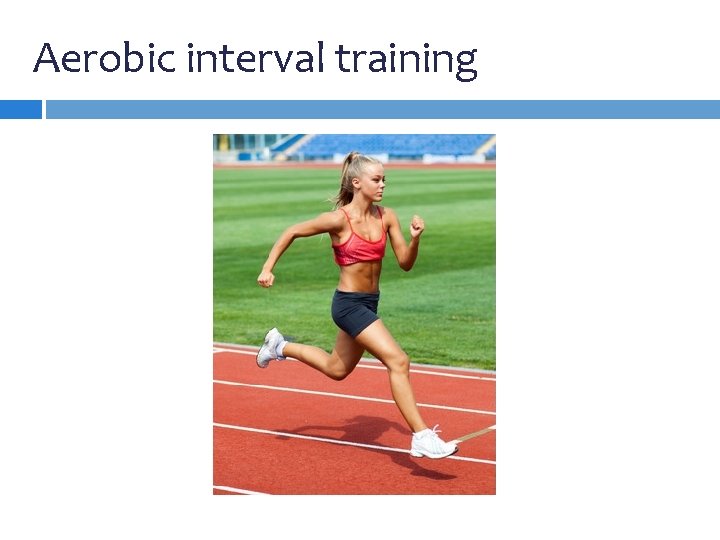
Aerobic interval training ü ü Interval training involves the breakdown of the training period into intervals of exercise or work, followed by intervals of rest or relief. Two basic rationales underpin interval training. These are that such training: is better for adapting the nervous system to the movement patterns experienced in competition (eg. Simulates activity more than other forms) allows the athlete to exercise for a longer period of time at high intensity, thereby aiding adaptations in the aerobic metabolic systems in the muscle (as there are more breaks to recover).
Aerobic interval training The major variables that are manipulated in interval training are time (duration) and intensity. These can be adjusted to provide improvements in both aerobic and anaerobic training. In aerobic training, the duration of the exercise interval needs to be long enough to allow athletes to reach their maximal oxygen uptake (max VO 2), but be short enough not to bring on fatigue. It is usually suggested that both brief and longer periods of exercise be included in interval training programs.
Aerobic interval training The intensity should allow athletes to reach their max VO 2, but the rest intervals should usually be active, such as walking or jogging slowly. This helps to remove accumulated lactic acid from the blood, and allows athletes to train longer. Two factors that are important here are training time and training distance. Training time is the rate at which the work is to be completed.
Aerobic interval training involves moderate-duration and high-intensity ‘pace or tempo’ training: 85– 90 % of maximum heart rate, very near to lactate threshold for 30– 60 minutes in bouts of 4– 10 minutes. Swimmers use this type of training regularly when they complete a series of sets while training; for example, completing five sets of 400 metres every 7– 8 minutes. Runners might run 1200 metres then walk for half a lap then repeat the process four to five times.
Aerobic interval training Although interval training is highly regarded, it is only one of many forms of training. The application of intervals to a training program greatly benefits both athletes and nonathletes, but close attention needs to be paid to the methodology employed.
Fartlek training
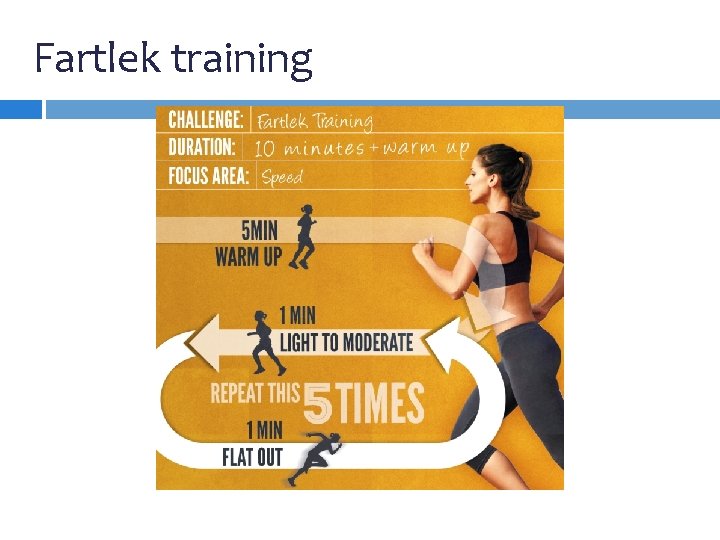
Fartlek training is the Swedish name for Speed Play is a combination of continuous training and interval training in that it involves continuous effort with periods of high intensity, followed by a recovery period. Generally speaking, the bursts of speed are usually of 5– 10 seconds duration, and are repeated every 2– 3 minutes. Speed Play is usually performed over undulating terrain (such as up and down hills) and is less formalised than interval training. The degree of aerobic versus anaerobic work is dependent on the athletes, and how they feel during the workout. The predominant improvement is seen in aerobic capacity. Speed Play can be easily adjusted to meet the needs of most athletes, and the needs of both interval and continuous systems.
Fartlek training (look and note only) An example of a Fartlek training session is: 1 Jog for 10 minutes to warm up, then stretch. 2 Run for 800– 1500 metres at a fast, steady speed. 3 Walk rapidly for 3 minutes. 4 Run continuously for 2000 metres, interspersing with a 50 metre sprint every 300 metres. 5 Run three lots of 400 metres at a fast pace, with a 400 -metre jog between each fast run. 6 Run slowly for 2 minutes. 7 Cool down and stretch.
Circuit training
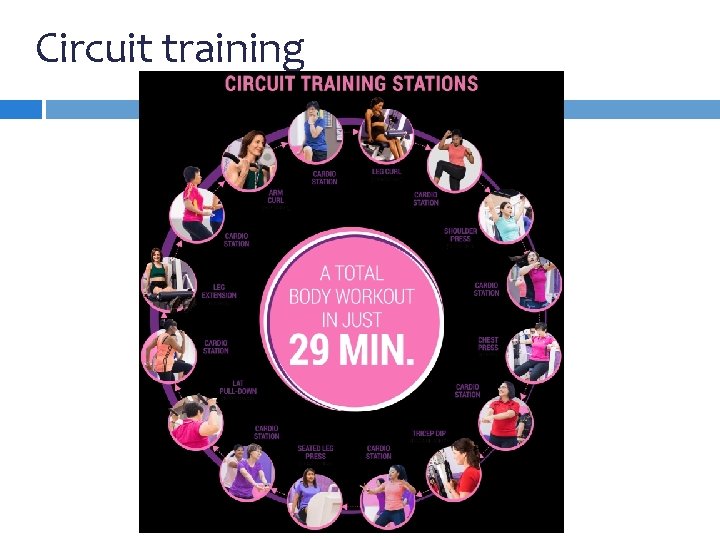
Circuit training is an arrangement of exercises that requires the athlete to spend some time completing each exercise before moving on. It is an excellent way to improve mobility and, at the same time, build strength and stamina. Depending on the equipment available, circuits can be developed to improve general fitness or can be highly specialised to meet the specific needs of certain athletes.
Circuit training usually consists of 6– 10 strength-type exercises that are completed one after the other. Body parts are also alternated so that consecutive exercises don’t work the same muscle groups. The strength-type exercises can be interspersed with more aerobic-type activities, or with rest. A simple circuit can be performed up to three times in a training session, depending on time constraints. There are two types of circuits: fixed resistance circuits and individual resistance circuits.
Circuit training In fixed resistance circuits, the resistance and the number of repetitions are fixed. The main advantage of this system is that the time taken to perform the circuit can be recorded to measure progress. For example, a person may perform 20 sit-ups, 20 push-ups, 100 skips, and so on, and time how long it takes to complete each circuit. As the time to complete the circuit falls the person may begin to increase the number of repetitions performed.
Circuit training In individual resistance circuits, each exercise is carried out with a fixed resistance for as many repetitions as possible in a given period of time; usually 30 seconds. In some cases, athletes also count the number of repetitions that they perform in the fixed time period. This method allows individual athletes to work at their own pace, and is consequently very popular in commercial fitness centres.
Circuit training Where gym equipment is not available to provide resistance, suitable exercises for a circuit training session include situps, push-ups, squat jumps, step-ups, skipping, chin-ups, dips, lateral jumps and ‘burpees’. Any other running, jumping, cycling, trampolining, jogging or body-weight lifting activities are also suitable. For variety (or for practice or fun), skills used in the athlete’s sport can be added to one of the stations. Fitness centres provide machines that offer resistance to a variety of major muscle groups. The resistance can be varied. Exercises using these machines can be interspersed with some of the other exercises listed above. Individual resistance circuits at gymnasiums are usually performed to music, and a buzzer signifies when it is time to move on to the next station.
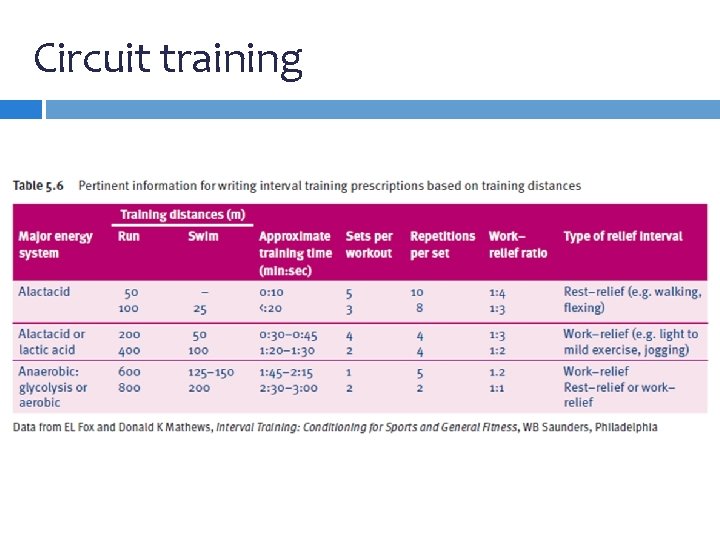
Circuit training Many teams use anaerobic intervals in their training to develop the speed component required by their sport. For example, football teams will spend the early part of preseason training developing an aerobic base within the players and will then design and employ an anaerobic interval program in the weeks leading up to the start of the season to increase the speed anaerobic endurance of the players before the first game. Table 5. 6 (the following slide) outlines the way running and swimming can be used to design anaerobic interval training programs.
Circuit training
Ø flexibility, eg static, ballistic, PNF, dynamic
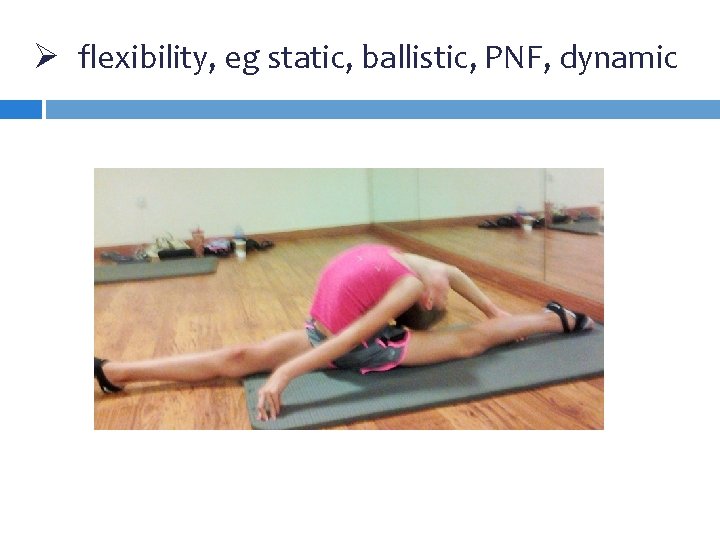
Ø flexibility, eg static, ballistic, PNF, dynamic Flexibility is the ability of joints to bend, stretch and twist through a range of motion without injury. Each joint has a specific range of motion. This range varies from person to person—with elite performers displaying better flexibility than those who are inactive. Thus, the degree of flexibility depends on the person, the joint and the form of exercise in which the person engages (specificity).
Ø flexibility, eg static, ballistic, PNF, dynamic ü ü ü ü Flexibility is important in: preventing injuries and muscle soreness improving the body’s mechanical efficiency increasing the ability of muscles to stretch improving coordination among muscle groups improving the relaxation of muscles reducing the tightening of muscles after performance counteracting the restricting effects of muscle growth resulting from resistance training.
Ø flexibility, eg static, ballistic, PNF, dynamic Within each muscle there exist sensory nerve endings called ‘muscle spindles’. The main function of the muscle spindles is to send messages back from the muscle to the brain about the state of the stretch. When a muscle is stretched, the muscle spindles automatically protect the muscle from over-stretching. They do this by counteracting the stretch—a so-called stretch reflex. The degree of force exerted by the stretch-reflex mechanism is proportional to the force and speed of the stretch. When these two forces work against each other, the likelihood of muscle tearing increases. To avoid this, muscles must be stretched slowly, and stretches must be held in a pain-free position after a suitable warm-up.
Static stretching
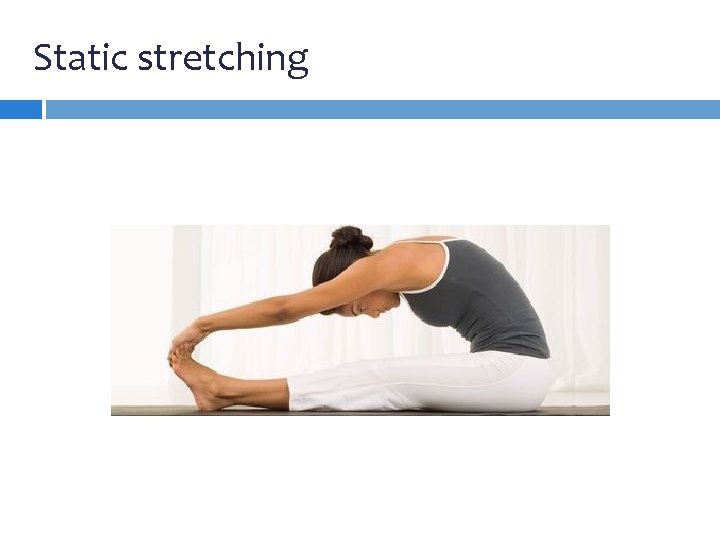
Static stretching is also called ‘passive stretching’. This involves the gradual lengthening of the muscle to a point where it is held for 10– 30 seconds. The point at which it is held should elicit a stretched feeling within the muscle. Static stretching is a safe and effective method of stretching muscles and joints because it is slow and sustained, and because it overcomes the stretch-reflex mechanism and allows the muscle to be stretched to its fullest possible length.
Dynamic stretching
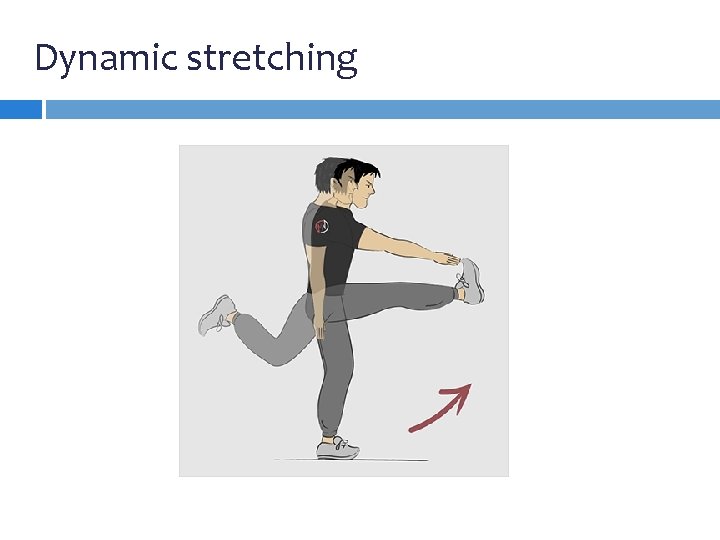
Dynamic stretching is also called ‘active’ or ‘range-of-motion’ (ROM) stretching. It stretches muscle groups that cross over joints. Dynamic stretching involves the gentle repetition of the types of movements that will be experienced in a performance. It is usually very specific to the performance. Such stretching is commonly carried out in an exercise class to music. First the body is warmed up using rhythmic movements of the large muscle groups. Following the warmup, the body is stretched to gently take the major joints through their full range of motion before increasing the intensity. An example of this type of stretching is a full lunge where the back knee touches the ground before the next leg is moved forward.
Ballistic stretching
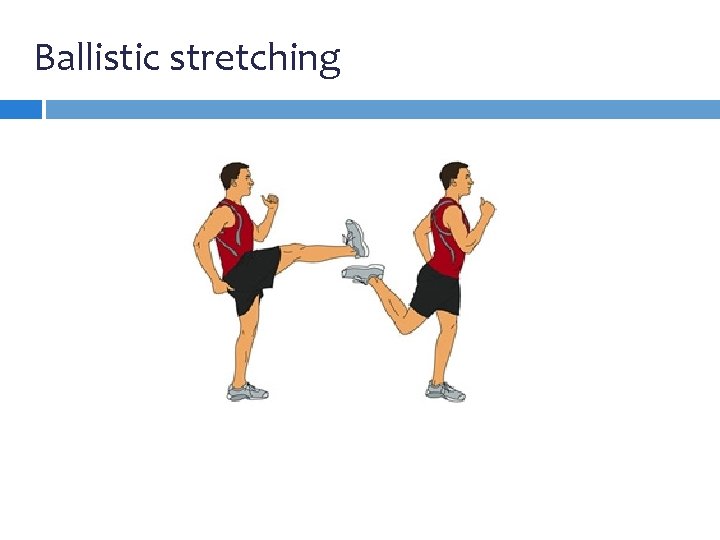
Ballistic stretching is generally known as ‘bounce stretching’. It was very popular in the 1950 s and 1960 s but has since been discredited because of the damage it causes to muscles. Due to the force of the stretch, the stretch reflex comes into play and places great pressure on the muscle fibres. Extended use of ballistic stretching will, in fact, decrease flexibility. This is because it leaves muscles in a state of contraction and the repair of the micro tears (and, in some cases, macro tears) leads to a further reduction in flexibility. However, ballistic stretching can be useful in some performances where ballistic and explosive actions are required. In these cases it should form part of the third stage of warm-up after a general warm-up, a static stretch period an active stretch period.
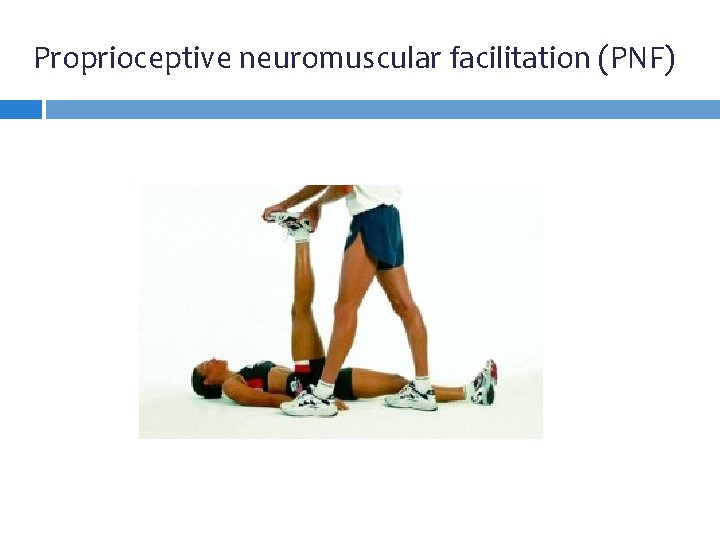
Proprioceptive neuromuscular facilitation (PNF)
Proprioceptive neuromuscular facilitation (PNF) ü Another form of stretch is known as proprioceptive neuromuscular facilitation (PNF). This has emerged from the field of rehabilitation, and is one of the most effective forms of stretching. It is based on two guiding principles: A muscle can relax better after it has undergone a maximum isometric contraction as its resistance to stretching is reduced.
Proprioceptive neuromuscular facilitation (PNF) ü ü ü PNF stretching involves: a static stretch an isometric contraction that is held for 6 seconds a further static stretch, which may be assisted. Due to the nature of the stretch, overstretching is a possibility. A person performing this form of stretching should therefore watch for a feeling of tension, mild pain or quivering muscles.
Questions to complete Distinguish between static stretching and ballistic stretching. Describe proprioceptive neuromuscular facilitation. In small groups, develop one of each of the following types of stretches for each of the major muscle groups in the body, then demonstrate examples of each type: � static � dynamic � ballistic � PNF. Explain the differences between strength training, power training and muscular endurance training.
Ø strength training, eg free/fixed weights, elastic, hydraulic
Ø strength training, eg free/fixed weights, elastic, hydraulic The term ‘strength training’ implies that strength can be improved through training. Strength can be defined as the ability of muscles to exert force. The greatest force that muscles can exert in a single maximal effort is said to be the performer’s absolute strength. There is a close relationship between strength and sports performance.
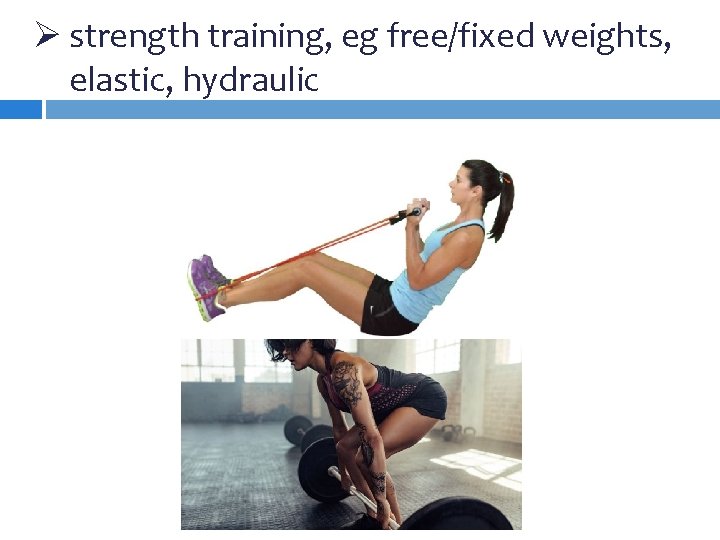
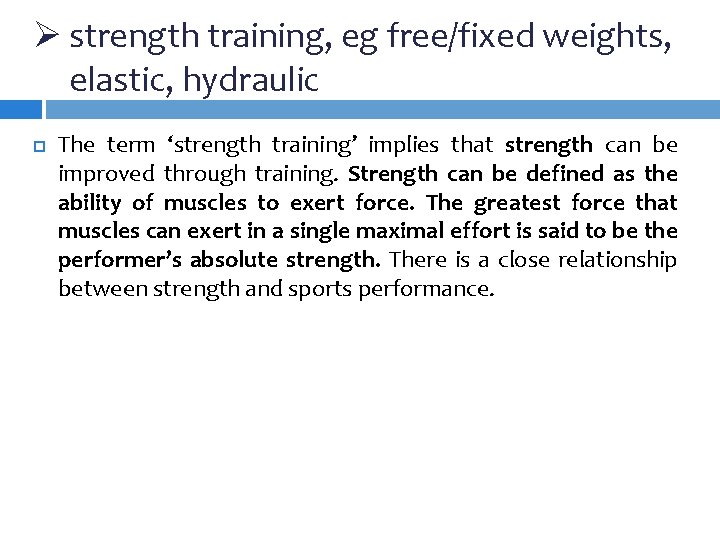
Ø strength training, eg free/fixed weights, elastic, hydraulic ü ü ü ü To develop strength, resistance must be applied to muscles as they contract. Often strength training is called resistance training. This resistance can take the form of: the person’s own body weight barbells or dumb-bells weight machine systems hydraulic resistance machines elastic bands water (such as swimming or aquarobics) pulleys or levers.
Ø strength training, eg free/fixed weights, elastic, hydraulic Different sporting activities involve different forms of resistance and require different types of resistance training. A swimmer encounters resistance in the water while swimming, but this type of strength training is vastly different from the training undertaken by a shot putter who needs to lift very heavy weights in a fast, explosive manner.
Ø strength training, eg free/fixed weights, elastic, hydraulic ü It is helpful to know some of the jargon associated with strength training: repetitions (reps)—the number of times an exercise is repeated without rest ü sets—the number of groups of repetitions of a particular exercise ü resistance—the amount of weight used as a load ü ü repetition maximum (RM)—the maximum number of repetitions that can be completed with a given resistance before fatigue becomes apparent; for example, ‘ 6 RM’ is performed when only six repetitions can be completed, and not seven rest—the time necessary for the muscle to recover after periods of overload.
Ø strength training, eg free/fixed weights, elastic, hydraulic Why do improvements occur after strength training? Strength improves because there is an increase in the size of muscle fibres (hypertrophy). This allows for a greater force to be produced during a maximal contraction. In addition to this increase in the size of muscle fibres, connective tissues (such as tendons and ligaments) are strengthened, which makes the athlete more able to resist injury. Another factor in strength training—particularly in explosive-type activities— is the ability to maximise the number of muscle fibres working to produce a movement and to coordinate the timing of their contraction. This allows the muscle to produce greater force. Therefore, strength can be enhanced through adaptations within the muscle and within the nervous system.
Ø strength training, eg free/fixed weights, elastic, hydraulic ü ü ü Resistance training can be used in numerous ways to obtain gains in the following: strength—the ability to exert force power—the ability to exert force in a short period of time endurance—the ability of the muscle to repeatedly contract against a resistance muscular bulk—an increase in muscle tissue leading to an increase in muscle size aerobic conditioning—the capacity of the heart and lungs to pump blood to working muscles.
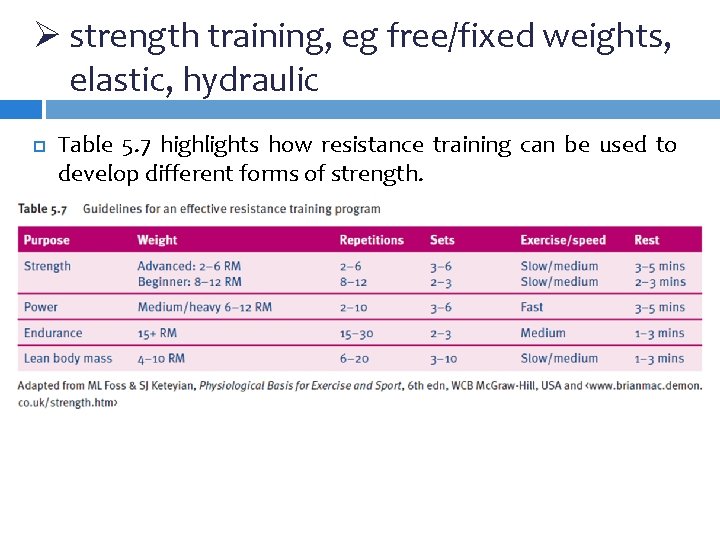
Ø strength training, eg free/fixed weights, elastic, hydraulic Table 5. 7 highlights how resistance training can be used to develop different forms of strength.
Ø strength training, eg free/fixed weights, elastic, hydraulic The variations in training for each type of strength are dependent on a number of factors. Basically, however, a muscle or muscle group will strengthen only if it has been stressed beyond normal. Therefore, the principle of progressive overload is very important in strength training, as is the principle of specificity. When a muscle contracts it will tend to shorten. If a force is applied in the opposite direction to the contraction, however, the muscle might stay at the same length or even be lengthened. This other force might come, for example, from other muscles, an immovable object or another person.
Types of contractions Two types of contractions play a major role in muscle development: static (isometric) and dynamic (isotonic and isokinetic) contractions. Isotonic contractions may be either eccentric or concentric.
Isometric contractions
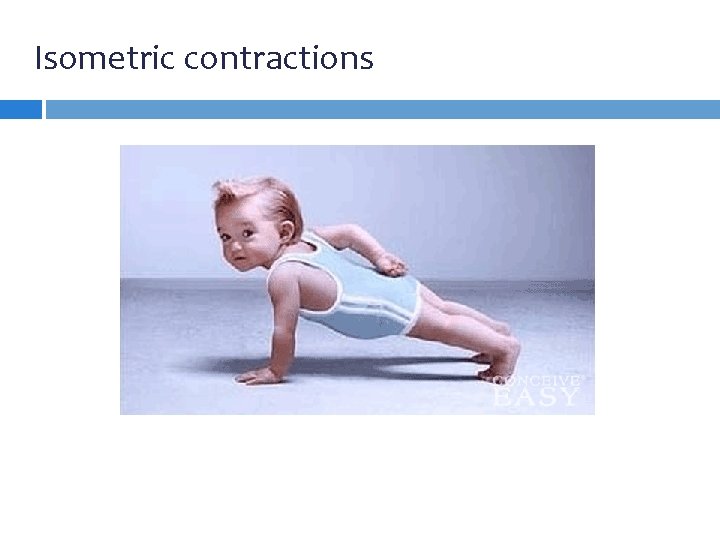
Isometric contractions occur when tension is developed within the muscle but there is no change in muscle length during the contraction. An example is gripping a squash racquet. There is little or no joint movement as tension is developed in muscles when gripping the racquet. Some other examples include pushing against a wall, pulling against an immovable object and holding a heavy shopping bag.
Isometric contractions Because there is no change in muscle length, isometric contractions are specific to particular joint angles. Isometric strength training is useful for developing strength in specific areas. Therefore, coaches need to select angles that are specific to the sport for which the person is training. Sports that require the same position to be held for some time (such as downhill skiing, judo and gymnastics) will particularly benefit from isometric training.
Isotonic contractions
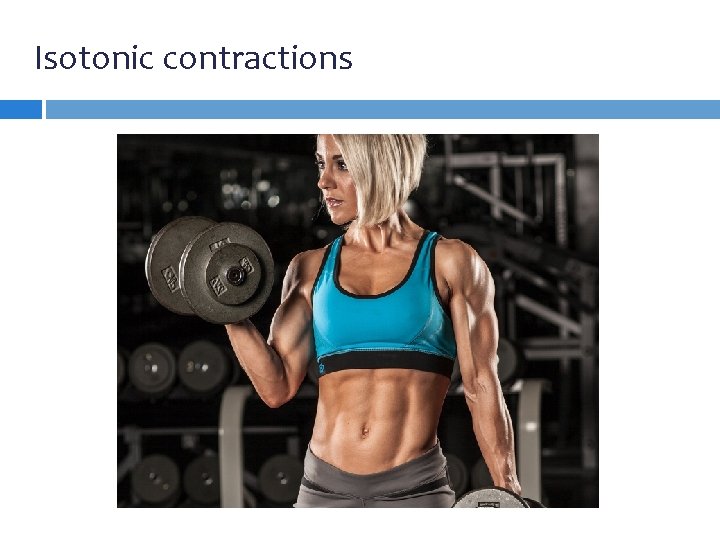
Isotonic contractions are those that cause the muscle length to change as tension is developed within the muscle. These contractions are also known as dynamic contractions. In isotonic contractions the weight is a constant load; that is, the weight does not change as it is moved through a range of motion. But the tension developed within the muscle changes as it moves through the range of motion; for example, doing a biceps curl with a bar bell. Isotonic contractions can be eccentric or concentric.
Isotonic contractions Eccentric contractions occur when tension is developed in the muscle while the muscle is lengthening. Consider the example of a flexed elbow being pushed down by external force while this action is being resisted by the arm muscles trying to flex the elbow and bring the forearm towards the shoulder. In this example, the resisting muscle will lengthen while contracting.
Isotonic contractions Concentric contractions occur when tension is developed within the muscle as the muscle shortens during contraction. For example, in the first stage of a biceps curl the biceps shorten. This causes tension to develop in the muscle, allowing the weight to be lifted.
Isotonic contractions Isotonic strength training is often called ‘traditional’ weight training. It uses the body or weight resistance to improve strength. Although the weight is fixed, the tension developed within the muscle varies with the joint angle, and with the efficiency of the lever at the joint. Therefore, although isotonic training is effective, it cannot create the same tension within a muscle through its entire range of motion. This makes it only partially effective.
Isotonic contractions Isotonic weight training is based on the performance of repetition maximum (RM). As noted earlier, RM is the maximum number of repetitions that can be completed before the muscle is fatigued. The key issue here is fatigue. If the muscle is fatigued it cannot lift the weight. As emphasised earlier, the greatest tension developed within a muscle (when it contracts isotonically) occurs when the muscle is in a lengthened state. Therefore, fatigue is proportional to the degree of tension developed in the muscle in its lengthened state. This limits the effectiveness of training because fatigue is a measure of the muscle’s weakest point.
Isokinetic contractions
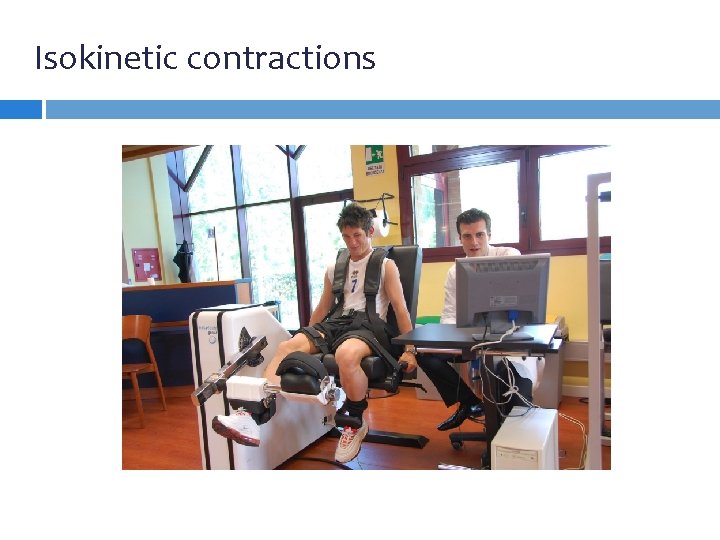
Isokinetic contractions occur when tension is developed in a muscle throughout its entire range of motion. As the muscle shortens, the resistance is increased to maintain constant tension at all joint angles, and all speeds of movement. Because maximal tension is developed throughout the entire range of motion, a muscle contracted isokinetically is comprehensively fatigued. For this reason, it is the most effective form of training for the development of muscular strength.
Isokinetic contractions Unfortunately, specialised equipment produced by companies such as Cybex and Nautilus is required for isokinetic training. Other machines using the concept of variable resistance have been developed in an attempt to maximise training by providing a variable tension throughout the entire range of motion. Although effective, these machines fail to control the speed of movement. These machines are better known as ‘variable resistance machines’ rather than as ‘isokinetic machines’.
Task to complete Explain the differences between strength training, power training and muscular endurance training and provide an explained example of a sport/activity that would benefit from each form of training.