
ALARM NBSC FRESHWATER SENIOR CAMPUS RESPONSE TO FUNDAMENTAL

ALARM NBSC FRESHWATER SENIOR CAMPUS
RESPONSE TO FUNDAMENTAL CHANGE IN APPROACH TO TEACHING AND LEARNING • Quality of HSC results/academic performance – It’s the kids’ issue/the clientele • Better kids will drive improved results
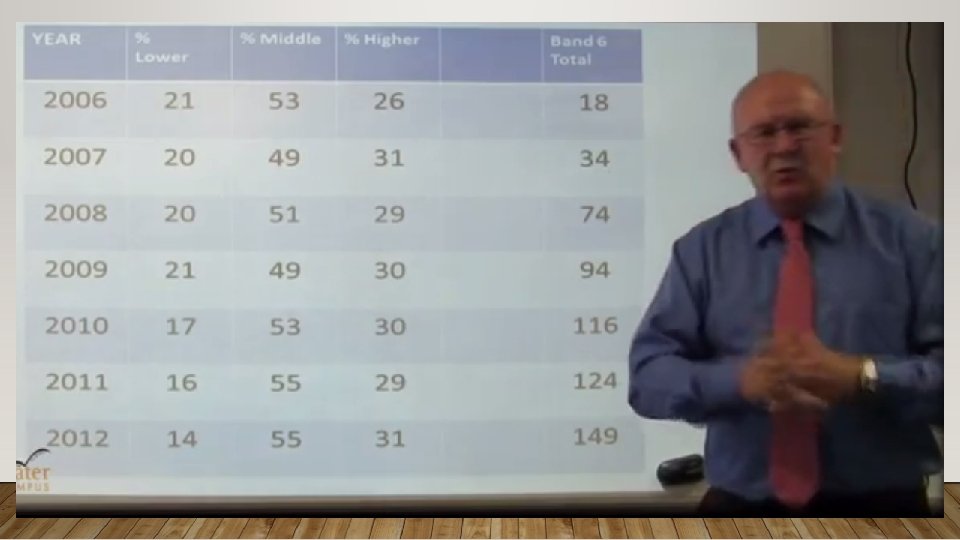
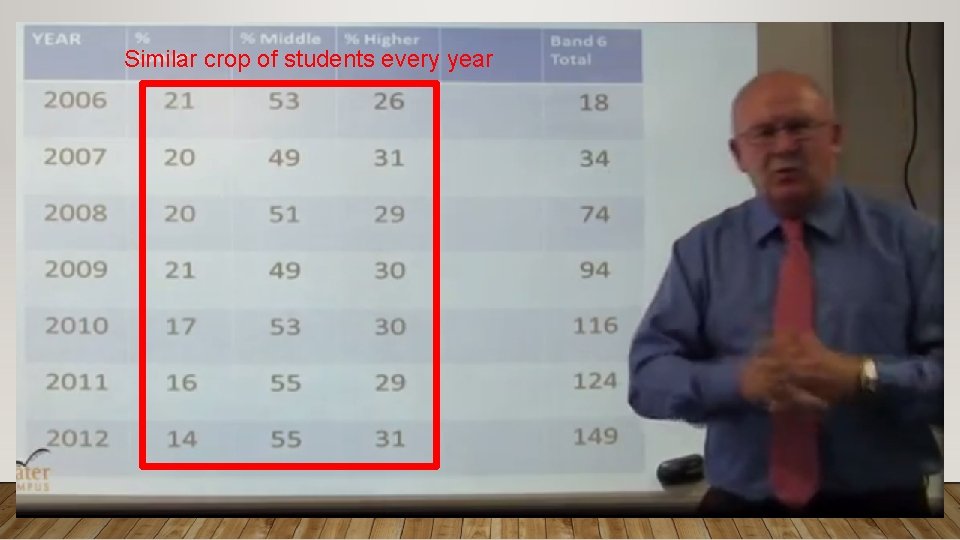
Similar crop of students every year
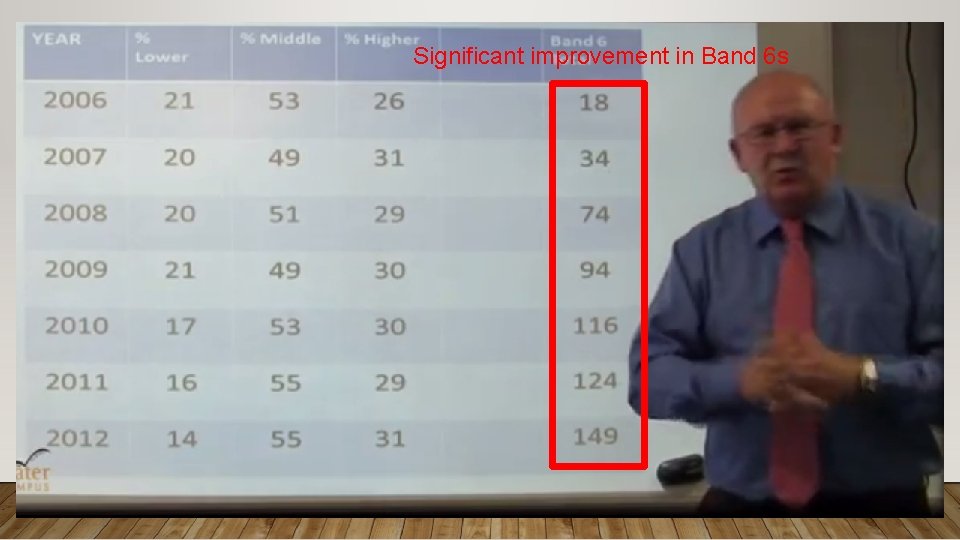
Significant improvement in Band 6 s
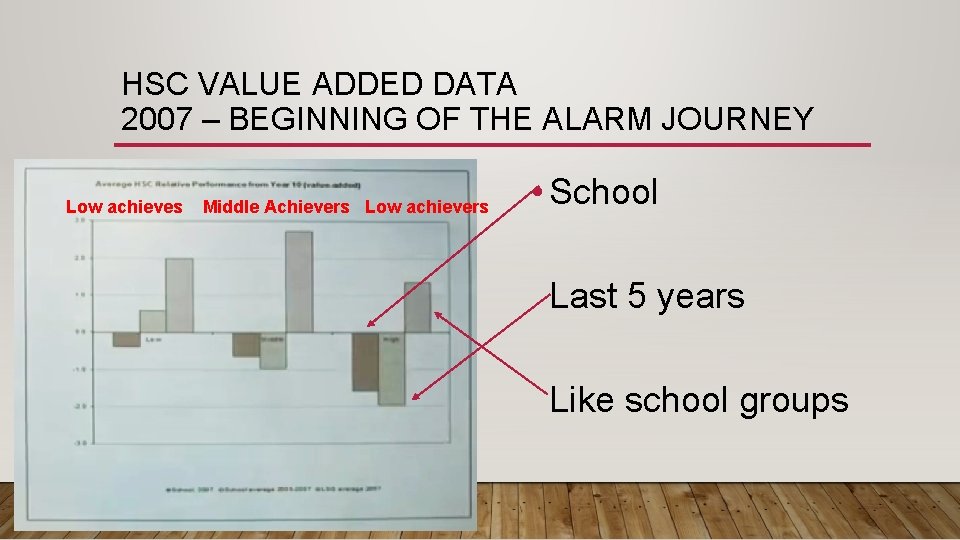
HSC VALUE ADDED DATA 2007 – BEGINNING OF THE ALARM JOURNEY Low achieves Middle Achievers Low achievers • School Last 5 years Like school groups
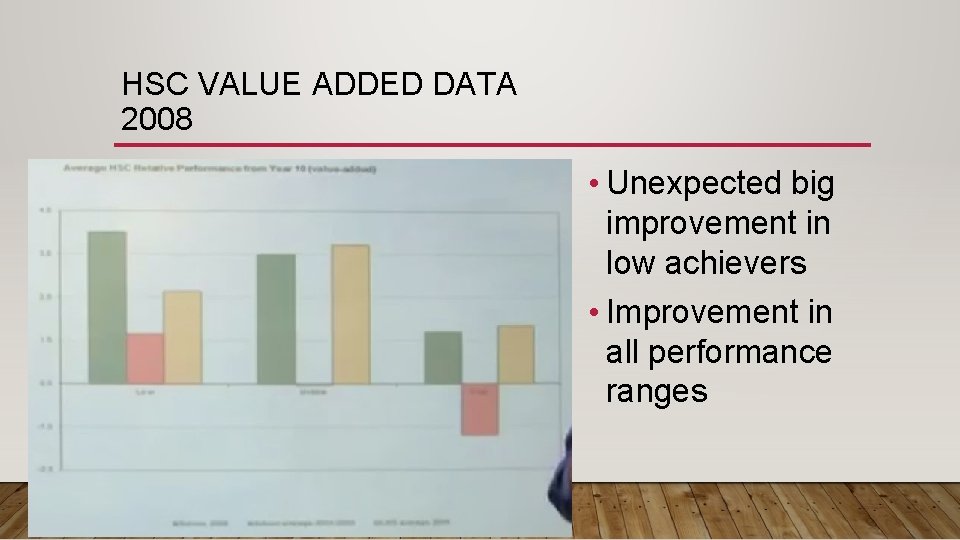
HSC VALUE ADDED DATA 2008 • Unexpected big improvement in low achievers • Improvement in all performance ranges
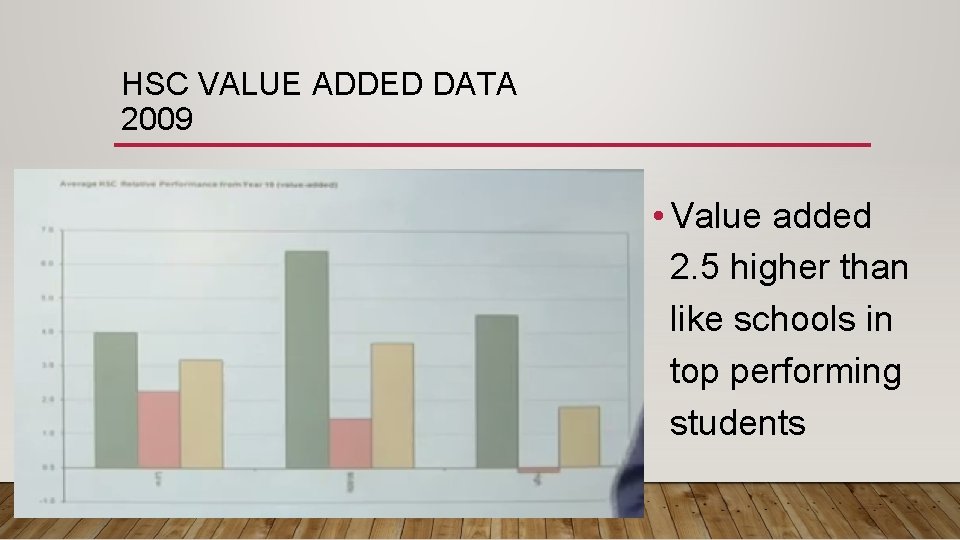
HSC VALUE ADDED DATA 2009 • Value added 2. 5 higher than like schools in top performing students
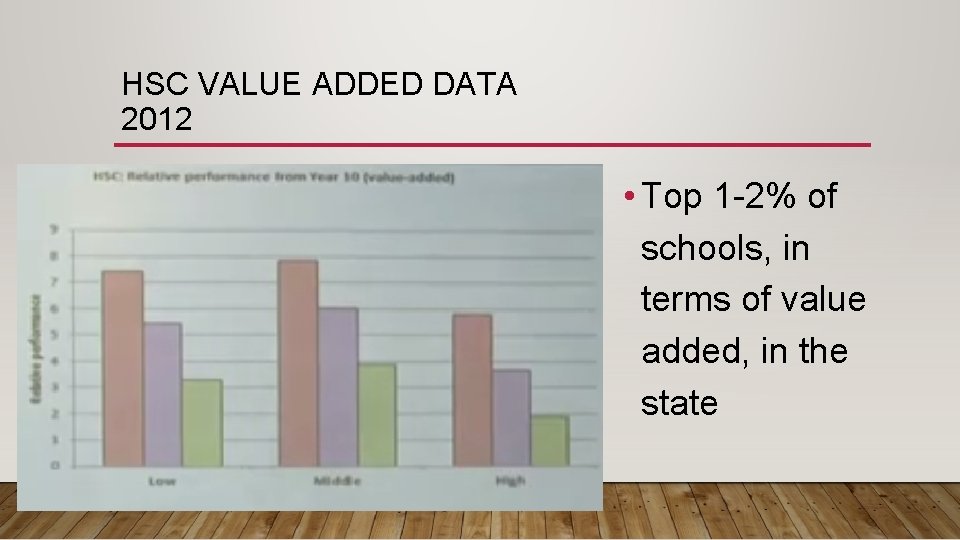
HSC VALUE ADDED DATA 2012 • Top 1 -2% of schools, in terms of value added, in the state
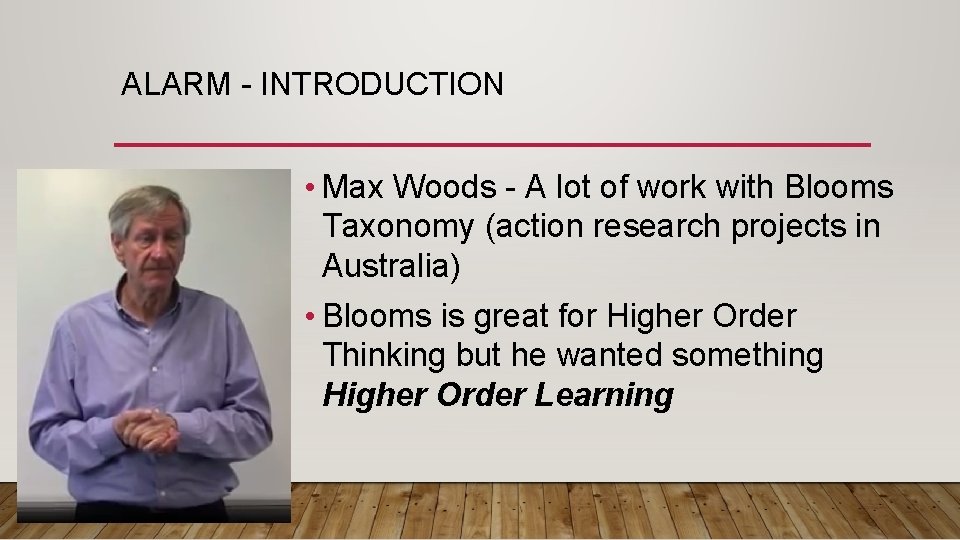
ALARM - INTRODUCTION • Max Woods - A lot of work with Blooms Taxonomy (action research projects in Australia) • Blooms is great for Higher Order Thinking but he wanted something Higher Order Learning
ALARM – INTRODUCTION 4 BASIC AREAS • Literacy – But at what level? Critical learners and responders for life. • Content to concept – The big picture - We know the big picture and select the ways that we will teach the ‘bits’. Students need to see the ‘big picture’/concept so that they know where all the little pieces fit. • What is a question? – Help students understand what a ‘question is’, what is it asking? • Structure – Can I help the students see a response structure and is it a structure that staff can use?
WHAT IS ALARM? • Worksheet • Tool • Template • A process to teach kids how to learn anything (except maths)
2 TYPES OF SUBJECTS • Connotative Interpretive – Interpret meaning though mood, tone, feeling etc. English, Visual Arts, Dance, Drama, LOTE, Photography, Music etc. (Aesthetic subjects) • Logical Interpretive – Meaning is interpreted through implication
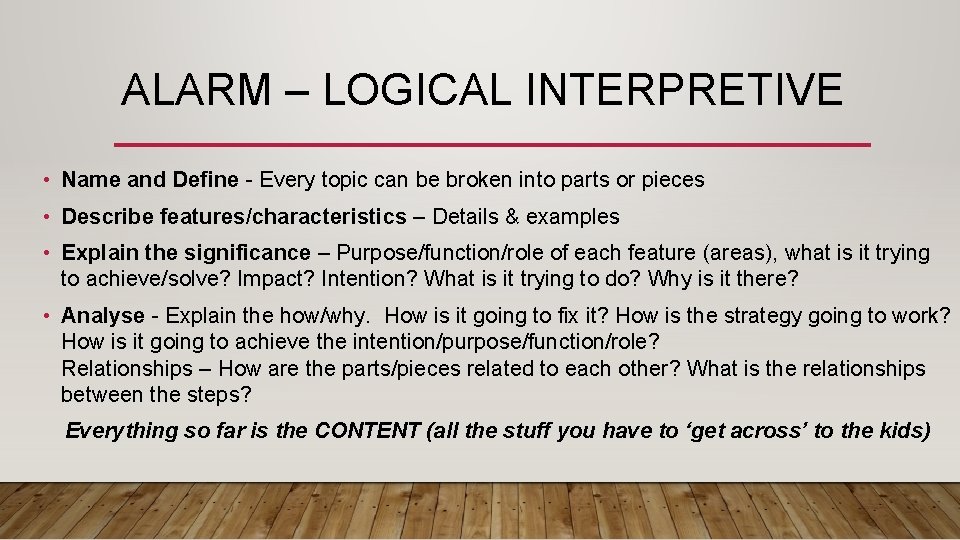
ALARM – LOGICAL INTERPRETIVE • Name and Define - Every topic can be broken into parts or pieces • Describe features/characteristics – Details & examples • Explain the significance – Purpose/function/role of each feature (areas), what is it trying to achieve/solve? Impact? Intention? What is it trying to do? Why is it there? • Analyse - Explain the how/why. How is it going to fix it? How is the strategy going to work? How is it going to achieve the intention/purpose/function/role? Relationships – How are the parts/pieces related to each other? What is the relationships between the steps? Everything so far is the CONTENT (all the stuff you have to ‘get across’ to the kids)
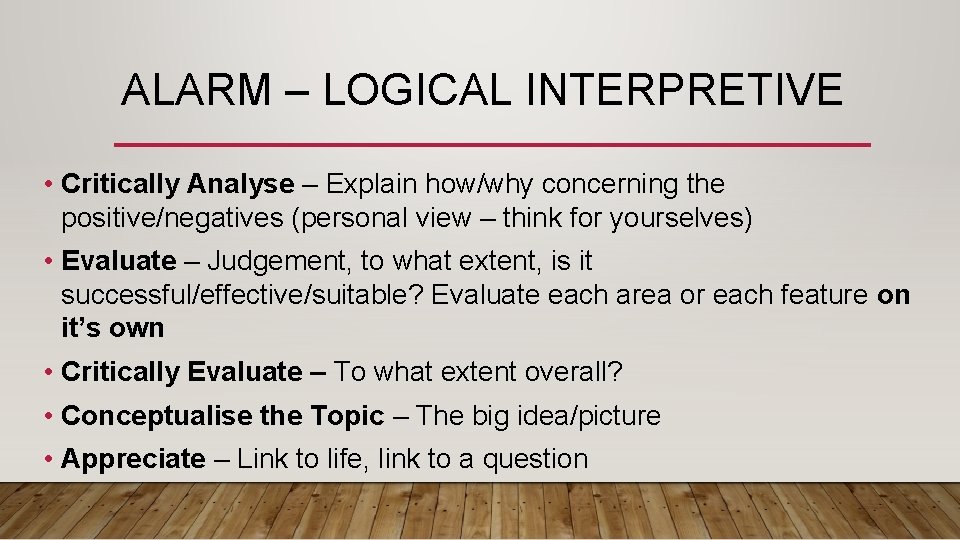
ALARM – LOGICAL INTERPRETIVE • Critically Analyse – Explain how/why concerning the positive/negatives (personal view – think for yourselves) • Evaluate – Judgement, to what extent, is it successful/effective/suitable? Evaluate each area or each feature on it’s own • Critically Evaluate – To what extent overall? • Conceptualise the Topic – The big idea/picture • Appreciate – Link to life, link to a question
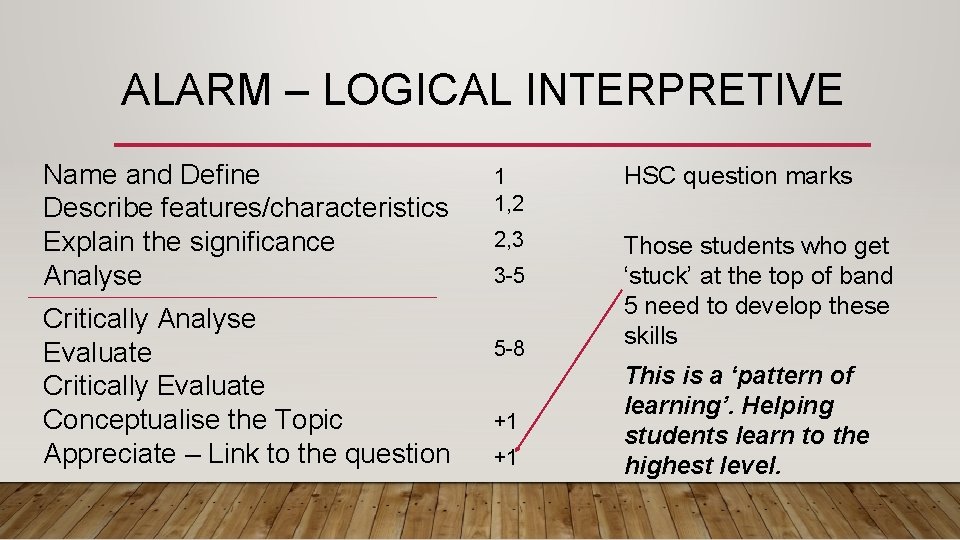
ALARM – LOGICAL INTERPRETIVE Name and Define Describe features/characteristics Explain the significance Analyse Critically Analyse Evaluate Critically Evaluate Conceptualise the Topic Appreciate – Link to the question 1 1, 2 HSC question marks 2, 3 Those students who get ‘stuck’ at the top of band 5 need to develop these skills 3 -5 5 -8 +1 +1 This is a ‘pattern of learning’. Helping students learn to the highest level.

ALARM – REFLECTION Name and Define Describe features/characteristics Explain the significance Analyse Critically Analyse Evaluate Critically Evaluate Conceptualise the Topic Appreciate – Link to the question Everything above the line is fact and content Everything below the line requires students to take risks in their learning. Students need to ‘reflect’ on their learning. Develop students’ ability to think for themselves
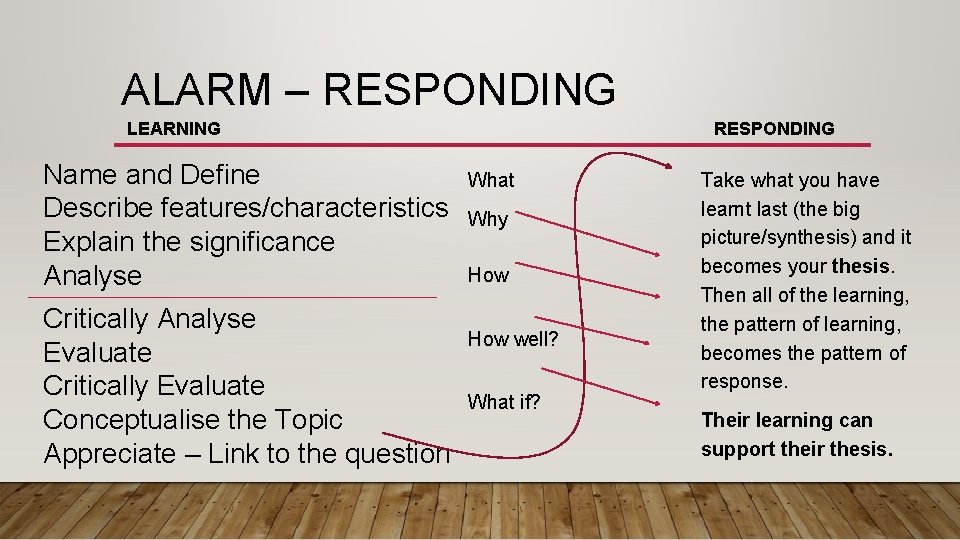
ALARM – RESPONDING LEARNING Name and Define Describe features/characteristics Explain the significance Analyse Critically Analyse Evaluate Critically Evaluate Conceptualise the Topic Appreciate – Link to the question RESPONDING What Why How well? What if? . Take what you have learnt last (the big picture/synthesis) and it becomes your thesis. Then all of the learning, the pattern of learning, becomes the pattern of response. Their learning can support their thesis. .
ALARM – METACOGNITION • Metacognition – Learning how to learn • Help kids see beyond what they see now • Help students know what is ‘missing’. What is missing in their responses/answers • Help students arrive at the answers themselves
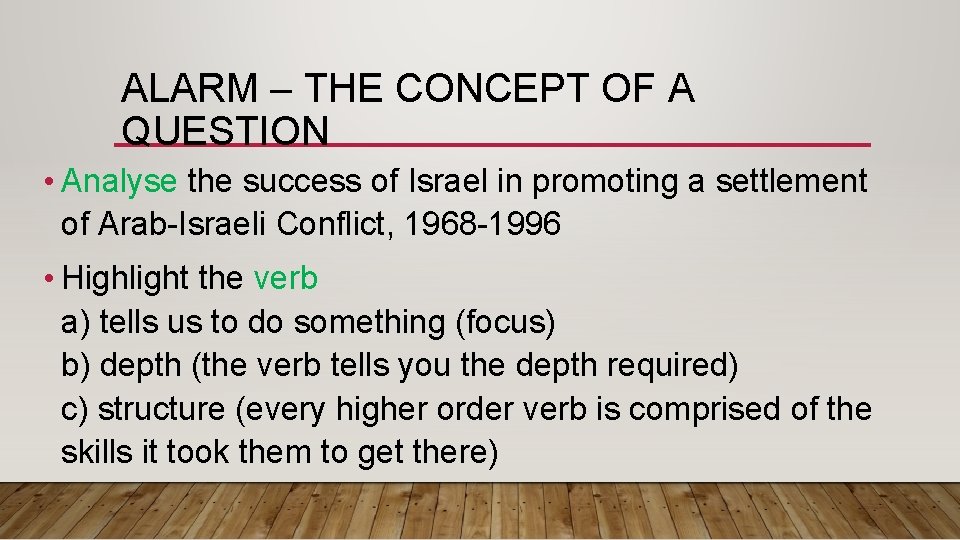
ALARM – THE CONCEPT OF A QUESTION • Analyse the success of Israel in promoting a settlement of Arab-Israeli Conflict, 1968 -1996 • Highlight the verb a) tells us to do something (focus) b) depth (the verb tells you the depth required) c) structure (every higher order verb is comprised of the skills it took them to get there)
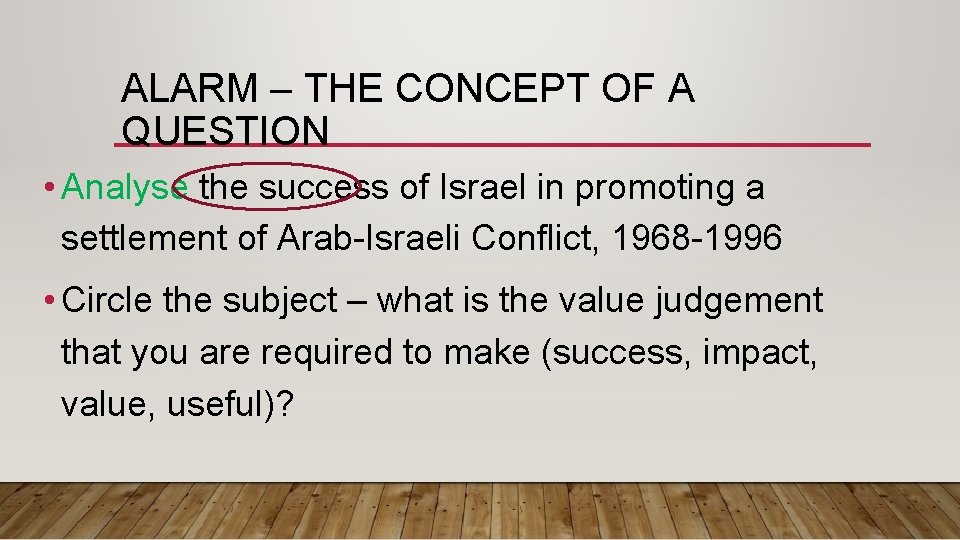
ALARM – THE CONCEPT OF A QUESTION • Analyse the success of Israel in promoting a settlement of Arab-Israeli Conflict, 1968 -1996 • Circle the subject – what is the value judgement that you are required to make (success, impact, value, useful)?
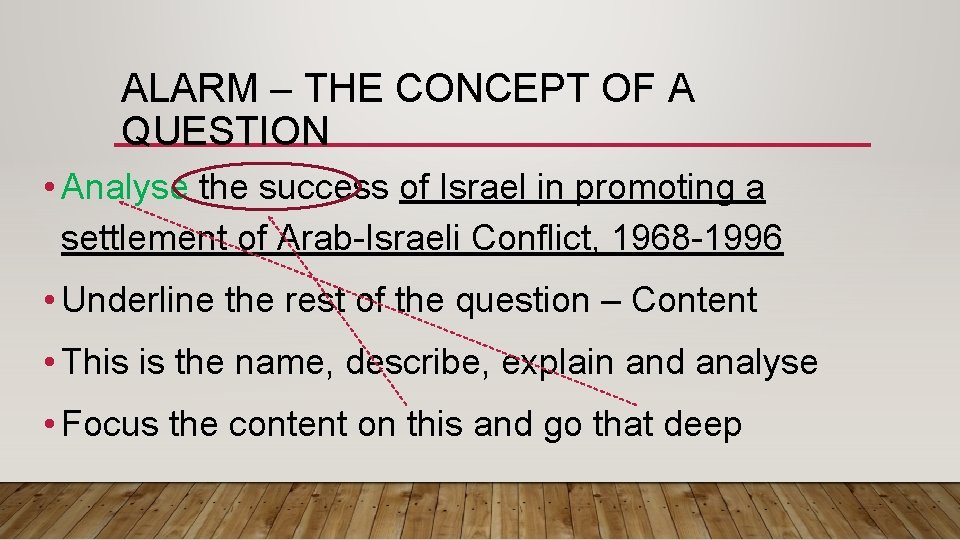
ALARM – THE CONCEPT OF A QUESTION • Analyse the success of Israel in promoting a settlement of Arab-Israeli Conflict, 1968 -1996 • Underline the rest of the question – Content • This is the name, describe, explain and analyse • Focus the content on this and go that deep
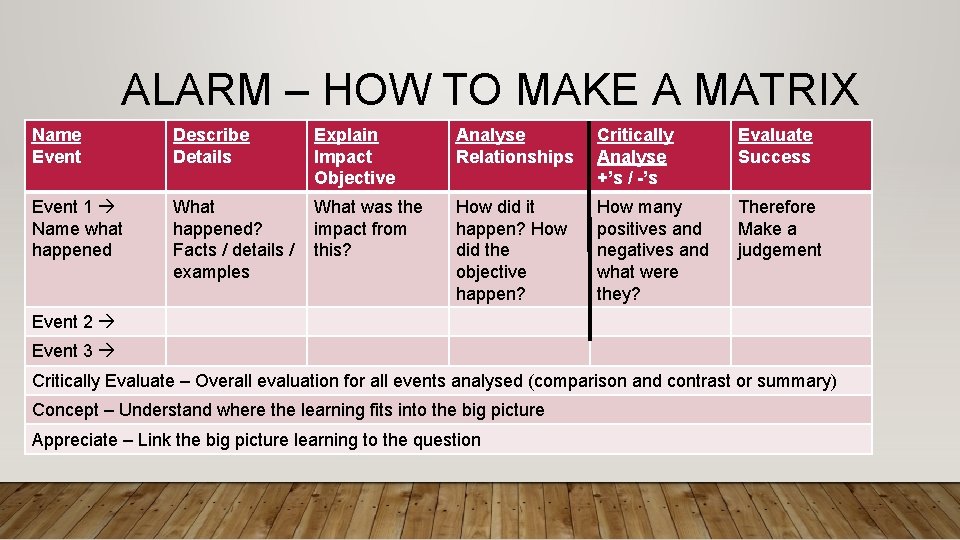
ALARM – HOW TO MAKE A MATRIX Name Event Describe Details Explain Impact Objective Analyse Relationships Critically Analyse +’s / -’s Evaluate Success Event 1 Name what happened What happened? Facts / details / examples What was the impact from this? How did it happen? How did the objective happen? How many positives and negatives and what were they? Therefore Make a judgement Event 2 Event 3 Critically Evaluate – Overall evaluation for all events analysed (comparison and contrast or summary) Concept – Understand where the learning fits into the big picture Appreciate – Link the big picture learning to the question
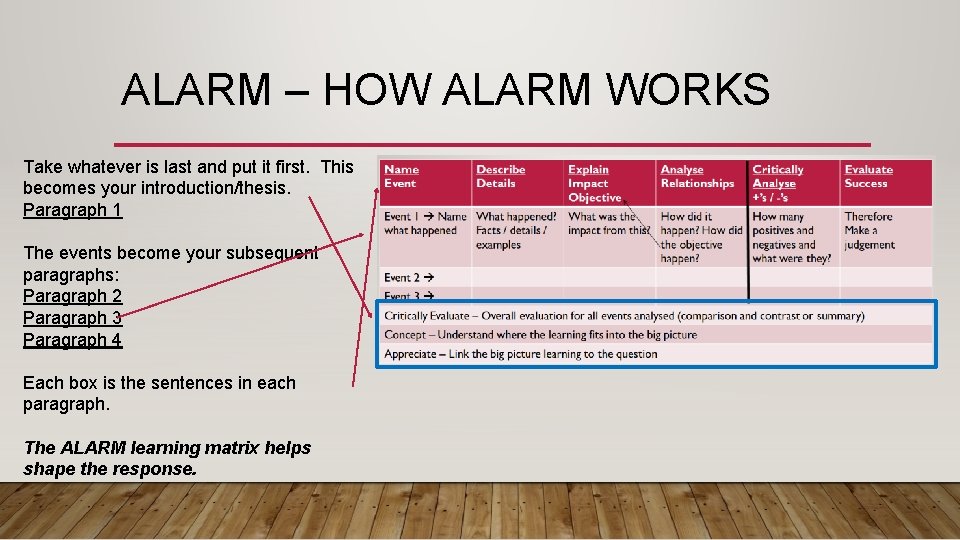
ALARM – HOW ALARM WORKS Take whatever is last and put it first. This becomes your introduction/thesis. Paragraph 1 The events become your subsequent paragraphs: Paragraph 2 Paragraph 3 Paragraph 4 Each box is the sentences in each paragraph. The ALARM learning matrix helps shape the response.
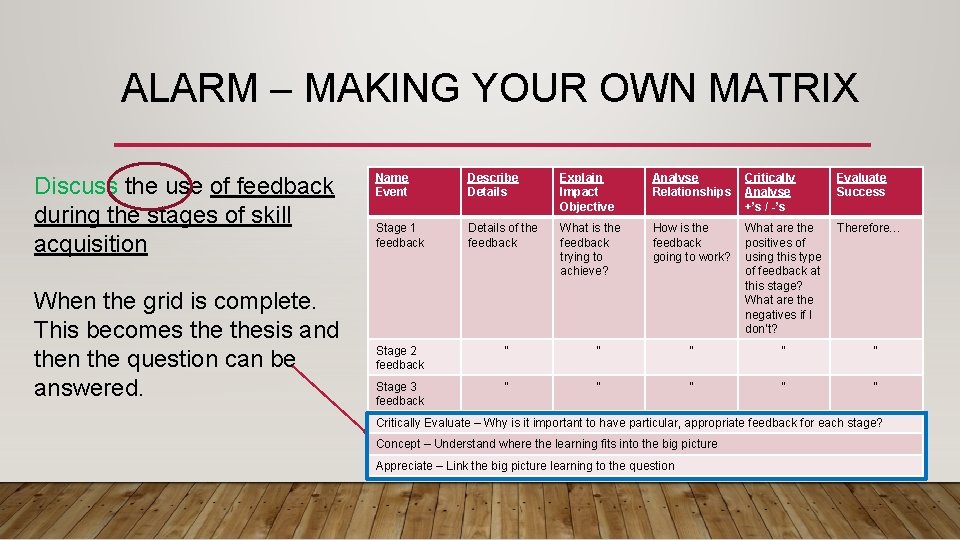
ALARM – MAKING YOUR OWN MATRIX Discuss the use of feedback during the stages of skill acquisition When the grid is complete. This becomes thesis and then the question can be answered. Name Event Describe Details Explain Impact Objective Analyse Relationships Critically Analyse +’s / -’s Evaluate Success Stage 1 feedback Details of the feedback What is the feedback trying to achieve? How is the feedback going to work? What are the positives of using this type of feedback at this stage? What are the negatives if I don’t? Therefore… Stage 2 feedback “ “ “ Stage 3 feedback “ “ “ Critically Evaluate – Why is it important to have particular, appropriate feedback for each stage? Concept – Understand where the learning fits into the big picture Appreciate – Link the big picture learning to the question
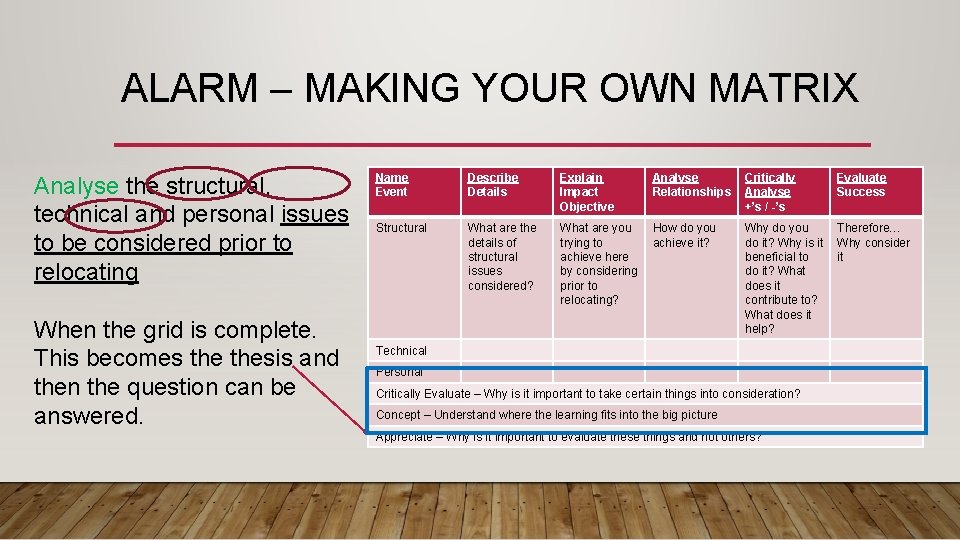
ALARM – MAKING YOUR OWN MATRIX Analyse the structural, technical and personal issues to be considered prior to relocating When the grid is complete. This becomes thesis and then the question can be answered. Name Event Describe Details Explain Impact Objective Analyse Relationships Critically Analyse +’s / -’s Evaluate Success Structural What are the details of structural issues considered? What are you trying to achieve here by considering prior to relocating? How do you achieve it? Why do you do it? Why is it beneficial to do it? What does it contribute to? What does it help? Therefore… Why consider it Technical Personal Critically Evaluate – Why is it important to take certain things into consideration? Concept – Understand where the learning fits into the big picture Appreciate – Why is it important to evaluate these things and not others?
ALARM – CONNOTATIVE INTERPRETIVE • Name and Define – Significant events/parts in the story/work/piece (problem/challenge within the writer/artist or a problem they have with the outside world or between characters, choice of medium) • Describe features/characteristics – Features/characteristics, Language techniques/conventions, Musical concepts, Frames, etc. • Explain the significance – Purpose/function/role of each technique, what effect / mood / tone / feeling / atmosphere is it trying to achieve/create? • Analyse - Explain the how/why. What is the impact on the relationships (inner and outer)? Positive or negative feelings. • Everything so far is the CONTENT (all the stuff you have to ‘get across’ to the kids)
ALARM – CONNOTATIVE INTERPRETIVE • Interpret Meaning – at the textural/universal level. What is theme? • Critically Analyse – Explain how/why concerning the positive/negatives. Positive/negatives to contribute/promote the meaning or is it obscuring the meaning? What is the experience of the composer/artist/author? • Evaluate – Judgement, to what extent, is it successful/effective? Evaluate each technique/ experience on its owns • Critically Evaluate – To what extent overall? How are all the techniques combining? • Conceptualise the Topic – The big idea/picture (link the message to the concept)
- Slides: 28