Hive A Warehousing Solution Over a MapReduce Framework

- Slides: 33
Hive – A Warehousing Solution Over a Map-Reduce Framework Presented by: Atul Bohara Feb 18, 2014
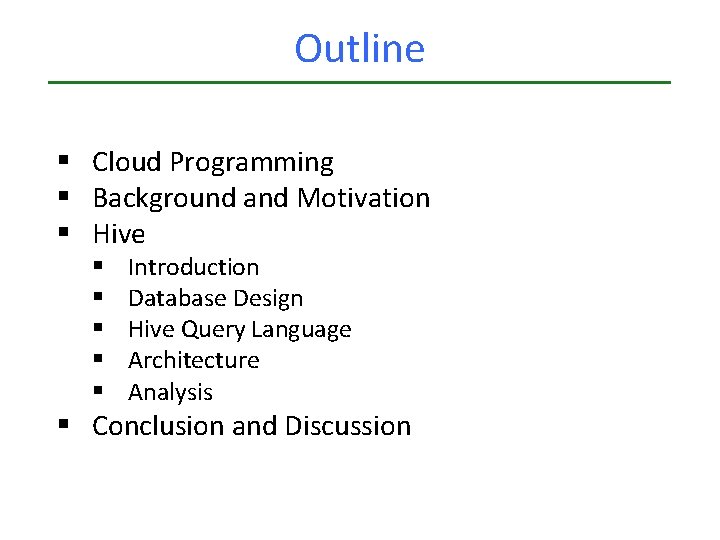
Outline § Cloud Programming § Background and Motivation § Hive § § § Introduction Database Design Hive Query Language Architecture Analysis § Conclusion and Discussion
Cloud Programming § Applications built for cloud computing - Handle large data sets - Distributed and parallel processing § Hadoop, Hive, Pig, HBase, Cassandra, Storm, Spark are some of the most popular systems
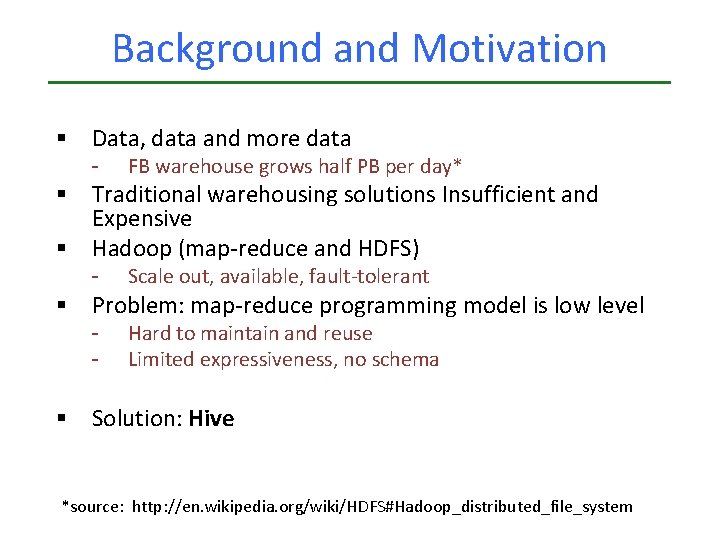
Background and Motivation § Data, data and more data - FB warehouse grows half PB per day* § Traditional warehousing solutions Insufficient and Expensive § Hadoop (map-reduce and HDFS) - Scale out, available, fault-tolerant § Problem: map-reduce programming model is low level - Hard to maintain and reuse Limited expressiveness, no schema § Solution: Hive *source: http: //en. wikipedia. org/wiki/HDFS#Hadoop_distributed_file_system
What is Hive? Open-source data warehousing solution built on top of Hadoop.
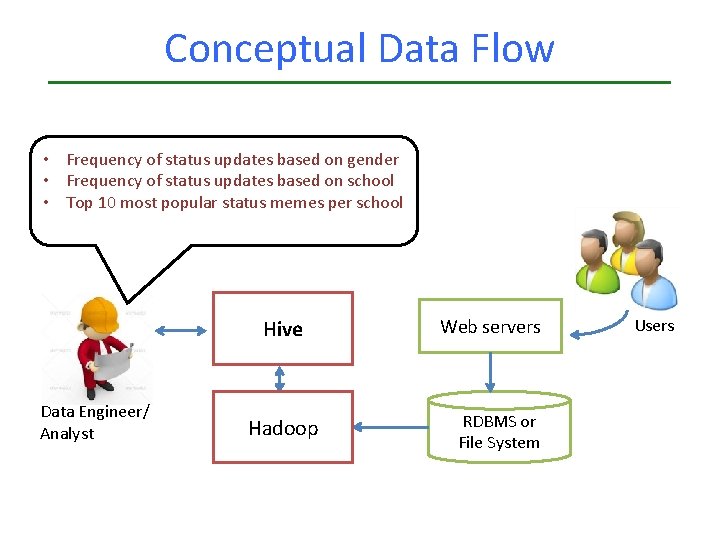
Conceptual Data Flow • Frequency of status updates based on gender • Frequency of status updates based on school • Top 10 most popular status memes per school Hive Data Engineer/ Analyst Hadoop Web servers RDBMS or File System Users
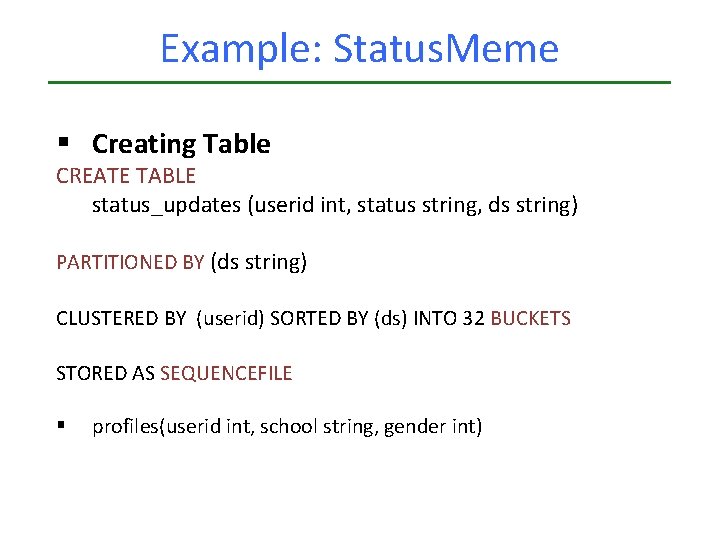
Example: Status. Meme § Creating Table CREATE TABLE status_updates (userid int, status string, ds string) PARTITIONED BY (ds string) CLUSTERED BY (userid) SORTED BY (ds) INTO 32 BUCKETS STORED AS SEQUENCEFILE § profiles(userid int, school string, gender int)
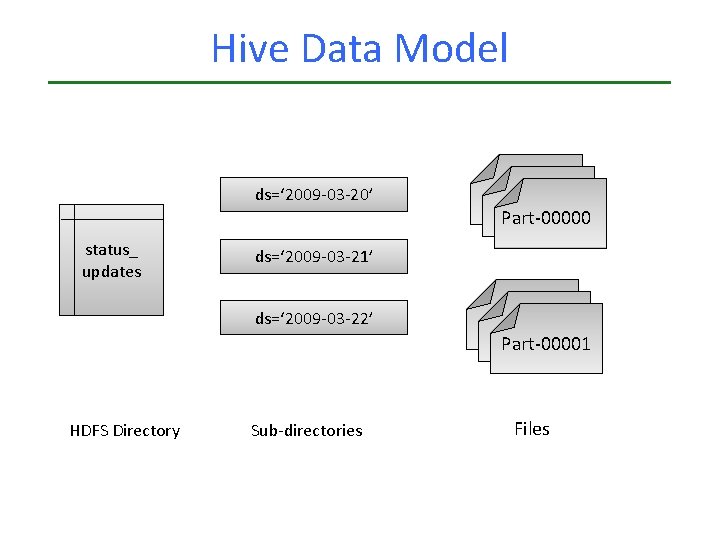
Hive Data Model ds=‘ 2009 -03 -20’ Part-00000 status_ updates ds=‘ 2009 -03 -21’ ds=‘ 2009 -03 -22’ Part-00001 HDFS Directory Sub-directories Files
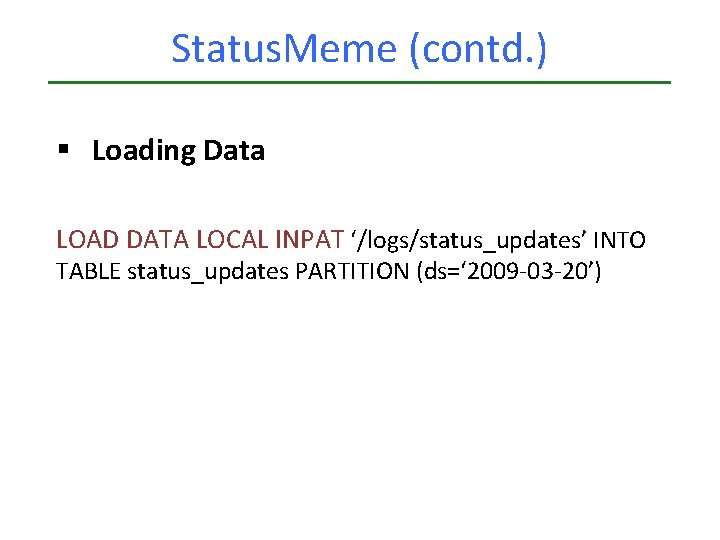
Status. Meme (contd. ) § Loading Data LOAD DATA LOCAL INPAT ‘/logs/status_updates’ INTO TABLE status_updates PARTITION (ds=‘ 2009 -03 -20’)
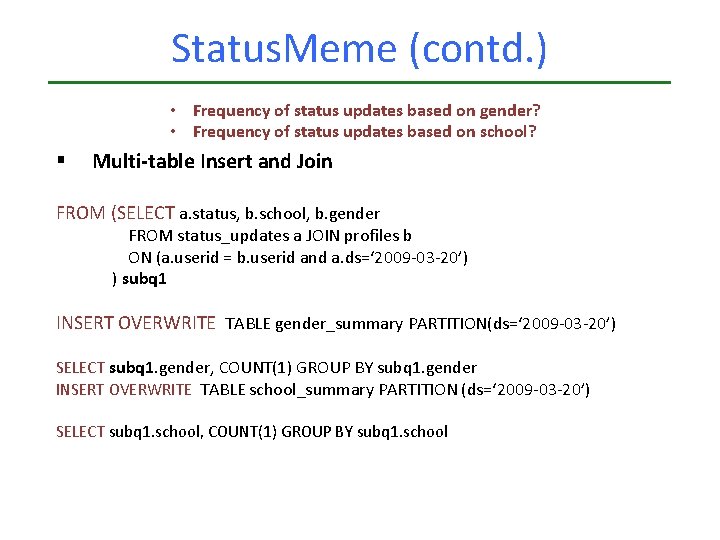
Status. Meme (contd. ) • Frequency of status updates based on gender? • Frequency of status updates based on school? § Multi-table Insert and Join FROM (SELECT a. status, b. school, b. gender FROM status_updates a JOIN profiles b ON (a. userid = b. userid and a. ds=‘ 2009 -03 -20’) ) subq 1 INSERT OVERWRITE TABLE gender_summary PARTITION(ds=‘ 2009 -03 -20’) SELECT subq 1. gender, COUNT(1) GROUP BY subq 1. gender INSERT OVERWRITE TABLE school_summary PARTITION (ds=‘ 2009 -03 -20’) SELECT subq 1. school, COUNT(1) GROUP BY subq 1. school
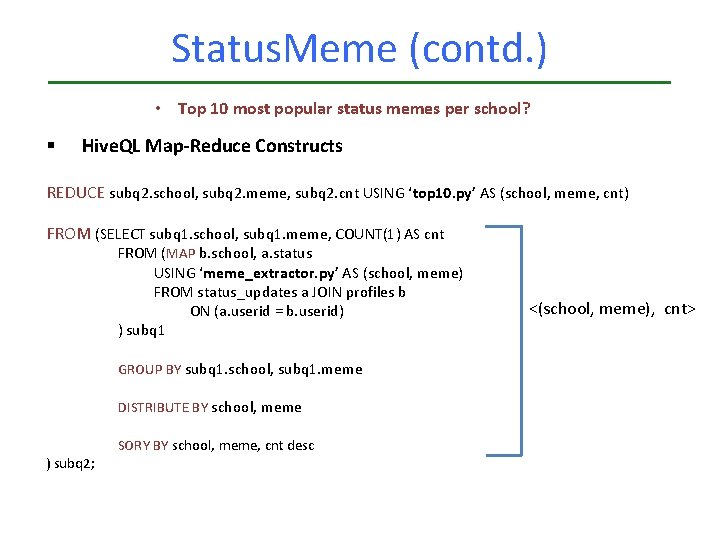
Status. Meme (contd. ) • Top 10 most popular status memes per school? § Hive. QL Map-Reduce Constructs REDUCE subq 2. school, subq 2. meme, subq 2. cnt USING ‘top 10. py’ AS (school, meme, cnt) FROM (SELECT subq 1. school, subq 1. meme, COUNT(1) AS cnt FROM (MAP b. school, a. status USING ‘meme_extractor. py’ AS (school, meme) FROM status_updates a JOIN profiles b ON (a. userid = b. userid) ) subq 1 GROUP BY subq 1. school, subq 1. meme DISTRIBUTE BY school, meme ) subq 2; SORY BY school, meme, cnt desc <(school, meme), cnt>
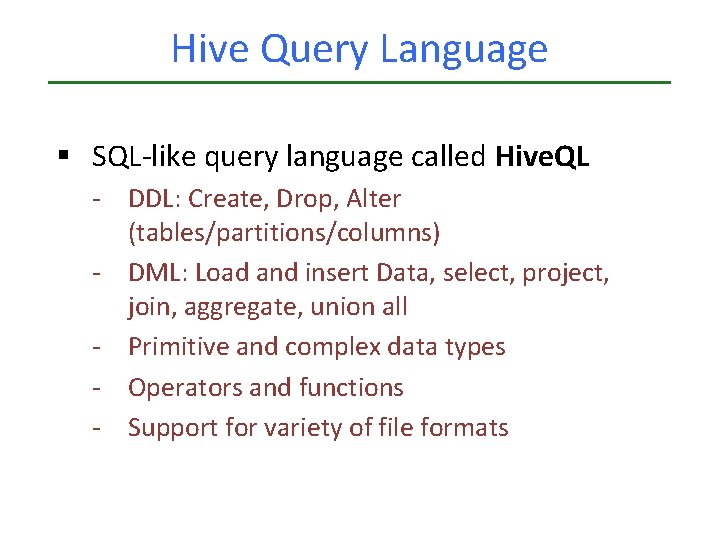
Hive Query Language § SQL-like query language called Hive. QL - DDL: Create, Drop, Alter (tables/partitions/columns) - DML: Load and insert Data, select, project, join, aggregate, union all - Primitive and complex data types - Operators and functions - Support for variety of file formats
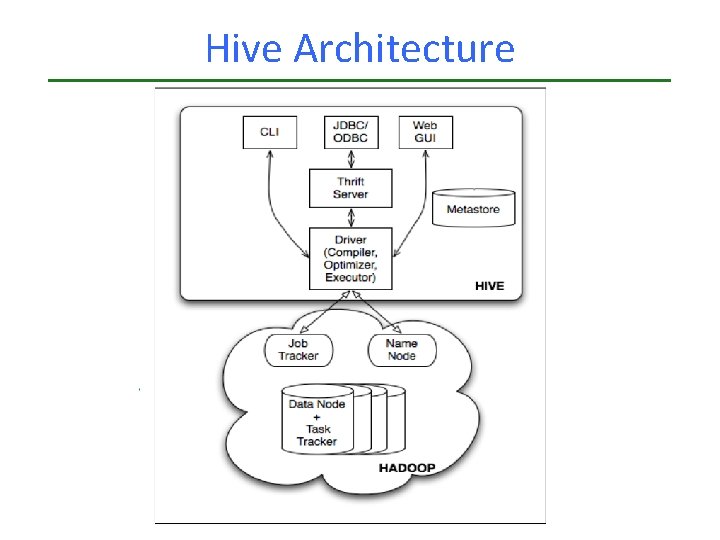
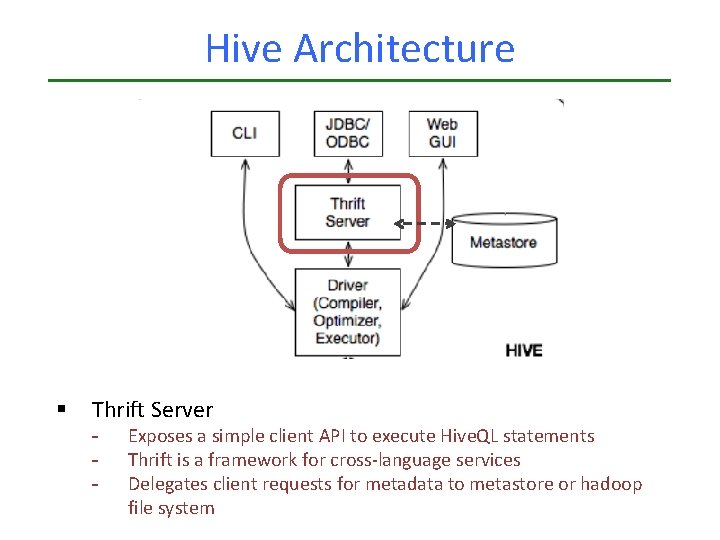
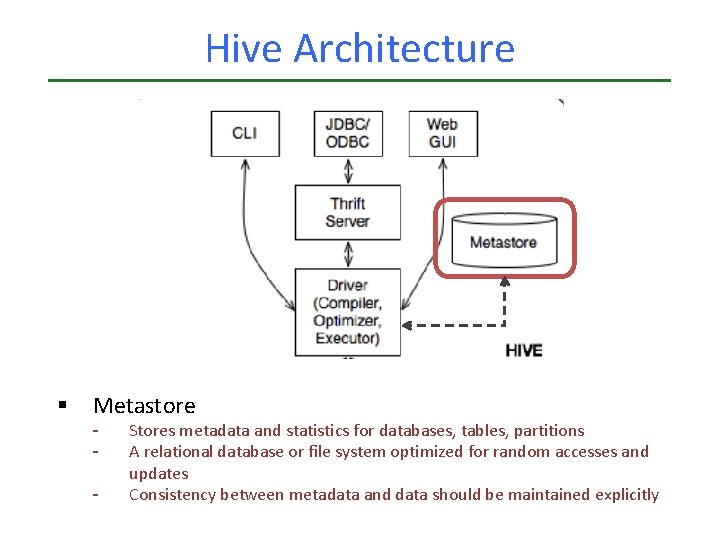
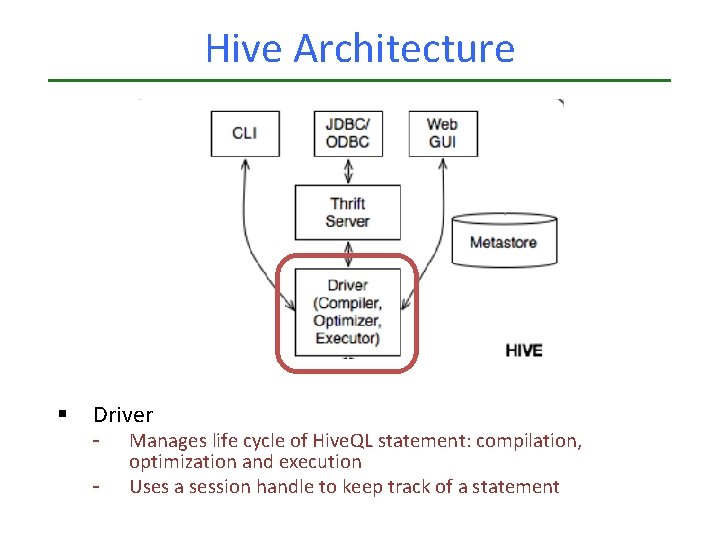
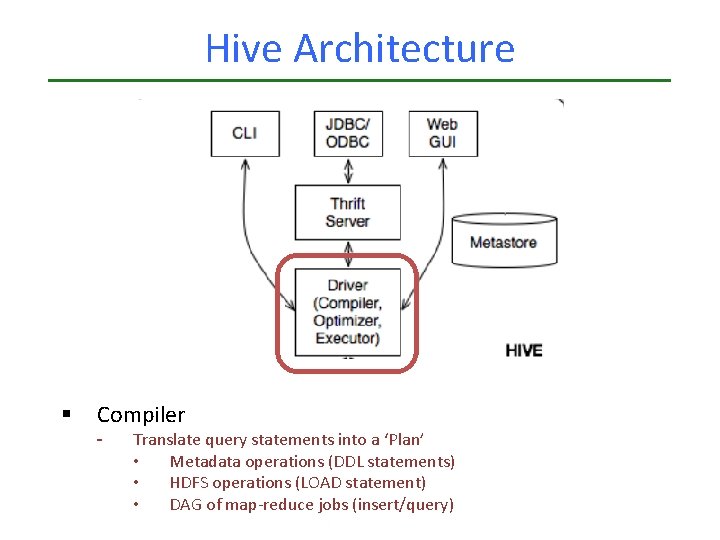
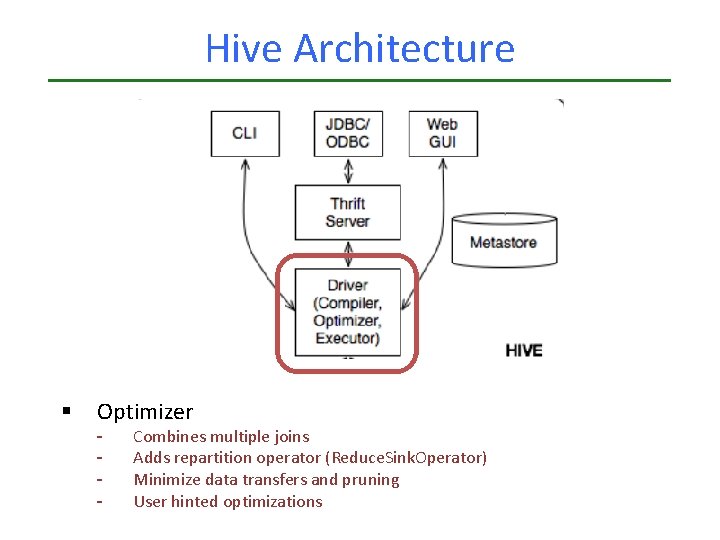
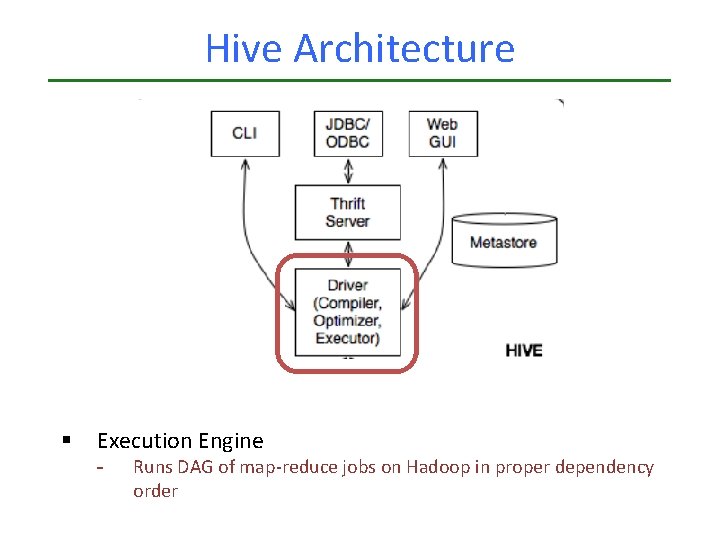
Hive Architecture
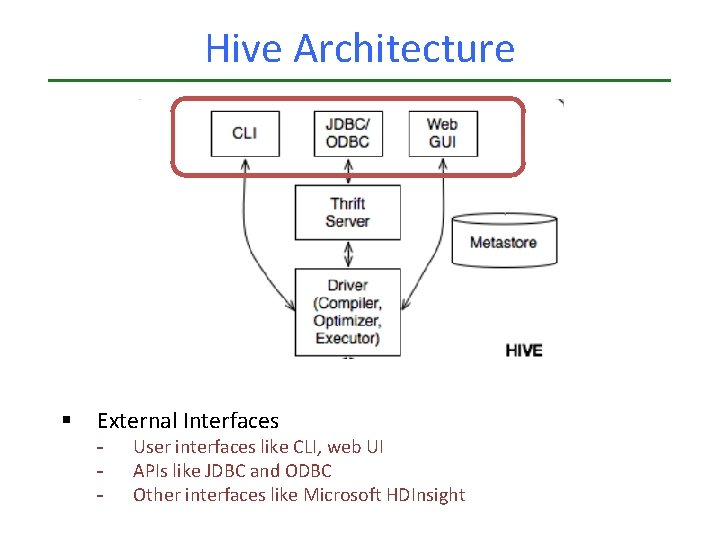
Hive Architecture § External Interfaces - User interfaces like CLI, web UI APIs like JDBC and ODBC Other interfaces like Microsoft HDInsight
Hive Architecture § Thrift Server - Exposes a simple client API to execute Hive. QL statements Thrift is a framework for cross-language services Delegates client requests for metadata to metastore or hadoop file system
Hive Architecture § Metastore - Stores metadata and statistics for databases, tables, partitions A relational database or file system optimized for random accesses and updates Consistency between metadata and data should be maintained explicitly
Hive Architecture § Driver - Manages life cycle of Hive. QL statement: compilation, optimization and execution Uses a session handle to keep track of a statement
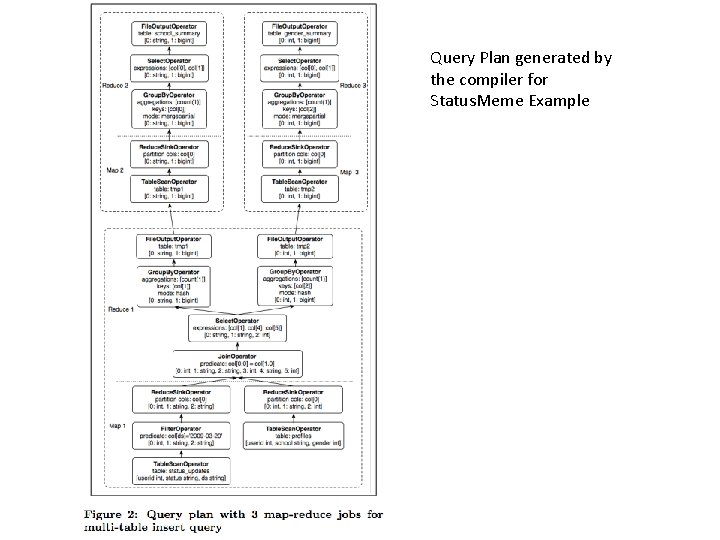
Hive Architecture § Compiler - Translate query statements into a ‘Plan’ • Metadata operations (DDL statements) • HDFS operations (LOAD statement) • DAG of map-reduce jobs (insert/query)
Hive Architecture § Optimizer - Combines multiple joins Adds repartition operator (Reduce. Sink. Operator) Minimize data transfers and pruning User hinted optimizations
Hive Architecture § Execution Engine - Runs DAG of map-reduce jobs on Hadoop in proper dependency order
Query Plan generated by the compiler for Status. Meme Example
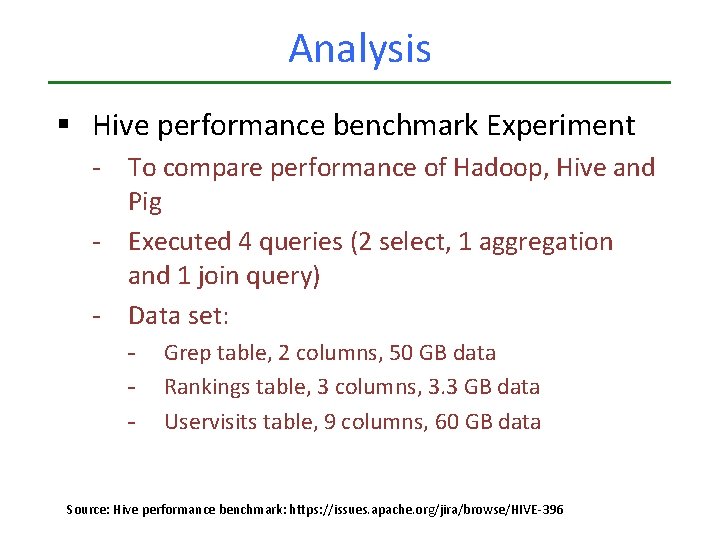
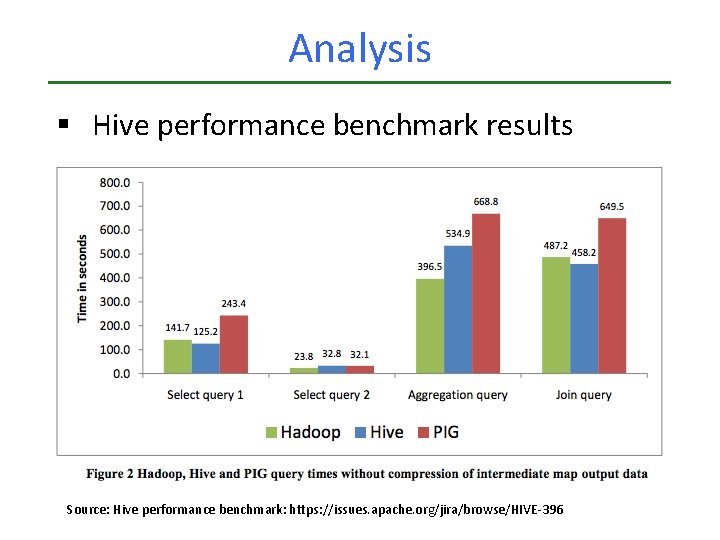
Analysis § Hive performance benchmark Experiment - To compare performance of Hadoop, Hive and Pig - Executed 4 queries (2 select, 1 aggregation and 1 join query) - Data set: - Grep table, 2 columns, 50 GB data Rankings table, 3 columns, 3. 3 GB data Uservisits table, 9 columns, 60 GB data Source: Hive performance benchmark: https: //issues. apache. org/jira/browse/HIVE-396
Analysis § Hive performance benchmark results Source: Hive performance benchmark: https: //issues. apache. org/jira/browse/HIVE-396
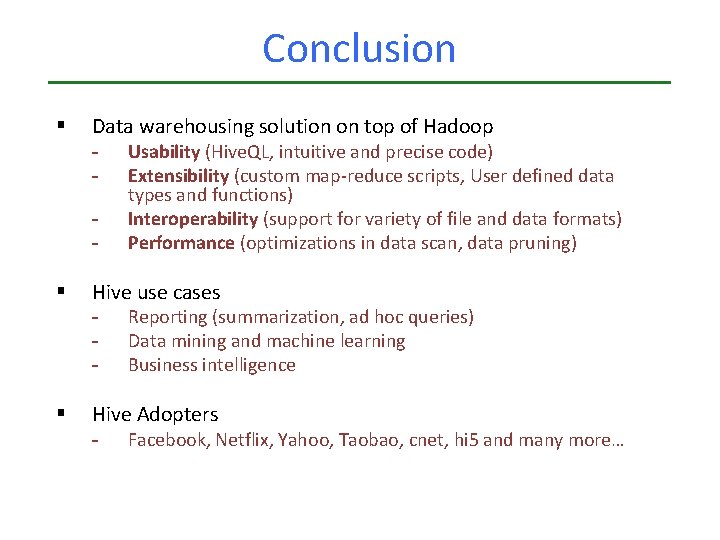
Conclusion § Data warehousing solution on top of Hadoop - § Hive use cases - § Usability (Hive. QL, intuitive and precise code) Extensibility (custom map-reduce scripts, User defined data types and functions) Interoperability (support for variety of file and data formats) Performance (optimizations in data scan, data pruning) Reporting (summarization, ad hoc queries) Data mining and machine learning Business intelligence Hive Adopters - Facebook, Netflix, Yahoo, Taobao, cnet, hi 5 and many more…
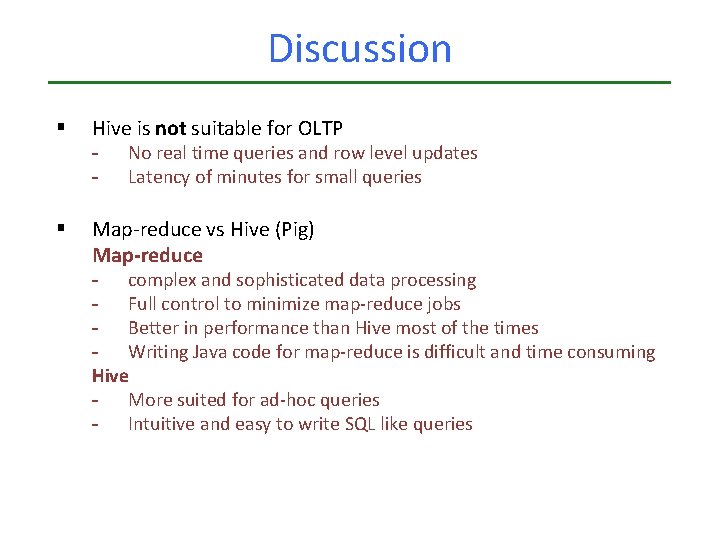
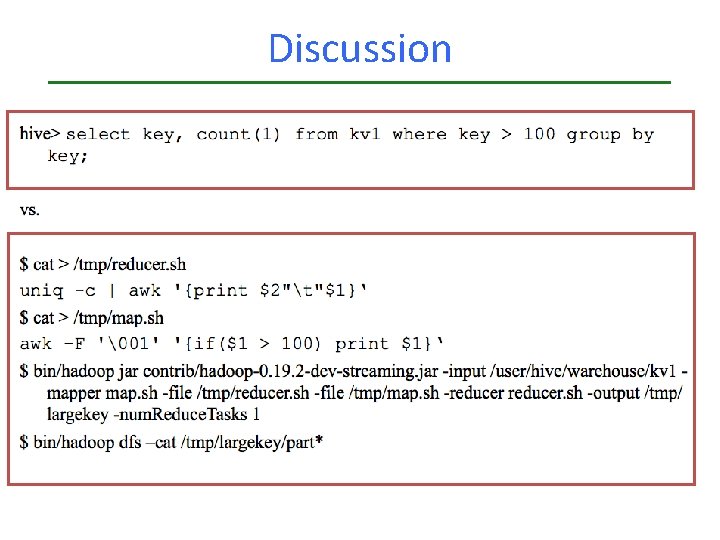
Discussion § Hive is not suitable for OLTP - § No real time queries and row level updates Latency of minutes for small queries Map-reduce vs Hive (Pig) Map-reduce - complex and sophisticated data processing - Full control to minimize map-reduce jobs - Better in performance than Hive most of the times - Writing Java code for map-reduce is difficult and time consuming Hive - More suited for ad-hoc queries - Intuitive and easy to write SQL like queries
Discussion
Discussion § Hive vs Pig - Hive is more natural to database developers and Pig is convenient for script/perl developers - Hive gives better performance than Pig - Pig is more suited for ETL and data movement, while Hive is better for ad hoc queries
Discussion “Hive is evolving as a parallel SQL DBMS which happens to use Hadoop as its storage and execution architecture” § Increasing Hive. QL Capabilities - § Optimization Techniques - § Cost-based optimization Performance Improvements - § Insert, update and delete with full ACID support REGEX support in selecting files for External Table Support for ‘dual’ table, information_schema Improving ‘Explain’ Adoption of RCFile for data placement, and most recently the ORC Integration with other Frameworks - Support with HBase, Cassandra
References § § § [1] Hive paper http: //www. vldb. org/pvldb/2/vldb 09 -938. pdf [2] Hive wiki https: //cwiki. apache. org/confluence/display/Hive/Home [3] Hive performance benchmarks https: //issues. apache. org/jira/browse/HIVE-396 [4] Hive Facebook presentation http: //www. sfbayacm. org/wp/wp-content/uploads/2010/01/ sig_2010_v 21. pdf [5] Hive vs Pig: Yahoo developers http: //developer. yahoo. com/blogs/hadoop/pig-hive-yahoo-464. html [6] Hive Apache JIRA page https: //issues. apache. org/jira/browse/HIVE
Backup Slides § Extra Material
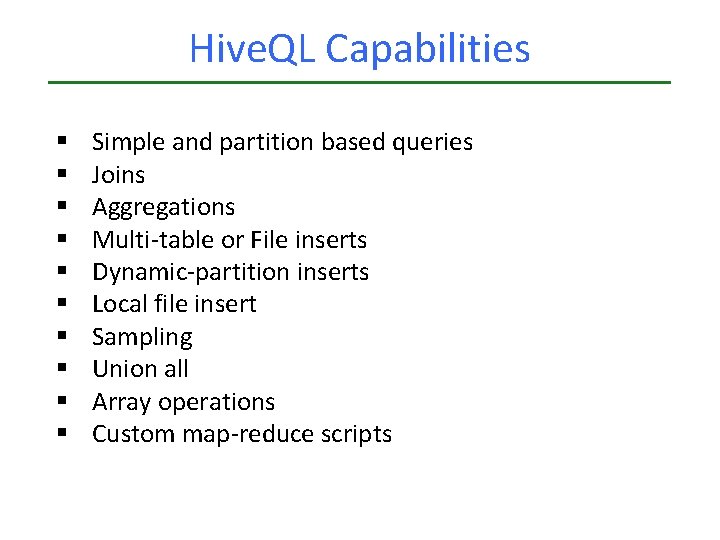
Hive. QL Capabilities § § § § § Simple and partition based queries Joins Aggregations Multi-table or File inserts Dynamic-partition inserts Local file insert Sampling Union all Array operations Custom map-reduce scripts
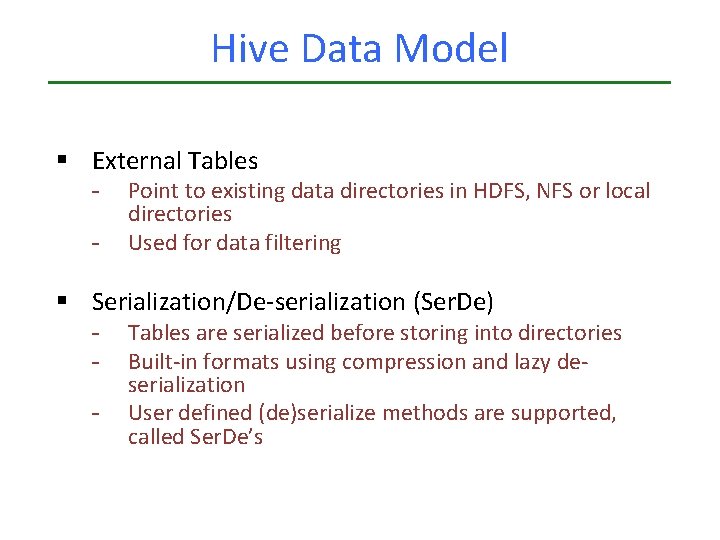
Hive Data Model § External Tables - Point to existing data directories in HDFS, NFS or local directories Used for data filtering § Serialization/De-serialization (Ser. De) - Tables are serialized before storing into directories Built-in formats using compression and lazy deserialization User defined (de)serialize methods are supported, called Ser. De’s
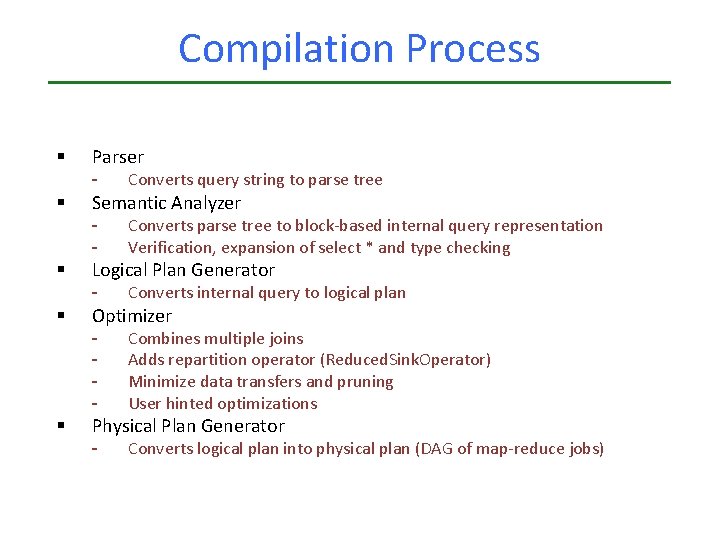
Compilation Process § Parser - § Semantic Analyzer - § Converts internal query to logical plan Optimizer - § Converts parse tree to block-based internal query representation Verification, expansion of select * and type checking Logical Plan Generator - § Converts query string to parse tree Combines multiple joins Adds repartition operator (Reduced. Sink. Operator) Minimize data transfers and pruning User hinted optimizations Physical Plan Generator - Converts logical plan into physical plan (DAG of map-reduce jobs)