
DataIntensive Computing with Map Reduce Session 4 Language




- Slides: 82
Data-Intensive Computing with Map. Reduce Session 4: Language Models and Inverted Indexing Jimmy Lin University of Maryland Thursday, February 14, 2013 This work is licensed under a Creative Commons Attribution-Noncommercial-Share Alike 3. 0 United States See http: //creativecommons. org/licenses/by-nc-sa/3. 0/us/ for details
Today’s Agenda ¢ Real-world word counting: language models l ¢ How to break all the rules and get away with it Crash course on information retrieval l l Basics of indexing and retrieval Inverted indexing in Map. Reduce
The two commandments of estimating probability distributions… Source: Wikipedia (Moses)
Probabilities must sum up to one Source: http: //www. flickr. com/photos/37680518@N 03/7746322384/
Thou shalt smooth Source: http: //www. flickr. com/photos/brettmorrison/3732910565/
Source: Warner Bros. Pictures
Map. Reduce Source: Google
Count. Normalize. Source: http: //www. flickr. com/photos/guvnah/7861418602/
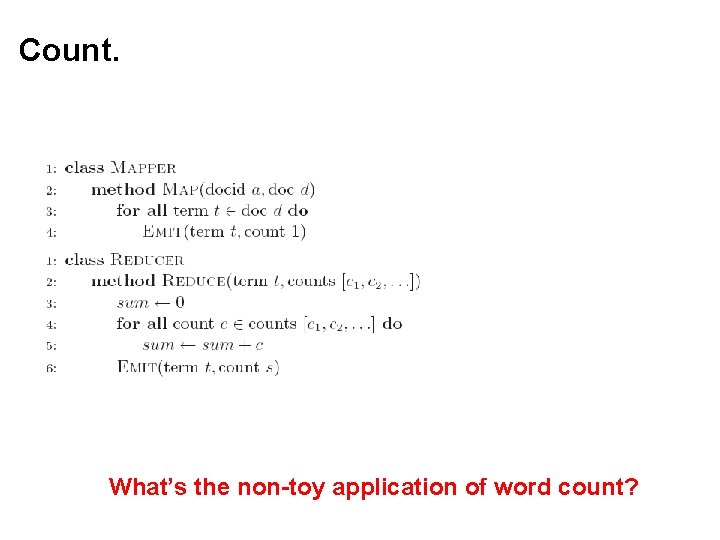
Count. What’s the non-toy application of word count?
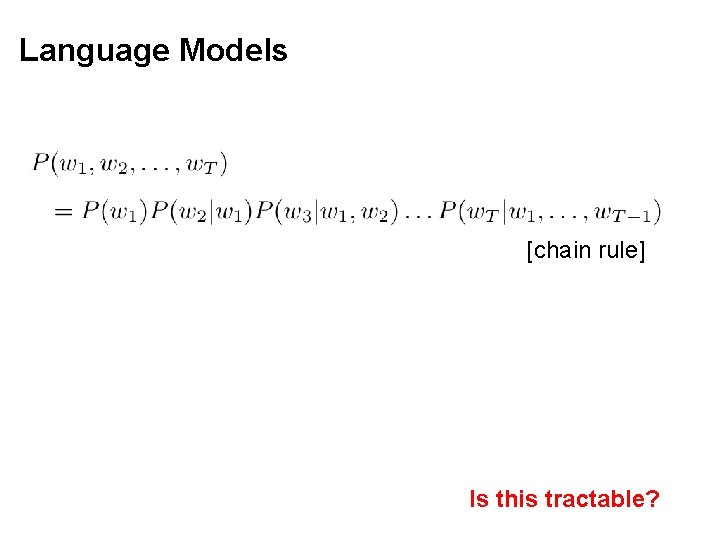
Language Models [chain rule] Is this tractable?
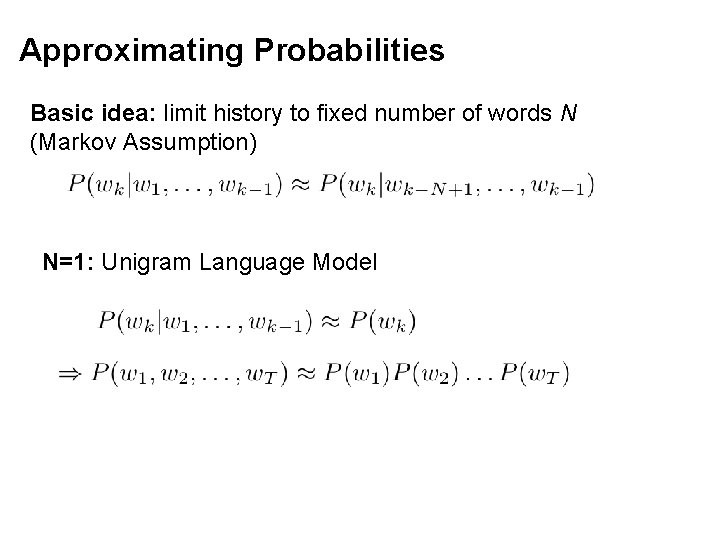
Approximating Probabilities Basic idea: limit history to fixed number of words N (Markov Assumption) N=1: Unigram Language Model
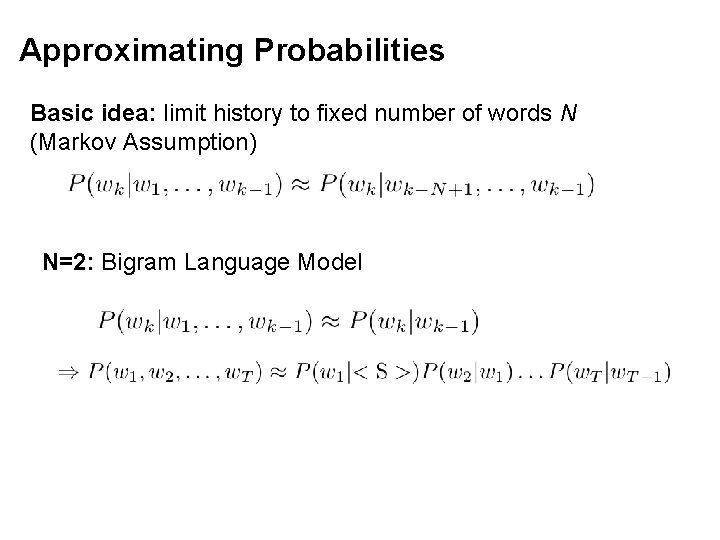
Approximating Probabilities Basic idea: limit history to fixed number of words N (Markov Assumption) N=2: Bigram Language Model
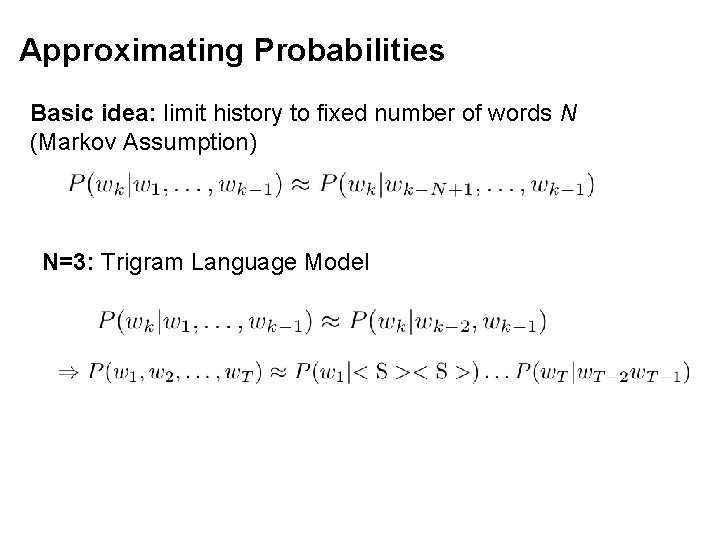
Approximating Probabilities Basic idea: limit history to fixed number of words N (Markov Assumption) N=3: Trigram Language Model
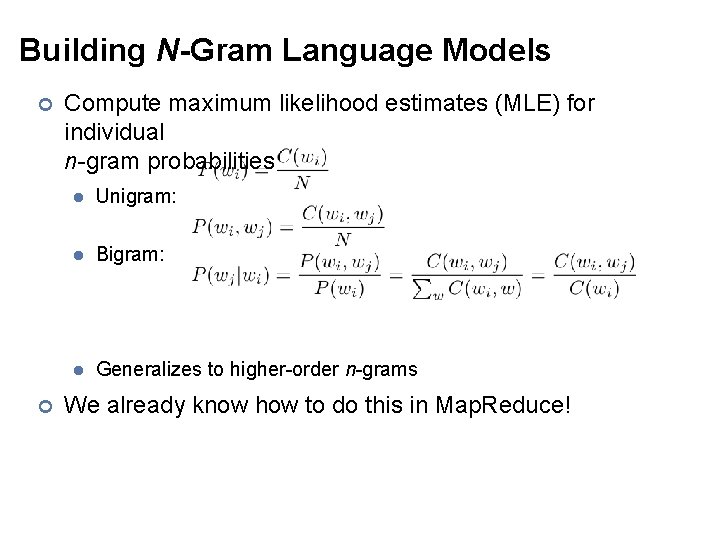
Building N-Gram Language Models ¢ ¢ Compute maximum likelihood estimates (MLE) for individual n-gram probabilities l Unigram: l Bigram: l Generalizes to higher-order n-grams We already know how to do this in Map. Reduce!
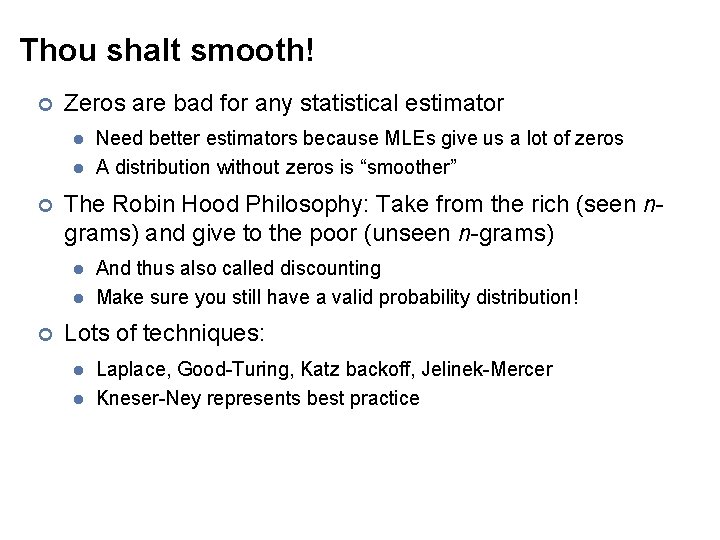
Thou shalt smooth! ¢ Zeros are bad for any statistical estimator l l ¢ The Robin Hood Philosophy: Take from the rich (seen ngrams) and give to the poor (unseen n-grams) l l ¢ Need better estimators because MLEs give us a lot of zeros A distribution without zeros is “smoother” And thus also called discounting Make sure you still have a valid probability distribution! Lots of techniques: l l Laplace, Good-Turing, Katz backoff, Jelinek-Mercer Kneser-Ney represents best practice
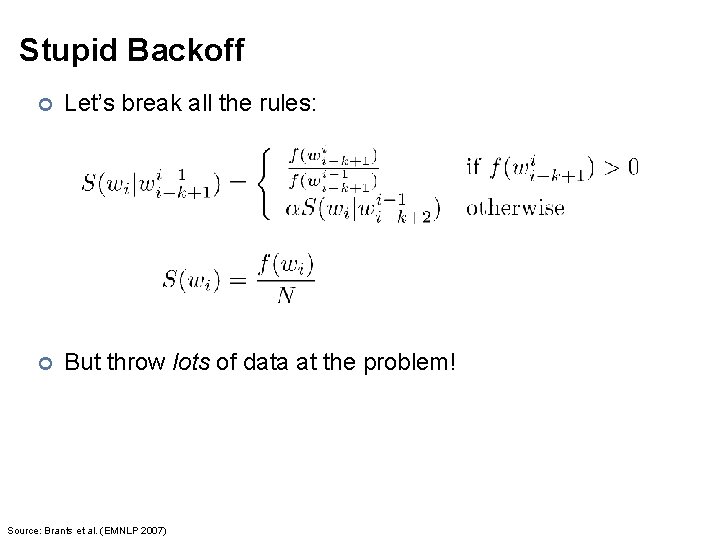
Stupid Backoff ¢ Let’s break all the rules: ¢ But throw lots of data at the problem! Source: Brants et al. (EMNLP 2007)
Stupid Backoff Implementation ¢ Same basic idea as “pairs” approach discussed previously ¢ A few optimizations: l l Convert words to integers, ordered by frequency (take advantage of VByte compression) Replicate unigram counts to all shards
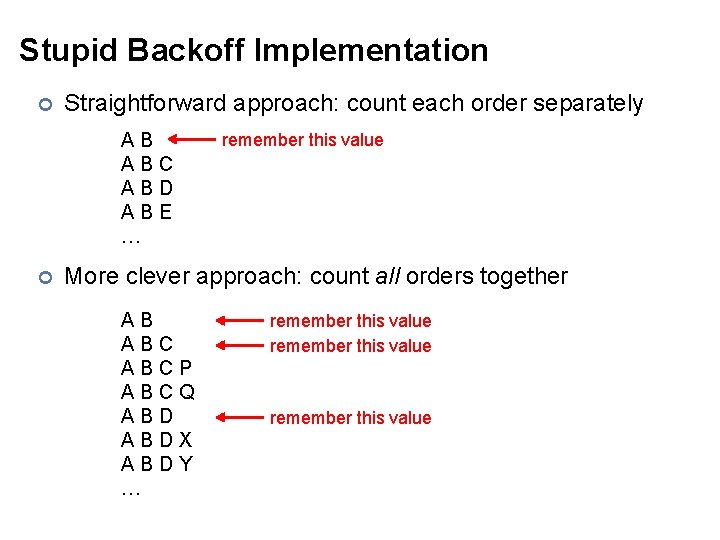
Stupid Backoff Implementation ¢ Straightforward approach: count each order separately AB ABC ABD ABE … ¢ remember this value More clever approach: count all orders together AB ABCP ABCQ ABDX ABDY … remember this value
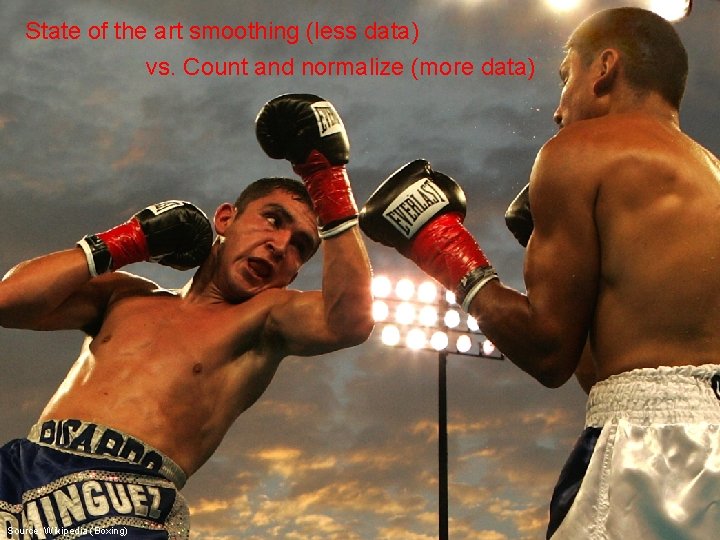
State of the art smoothing (less data) vs. Count and normalize (more data) Source: Wikipedia (Boxing)
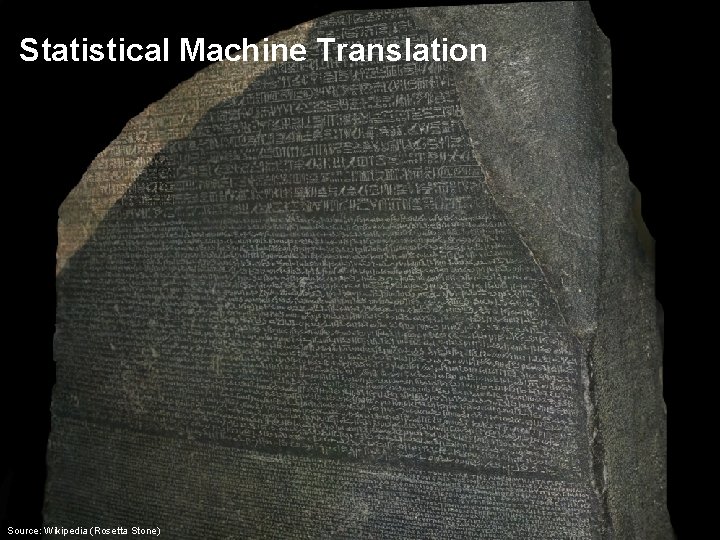
Statistical Machine Translation Source: Wikipedia (Rosetta Stone)
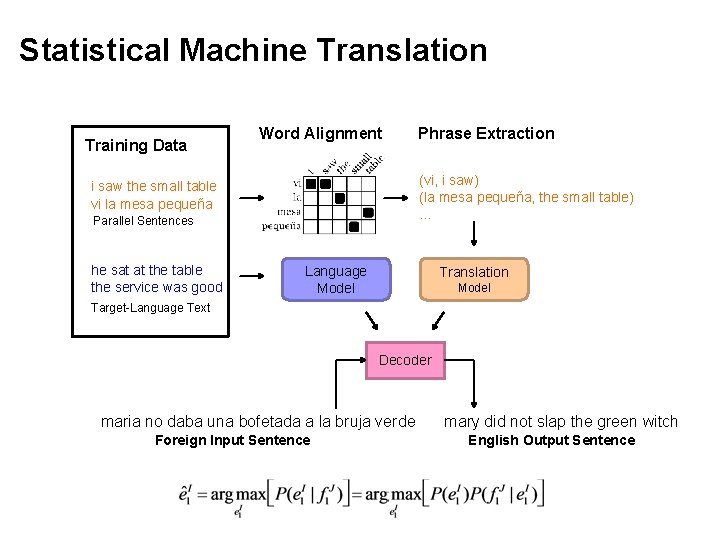
Statistical Machine Translation Training Data Word Alignment (vi, i saw) (la mesa pequeña, the small table) … i saw the small table vi la mesa pequeña Parallel Sentences he sat at the table the service was good Phrase Extraction Language Model Translation Model Target-Language Text Decoder maria no daba una bofetada a la bruja verde Foreign Input Sentence mary did not slap the green witch English Output Sentence
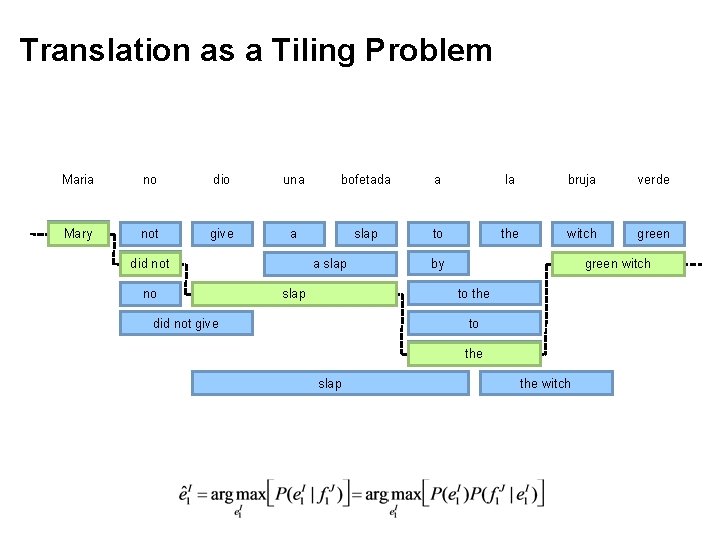
Translation as a Tiling Problem Maria no dio una bofetada a la bruja verde Mary not give a slap to the witch green did not no a slap by green witch to the slap did not give to the slap the witch
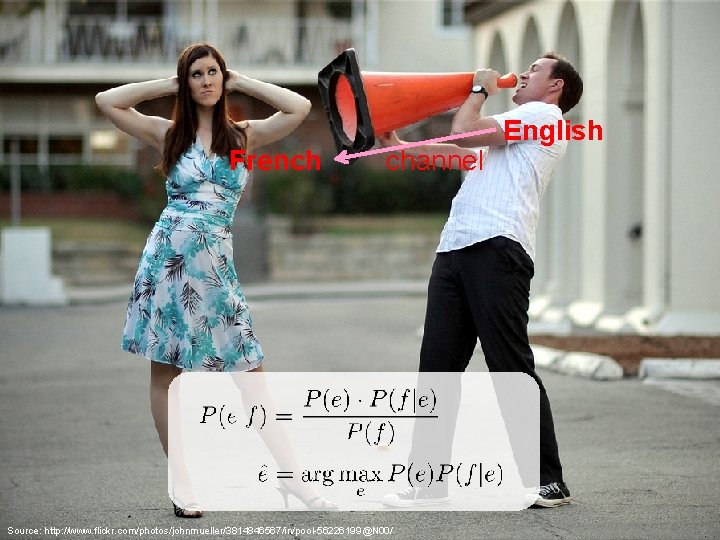
French channel Source: http: //www. flickr. com/photos/johnmueller/3814846567/in/pool-56226199@N 00/ English
Results: Running Time Source: Brants et al. (EMNLP 2007)
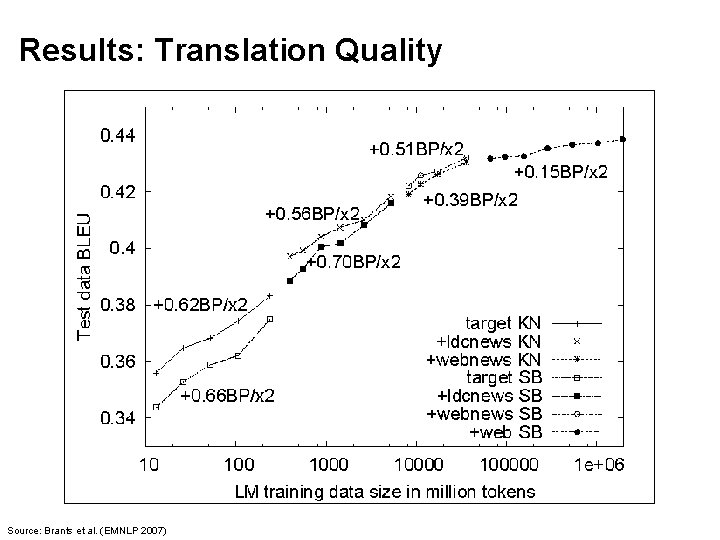
Results: Translation Quality Source: Brants et al. (EMNLP 2007)
Today’s Agenda ¢ Real-world word counting: language models l ¢ How to break all the rules and get away with it Crash course on information retrieval l l Basics of indexing and retrieval Inverted indexing in Map. Reduce
First, nomenclature… ¢ Information retrieval (IR) l l ¢ What do we search? l l ¢ Focus on textual information (= text/document retrieval) Other possibilities include image, video, music, … Generically, “collections” Less-frequently used, “corpora” What do we find? l l Generically, “documents” Even though we may be referring to web pages, PDFs, Power. Point slides, paragraphs, etc.
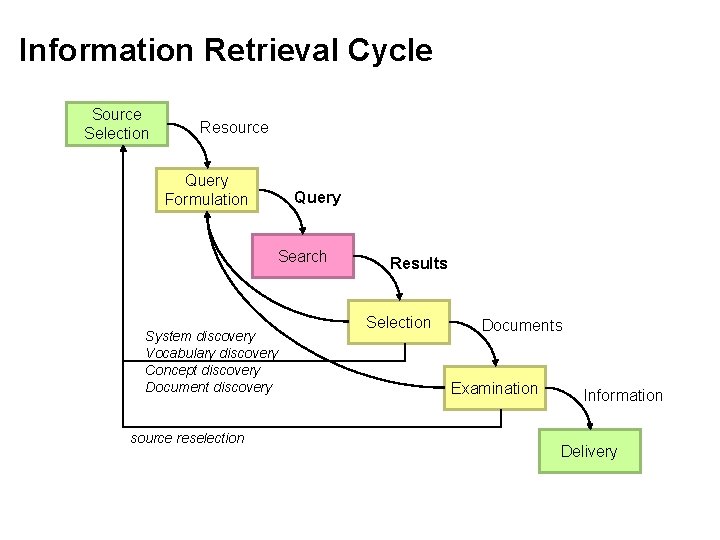
Information Retrieval Cycle Source Selection Resource Query Formulation Query Search System discovery Vocabulary discovery Concept discovery Document discovery source reselection Results Selection Documents Examination Information Delivery
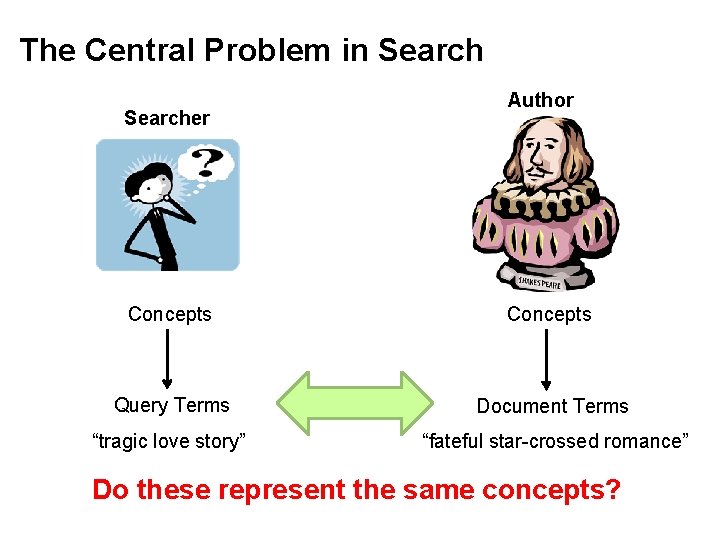
The Central Problem in Searcher Author Concepts Query Terms Document Terms “tragic love story” “fateful star-crossed romance” Do these represent the same concepts?
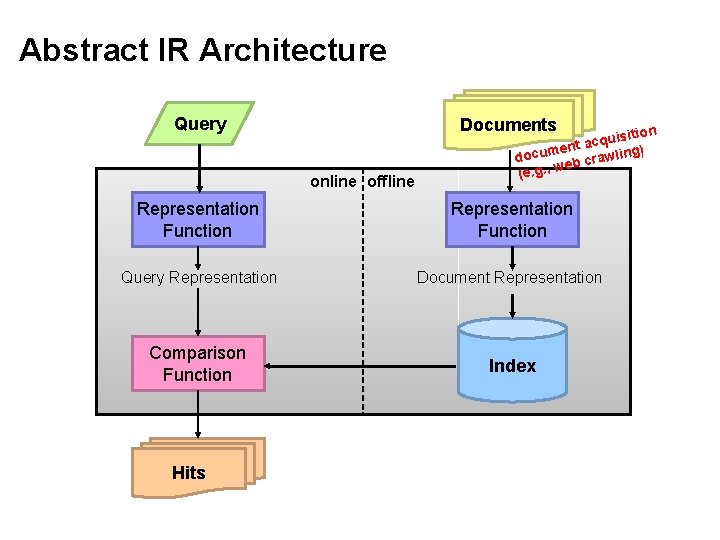
Abstract IR Architecture Query Documents online offline sition i u q c ent a ) docum b crawling we (e. g. , Representation Function Query Representation Document Representation Comparison Function Index Hits
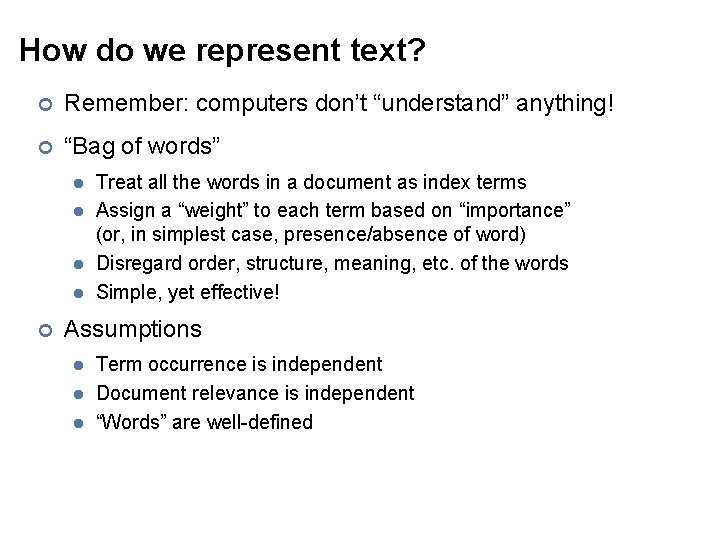
How do we represent text? ¢ Remember: computers don’t “understand” anything! ¢ “Bag of words” l l ¢ Treat all the words in a document as index terms Assign a “weight” to each term based on “importance” (or, in simplest case, presence/absence of word) Disregard order, structure, meaning, etc. of the words Simple, yet effective! Assumptions l l l Term occurrence is independent Document relevance is independent “Words” are well-defined
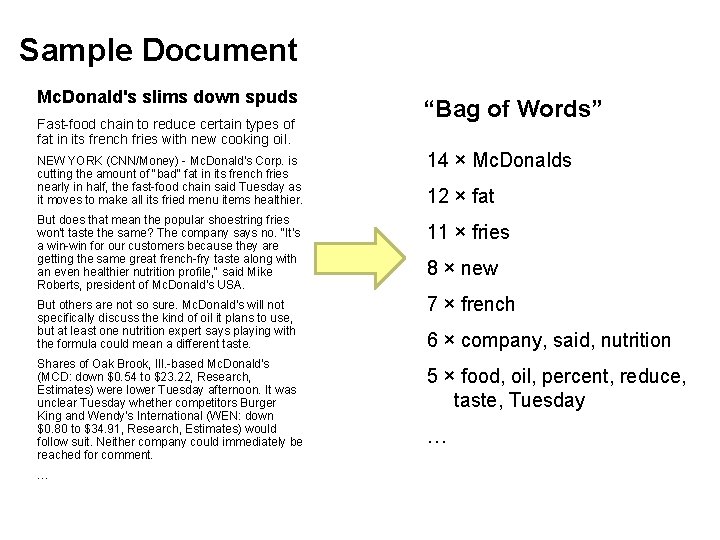
Sample Document Mc. Donald's slims down spuds Fast-food chain to reduce certain types of fat in its french fries with new cooking oil. NEW YORK (CNN/Money) - Mc. Donald's Corp. is cutting the amount of "bad" fat in its french fries nearly in half, the fast-food chain said Tuesday as it moves to make all its fried menu items healthier. But does that mean the popular shoestring fries won't taste the same? The company says no. "It's a win-win for our customers because they are getting the same great french-fry taste along with an even healthier nutrition profile, " said Mike Roberts, president of Mc. Donald's USA. But others are not so sure. Mc. Donald's will not specifically discuss the kind of oil it plans to use, but at least one nutrition expert says playing with the formula could mean a different taste. Shares of Oak Brook, Ill. -based Mc. Donald's (MCD: down $0. 54 to $23. 22, Research, Estimates) were lower Tuesday afternoon. It was unclear Tuesday whether competitors Burger King and Wendy's International (WEN: down $0. 80 to $34. 91, Research, Estimates) would follow suit. Neither company could immediately be reached for comment. … “Bag of Words” 14 × Mc. Donalds 12 × fat 11 × fries 8 × new 7 × french 6 × company, said, nutrition 5 × food, oil, percent, reduce, taste, Tuesday …
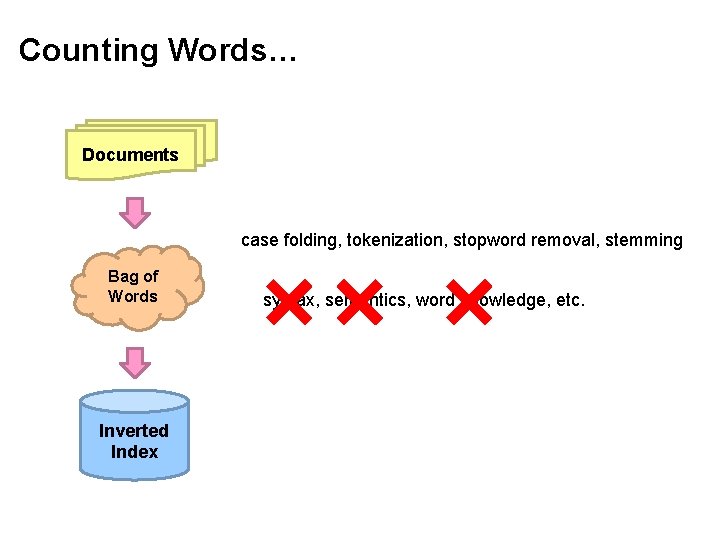
Counting Words… Documents case folding, tokenization, stopword removal, stemming Bag of Words Inverted Index syntax, semantics, word knowledge, etc.
Boolean Retrieval ¢ Users express queries as a Boolean expression l l ¢ AND, OR, NOT Can be arbitrarily nested Retrieval is based on the notion of sets l l Any given query divides the collection into two sets: retrieved, not-retrieved Pure Boolean systems do not define an ordering of the results
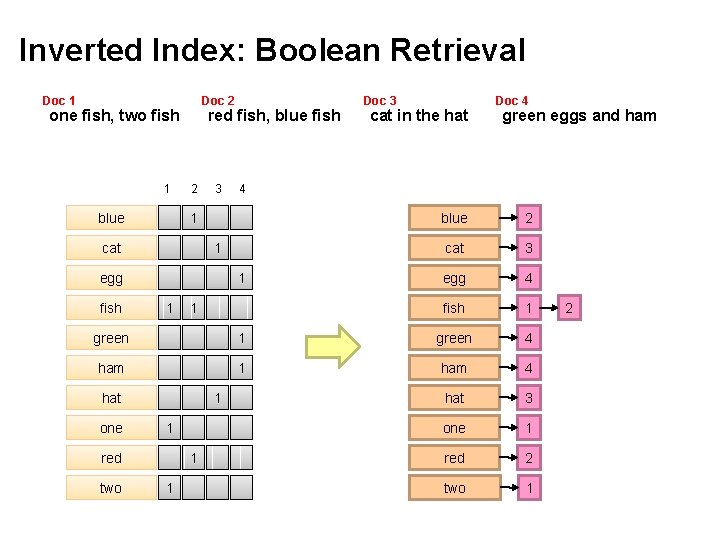
Inverted Index: Boolean Retrieval Doc 1 Doc 2 one fish, two fish 1 blue red fish, blue fish 2 3 1 egg fish 1 1 cat in the hat Doc 4 green eggs and ham 4 1 cat Doc 3 1 blue 2 cat 3 egg 4 fish 1 green 4 ham 1 ham 4 hat 3 one 1 red 2 two 1 hat one 1 1 red two 1 1 2
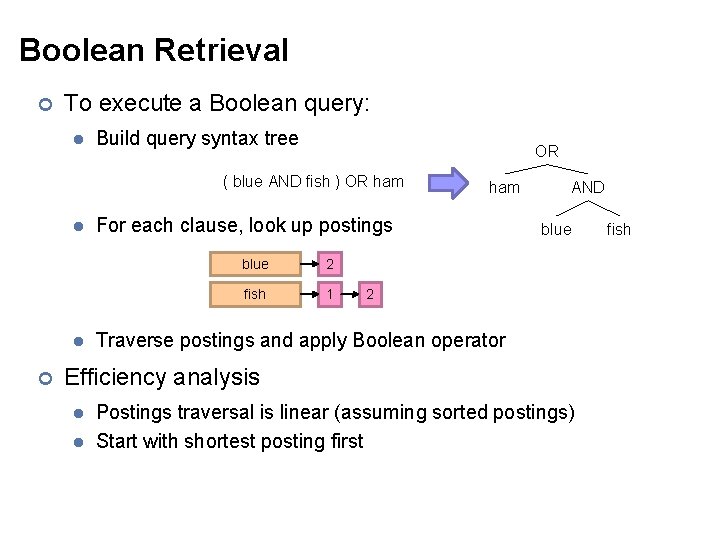
Boolean Retrieval ¢ To execute a Boolean query: l Build query syntax tree OR ( blue AND fish ) OR ham l l ¢ ham For each clause, look up postings blue 2 fish 1 AND blue 2 Traverse postings and apply Boolean operator Efficiency analysis l l Postings traversal is linear (assuming sorted postings) Start with shortest posting first fish
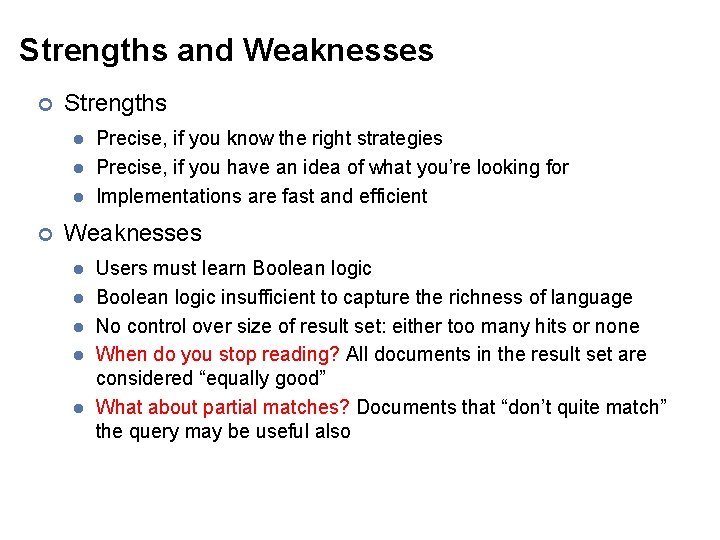
Strengths and Weaknesses ¢ Strengths l l l ¢ Precise, if you know the right strategies Precise, if you have an idea of what you’re looking for Implementations are fast and efficient Weaknesses l l l Users must learn Boolean logic insufficient to capture the richness of language No control over size of result set: either too many hits or none When do you stop reading? All documents in the result set are considered “equally good” What about partial matches? Documents that “don’t quite match” the query may be useful also
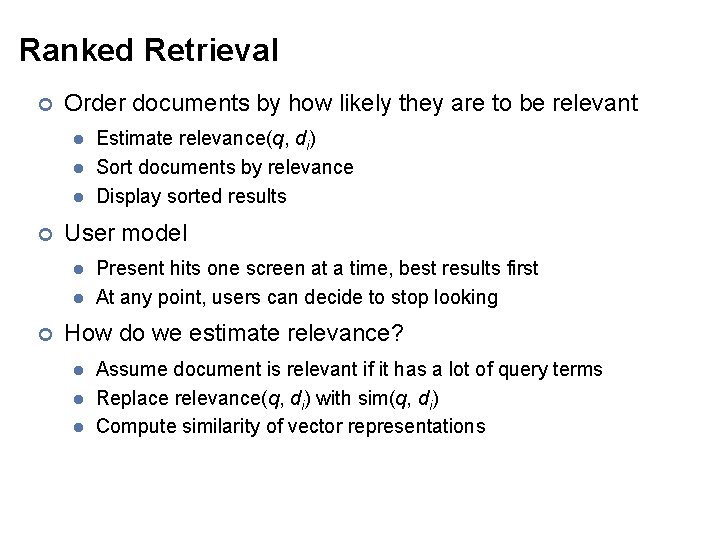
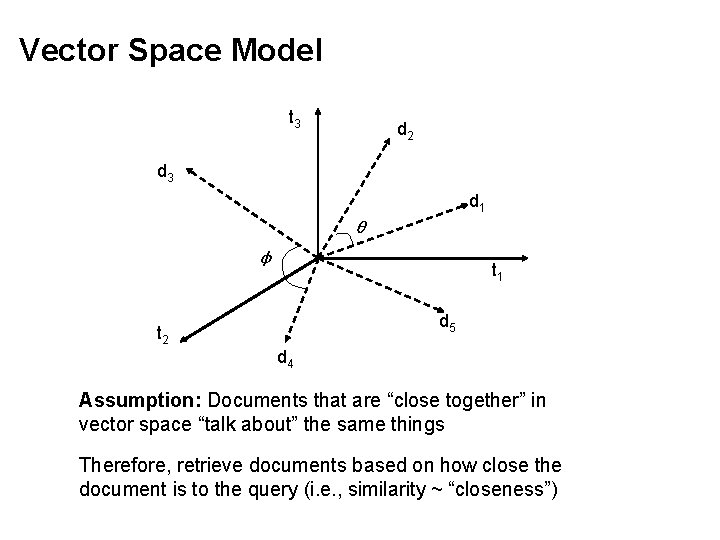
Ranked Retrieval ¢ Order documents by how likely they are to be relevant l l l ¢ User model l l ¢ Estimate relevance(q, di) Sort documents by relevance Display sorted results Present hits one screen at a time, best results first At any point, users can decide to stop looking How do we estimate relevance? l l l Assume document is relevant if it has a lot of query terms Replace relevance(q, di) with sim(q, di) Compute similarity of vector representations
Vector Space Model t 3 d 2 d 3 d 1 θ φ t 1 d 5 t 2 d 4 Assumption: Documents that are “close together” in vector space “talk about” the same things Therefore, retrieve documents based on how close the document is to the query (i. e. , similarity ~ “closeness”)
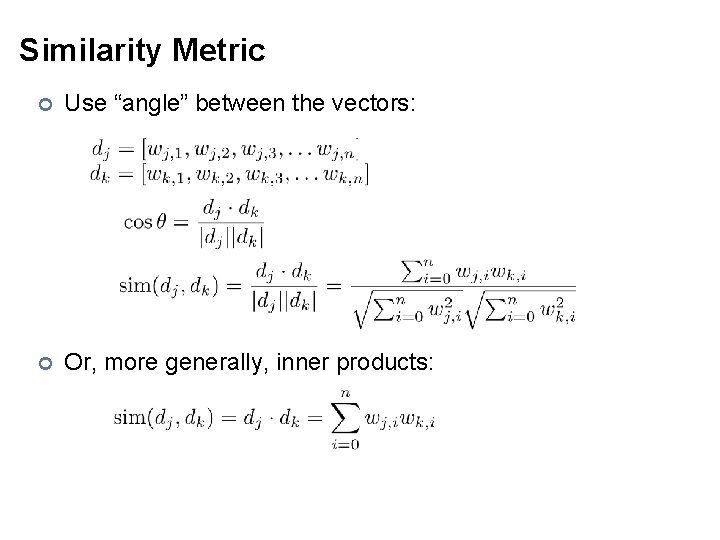
Similarity Metric ¢ Use “angle” between the vectors: ¢ Or, more generally, inner products:
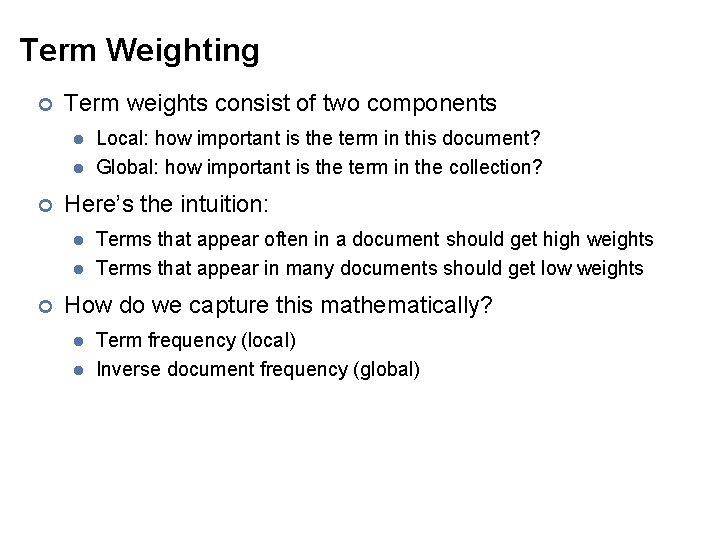
Term Weighting ¢ Term weights consist of two components l l ¢ Here’s the intuition: l l ¢ Local: how important is the term in this document? Global: how important is the term in the collection? Terms that appear often in a document should get high weights Terms that appear in many documents should get low weights How do we capture this mathematically? l l Term frequency (local) Inverse document frequency (global)
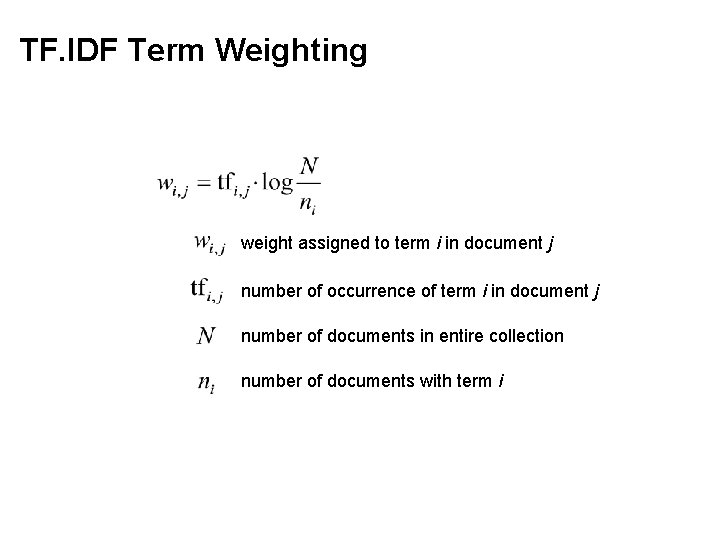
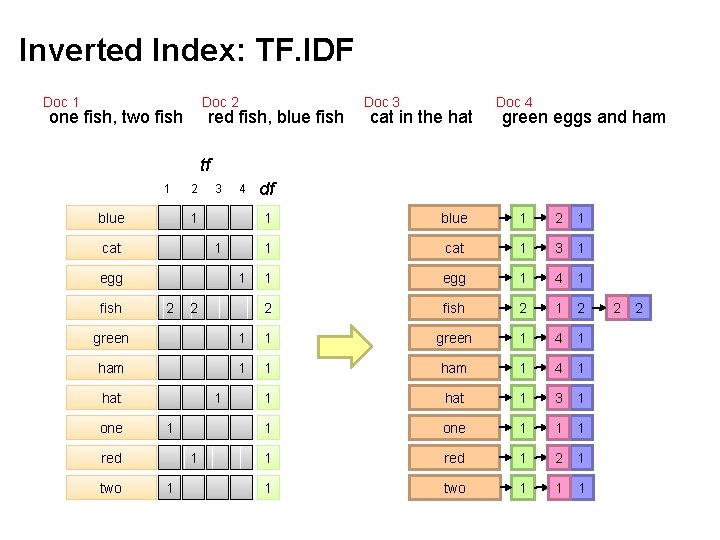
TF. IDF Term Weighting weight assigned to term i in document j number of occurrence of term i in document j number of documents in entire collection number of documents with term i
Inverted Index: TF. IDF Doc 1 Doc 2 one fish, two fish red fish, blue fish Doc 3 cat in the hat Doc 4 green eggs and ham tf 1 blue 2 3 1 cat 1 egg fish 4 1 2 2 df 1 blue 1 2 1 1 cat 1 3 1 1 egg 1 4 1 2 fish 2 1 2 green 1 1 green 1 4 1 ham 1 4 1 1 hat 1 3 1 1 one 1 1 red 1 2 1 1 two 1 1 1 hat one 1 1 red two 1 1 2 2
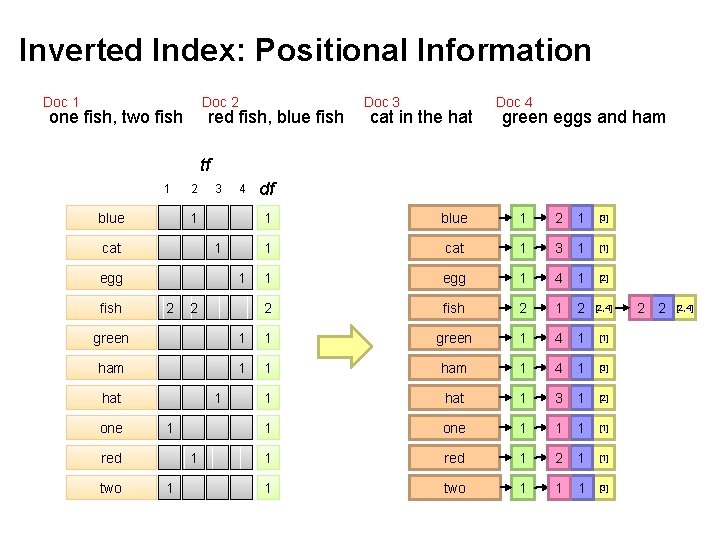
Positional Indexes ¢ Store term position in postings ¢ Supports richer queries (e. g. , proximity) ¢ Naturally, leads to larger indexes…
Inverted Index: Positional Information Doc 1 Doc 2 one fish, two fish red fish, blue fish Doc 3 cat in the hat Doc 4 green eggs and ham tf 1 blue 2 3 1 cat 1 egg fish 4 1 2 2 df 1 blue 1 2 1 [3] 1 cat 1 3 1 [1] 1 egg 1 4 1 [2] 2 fish 2 1 2 [2, 4] green 1 1 green 1 4 1 [1] ham 1 1 ham 1 4 1 [3] 1 hat 1 3 1 [2] 1 one 1 1 1 [1] 1 red 1 2 1 [1] 1 two 1 1 1 [3] hat one 1 1 red two 1 1 2 2 [2, 4]
Retrieval in a Nutshell ¢ Look up postings lists corresponding to query terms ¢ Traverse postings for each query term ¢ Store partial query-document scores in accumulators ¢ Select top k results to return
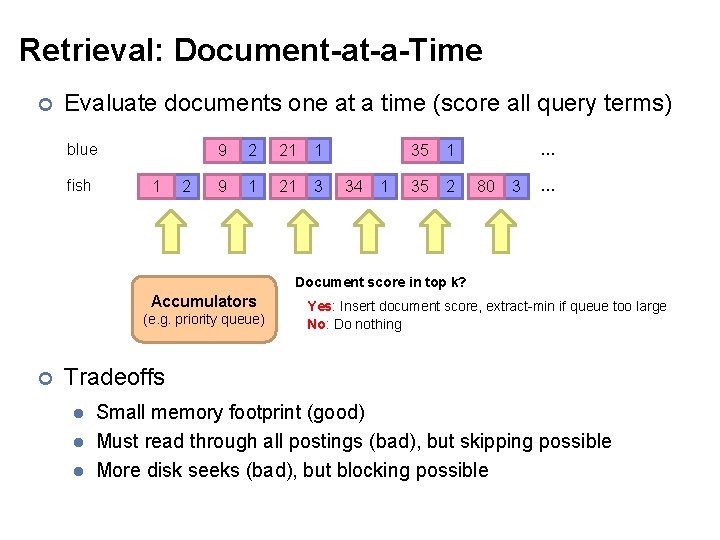
Retrieval: Document-at-a-Time ¢ Evaluate documents one at a time (score all query terms) blue fish 1 2 9 2 21 1 9 1 21 3 34 1 35 2 … 80 3 … Document score in top k? Accumulators (e. g. priority queue) ¢ Yes: Insert document score, extract-min if queue too large No: Do nothing Tradeoffs l l l Small memory footprint (good) Must read through all postings (bad), but skipping possible More disk seeks (bad), but blocking possible
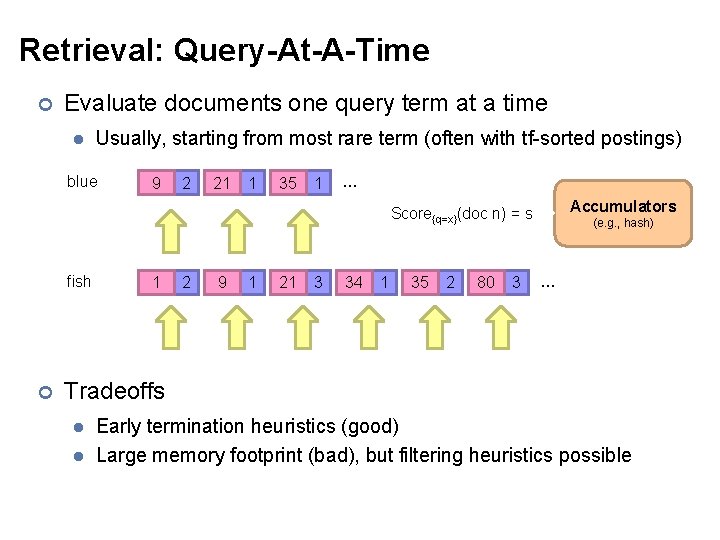
Retrieval: Query-At-A-Time ¢ Evaluate documents one query term at a time l Usually, starting from most rare term (often with tf-sorted postings) blue 9 2 21 1 35 1 … Accumulators Score{q=x}(doc n) = s fish ¢ 1 2 9 1 21 3 34 1 35 2 80 3 (e. g. , hash) … Tradeoffs l l Early termination heuristics (good) Large memory footprint (bad), but filtering heuristics possible
Map. Reduce it? ¢ The indexing problem l l l ¢ Pe rfect for M Scalability is critical ap. Reduce ! Must be relatively fast, but need not be real time Fundamentally a batch operation Incremental updates may or may not be important For the web, crawling is a challenge in itself The retrieval problem l l Must have sub-second response time For the web, only need relatively few results d… o o g o s t o n Uh…
Indexing: Performance Analysis ¢ Fundamentally, a large sorting problem l l Terms usually fit in memory Postings usually don’t ¢ How is it done on a single machine? ¢ How can it be done with Map. Reduce? ¢ First, let’s characterize the problem size: l l Size of vocabulary Size of postings
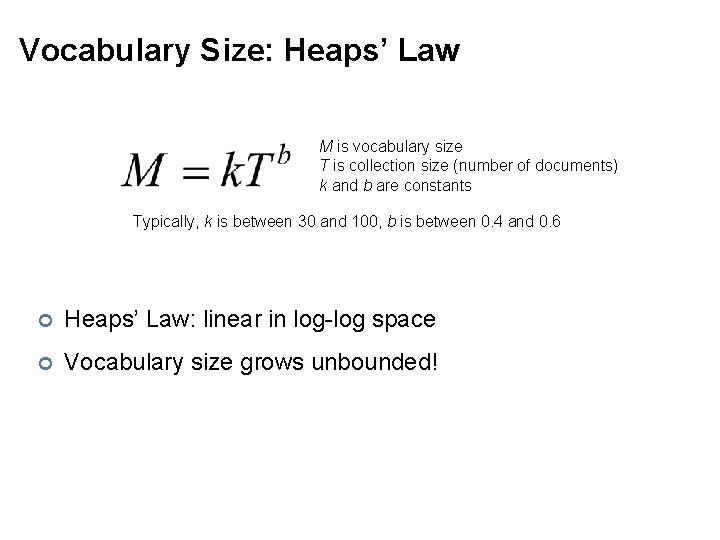
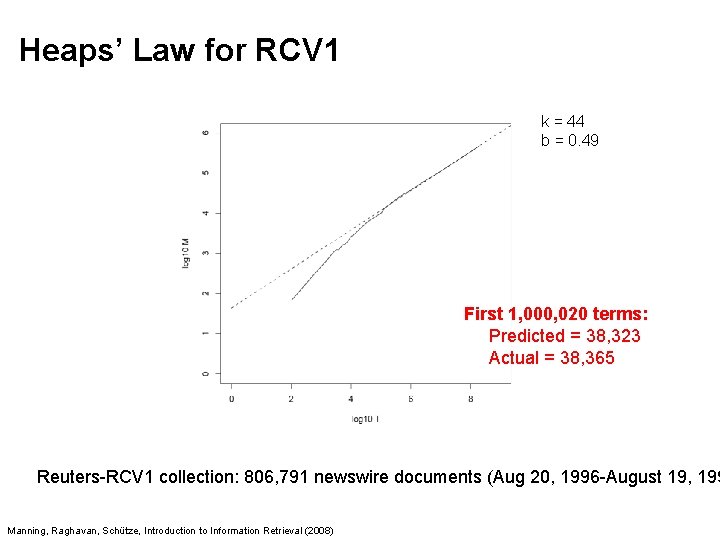
Vocabulary Size: Heaps’ Law M is vocabulary size T is collection size (number of documents) k and b are constants Typically, k is between 30 and 100, b is between 0. 4 and 0. 6 ¢ Heaps’ Law: linear in log-log space ¢ Vocabulary size grows unbounded!
Heaps’ Law for RCV 1 k = 44 b = 0. 49 First 1, 000, 020 terms: Predicted = 38, 323 Actual = 38, 365 Reuters-RCV 1 collection: 806, 791 newswire documents (Aug 20, 1996 -August 19, 199 Manning, Raghavan, Schütze, Introduction to Information Retrieval (2008)
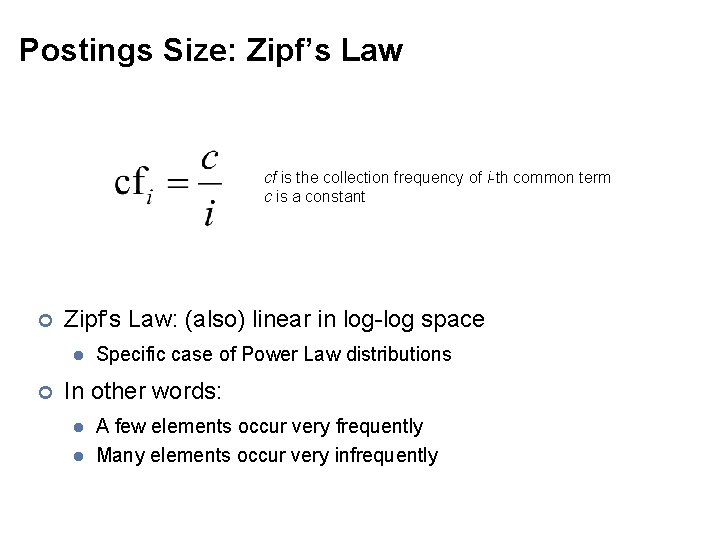
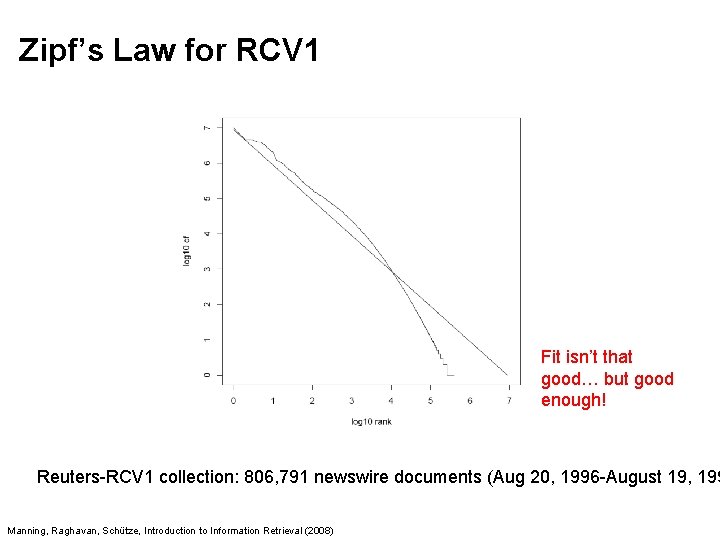
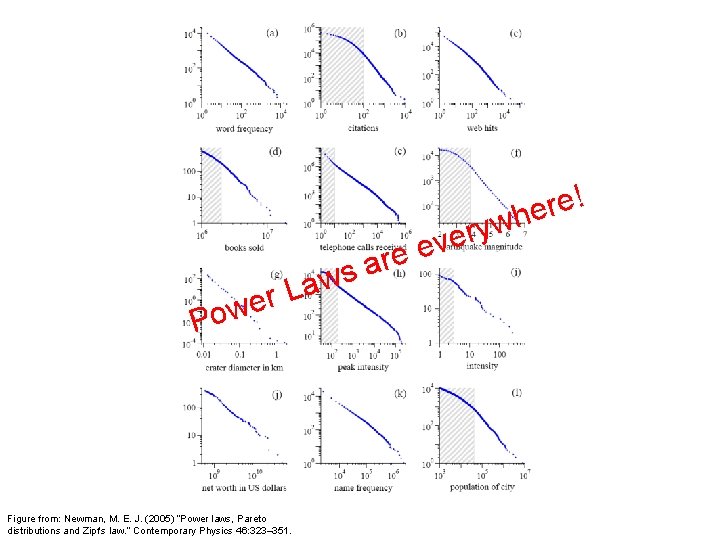
Postings Size: Zipf’s Law cf is the collection frequency of i-th common term c is a constant ¢ Zipf’s Law: (also) linear in log-log space l ¢ Specific case of Power Law distributions In other words: l l A few elements occur very frequently Many elements occur very infrequently
Zipf’s Law for RCV 1 Fit isn’t that good… but good enough! Reuters-RCV 1 collection: 806, 791 newswire documents (Aug 20, 1996 -August 19, 199 Manning, Raghavan, Schütze, Introduction to Information Retrieval (2008)
a L r we Po Figure from: Newman, M. E. J. (2005) “Power laws, Pareto distributions and Zipf's law. ” Contemporary Physics 46: 323– 351. e r a ws w y r eve ! e r he
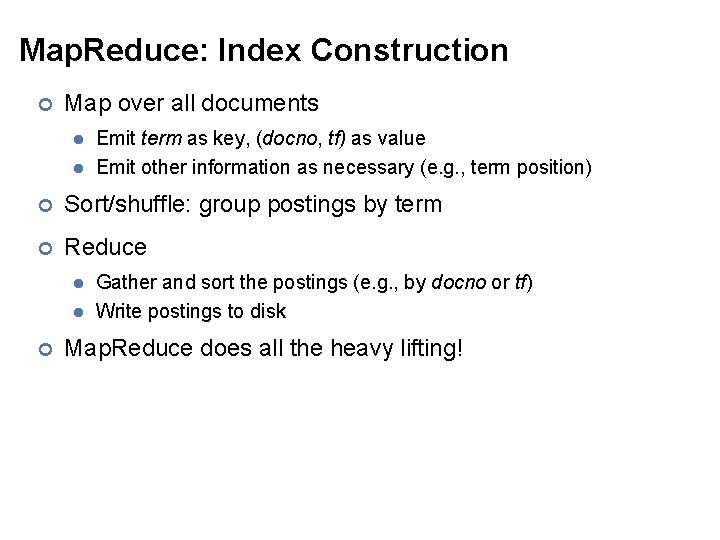
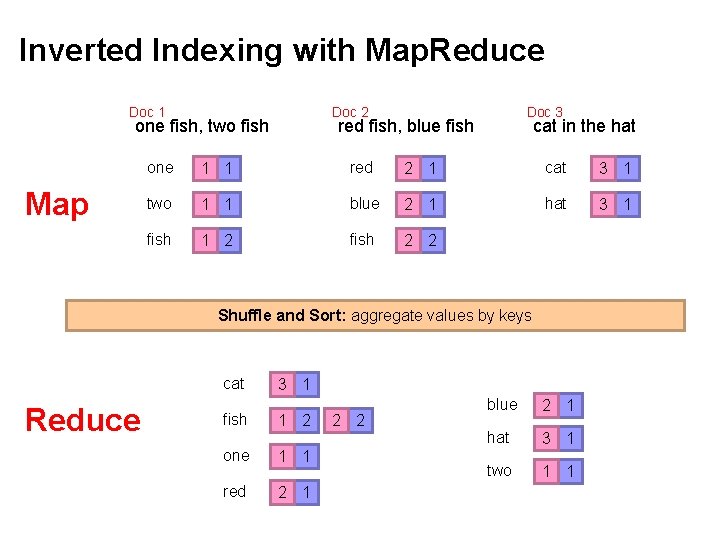
Map. Reduce: Index Construction ¢ Map over all documents l l Emit term as key, (docno, tf) as value Emit other information as necessary (e. g. , term position) ¢ Sort/shuffle: group postings by term ¢ Reduce l l ¢ Gather and sort the postings (e. g. , by docno or tf) Write postings to disk Map. Reduce does all the heavy lifting!
Inverted Indexing with Map. Reduce Doc 1 Doc 2 one fish, two fish Map Doc 3 red fish, blue fish cat in the hat one 1 1 red 2 1 cat 3 1 two 1 1 blue 2 1 hat 3 1 fish 1 2 fish 2 2 Shuffle and Sort: aggregate values by keys cat Reduce fish 3 1 1 2 one 1 1 red 2 1 2 2 blue 2 1 hat 3 1 two 1 1
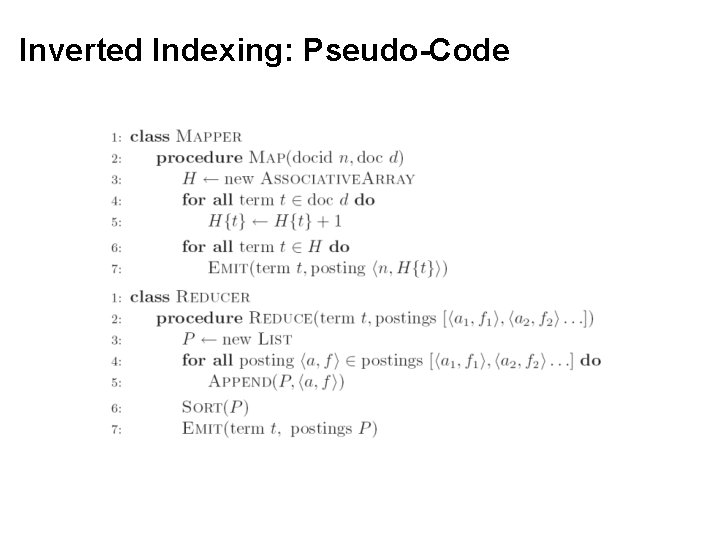
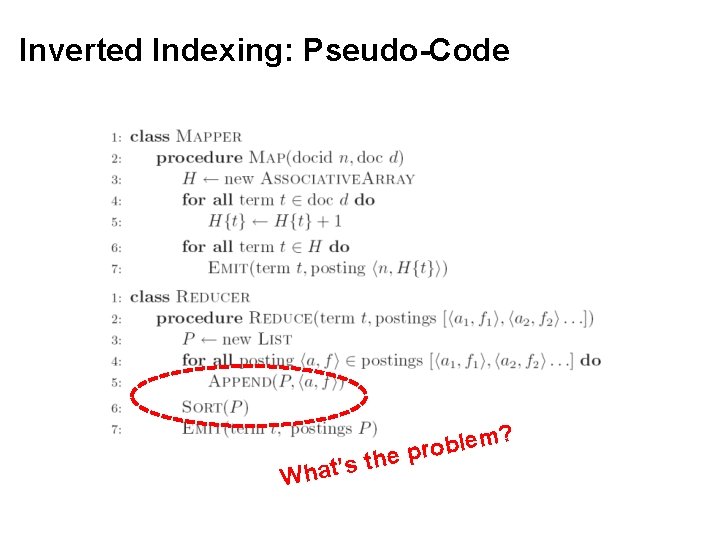
Inverted Indexing: Pseudo-Code
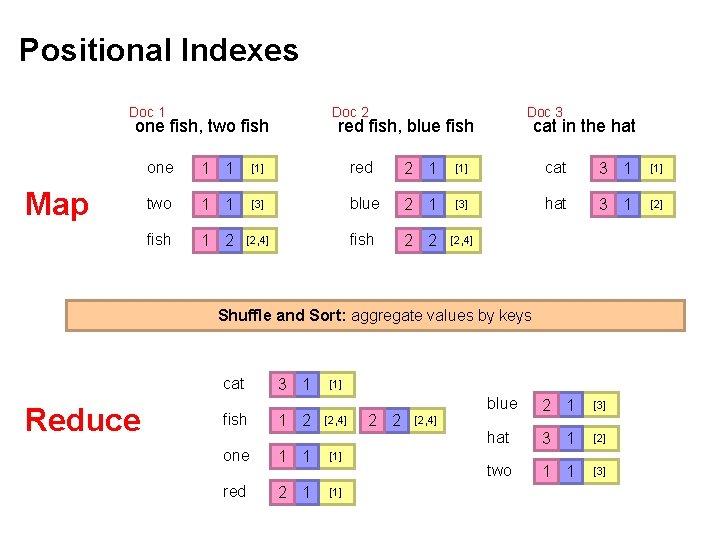
Positional Indexes Doc 1 Doc 2 one fish, two fish Map Doc 3 red fish, blue fish cat in the hat one 1 1 [1] red 2 1 [1] cat 3 1 [1] two 1 1 [3] blue 2 1 [3] hat 3 1 [2] fish 1 2 [2, 4] fish 2 2 [2, 4] Shuffle and Sort: aggregate values by keys cat Reduce fish one red 3 1 1 2 1 [1] [2, 4] [1] 2 2 blue 2 1 [3] hat 3 1 [2] two 1 1 [3] [2, 4]
Inverted Indexing: Pseudo-Code s What’ th ? m e l b e pro
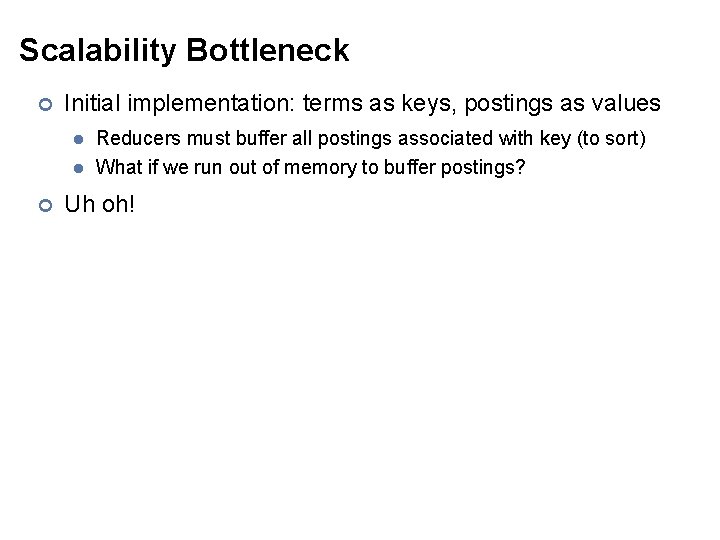
Scalability Bottleneck ¢ Initial implementation: terms as keys, postings as values l l ¢ Reducers must buffer all postings associated with key (to sort) What if we run out of memory to buffer postings? Uh oh!
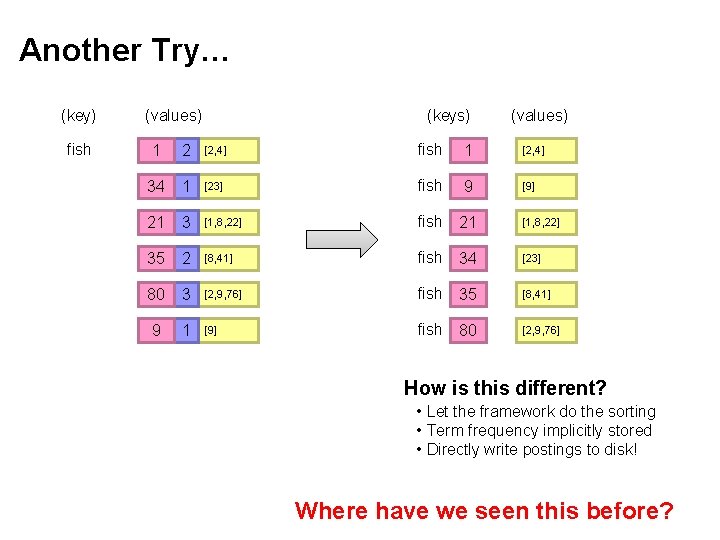
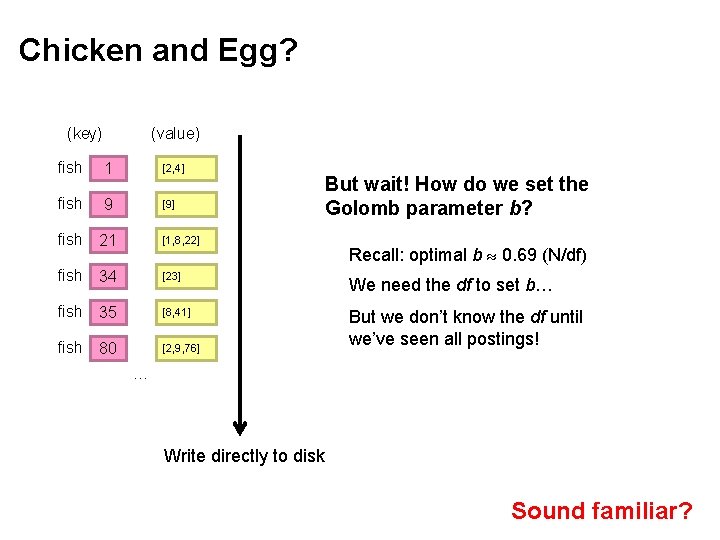
Another Try… (key) fish (values) (keys) (values) 1 2 [2, 4] fish 1 [2, 4] 34 1 [23] fish 9 [9] 21 3 [1, 8, 22] fish 21 [1, 8, 22] 35 2 [8, 41] fish 34 [23] 80 3 [2, 9, 76] fish 35 [8, 41] 9 1 [9] fish 80 [2, 9, 76] How is this different? • Let the framework do the sorting • Term frequency implicitly stored • Directly write postings to disk! Where have we seen this before?
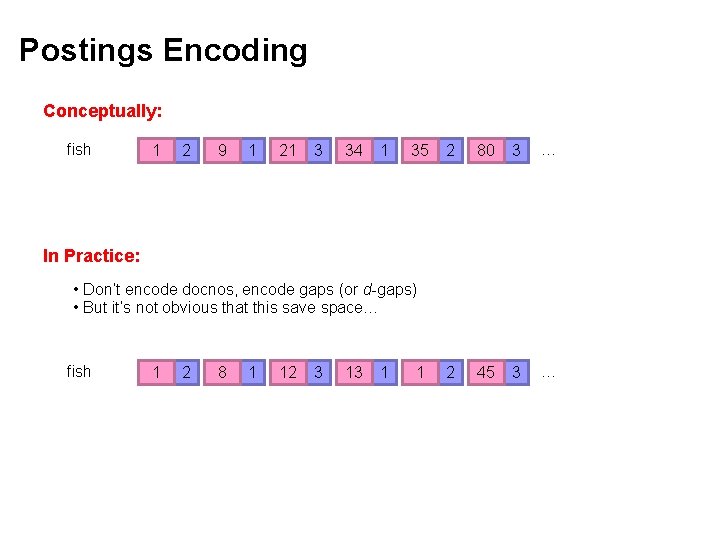
Postings Encoding Conceptually: fish 1 2 9 1 21 3 34 1 35 2 80 3 … 2 45 3 … In Practice: • Don’t encode docnos, encode gaps (or d-gaps) • But it’s not obvious that this save space… fish 1 2 8 1 12 3 13 1 1
Overview of Index Compression ¢ Byte-aligned vs. bit-aligned ¢ Byte-aligned technique l l l ¢ Non-parameterized bit-aligned l l l ¢ VByte Simple 9 and variants PFor. Delta Unary codes Parameterized bit-aligned l Golomb codes (local Bernoulli model) Want more detail? Read Managing Gigabytes by Witten, Moffat, and Bell!
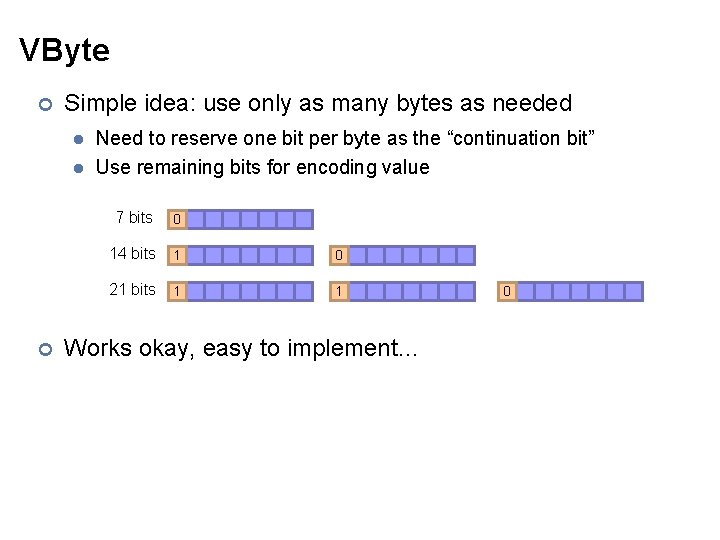
VByte ¢ Simple idea: use only as many bytes as needed l l ¢ Need to reserve one bit per byte as the “continuation bit” Use remaining bits for encoding value 7 bits 0 14 bits 1 0 21 bits 1 1 Works okay, easy to implement… 0
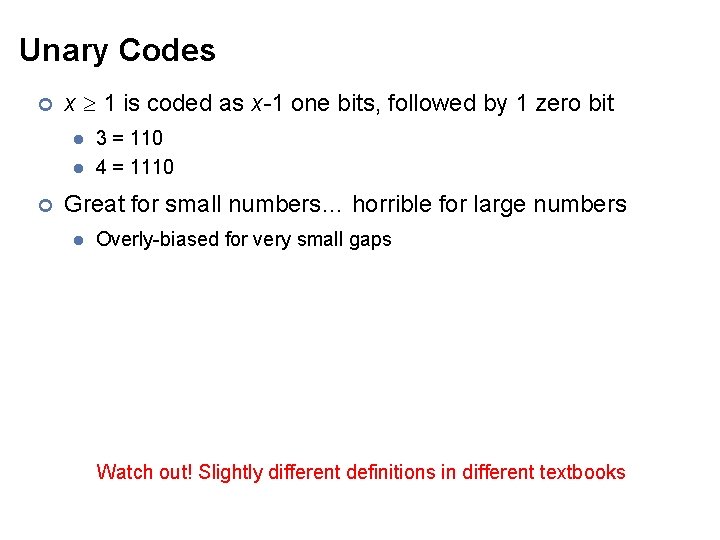
Unary Codes ¢ x 1 is coded as x-1 one bits, followed by 1 zero bit l l ¢ 3 = 110 4 = 1110 Great for small numbers… horrible for large numbers l Overly-biased for very small gaps Watch out! Slightly different definitions in different textbooks
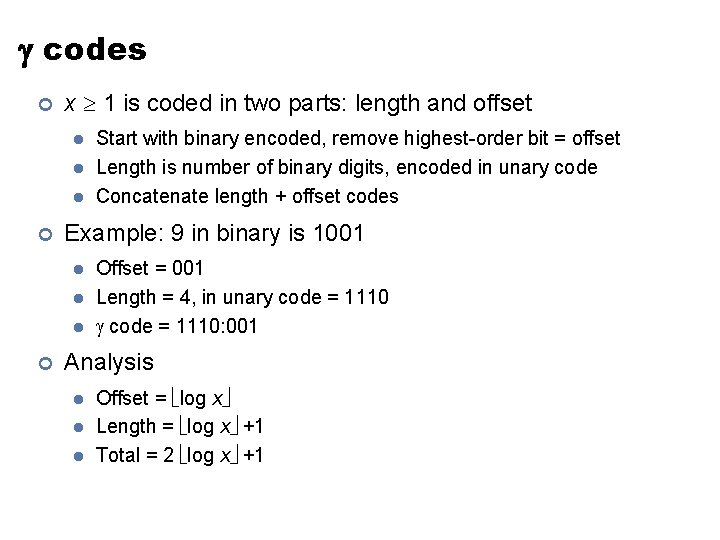
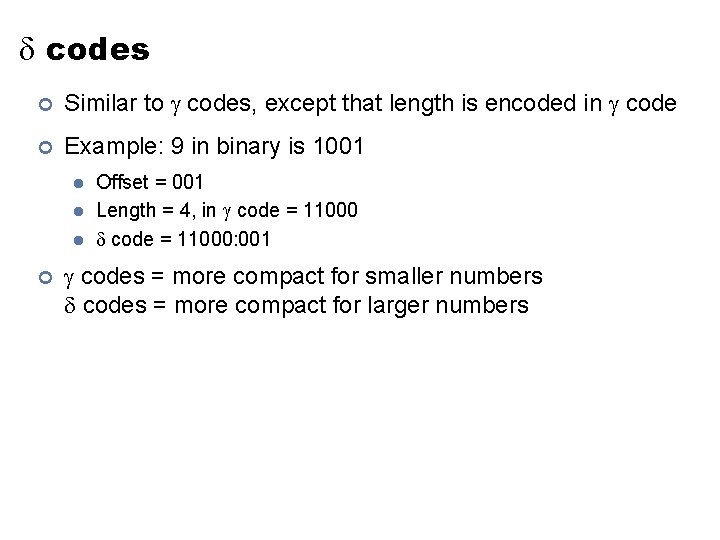
codes ¢ x 1 is coded in two parts: length and offset l l l ¢ Example: 9 in binary is 1001 l l l ¢ Start with binary encoded, remove highest-order bit = offset Length is number of binary digits, encoded in unary code Concatenate length + offset codes Offset = 001 Length = 4, in unary code = 1110: 001 Analysis l l l Offset = log x Length = log x +1 Total = 2 log x +1
codes ¢ Similar to codes, except that length is encoded in code ¢ Example: 9 in binary is 1001 l l l ¢ Offset = 001 Length = 4, in code = 11000: 001 codes = more compact for smaller numbers codes = more compact for larger numbers
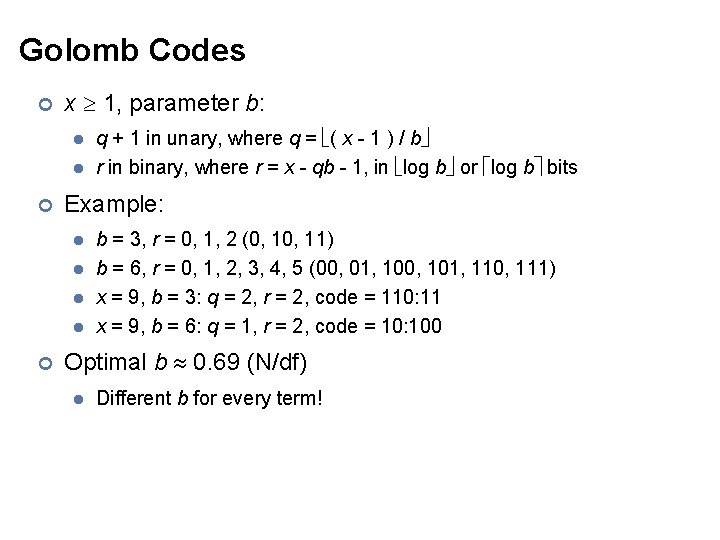
Golomb Codes ¢ x 1, parameter b: l l ¢ Example: l l ¢ q + 1 in unary, where q = ( x - 1 ) / b r in binary, where r = x - qb - 1, in log b or log b bits b = 3, r = 0, 1, 2 (0, 11) b = 6, r = 0, 1, 2, 3, 4, 5 (00, 01, 100, 101, 110, 111) x = 9, b = 3: q = 2, r = 2, code = 110: 11 x = 9, b = 6: q = 1, r = 2, code = 10: 100 Optimal b 0. 69 (N/df) l Different b for every term!
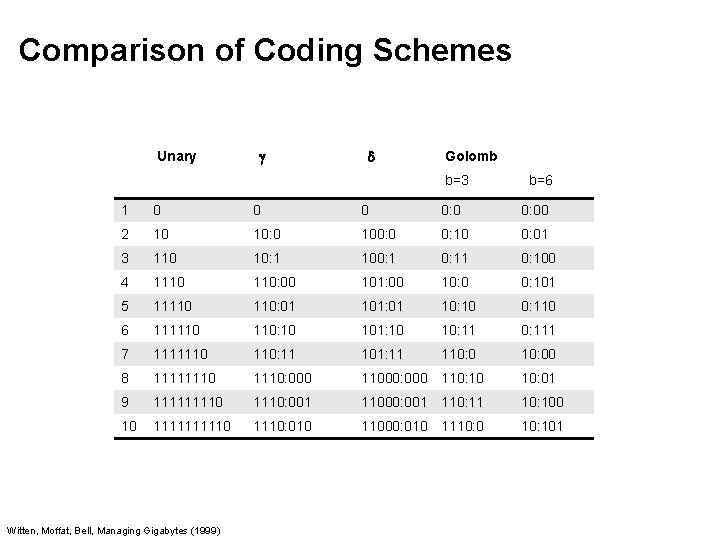
Comparison of Coding Schemes Unary Golomb b=3 b=6 1 0 0: 00 2 10 10: 0 100: 0 0: 10 0: 01 3 110 10: 1 100: 100 4 1110 110: 00 101: 00 10: 0 0: 101 5 11110 110: 01 101: 01 10: 10 0: 110 6 111110 110: 10 101: 10 10: 111 7 1111110 110: 11 101: 11 110: 00 8 11111110: 000 11000: 000 110: 10 10: 01 9 11110: 001 11000: 001 110: 11 10: 100 10 111110: 010 11000: 010 1110: 0 10: 101 Witten, Moffat, Bell, Managing Gigabytes (1999)
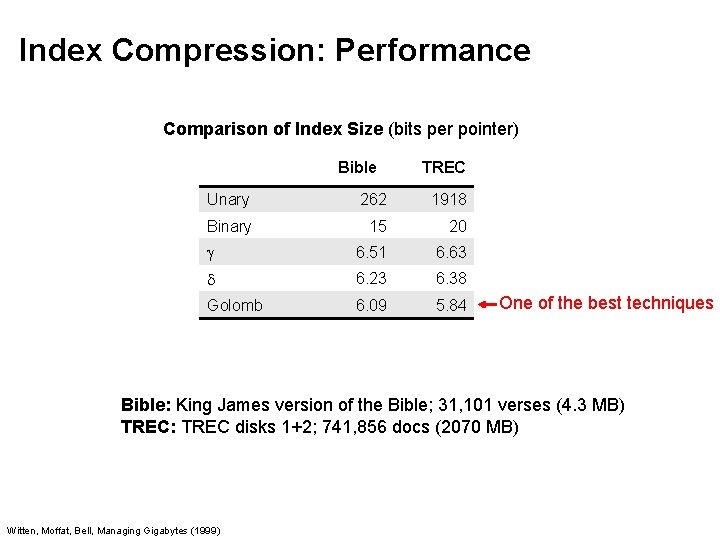
Index Compression: Performance Comparison of Index Size (bits per pointer) Bible TREC Unary 262 1918 Binary 15 20 6. 51 6. 63 6. 23 6. 38 Golomb 6. 09 5. 84 One of the best techniques Bible: King James version of the Bible; 31, 101 verses (4. 3 MB) TREC: TREC disks 1+2; 741, 856 docs (2070 MB) Witten, Moffat, Bell, Managing Gigabytes (1999)
Chicken and Egg? (key) (value) fish 1 [2, 4] fish 9 [9] fish 21 [1, 8, 22] fish 34 [23] We need the df to set b… fish 35 [8, 41] fish 80 [2, 9, 76] But we don’t know the df until we’ve seen all postings! But wait! How do we set the Golomb parameter b? Recall: optimal b 0. 69 (N/df) … Write directly to disk Sound familiar?
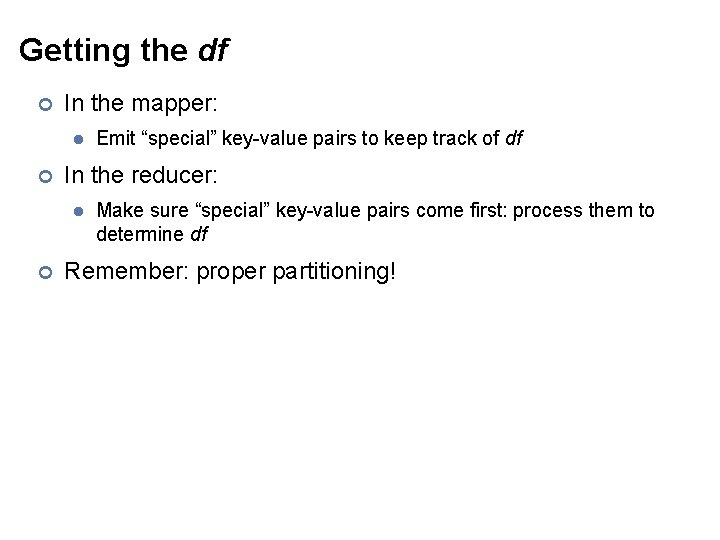
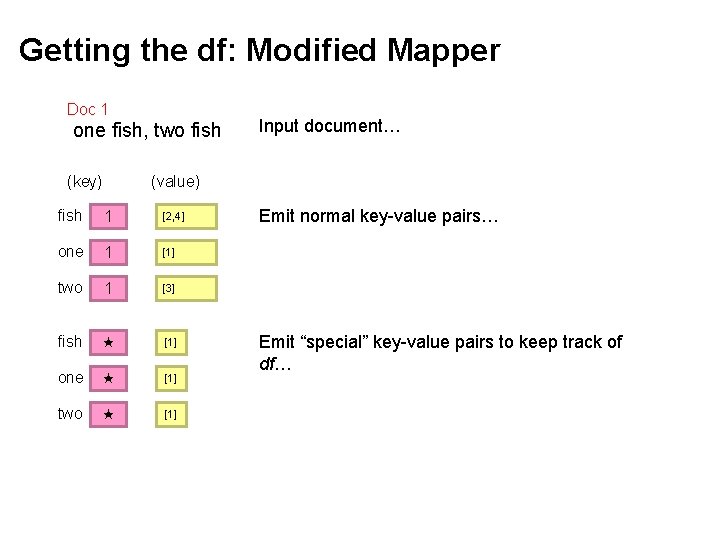
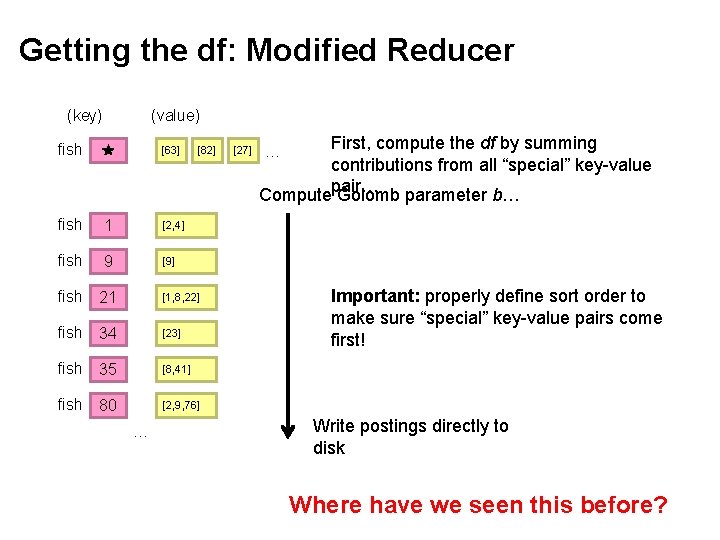
Getting the df ¢ In the mapper: l ¢ In the reducer: l ¢ Emit “special” key-value pairs to keep track of df Make sure “special” key-value pairs come first: process them to determine df Remember: proper partitioning!
Getting the df: Modified Mapper Doc 1 one fish, two fish (key) Input document… (value) fish 1 [2, 4] one 1 [1] two 1 [3] fish [1] one [1] two [1] Emit normal key-value pairs… Emit “special” key-value pairs to keep track of df…
Getting the df: Modified Reducer (key) (value) fish [63] fish 1 [2, 4] fish 9 [9] fish 21 [1, 8, 22] fish 34 [23] fish 35 [8, 41] fish 80 [2, 9, 76] … [82] [27] First, compute the df by summing contributions from all “special” key-value Computepair… Golomb parameter b… … Important: properly define sort order to make sure “special” key-value pairs come first! Write postings directly to disk Where have we seen this before?
Map. Reduce it? ¢ The indexing problem l l l ¢ Scalability is paramount Must be relatively fast, but need not be real time Fundamentally a batch operation Incremental updates may or may not be important For the web, crawling is a challenge in itself The retrieval problem l l Just covered Must have sub-second response time For the web, only need relatively few results Now
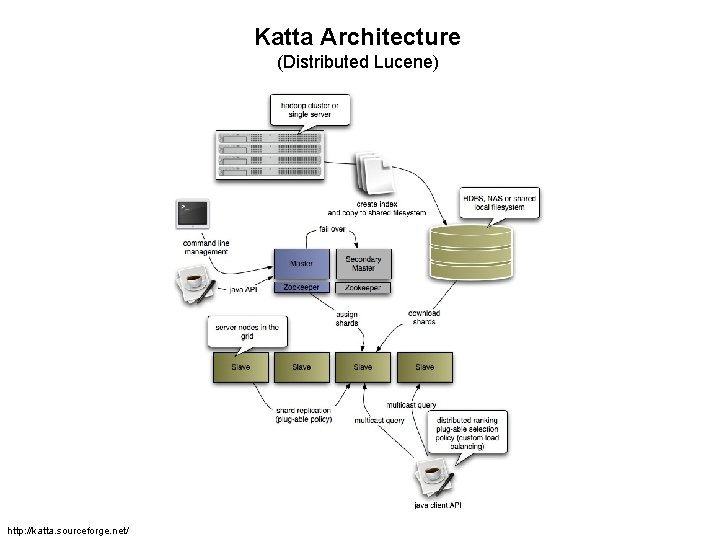
Retrieval with Map. Reduce? ¢ Map. Reduce is fundamentally batch-oriented l l ¢ Optimized for throughput, not latency Startup of mappers and reducers is expensive Map. Reduce is not suitable for real-time queries! l Use separate infrastructure for retrieval…
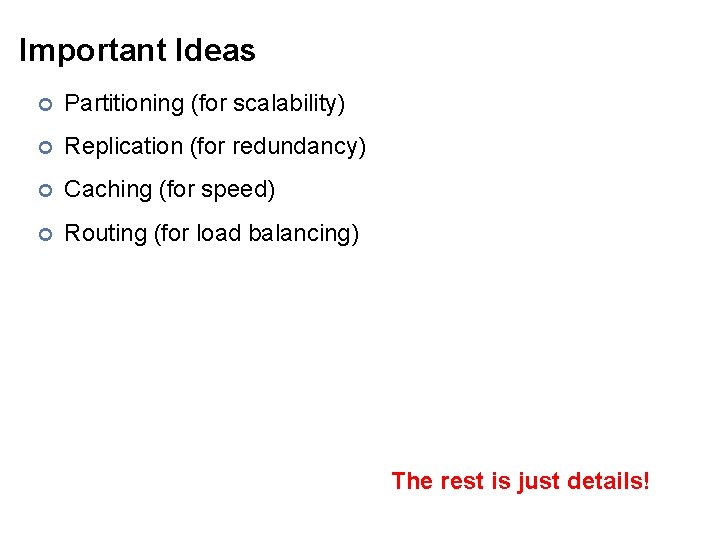
Important Ideas ¢ Partitioning (for scalability) ¢ Replication (for redundancy) ¢ Caching (for speed) ¢ Routing (for load balancing) The rest is just details!
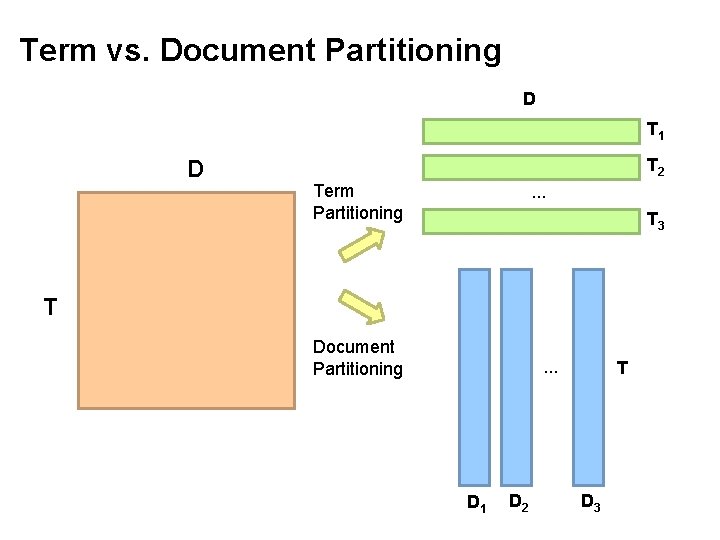
Term vs. Document Partitioning D T 1 D T 2 Term Partitioning … T 3 T Document Partitioning T … D 1 D 2 D 3
Katta Architecture (Distributed Lucene) http: //katta. sourceforge. net/
Questions? Source: Wikipedia (Japanese rock garden)