Historic Coal Mining The Importance and Legacy of
- Slides: 39
Historic Coal Mining The Importance and Legacy of Coal Lessons Prepared by Trout Unlimited With Funds from Pennsylvania Department of Environmental Protection
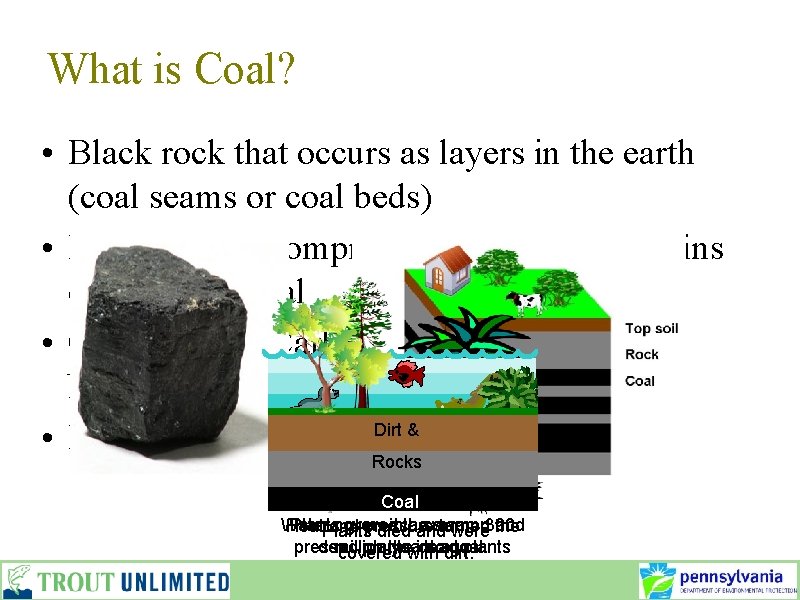
What is Coal? • Black rock that occurs as layers in the earth (coal seams or coal beds) • Formed from compressed and heated remains of plant material • Composed of Carbon, Hydrogen, Oxygen, Nitrogen, and Sulfur Dirt & Dirt • Fossil Fuel; Combustible Rocks Dead Plants Coal Water covered the swamp and Plants grew in a swamp 300 Heat and pressure turned the Plants died and were pressed on the dead plants million years ago dead plants into coal. covered with dirt.
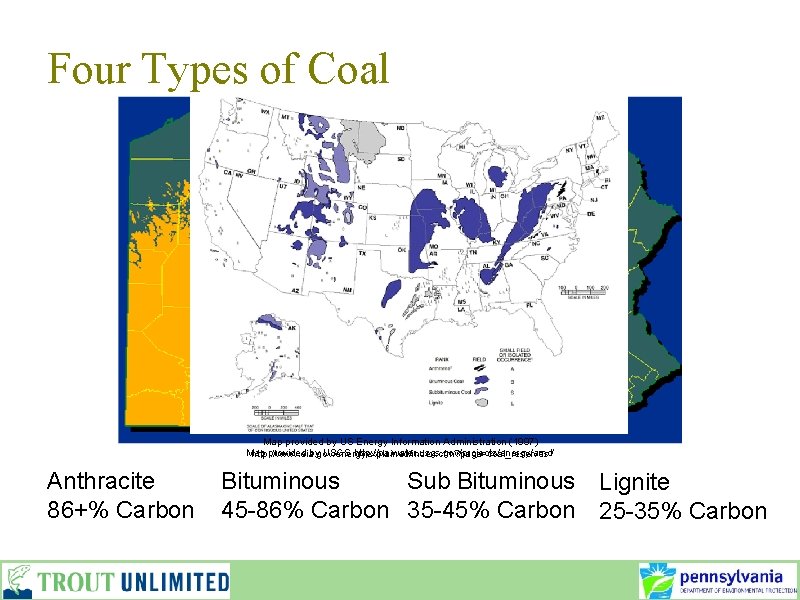
Four Types of Coal Map provided by US Energy Information Administration (1997) Map provided by USGS http: //pa. water. usgs. gov/projects/energy/amd/ http: //www. eia. gov/energyexplained/index. cfm? page=coal_reserves Anthracite 86+% Carbon Bituminous Sub Bituminous Lignite 45 -86% Carbon 35 -45% Carbon 25 -35% Carbon
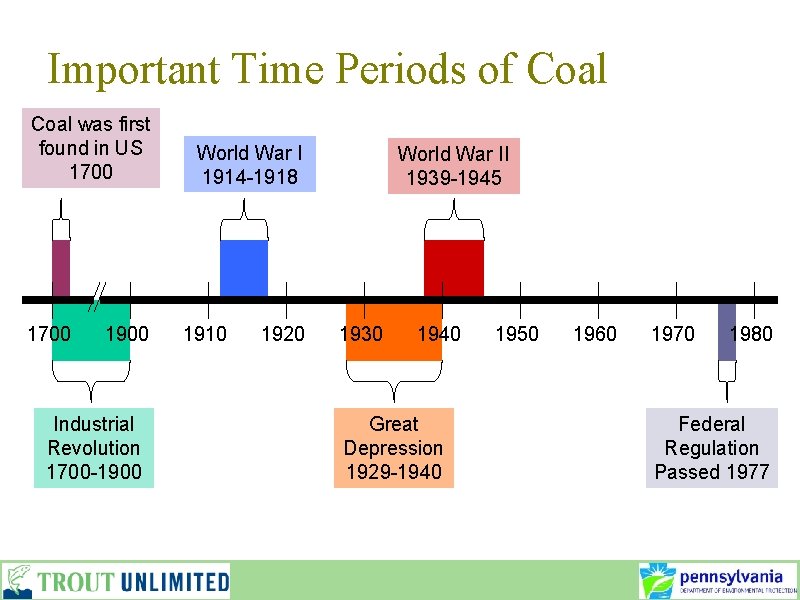
Important Time Periods of Coal was first found in US 1700 1900 Industrial Revolution 1700 -1900 World War I 1914 -1918 1910 1920 World War II 1939 -1945 1930 1940 Great Depression 1929 -1940 1950 1960 1970 1980 Federal Regulation Passed 1977
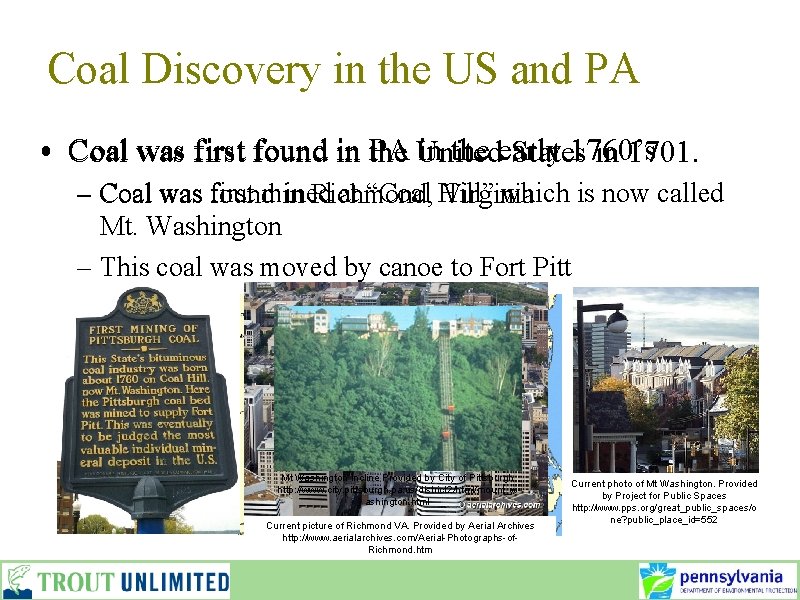
Coal Discovery in the US and PA PA United in the early 1760’s • Coal was first found in the States in 1701. first mined at “Coal Hill” which is now called – Coal was found in Richmond, Virginia Mt. Washington – This coal was moved by canoe to Fort Pitt Mt Washington Incline Provided by City of Pittsburgh http: //www. city. pittsburgh. pa. us/district 2/html/mount_w ashington. html Current picture of Richmond VA. Provided by Aerial Archives http: //www. aerialarchives. com/Aerial-Photographs-of. Map of Virginia. Made using National Atlas Richmond. htm http: //www. nationalatlas. gov/mapmaker Current photo of Mt Washington. Provided by Project for Public Spaces http: //www. pps. org/great_public_spaces/o ne? public_place_id=552
The Industrial Revolution Coal’s role in development and culture
Industrial Revolution • Took place in the 18 th to 19 th centuries • Marked a shift from predominantly rural societies to industrial and urban societies. • Early manufacturing was done using hand tools or basic machines. Industry now began using powered, special-purpose machinery, factories and mass production.
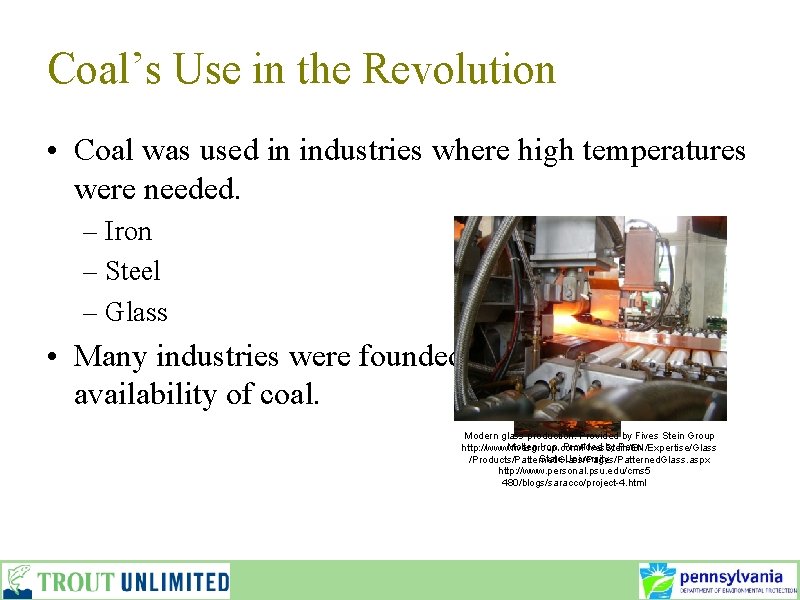
Coal’s Use in the Revolution • Coal was used in industries where high temperatures were needed. – Iron – Steel – Glass • Many industries were founded in PA due to the availability of coal. Steel being produced. Provided by American Steel and Iron Institute http: //www. steel. org/ Modern glass production. Provided by Fives Stein Group Molten Iron. Provided by Penn http: //www. fivesgroup. com/Fives. Stein/EN/Expertise/Glass State University /Products/Patterned. Glass/Pages/Patterned. Glass. aspx http: //www. personal. psu. edu/cms 5 480/blogs/saracco/project-4. html
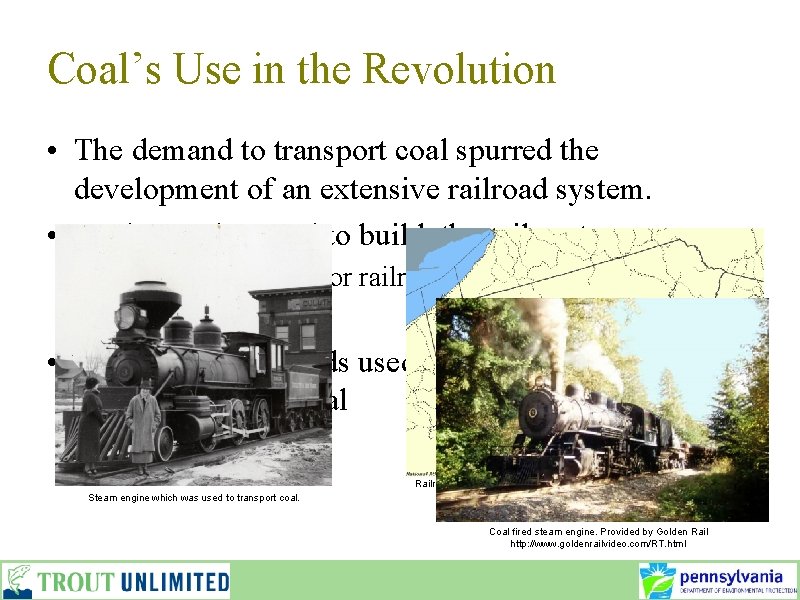
Coal’s Use in the Revolution • The demand to transport coal spurred the development of an extensive railroad system. • Coal was also used to build the rail system – Building materials for railroads (Iron rails, bridges, etc. . ) – Powering engines • Many of the railroads used today were originally built to transport coal Railroads of PA. Map made using National Atlas http: //www. nationalatlas. gov/ Steam engine which was used to transport coal. Railroad construction. Photo provided by Clemson University http: //www. clemson. edu/caah/history/Faculty. Pages/Pam. Mack/l ec 122/amtran. htm Coal fired steam engine. Provided by Golden Rail http: //www. goldenrailvideo. com/RT. html
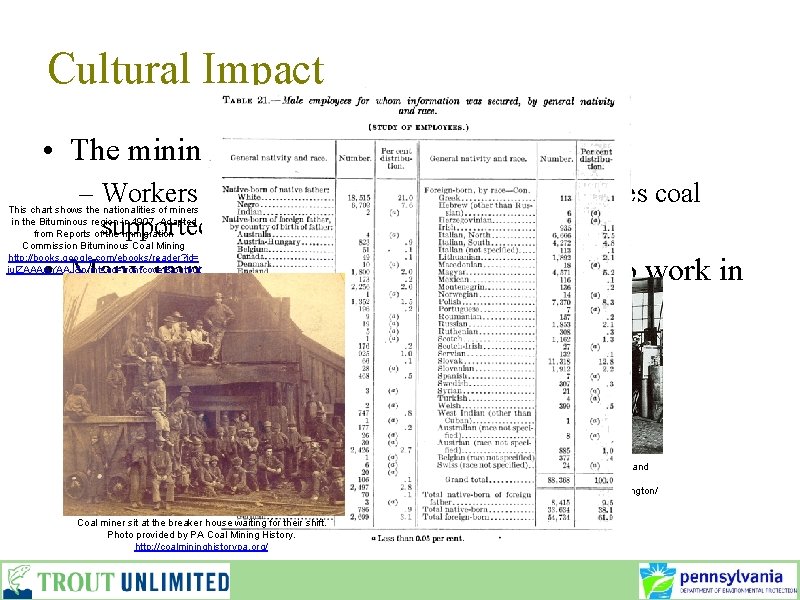
Cultural Impact • The mining of coal required many workers – Workers were also needed in the other industries coal supported. This chart shows the nationalities of miners in the Bituminous region in 1907. Adapted from Reports of the Immigration Commission Bituminous Coal Mining http: //books. google. com/ebooks/reader? id= jul. ZAAAAYAAJ&printsec=frontcover&output =reader • Many immigrants came to the coal region to work in the mines Machine shop at a mine. Photo Provided by Coal and Coke Heritage Center http: //www. coalcampusa. com/westpa/klondike/buffington/ buffington. htm Coal miner sit at the breaker house waiting for their shift. Photo provided by PA Coal Mining History. http: //coalmininghistorypa. org/
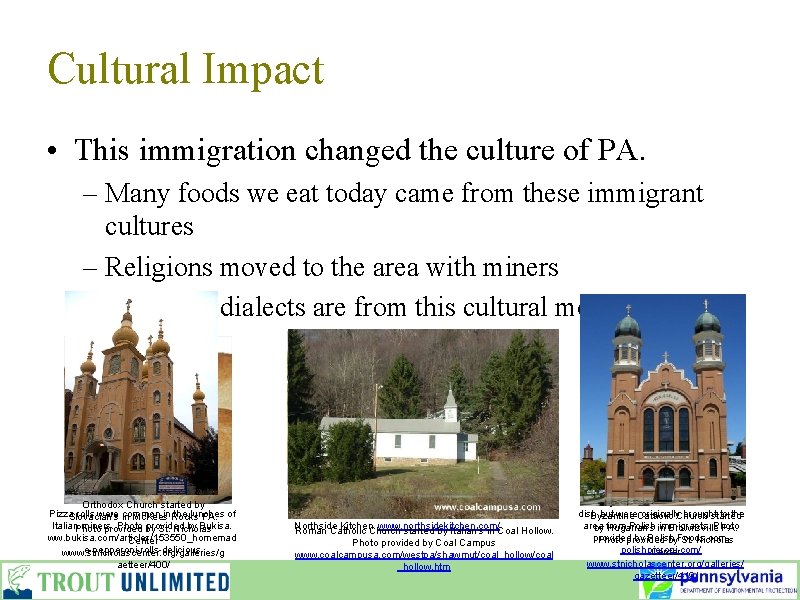
Cultural Impact • This immigration changed the culture of PA. – Many foods we eat today came from these immigrant cultures – Religions moved to the area with miners – Many PA dialects are from this cultural movement. Orthodox Church started by Pizza rolls were common in the lunches of Slovacian’s in Mc. Kees Rocks PA. Italian miners. Photo provided by Bukisa. Photo provided by St. Nicholas ww. bukisa. com/articles/153550_homemad Center e-pepperoni-rolls-delicious www. stnicholascenter. org/galleries/g aetteer/400/ Haluski is a popular polish dish that was brought to the area by immigrants. Photo provided by Northside Kitchen. www. northsidekitchen. com/ Roman Catholic Church started by Italian’s in Coal Hollow. Photo provided by Coal Campus www. coalcampusa. com/westpa/shawmut/coal_hollow/coal _hollow. htm Pierogies have become a common dish but were originally brought to the Byzantine Catholic Church started area from Polish immigrants. Photo by Hugarian’s in Brownsville PA. provided by Polish Foods. com. Photo provided by St. Nicholas polishpierogi. com/ Center www. stnicholascenter. org/galleries/ gazetteer/419/
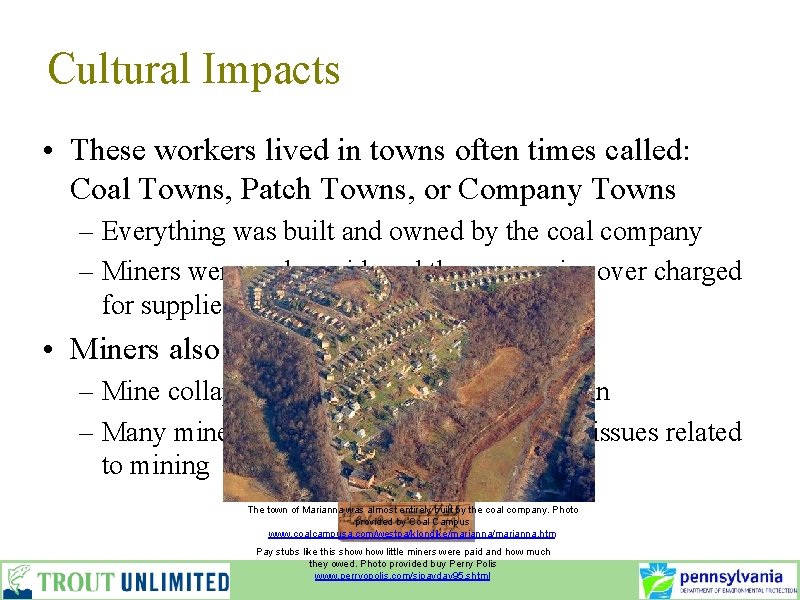
Cultural Impacts • These workers lived in towns often times called: Coal Towns, Patch Towns, or Company Towns – Everything was built and owned by the coal company – Miners were under paid, and the companies over charged for supplies • Miners also faced dangers in the mines – Mine collapses and explosions were common – Many miners died in the mines or of health issues related to mining The town of Marianna was almost entirely built by the coal company. Photo provided by Coal Campus www. coalcampusa. com/westpa/klondike/marianna. htm Pay stubs like this show little miners were paid and how much they owed. Photo provided buy Perry Polis www. perryopolis. com/sjpayday 95. shtml
World War I PA Coal’s Role in the Fight and the Implications
World War I • World War I lasted from 1914 - 1918 • The fighting was mainly limited to Europe – US involvement was in support of our Allies • US also provided many of the supplies needed in Europe – Arms and artillery – Fuel – Supplies to rebuild bombed areas
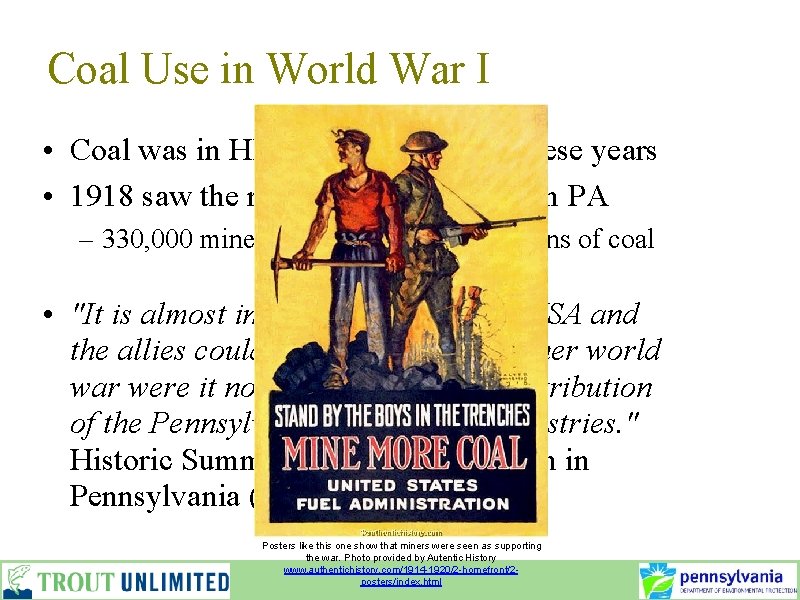
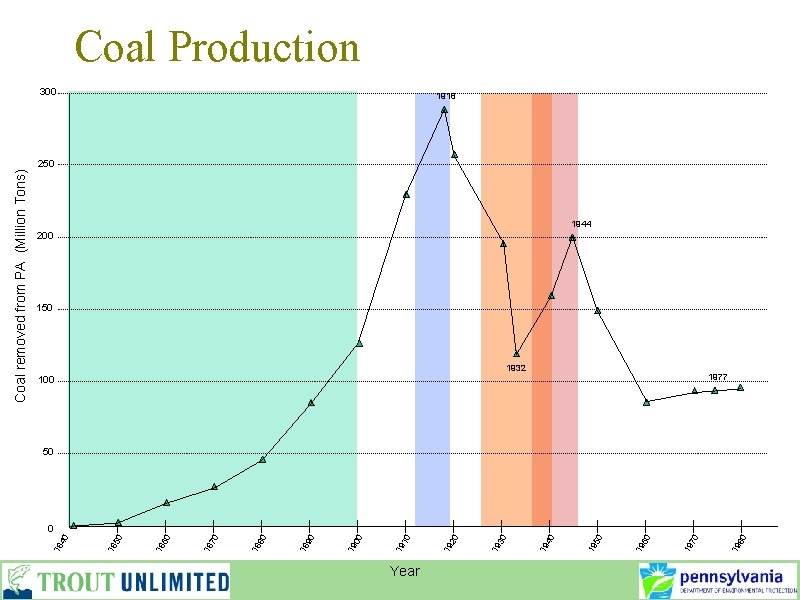
Coal Use in World War I • Coal was in HIGH demand during these years • 1918 saw the most coal removed from PA – 330, 000 miners removed 277 million tons of coal • "It is almost inconceivable that the USA and the allies could have prevailed in either world war were it not for the dominant contribution of the Pennsylvania coal mining industries. " Historic Summary of Coal Production in Pennsylvania (Foreman, 2009) Posters like this one show that miners were seen as supporting the war. Photo provided by Autentic History www. authentichistory. com/1914 -1920/2 -homefront/2 posters/index. html
Cultural Impacts of World War I • Young men left to fight the war, which changed the age of coal miners – Most miners were older or very young • Despite the acceptance of women in other industries, in many mines women were not permitted – This highlighted the Women’s Rights movement
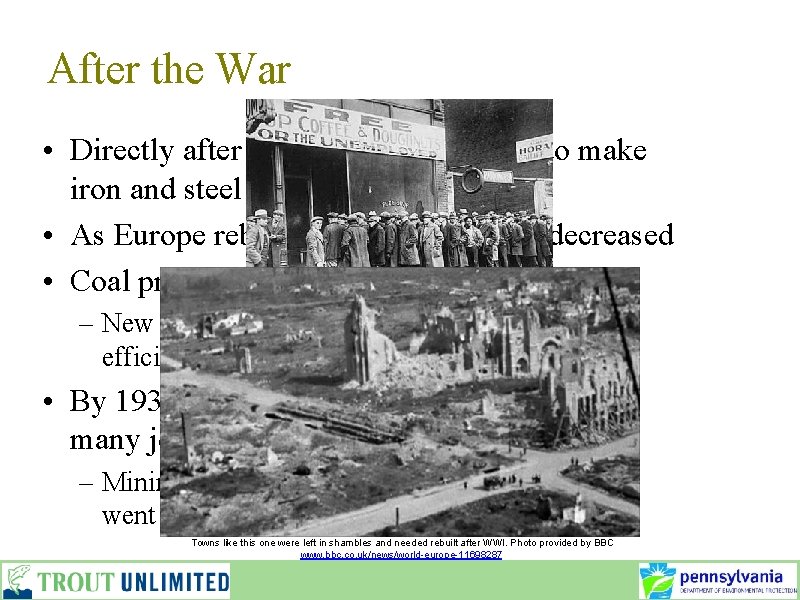
After the War • Directly after the War coal was used to make iron and steel for rebuilding • As Europe rebuilt the use of US coal decreased • Coal production started to slow – New technologies also made coal mining more efficient and fewer miners were needed The jobless stand in line for free food hand outs. Photo Provided by Centre County History. libcom. org/history/1930 -1939 unemployed-workers-movement • By 1930 the Great Depression had claimed many jobs and coal demand was low – Mining companies either cut back drastically or went bankrupt. Towns like this one were left in shambles and needed rebuilt after WWI. Photo provided by BBC www. bbc. co. uk/news/world-europe-11698287
Cultural Impacts in Coal Region • When a coal company went bankrupt the town that was supported was left with no industry • With the loss of jobs many immigrants relocated – Many had no money to move so they were forced to stay in “dying” towns • Mining was very limited during the Depression – A significant amount of coal was mined by men to their heat homes
World War II PA Coal’s Use in the fight
World War II • World War II took place from 1939 -1945 – US became involved in 1941 after the bombing of Pearl Harbor • Truly a World War, fighting took place across the globe • New technology allowed for more advanced fighting, yet coal was still the dominate fuel to be used for the fight
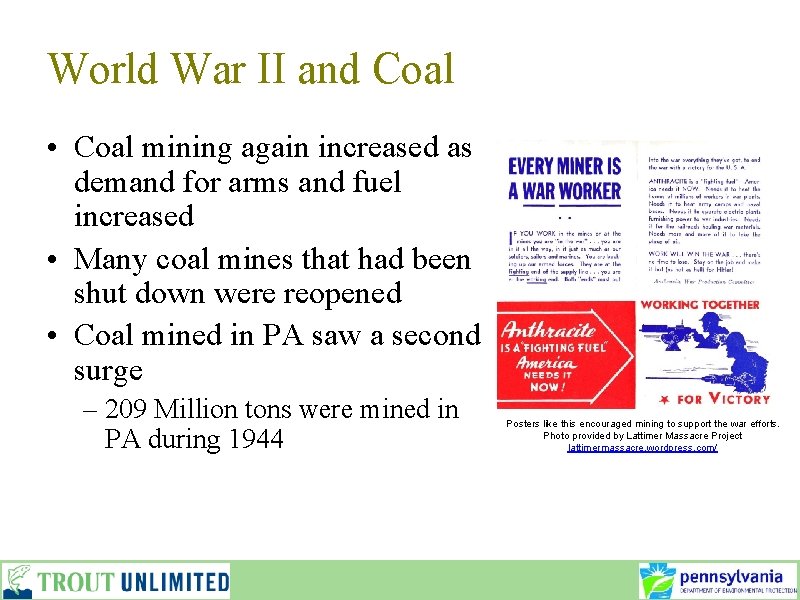
World War II and Coal • Coal mining again increased as demand for arms and fuel increased • Many coal mines that had been shut down were reopened • Coal mined in PA saw a second surge – 209 Million tons were mined in PA during 1944 Posters like this encouraged mining to support the war efforts. Photo provided by Lattimer Massacre Project lattimermassacre. wordpress. com/
Cultural and Economic Impacts • World War II helped to pull the country out of the Great Depression • After the war a decrease in mining occurred again. – The advent of cheaper refining processes and more readily available oil decrease the need for coal – By 1961 coal production in PA slumped to 80 million tons, the lowest it had been since 1888
Year 1932 80 100 19 70 19 60 19 50 19 40 19 3 20 300 19 10 19 00 19 90 18 80 18 70 18 60 18 50 18 40 18 Coal removed from PA (Million Tons) Coal Production 1918 250 200 1944 150 1977 50 0
Mining Practices How Mining practices changed with time
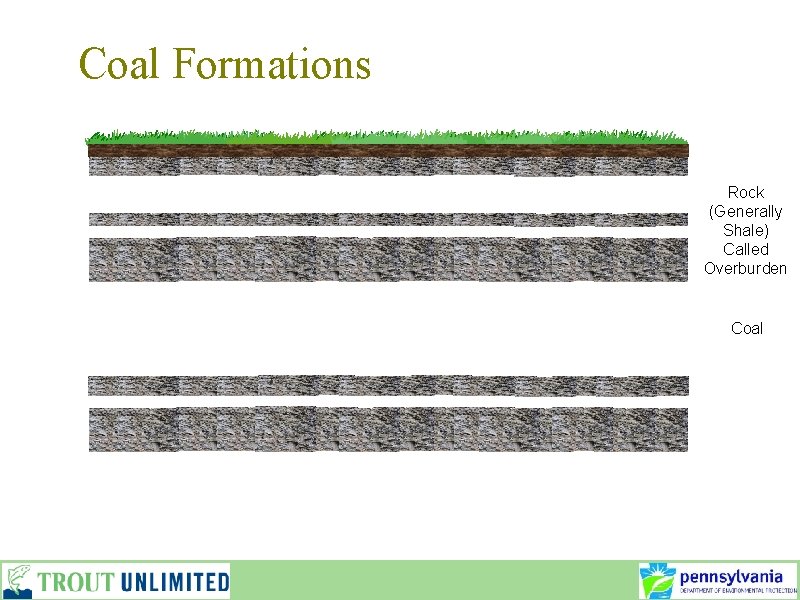
Coal Formations Rock (Generally Shale) Called Overburden Coal
Drift Mining
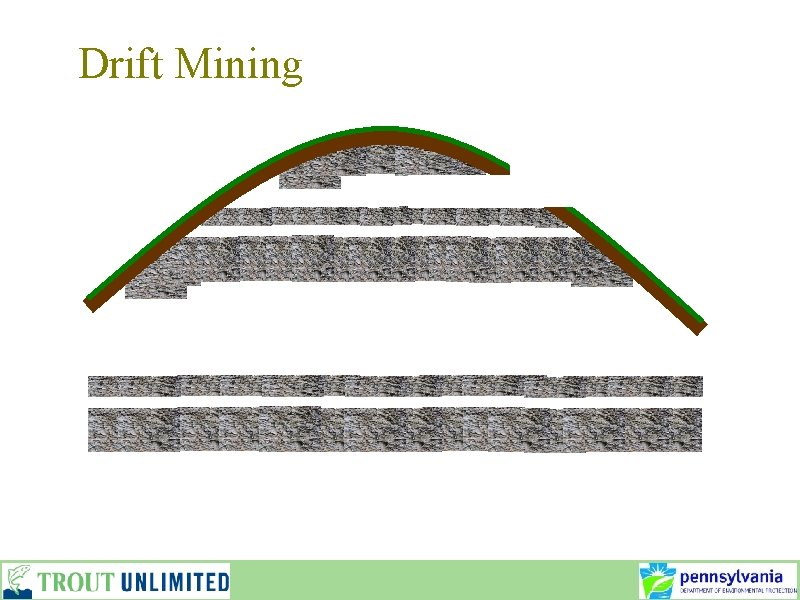
Drift Mining 1760 -… • Early form of mining allowed coal to be removed without large equipment • Mine was located at the same level as the coal seam • The side of a hill or mountain was cut vertically to reveal coal – Miners could remove coal with out removing all of the overburden • Mines were unstable and inefficient
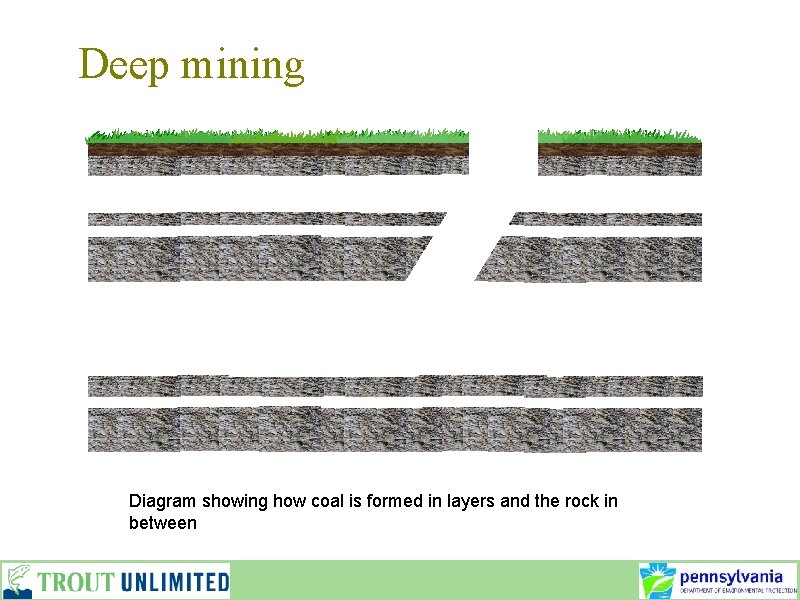
Deep mining Diagram showing how coal is formed in layers and the rock in between
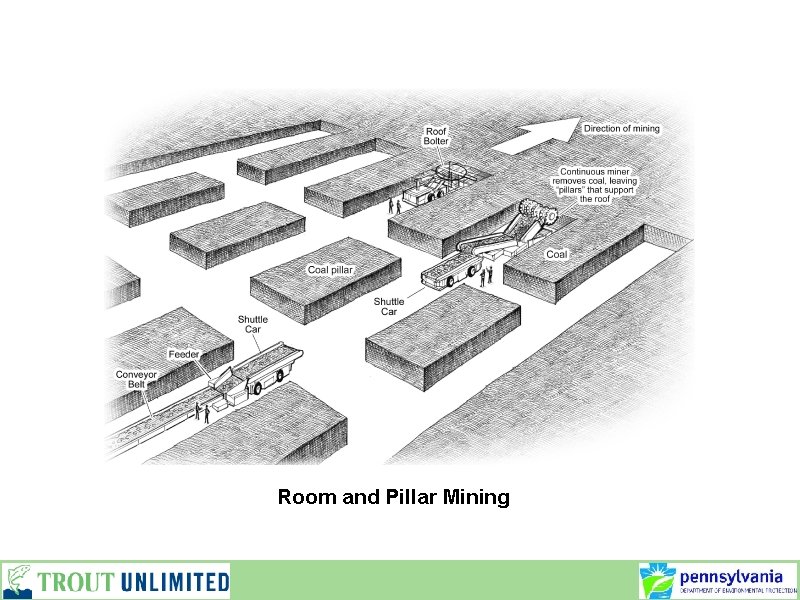
Deep Mining • Replaced drift mining but required more equipment • Miners dug down to the coal and removed it using underground rail systems • Often times mined in what was termed “Room and Pillar” – Coal removed from large “rooms” with thick “pillars” supporting the roof – Often times when done with the mining workers removed the pillars to access the coal • Lead to many collapses
Deep Mining • Early Deep mining required explosives to blast coal out – Labor intensive requires drilling, cutting, blasting, and loading • Later technology allowed for continuous mining – Machines which cut coal using a wheel – Combines all the above steps into one – Still leaves pillars of coal • It was not till much later that “bolting” or strengthening the roof was employed
Deep Mining • Longwall mining was later developed which allowed even more coal to be removed with less work • This machine removes all the coal from a large area • As the machine moves through the mine the roof is allowed to collapse behind it – This can lead to significant surface disturbance
Room and Pillar Mining
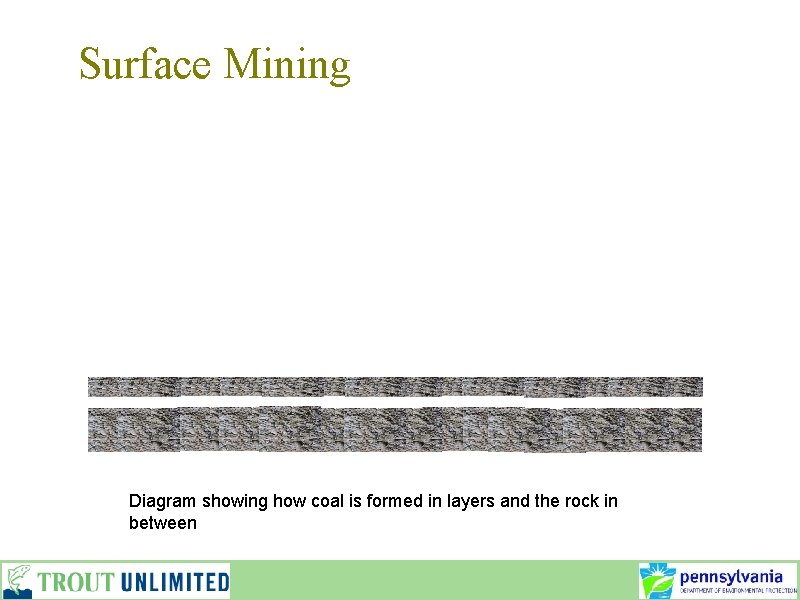
Surface Mining Diagram showing how coal is formed in layers and the rock in between
Surface Mining • Removes the overburden from above the coal allowing access to the coal • First surface mines were not efficient • As technology evolved it became very effective at removing large portions of coal without as much labor – Safer for miners • To be efficient requires large machinery • Sometimes called “Strip Mining”
Mining practices overview • Drift mining (1700’s-1850’s) Removes 10 -25% of available coal • Deep Mining (1830 -present day) Removes 30 -50% of available coal • Longwall (1950’s- present day) removes 85% of coal of available coal • Large scale commercial Surface Mining (1930’spresent day) removes +85% of available coal
Effects of Coal Mining • Coal mining was not well regulated until 1977 • Mines were often left open and surface mines were not filled in • Rock and unusable coal was left piled near the mine – Called Gob piles (Garbage of Bituminous), Refuse Piles, Boney Piles, or Culm Banks • Water contamination from the exposed mines and refuse polluted nearby streams and rivers
Regulation of Coal Mining • In 1977 the Surface Mining Control and Reclamation Act (SMACRA) was passed • This federal law regulated coal mining and decreased its environmental impact • Coal companies are now required to undergo extensive permitting – Clean-up plans must be made prior to mining occurring – Companies pay large bonds to the state to ensure they will follow through with clean up
SMACRA • SMACRA has many regulatory roles – Formed the Office of Surface Mining- Enforces the regulations set forth in the act – Established a fund to clean up previously abandoned mine sites – Aims to have minimal environmental impacts due to coal mining
Current Mining • For the rest of these lessons mining prior to 1977 will be referred to as “historic coal mining” • Current coal mining will not be discussed in future lessons – All pollution discussed is a lingering result of historic mining practices