
Public Administration Politics not politics What is the
Public Administration Politics not politics What is the connection? n Politics sets the tasks for administration. but should not manipulate it’s offices. n Politicians should be neutral when shaping public policy. n Administration (civil servants) – should be non-partisan and neutral in implementing public politics. Is this true in real life? n
That’s why values clash The clash of values in the administration of Public Policy: 1 - Efficiency versus responsiveness. 2 - Public versus private. 3 - Neutrality versus tolerance. 4 - Economic capitalism versus individual rights. 5 - Limited government versus popular sovereignty. n
1 -Efficiency n n versus responsiveness At any level of government, policies are made to respond to citizens demands. Government use common citizens to conduct its business. But, making government to the will of the people is dangerous, it could quickly become too responsive. Citizens might seek their own benefit rather than the common good.
2 -Efficiency versus responsiveness That’s why we need to make sure that government will have the ability to produce the desired good, service or effect with minimum effort and expenses = Efficiency
3 - Public versus Private n n n Some activities are best conducted by public agent, such as the army, post office, etc. Some activities are viewed best in the hands of private enterprises. But, government agencies, might have to regulate or control private commerce to ensure that the private sector doesn’t create publicly harmful results.
4 - Neutrality versus tolerance n n Neutrality governmental agencies deal with citizens as equal. Tolerance protected classes. government may have to intervene to protect the rights of certain groups.
5 - Economic capitalism versus individual rights Capitalism = all or most of the means of production and distribution are privately owned and operated for profit under fully competitive conditions. n Individual rights = unfettered capitalism can easily harm the individual. Thus: - government must intervene to protect the individual from excessive manipulation by capitalist economic forces. n
6 - Limited government versus popular sovereignty n n Popular sovereignty -- reflect the will of the majority while protecting the rights of individuals. Limited government -- the government is best which governs least.
Public Administration n n Administration. Bureaucracy. Public Policy Process. Public Administration
Administration n The execution and implementation of Public Policy. Administration connotes all of rules, regulations and procedures developed to manage the affairs of government. Red Tape is excessive use of rules, regulations and procedures.
Bureaucracy n n The administration of large scale organization through departments and their agencies. -ve connotations excessive red tape that impede serving the implementation of public policy
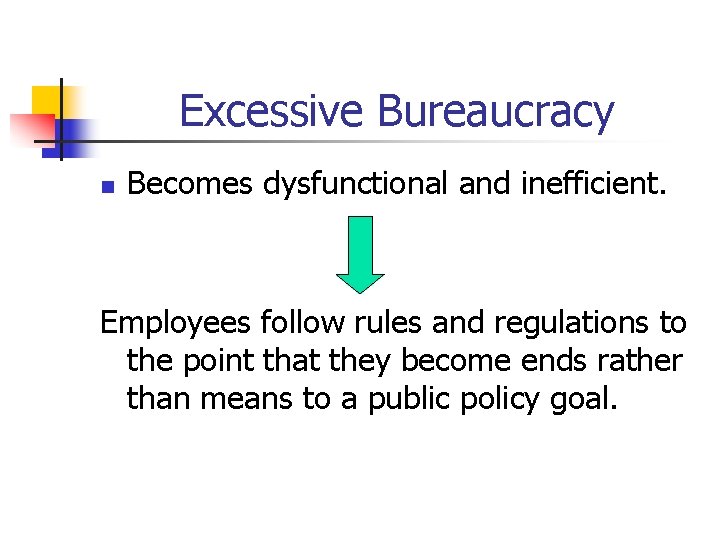
Excessive Bureaucracy n Becomes dysfunctional and inefficient. Employees follow rules and regulations to the point that they become ends rather than means to a public policy goal.
Public Policy n n n Decisions made by government that show actions taken by governmental actors in pursuing to perceived problems. Public Administration is the tool by which policy is implemented. Public Policy requires the creation of governmental organizations such as agencies, bureaus or departments, etc.
The Policy Process A set or series of stages through which policy is established and implemented.
1. Agenda setting stage n Involves the identification of a problem and the development of a consensus that this is a problem with which government should be concerned.
2. Policy Formulation Stage n n n Alternative methods to deal with the problem are discussed and refined. Which level of government best decide from among the alternatives. In this stage costs and benefits are assessed for each alternative.
3. Policy enactment stage n In this stage an authoritative agency of government (a president or governor) makes a specific decision to adopt a policy alternative.
4. Implementation n The authorization and funding of a specific government program and the decision about which particular government agency will deal with the problem.
5. Policy analysis – program evaluation stage n Evaluation assesses how well the policy is addressing, solving, or at least mitigating the problem.
6. Feedback n The policy adopters weigh information about whether to continue, revise, or terminate the policy
Public Administration n n Refers to what government agencies do to develop and implement Public Policy. This is a simple definition, but in reality, public administration is a complex concept. Public administration is about political process. Political decisions and processes are what distinguishes public administration from private or business administration.
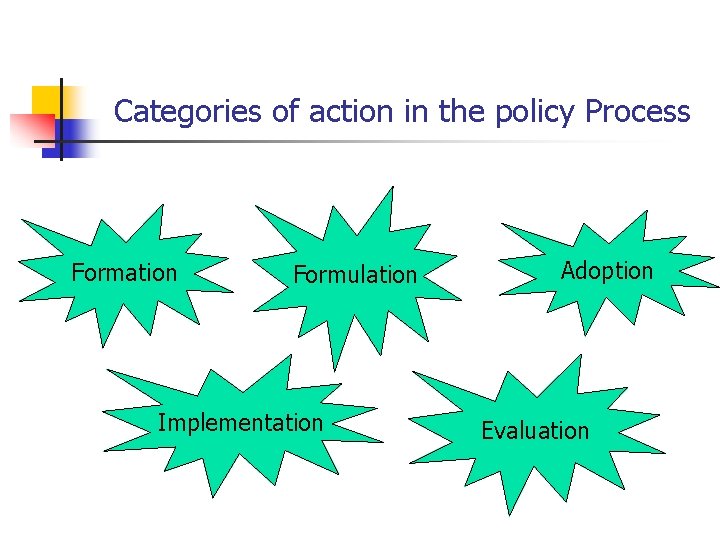
Categories of action in the policy Process Formation Formulation Implementation Adoption Evaluation
Policy Formation Addresses questions such as: What is the Policy Problem? What makes it a public Problem? How does it get on the agenda of government?
Policy Formulation Addresses questions such as: Who participates in policy formulation? How are alternatives to deal with the problem developed?
Policy Adoption Addresses questions such as: How is a policy adopted or enacted? What requirements must be met? Who adopts the policy?
Policy Implementation Addresses questions such as: What is done or not done to carry out a policy? What effect does this have on policy content?
Policy Evaluation Addresses questions such as: How is the effectiveness of policy measured? Who evaluates the policy? What are the consequences of the policy evaluation? Are there demands for revision or repeal?
Subconcepts 1 - Policy: - a purposive course of action followed by an actor or set of actors in dealing with a problem. 2 - Public Policy: Policy policies developed by governmental bodies or officials. 3 - Policy Demands: - requests of government officials by other actors in the political system for action or inaction on some perceived problem.
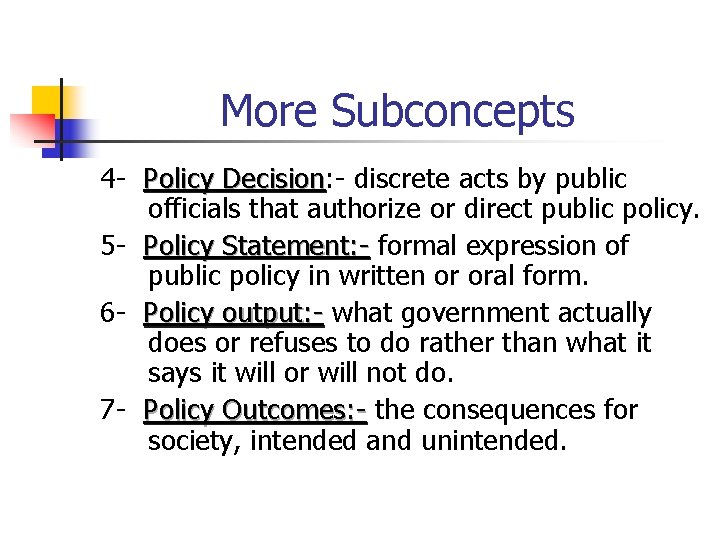
More Subconcepts 4 - Policy Decision: Decision discrete acts by public officials that authorize or direct public policy. 5 - Policy Statement: - formal expression of public policy in written or oral form. 6 - Policy output: - what government actually does or refuses to do rather than what it says it will or will not do. 7 - Policy Outcomes: - the consequences for society, intended and unintended.
- Slides: 29