Hirschsprung s disease introduction Hirschsprung disease is a



- Slides: 22
Hirschsprung, s disease
introduction Hirschsprung disease is a disorder of the neuroenteric pathways within the distal large bowel that prevents bowel relaxation, resulting in a functional distal bowel obstruction. Hirschsprung disease is not an acquired disease as the name suggests, but rather is a congenital absence of neuroganglion cells from the distal intestine that affects 1 in 4500 -7000 newborns
introduction Hirschsprung disease is more common in white infants and affects males 4 times more frequently than females. In approximately 12. 5% of patients, Hirschsprung disease may be familial, especially when the entire colon is affected, which is termed total. colonic aganglionosis
pathophysiology Functional bowel obstruction in Hirschsprung disease results from an inability of the colon to relax during peristalsis. The relaxation phase of peristalsis usually occurs as a reflex to the antegrade peristaltic wave. In Hirschsprung disease, the affected bowel cannot relax and, therefore, remains. contracted
pathophysiology The relaxation phase reflex is controlled by neuroenteric ganglion cells, which are present in the submucosa layer of the intestine. If these ganglion cells are not present, the peristaltic relaxation phase is not conducted to the affected distal segment of the bowel. The affected distal colon does not relax appropriately, and a functional obstruction develops.
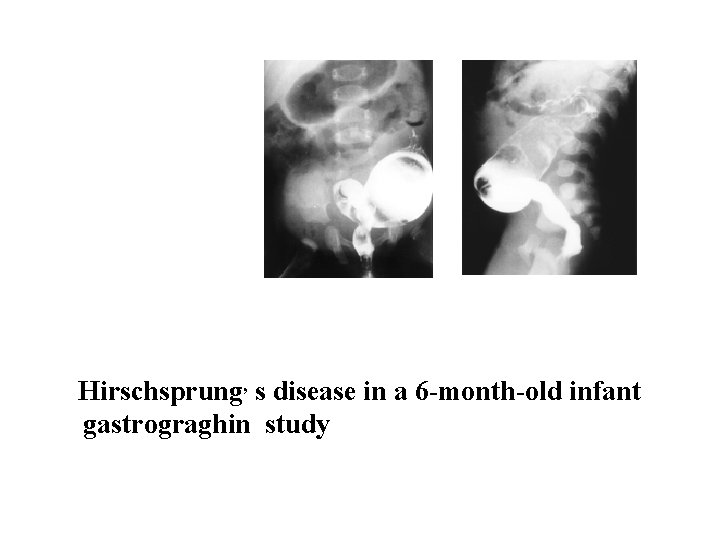
diagnosis Diagnosis of Hirschsprung disease is suggested by contrast enema and confirmed by rectal biopsy. If Hirschsprung disease is suggested, perform a contrast enema. Older children with Hirschsprung disease show a characteristic transition zone between narrow-caliber aganglionic bowel and dilated upstream normally ganglionated bowel.
Gastrograghin enema A distinct transition zone is often difficult to observe in newborns. Failure to evacuate the contrast in 24 hours following the contrast enema may be diagnostic for Hirschsprung disease.
Rectal biopsy may be readily performed at the bedside in newborns with a specially designed rectal biopsy tool. This instrument suctions the rectal mucosa and submucosa into the tool and amputates the specimen without perforating the serosa of the rectum. Collection of the specimen via suction is replacing the more conventional open biopsy method of obtaining tissue for histopathologic examination
Rectal biopsy The specimen is examined for the presence of ganglion cells in the submucosal layer. In addition, acetylcholinesterase staining of the submucosa identifies abnormal hypertrophic nerve fibers in Hirschsprung tissue. All children with delayed passage of meconium with a suspicious finding on contrast enema should undergo rectal biopsy prior to discharge
management Several different surgical approaches have been described that pull ganglionated bowel down to the rectum. Most pediatric surgeons have performed a colostomy to allow for decompression of the. bowel
Hirschsprung, s disease in a 6 -month-old infant gastrograghin study
Surgical treatment • In 1948, Swenson performed the first operation for definitive treatment of Hirschsprung, s disease and reported on 50 cases. • Two subsequent open procedures – the Soave and the Duhamel – are commonly performed today. • These procedures were initially staged (diverting colostomy first (and then secondstage procedure through a left lower abdominal incision with a transanal anastomosis.
The Soave or endorectal pullthrough • This procedure consists of removing the mucosa (the lining) of the rectum and pulling ganglionic bowel through a short aganglionic muscular cuff. • By remaining within the muscular cuff of the aganglionic segment, important sensory fibers and the function of the internal sphincter are preserved.
Recent trends in surgery for Hirschsprung's disease • Recent trends in surgery for Hirschsprung's disease have been toward earlier repair and fewer surgical stages. • A one-stage pull-through for Hirschsprung's disease avoids the additional anesthesia, surgery, and complications of a colostomy. • Laparoscopic-assisted approach diminishes surgical trauma to the peritoneal cavity In Young child.
PRIMARY PULL-THROUGH FOR HIRSCHSPRUNG'S DISEASE • As originally described, all three of the operations listed above are performed after first creating a colostomy when the diagnosis of Hirschsprung's disease is made. The pull-through is usually performed sometime in the first year of life. • A primary pull-through without colostomy is now offered to many patients if the child is appropriate for the operation. The operation has been done using all three of the major techniques.
A one-stage pull-through • A one-stage pull-through for Hirschsprung's disease avoids the additional anesthesia, surgery, and complications of a colostomy. • A one-stage pull-through should be done in selected patients, with a transition zone in the sigmoid colon or rectum.
LAPAROSCOPIC AND TRANSANAL APPROACHES TO HIRSCHSPRUNG'S DISEASE
laparoscopic pull-through procedure • In 1995, (Georgeson KE, Fuenfer MM, Hardin WD) Alabama at Birmingham the first 1 -stage laparoscopic pull-through procedure was reported. • Raffensperger published the first report of a Swenson procedure performed laparoscopically at Children's Memorial Hospital in 1996.
laparoscopic pull-through procedure • Georgeson, et al, 1999, division of pediatric surgery, University of Alabama at Birmingham have the largest report of the laparoscopic assisted endorectal )Soave) pullthrough to date with 80 patients. (Video Film ).
• The use of advanced laparoscopic techniques for Hirschsprung's disease is now used by many pediatric surgeons. All three of the primary operations have now been performed using laparoscopic techniques. • The transanal approach is best used only in children with a transition zone in the sigmoid colon or rectum.
thank you