HIPAA Summit V A Case Study Kaisers HIPAA


- Slides: 23
HIPAA Summit V A Case Study: Kaiser’s HIPAA Compliance from the Perspectives of Kaiser’s Hospitals and Clinics John Des. Marteau, MD FACA Kaiser Permanente Mid-Atlantic HIPAA Project
Focus on HIPAA Privacy l l Of the three key HIPAA Administrative Services components, Privacy has the first compliance date – April 14, 2003 Privacy requirements have a tremendous impact – touching everyone from CEO to Medical Directors to physicians to patients to office staff and volunteers 2
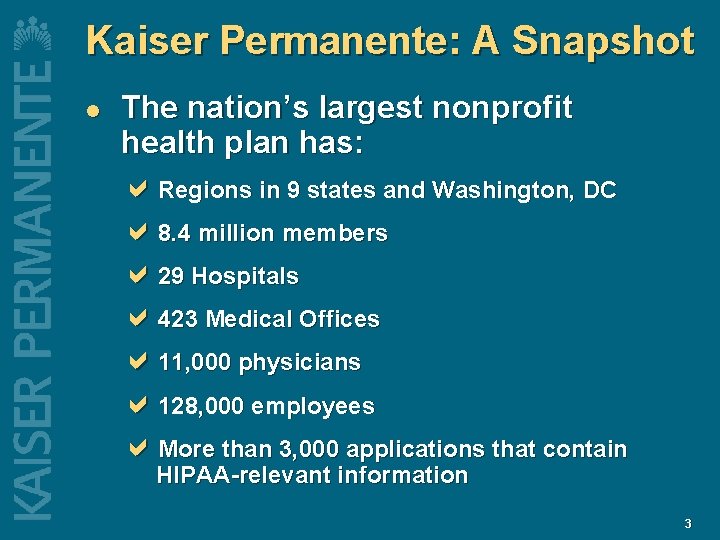
Kaiser Permanente: A Snapshot l The nation’s largest nonprofit health plan has: a. Regions in 9 states and Washington, DC a 8. 4 million members a 29 Hospitals a 423 Medical Offices a 11, 000 physicians a 128, 000 employees a. More than 3, 000 applications that contain HIPAA-relevant information 3
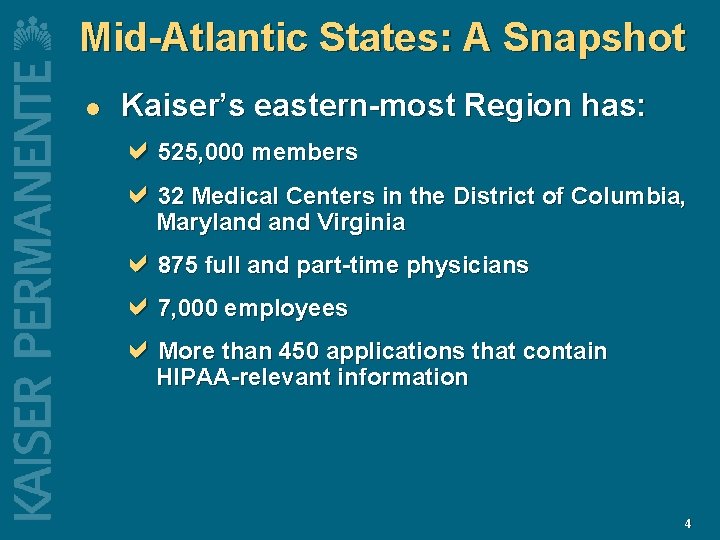
Mid-Atlantic States: A Snapshot l Kaiser’s eastern-most Region has: a 525, 000 members a 32 Medical Centers in the District of Columbia, Maryland Virginia a 875 full and part-time physicians a 7, 000 employees a. More than 450 applications that contain HIPAA-relevant information 4
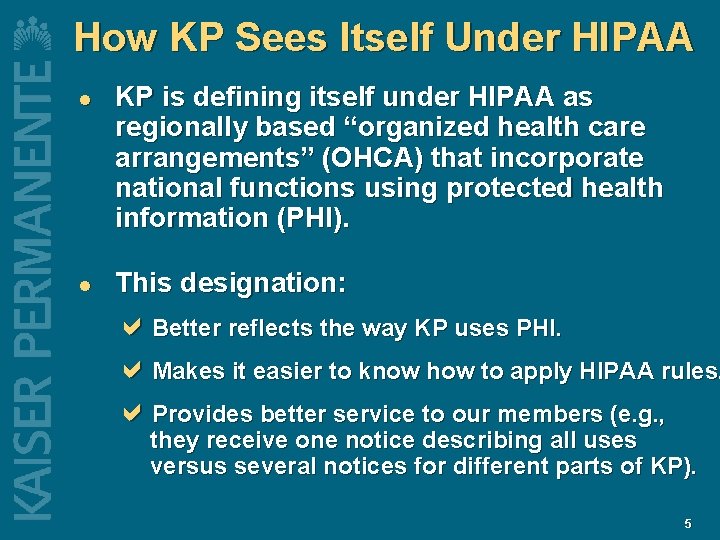
How KP Sees Itself Under HIPAA l l KP is defining itself under HIPAA as regionally based “organized health care arrangements” (OHCA) that incorporate national functions using protected health information (PHI). This designation: a. Better reflects the way KP uses PHI. a. Makes it easier to know how to apply HIPAA rules. a. Provides better service to our members (e. g. , they receive one notice describing all uses versus several notices for different parts of KP). 5
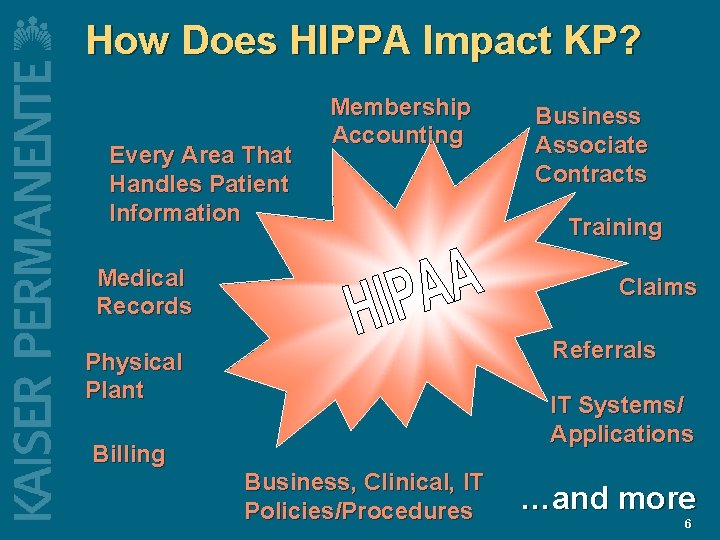
How Does HIPPA Impact KP? Every Area That Handles Patient Information Membership Accounting Medical Records Business Associate Contracts Training Claims Referrals Physical Plant IT Systems/ Applications Billing Business, Clinical, IT Policies/Procedures …and more 6
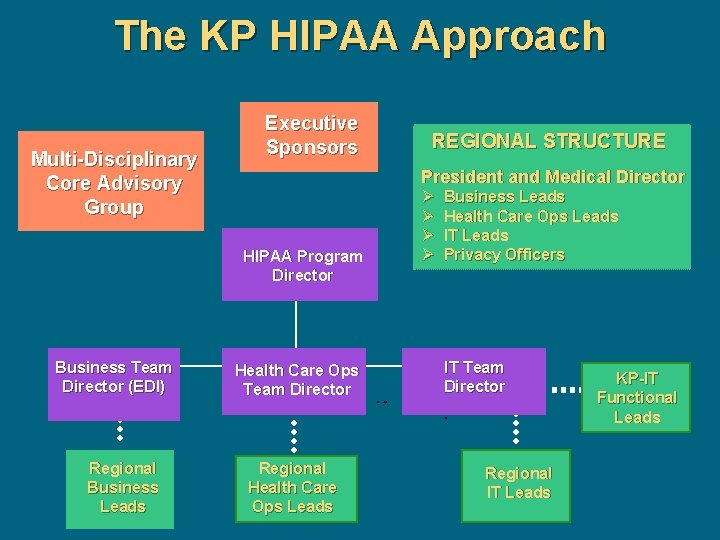
The KP HIPAA Approach Multi-Disciplinary Core Advisory Group Executive Sponsors President and Medical Director HIPAA Program Director Business Team Director (EDI) Regional Business Leads REGIONAL STRUCTURE Health Care Ops Team Director Regional Health Care Ops Leads Ø Ø Business Leads Health Care Ops Leads IT Leads Privacy Officers IT Team Director Regional IT Leads KP-IT Functional Leads
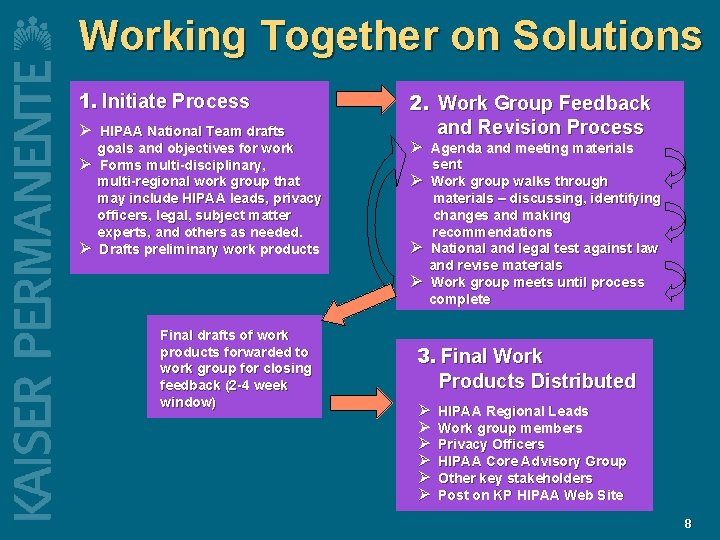
Working Together on Solutions 1. Initiate Process Ø HIPAA National Team drafts Ø Ø goals and objectives for work Forms multi-disciplinary, multi-regional work group that may include HIPAA leads, privacy officers, legal, subject matter experts, and others as needed. Drafts preliminary work products 2. Work Group Feedback and Revision Process Ø Agenda and meeting materials Ø Ø Ø Final drafts of work products forwarded to work group for closing feedback (2 -4 week window) sent Work group walks through materials – discussing, identifying changes and making recommendations National and legal test against law and revise materials Work group meets until process complete 3. Final Work Products Distributed Ø Ø Ø HIPAA Regional Leads Work group members Privacy Officers HIPAA Core Advisory Group Other key stakeholders Post on KP HIPAA Web Site 8
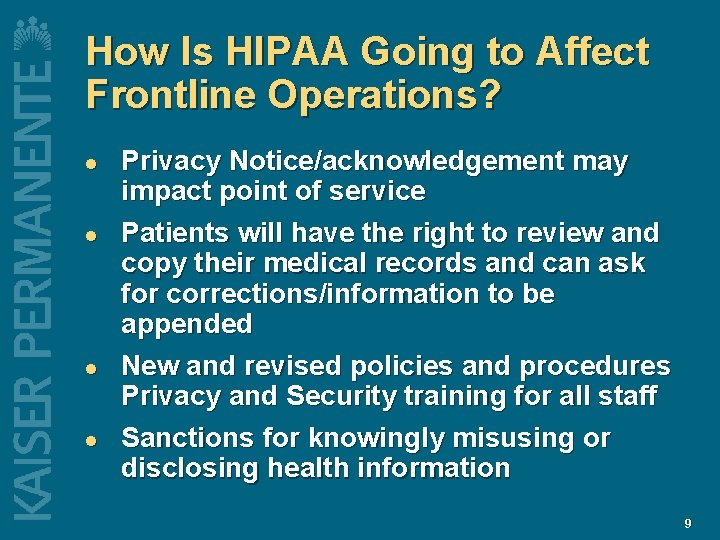
How Is HIPAA Going to Affect Frontline Operations? l l Privacy Notice/acknowledgement may impact point of service Patients will have the right to review and copy their medical records and can ask for corrections/information to be appended New and revised policies and procedures Privacy and Security training for all staff Sanctions for knowingly misusing or disclosing health information 9
KP Has Developed Some Solutions, but Still Faces a Host of Challenges. . . 10
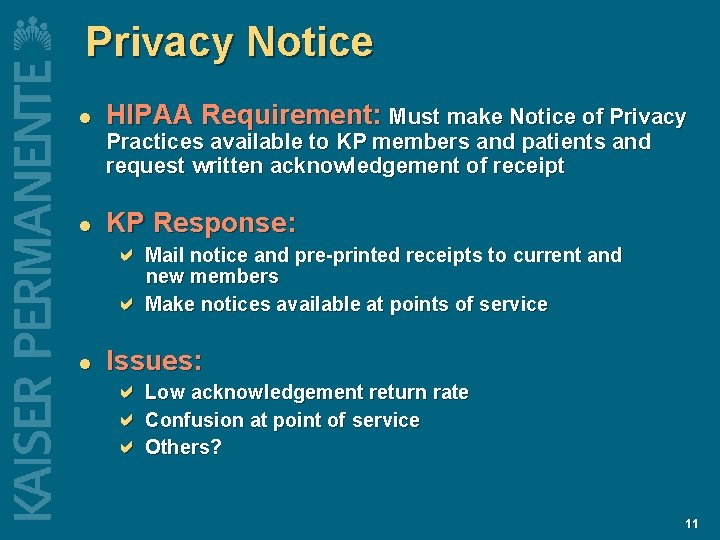
Privacy Notice l HIPAA Requirement: Must make Notice of Privacy Practices available to KP members and patients and request written acknowledgement of receipt l KP Response: a Mail notice and pre-printed receipts to current and new members a Make notices available at points of service l Issues: a Low acknowledgement return rate a Confusion at point of service a Others? 11
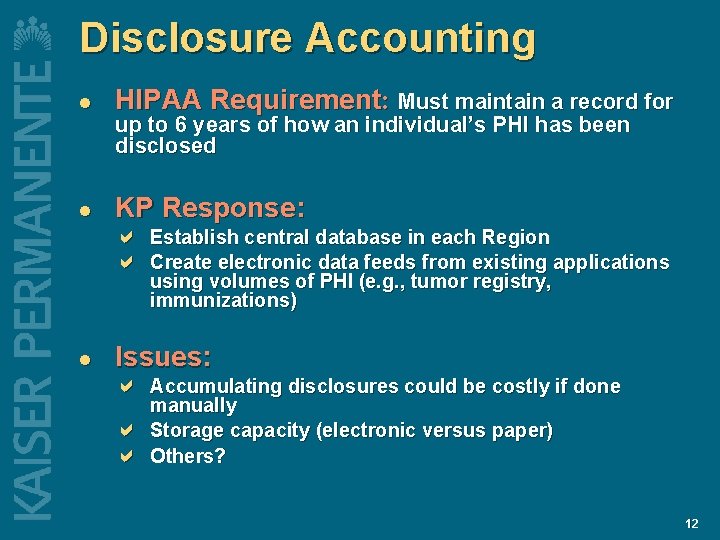
Disclosure Accounting l HIPAA Requirement: Must maintain a record for l KP Response: up to 6 years of how an individual’s PHI has been disclosed a Establish central database in each Region a Create electronic data feeds from existing applications using volumes of PHI (e. g. , tumor registry, immunizations) l Issues: a Accumulating disclosures could be costly if done a a manually Storage capacity (electronic versus paper) Others? 12
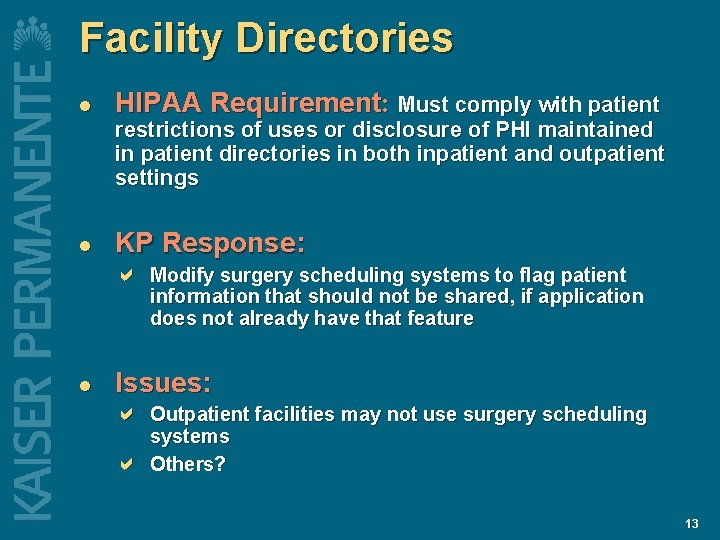
Facility Directories l HIPAA Requirement: Must comply with patient restrictions of uses or disclosure of PHI maintained in patient directories in both inpatient and outpatient settings l KP Response: a Modify surgery scheduling systems to flag patient information that should not be shared, if application does not already have that feature l Issues: a Outpatient facilities may not use surgery scheduling a systems Others? 13
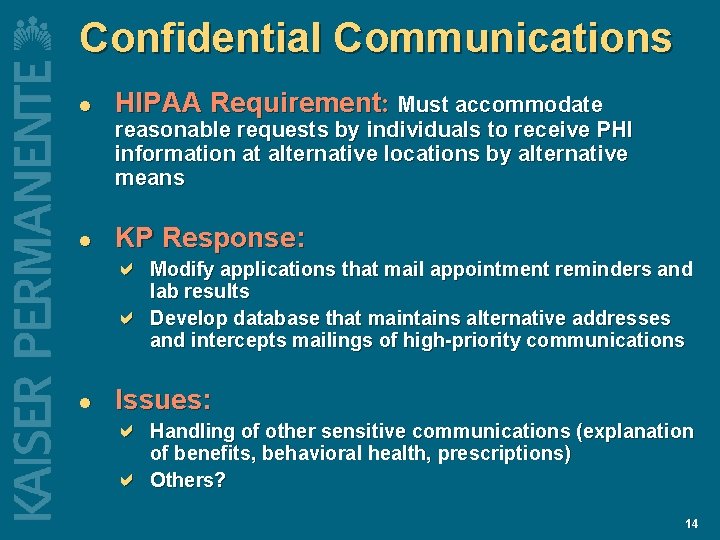
Confidential Communications l HIPAA Requirement: Must accommodate reasonable requests by individuals to receive PHI information at alternative locations by alternative means l KP Response: a Modify applications that mail appointment reminders and a l lab results Develop database that maintains alternative addresses and intercepts mailings of high-priority communications Issues: a Handling of other sensitive communications (explanation a of benefits, behavioral health, prescriptions) Others? 14
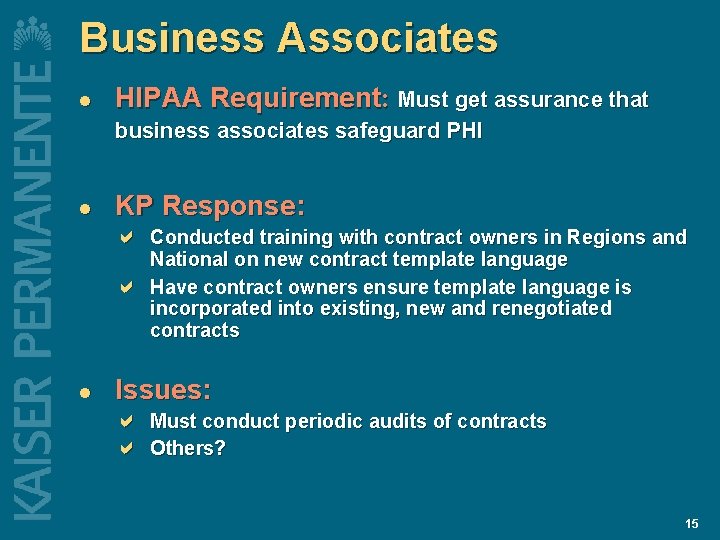
Business Associates l HIPAA Requirement: Must get assurance that business associates safeguard PHI l KP Response: a Conducted training with contract owners in Regions and a l National on new contract template language Have contract owners ensure template language is incorporated into existing, new and renegotiated contracts Issues: a a Must conduct periodic audits of contracts Others? 15
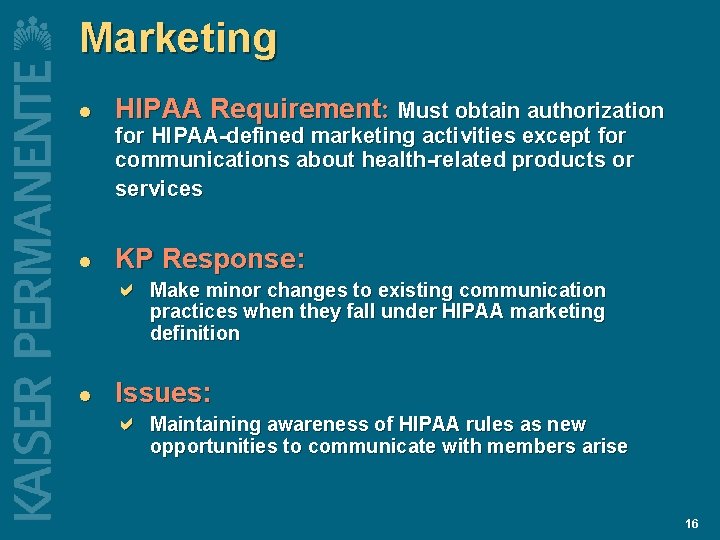
Marketing l HIPAA Requirement: Must obtain authorization for HIPAA-defined marketing activities except for communications about health-related products or services l KP Response: a Make minor changes to existing communication practices when they fall under HIPAA marketing definition l Issues: a Maintaining awareness of HIPAA rules as new opportunities to communicate with members arise 16
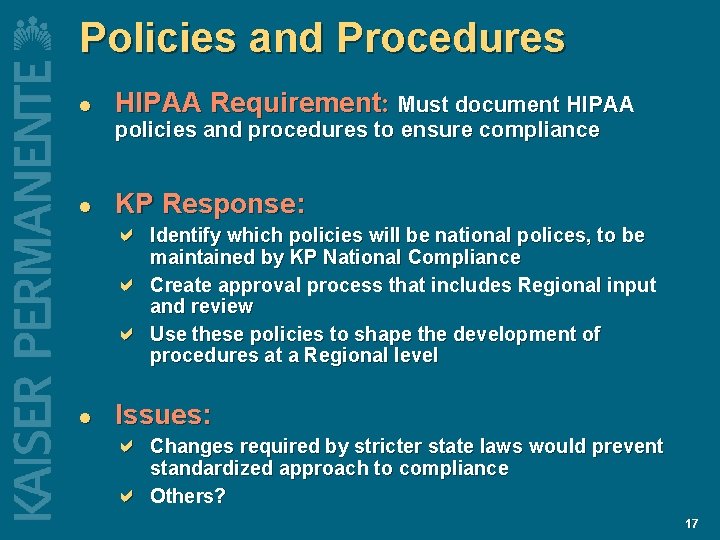
Policies and Procedures l HIPAA Requirement: Must document HIPAA policies and procedures to ensure compliance l KP Response: a Identify which policies will be national polices, to be a a l maintained by KP National Compliance Create approval process that includes Regional input and review Use these policies to shape the development of procedures at a Regional level Issues: a Changes required by stricter state laws would prevent a standardized approach to compliance Others? 17
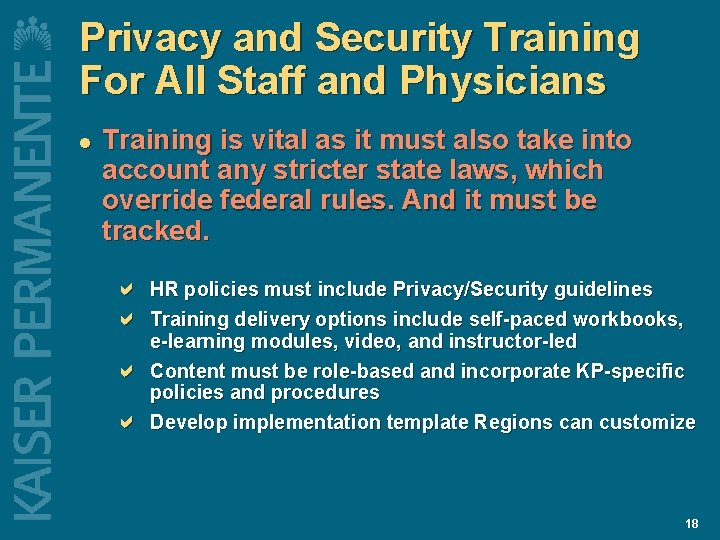
Privacy and Security Training For All Staff and Physicians l Training is vital as it must also take into account any stricter state laws, which override federal rules. And it must be tracked. a HR policies must include Privacy/Security guidelines a Training delivery options include self-paced workbooks, a a e-learning modules, video, and instructor-led Content must be role-based and incorporate KP-specific policies and procedures Develop implementation template Regions can customize 18
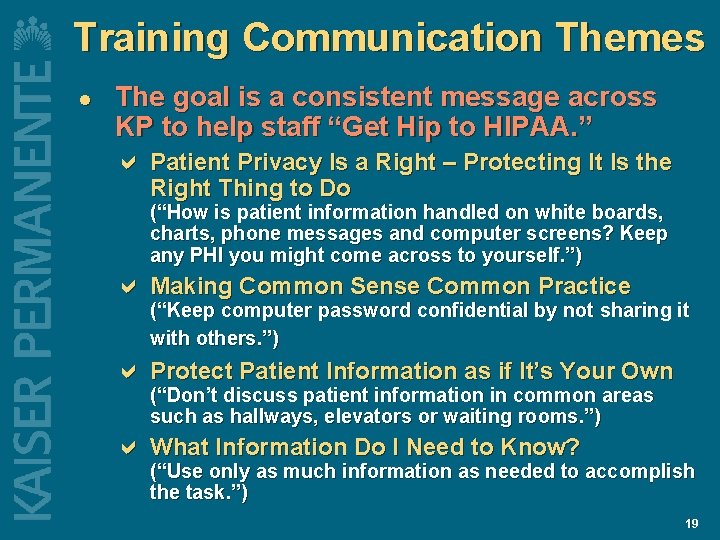
Training Communication Themes l The goal is a consistent message across KP to help staff “Get Hip to HIPAA. ” a Patient Privacy Is a Right – Protecting It Is the Right Thing to Do (“How is patient information handled on white boards, charts, phone messages and computer screens? Keep any PHI you might come across to yourself. ”) a Making Common Sense Common Practice (“Keep computer password confidential by not sharing it with others. ”) a Protect Patient Information as if It’s Your Own (“Don’t discuss patient information in common areas such as hallways, elevators or waiting rooms. ”) a What Information Do I Need to Know? (“Use only as much information as needed to accomplish the task. ”) 19
To Keep KP’s Privacy Efforts on Track… 20
Privacy Officer’s Role l l Each Region has designated a Privacy Officer, who will have a dotted line to KP National Compliance. This provides a community of privacy experts sharing best practices and striving for consistency when appropriate. Duties vary but all include: a Develop/maintain privacy program/plan a Develop policies and procedures a Ensure compliance with federal/state law a Monitor systems development a Oversee privacy training/awareness a Collaborate on development sanctions a Plan for reporting concerns/violations a Risk assessments a Investigate breaches a And more. . . 21
Contributing to the Success of HIPAA at Kaiser Permanente l l l HIPAA and patient privacy are in alignment with KP values Active national and regional sponsorship Dedicated national and regional HIPAA teams Multi-disciplinary approach KP is a “learning” organization Our 55 -year history of providing high-quality health care service to diverse populations 22
Questions? KP HIPAA Web Site: http: //kpnet. kp. org/hipaa l l john. desmarteau@kp. org (301) 523 -7571 23