
Unit 3 Corporate strategies Text B Starbucks foreign
Unit 3 Corporate strategies Text B Starbucks’ foreign direct investment
Lead-in Global expansion • Wal-Mart: catering to the local shopping preferences • Starbucks: maintaining the original flavour – replicating (复制) “Starbucks experiences” in foreign countries • Could you think about any reason for Starbucks’ strategy?
Academic reading Text B Starbucks’ foreign expansion • Read para. 1 • Synthesize the information about Starbucks’ corporate strategies • Fill in the table on p. 58: • Products, Customer service, Employee
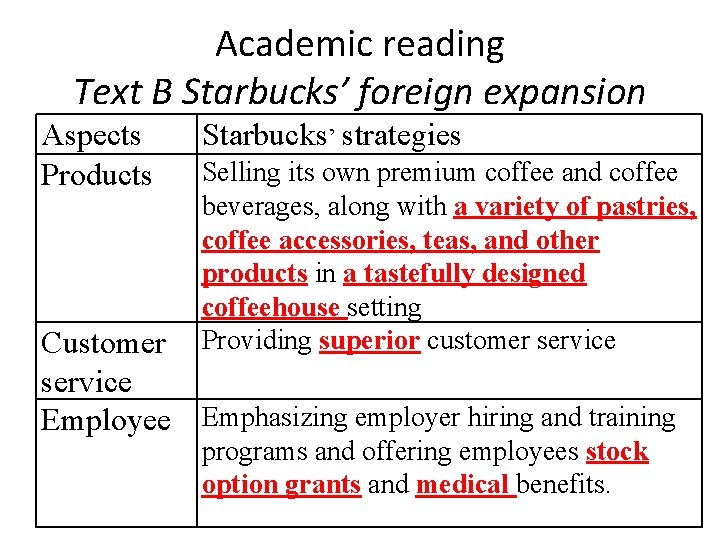
Academic reading Text B Starbucks’ foreign expansion Aspects Products Starbucks’ strategies Selling its own premium coffee and coffee beverages, along with a variety of pastries, coffee accessories, teas, and other products in a tastefully designed coffeehouse setting Providing superior customer service Customer service Employee Emphasizing employer hiring and training programs and offering employees stock option grants and medical benefits.
Academic reading Text B Starbucks’ foreign expansion stock option (para. 1, L 4 on p. 56) • (公司以优惠价格提供给员 的)认股权,股 票购买权 • It is the right for an employee at a publiclytraded company (上市公司) to buy shares (购买股 票) in that company for a certain price (usually lower than the usual price).
Academic reading Text B Starbucks’ foreign expansion stock option (para. 1, L 4 on p. 56) • Stock options in this sense are often a part of compensations (薪酬的一部分) for senior- and middle-level executives in large companies. • These stock options have certain rules governing when and how the option can be exercised (指导何时、以何种方式行使认股权).
Academic reading Text B Starbucks’ foreign expansion • Para. 2 -6 Starbucks’ international expansions in • Japan • Thailand • Switzerland
Academic reading Text B Starbucks’ foreign expansion International expansion: • Principle: Making sure overseas operations replicate the “Starbucks experience” • Strategies: Franchising, joint ventures with local partners or wholly-owned subsidiaries depending on local conditions
Specialized vocabulary • a franchising strategy 特许经营权 (para. 2, L 3) • It is a corporate strategy based on an agreement in which an entrepreneur buys a license to use another business’ products, brand, or proprietary knowledge (使用另一家企 业的产品,品牌,或者专利知识).
Specialized vocabulary • licensing agreement 特许权协议 (para. 2, L 5) • A legal contract between the licensor and the licensee. • In a typical licensing agreement, the licensor grants the licensee the right to produce and sell goods, apply a brand name or trademark, or use the patented technology owned by the licensor.
Academic reading Text B Starbucks’ foreign expansion • Read Para. 2 -6 • Synthesize the strategies of Starbucks’ international expansions in • Japan – xxxx • Thailand – xxxx • Switzerland – xxxx
Academic reading Text B Starbucks’ foreign expansion • Cases: • In Japan – Established a joint venture with a local retailer Sazaby Inc. . – Each company holding a 50% stake in the venture
Academic reading Text B Starbucks’ foreign expansion • Cases: • In Thailand – Acquired Coffee Partners, the local Thai company (wholly-owned subsidiary)
Academic reading Text B Starbucks’ foreign expansion • Cases: • In Switzerland – Established a joint venture with Bon Appetit Group, a Swiss company – Bon Appetit holding a majority stake in the venture
Specialized vocabulary • foreign direct investment 外国直接投资(para. 2, L 6) • A foreign direct investment (FDI) is a controlling ownership in a business enterprise in one country by an entity based in another country.
Specialized vocabulary • Broadly, foreign direct investment includes mergers and acquisitions (合并和收购), building new facilities, and reinvesting profits earned from overseas operations (把海外运营的收益用于 再投资). • FDI usually involves participation in management (参与管理), joint-venture, transfer of technology and expertise (转移技术和专门知识).
Specialized vocabulary • majority stake 多数股权(para. 6, L 4) • It is the ownership of 50% plus of the stock in a publicly-traded company. This gives the holder outright control of the company’s operations (对于公司运营的完全控制权), especially the election of its board of directors.
Viewing: Unilever’s cooperate strategies • Profit is not always the point – A TED speech by Harish Manwani – COO, Unilever – Harish Manwani joined Unilever as a management trainee in 1976; he is now the company's chief operating officer.
Viewing • The fourth G added to the original model of 3 G’s growth • Examples of the fourth G in Unilever’s operations: – A largest hand-washing program in the world – Unilever’s Project Shakti in India – A rinse product launched recently
Viewing • The fourth G added to the original model of 3 G’s growth: the G of growth that is responsible. • The growth is not just for creating economic value, but for creating social value, to play a role in terms of serving the communities which actually sustain a business.
Viewing Examples of the fourth G in Unilever’s operations: • Unilever runs a largest hand-washing program in the world, a program on hygiene and health that now touches half a billion people
Viewing Examples of the fourth G in Unilever’s operations: • Unilever’s Project Shakti, that is, teaching women in India how to do small business and how to carry the message of nutrition and hygiene, which has 60, 000 such women now in India.
Viewing Examples of the fourth G in Unilever’s operations: • One rinse product launched recently, which allows people to save water every time they wash clothes.
- Slides: 23