Gustav Holst Mars Primary classroom lesson plan Written





- Slides: 32
Gustav Holst Mars Primary classroom lesson plan Written by Rachel Leach
Lesson outcomes After this lesson, pupils will be able to: • listen and reflect on a piece of orchestral music • learn musical motifs from Holst’s Mars and structure them into a piece • invent their own musical motifs and structure them into a piece • perform as an ensemble • learn musical language appropriate to the task Copyright : Words - Rachel Leach, Design - BBC 2
Curriculum checklist Learners will: • play and perform in ensemble contexts, using voices and playing musical instruments • improvise and compose music for a range of purposes using the interrelated dimensions of music • listen with attention to detail and recall sounds with increasing aural memory Copyright : Words - Rachel Leach, Design - BBC 3
Glossary of music terms Term Definition Coda another word for ending Crescendo gradually getting louder Motif a small musical idea Ostinato a repeating pattern Pitched percussion instruments that can play different pitches – xylophones, glockenspiels, chime bars etc. Pulse the steady ‘’beat’ underneath much music made up of notes of the same length (like a ticking clock or steady footsteps) Unpitched percussion instruments that can only make a limited number of sounds – drums, shakers woodblocks, tambourine etc. Copyright : Words - Rachel Leach, Design - BBC 4
Lesson 1 Watching and listening Copyright Rachel Leach & BBC
Background – the composer Gustav Holst (1874 - 1934) • British composer • Eccentric character fascinated by space, astrology, alternative faiths, meditation and vegetarianism LESSON 1 Copyright : Words - Rachel Leach, Design - BBC 6
Background – the music ‘Mars’ from The Planets Suite § Written in 1918 for very large orchestra § The full suite describes 7 planets (no Earth) § Holst was particularly interested in the ‘character’ of each planet rather than its science LESSON 1 Copyright : Words - Rachel Leach, Design - BBC 7
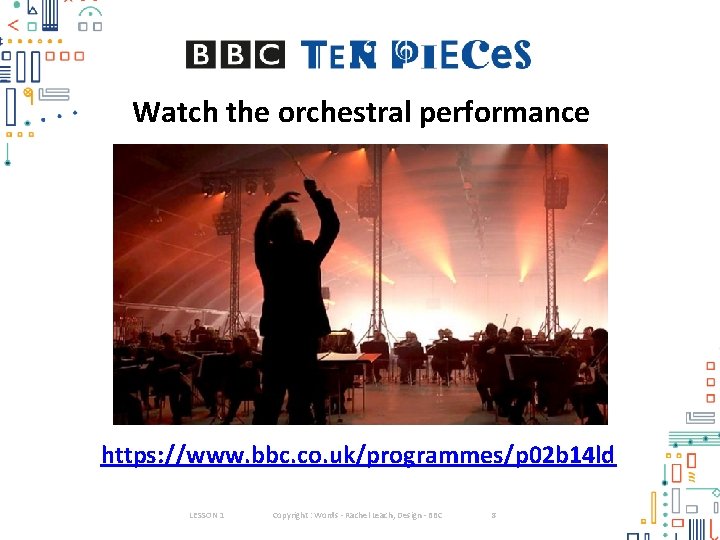
Watch the orchestral performance https: //www. bbc. co. uk/programmes/p 02 b 14 ld LESSON 1 Copyright : Words - Rachel Leach, Design - BBC 8
Answer in one word a) If the music was describing a colour, which colour would it be? b) If the music was describing a shape, which shape would it be? c) If the music was describing a line, would it be curvy and smooth or spiky and jagged? LESSON 1 Copyright : Words - Rachel Leach, Design - BBC 9
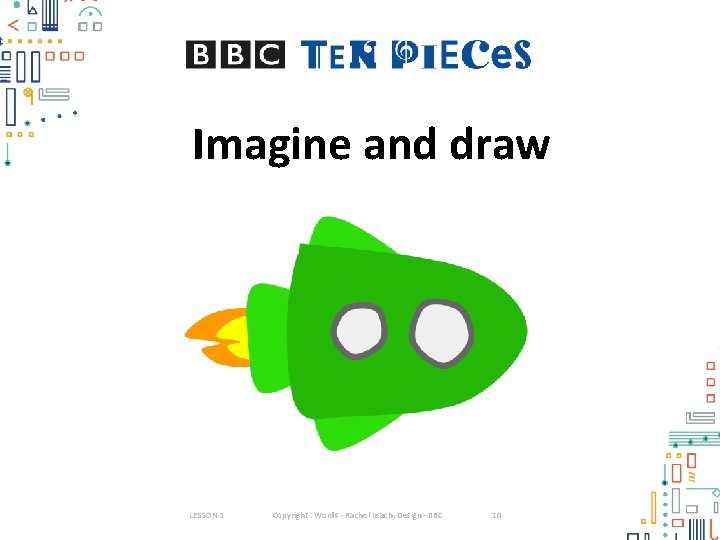
Imagine and draw LESSON 1 Copyright : Words - Rachel Leach, Design - BBC 10
Lesson 2 Five-beat repeating patterns (ostinatos) Copyright Rachel Leach & BBC
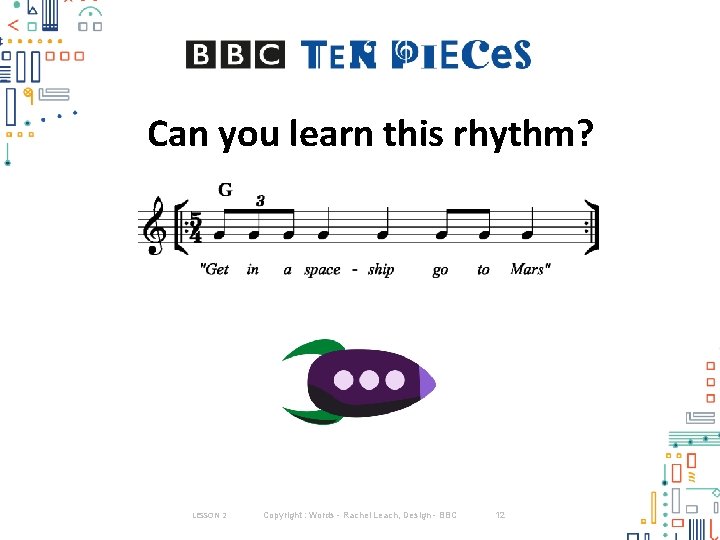
Can you learn this rhythm? LESSON 2 Copyright : Words - Rachel Leach, Design - BBC 12
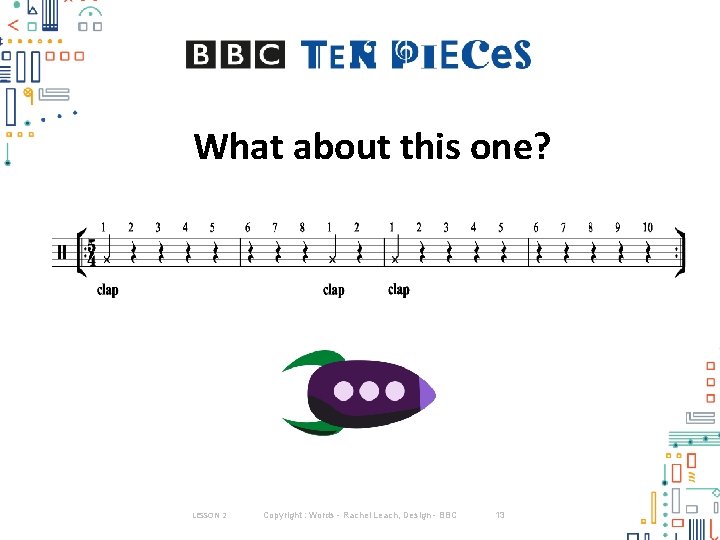
What about this one? LESSON 2 Copyright : Words - Rachel Leach, Design - BBC 13
Ostinato LESSON 2 Copyright : Words - Rachel Leach, Design - BBC 14
These patterns can work on instruments LESSON 2 Copyright : Words - Rachel Leach, Design - BBC 15
Crescendo LESSON 2 Copyright : Words - Rachel Leach, Design - BBC 16
Lesson 3 March Copyright Rachel Leach & BBC
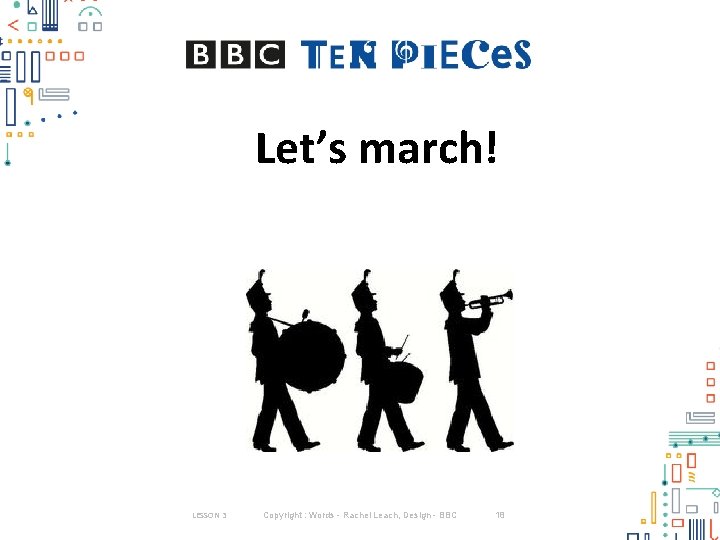
Let’s march! LESSON 3 Copyright : Words - Rachel Leach, Design - BBC 18
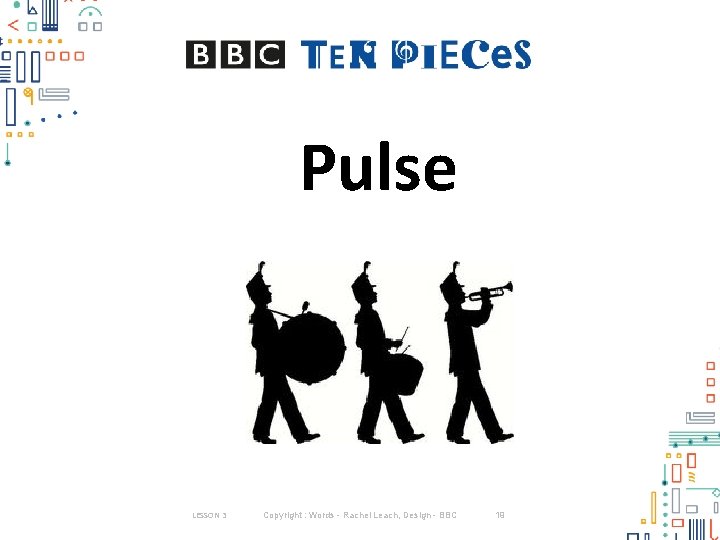
Pulse LESSON 3 Copyright : Words - Rachel Leach, Design - BBC 19
• What is Mars like? • Think the answer over and over as you clap the pulse • Speak their answer over your pulse • Clap the answer round around. You’ve created an ostinato! LESSON 3 Copyright : Words - Rachel Leach, Design - BBC 20
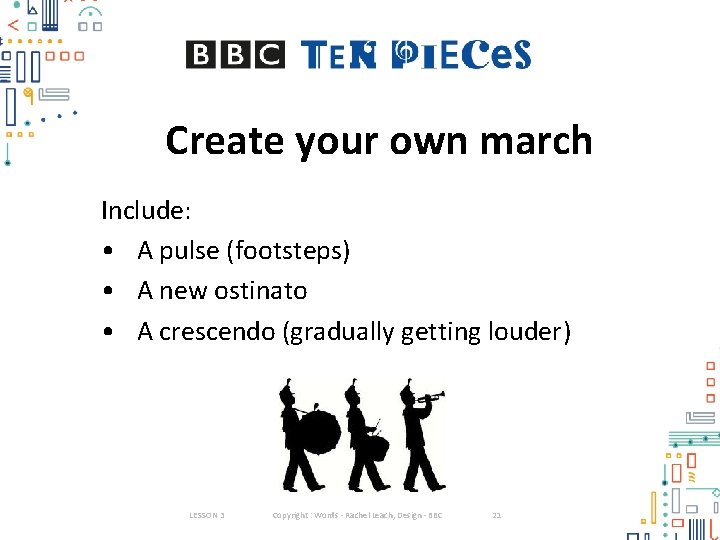
Create your own march Include: • A pulse (footsteps) • A new ostinato • A crescendo (gradually getting louder) LESSON 3 Copyright : Words - Rachel Leach, Design - BBC 21
Lesson 4 Structure Copyright Rachel Leach & BBC
Recap • • • ‘Get in a spaceship go to Mars’ ‘ 8, 2, 10’ Pulse (These rhythms are in 5) ‘Footstep’ pulse New Mars ostinato (These rhythms are probably in 2 or 4) LESSON 4 Copyright : Words - Rachel Leach, Design - BBC 23
Create a structure like Holst • Crescendo using ‘get in a spaceship’ • March (with crescendo) • New section combining ideas from both (both of his sections are in 5) LESSON 4 Copyright : Words - Rachel Leach, Design - BBC 24
Lesson 5 Coda (ending) Copyright Rachel Leach & BBC
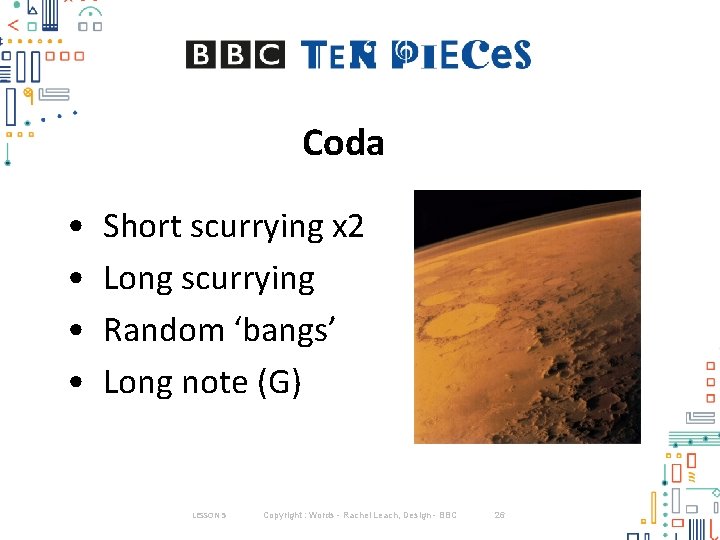
Coda • • Short scurrying x 2 Long scurrying Random ‘bangs’ Long note (G) LESSON 5 Copyright : Words - Rachel Leach, Design - BBC 26
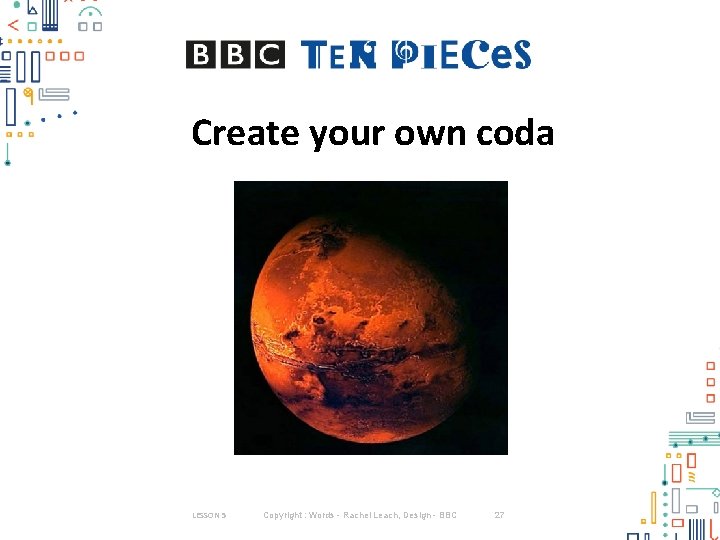
Create your own coda LESSON 5 Copyright : Words - Rachel Leach, Design - BBC 27
Let’s perform LESSON 5 Copyright : Words - Rachel Leach, Design - BBC 28
Lesson 6 Create your own ‘new’ planets piece Copyright Rachel Leach & BBC
Create your own motifs LESSON 6 Copyright : Words - Rachel Leach, Design - BBC 30
Create your own piece • • What goes first? What goes last? Do any of the ideas fit together? Do the ideas overlap, transform or repeat? LESSON 6 Copyright : Words - Rachel Leach, Design - BBC 31
Taking it further – cross-curricular activities RESEARCH: look into the science of the other planets LISTENING: Holst did write music for Venus, Mercury, Jupiter, Saturn, Uranus and Neptune. Listen to these pieces and use them as the inspiration for artwork, literacy and music LITERACY: Write a story or newspaper report about travelling to and landing on one of the planets. ART: invent and draw a new planet. Copyright : Words - Rachel Leach, Design - BBC 32