Growth Sparing Spinal Deformity Surgical Techniques in Children




- Slides: 37
Growth Sparing Spinal Deformity Surgical Techniques in Children < 10 Years of Age ICEOS Toronto Nov 2010 L Letko M Ruf J Harms
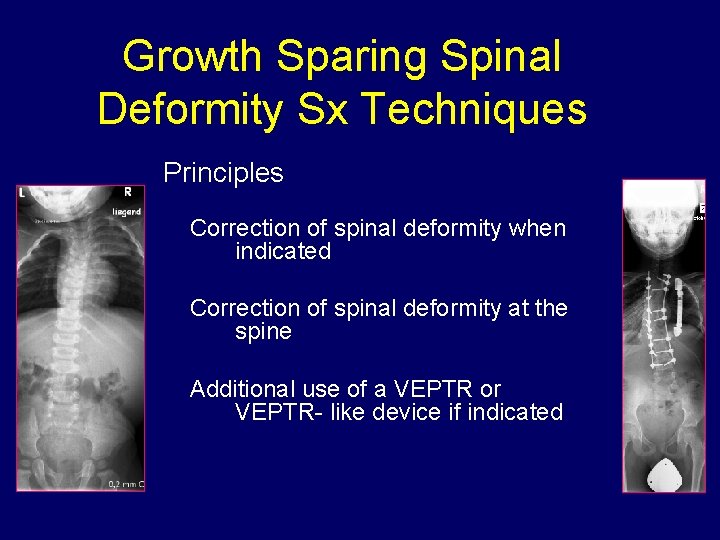
Growth Sparing Spinal Deformity Sx Techniques Principles Correction of spinal deformity when indicated Correction of spinal deformity at the spine Additional use of a VEPTR or VEPTR- like device if indicated
Growth Sparing Spinal Deformity Sx Techniques Principles Dissection extraperiosteal except in fusion area Use of pedicle screws & rod(s) since 1994 Allow continued guided growth w/ periodic distractions/instrumentation change as needed
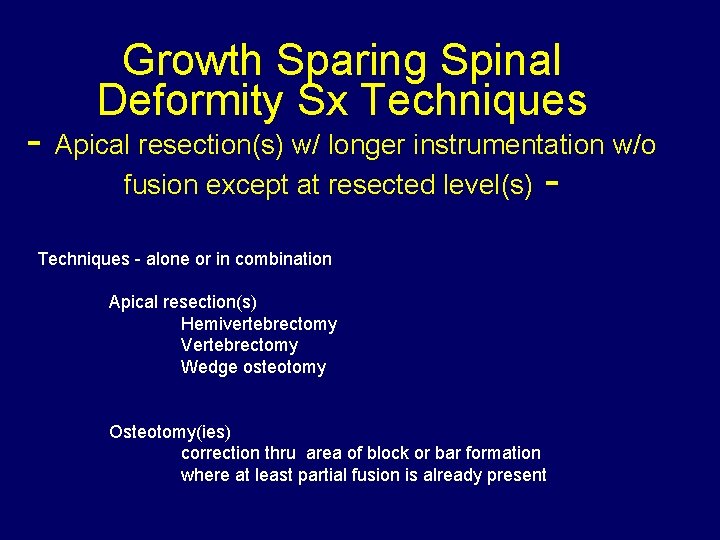
Growth Sparing Spinal Deformity Sx Techniques Apical resection(s) w/ longer instrumentation w/o fusion except at resected level(s) Instrumentation without fusion Bilateral Unilateral
Growth Sparing Spinal Deformity Sx Techniques Indications Congenital/Syndromic NFM MMC Post thoracotomy Juvenile idiopathic scoliosis
Growth Sparing Spinal Deformity Sx Techniques - Apical resection(s) w/ longer instrumentation w/o fusion except at resected level(s) Indications Rigid curve w/ flexible 2° curves Multiple anomalies
Growth Sparing Spinal Deformity Sx Techniques - Apical resection(s) w/ longer instrumentation w/o fusion except at resected level(s) Techniques - alone or in combination Apical resection(s) Hemivertebrectomy Vertebrectomy Wedge osteotomy Osteotomy(ies) correction thru area of block or bar formation where at least partial fusion is already present
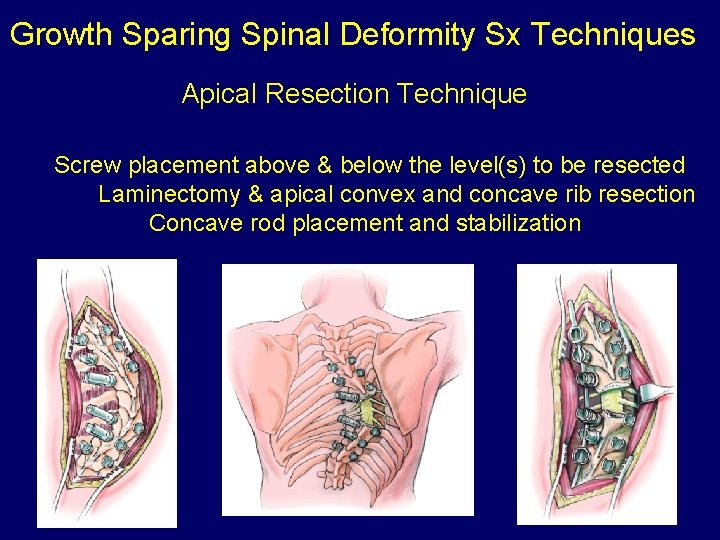
Growth Sparing Spinal Deformity Sx Techniques Apical Resection Technique Screw placement above & below the level(s) to be resected Laminectomy & apical convex and concave rib resection Concave rod placement and stabilization
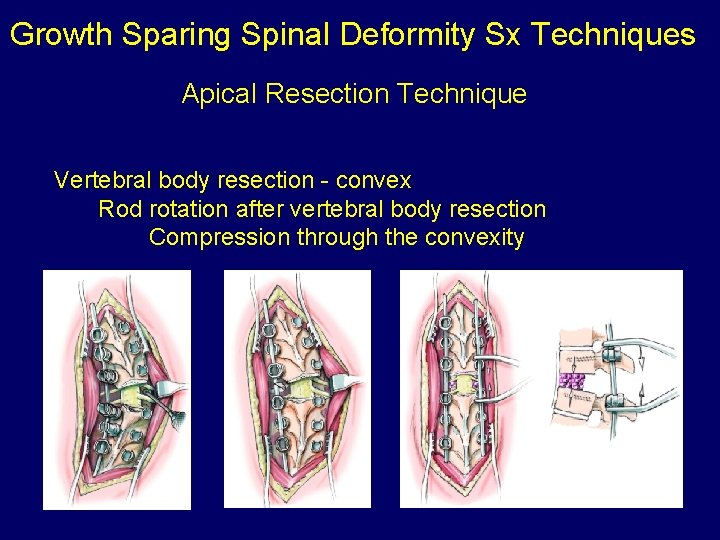
Growth Sparing Spinal Deformity Sx Techniques Apical Resection Technique Vertebral body resection - convex Rod rotation after vertebral body resection Compression through the convexity
Growth Sparing Spinal Deformity Sx Techniques – - Apical resection(s) w/ longer instrumentation w/o fusion except at resected level(s) Treatment strategies Distractions in non-fused region as needed Replacement of rod/screws with breakage/loosening (w/ larger instrumentation system as needed)
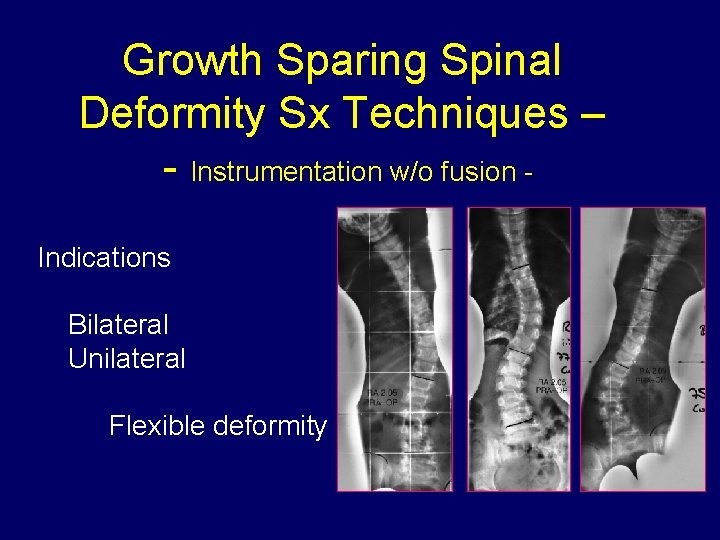
Growth Sparing Spinal Deformity Sx Techniques – - Instrumentation w/o fusion - Indications Bilateral Unilateral Flexible deformity
Growth Sparing Spinal Deformity Sx Techniques – Instrumentation Without Fusion- Bilateral & Unilateral OPERATIVE TECHNIQUE Spinal preparation using a scissor or scalpel staying above the periosteum Pedicle screw placement in the area to be instrumented but not fused Rod placement followed by correction No brace immobilization
Growth Sparing Spinal Deformity Sx Techniques – Instrumentation w/o fusion - Bilateral & Unilateral Treatment strategies Distractions as needed Replacement of rod/screws with breakage/loosening (w/ larger system as needed) Transition to apical resection & instrumentation if curve(s) become rigid
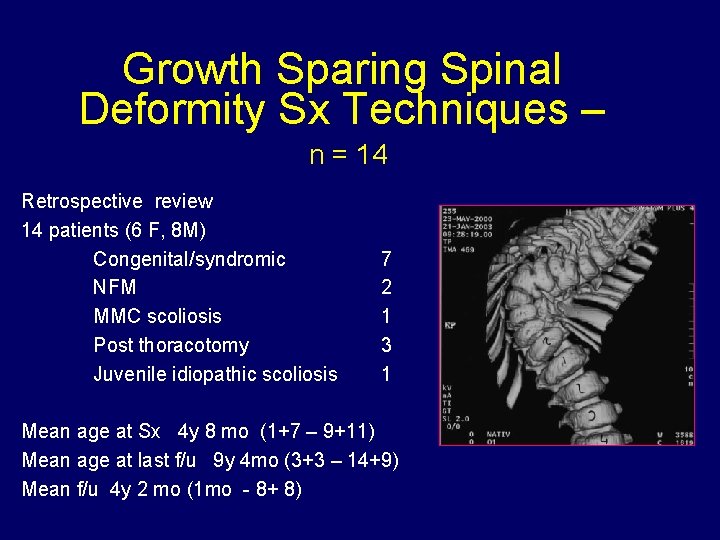
Growth Sparing Spinal Deformity Sx Techniques – n = 14 Retrospective review 14 patients (6 F, 8 M) Congenital/syndromic NFM MMC scoliosis Post thoracotomy Juvenile idiopathic scoliosis 7 2 1 3 1 Mean age at Sx 4 y 8 mo (1+7 – 9+11) Mean age at last f/u 9 y 4 mo (3+3 – 14+9) Mean f/u 4 y 2 mo (1 mo - 8+ 8)
Growth Sparing Spinal Deformity Sx Techniques – n = 14 Treated w/ resection(s) 12 Treated w/ unilateral instrumentation 1 Treated w/ bilateral Instrumentation 1
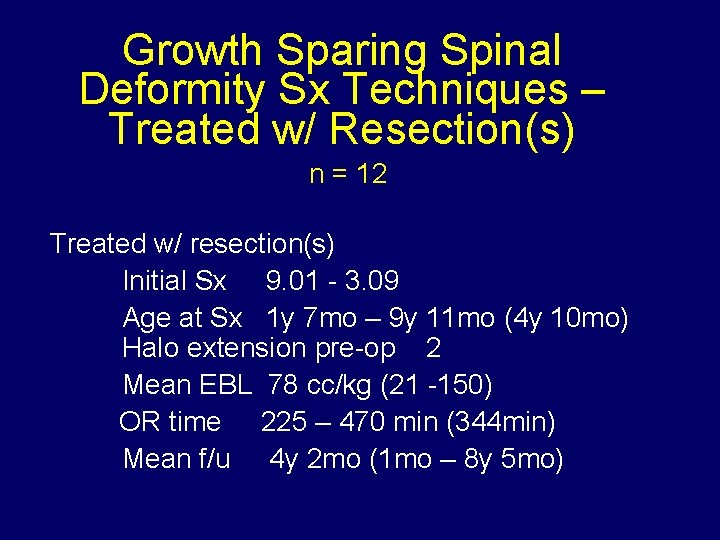
Growth Sparing Spinal Deformity Sx Techniques – Treated w/ Resection(s) n = 12 Treated w/ resection(s) Initial Sx 9. 01 - 3. 09 Age at Sx 1 y 7 mo – 9 y 11 mo (4 y 10 mo) Halo extension pre-op 2 Mean EBL 78 cc/kg (21 -150) OR time 225 – 470 min (344 min) Mean f/u 4 y 2 mo (1 mo – 8 y 5 mo)
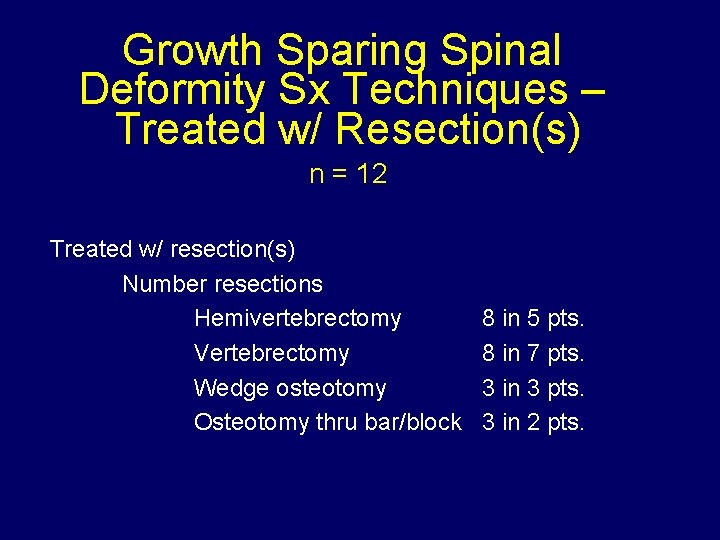
Growth Sparing Spinal Deformity Sx Techniques – Treated w/ Resection(s) n = 12 Treated w/ resection(s) Number resections Hemivertebrectomy Vertebrectomy Wedge osteotomy Osteotomy thru bar/block 8 in 5 pts. 8 in 7 pts. 3 in 3 pts. 3 in 2 pts.
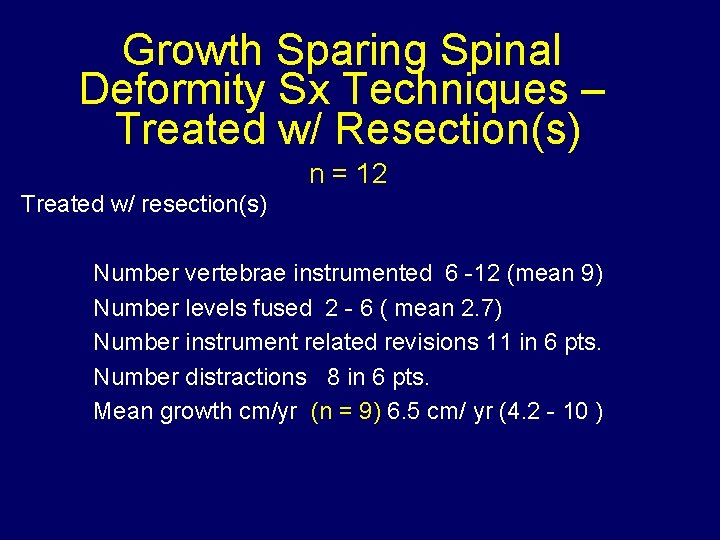
Growth Sparing Spinal Deformity Sx Techniques – Treated w/ Resection(s) n = 12 Treated w/ resection(s) Number vertebrae instrumented 6 -12 (mean 9) Number levels fused 2 - 6 ( mean 2. 7) Number instrument related revisions 11 in 6 pts. Number distractions 8 in 6 pts. Mean growth cm/yr (n = 9) 6. 5 cm/ yr (4. 2 - 10 )
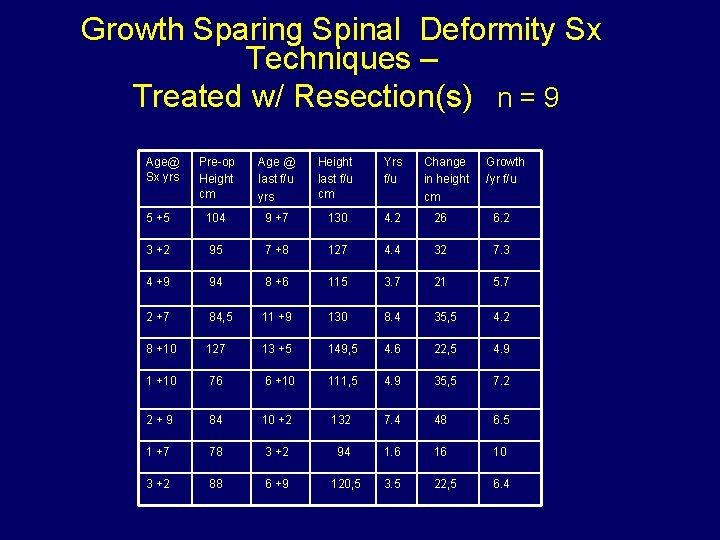
Growth Sparing Spinal Deformity Sx Techniques – Treated w/ Resection(s) n = 9 Age@ Sx yrs Pre-op Height cm Age @ last f/u yrs Height last f/u cm Yrs f/u Change in height cm Growth /yr f/u 5 +5 104 9 +7 130 4. 2 26 6. 2 3 +2 95 7 +8 127 4. 4 32 7. 3 4 +9 94 8 +6 115 3. 7 21 5. 7 2 +7 84, 5 11 +9 130 8. 4 35, 5 4. 2 8 +10 127 13 +5 149, 5 4. 6 22, 5 4. 9 1 +10 76 6 +10 111, 5 4. 9 35, 5 7. 2 2 + 9 84 10 +2 132 7. 4 48 6. 5 1 +7 78 3 +2 94 1. 6 16 10 3 +2 88 6 +9 120, 5 3. 5 22, 5 6. 4
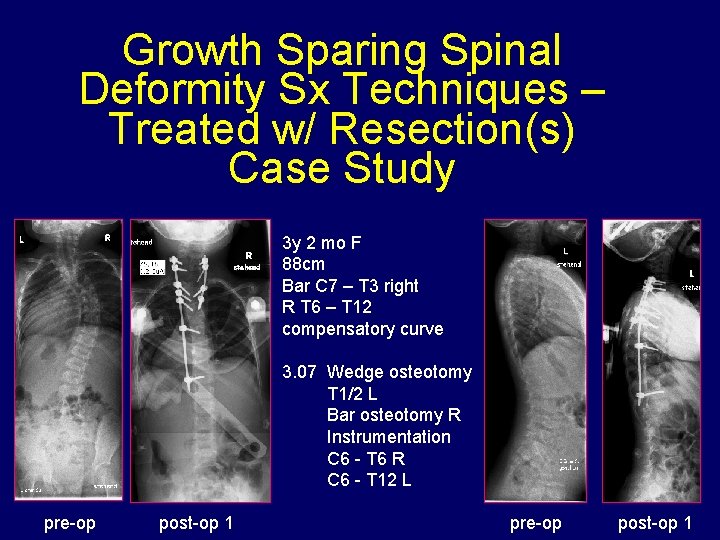
Growth Sparing Spinal Deformity Sx Techniques – Treated w/ Resection(s) Case Study 3 y 2 mo F 88 cm Bar C 7 – T 3 right R T 6 – T 12 compensatory curve 3. 07 Wedge osteotomy T 1/2 L Bar osteotomy R Instrumentation C 6 - T 6 R C 6 - T 12 L pre-op post-op 1
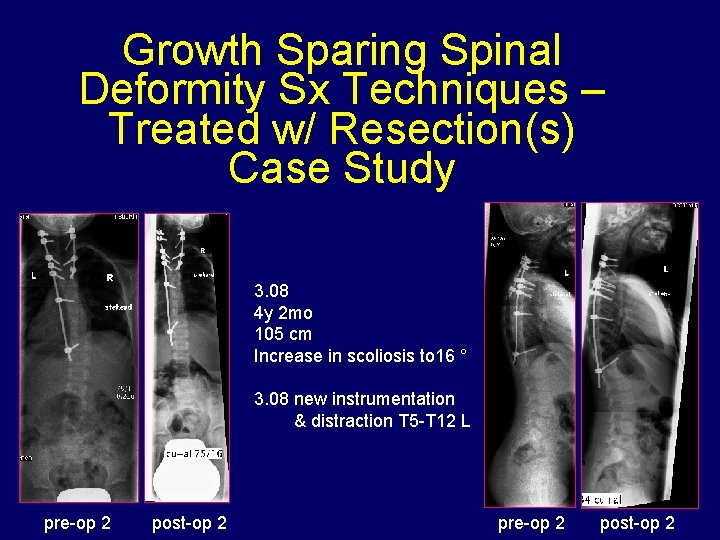
Growth Sparing Spinal Deformity Sx Techniques – Treated w/ Resection(s) Case Study 3. 08 4 y 2 mo 105 cm Increase in scoliosis to 16 ° 3. 08 new instrumentation & distraction T 5 -T 12 L pre-op 2 post-op 2
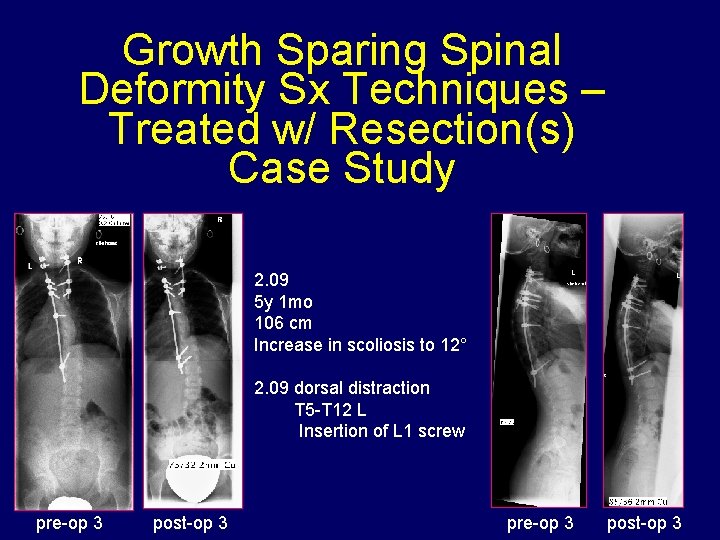
Growth Sparing Spinal Deformity Sx Techniques – Treated w/ Resection(s) Case Study 2. 09 5 y 1 mo 106 cm Increase in scoliosis to 12° 2. 09 dorsal distraction T 5 -T 12 L Insertion of L 1 screw pre-op 3 post-op 3
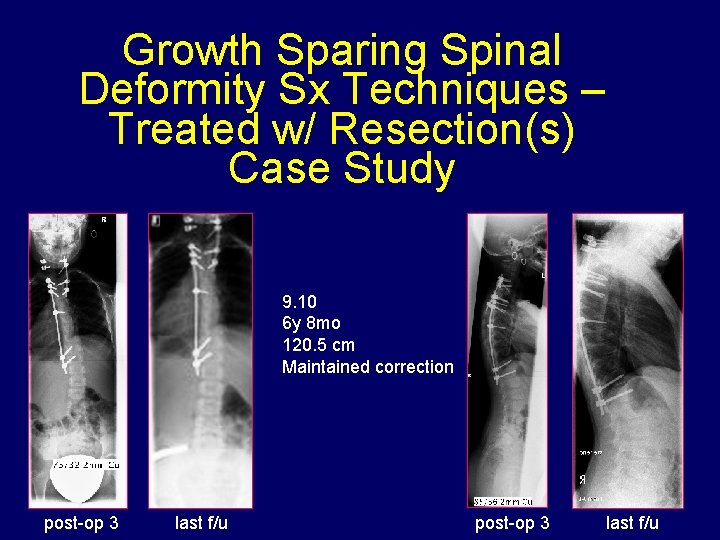
Growth Sparing Spinal Deformity Sx Techniques – Treated w/ Resection(s) Case Study 9. 10 6 y 8 mo 120. 5 cm Maintained correction post-op 3 last f/u
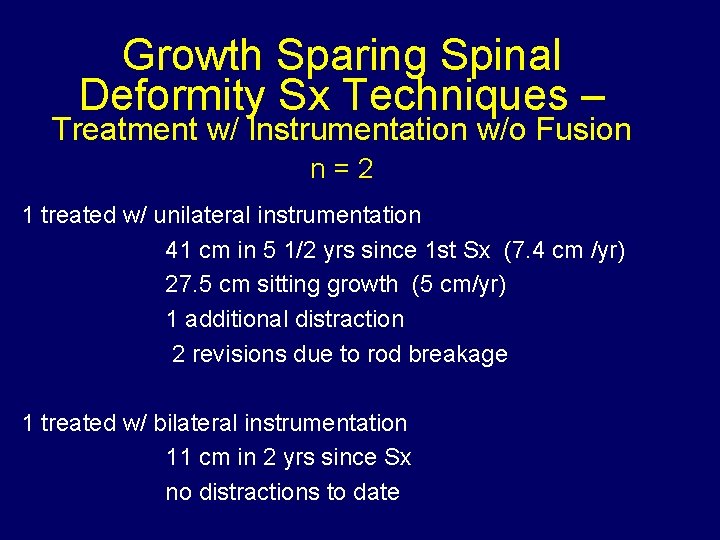
Growth Sparing Spinal Deformity Sx Techniques – Treatment w/ Instrumentation w/o Fusion n = 2 1 treated w/ unilateral instrumentation 41 cm in 5 1/2 yrs since 1 st Sx (7. 4 cm /yr) 27. 5 cm sitting growth (5 cm/yr) 1 additional distraction 2 revisions due to rod breakage 1 treated w/ bilateral instrumentation 11 cm in 2 yrs since Sx no distractions to date
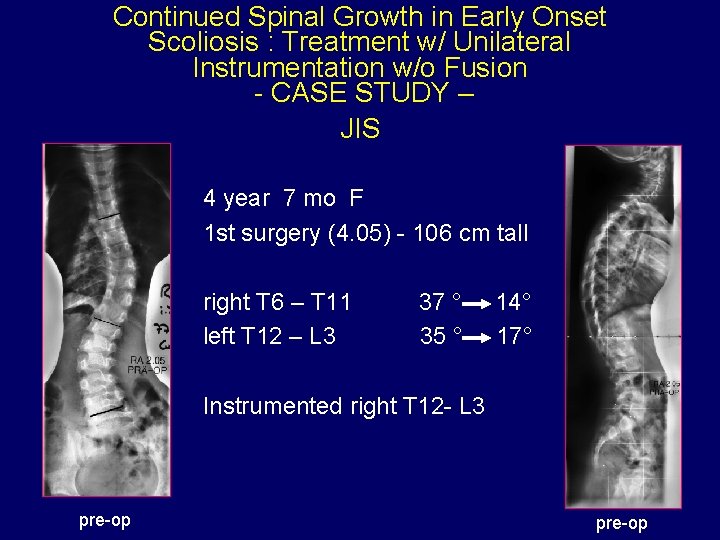
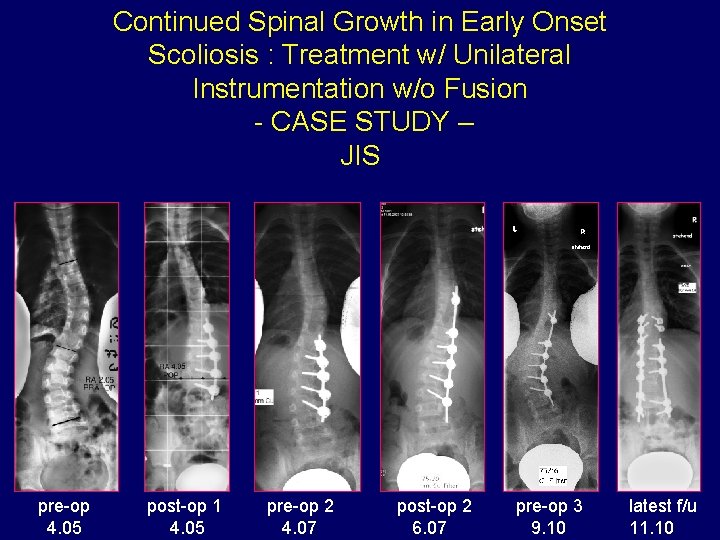
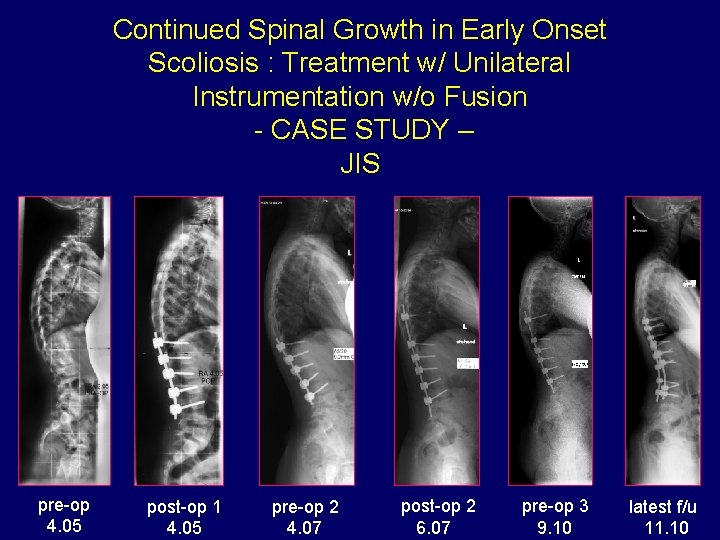
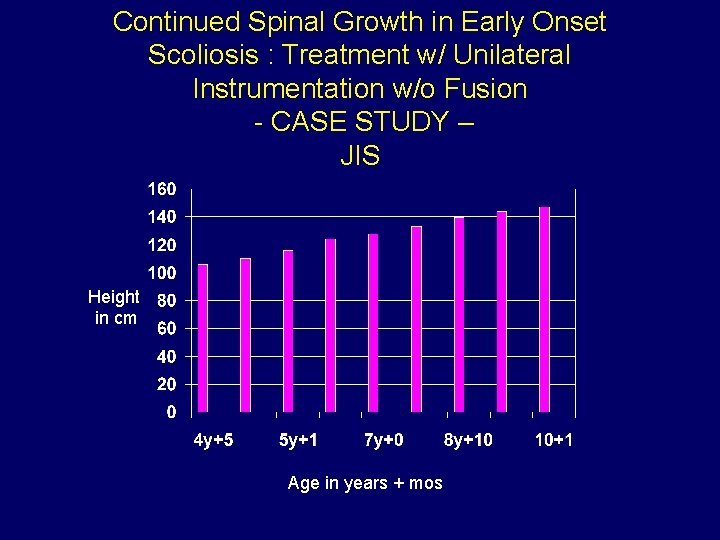
Continued Spinal Growth in Early Onset Scoliosis : Treatment w/ Unilateral Instrumentation w/o Fusion - CASE STUDY – JIS 4 year 7 mo F 1 st surgery (4. 05) - 106 cm tall right T 6 – T 11 37 ° 14° left T 12 – L 3 35 ° 17° Instrumented right T 12 - L 3 pre-op
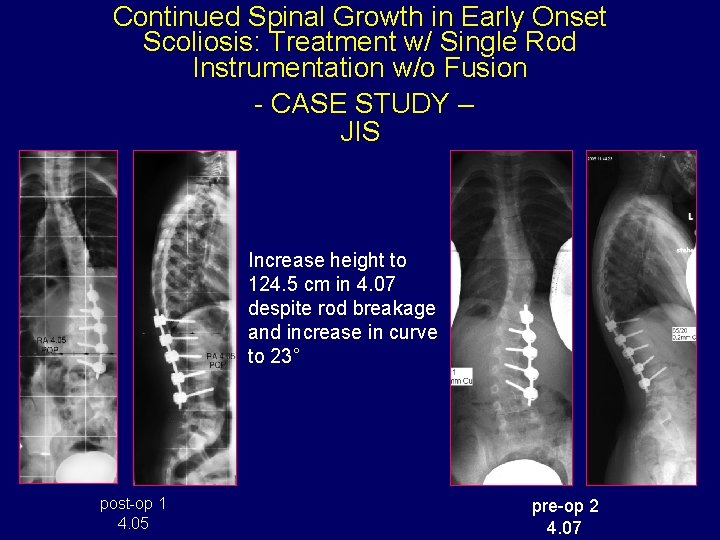
Continued Spinal Growth in Early Onset Scoliosis: Treatment w/ Single Rod Instrumentation w/o Fusion - CASE STUDY – JIS Increase height to 124. 5 cm in 4. 07 despite rod breakage and increase in curve to 23° post-op 1 4. 05 pre-op 2 4. 07
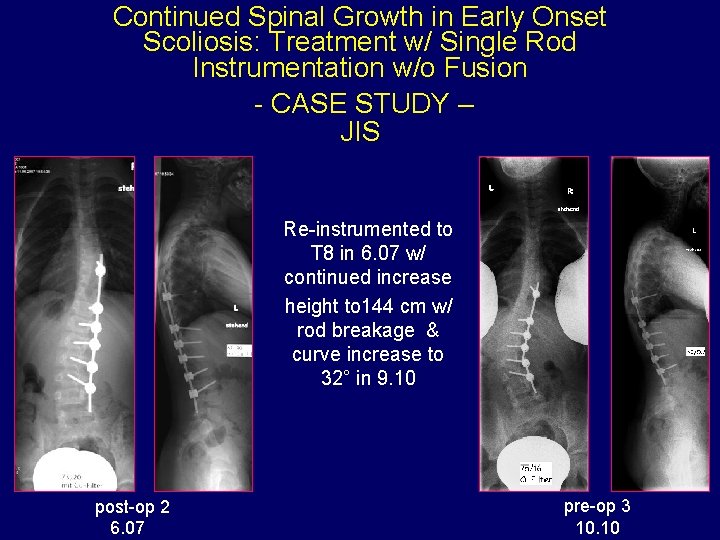
Continued Spinal Growth in Early Onset Scoliosis: Treatment w/ Single Rod Instrumentation w/o Fusion - CASE STUDY – JIS Re-instrumented to T 8 in 6. 07 w/ continued increase height to 144 cm w/ rod breakage & curve increase to 32° in 9. 10 post-op 2 6. 07 pre-op 3 10. 10
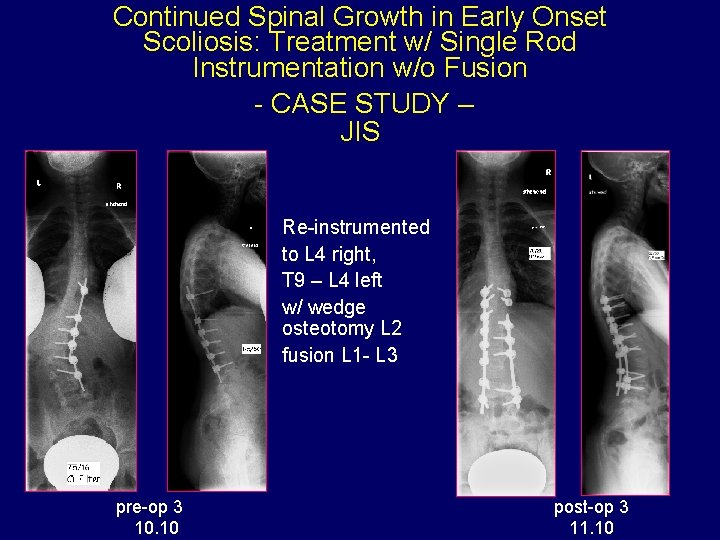
Continued Spinal Growth in Early Onset Scoliosis: Treatment w/ Single Rod Instrumentation w/o Fusion - CASE STUDY – JIS Re-instrumented to L 4 right, T 9 – L 4 left w/ wedge osteotomy L 2 fusion L 1 - L 3 pre-op 3 10. 10 post-op 3 11. 10
Continued Spinal Growth in Early Onset Scoliosis : Treatment w/ Unilateral Instrumentation w/o Fusion - CASE STUDY – JIS pre-op 4. 05 post-op 1 4. 05 pre-op 2 4. 07 post-op 2 6. 07 pre-op 3 9. 10 latest f/u 11. 10
Continued Spinal Growth in Early Onset Scoliosis : Treatment w/ Unilateral Instrumentation w/o Fusion - CASE STUDY – JIS pre-op 4. 05 post-op 1 4. 05 pre-op 2 4. 07 post-op 2 6. 07 pre-op 3 9. 10 latest f/u 11. 10
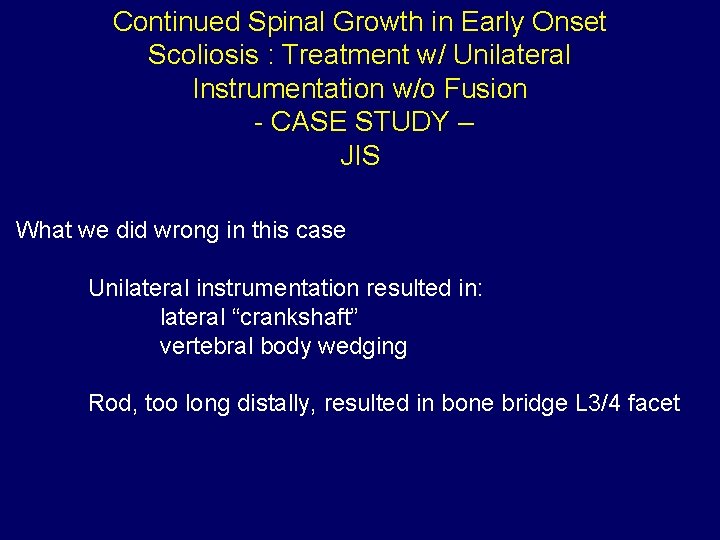
Continued Spinal Growth in Early Onset Scoliosis : Treatment w/ Unilateral Instrumentation w/o Fusion - CASE STUDY – JIS What we did wrong in this case Unilateral instrumentation resulted in: lateral “crankshaft” vertebral body wedging Rod, too long distally, resulted in bone bridge L 3/4 facet
Continued Spinal Growth in Early Onset Scoliosis : Treatment w/ Unilateral Instrumentation w/o Fusion - CASE STUDY – JIS Increase in Height in cm Age in years + mos
Growth Sparing Spinal Deformity Sx Techniques – Complications & Instrumention Related Events n = 14 Complications Dural leak by ROH Transient post-op brachial plexus palsy Post-op wound infection Adding on 1 2 1 3 7 Instrumented related events Development of thoracic lordosis/ hypokyphosis 4 Scoliosis development after rod removal to Tx thoracic lordosis 3 Rod breakage in non-fused region 4 in 3 patients Proximal screw prominence requiring removal 2 13 20 in 10 patients No proximal junctional kyphosis No spinal cord neurological deficits No crankschaft in fused region
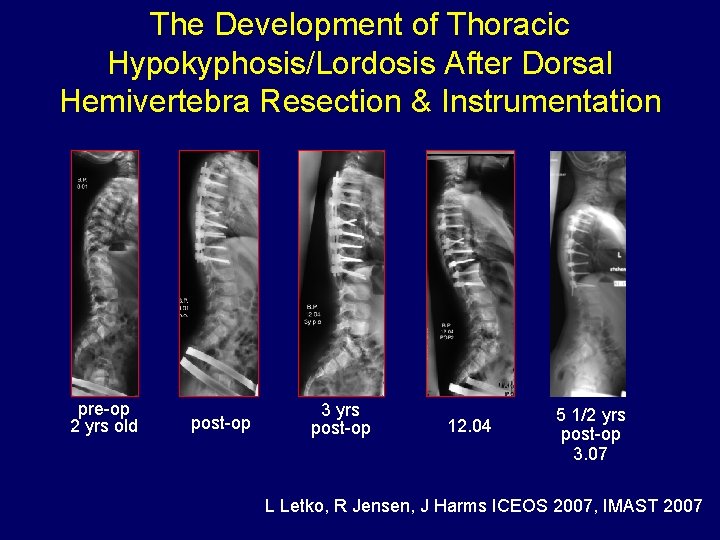
The Development of Thoracic Hypokyphosis/Lordosis After Dorsal Hemivertebra Resection & Instrumentation pre-op 2 yrs old post-op 3 yrs post-op 12. 04 5 1/2 yrs post-op 3. 07 L Letko, R Jensen, J Harms ICEOS 2007, IMAST 2007
Growth Sparing Spinal Deformity Sx Techniques – Issues Do these patients need to be definitively fused ? If so, when? Crankshaft? Not in fused region rather an adding on with rotation below the instrumented levels Development of 2° “ idiopathic like curve”
Growth Sparing Spinal Deformity Sx Techniques – - Conclusions Apical resection(s) w/ longer instrumentation w/o fusion except at resected level(s) and uni or bilateral instrumentation w/o fusion allow for excellent spinal deformity correction & continued spinal growth Extraperiosteal dissection is essential in areas where fusion is not desired An increase in scoliosis &/or rod breakage is expected with growth Posterior segmental pedicle screw instrumentation may result in posterior tethering w/ continued anterior growth & the development of hypokyphosis /lordosis in the growing thoracic spine This may be reversed by rod removal indicating continued growth
Growth Sparing Spinal Deformity Sx Techniques – - Conclusions Adding on may develop & need to be treated in the growing spine No cases of proximal junctional kyphosis have occurred to date in our patients With bilateral segmental pedicle screw instrumentation, no patient has been revised due to crankshaft in the fused region