Grid Activities in CMS Asad Samar Caltech PPDG
- Slides: 15
Grid Activities in CMS Asad Samar (Caltech) PPDG meeting, Argonne July 13 -14, 2000
Introduction • Need for CMS Grid activities • Requirement Specification • Distributed Data Management – Functionality required – Architecture • Distributed Computation – Functionality required – Architecture • • Common Components Deliverables, mile stones and status Meat for other projects Conclusions
Need for CMS Grid Activities • Other related Grid projects – EU-Grid (Data. Grid) – PPDG – Gri. Phy. N • Time scale for CMS Grid services – Fall 2000 (usable prototype with a minimum replication functionality)
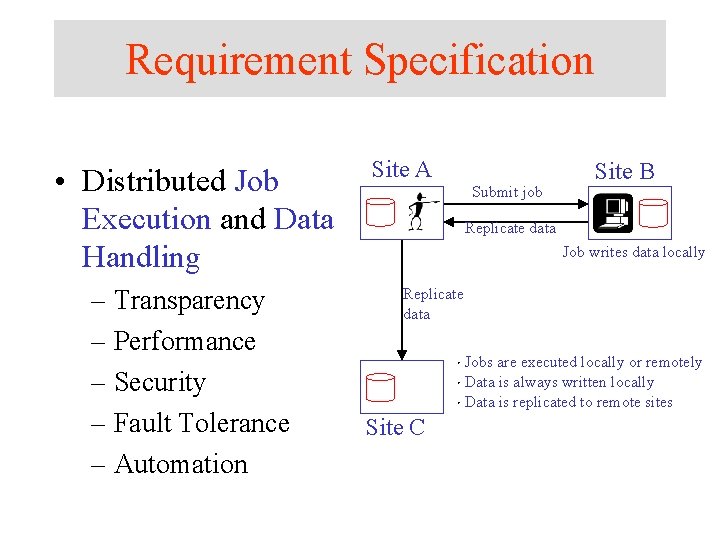
Requirement Specification • Distributed Job Execution and Data Handling – Transparency – Performance – Security – Fault Tolerance – Automation Site A Submit job Site B Replicate data Job writes data locally Replicate data Jobs are executed locally or remotely " Data is always written locally " Data is replicated to remote sites " Site C
Distributed Data Management • Functionality required – Store and manage the data produced locally. – Replication • Replicate both the data and meta-data produced to sites on an on-demand basis or streaming for special scenarios. • Handle the replica catalogues. • Perform replica selection and synchronization tasks. – Provide secure access to remote users.
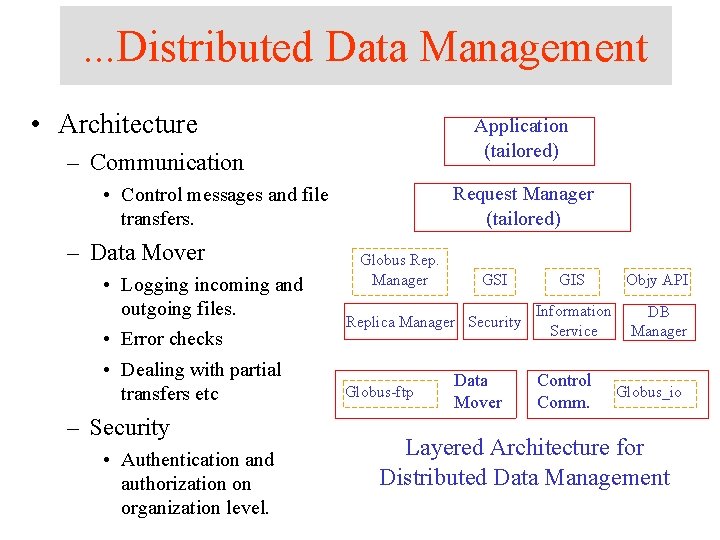
. . . Distributed Data Management • Architecture Application (tailored) – Communication Request Manager (tailored) • Control messages and file transfers. – Data Mover • Logging incoming and outgoing files. • Error checks • Dealing with partial transfers etc – Security • Authentication and authorization on organization level. Globus Rep. Manager GSI Replica Manager Security Globus-ftp Data Mover GIS Objy API Information Service DB Manager Control Comm. Globus_io Layered Architecture for Distributed Data Management
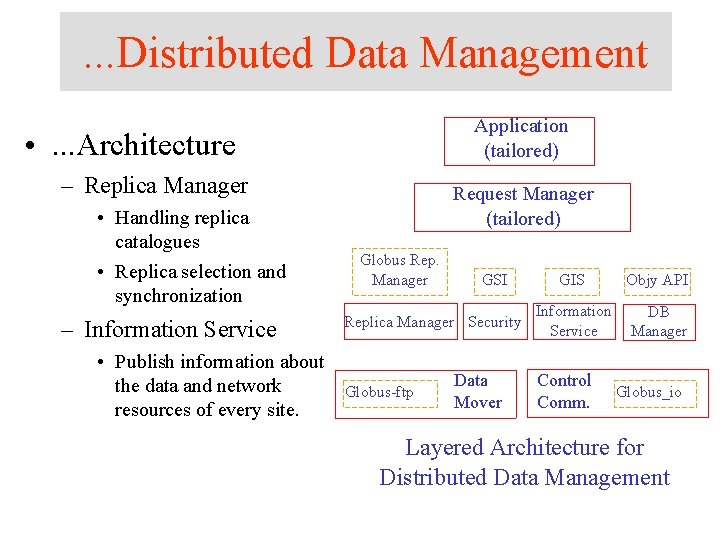
. . . Distributed Data Management Application (tailored) • . . . Architecture – Replica Manager • Handling replica catalogues • Replica selection and synchronization – Information Service • Publish information about the data and network resources of every site. Request Manager (tailored) Globus Rep. Manager GSI Replica Manager Security Globus-ftp Data Mover GIS Objy API Information Service DB Manager Control Comm. Globus_io Layered Architecture for Distributed Data Management
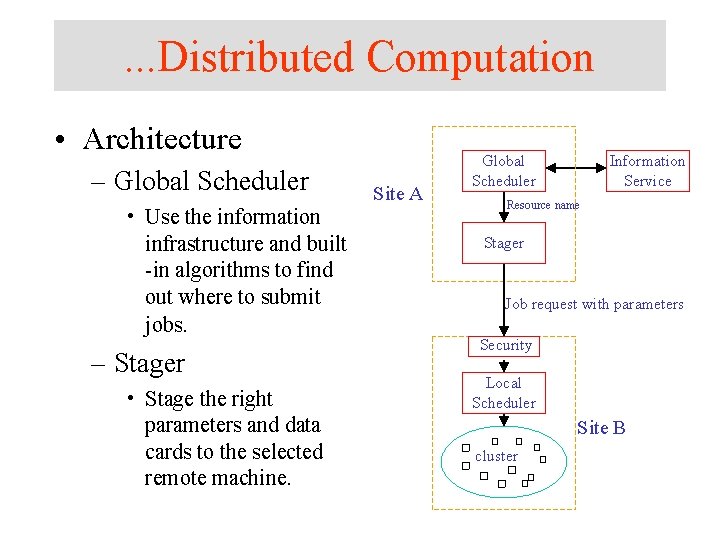
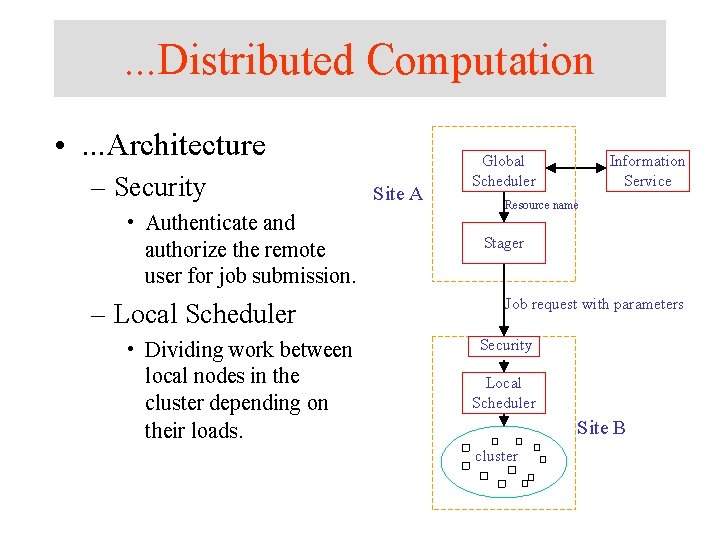
Distributed Computation • Functionality required – Select a remote machine/cluster to run the job, depending on • • Hardware and software specs. CPU Load and jobs already in queue. Available disk space. Network status – Stage the right parameters and data cards for the executable on the remote machine/cluster. – Schedule the job locally based on the loads on different nodes in the cluster.
. . . Distributed Computation • Architecture – Global Scheduler • Use the information infrastructure and built -in algorithms to find out where to submit jobs. – Stager • Stage the right parameters and data cards to the selected remote machine. Site A Global Scheduler Information Service Resource name Stager Job request with parameters Security Local Scheduler Site B cluster
. . . Distributed Computation • . . . Architecture – Security • Authenticate and authorize the remote user for job submission. – Local Scheduler • Dividing work between local nodes in the cluster depending on their loads. Site A Global Scheduler Information Service Resource name Stager Job request with parameters Security Local Scheduler Site B cluster
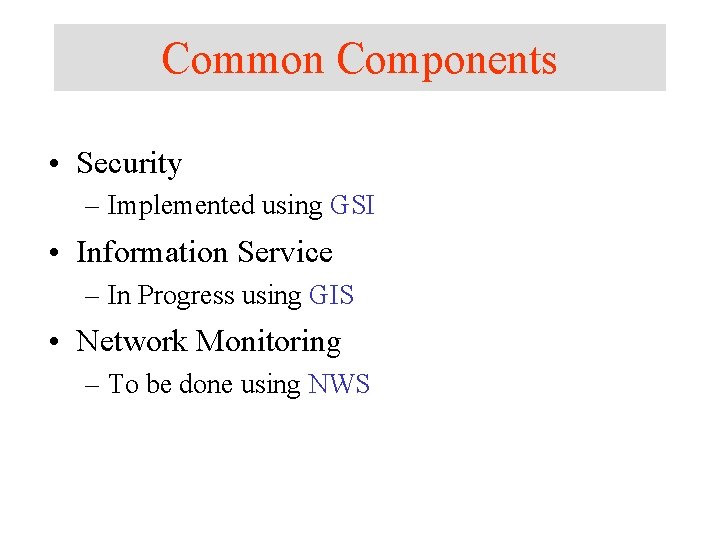
Common Components • Security – Implemented using GSI • Information Service – In Progress using GIS • Network Monitoring – To be done using NWS
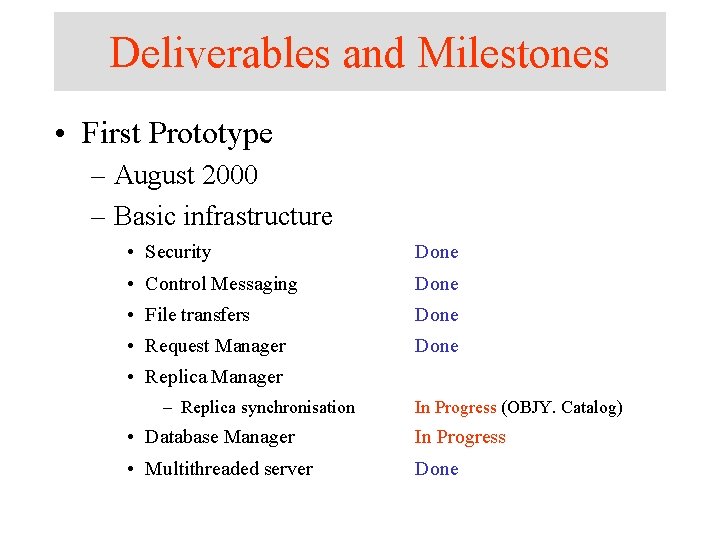
Deliverables and Milestones • First Prototype – August 2000 – Basic infrastructure • Security Done • Control Messaging Done • File transfers Done • Request Manager Done • Replica Manager – Replica synchronisation In Progress (OBJY. Catalog) • Database Manager In Progress • Multithreaded server Done
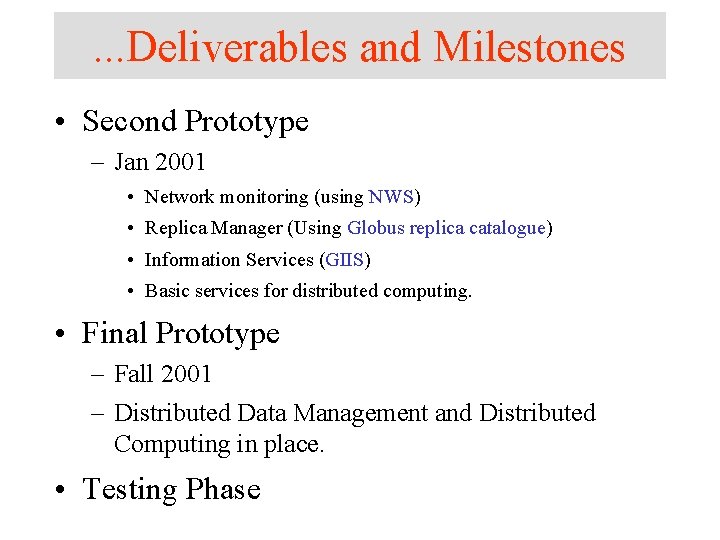
. . . Deliverables and Milestones • Second Prototype – Jan 2001 • Network monitoring (using NWS) • Replica Manager (Using Globus replica catalogue) • Information Services (GIIS) • Basic services for distributed computing. • Final Prototype – Fall 2001 – Distributed Data Management and Distributed Computing in place. • Testing Phase
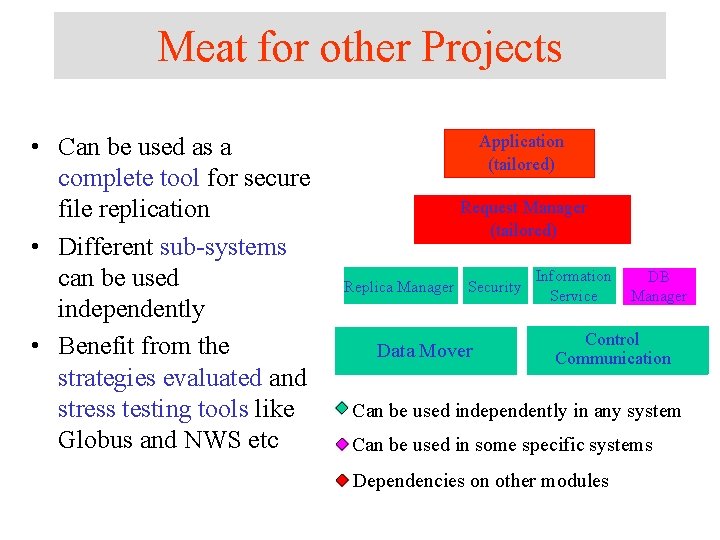
Meat for other Projects • Can be used as a complete tool for secure file replication • Different sub-systems can be used independently • Benefit from the strategies evaluated and stress testing tools like Globus and NWS etc Application (tailored) Request Manager (tailored) Replica Manager Security Data Mover Information Service DB Manager Control Communication Can be used independently in any system Can be used in some specific systems Dependencies on other modules
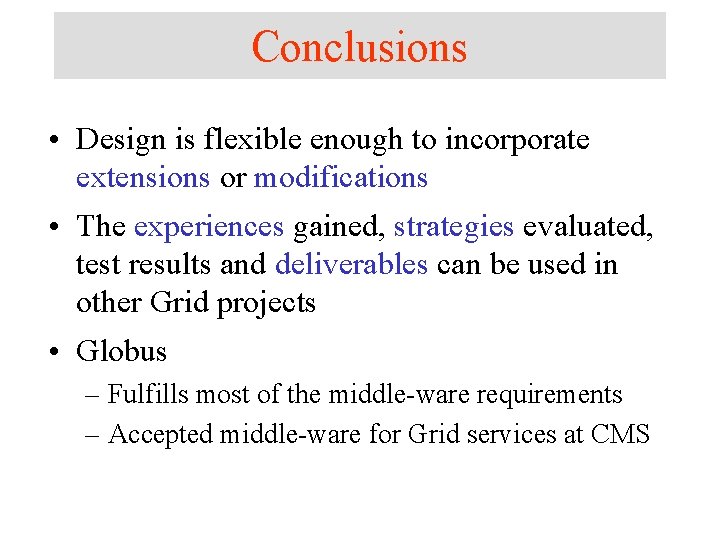
Conclusions • Design is flexible enough to incorporate extensions or modifications • The experiences gained, strategies evaluated, test results and deliverables can be used in other Grid projects • Globus – Fulfills most of the middle-ware requirements – Accepted middle-ware for Grid services at CMS