Governing At the Edge of Chaos George Washington




- Slides: 42
Governing "At the Edge of Chaos" George Washington University Reflexivity Series September 17, 2018 Morris Bosin - Presenter © 2016 Grant Thornton LLP | All rights reserved
My Background • Doctorate in Public Administration and General Systems Theory – George Washington University – 1983 • 40+ year Federal government career FDA, NOAA, State, DOD • • Consultant - Interior, FAA, Homeland Security – 14 years Adjunct Professor – UMUC Tee ball, lacrosse, soccer, dance, swimming devotee (8 grandkids) Dedicated Nats fan (since 1949 when they were the Washington Senators) © 2016 Grant Thornton LLP | All rights reserved
Overview – Questions to be Addressed • What is the epistemological basis for public sector governance roles? • How do these roles change under boundary conditions? • What kinds of boundary conditions are being addressed? © 2016 Grant Thornton LLP | All rights reserved
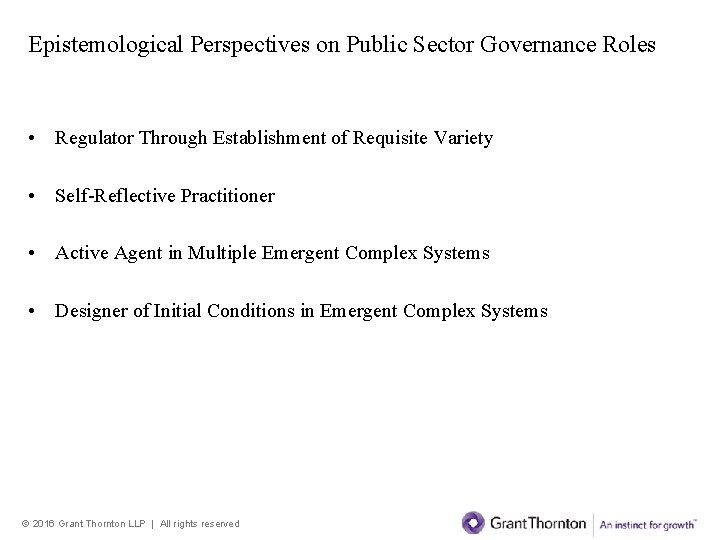
Epistemological Perspectives on Public Sector Governance Roles • Regulator Through Establishment of Requisite Variety • Self-Reflective Practitioner • Active Agent in Multiple Emergent Complex Systems • Designer of Initial Conditions in Emergent Complex Systems © 2016 Grant Thornton LLP | All rights reserved
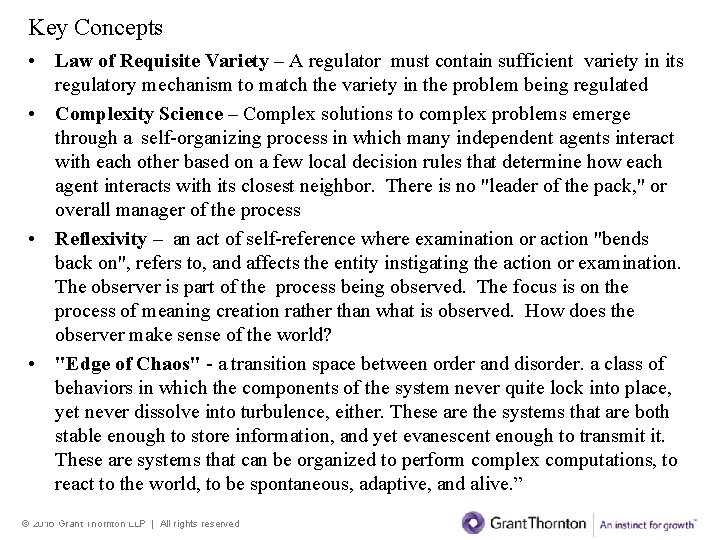
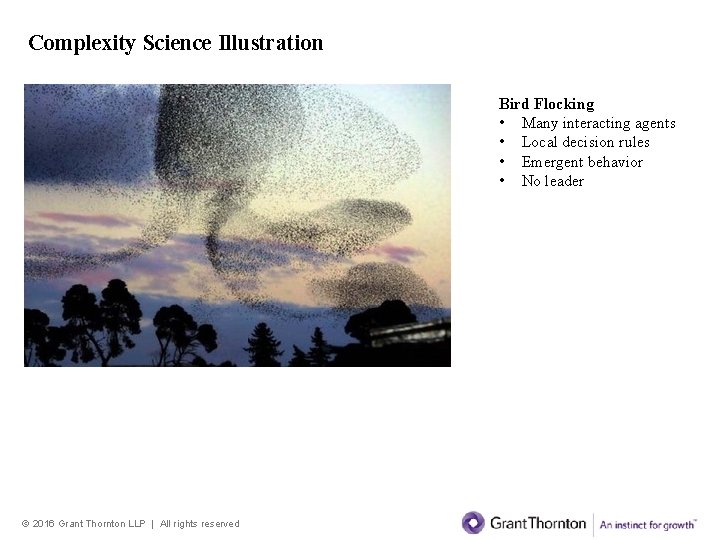
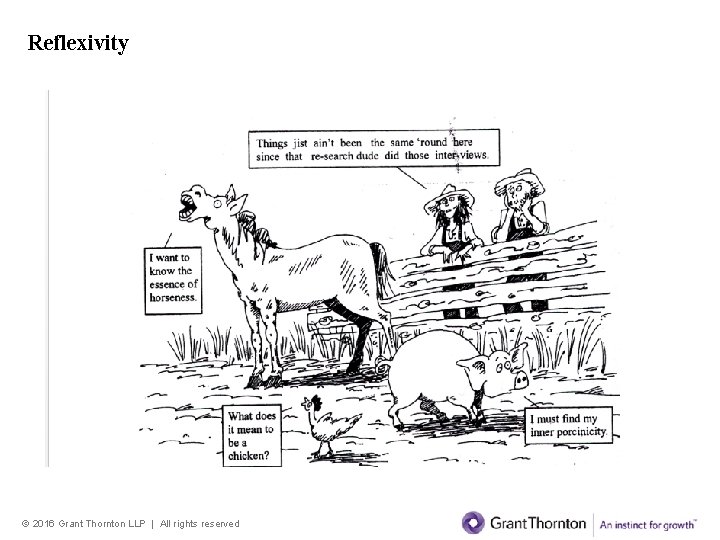
Key Concepts • Law of Requisite Variety – A regulator must contain sufficient variety in its regulatory mechanism to match the variety in the problem being regulated • Complexity Science – Complex solutions to complex problems emerge through a self-organizing process in which many independent agents interact with each other based on a few local decision rules that determine how each agent interacts with its closest neighbor. There is no "leader of the pack, " or overall manager of the process • Reflexivity – an act of self-reference where examination or action "bends back on", refers to, and affects the entity instigating the action or examination. The observer is part of the process being observed. The focus is on the process of meaning creation rather than what is observed. How does the observer make sense of the world? • "Edge of Chaos" - a transition space between order and disorder. a class of behaviors in which the components of the system never quite lock into place, yet never dissolve into turbulence, either. These are the systems that are both stable enough to store information, and yet evanescent enough to transmit it. These are systems that can be organized to perform complex computations, to react to the world, to be spontaneous, adaptive, and alive. ” rder disorder © 2016 Grant Thornton LLP | All rights reserved
Relation Between Complexity Science and "Edge of Chaos" “Evolution tends to push systems towards the edge of chaos, where complex, interesting behaviors such as life can occur" * * J. T. Bonner, Evolution of complexity © 2016 Grant Thornton LLP | All rights reserved
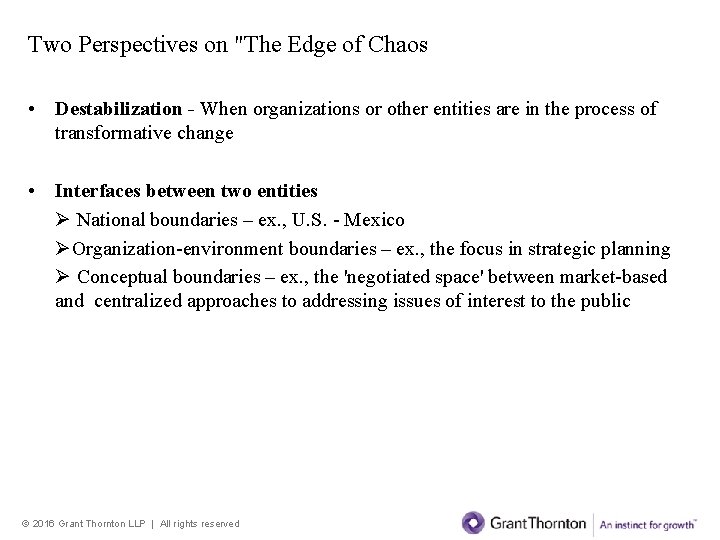
Two Perspectives on "The Edge of Chaos • Destabilization - When organizations or other entities are in the process of transformative change • Interfaces between two entities Ø National boundaries – ex. , U. S. - Mexico ØOrganization-environment boundaries – ex. , the focus in strategic planning Ø Conceptual boundaries – ex. , the 'negotiated space' between market-based and centralized approaches to addressing issues of interest to the public © 2016 Grant Thornton LLP | All rights reserved
Law of Requisite Variety Illustration - Conversation with My Son – An Ardent Backpacker and Hiker • Me: Would you like to hear about a topic I'm discussing at an upcoming forum? • Son: If you must. • Me: It's called the Law of Requisite Variety • Son: Explain • Me: Blah blah • Son: Let me see if I can explain it in my own terms I'm packing for a one week trip this January on the Appalachian Trail. If I don't pack the right stuff I may get hungry, frozen, lost or attacked by a bear. If I pack for every single possible eventuality the backpack will weigh 90 pounds and I won't be able to stand up. So I have to pack for the important stuff. • Son: Did I get it? • Me: You got it! © 2016 Grant Thornton LLP | All rights reserved
Complexity Science Illustration Bird Flocking • Many interacting agents • Local decision rules • Emergent behavior • No leader © 2016 Grant Thornton LLP | All rights reserved
Reflexivity © 2016 Grant Thornton LLP | All rights reserved
Reflexivity © 2016 Grant Thornton LLP | All rights reserved
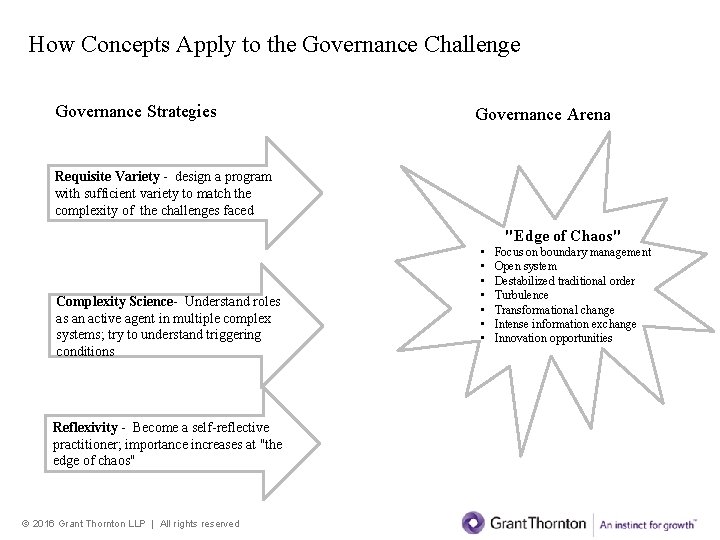
How Concepts Apply to the Governance Challenge Governance Strategies Governance Arena Requisite Variety - design a program with sufficient variety to match the complexity of the challenges faced "Edge of Chaos" Complexity Science- Understand roles as an active agent in multiple complex systems; try to understand triggering conditions Reflexivity - Become a self-reflective practitioner; importance increases at "the edge of chaos" © 2016 Grant Thornton LLP | All rights reserved • • Focus on boundary management Open system Destabilized traditional order Turbulence Transformational change Intense information exchange Innovation opportunities
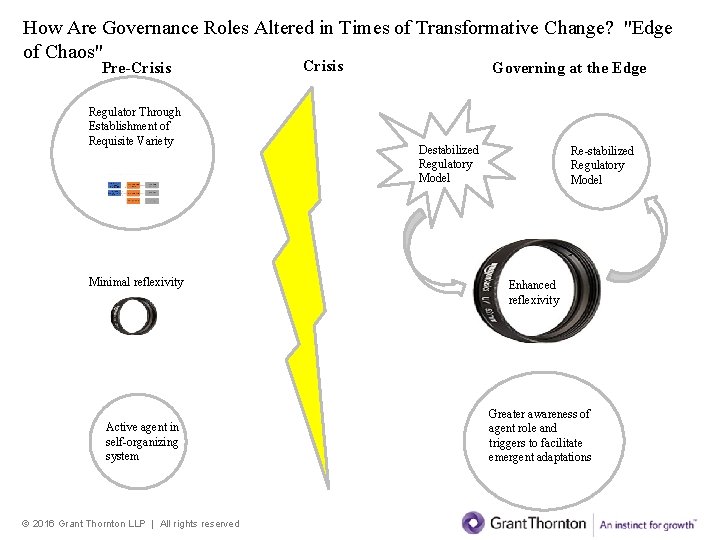
How Are Governance Roles Altered in Times of Transformative Change? "Edge of Chaos" Pre-Crisis Regulator Through Establishment of Requisite Variety Minimal reflexivity Active agent in self-organizing system © 2016 Grant Thornton LLP | All rights reserved Crisis Governing at the Edge Destabilized Regulatory Model Re-stabilized Regulatory Model Enhanced reflexivity Greater awareness of agent role and triggers to facilitate emergent adaptations
U. S. Food and Drug Administration FDA Mission: The Food and Drug Administration is responsible for protecting the public health by ensuring the safety, efficacy, and security of human and veterinary drugs, biological products, and medical devices; and by ensuring the safety of our nation's food supply, cosmetics, and products that emit radiation. © 2016 Grant Thornton LLP | All rights reserved
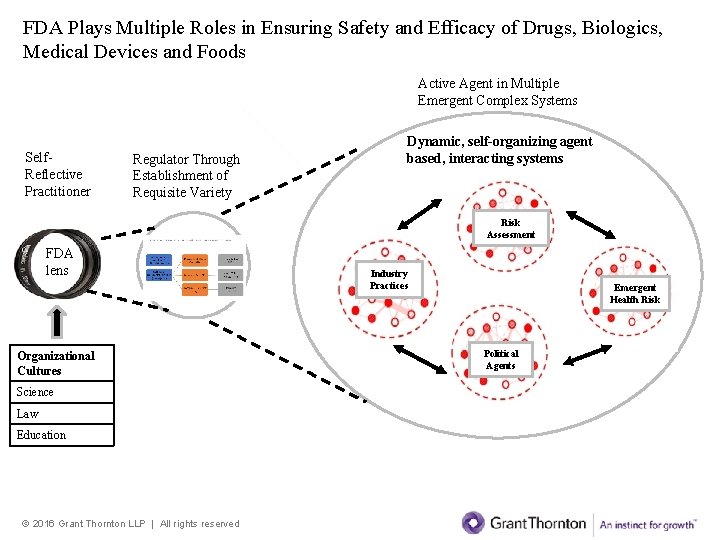
FDA Plays Multiple Roles in Ensuring Safety and Efficacy of Drugs, Biologics, Medical Devices and Foods Active Agent in Multiple Emergent Complex Systems Self. Reflective Practitioner Regulator Through Establishment of Requisite Variety Dynamic, self-organizing agent based, interacting systems Risk Assessment FDA lens Organizational Cultures Science Law Education © 2016 Grant Thornton LLP | All rights reserved Industry Practices Emergent Health Risk Political Agents
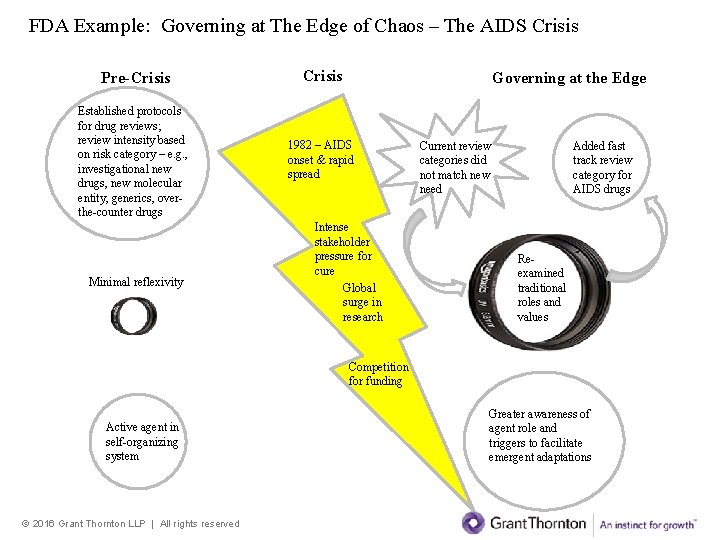
FDA Example: Governing at The Edge of Chaos – The AIDS Crisis Pre-Crisis Established protocols for drug reviews; review intensity based on risk category – e. g. , investigational new drugs, new molecular entity, generics, overthe-counter drugs 1982 – AIDS onset & rapid spread Minimal reflexivity Governing at the Edge Intense stakeholder pressure for cure Global surge in research Current review categories did not match new need Added fast track review category for AIDS drugs Reexamined traditional roles and values Competition for funding Active agent in self-organizing system © 2016 Grant Thornton LLP | All rights reserved Greater awareness of agent role and triggers to facilitate emergent adaptations
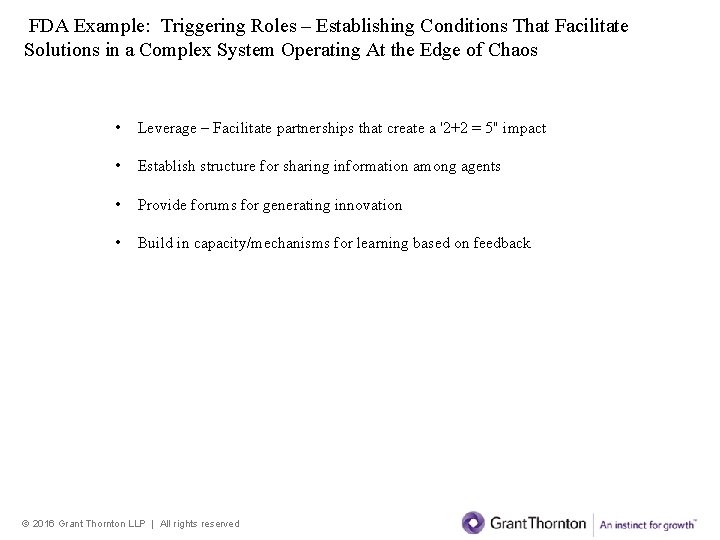
FDA Example: Triggering Roles – Establishing Conditions That Facilitate Solutions in a Complex System Operating At the Edge of Chaos • Leverage – Facilitate partnerships that create a '2+2 = 5" impact • Establish structure for sharing information among agents • Provide forums for generating innovation • Build in capacity/mechanisms for learning based on feedback © 2016 Grant Thornton LLP | All rights reserved
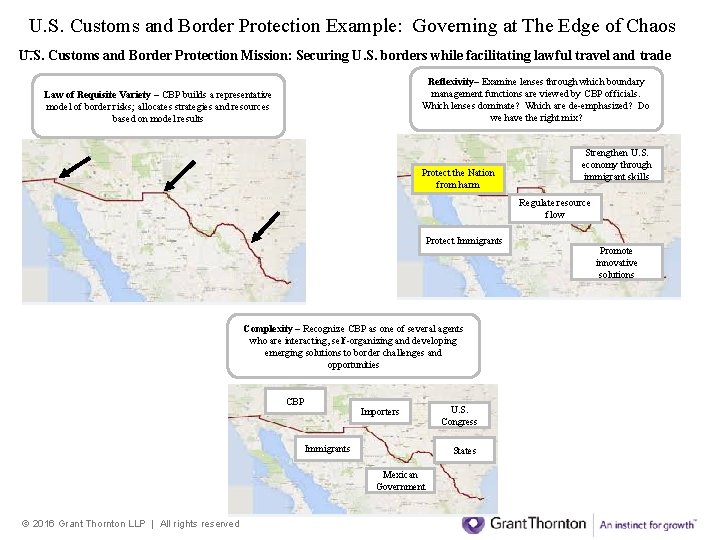
U. S. Customs and Border Protection Example: Governing at The Edge of Chaos – Customs and Border Protection Mission: Securing U. S. borders while facilitating lawful travel and trade U. S. Reflexivity– Examine lenses through which boundary management functions are viewed by CBP officials. Which lenses dominate? Which are de-emphasized? Do we have the right mix? Law of Requisite Variety – CBP builds a representative model of border risks; allocates strategies and resources based on model results Protect the Nation from harm Strengthen U. S. economy through immigrant skills Regulate resource flow Protect Immigrants Complexity – Recognize CBP as one of several agents who are interacting, self-organizing and developing emerging solutions to border challenges and opportunities CBP Importers Immigrants States Mexican Government © 2016 Grant Thornton LLP | All rights reserved U. S. Congress Promote innovative solutions
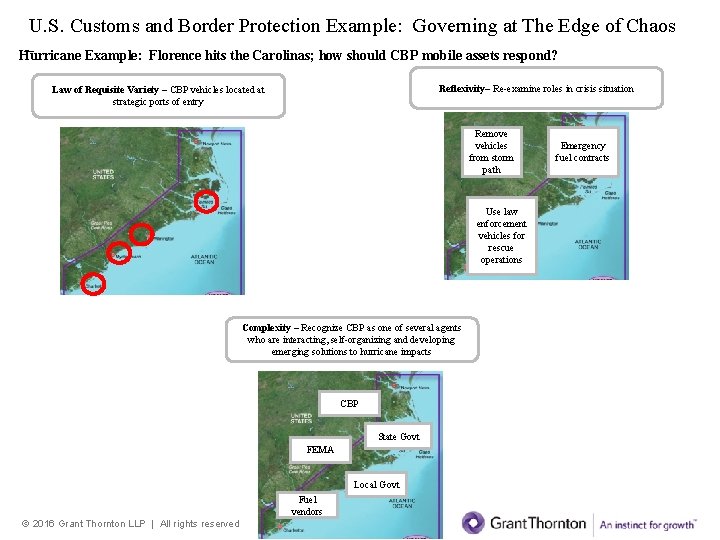
U. S. Customs and Border Protection Example: Governing at The Edge of Chaos – Hurricane Example: Florence hits the Carolinas; how should CBP mobile assets respond? Reflexivity– Re-examine roles in crisis situation Law of Requisite Variety – CBP vehicles located at strategic ports of entry Remove vehicles from storm path Use law enforcement vehicles for rescue operations Complexity – Recognize CBP as one of several agents who are interacting, self-organizing and developing emerging solutions to hurricane impacts Fuel vendors CBP State Govt FEMA Local Govt Fuel vendors Fuel State Govt vendors © 2016 Grant Thornton LLP | All rights reserved Emergency fuel contracts
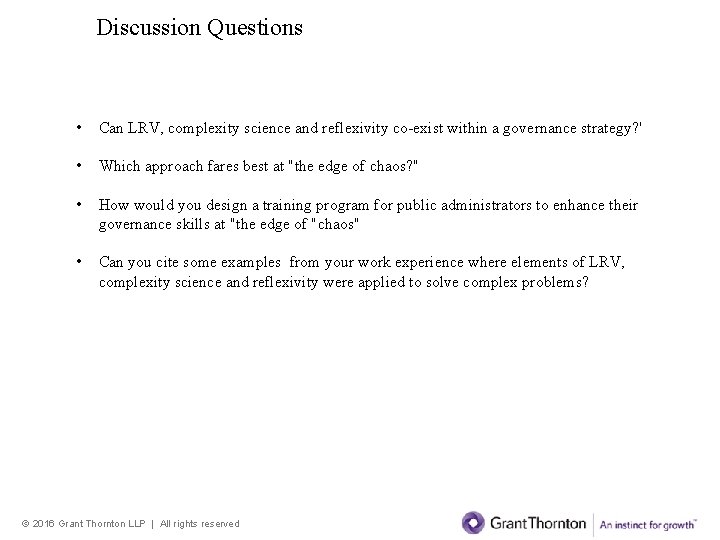
Discussion Questions • Can LRV, complexity science and reflexivity co-exist within a governance strategy? ' • Which approach fares best at "the edge of chaos? " • How would you design a training program for public administrators to enhance their governance skills at "the edge of "chaos" • Can you cite some examples from your work experience where elements of LRV, complexity science and reflexivity were applied to solve complex problems? © 2016 Grant Thornton LLP | All rights reserved
Appendix © 2016 Grant Thornton LLP | All rights reserved
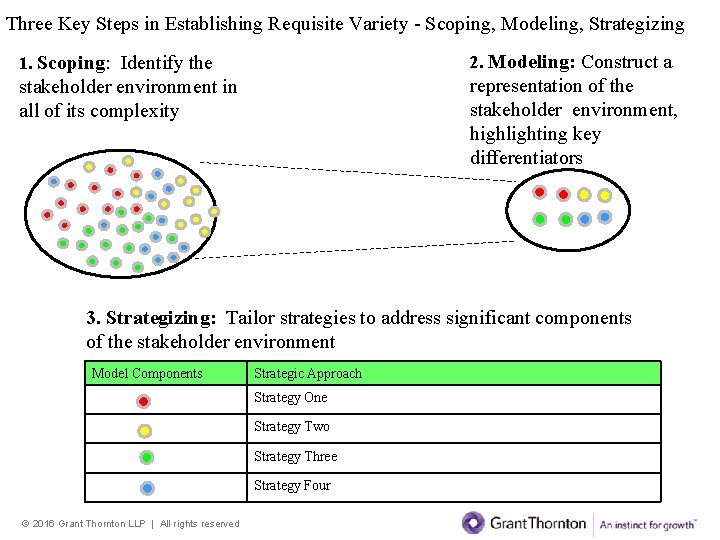
Three Key Steps in Establishing Requisite Variety - Scoping, Modeling, Strategizing 1. Scoping: Identify the 2. Modeling: Construct a stakeholder environment in all of its complexity representation of the stakeholder environment, highlighting key differentiators 3. Strategizing: Tailor strategies to address significant components of the stakeholder environment Model Components Strategic Approach Strategy One Strategy Two Strategy Three Strategy Four © 2016 Grant Thornton LLP | All rights reserved
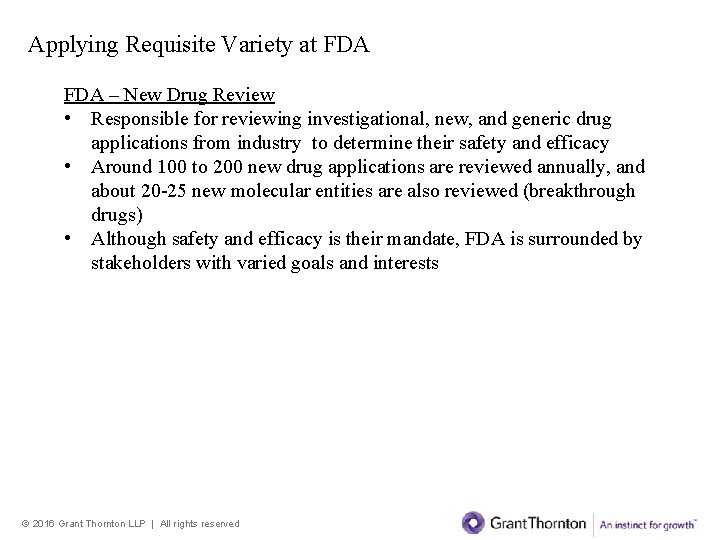
Applying Requisite Variety at FDA – New Drug Review • Responsible for reviewing investigational, new, and generic drug applications from industry to determine their safety and efficacy • Around 100 to 200 new drug applications are reviewed annually, and about 20 -25 new molecular entities are also reviewed (breakthrough drugs) • Although safety and efficacy is their mandate, FDA is surrounded by stakeholders with varied goals and interests © 2016 Grant Thornton LLP | All rights reserved
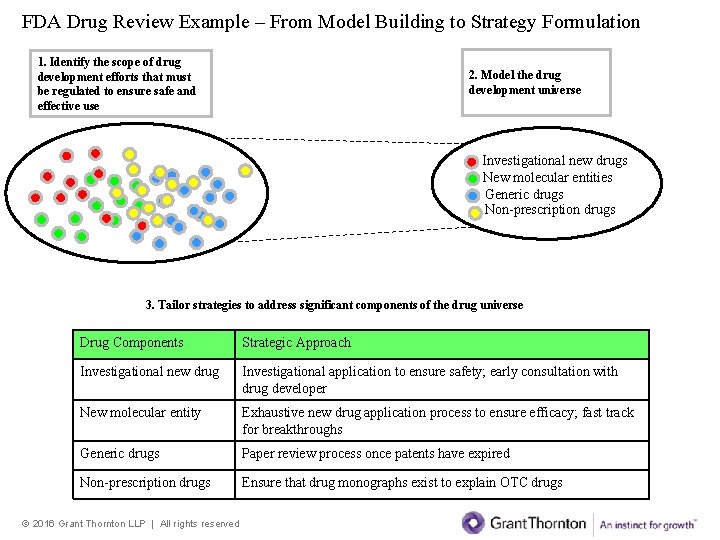
FDA Drug Review Example – From Model Building to Strategy Formulation 1. Identify the scope of drug development efforts that must be regulated to ensure safe and effective use 2. Model the drug development universe Investigational new drugs New molecular entities Generic drugs Non-prescription drugs 3. Tailor strategies to address significant components of the drug universe Drug Components Strategic Approach Investigational new drug Investigational application to ensure safety; early consultation with drug developer New molecular entity Exhaustive new drug application process to ensure efficacy; fast track for breakthroughs Generic drugs Paper review process once patents have expired Non-prescription drugs Ensure that drug monographs exist to explain OTC drugs © 2016 Grant Thornton LLP | All rights reserved
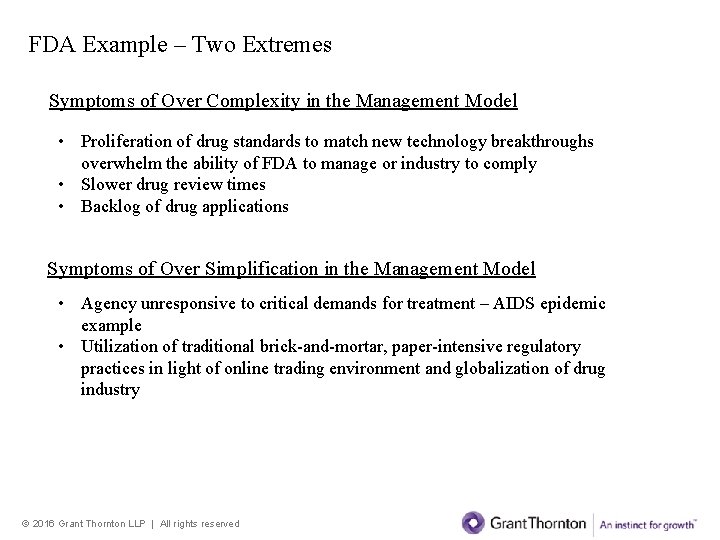
FDA Example – Two Extremes Symptoms of Over Complexity in the Management Model • Proliferation of drug standards to match new technology breakthroughs overwhelm the ability of FDA to manage or industry to comply • Slower drug review times • Backlog of drug applications Symptoms of Over Simplification in the Management Model • Agency unresponsive to critical demands for treatment – AIDS epidemic example • Utilization of traditional brick-and-mortar, paper-intensive regulatory practices in light of online trading environment and globalization of drug industry © 2016 Grant Thornton LLP | All rights reserved
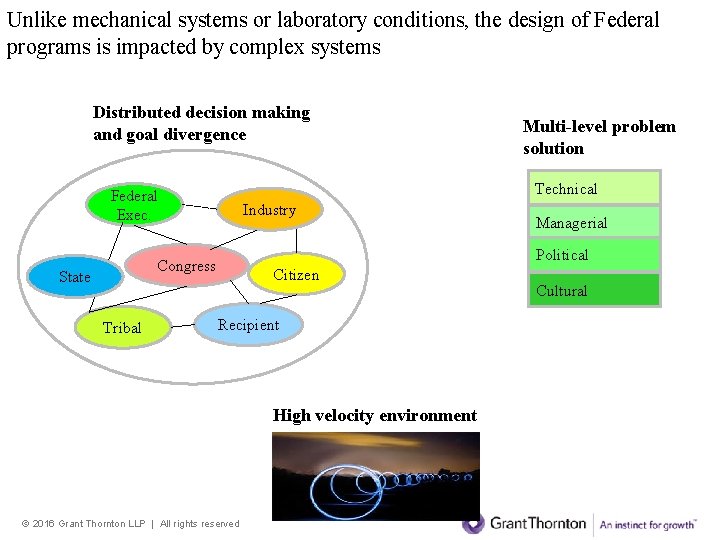
Unlike mechanical systems or laboratory conditions, the design of Federal programs is impacted by complex systems Distributed decision making and goal divergence Technical Federal Exec. Industry Tribal Managerial Political Congress State Multi-level problem solution Citizen Recipient High velocity environment © 2016 Grant Thornton LLP | All rights reserved Cultural
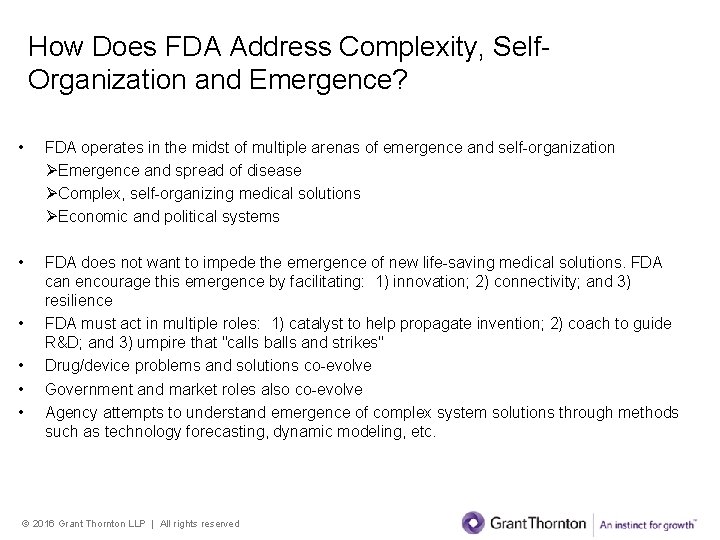
How Does FDA Address Complexity, Self. Organization and Emergence? • FDA operates in the midst of multiple arenas of emergence and self-organization ØEmergence and spread of disease ØComplex, self-organizing medical solutions ØEconomic and political systems • FDA does not want to impede the emergence of new life-saving medical solutions. FDA can encourage this emergence by facilitating: 1) innovation; 2) connectivity; and 3) resilience FDA must act in multiple roles: 1) catalyst to help propagate invention; 2) coach to guide R&D; and 3) umpire that "calls balls and strikes" Drug/device problems and solutions co-evolve Government and market roles also co-evolve Agency attempts to understand emergence of complex system solutions through methods such as technology forecasting, dynamic modeling, etc. • • © 2016 Grant Thornton LLP | All rights reserved
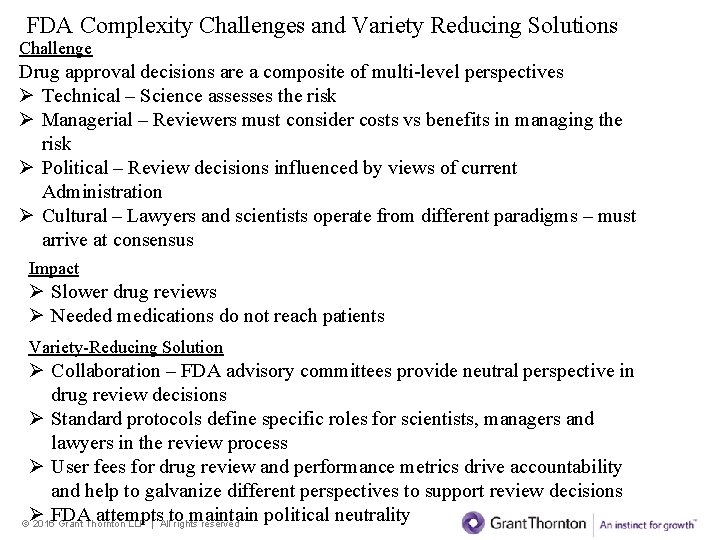
FDA Complexity Challenges and Variety Reducing Solutions Challenge Drug approval decisions are a composite of multi-level perspectives Ø Technical – Science assesses the risk Ø Managerial – Reviewers must consider costs vs benefits in managing the risk Ø Political – Review decisions influenced by views of current Administration Ø Cultural – Lawyers and scientists operate from different paradigms – must arrive at consensus Impact Ø Slower drug reviews Ø Needed medications do not reach patients Variety-Reducing Solution Ø Collaboration – FDA advisory committees provide neutral perspective in drug review decisions Ø Standard protocols define specific roles for scientists, managers and lawyers in the review process Ø User fees for drug review and performance metrics drive accountability and help to galvanize different perspectives to support review decisions Ø FDA attempts to maintain political neutrality © 2016 Grant Thornton LLP | All rights reserved
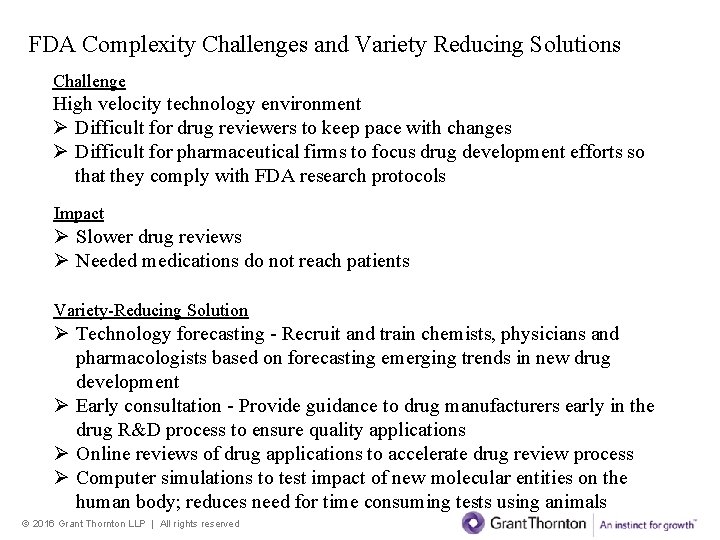
FDA Complexity Challenges and Variety Reducing Solutions Challenge High velocity technology environment Ø Difficult for drug reviewers to keep pace with changes Ø Difficult for pharmaceutical firms to focus drug development efforts so that they comply with FDA research protocols Impact Ø Slower drug reviews Ø Needed medications do not reach patients Variety-Reducing Solution Ø Technology forecasting - Recruit and train chemists, physicians and pharmacologists based on forecasting emerging trends in new drug development Ø Early consultation - Provide guidance to drug manufacturers early in the drug R&D process to ensure quality applications Ø Online reviews of drug applications to accelerate drug review process Ø Computer simulations to test impact of new molecular entities on the human body; reduces need for time consuming tests using animals © 2016 Grant Thornton LLP | All rights reserved
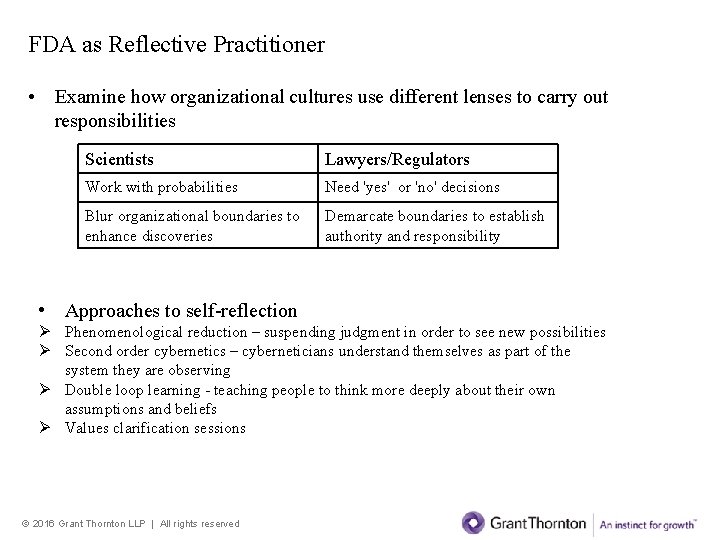
FDA as Reflective Practitioner • Examine how organizational cultures use different lenses to carry out responsibilities Scientists Lawyers/Regulators Work with probabilities Need 'yes' or 'no' decisions Blur organizational boundaries to enhance discoveries Demarcate boundaries to establish authority and responsibility • Approaches to self-reflection Ø Phenomenological reduction – suspending judgment in order to see new possibilities Ø Second order cybernetics – cyberneticians understand themselves as part of the system they are observing Ø Double loop learning - teaching people to think more deeply about their own assumptions and beliefs Ø Values clarification sessions © 2016 Grant Thornton LLP | All rights reserved
Summary • Federal leaders instinctively employ LRV in managing complex problems • The challenge is achieving the delicate balance between over-complexity and over-simplification in the design of an effective management approach • Unlike closed mechanical or human systems, the LRV approach encounters extenuating circumstances when applied in the dynamic open system environment of a Federal program • Strategies are available to assist in reducing complexity and enabling successful problem management – if not resolution • Federal leaders play a duel role: 1) effectively managing programs within their domain to achieve mission; 2) engaging in complex systems as an active agent and facilitating solutions by promoting innovation, resiliency and connectivity • Federal leaders should engage in self-reflection to become more aware of the 'lenses' they use to understand their environment; and to see new and fresh perspectives in addressing challenges © 2016 Grant Thornton LLP | All rights reserved
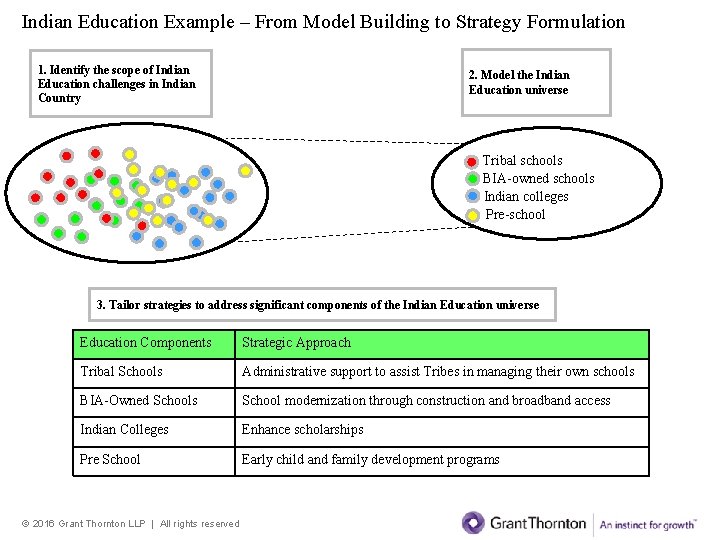
Indian Education Example – From Model Building to Strategy Formulation 1. Identify the scope of Indian Education challenges in Indian Country 2. Model the Indian Education universe Tribal schools BIA-owned schools Indian colleges Pre-school 3. Tailor strategies to address significant components of the Indian Education universe Education Components Strategic Approach Tribal Schools Administrative support to assist Tribes in managing their own schools BIA-Owned Schools School modernization through construction and broadband access Indian Colleges Enhance scholarships Pre School Early child and family development programs © 2016 Grant Thornton LLP | All rights reserved
Indian Education Example – Two Extremes Symptoms of Over Complexity in the Management Model • Proliferation of approaches to educational standards between Federal, state and Tribal entities strain school administrators' capacity to teach and test simultaneously Symptoms of Over Simplification in the Management Model • Over-reliance on uniform national educational standards is unresponsive to individual needs for educational standards at the Tribal level © 2016 Grant Thornton LLP | All rights reserved
Indian Education Challenges and Variety Reducing Solutions Challenge Ø Conflicting Federal, state and tribal standards of learning Ø Tension between goals of maintaining cultural integrity and preparing students to succeed in the larger society Impact Ø Testing overwhelms teaching environment, leaving little room for learning Ø Frustrated students who are being tested at levels beyond their capacity Ø Students marginalized between cultures that detract from learning readiness Variety-Reducing Solution Ø Collaborate among governing entities to align standards; have minimum core competencies throughout – establish intergovernmental bodies Ø Align from top down or bottom up? Ø Establish strong leadership at the school level that can mitigate the impact of complex and competing standards; strong leaders are great variety reducers © 2016 Grant Thornton LLP | All rights reserved
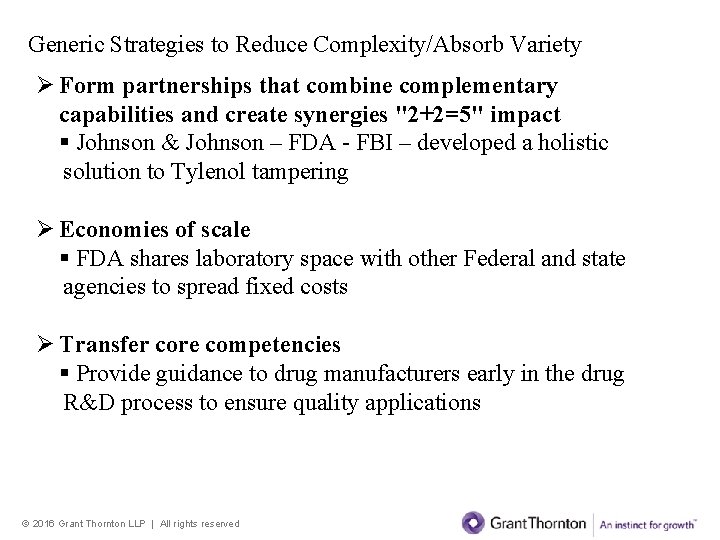
Generic Strategies to Reduce Complexity/Absorb Variety Ø Form partnerships that combine complementary capabilities and create synergies "2+2=5" impact § Johnson & Johnson – FDA - FBI – developed a holistic solution to Tylenol tampering Ø Economies of scale § FDA shares laboratory space with other Federal and state agencies to spread fixed costs Ø Transfer core competencies § Provide guidance to drug manufacturers early in the drug R&D process to ensure quality applications © 2016 Grant Thornton LLP | All rights reserved
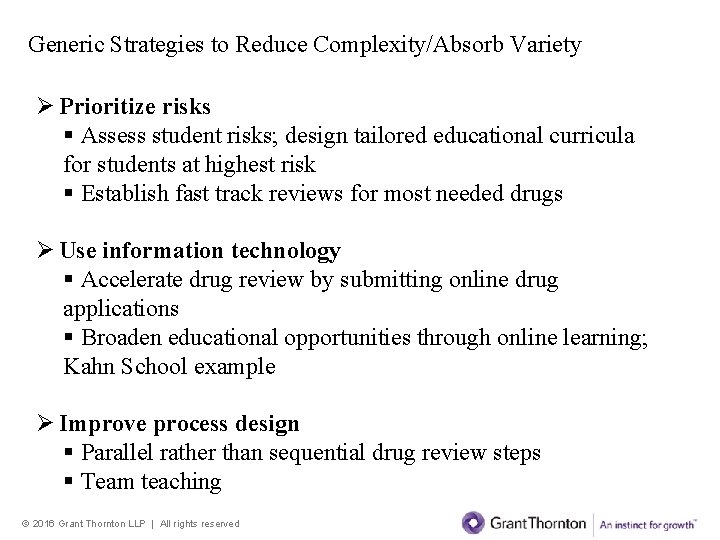
Generic Strategies to Reduce Complexity/Absorb Variety Ø Prioritize risks § Assess student risks; design tailored educational curricula for students at highest risk § Establish fast track reviews for most needed drugs Ø Use information technology § Accelerate drug review by submitting online drug applications § Broaden educational opportunities through online learning; Kahn School example Ø Improve process design § Parallel rather than sequential drug review steps § Team teaching © 2016 Grant Thornton LLP | All rights reserved
Appendix © 2016 Grant Thornton LLP | All rights reserved
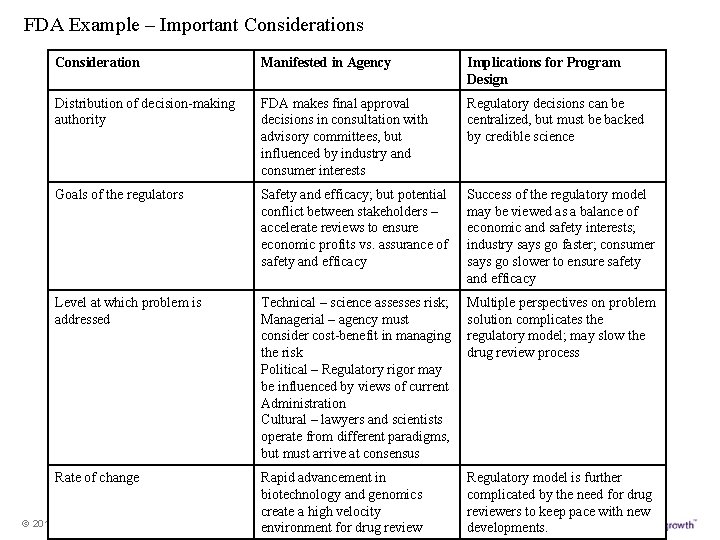
FDA Example – Important Considerations Consideration Manifested in Agency Implications for Program Design Distribution of decision-making authority FDA makes final approval decisions in consultation with advisory committees, but influenced by industry and consumer interests Regulatory decisions can be centralized, but must be backed by credible science Goals of the regulators Safety and efficacy; but potential conflict between stakeholders – accelerate reviews to ensure economic profits vs. assurance of safety and efficacy Success of the regulatory model may be viewed as a balance of economic and safety interests; industry says go faster; consumer says go slower to ensure safety and efficacy Level at which problem is addressed Technical – science assesses risk; Managerial – agency must consider cost-benefit in managing the risk Political – Regulatory rigor may be influenced by views of current Administration Cultural – lawyers and scientists operate from different paradigms, but must arrive at consensus Multiple perspectives on problem solution complicates the regulatory model; may slow the drug review process Rate of change Rapid advancement in biotechnology and genomics create a high velocity environment for drug review Regulatory model is further complicated by the need for drug reviewers to keep pace with new developments. © 2016 Grant Thornton LLP | All rights reserved
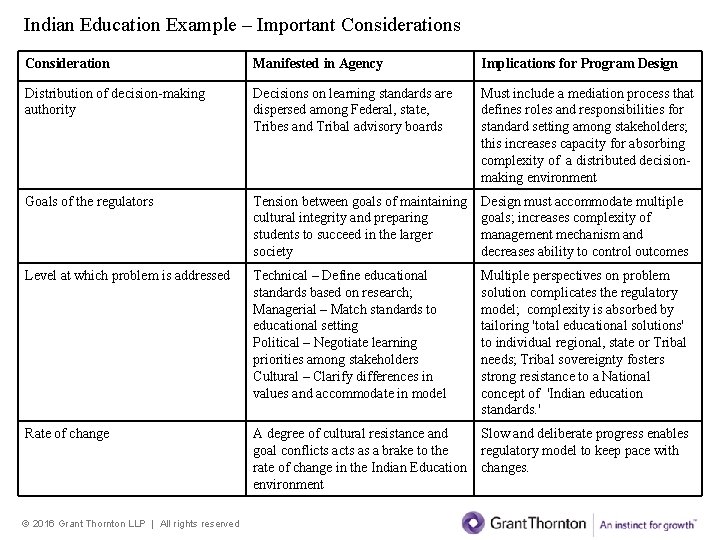
Indian Education Example – Important Considerations Consideration Manifested in Agency Implications for Program Design Distribution of decision-making authority Decisions on learning standards are dispersed among Federal, state, Tribes and Tribal advisory boards Must include a mediation process that defines roles and responsibilities for standard setting among stakeholders; this increases capacity for absorbing complexity of a distributed decisionmaking environment Goals of the regulators Tension between goals of maintaining cultural integrity and preparing students to succeed in the larger society Design must accommodate multiple goals; increases complexity of management mechanism and decreases ability to control outcomes Level at which problem is addressed Technical – Define educational standards based on research; Managerial – Match standards to educational setting Political – Negotiate learning priorities among stakeholders Cultural – Clarify differences in values and accommodate in model Multiple perspectives on problem solution complicates the regulatory model; complexity is absorbed by tailoring 'total educational solutions' to individual regional, state or Tribal needs; Tribal sovereignty fosters strong resistance to a National concept of 'Indian education standards. ' Rate of change A degree of cultural resistance and goal conflicts as a brake to the rate of change in the Indian Education environment Slow and deliberate progress enables regulatory model to keep pace with changes. © 2016 Grant Thornton LLP | All rights reserved
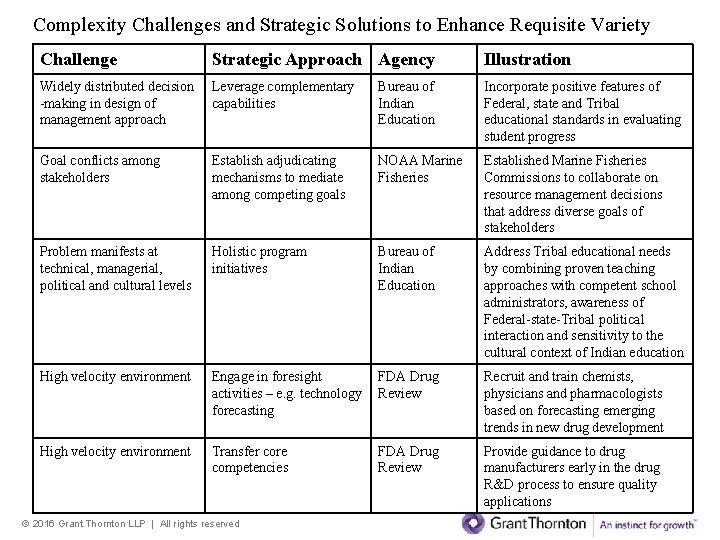
Complexity Challenges and Strategic Solutions to Enhance Requisite Variety Challenge Strategic Approach Agency Illustration Widely distributed decision -making in design of management approach Leverage complementary capabilities Bureau of Indian Education Incorporate positive features of Federal, state and Tribal educational standards in evaluating student progress Goal conflicts among stakeholders Establish adjudicating mechanisms to mediate among competing goals NOAA Marine Fisheries Established Marine Fisheries Commissions to collaborate on resource management decisions that address diverse goals of stakeholders Problem manifests at technical, managerial, political and cultural levels Holistic program initiatives Bureau of Indian Education Address Tribal educational needs by combining proven teaching approaches with competent school administrators, awareness of Federal-state-Tribal political interaction and sensitivity to the cultural context of Indian education High velocity environment Engage in foresight activities – e. g. technology forecasting FDA Drug Review Recruit and train chemists, physicians and pharmacologists based on forecasting emerging trends in new drug development High velocity environment Transfer core competencies FDA Drug Review Provide guidance to drug manufacturers early in the drug R&D process to ensure quality applications © 2016 Grant Thornton LLP | All rights reserved
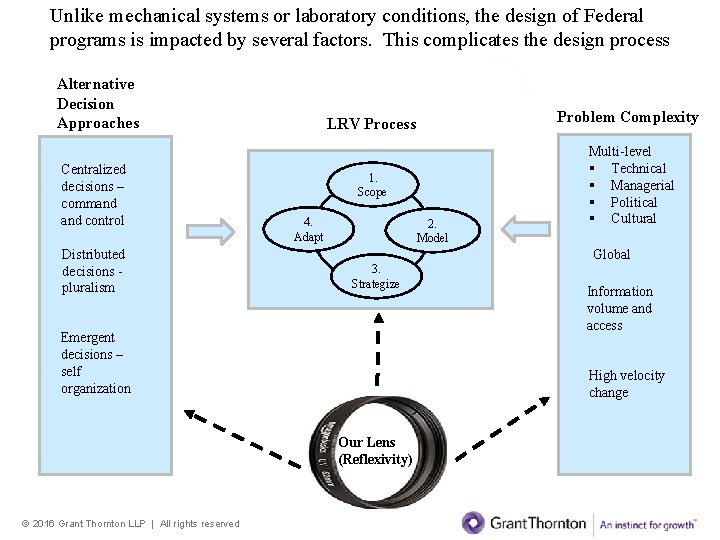
Unlike mechanical systems or laboratory conditions, the design of Federal programs is impacted by several factors. This complicates the design process Alternative Decision Approaches Centralized decisions – command control Distributed decisions pluralism 1. Scope 4. Adapt 2. Model Multi-level § Technical § Managerial § Political § Cultural Global 3. Strategize Emergent decisions – self organization Information volume and access High velocity change Our Lens (Reflexivity) © 2016 Grant Thornton LLP | All rights reserved Problem Complexity LRV Process
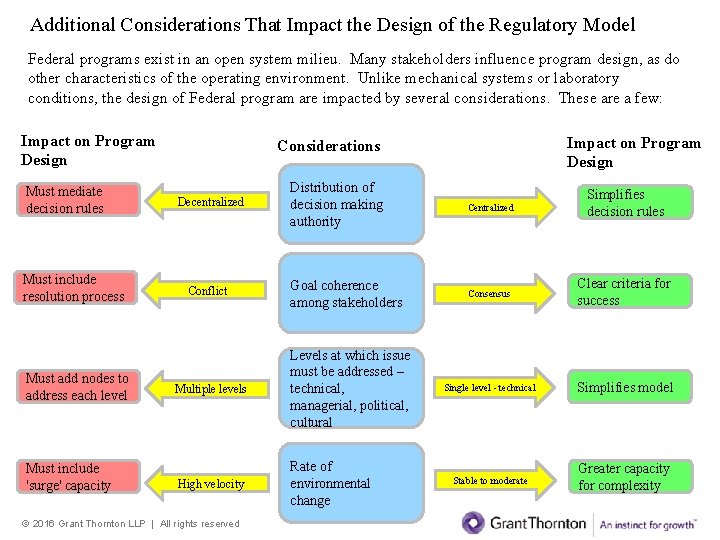
Additional Considerations That Impact the Design of the Regulatory Model Federal programs exist in an open system milieu. Many stakeholders influence program design, as do other characteristics of the operating environment. Unlike mechanical systems or laboratory conditions, the design of Federal program are impacted by several considerations. These are a few: Impact on Program Design Must mediate decision rules Must include resolution process Must add nodes to address each level Must include 'surge' capacity Impact on Program Design Considerations Decentralized Conflict Distribution of decision making authority Centralized Simplifies decision rules Goal coherence among stakeholders Consensus Clear criteria for success Single level - technical Simplifies model Stable to moderate Greater capacity for complexity Multiple levels Levels at which issue must be addressed – technical, managerial, political, cultural High velocity Rate of environmental change © 2016 Grant Thornton LLP | All rights reserved