Getaran Harmonik Paksa Getaran Harmonik Paksa Eksitasi harmonik








- Slides: 25
Getaran Harmonik Paksa
Getaran Harmonik Paksa • Eksitasi harmonik terjadi biasanya akibat ketidakseimbangan pada mesin-mesin yg berputar. • Eksitasi harmonik dapat berbentuk gaya atau simpangan beberapa titik dalam sistem.
Sistem 1 dof mengalami redaman c dan dieksitasi gaya harmonik Fo cos ωt c k m
• The solution to this equation consists of two parts, the complementary function, which is the solution of the homogeneous equation, and the particular integral. • The complementary function. in this case, is a damped free vibration. • The particular solution is a steady-state oscillation of the same frequency was that of the excitation.
See Blackboard
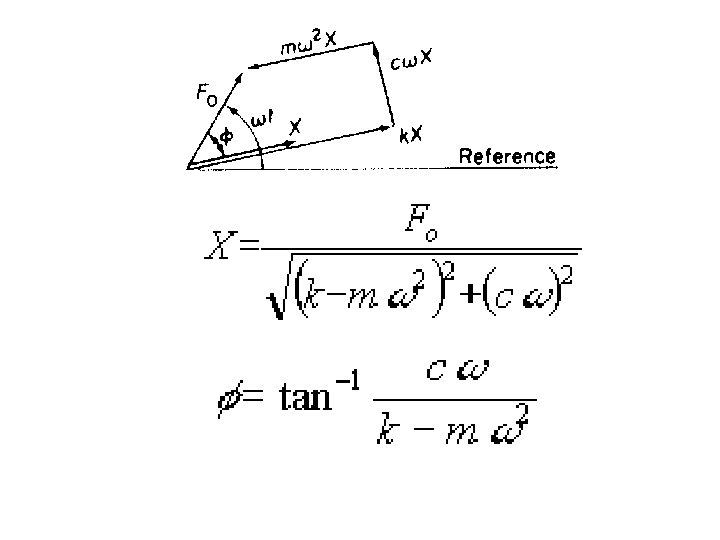
Secara Grafis • We can assume the particular solution to be of the form : where X is the amplitude of oscillation ø is the phase of the displacement with respect to the exciting force.
Secara grafis
• Expressing in non-dimensional term by dividing the numerator and denominator by k, we obtain :
• Expressed in terms of the following quantities:
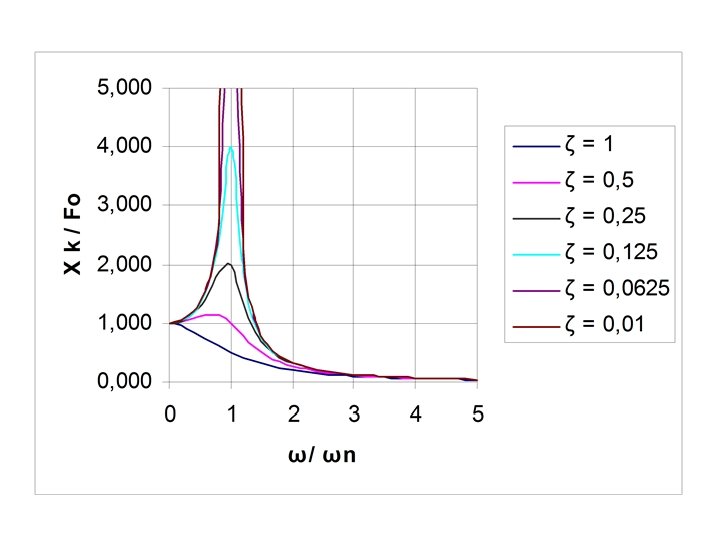
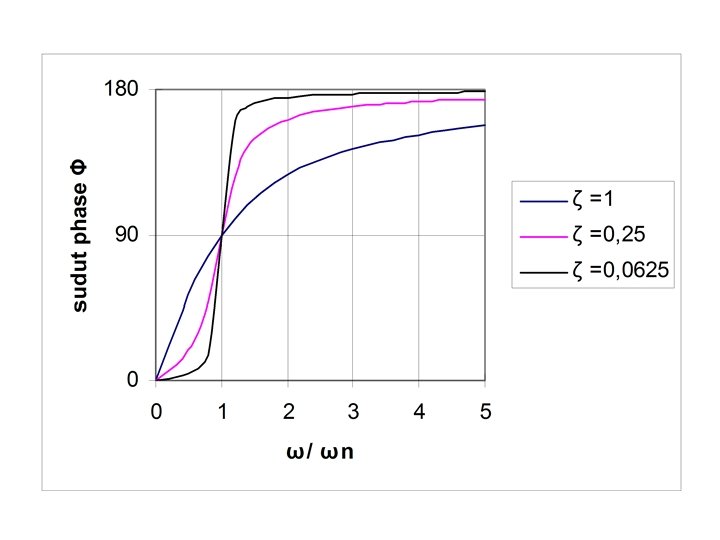
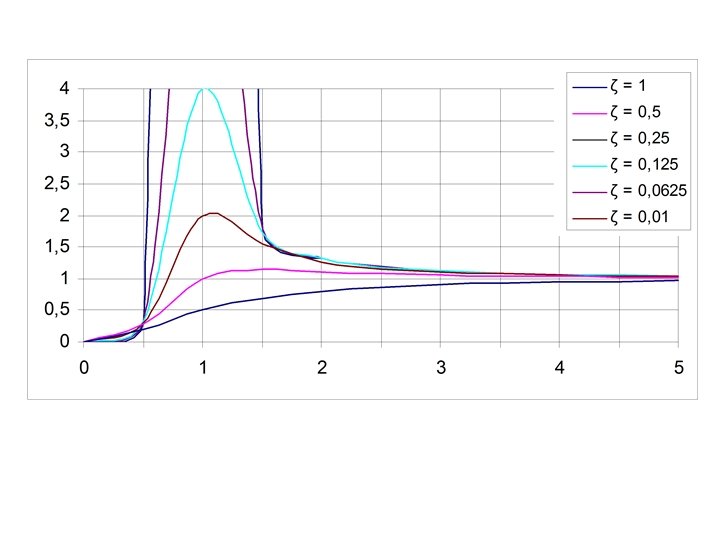
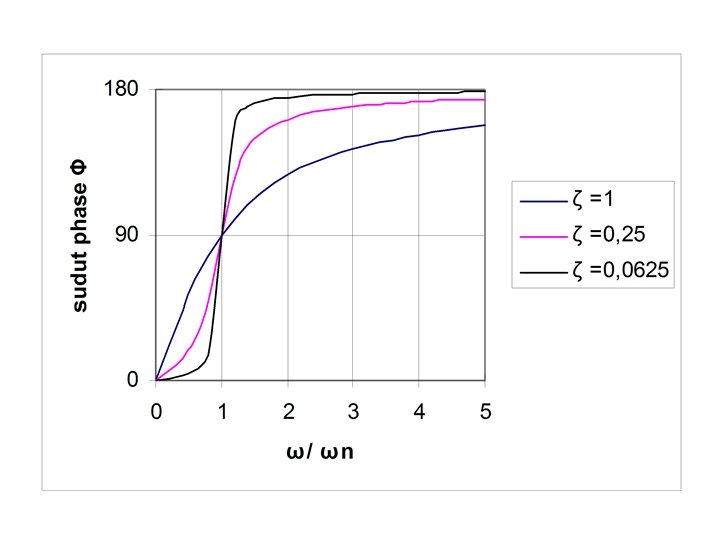
• The non-dimensional expressions for the amplitude and phase then become • These equations indicate that the non dimensional amplitude , and the phase ø are functions only of the frequency ratio , and the damping factor ζ
See Blackboard
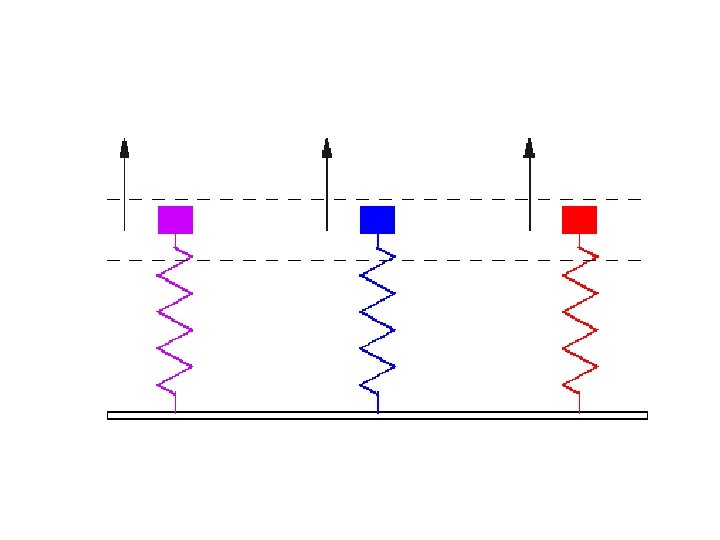
Three identical damped 1 -DOF mass-spring oscillators. all with natural frequency f 0=1, are initially at rest. A time harmonic force F=F 0 cos(2 pi f t) is applied to each of three damped 1 -DOF mass-spring oscillators starting at time t=0. The driving frequencies ω of the applied forces are f 0=0. 4, f 0=1. 01, f 0=1. 6
Open Matlab
Rotating Unbalance
Rotating Unbalance • Unbalance in rotating machines is a common source of vibration excitation. • We consider here a spring-mass system constrained to move in the vertical direction and excited by a rotating machine that is unbalanced.
Rotating Unbalance • The unbalance is represented by an eccentric mass m with eccentricity e that is rotating with angular velocity w. • By letting x be the displacement of the non rotating mass (M - m) from the static equilibrium position, the displacement of m is :
Rotating Unbalance • The equation of motion is then : • which can be rearranged to : • It is evident that this equation is identical to previous equation, where is replaced by
Rotating Unbalance • Hence the steady-state solution of the previous section can be replaced by :
Rotating Unbalance • These can be further reduced to non dimensional form :