GEAR Up for Mentorship Growth Equity Alignment Retention

- Slides: 21
GEAR Up for Mentorship Growth + Equity + Alignment = Retention Sarah Finch, Ph. D. Amanda M. Romero, M. Des.
GEAR Up: Workshop Agenda ● ● ● What is Retention By Design Stats: The Numbers GEAR Up ○ Goal ○ What is Mentoring/Mentorship ○ Benefits ○ The Pilot
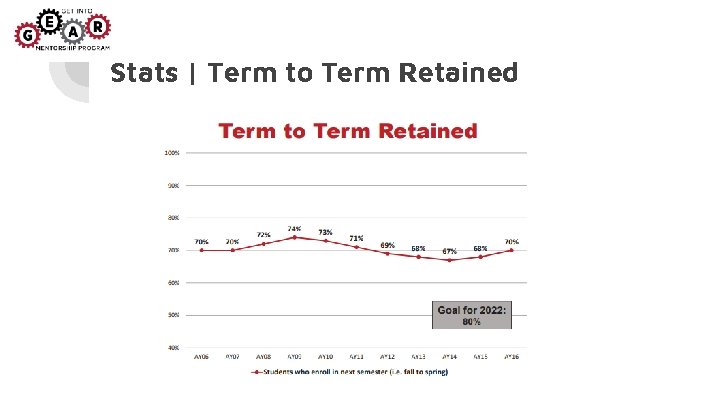
Retention by Design Genesis Problem Statement ● While completion numbers have been steadily increasing, our term-to-term retention numbers have not been growing at the same rate. ● While everyone at the college plays a role in retention and persistence, no one particular department owns retention.
Retention by Design Genesis Retention By Design (RBD) is a cross-departmental and cross-divisional workgroup dedicated to identifying the biggest barriers to retention and persistence and working collaboratively to address these issues. RBD consists of faculty, staff, and administrators from many college areas (eg. Instruction, Human Resources, Accounting, Advising, Financial Aid, Student Affairs, Registration, etc…) who are being empowered to research best practices and develop potential solutions to ensure that our students have the resources needed to persist and reach their individual goals.
The Team | Employee Mentoring ● ● ● ● ● Carlina Figueroa Sarah Finch Karla Knepper Brandy Mariani Valerie Mayfield Julie Mc. Daniel Amanda Romero Joellen Steele Ty. Ann Stewart Chris Welch
Retention by Design | Subcommittees ● Data Team ○ ● ● Employee Mentoring Team Evaluate Assistance Opportunities ○ ○ ○ ● We are looking into the use of the Illume software to determine current student’s likelihood to persist and reviewing appropriate options to intervene. Sinclair is utilizing a new “Emergency Grant” fund to help students outside of tuition and books. We are reviewing the current resource guide to create a “One Stop” bank that is easily accessible. Financial literacy among the student is another major focus of this group. Explore Expanded grade & Attendance Reporting in LMS (Learning Management System) ○ This could provide consistency with grade recording and reporting to allow students and faculty to know how a student is progressing in the course throughout the term before final grading.
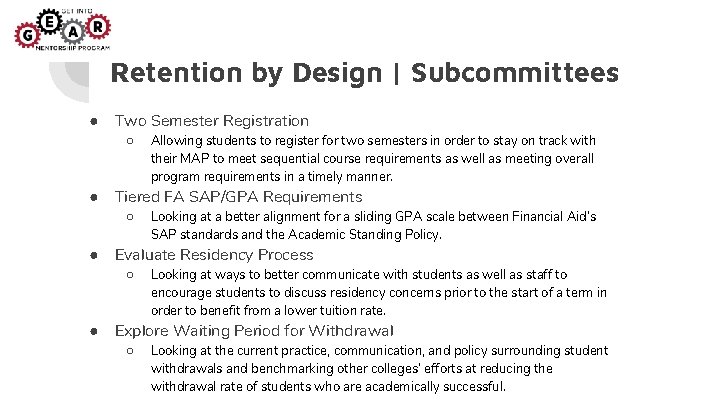
Retention by Design | Subcommittees ● Two Semester Registration ○ ● Tiered FA SAP/GPA Requirements ○ ● Looking at a better alignment for a sliding GPA scale between Financial Aid’s SAP standards and the Academic Standing Policy. Evaluate Residency Process ○ ● Allowing students to register for two semesters in order to stay on track with their MAP to meet sequential course requirements as well as meeting overall program requirements in a timely manner. Looking at ways to better communicate with students as well as staff to encourage students to discuss residency concerns prior to the start of a term in order to benefit from a lower tuition rate. Explore Waiting Period for Withdrawal ○ Looking at the current practice, communication, and policy surrounding student withdrawals and benchmarking other colleges’ efforts at reducing the withdrawal rate of students who are academically successful.
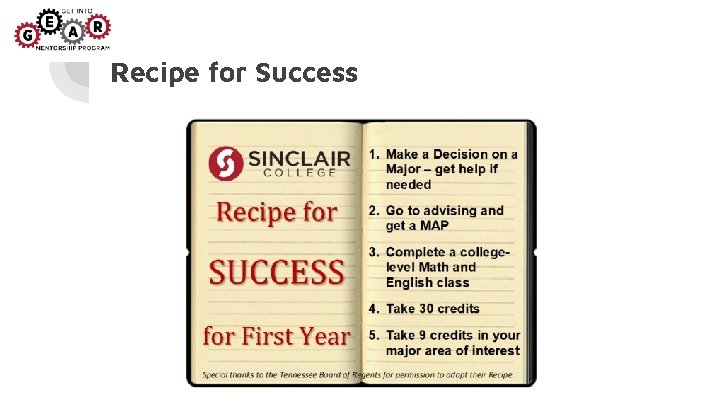
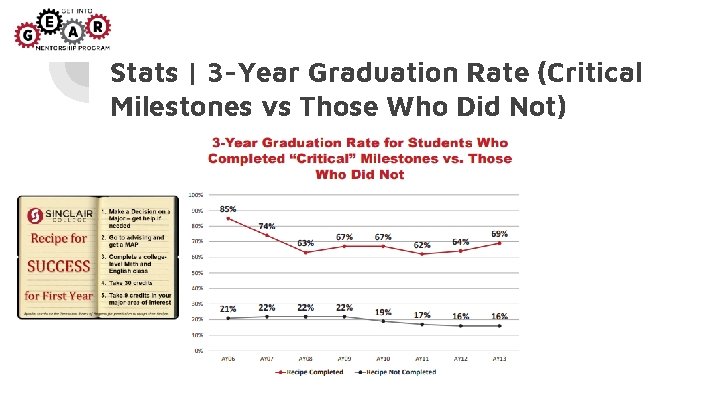
Recipe for Success
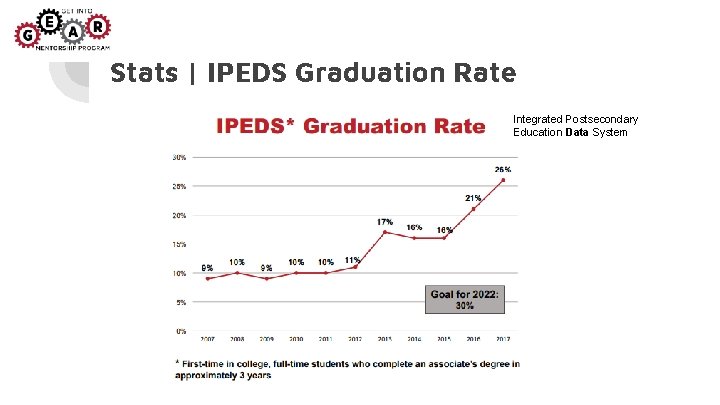
Stats | IPEDS Graduation Rate Integrated Postsecondary Education Data System
Stats | Term to Term Retained
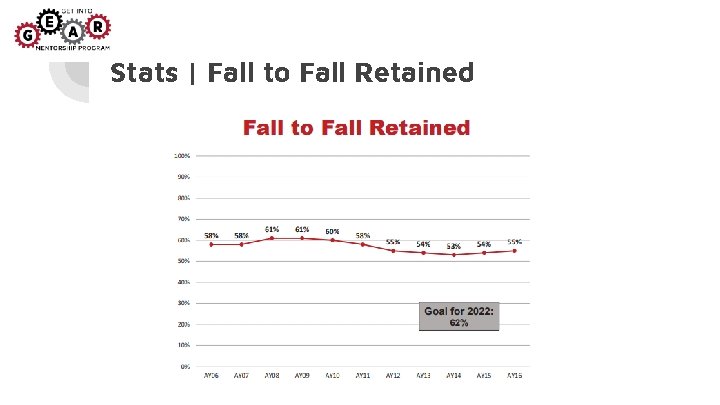
Stats | Fall to Fall Retained
Stats | 3 -Year Graduation Rate (Critical Milestones vs Those Who Did Not)
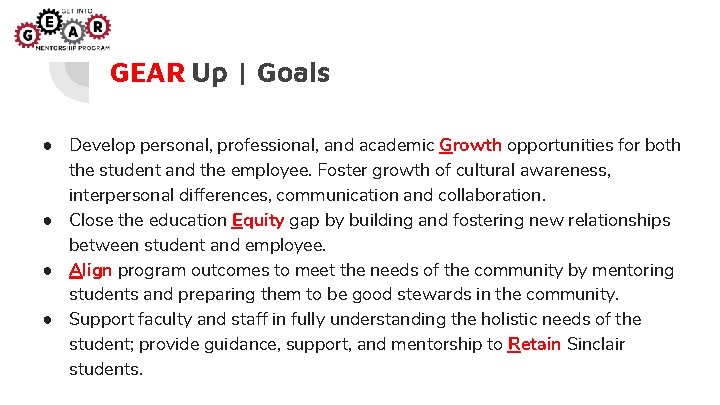
GEAR Up | Goals ● Develop personal, professional, and academic Growth opportunities for both the student and the employee. Foster growth of cultural awareness, interpersonal differences, communication and collaboration. ● Close the education Equity gap by building and fostering new relationships between student and employee. ● Align program outcomes to meet the needs of the community by mentoring students and preparing them to be good stewards in the community. ● Support faculty and staff in fully understanding the holistic needs of the student; provide guidance, support, and mentorship to Retain Sinclair students.
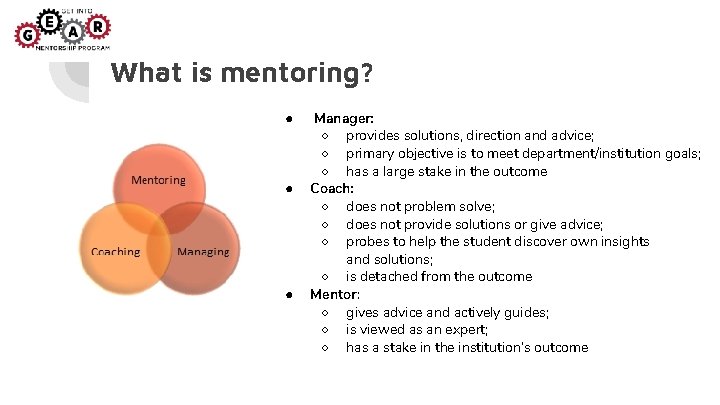
What is mentoring? ● ● ● Manager: ○ provides solutions, direction and advice; ○ primary objective is to meet department/institution goals; ○ has a large stake in the outcome Coach: ○ does not problem solve; ○ does not provide solutions or give advice; ○ probes to help the student discover own insights and solutions; ○ is detached from the outcome Mentor: ○ gives advice and actively guides; ○ is viewed as an expert; ○ has a stake in the institution’s outcome
What is Mentoring? In academics, mentor is often used synonymously with faculty adviser. ● A fundamental difference between mentoring and advising is more than advising; mentoring is a personal, as well as, professional relationship. ● A mentoring relationship develops over an extended period, during which a student's needs and the nature of the relationship tend to change. ● A mentor will try to be aware of these changes and vary the degree and type of attention, help, advice, information, and encouragement that he or she provides. ● In the broad sense intended here, a mentor is someone who takes a special interest in helping another person develop into a successful professional. Suggested Citation: "1 What is a Mentor? . " Institute of Medicine, National Academy of Sciences, and National Academy of Engineering. 1997. Adviser, Teacher, Role Model, Friend: On Being a Mentor to Students in Science and Engineering. Washington, DC: The National Academies Press. doi: 10. 17226/5789.
Why is mentoring important? ● ● ● ● Students gain knowledge and potential connections through their relationship with the mentor. Mentors gain insight into the student experience at Sinclair. Provides a connection between one student and one employee that can lead to increased retention and success for the student and an increased connection to the College for the employee. Increases the number of personal connections students have to Sinclair by at least one. Provides personal support for the student. Mentors provide information about Sinclair resources that the student might not otherwise find. Connects students with a role model.
What are the qualities of a good mentor?
What are the qualities of a good mentor? ● ● ● Willing to share skills, knowledge, and expertise Demonstrates a positive attitude and acts as a positive role model Take a personal interest in the mentoring relationship and takes the responsibility seriously Exhibits enthusiasm in the department and college Values ongoing learning and growth (professional and personal) Provides guidance and constructive feedback Respected by colleagues and employees in all levels of the organization Sets and meets ongoing personal and professional goals Values the opinions and initiatives of others Motivates others by setting a good example Is able to set appropriate boundaries with their mentees
Benefits to Employees ● ● ● ● ● Gain student perspective about Sinclair and learn more about Sinclair business operations Employee retention and further engagement in the Sinclair campus culture Further develop that Intrinsic motivation to feel good about providing a service to students Opportunity for Reverse Mentoring – student teach and aid the mentor in learning something new i. e. social media, digital networking Increase self confidence in your own skills and abilities Become more empowered and more engaged in the workplace Develop your communication, interpersonal relationships, and personal skills Use mentoring relationship to grow and develop leadership skills that can be used within your department May create an opportunity to identify next stage of your own career or development
The Pilot ● Training employees ○ Through the CTL ○ October, November, December ● TRIO participants (no more than 15) ○ First generation students, only ● Pilot begins Spring, 2019 ○ Pairing employees by end of fall term ○ Occasional group events
GEAR Up | Q & A