NearPeer Mentorship Program TFEL Partnership and University of



- Slides: 21
Near-Peer Mentorship Program TFEL Partnership and University of Calgary Presented by: Dr. Julie Drolet, Ph. D, RSW Lula Adam, MSW Research Assistant Diana Adamo, MSW Research Assistant Omid Alemi, MSW Research Assistant October 23 rd, 2020
TERRITORIAL ACKNOWLEDGEMENT The University of Calgary respectfully acknowledges the traditional territories of the people of the Treaty 7 region in Southern Alberta, which includes the Blackfoot Confederacy (comprising the Siksika, Piikani, and Kainai First Nations), as well as the Tsuut’ina First Nation, and the Stoney Nakoda (including the Chiniki, Bearspaw, and Wesley First Nations). The City of Calgary is also home to Métis Nation of Alberta, Region III. L’Université de Calgary reconnaît respectueusement qu’elle est située sur les terres du Traité 6, lieu de rassemblement traditionnel pour de nombreux peuples autochtones dont les Cris, les Pieds-Noirs, les Métis, les Sioux des Nakotas, les Iroquois, les Dénés, les Ojibwés/Saulteaux/Anichinabés, les Inuits et bien d’autres encore, dont les histoires, les langues et les cultures continuent d’influencer notre communauté si vivante. ii’ taa’poh’to’p University of Calgary Office of Indigenous Engagement
ACKNOWLEDGEMENT The Transforming the Field Education Landscape (TFEL) project is supported in part by the Social Sciences and Humanities Research Council of Canada. Partnership Grant: Talent (2019 -2024)
TRANSFORMIN G THE FIELD EDUCATION LANDSCAPE (TFEL) “ THE GOAL OF THIS PARTNERSHIP IS TO INTEGRATE RESEARCH AND PRACTICE IN THE PREPARATION OF THE NEXT GENERATION OF SOCIAL WORKERS BY DEVELOPING PARTNERED RESEARCH TRAINING INITIATIVES, BOTH WITHIN ACADEMIA AND ACROSS THE PUBLIC AND NOTFOR-PROFIT SECTORS, THAT ENHANCE STUDENT AND TRAINEE RESEARCH PRACTICE KNOWLEDGE AND APPLIED SKILL DEVELOPMENT. " TRAIN. MENTOR. TRANSFORM. LEARN MORE AT HTTPS: //TFELPROJECT. COM
A JOURNEY TO EXPLORE UNCHARTED SPACE
Introduce yourself! ICE BREAKER Your name Program and year Name a skill, hobby, or fact about yourself you've learnt during COVID 19.
WHAT IS ”NEAR-PEER” MENTORSHIP? Near-peer mentorship consists of student peers, who have similar goals, interests and backgrounds, providing mentorship to another. The mentor can provide first-hand experience, advice and insight to mentees about different processes. For instance, a more advanced student will provide mentoring to a junior student This mentorship has the potential to enhance reflection and ease the transition to new situations for junior social worker students (Akinla et al. , 2018; Mc. Evoy et al. , 2016; Mc. Kenna & Williams, 2016), Mentors will have the opportunity to consolidate their knowledge, gain leadership skills and grow professionally (Tenenbaum et al. , 2014; Wagner & du Toit, 2019). The application of near-peer mentorship models in social work can support community building and provide increased psychosocial supports for new students. Allows mentors and mentees to build relationships with one another, engage in reciprocal learning and support the transition of students into highly qualified professionals.
PROGRAM OBJECTIVES This one-year pilot program will take place at the University of Calgary in the Social Work Program offered in Edmonton. TFEL Mentorship Coordinators will help facilitate and support the program collaboratively with faculty members at the University of Calgary. The program will be available to BSW students, MSW foundation students and MSW specialization students. Objectives: 1. Foster relationships among mentors and mentees and allow for reciprocal learning opportunities. 2. Provide psychosocial support for junior students in order to aid the transition into field placements and throughout their social work program. 3. Enhance the mentees’ working knowledge of social work as a profession, along with its principles, ethical standards, foundational theories, and their practical applications. 4. Foster the development of leadership and professional skills among mentors.
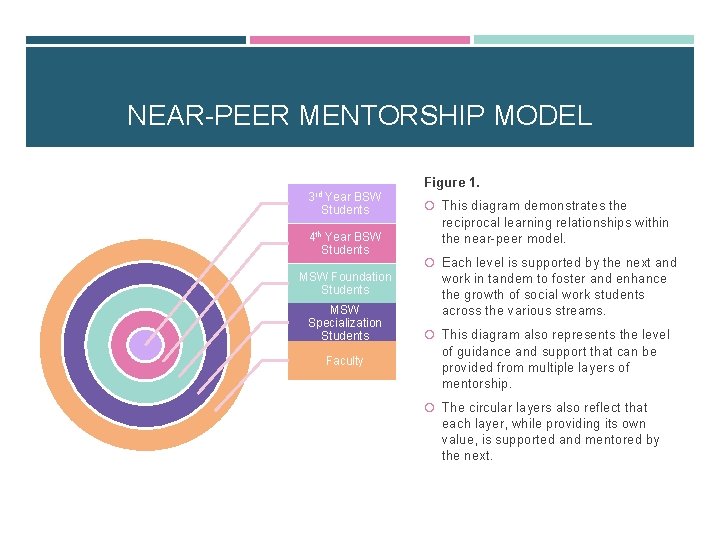
NEAR-PEER MENTORSHIP MODEL Figure 1. 3 rd Year BSW Students 4 th Year BSW Students MSW Foundation Students MSW Specialization Students Faculty This diagram demonstrates the reciprocal learning relationships within the near-peer model. Each level is supported by the next and work in tandem to foster and enhance the growth of social work students across the various streams. This diagram also represents the level of guidance and support that can be provided from multiple layers of mentorship. The circular layers also reflect that each layer, while providing its own value, is supported and mentored by the next.
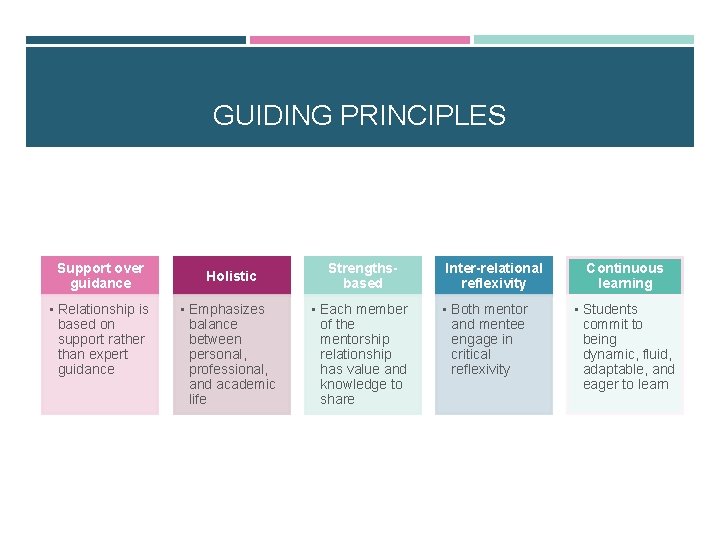
GUIDING PRINCIPLES Support over guidance • Relationship is based on support rather than expert guidance Holistic Strengthsbased • Emphasizes balance between personal, professional, and academic life • Each member of the mentorship relationship has value and knowledge to share Inter-relational reflexivity • Both mentor and mentee engage in critical reflexivity Continuous learning • Students commit to being dynamic, fluid, adaptable, and eager to learn
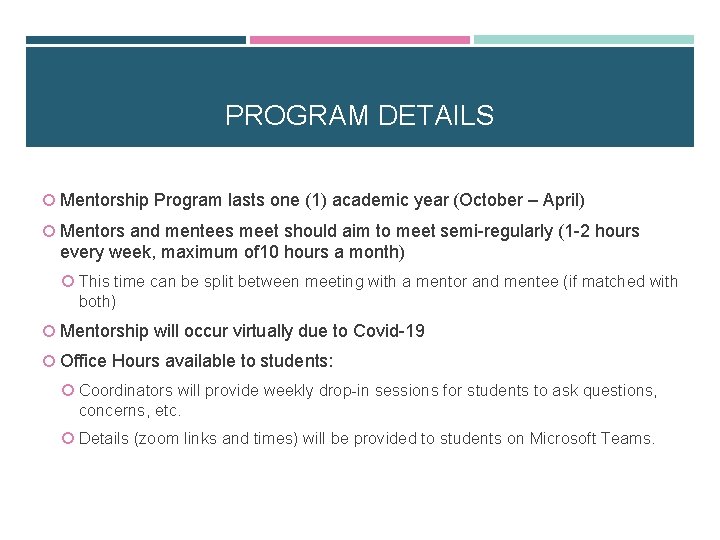
PROGRAM DETAILS Mentorship Program lasts one (1) academic year (October – April) Mentors and mentees meet should aim to meet semi-regularly (1 -2 hours every week, maximum of 10 hours a month) This time can be split between meeting with a mentor and mentee (if matched with both) Mentorship will occur virtually due to Covid-19 Office Hours available to students: Coordinators will provide weekly drop-in sessions for students to ask questions, concerns, etc. Details (zoom links and times) will be provided to students on Microsoft Teams.
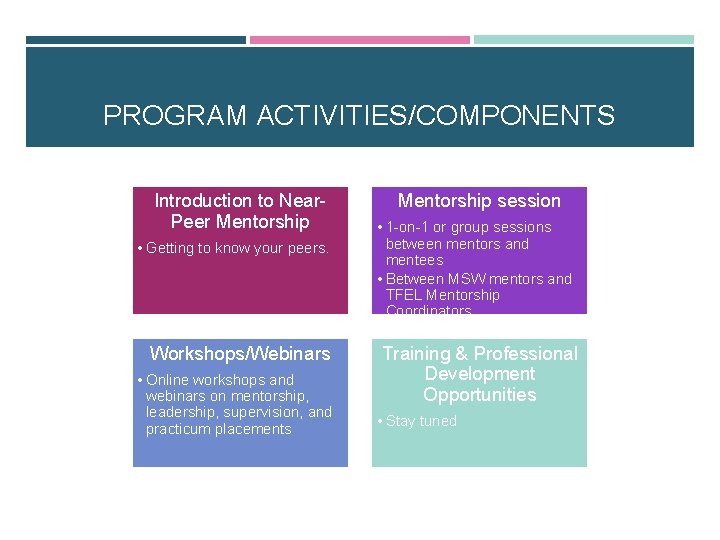
PROGRAM ACTIVITIES/COMPONENTS Introduction to Near. Peer Mentorship • Getting to know your peers. Workshops/Webinars • Online workshops and webinars on mentorship, leadership, supervision, and practicum placements Mentorship session • 1 -on-1 or group sessions between mentors and mentees • Between MSW mentors and TFEL Mentorship Coordinators Training & Professional Development Opportunities • Stay tuned
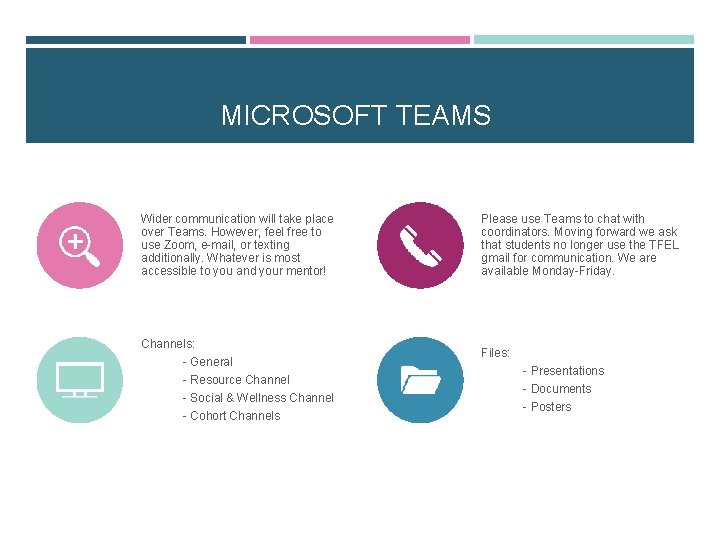
MICROSOFT TEAMS Wider communication will take place over Teams. However, feel free to use Zoom, e-mail, or texting additionally. Whatever is most accessible to you and your mentor! Channels: - General - Resource Channel - Social & Wellness Channel - Cohort Channels Please use Teams to chat with coordinators. Moving forward we ask that students no longer use the TFEL gmail for communication. We are available Monday-Friday. Files: - Presentations - Documents - Posters
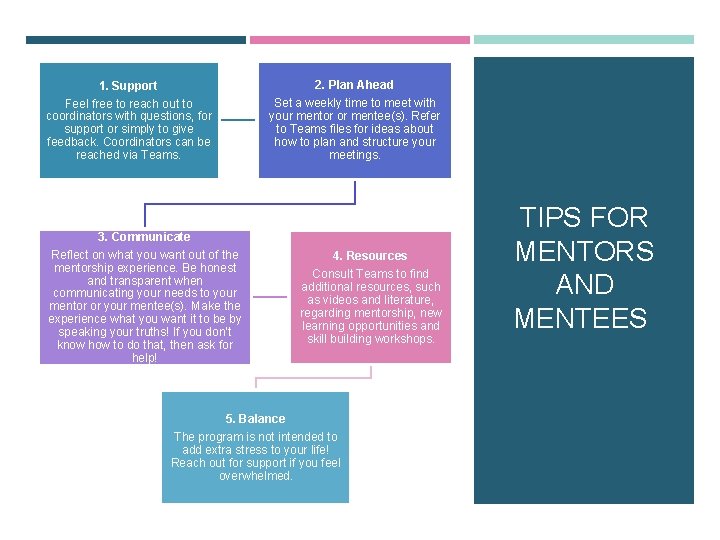
1. Support Feel free to reach out to coordinators with questions, for support or simply to give feedback. Coordinators can be reached via Teams. 2. Plan Ahead Set a weekly time to meet with your mentor or mentee(s). Refer to Teams files for ideas about how to plan and structure your meetings. 3. Communicate Reflect on what you want out of the mentorship experience. Be honest and transparent when communicating your needs to your mentor or your mentee(s). Make the experience what you want it to be by speaking your truths! If you don’t know how to do that, then ask for help! 4. Resources Consult Teams to find additional resources, such as videos and literature, regarding mentorship, new learning opportunities and skill building workshops. 5. Balance The program is not intended to add extra stress to your life! Reach out for support if you feel overwhelmed. TIPS FOR MENTORS AND MENTEES
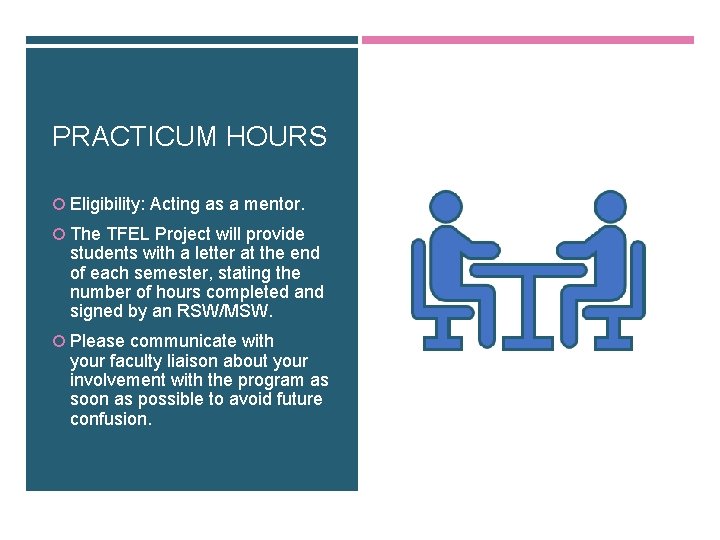
PRACTICUM HOURS Eligibility: Acting as a mentor. The TFEL Project will provide students with a letter at the end of each semester, stating the number of hours completed and signed by an RSW/MSW. Please communicate with your faculty liaison about your involvement with the program as soon as possible to avoid future confusion.
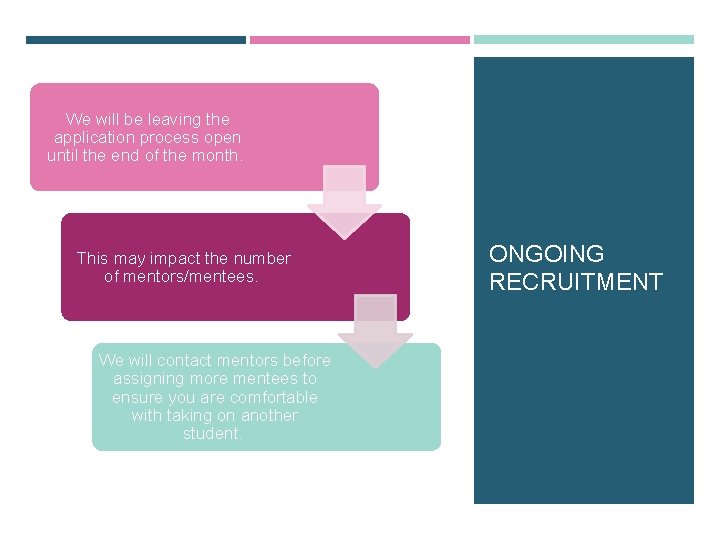
We will be leaving the application process open until the end of the month. This may impact the number of mentors/mentees. We will contact mentors before assigning more mentees to ensure you are comfortable with taking on another student. ONGOING RECRUITMENT
EVALUATION In order to gain understanding of your experience and how to make improvements, we will ask participants to complete surveys. Surveys will be distributed on a bimonthly basis. Please do not hesitate to contact the program coordinators any time! These surveys will inform an evaluation of the program. Your feedback will be integrated in the implementation and design on future mentorship programs in social work.
Reading week – Nov 9 -13 - Meetings are optional. Take this time to relax! Holiday break – December UPCOMING DATES 11 th until Winter term. Feel free to stay in contact with the community over Teams. However, coordinators will not be available, and no workshops will be offered during the holidays. Workshops - Stay tuned. TFEL opportunities Field Image Showcase Field Research Scholars Program Coordinators will post upcoming TFEL webinars and events on the Teams General channel.
WHAT'S NEXT? Setting up a schedule with your mentor/mentee. Interacting through Teams and using channels to communicate with other students. Goal setting. Check out the General channels 'Files' to find suggestions for mentorship meetings.
QUESTIONS ?
For more information about the project please email tfelproject@gmail. com Project Management Office Dr. Julie Drolet Project Director jdrolet@ucalgary. ca