From Zhou Gong to Confucius The Construction of
- Slides: 32
从周公到孔子:儒家文化的历史建构 陈炎 From Zhou Gong to Confucius: The Construction of Confucian Culture Chen Yan
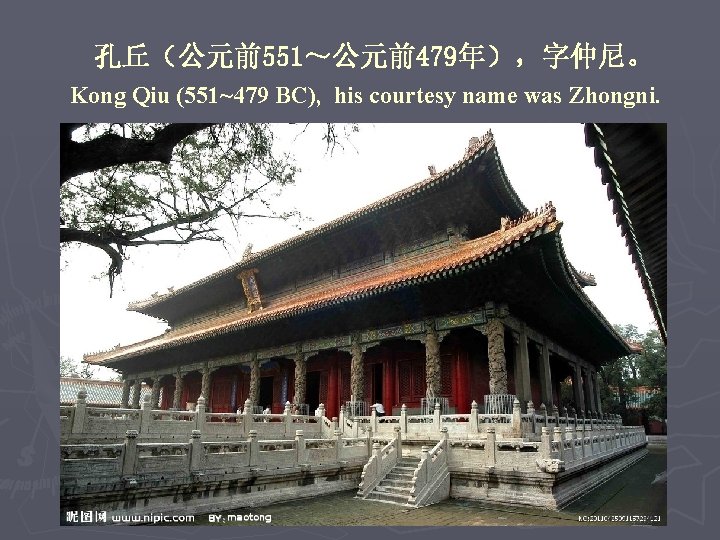
孔丘(公元前551~公元前479年),字仲尼。 Kong Qiu (551~479 BC), his courtesy name was Zhongni.
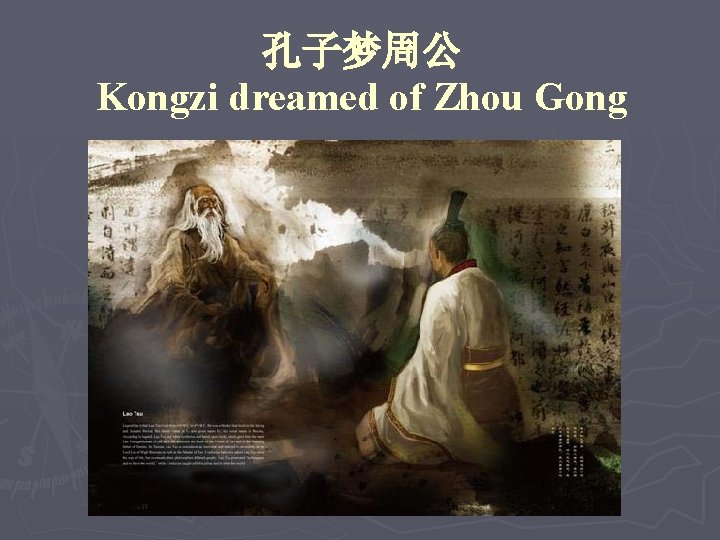
孔子梦周公 Kongzi dreamed of Zhou Gong
周公继位的四大理由 Four reasons for Zhou Gong Inheriting the throne 第一,出身高贵:他以文王之子的身份继承王位,完全是 可以被接受的。况且其兄武王并非长子。姬发因其兄伯邑考被 商纣王所杀而得以继位,姬旦也同样有理由因其兄姬发早逝而 得以继位。 Firstly, Zhou Gong was highbred. As the son of Wen Wang, to inherit the throne was acceptable. In addition, Wu Wang also had an older brother, so he was not the first son. Ji Fa, that is, Wu Wang, became the emperor due to his older brother Boyikao (伯邑考) who was killed by Chou Wang, the Emperor of Shang. Ji Dan, that is, Zhou Gong, would have the same reasons to inherit the throne from his brother Ji Fa who died early.
第二,已有先例:周朝所取代的商朝本身就存在 着“兄终弟及”和“父死子继”的两种继承习惯。 当时周朝初立,完全可以采取前朝的旧例。 Secondly, Shang Dynasty had already had the institutions allowing the younger brother or the son to inherit the throne from his dead older brother or father; what’s more, it was the beginning of the existence of Zhou Dynasty, and the rule for power transfer could be established afresh.
第三,功勋显赫:周公不仅辅佐武王打败了殷商,而且继 武王之后捍卫了国家,有功于这个新生的王朝。 Thirdly, Zhou Gong not only helped his older brother to overthrow Shang Dynasty but also maintained the new regime, and he was in full power and able to establish himself as the new emperor substantially and politically. 第四:大权在握:武王去世时其子只有12岁,周公还政时 成王也只有19岁,一个文韬武略的政治家不太可能是被一个黄 口小儿逼下台的。 Fourthly, the Prince Song (诵) was only 12 years old when his father Wu Wang died, and only 19 years old when Zhou Gong returned the power to him. How could such a verdant young prince be as competent as an adept politician as Zhou Gong?
确立长子继承制的意义 The meaning of exclusive inheritance of political power by the emperor’s first son 第一,避免皇室内部的纷争:传长与传贤、传兄之子与传 弟之子之间的矛盾。 Firstly, to prevent the royal family from inner conflicts, in Shang Dynasty preceding Zhou Dynasty, the dead emperor’s throne would be inherited by his brother or son. An emperor may not have a brother, so his son must have the same right. So in the course of the transfer power, there would be some conflicts, which would trigger the inner struggles in the royal family, leading the reign to declination.
第二,奠定了分封制的基础。因为除了嫡长子之外,那 些无权继承王位的王子们可以通过分封而将自己的权力欲望 在外部世界得以实现,并通过这种实现而反过来拱卫王室。 Secondly, to lay the foundations for enfeoffment, the princes who had not inherited the throne would satisfy their desire for power by means of ruling the enfeoffment and in turn to support the royal family. 第三,形成“家”“国”一体的社稷。 Thirdly, the capital and the country are one family.
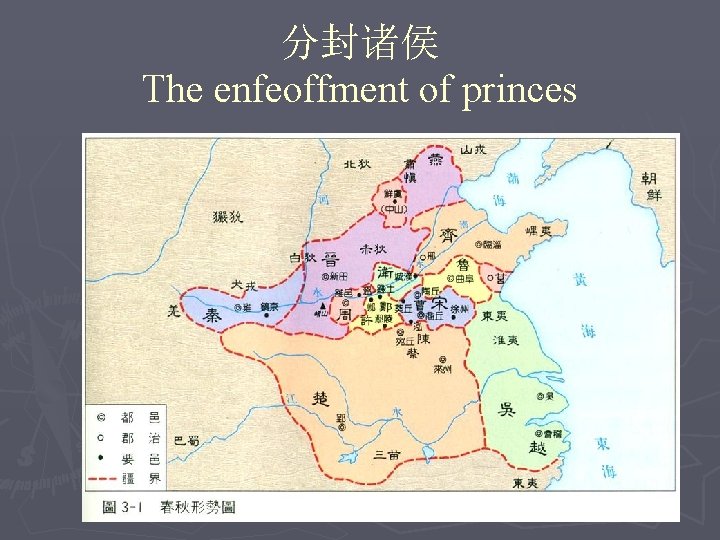
分封诸侯 The enfeoffment of princes
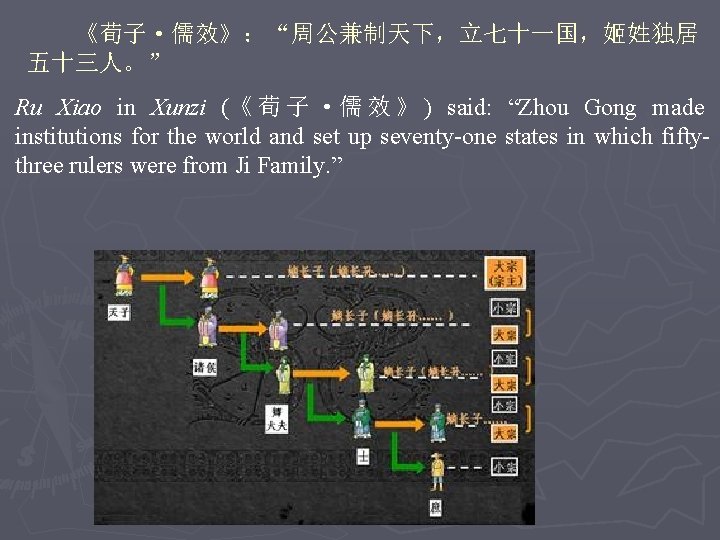
《荀子·儒效》:“周公兼制天下,立七十一国,姬姓独居 五十三人。” Ru Xiao in Xunzi (《 荀 子 ·儒 效 》 ) said: “Zhou Gong made institutions for the world and set up seventy-one states in which fiftythree rulers were from Ji Family. ”
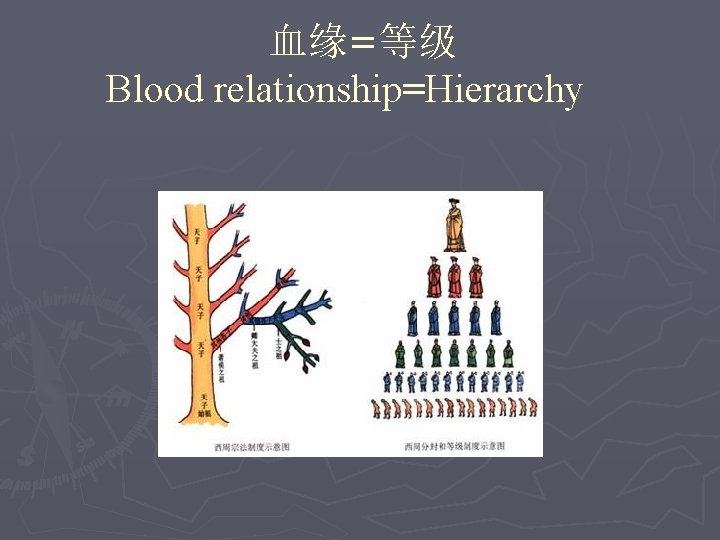
血缘=等级 Blood relationship=Hierarchy
变方国联盟为社稷一统 From league of local countries to national unity 商朝的统治者主要依靠强大的武力威慑而使周边的方国俯首称臣;周代 的统治者则主要依靠以血缘为纽带的政治制度将国家的权力渗透到周边地区。 “于是周人的世界,是一个‘天下’,不是一个‘大邑’;周人的政治权力, 抟铸了一个文化的共同体。” 显然,这个“文化的共同体”是建立在“血缘 的共同体”基础之上的,这便是所谓的宗法制。 Shang’s rulers kept the remote local countries obedient by powerful forces while Zhou permeated the government to the far places by means of spreading its politics based on the blood linkage. “So Zhou’s world is ‘the land under Heaven’ (天下) rather than a big city-state, and its political power has made a cultural community. ” Obviously, the cultural community is based on the royal blood linkage, which is called patriarchal system (宗法).
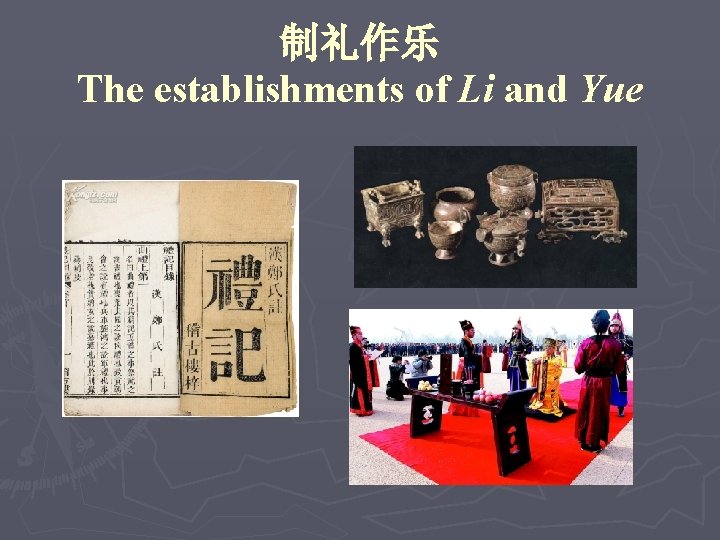
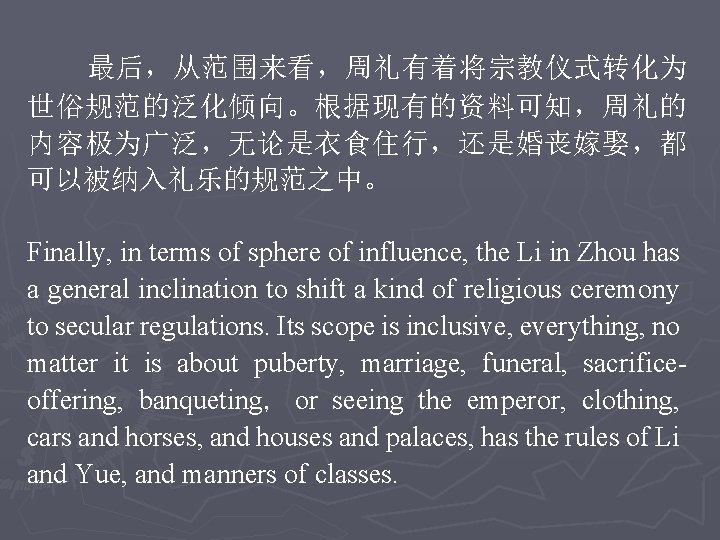
制礼作乐 The establishments of Li and Yue
周公对夏商之礼的改造 Zhou Gong developed Xia and Shang’s Li(礼) into a set of sophisticated rules of behaviors for the maintenance of Zhou’s patriarchal system. 首先,从对象来看, 周人之礼不是以祭拜鬼神为主,而是以 祭祖、祭天先为主。 Firstly, speaking from the objects of worship, Zhou Li (周礼) is for ancestry and Heaven rather than ghosts and gods.
其次,从主体来看,周礼不仅注重祭祀的对象 的功能,更加注重祭祀主体的权利。不同血缘身份 和政治地位的人不仅参与礼乐活动的权利不同,而 且拥有祭祀活动的资源也不同。 Secondly, Zhou’s ceremony emphasized the worshipers more than the worshiped. The persons with different blood relations and political statuses took part in different ceremonies of offering and possessed different resources for worship.
最后,从范围来看,周礼有着将宗教仪式转化为 世俗规范的泛化倾向。根据现有的资料可知,周礼的 内容极为广泛,无论是衣食住行,还是婚丧嫁娶,都 可以被纳入礼乐的规范之中。 Finally, in terms of sphere of influence, the Li in Zhou has a general inclination to shift a kind of religious ceremony to secular regulations. Its scope is inclusive, everything, no matter it is about puberty, marriage, funeral, sacrificeoffering, banqueting, or seeing the emperor, clothing, cars and horses, and houses and palaces, has the rules of Li and Yue, and manners of classes.
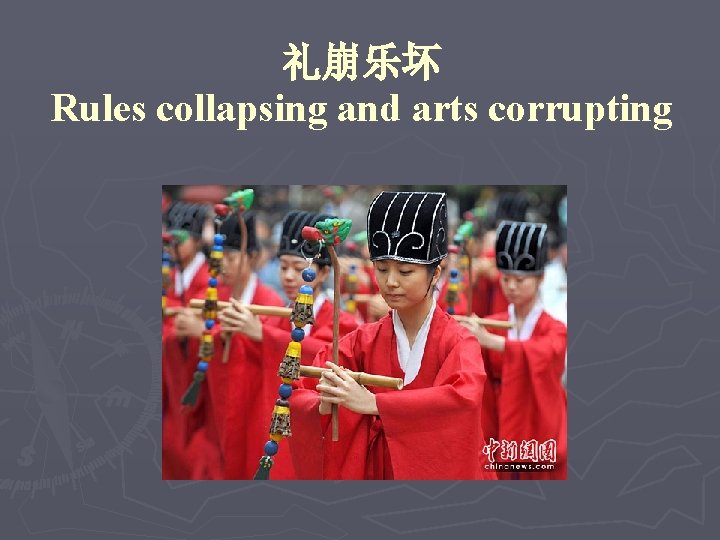
礼崩乐坏 Rules collapsing and arts corrupting
从职业的“儒”到思想的“家” Ru(儒):from a profession to a thought “近代有学者认为,‘儒’的前身是古代专为贵 族服务的巫、史、祝、卜;在春秋大动荡时期,‘儒 ’失去了原有的地位,由于他们熟悉贵族的礼仪,便 以‘相礼’为谋生的职业。” “Some modern scholars suppose 儒 (Ru) are shamans serving the nobility. In the turbulent time of the Spring and Autumn (春秋� 代) they lost their statuses and acted as master of ceremonies as profession. ”
孔子曰:“吾少也贱,故多能鄙事”,“出则 事公卿,入则事父兄,丧事不敢不勉,不为酒困, 何有于我哉? ”(《论语·子罕》) Kongzi said, “When I was young, my condition was low, and therefore I acquired my ability in many things, but they were mean matters. ”“I am out to serve the nobility while I stay at home to serve my father and older brother. I dare not be careless about funeral rites, and I have never indulged in drinking. What could be a difficult for me? ” (Tsze Han in Confucian Analects)
以“仁”释“礼” The explanation of Li in terms of Ren “礼云礼云,钟鼓云乎哉?乐云乐云,玉帛云乎哉?”(《论 语·阳货》) “We are talking about Li (礼); Does it means we are talking about jade and silk? We are talking about Yue (� ); Does it means we are talking about something played with the musical instruments such as Zhong (bells) and Gu (drums)? ”(Yang Ho in Confucian Analects) “人而不仁,如礼何?人而不仁,如乐何?” (《论语·八佾》) “As a man you are not Ren (仁, kind), then how could you observe Li ( 礼)? As a man, you are not kind, then how could you perform Yue (� )? ” (Pa Yih in Confucian Analects)
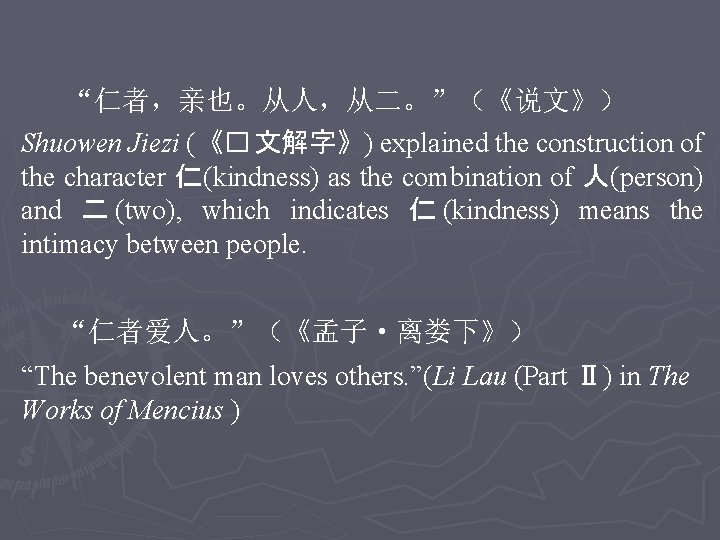
“仁者,亲也。从人,从二。”(《说文》) Shuowen Jiezi (《� 文解字》) explained the construction of the character 仁(kindness) as the combination of 人(person) and 二 (two), which indicates 仁 (kindness) means the intimacy between people. “仁者爱人。”(《孟子·离娄下》) “The benevolent man loves others. ”(Li Lau (Part Ⅱ) in The Works of Mencius )
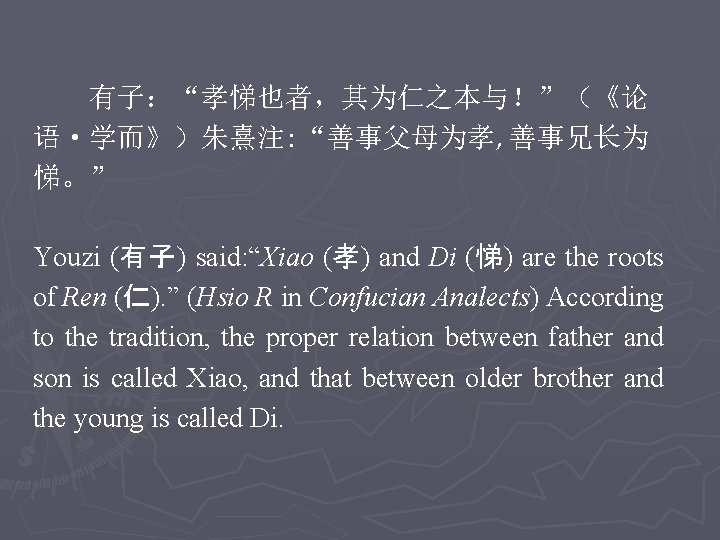
有子:“孝悌也者,其为仁之本与!”(《论 语·学而》)朱熹注: “善事父母为孝, 善事兄长为 悌。” Youzi (有 子 ) said: “Xiao (孝 ) and Di (悌 ) are the roots of Ren (仁). ” (Hsio R in Confucian Analects) According to the tradition, the proper relation between father and son is called Xiao, and that between older brother and the young is called Di.
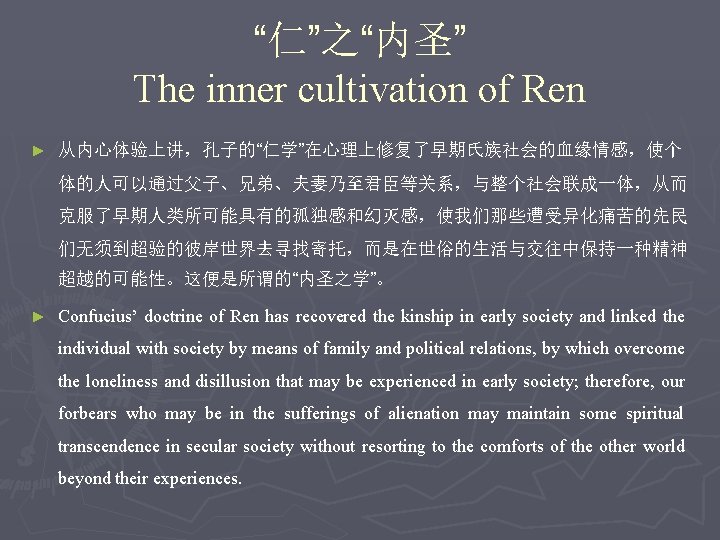
“仁”之“内圣” The inner cultivation of Ren ► 从内心体验上讲,孔子的“仁学”在心理上修复了早期氏族社会的血缘情感,使个 体的人可以通过父子、兄弟、夫妻乃至君臣等关系,与整个社会联成一体,从而 克服了早期人类所可能具有的孤独感和幻灭感,使我们那些遭受异化痛苦的先民 们无须到超验的彼岸世界去寻找寄托,而是在世俗的生活与交往中保持一种精神 超越的可能性。这便是所谓的“内圣之学”。 ► Confucius’ doctrine of Ren has recovered the kinship in early society and linked the individual with society by means of family and political relations, by which overcome the loneliness and disillusion that may be experienced in early society; therefore, our forbears who may be in the sufferings of alienation may maintain some spiritual transcendence in secular society without resorting to the comforts of the other world beyond their experiences.
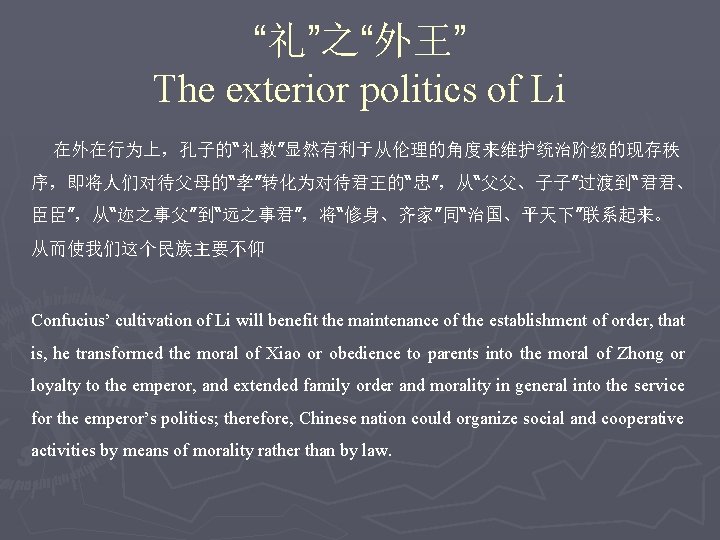
“礼”之“外王” The exterior politics of Li 在外在行为上,孔子的“礼教”显然有利于从伦理的角度来维护统治阶级的现存秩 序,即将人们对待父母的“孝”转化为对待君王的“忠”,从“父父、子子”过渡到“君君、 臣臣”,从“迩之事父”到“远之事君”,将“修身、齐家”同“治国、平天下”联系起来。 从而使我们这个民族主要不仰 Confucius’ cultivation of Li will benefit the maintenance of the establishment of order, that is, he transformed the moral of Xiao or obedience to parents into the moral of Zhong or loyalty to the emperor, and extended family order and morality in general into the service for the emperor’s politics; therefore, Chinese nation could organize social and cooperative activities by means of morality rather than by law.
结论 Conclusion 所谓儒学,并不是凭空产生的,也不是孔子一人所创造的。 在孔子之前,至少还有周公。我们知道,在唐代以前,儒家的 文庙一直是以周公为主祀、孔子等先贤为陪祀的。 Confucianism is neither something out of the void nor an achievement by Confucius alone. There has already been a Zhou Gong preceding Confucius at least. We know that before Tang Dynasty the main worshiped in Confucian Temple of Literature (文 �) had been Zhou Gong while Confucius was only an accompany of Zhou Gong.
后因唐玄宗李隆基不能容忍周公在武王逝世、成王年幼时期一 度“摄政”的行为,而出于“正统”的意识形态需要才下令取 消周公在文庙中被供奉的资格,改以孔子为主。从原始儒学的 两大范畴来看,“仁”是孔子发明的,“礼”则是周公创造的。 Later Li Longji (李 隆 基 ), the Emperor Xuanzong of Tang Dynasty, out of his orthodoxy ideology, was not tolerant of Zhou Gong’s acting as the regent and deprived of Zhou Gong’s qualification to be worshiped in the Temple, and replaced him with Confucius. Viewing from the two key concepts of Confucianism, Ren (仁) is admittedly an invention by Confucius while Li (礼) is created by Zhou Gong.
既然“分封诸侯”的政治制度与“制礼作乐”的行为 方式和“以仁释礼”的意识形态是三位一体的,所以儒家 思想才最符合中国古代的社会土壤,才可能成为主流意识 形态。 Now that the political system based on the states of feudal princes, and the behavior rule by means of the establishments of Li and Yue, and the ideology of Li explained in terms of Ren, formed a trinity, so Confucianism has become the social bonding agent which suits the ancient society perfectly and the mainstream of ideology.
问题一 首先,既然儒家思想所� 以存在的社会土壤是独 特的,那么我� 是否有� 力称之� “普世价� ”? In as much the social conditions on which Confucianism relies are special, is it right for us to say it is a set of universal values?
问题二 其次,今天,如果儒家思想所� 以存在的社会土壤 即已消失,那么� 种独特的意� 形� 将如何延� ? If the social conditions on which Confucianism relies have disappeared, how will the special ideology continue?
问题三 最后,“全球化”和“现代化”的语境下, 我们将如何使儒家文化与其他民族文化协调 共生?并如何实现儒家文化的历史转型? In the contexts of globalization and modernization, how can we coordinate Confusion culture and other nation's cultures? How can we realize the historical transformation of Confucian culture?